 Скачать презентацию Powering up Economic Capital Overcoming Barriers To Achieve
911c96b2f602e2cf75530fbc4bb22541.ppt
- Количество слайдов: 21



Powering up Economic Capital: Overcoming Barriers To Achieve Effective Implementation July 27 th, 2005 Jean-Bernard Caen – DEXIA Head of Economic Capital <This document presents the point of view of its author, which may differ from DEXIA’s. It supports an oral presentation and is incomplete without it. This support is protected by copyright laws. > © Jean-Bernard Caen 2005 & + 1
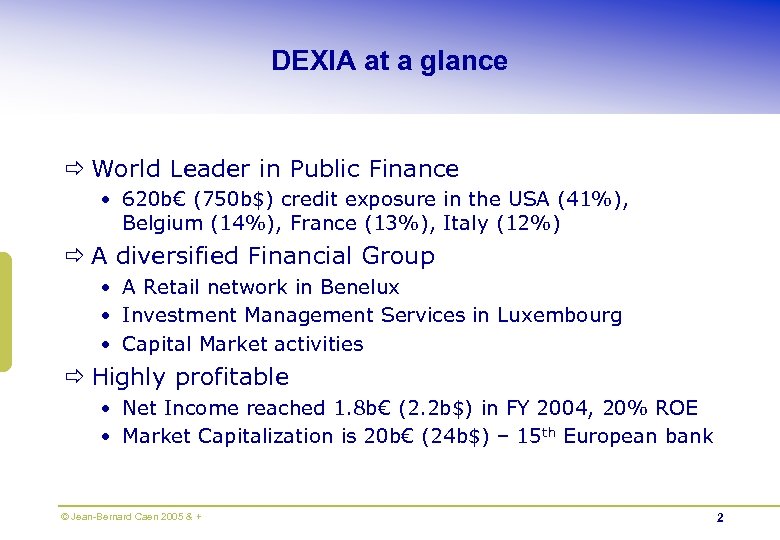
DEXIA at a glance ð World Leader in Public Finance • 620 b€ (750 b$) credit exposure in the USA (41%), Belgium (14%), France (13%), Italy (12%) ð A diversified Financial Group • A Retail network in Benelux • Investment Management Services in Luxembourg • Capital Market activities ð Highly profitable • Net Income reached 1. 8 b€ (2. 2 b$) in FY 2004, 20% ROE • Market Capitalization is 20 b€ (24 b$) – 15 th European bank © Jean-Bernard Caen 2005 & + 2
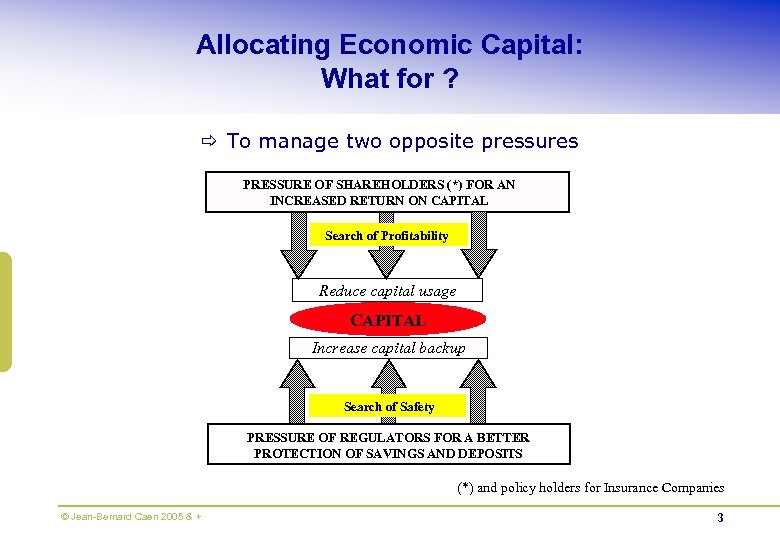
Allocating Economic Capital: What for ? ð To manage two opposite pressures PRESSURE OF SHAREHOLDERS (*) FOR AN INCREASED RETURN ON CAPITAL Search of Profitability Reduce capital usage CAPITAL Increase capital backup Search of Safety PRESSURE OF REGULATORS FOR A BETTER PROTECTION OF SAVINGS AND DEPOSITS (*) and policy holders for Insurance Companies © Jean-Bernard Caen 2005 & + 3
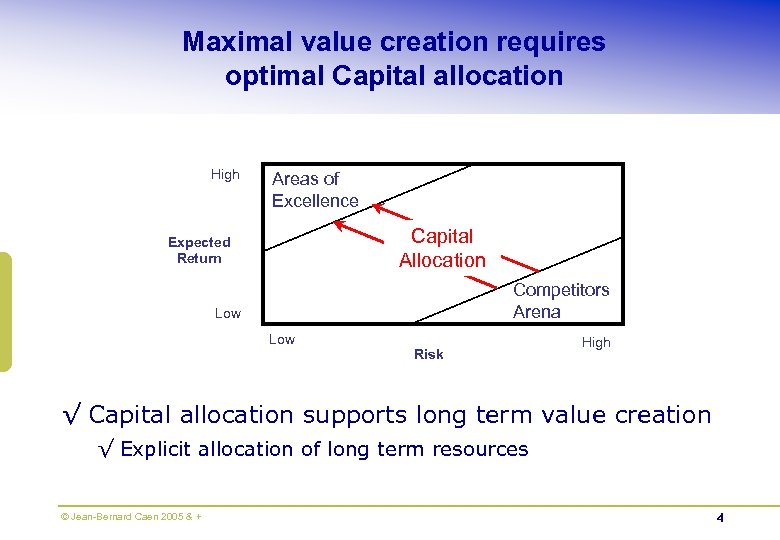
Maximal value creation requires optimal Capital allocation High Areas of Excellence Capital Allocation Expected Return Competitors Arena Low Risk High √ Capital allocation supports long term value creation √ Explicit allocation of long term resources © Jean-Bernard Caen 2005 & + 4
ECAP potential benefits are huge ð ECAP creates value • Better strategic development decisions • Incentives in line with shareholders interests ð ECAP brings in higher returns • Effective external pricing policy • Effective internal funds transfer pricing ð ECAP reduces risk • Reduction of Credit Concentration • Disclosures transparency reduces risk for shareholders © Jean-Bernard Caen 2005 & + 5
The Insurance Case ð The Insurance specificity is that the policy holder bear a part of the risks (i. e. of the capital) • Which part is usually not explicit for easier management of the trade-off between financial and commercial goals ð Managing Insurance risks is managing one big ALM • But share- and policy-holders do not have the same risk aversion and expected return ð Defining a profit sharing rule is an absolute must for modeling Insurance ALM • It will form the back-bone of sound economic management © Jean-Bernard Caen 2005 & + 6
The range and scope of Economic Capital (ECAP) potential uses are wide 1. Regulatory constraint 2. Common metrics for measuring risks 3. Limits 4. Performance measurement and value analysis 5. Effective pricing of risk 6. Credit Portfolio management 7. Reduction of Excess Capital 8. Managers compensation and incentives in line with shareholders interest 9. External disclosure of risk profile Why aren’t these functions implemented? © Jean-Bernard Caen 2005 & + 7
The product has big potential benefits. Where can the production process be blocked? ð ARE BIG POTENTIAL BENEFITS ENOUGH TO: • Start an Economic Capital function? YES Ø Finance or Risk line? • Allocate adequate resources? MAY BE Ø The ear of the boss • Read the out coming results? MAY BE Ø One more reporting… • Make decisions based upon Economic Capital? NO Ø Too new, too volatile, too strange, too technical Ø Difficult to back-test, to handle, to pilot ð THERE IS A REAL HAZARD TO BE STUCK AT THAT STAGE!! © Jean-Bernard Caen 2005 & + 8
CAP…CAP… The hen house is noisy ð CAPITAL has become a buzzword • One word with multiple meanings => ð Which CAPITAL: Accounting? Regulatory? Economic? • Three referential with many interactions ð Which CAPITAL: Used? Required? Available? • Three natures of capital © Jean-Bernard Caen 2005 & + 9
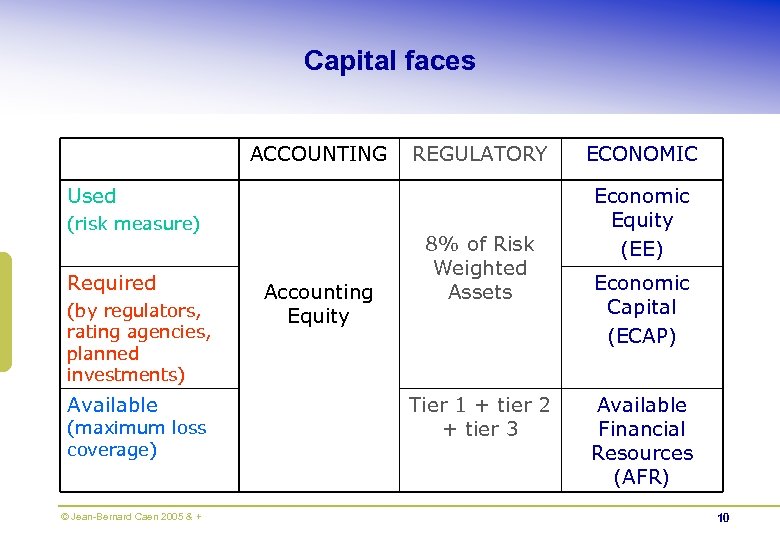
Capital faces ACCOUNTING REGULATORY Used (risk measure) Required (by regulators, rating agencies, planned investments) Available (maximum loss coverage) © Jean-Bernard Caen 2005 & + Accounting Equity 8% of Risk Weighted Assets Tier 1 + tier 2 + tier 3 ECONOMIC Economic Equity (EE) Economic Capital (ECAP) Available Financial Resources (AFR) 10
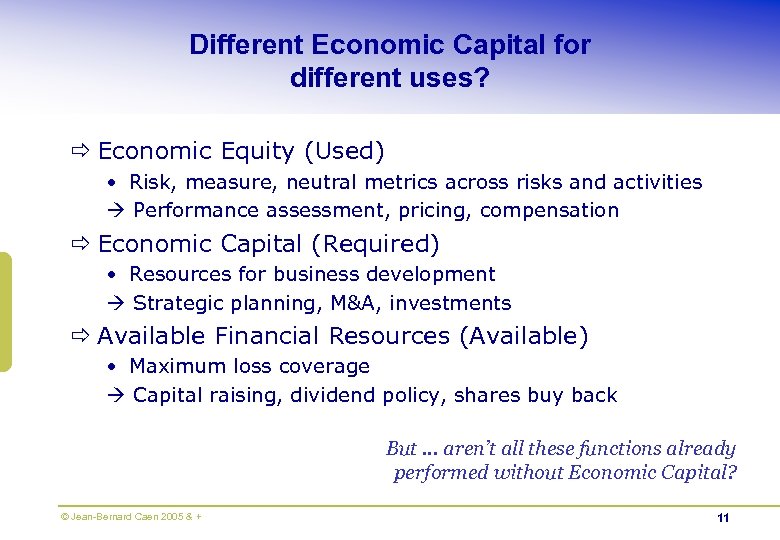
Different Economic Capital for different uses? ð Economic Equity (Used) • Risk, measure, neutral metrics across risks and activities Performance assessment, pricing, compensation ð Economic Capital (Required) • Resources for business development Strategic planning, M&A, investments ð Available Financial Resources (Available) • Maximum loss coverage Capital raising, dividend policy, shares buy back But … aren’t all these functions already performed without Economic Capital? © Jean-Bernard Caen 2005 & + 11
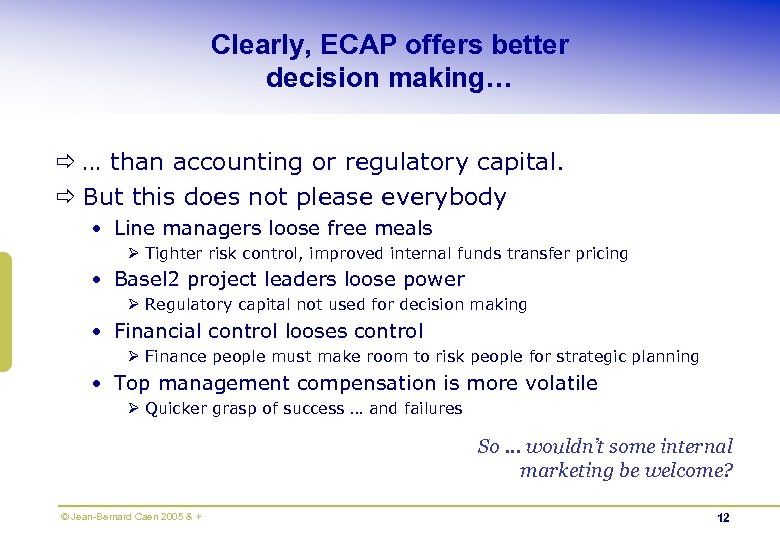
Clearly, ECAP offers better decision making… ð … than accounting or regulatory capital. ð But this does not please everybody • Line managers loose free meals Ø Tighter risk control, improved internal funds transfer pricing • Basel 2 project leaders loose power Ø Regulatory capital not used for decision making • Financial control looses control Ø Finance people must make room to risk people for strategic planning • Top management compensation is more volatile Ø Quicker grasp of success … and failures So … wouldn’t some internal marketing be welcome? © Jean-Bernard Caen 2005 & + 12
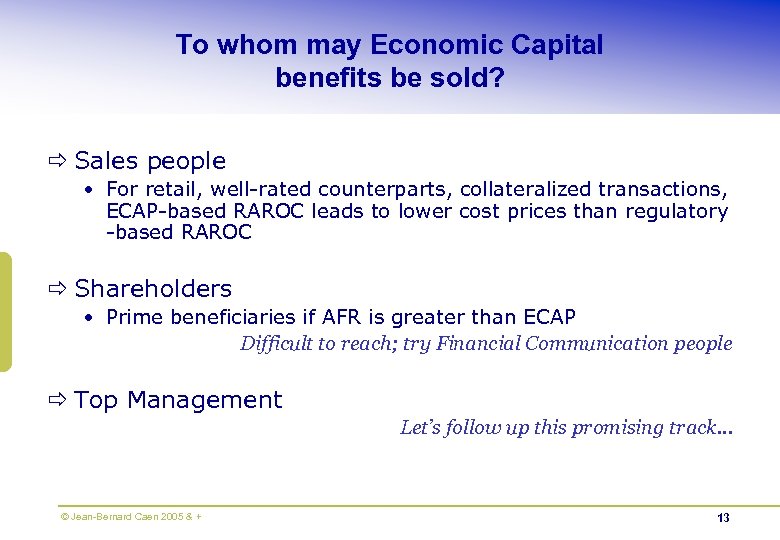
To whom may Economic Capital benefits be sold? ð Sales people • For retail, well-rated counterparts, collateralized transactions, ECAP-based RAROC leads to lower cost prices than regulatory -based RAROC ð Shareholders • Prime beneficiaries if AFR is greater than ECAP Difficult to reach; try Financial Communication people ð Top Management Let’s follow up this promising track… © Jean-Bernard Caen 2005 & + 13
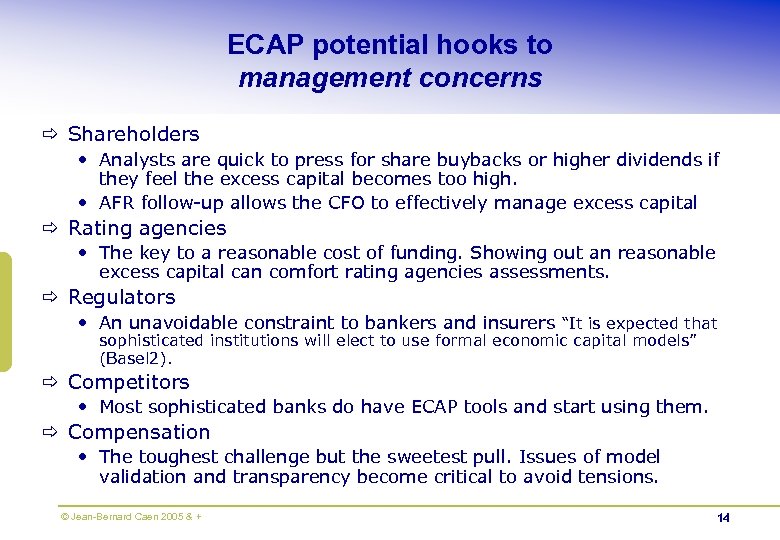
ECAP potential hooks to management concerns ð Shareholders • Analysts are quick to press for share buybacks or higher dividends if they feel the excess capital becomes too high. • AFR follow-up allows the CFO to effectively manage excess capital ð Rating agencies • The key to a reasonable cost of funding. Showing out an reasonable excess capital can comfort rating agencies assessments. ð Regulators • An unavoidable constraint to bankers and insurers “It is expected that sophisticated institutions will elect to use formal economic capital models” (Basel 2). ð Competitors • Most sophisticated banks do have ECAP tools and start using them. ð Compensation • The toughest challenge but the sweetest pull. Issues of model validation and transparency become critical to avoid tensions. © Jean-Bernard Caen 2005 & + 14
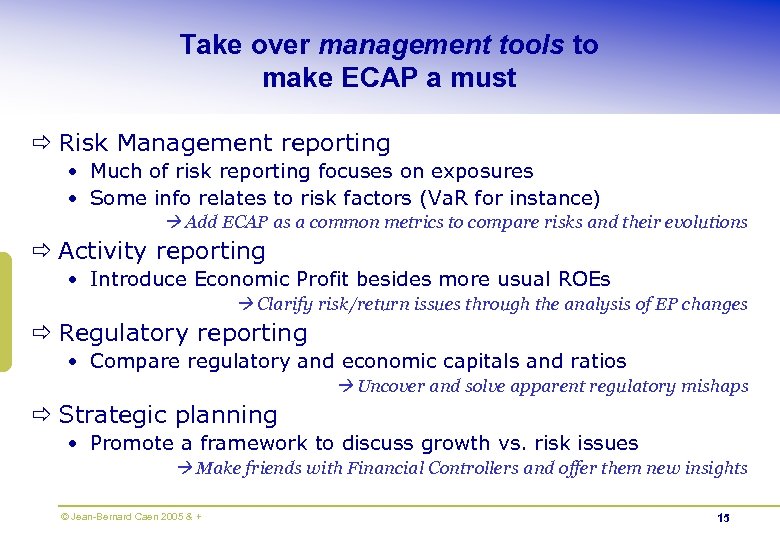
Take over management tools to make ECAP a must ð Risk Management reporting • Much of risk reporting focuses on exposures • Some info relates to risk factors (Va. R for instance) Add ECAP as a common metrics to compare risks and their evolutions ð Activity reporting • Introduce Economic Profit besides more usual ROEs Clarify risk/return issues through the analysis of EP changes ð Regulatory reporting • Compare regulatory and economic capitals and ratios Uncover and solve apparent regulatory mishaps ð Strategic planning • Promote a framework to discuss growth vs. risk issues Make friends with Financial Controllers and offer them new insights © Jean-Bernard Caen 2005 & + 15
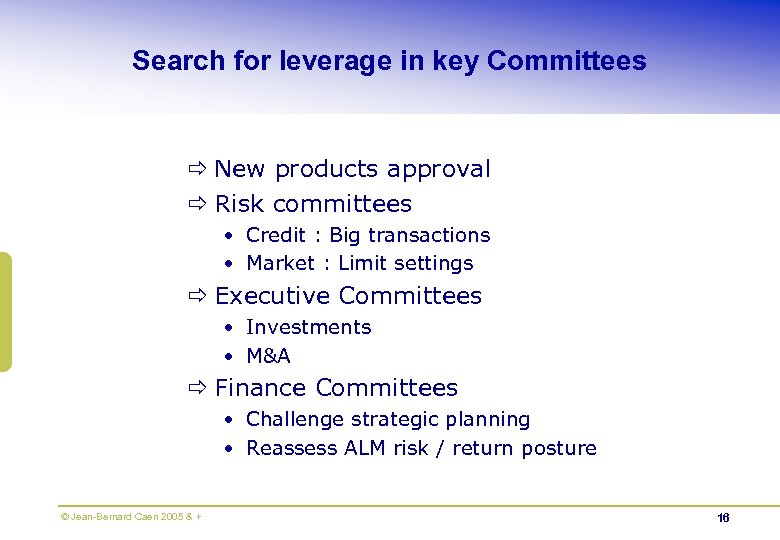
Search for leverage in key Committees ð New products approval ð Risk committees • Credit : Big transactions • Market : Limit settings ð Executive Committees • Investments • M&A ð Finance Committees • Challenge strategic planning • Reassess ALM risk / return posture © Jean-Bernard Caen 2005 & + 16
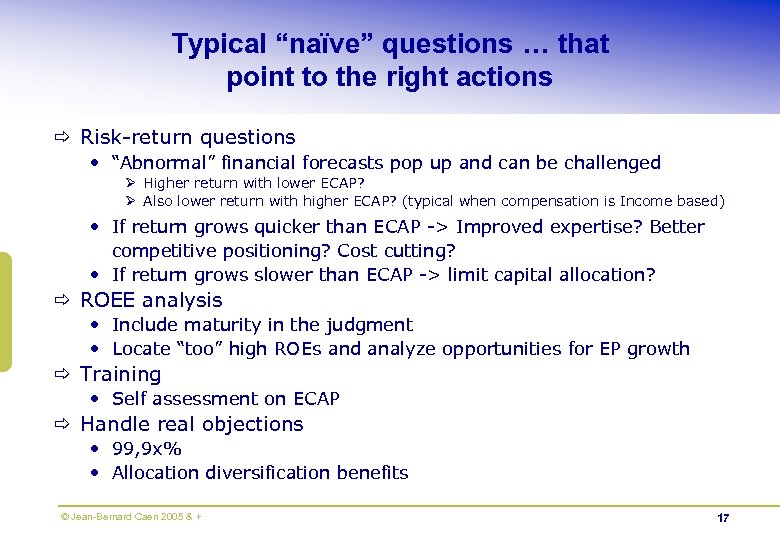
Typical “naïve” questions … that point to the right actions ð Risk-return questions • “Abnormal” financial forecasts pop up and can be challenged Ø Higher return with lower ECAP? Ø Also lower return with higher ECAP? (typical when compensation is Income based) • If return grows quicker than ECAP -> Improved expertise? Better competitive positioning? Cost cutting? • If return grows slower than ECAP -> limit capital allocation? ð ROEE analysis • Include maturity in the judgment • Locate “too” high ROEs and analyze opportunities for EP growth ð Training • Self assessment on ECAP ð Handle real objections • 99, 9 x% • Allocation diversification benefits © Jean-Bernard Caen 2005 & + 17
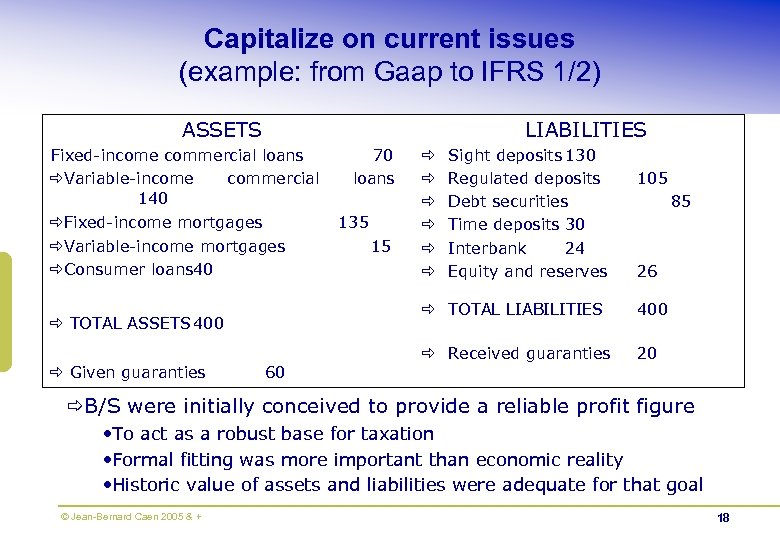
Capitalize on current issues (example: from Gaap to IFRS 1/2) ASSETS LIABILITIES Fixed-income commercial loans 70 ðVariable-income commercial loans 140 ðFixed-income mortgages 135 ðVariable-income mortgages ðConsumer loans 40 Sight deposits 130 Regulated deposits Debt securities Time deposits 30 Interbank 24 Equity and reserves 105 85 26 ð TOTAL LIABILITIES ð TOTAL ASSETS 400 ð Given guaranties 15 ð ð ð 60 400 ð Received guaranties 20 ðB/S were initially conceived to provide a reliable profit figure • To act as a robust base for taxation • Formal fitting was more important than economic reality • Historic value of assets and liabilities were adequate for that goal © Jean-Bernard Caen 2005 & + 18
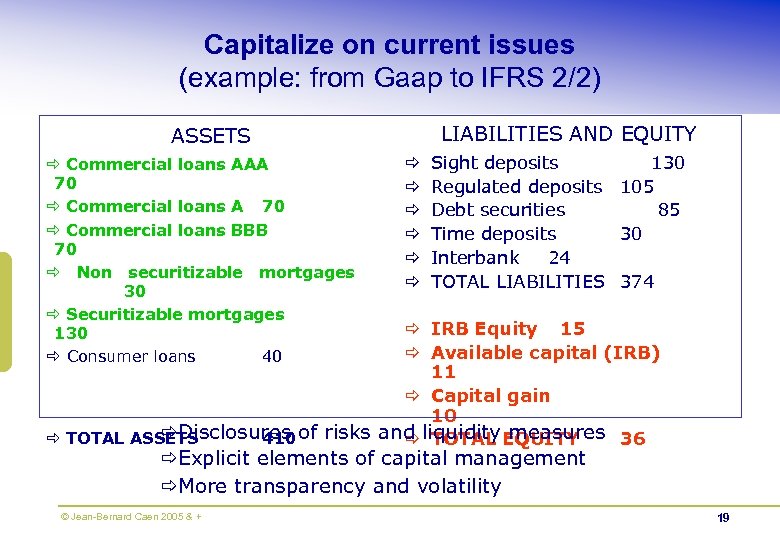
Capitalize on current issues (example: from Gaap to IFRS 2/2) LIABILITIES AND EQUITY ASSETS ð Commercial loans AAA 70 ð Commercial loans BBB 70 ð Non securitizable mortgages 30 ð Securitizable mortgages 130 ð Consumer loans 40 ð ð ð Sight deposits Regulated deposits Debt securities Time deposits Interbank 24 TOTAL LIABILITIES 130 105 85 30 374 ð IRB Equity 15 ð Available capital (IRB) 11 ð Capital gain 10 ðDisclosures of risks and liquidity measures 36 ð TOTAL ASSETS 410 ð TOTAL EQUITY ðExplicit elements of capital management ðMore transparency and volatility © Jean-Bernard Caen 2005 & + 19
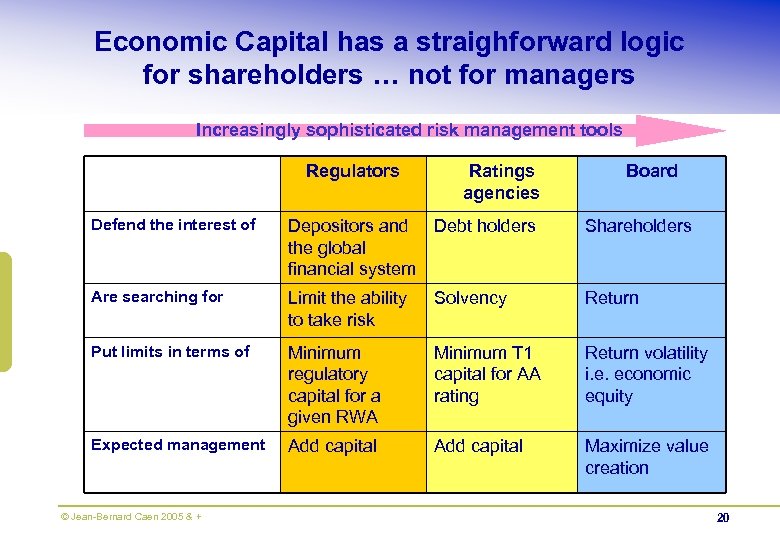
Economic Capital has a straighforward logic for shareholders … not for managers Increasingly sophisticated risk management tools Regulators Ratings agencies Board Defend the interest of Depositors and Debt holders the global financial system Shareholders Are searching for Limit the ability to take risk Solvency Return Put limits in terms of Minimum regulatory capital for a given RWA Minimum T 1 capital for AA rating Return volatility i. e. economic equity Expected management Add capital Maximize value creation © Jean-Bernard Caen 2005 & + 20
Conclusion ð A schopenhauer puts it: « ALL TRUTH GOES THROUGH THREE STEPS FIRST IT IS RIDICULED THEN IT IS OPPOSED TO FINALLY CONSIDER IT HAS ALWAYS BEEN OBVIOUS » ð Do not consider resting when you reach the third step! • This is where it all begins… Thank you for listening © Jean-Bernard Caen 2005 & + 21
Скачать презентацию Powering up Economic Capital Overcoming Barriers To Achieve
911c96b2f602e2cf75530fbc4bb22541.ppt