 Скачать презентацию Powerful numbers Numbers that matter A short reflection
98599554d50ad9176b13daece2afba28.ppt
- Количество слайдов: 22



Powerful numbers Numbers that matter A short reflection on influential analyses in the history of science policy and the numbers decision makers use Diana Hicks School of Public Policy Georgia Institute of Technology October 2009 IEEE workshop on STEM measures of innovation and competitiveness George Washington University, Washington DC
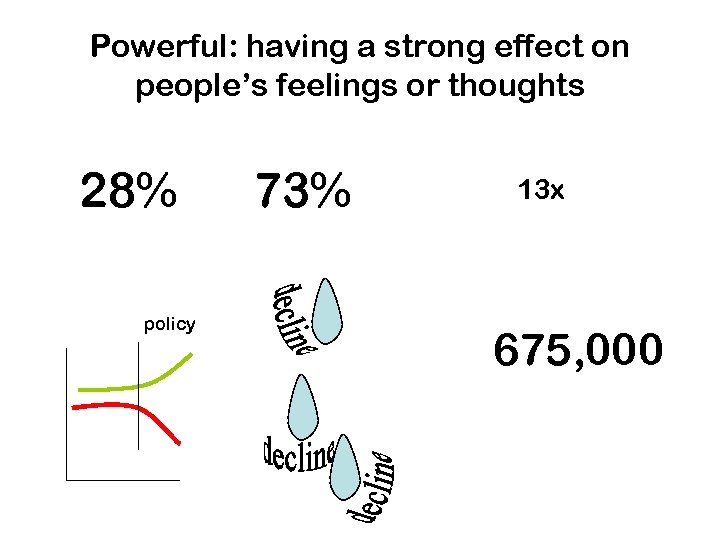
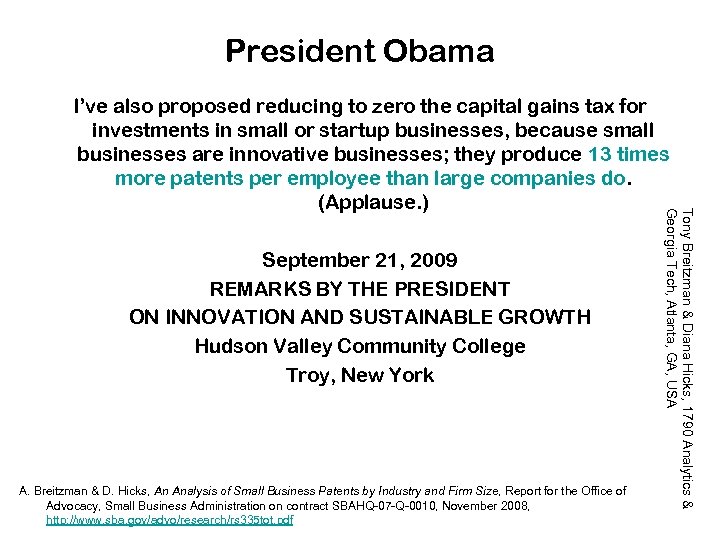
Powerful: having a strong effect on people’s feelings or thoughts 28% policy 73% 13 x 675, 000
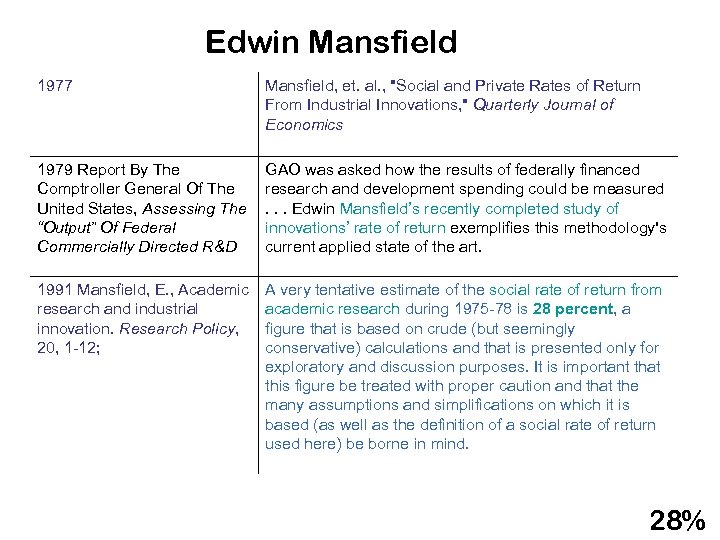
Edwin Mansfield 1977 Mansfield, et. al. , "Social and Private Rates of Return From Industrial Innovations, " Quarterly Journal of Economics 1979 Report By The Comptroller General Of The United States, Assessing The “Output” Of Federal Commercially Directed R&D GAO was asked how the results of federally financed research and development spending could be measured . . . Edwin Mansfield’s recently completed study of innovations’ rate of return exemplifies this methodology's current applied state of the art. 1991 Mansfield, E. , Academic research and industrial innovation. Research Policy, 20, 1 -12; A very tentative estimate of the social rate of return from academic research during 1975 -78 is 28 percent, a figure that is based on crude (but seemingly conservative) calculations and that is presented only for exploratory and discussion purposes. It is important that this figure be treated with proper caution and that the many assumptions and simplifications on which it is based (as well as the definition of a social rate of return used here) be borne in mind. 28%
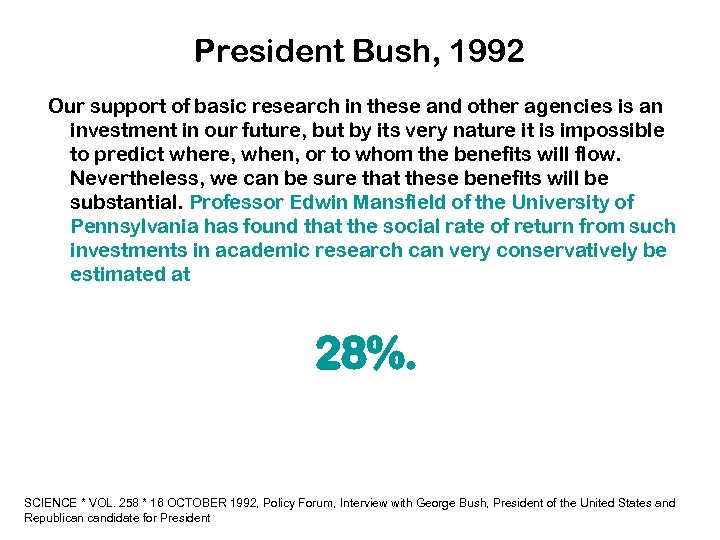
President Bush, 1992 Our support of basic research in these and other agencies is an investment in our future, but by its very nature it is impossible to predict where, when, or to whom the benefits will flow. Nevertheless, we can be sure that these benefits will be substantial. Professor Edwin Mansfield of the University of Pennsylvania has found that the social rate of return from such investments in academic research can very conservatively be estimated at 28%. SCIENCE * VOL. 258 * 16 OCTOBER 1992, Policy Forum, Interview with George Bush, President of the United States and Republican candidate for President
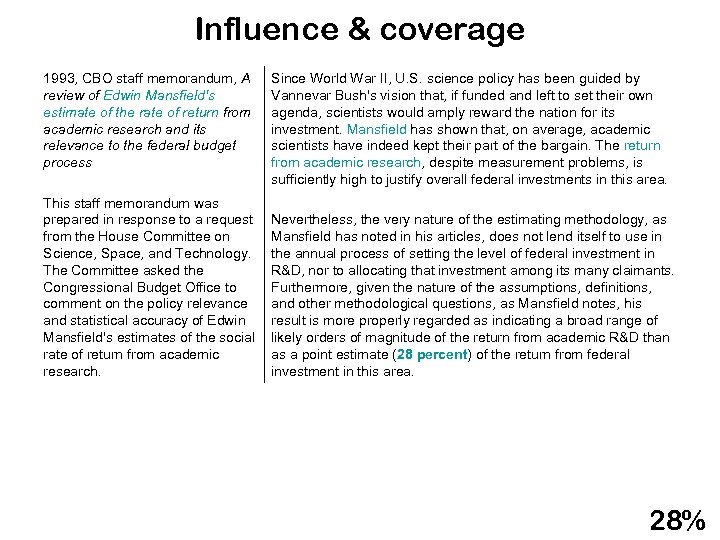
Influence & coverage 1993, CBO staff memorandum, A review of Edwin Mansfield's estimate of the rate of return from academic research and its relevance to the federal budget process This staff memorandum was prepared in response to a request from the House Committee on Science, Space, and Technology. The Committee asked the Congressional Budget Office to comment on the policy relevance and statistical accuracy of Edwin Mansfield's estimates of the social rate of return from academic research. Since World War II, U. S. science policy has been guided by Vannevar Bush's vision that, if funded and left to set their own agenda, scientists would amply reward the nation for its investment. Mansfield has shown that, on average, academic scientists have indeed kept their part of the bargain. The return from academic research, despite measurement problems, is sufficiently high to justify overall federal investments in this area. Nevertheless, the very nature of the estimating methodology, as Mansfield has noted in his articles, does not lend itself to use in the annual process of setting the level of federal investment in R&D, nor to allocating that investment among its many claimants. Furthermore, given the nature of the assumptions, definitions, and other methodological questions, as Mansfield notes, his result is more properly regarded as indicating a broad range of likely orders of magnitude of the return from academic R&D than as a point estimate (28 percent) of the return from federal investment in this area. 28%
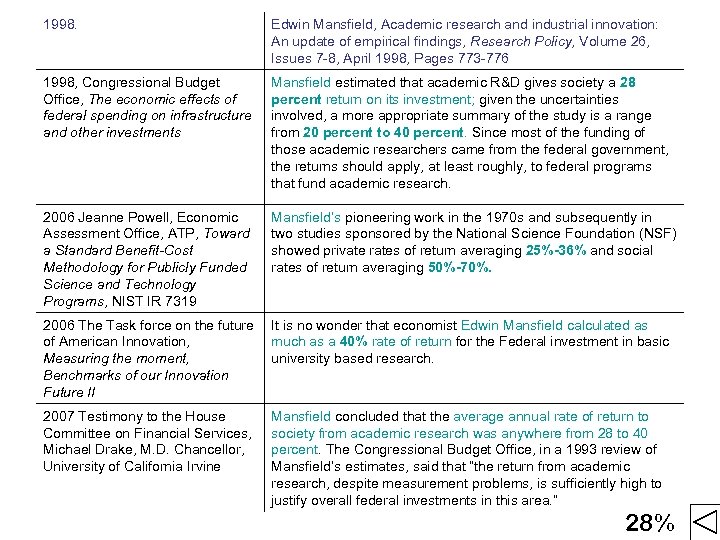
1998. Edwin Mansfield, Academic research and industrial innovation: An update of empirical findings, Research Policy, Volume 26, Issues 7 -8, April 1998, Pages 773 -776 1998, Congressional Budget Office, The economic effects of federal spending on infrastructure and other investments Mansfield estimated that academic R&D gives society a 28 percent return on its investment; given the uncertainties involved, a more appropriate summary of the study is a range from 20 percent to 40 percent. Since most of the funding of those academic researchers came from the federal government, the returns should apply, at least roughly, to federal programs that fund academic research. 2006 Jeanne Powell, Economic Assessment Office, ATP, Toward a Standard Benefit-Cost Methodology for Publicly Funded Science and Technology Programs, NIST IR 7319 Mansfield’s pioneering work in the 1970 s and subsequently in two studies sponsored by the National Science Foundation (NSF) showed private rates of return averaging 25%-36% and social rates of return averaging 50%-70%. 2006 The Task force on the future It is no wonder that economist Edwin Mansfield calculated as of American Innovation, much as a 40% rate of return for the Federal investment in basic Measuring the moment, university based research. Benchmarks of our Innovation Future II 2007 Testimony to the House Committee on Financial Services, Michael Drake, M. D. Chancellor, University of California Irvine Mansfield concluded that the average annual rate of return to society from academic research was anywhere from 28 to 40 percent. The Congressional Budget Office, in a 1993 review of Mansfield’s estimates, said that “the return from academic research, despite measurement problems, is sufficiently high to justify overall federal investments in this area. ” 28%
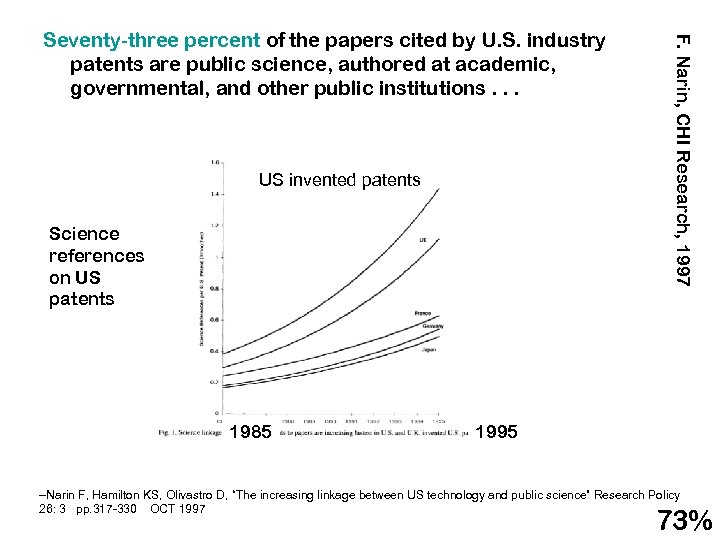
US invented patents Science references on US patents 1985 F. Narin, CHI Research, 1997 Seventy-three percent of the papers cited by U. S. industry patents are public science, authored at academic, governmental, and other public institutions. . . 1995 –Narin F, Hamilton KS, Olivastro D, “The increasing linkage between US technology and public science” Research Policy 26: 3 pp. 317 -330 OCT 1997 73%
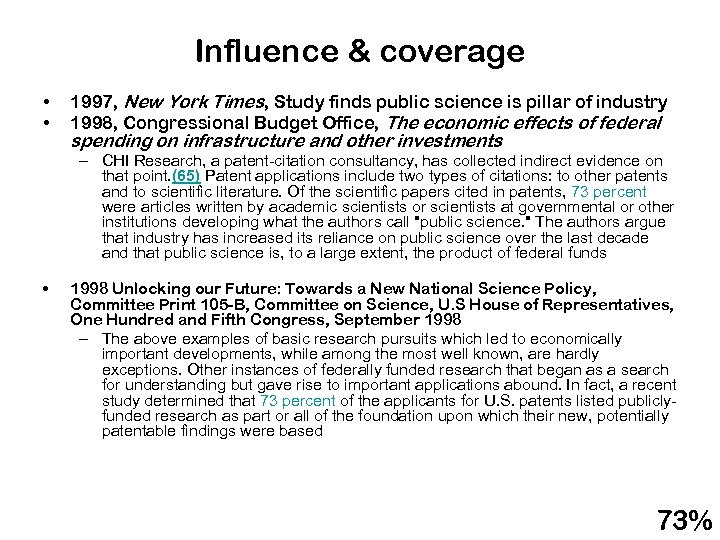
Influence & coverage • • 1997, New York Times, Study finds public science is pillar of industry 1998, Congressional Budget Office, The economic effects of federal spending on infrastructure and other investments – CHI Research, a patent-citation consultancy, has collected indirect evidence on that point. (65) Patent applications include two types of citations: to other patents and to scientific literature. Of the scientific papers cited in patents, 73 percent were articles written by academic scientists or scientists at governmental or other institutions developing what the authors call "public science. " The authors argue that industry has increased its reliance on public science over the last decade and that public science is, to a large extent, the product of federal funds • 1998 Unlocking our Future: Towards a New National Science Policy, Committee Print 105 -B, Committee on Science, U. S House of Representatives, One Hundred and Fifth Congress, September 1998 – The above examples of basic research pursuits which led to economically important developments, while among the most well known, are hardly exceptions. Other instances of federally funded research that began as a search for understanding but gave rise to important applications abound. In fact, a recent study determined that 73 percent of the applicants for U. S. patents listed publiclyfunded research as part or all of the foundation upon which their new, potentially patentable findings were based 73%
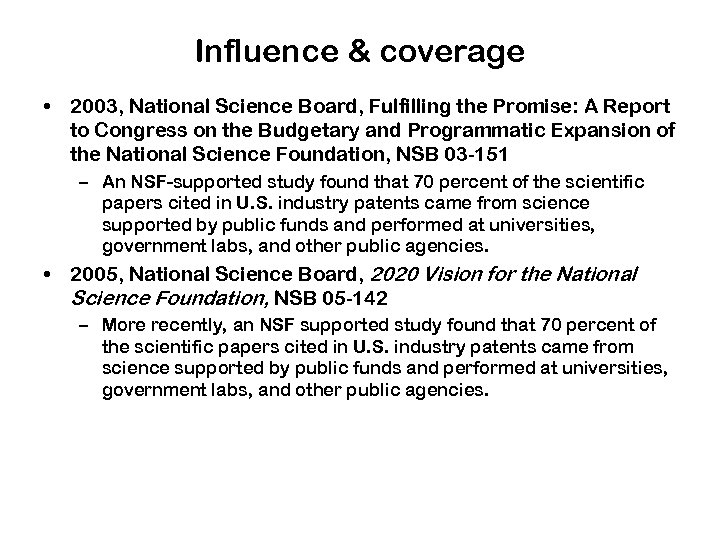
Influence & coverage • 2003, National Science Board, Fulfilling the Promise: A Report to Congress on the Budgetary and Programmatic Expansion of the National Science Foundation, NSB 03 -151 – An NSF-supported study found that 70 percent of the scientific papers cited in U. S. industry patents came from science supported by public funds and performed at universities, government labs, and other public agencies. • 2005, National Science Board, 2020 Vision for the National Science Foundation, NSB 05 -142 – More recently, an NSF supported study found that 70 percent of the scientific papers cited in U. S. industry patents came from science supported by public funds and performed at universities, government labs, and other public agencies.
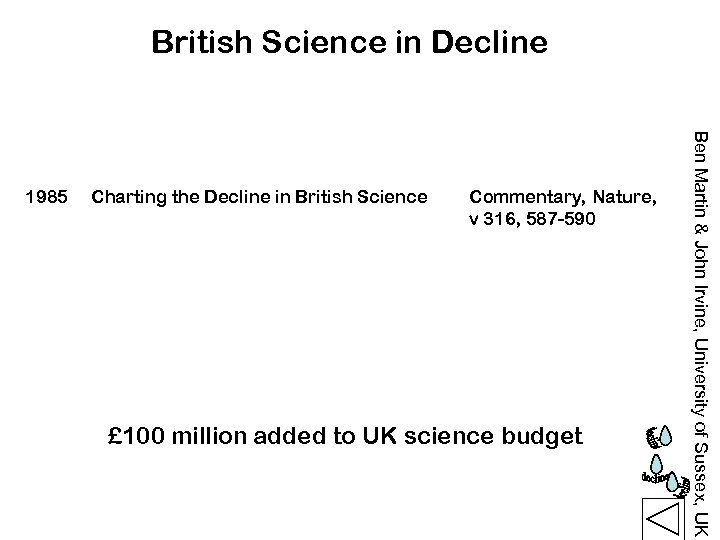
British Science in Decline Charting the Decline in British Science Commentary, Nature, v 316, 587 -590 1986 Is Britain Spending Enough on Science? Commentary, Nature, v 323, 591 -594 1987 The Continuing Decline of British Science Commentary, Nature, v 330, 123 -126 £ 100 million added to UK science budget Ben Martin & John Irvine, University of Sussex, UK 1985
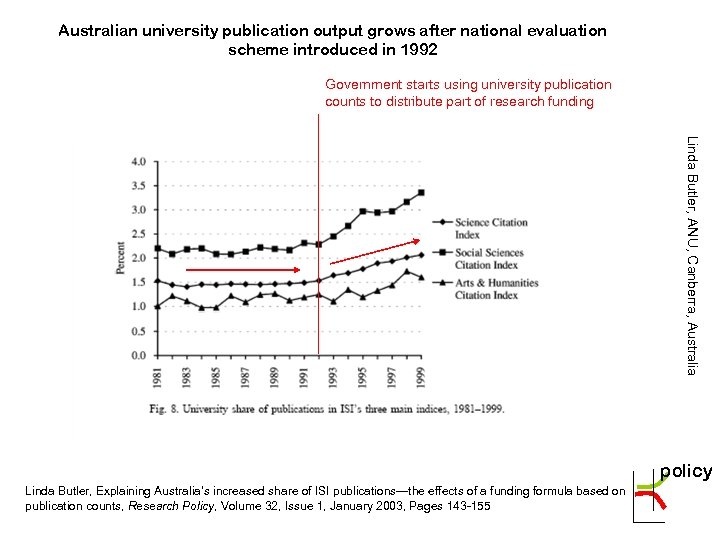
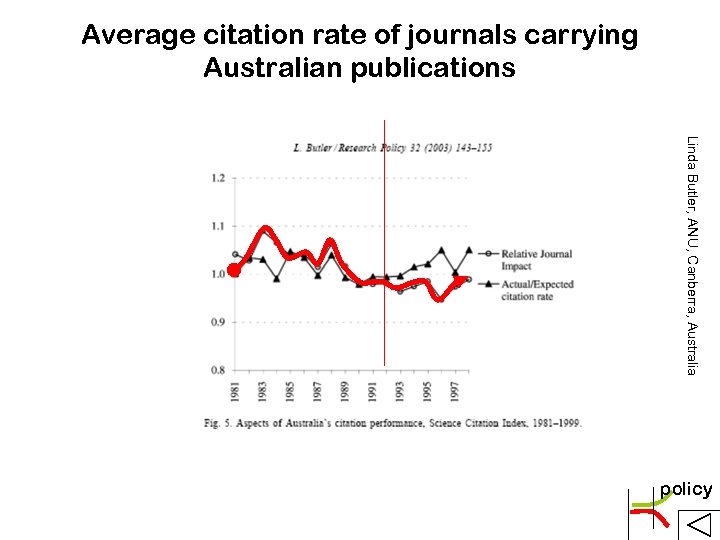
Australian university publication output grows after national evaluation scheme introduced in 1992 Government starts using university publication counts to distribute part of research funding Linda Butler, ANU, Canberra, Australia policy Linda Butler, Explaining Australia’s increased share of ISI publications—the effects of a funding formula based on publication counts, Research Policy, Volume 32, Issue 1, January 2003, Pages 143 -155
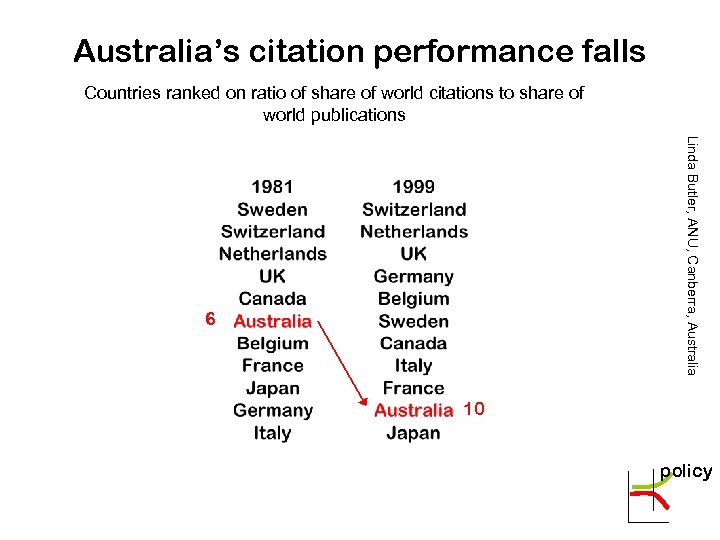
Australia’s citation performance falls Countries ranked on ratio of share of world citations to share of world publications Linda Butler, ANU, Canberra, Australia 6 10 policy
Average citation rate of journals carrying Australian publications Linda Butler, ANU, Canberra, Australia policy
Research QUALITY framework
President Obama September 21, 2009 REMARKS BY THE PRESIDENT ON INNOVATION AND SUSTAINABLE GROWTH Hudson Valley Community College Troy, New York A. Breitzman & D. Hicks, An Analysis of Small Business Patents by Industry and Firm Size, Report for the Office of Advocacy, Small Business Administration on contract SBAHQ-07 -Q-0010, November 2008, http: //www. sba. gov/advo/research/rs 335 tot. pdf Tony Breitzman & Diana Hicks, 1790 Analytics & Georgia Tech, Atlanta, GA, USA I’ve also proposed reducing to zero the capital gains tax for investments in small or startup businesses, because small businesses are innovative businesses; they produce 13 times more patents per employee than large companies do. (Applause. )
Used by high level VA hospital system official in informal contact with Congressmen Tony Breitzman, 1790 Analytics On average, a VA sponsored researcher appears in either the New England Journal of Medicine or JAMA every week.
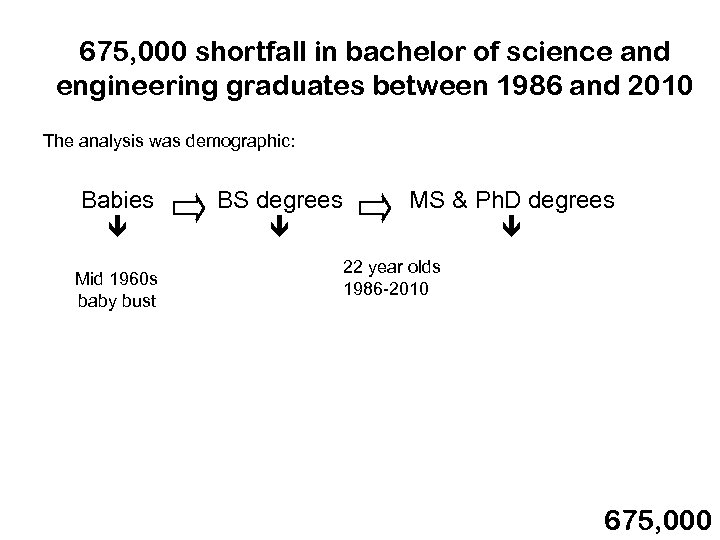
675, 000 shortfall in bachelor of science and engineering graduates between 1986 and 2010 The analysis was demographic: Babies Mid 1960 s baby bust BS degrees MS & Ph. D degrees 22 year olds 1986 -2010 675, 000
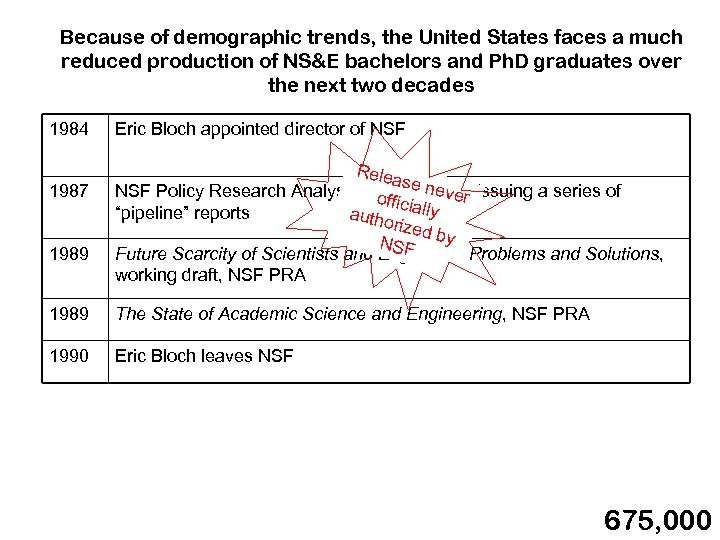
Because of demographic trends, the United States faces a much reduced production of NS&E bachelors and Ph. D graduates over the next two decades 1984 1987 1989 Eric Bloch appointed director of NSF Relea se ne NSF Policy Research Analysis division starts issuing a series of officia ver lly autho “pipeline” reports rized NSF by Future Scarcity of Scientists and Engineers: Problems and Solutions, working draft, NSF PRA 1989 The State of Academic Science and Engineering, NSF PRA 1990 Eric Bloch leaves NSF 675, 000
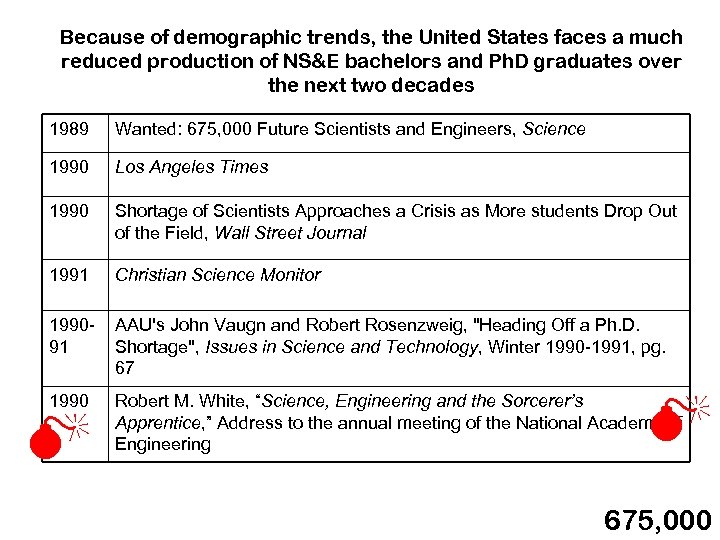
Because of demographic trends, the United States faces a much reduced production of NS&E bachelors and Ph. D graduates over the next two decades 1989 Wanted: 675, 000 Future Scientists and Engineers, Science 1990 Los Angeles Times 1990 Shortage of Scientists Approaches a Crisis as More students Drop Out of the Field, Wall Street Journal 1991 Christian Science Monitor 199091 AAU's John Vaugn and Robert Rosenzweig, "Heading Off a Ph. D. Shortage", Issues in Science and Technology, Winter 1990 -1991, pg. 67 1990 Robert M. White, “Science, Engineering and the Sorcerer’s Apprentice, ” Address to the annual meeting of the National Academy of Engineering 675, 000
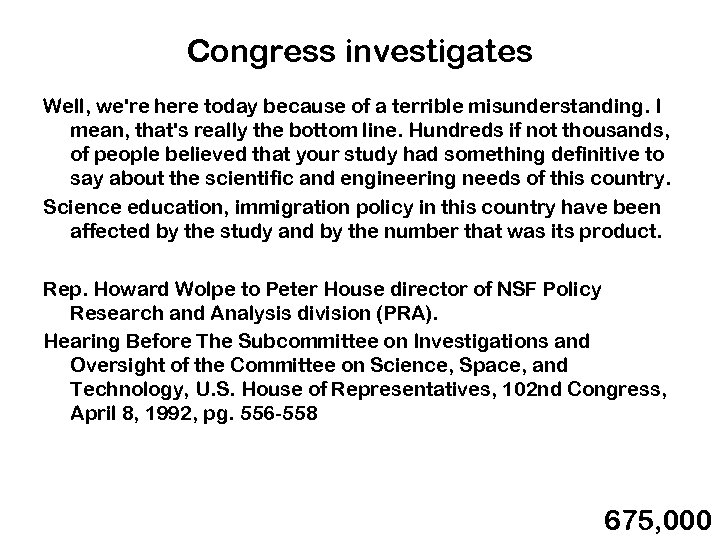
Congress investigates Well, we're here today because of a terrible misunderstanding. I mean, that's really the bottom line. Hundreds if not thousands, of people believed that your study had something definitive to say about the scientific and engineering needs of this country. Science education, immigration policy in this country have been affected by the study and by the number that was its product. Rep. Howard Wolpe to Peter House director of NSF Policy Research and Analysis division (PRA). Hearing Before The Subcommittee on Investigations and Oversight of the Committee on Science, Space, and Technology, U. S. House of Representatives, 102 nd Congress, April 8, 1992, pg. 556 -558 675, 000
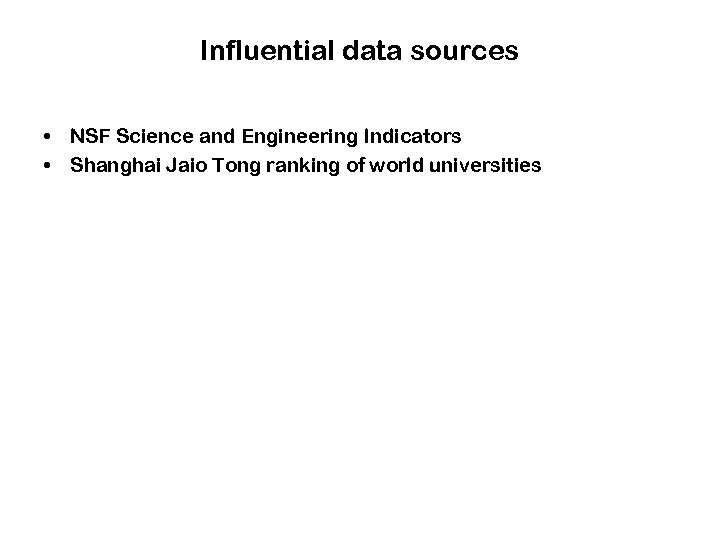
Influential data sources • NSF Science and Engineering Indicators • Shanghai Jaio Tong ranking of world universities
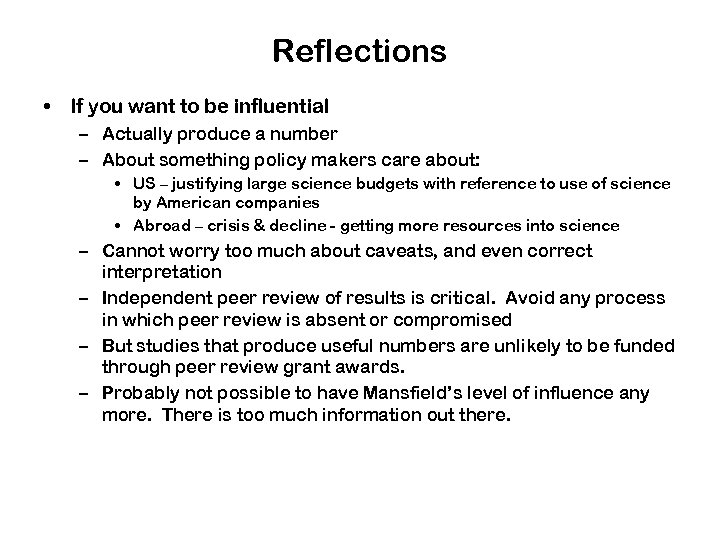
Reflections • If you want to be influential – Actually produce a number – About something policy makers care about: • US – justifying large science budgets with reference to use of science by American companies • Abroad – crisis & decline - getting more resources into science – Cannot worry too much about caveats, and even correct interpretation – Independent peer review of results is critical. Avoid any process in which peer review is absent or compromised – But studies that produce useful numbers are unlikely to be funded through peer review grant awards. – Probably not possible to have Mansfield’s level of influence any more. There is too much information out there.
Скачать презентацию Powerful numbers Numbers that matter A short reflection
98599554d50ad9176b13daece2afba28.ppt