


 Скачать презентацию Power Quality M Jegadeesan ASP EEE KLN College of
3aec3765b30609c1ba7c1d3fe8d1f92e.ppt
- Количество слайдов: 70
 Power Quality M. Jegadeesan ASP/EEE KLN College of Engineering Pottapalayam
 Electricity • Electricity provides the power you need to run your home electronic equipment. • Sometimes, interference in the supply of electricity affects your equipment runs. • Many older appliances can tolerate short power disturbances. • Many newer appliances, such as personal computers, Microwave ovens and sophisticated stereo systems, have sensitive electronics that can be disrupted or damaged. 3/18/2018 2
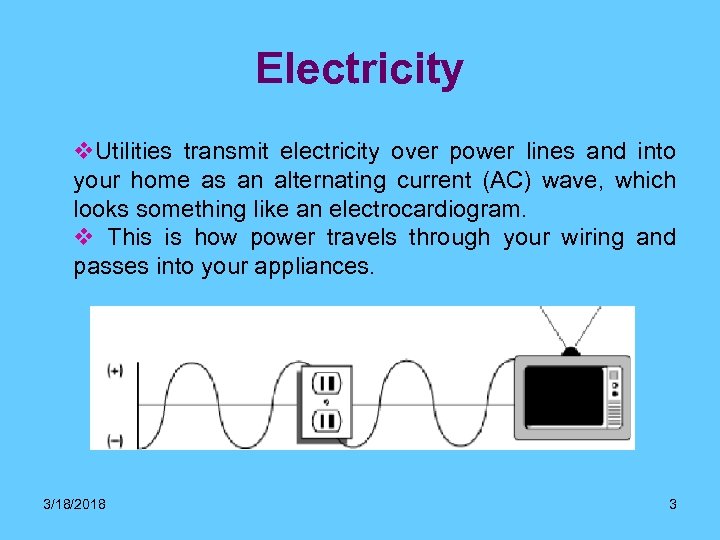 Electricity v. Utilities transmit electricity over power lines and into your home as an alternating current (AC) wave, which looks something like an electrocardiogram. v This is how power travels through your wiring and passes into your appliances. 3/18/2018 3
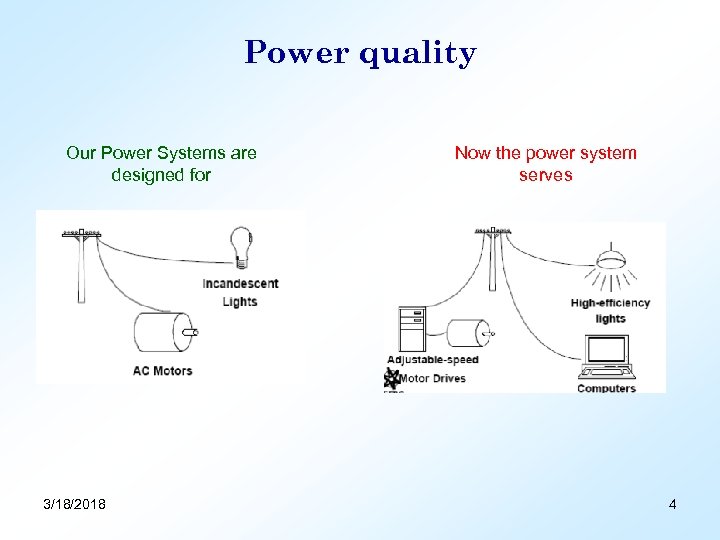 Power quality Our Power Systems are designed for 3/18/2018 Now the power system serves 4
 What is Power Quality? • ‘Power quality’ broadly refers to the delivery of a sufficiently high grade of electric service. • In general, it involves maintaining a sinusoidal load bus voltage at stipulated magnitude and frequency. 3/18/2018 5
 Why is Power Quality Important? • It affects both utilities as suppliers and customers as users 3/18/2018 6
 Impact on Customer Side • Computers and communication equipment are susceptible to power system disturbances which can lead to loss of data and erratic operation. • Automated manufacturing processes such as paper-making machinery, chip-making assembly lines, etc. can shutdown in case of even short voltage sags. 3/18/2018 7
 Impact on Customer Side (cont. ) • Induction and synchronous motors can have excessive losses and heating. • Home electronic equipment are vulnerable to power quality problems - e. g. , blinking VCR machines and digital clocks. • Equipment and process control malfunction translates to dollars of expense for replacement parts and for down time, impacting adversely on profitability and product quality. 3/18/2018 8
 Impact on Utility Side • Failure of power-factor correction capacitors due to resonance conditions. • Increased losses in cables, transformers and conductors, especially neutral wires. • Errors in energy meters, which are calibrated to operate under sinusoidal conditions. 3/18/2018 9
 Impact on Utility Side (cont. ) • Incorrect operation of protective relays, particularly in solid-state and microprocessor -controlled systems. • Interference with ripple control and power line carrier systems used for remote switching, load control, etc. • Unhappy customers as well as malfunction and failure of system components and control systems, impacting adversely on profitability. 3/18/2018 10
 Sources of Power Quality Problems • • Power electronic devices IT and office equipments Arching devices Load switching Large motor starting Embedded generation Sensitive equipment Storm and environmental related damage 3/18/2018 11
 Common Manifestations of Power quality v. Reactive power - Low power factor v. Harmonics - current & voltage distortions v. Frequency limits - under & over frequencies v. Steady state voltage limits - under & over voltages v. Transients v. Sags & Swells v. Unbalance v. Sequence components v. Black outs & Brown outs v Flicker v. Neutral shifts 3/18/2018 12
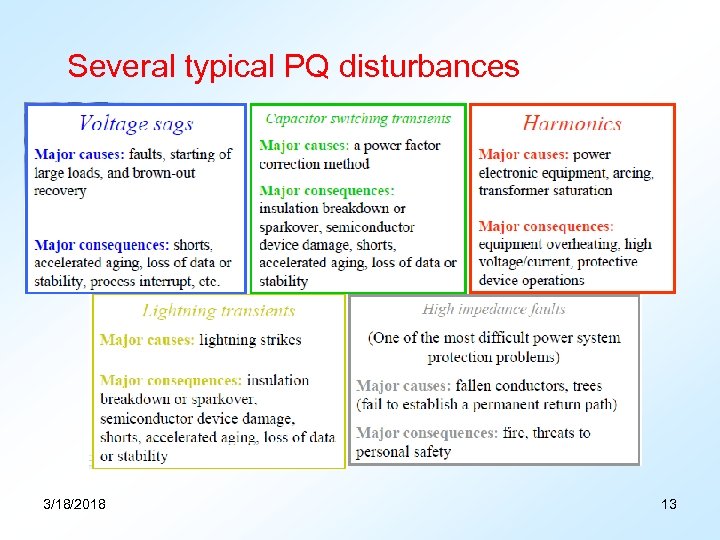 Several typical PQ disturbances 3/18/2018 13
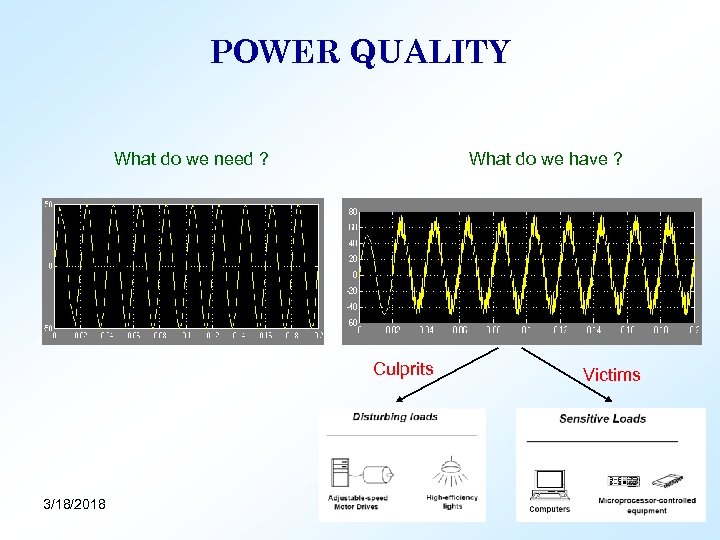 POWER QUALITY What do we need ? What do we have ? Culprits 3/18/2018 Victims
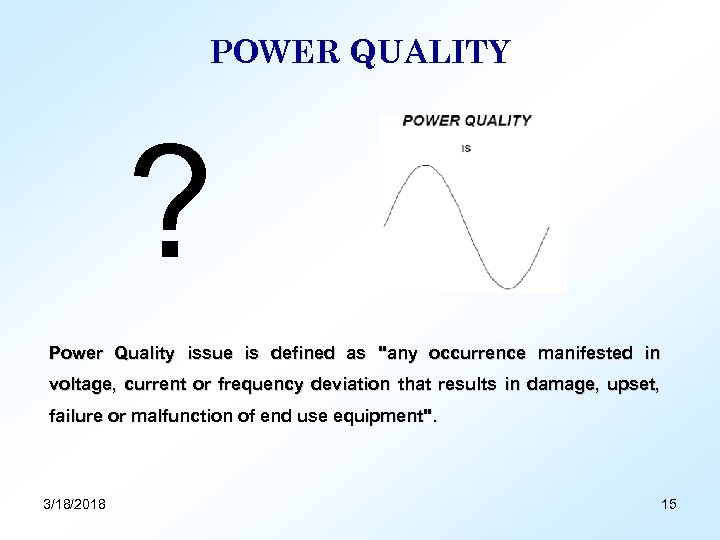 POWER QUALITY ? Power Quality issue is defined as "any occurrence manifested in voltage, current or frequency deviation that results in damage, upset, failure or malfunction of end use equipment". 3/18/2018 15
 Why is it a Concern? Power quality problems can cause: v Equipment malfunctions v Excessive wear or premature v failure of equipment v Increased costs from downtime v Increased maintenance, repair time and expense v Outside consultant expense 3/18/2018 16
 POWER QUALITY • Power quality is the combination of Voltage Quality and Current Quality. Voltage Quality • Voltage Quality is concerned with deviation of the actual voltage from the ideal voltage. • The ideal voltage is the single frequency sine of constant frequency and amplitude. 3/18/2018 17
 POWER QUALITY Current Quality • Current Quality is concerned with deviation of the actual Current from the ideal Current. • The ideal current is the single frequency sine of constant frequency and amplitude. 3/18/2018 18
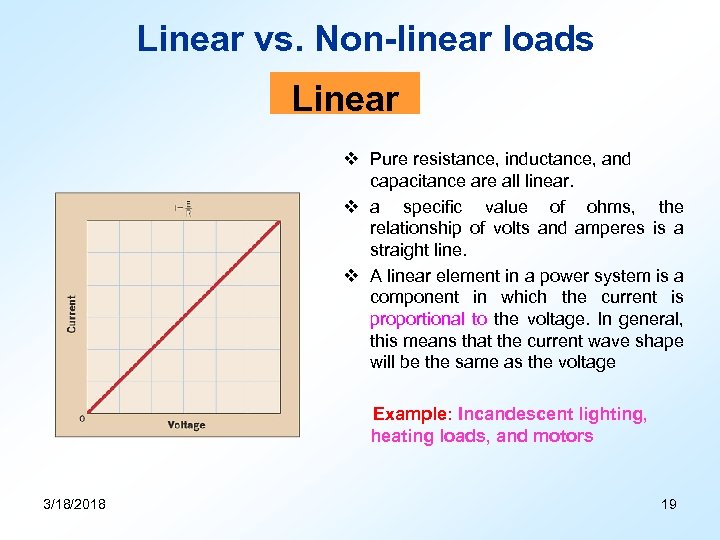 Linear vs. Non-linear loads Linear v Pure resistance, inductance, and capacitance are all linear. v a specific value of ohms, the relationship of volts and amperes is a straight line. v A linear element in a power system is a component in which the current is proportional to the voltage. In general, this means that the current wave shape will be the same as the voltage Example: Incandescent lighting, heating loads, and motors 3/18/2018 19
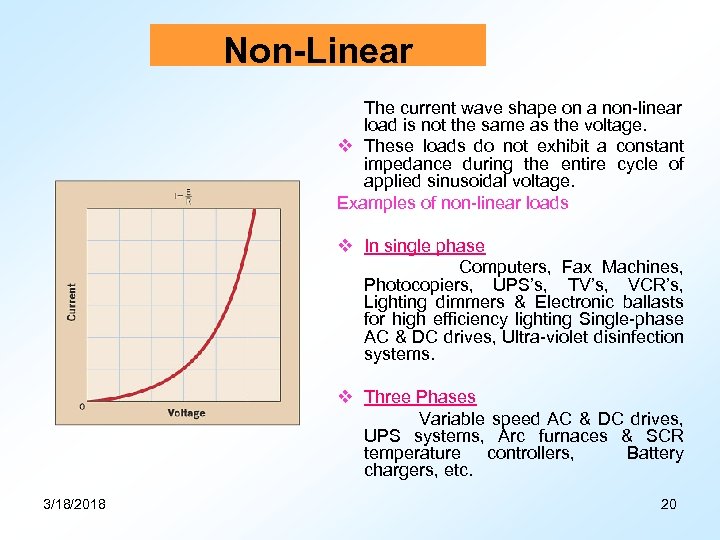 Non-Linear The current wave shape on a non-linear load is not the same as the voltage. v These loads do not exhibit a constant impedance during the entire cycle of applied sinusoidal voltage. Examples of non-linear loads v In single phase Computers, Fax Machines, Photocopiers, UPS’s, TV’s, VCR’s, Lighting dimmers & Electronic ballasts for high efficiency lighting Single-phase AC & DC drives, Ultra-violet disinfection systems. v Three Phases Variable speed AC & DC drives, UPS systems, Arc furnaces & SCR temperature controllers, Battery chargers, etc. 3/18/2018 20
 POWER QUALITY PROBLEMS v. Overloading, v under voltage v sustained interruption v. Waveform Distortion Harmonics, Noise & Interference v. Voltage Fluctuations Voltage Sags & Swells 3/18/2018 21
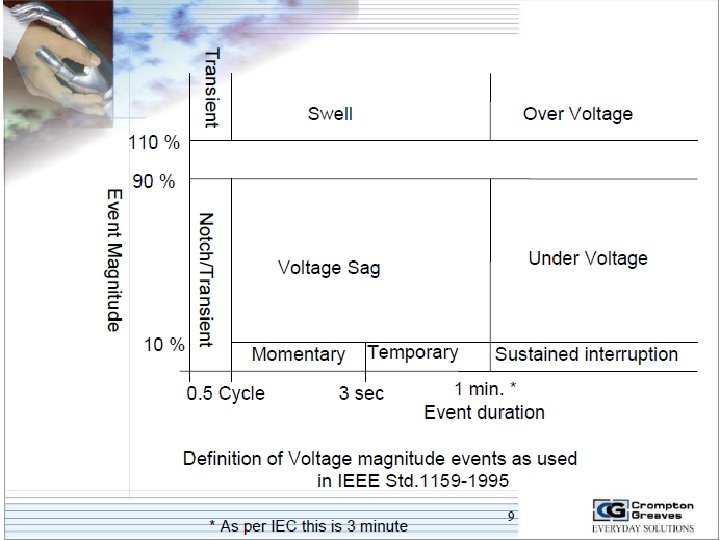
 Steady state Disturbance Long Duration Disturbances v Overvoltage v Under voltage v Sustained Interruptions Short Duration Disturbances v Sag v Swells v Interruptions 3/18/2018 22
 Long Duration Disturbances • Long-duration variations encompass root-meansquare (rms) deviations at power frequencies for longer than 1 min. • Long-duration variations can be either over voltages or under voltages. • Overvoltages and undervoltages generally are not the result of system faults, but are caused by load variations on the system and system switching operations. • Such variations are typically displayed as plots of rms voltage versus time. 3/18/2018 23
 Overvoltage An overvoltage is an increase in the rms ac voltage greater than 110 percent at the power frequency for a duration longer than 1 min. • load switching (e. g. , switching off a large load or energizing a capacitor bank). • Incorrect tap settings on transformers can also result in system overvoltages. 3/18/2018 A 24
 Under voltage An undervoltage is a decrease in the rms ac voltage to less than 90 percent at the power frequency for a duration longer than 1 min. v opposite of the events that cause overvoltages. v load switching on or a capacitor bank switching off can cause an under voltage Brownout The term brownout is often used to describe sustained periods of undervoltage initiated as a specific utility dispatch strategy to reduce power demand. 3/18/2018 25
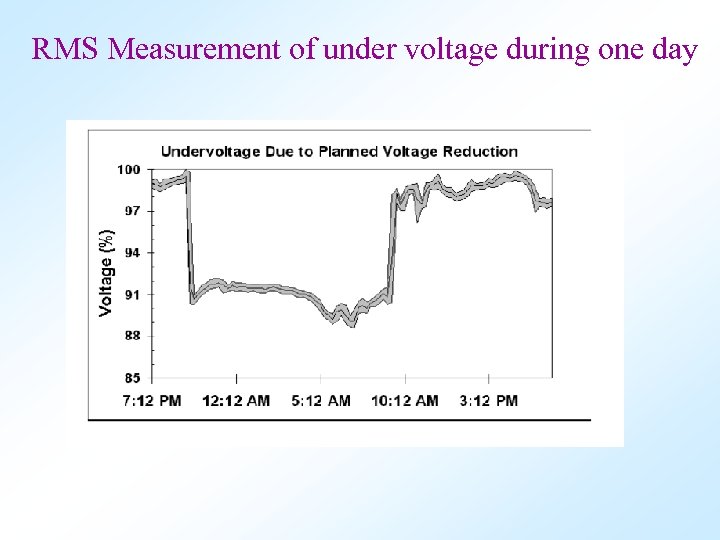 RMS Measurement of under voltage during one day
 Sustained Interruptions • When the supply voltage has been zero for a period of time in excess of 1 min, the long-duration voltage variation is considered a sustained interruption. • Voltage interruptions longer than 1 min are often permanent and require human intervention to repair the system for restoration. Outage • Utilities use outage or interruption to describe phenomena of similar nature for reliability reporting purposes. However, this causes confusion for end users who think of an outage as any interruption of power that shuts down a process. 3/18/2018 27
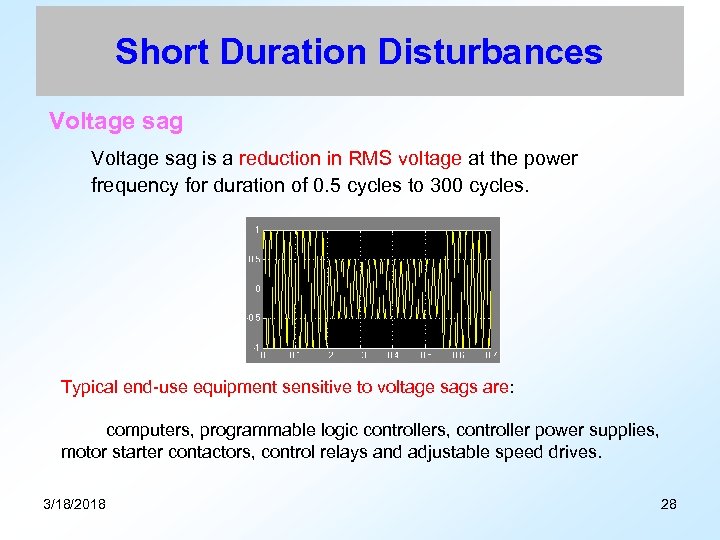 Short Duration Disturbances Voltage sag is a reduction in RMS voltage at the power frequency for duration of 0. 5 cycles to 300 cycles. Typical end-use equipment sensitive to voltage sags are: computers, programmable logic controllers, controller power supplies, motor starter contactors, control relays and adjustable speed drives. 3/18/2018 28
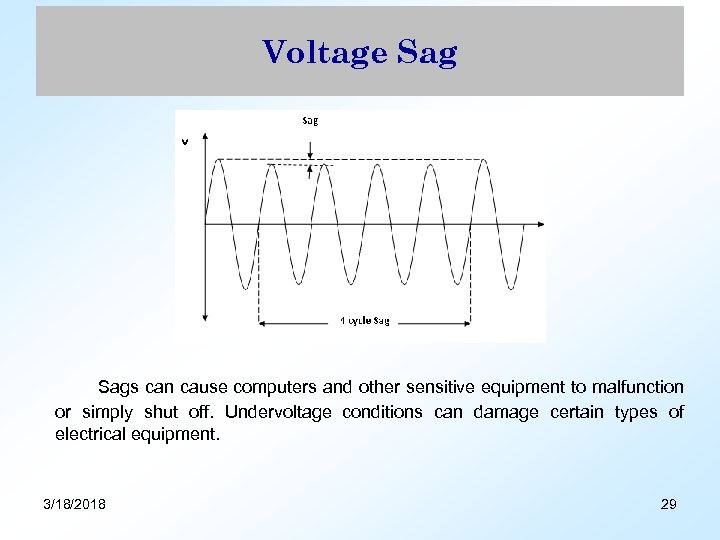 Voltage Sags can cause computers and other sensitive equipment to malfunction or simply shut off. Undervoltage conditions can damage certain types of electrical equipment. 3/18/2018 29
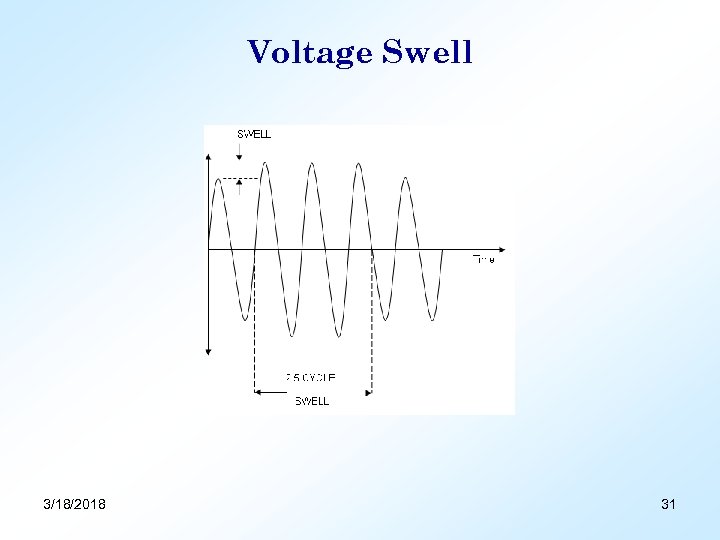
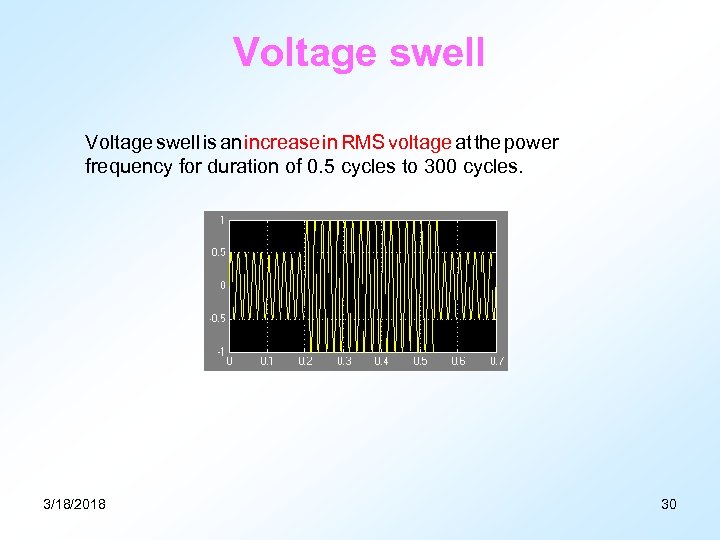 Voltage swell is an increase in RMS voltage at the power frequency for duration of 0. 5 cycles to 300 cycles. 3/18/2018 30
 Voltage Swell 3/18/2018 31
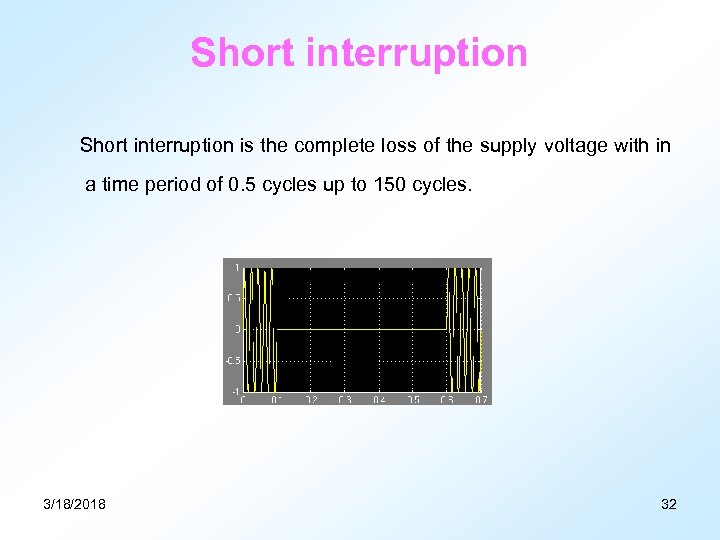 Short interruption is the complete loss of the supply voltage with in a time period of 0. 5 cycles up to 150 cycles. 3/18/2018 32
 Voltage Variation Sources v Supply side variations v Short circuits v Capacitor switching v Load switching v Regulator malfunction v Load side variations v Motor starting 3/18/2018 34
 Voltage Flicker • A waveform may exhibit voltage flicker if its waveform amplitude is modulated at frequencies less than 25 Hz, which the human eye can detect as a variation in the lamp intensity of a standard bulb. • Voltage flicker is caused by an arcing condition on the power system. • Flicker problems can be corrected with the installation of filters, static VAR systems, or distribution static compensators 3/18/2018 35
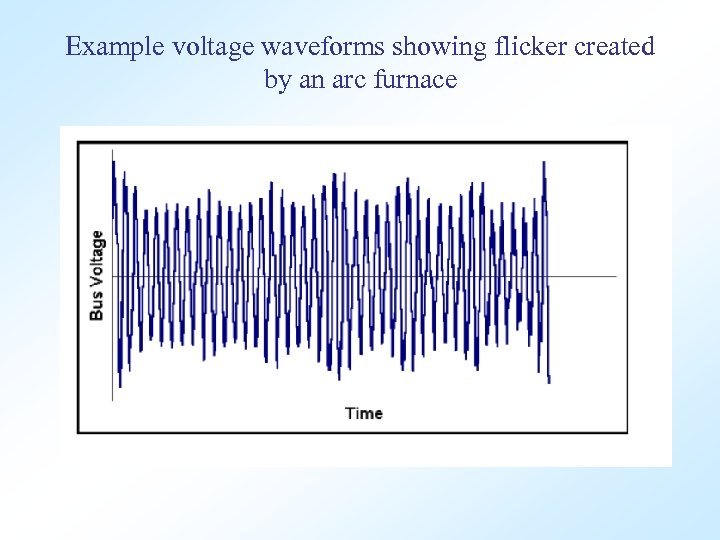 Example voltage waveforms showing flicker created by an arc furnace
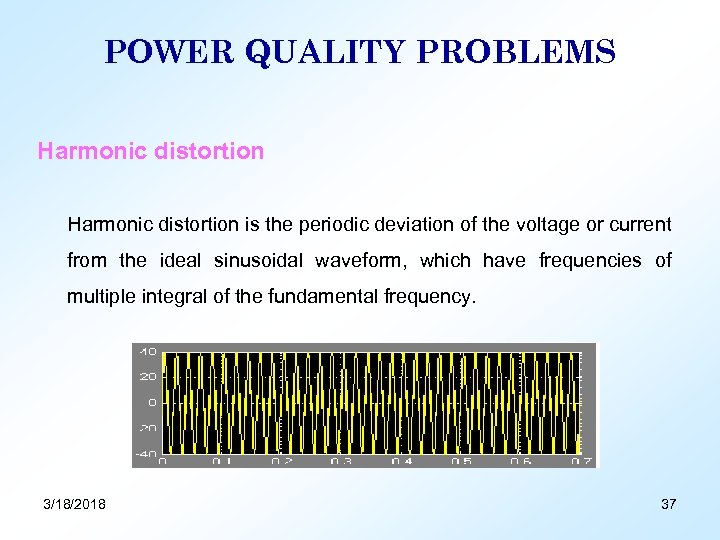 POWER QUALITY PROBLEMS Harmonic distortion is the periodic deviation of the voltage or current from the ideal sinusoidal waveform, which have frequencies of multiple integral of the fundamental frequency. 3/18/2018 37
 What Are Harmonics? • “A component frequency of a harmonic motion of an electromagnetic wave that is an integral multiple of the fundamental frequency” • US fundamental frequency is 60 Hertz – 3 rd Harmonic is 3 x 60 Hz or 180 Hz – 5 th Harmonic is 5 x 60 Hz or 300 Hz, etc. 3/18/2018 38
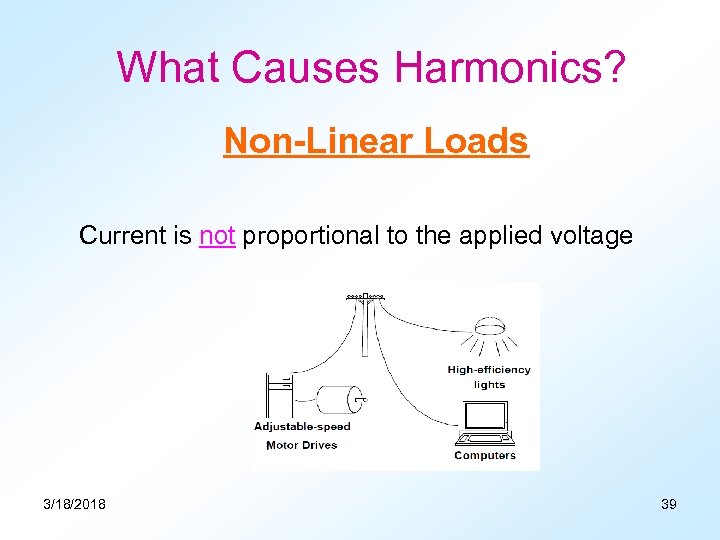 What Causes Harmonics? Non-Linear Loads Current is not proportional to the applied voltage 3/18/2018 39
 Harmonics 3/18/2018 40
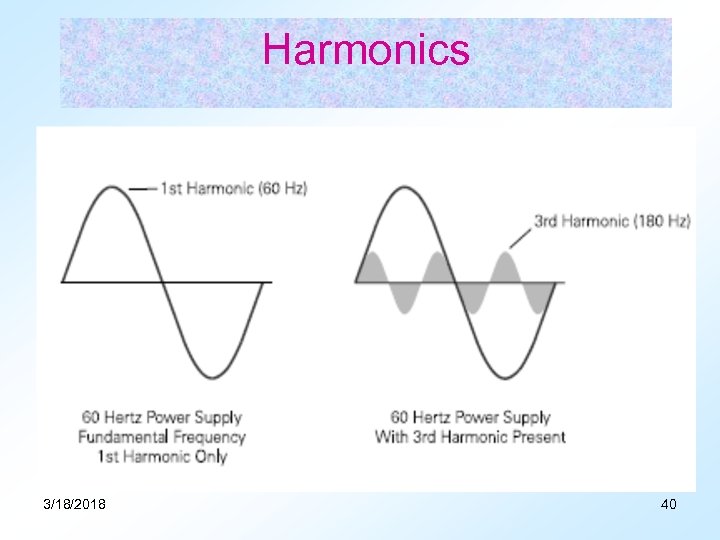
 Harmonics • The base frequency of the power supply is said to be the fundamental frequency or first harmonic. • The fundamental frequency or first harmonic of a 60 Hz power supply is 60 Hz. • Additional harmonics can appear on the power supply. These harmonics are usually whole number multiplies of the first harmonic. • The third harmonic of a 60 Hz power supply, for example, is 180 Hz (60 x 3). 3/18/2018 41
 Harmonics • When a harmonic waveform is superimposed on the fundamental sine wave a distinctive waveform is produced. • In this example, the third harmonic is seen superimposed on the fundamental frequency. The problem of waveform distortion becomes more complex when additional harmonics are present. 3/18/2018 42
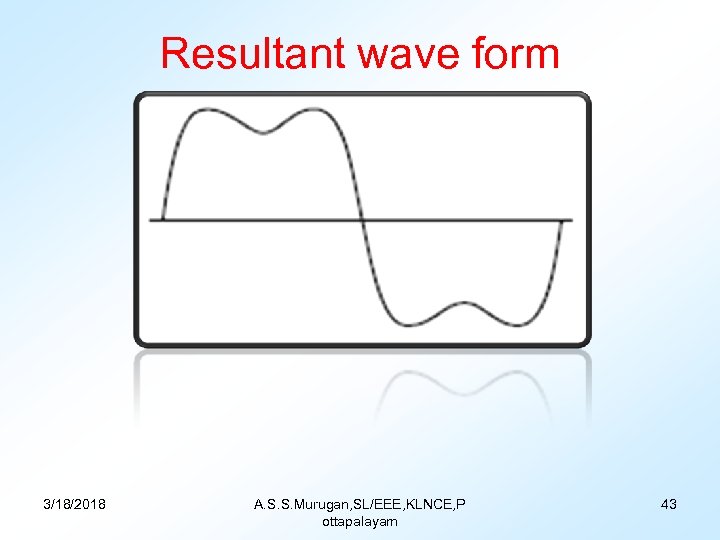 Resultant wave form 3/18/2018 A. S. S. Murugan, SL/EEE, KLNCE, P ottapalayam 43
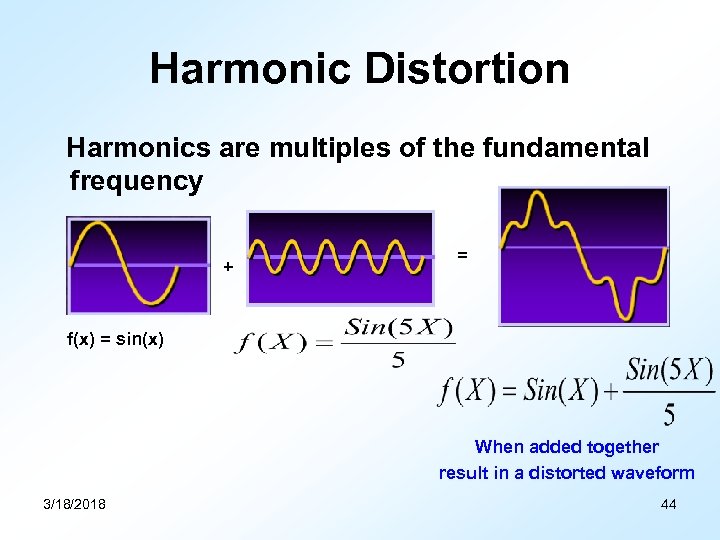 Harmonic Distortion Harmonics are multiples of the fundamental frequency + = f(x) = sin(x) When added together result in a distorted waveform 3/18/2018 44
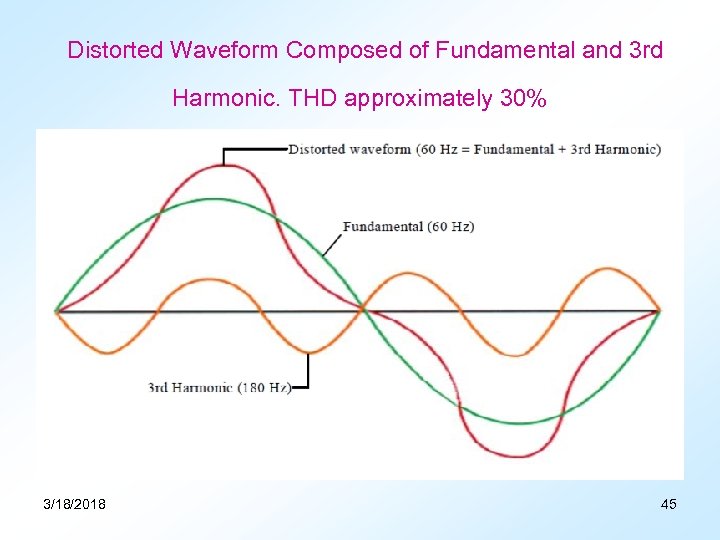 Distorted Waveform Composed of Fundamental and 3 rd Harmonic. THD approximately 30% 3/18/2018 45
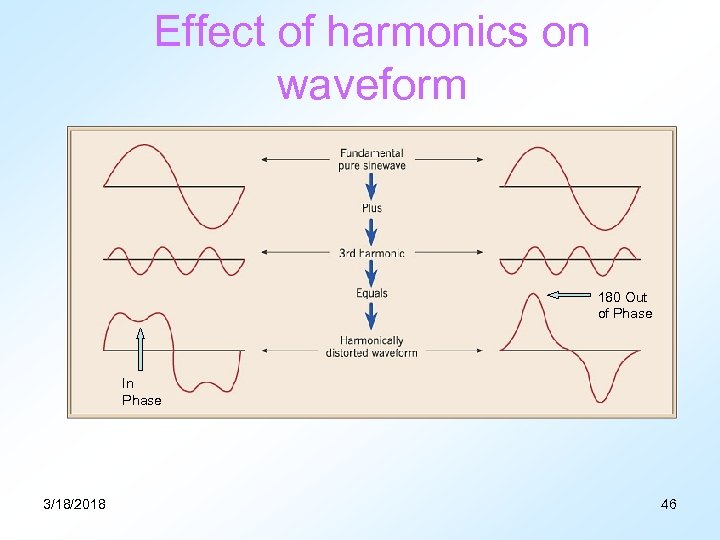 Effect of harmonics on waveform 180 Out of Phase In Phase 3/18/2018 46
 What do harmonics do? • Harmonics are carried through the system from the source and can nearly double the amount of current on the neutral conductor in three phase four wire distribution systems. • Distorted currents from harmonic-producing loads also distort the voltage as they pass through the system impedence. Therefore, a distorted voltage can be presented to other end users on the system. • Overall electrical system and power quality is affected by the introduction of harmonics. 3/18/2018 47
 Sources of Harmonics • Solid State Electronic Devices which contain a poor power supply – Computers (PCs/CPUs) – Laser Printers – Copy Machines • • • Solid State UPS Units Solid State Devices (Fluorescent lighting ballasts) Rectifiers (AC-DC Converters VFDs) Welding Units Arc Furnaces 3/18/2018 48
 Interharmonics are defined as frequency components of voltages or currents that are not an integer multiple of the normal system frequency (e. g. , 60 or 50 Hz). The main sources of interharmonics are static frequency converters, cycloconverters, induction motors, and arcing devices. Power line carrier signals can be considered as interharmonics. The effects of interharmonics are not well known but have been shown to affect power line carrier signaling and induce visual flicker in display devices such as cathode ray tubes (CRTs). 3/18/2018 49
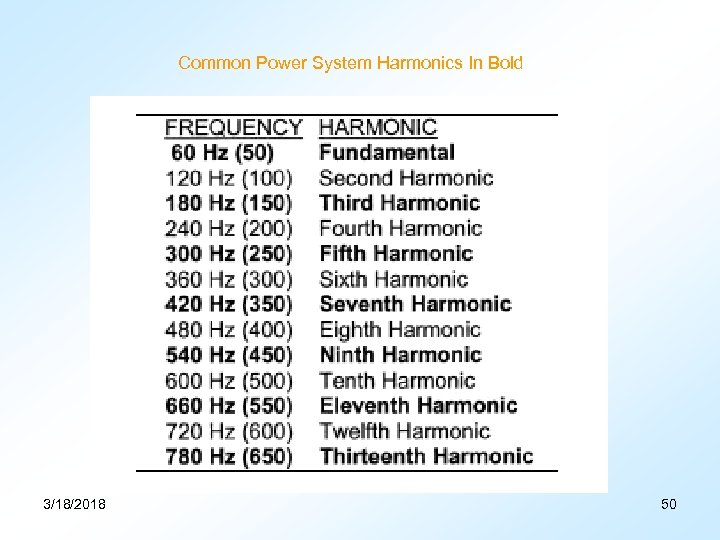 Common Power System Harmonics In Bold 3/18/2018 50
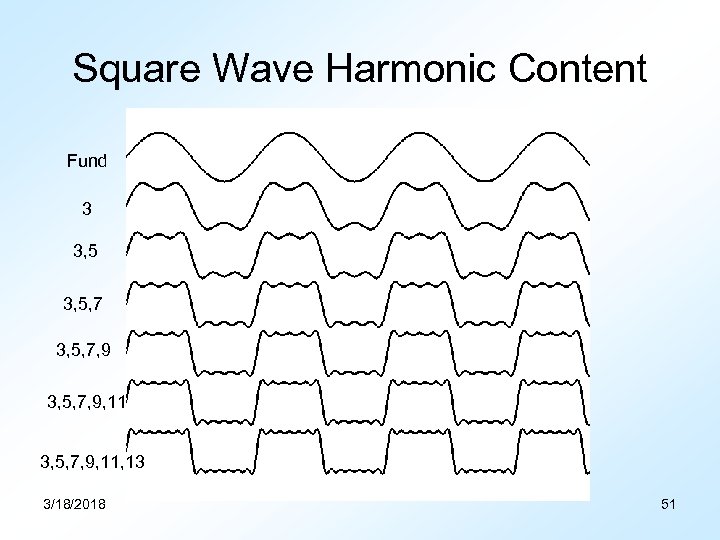 Square Wave Harmonic Content Fund 3 3, 5, 7, 9, 11 3, 5, 7, 9, 11, 13 3/18/2018 51
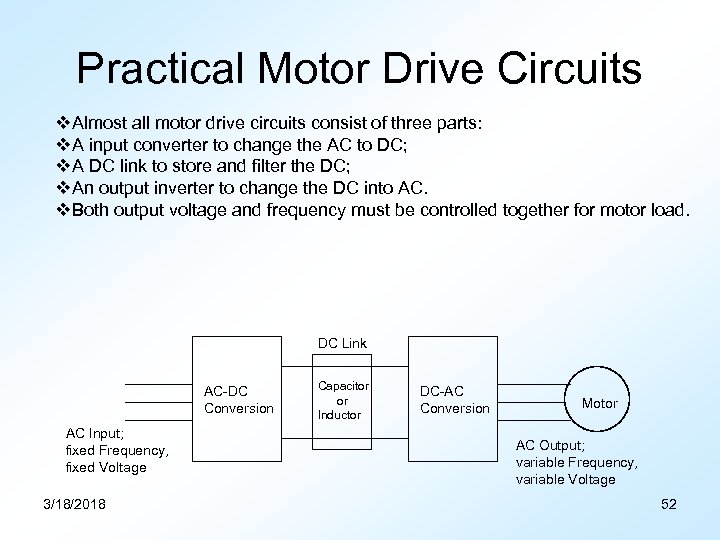 Practical Motor Drive Circuits v. Almost all motor drive circuits consist of three parts: v. A input converter to change the AC to DC; v. A DC link to store and filter the DC; v. An output inverter to change the DC into AC. v. Both output voltage and frequency must be controlled together for motor load. DC Link AC-DC Conversion AC Input; fixed Frequency, fixed Voltage 3/18/2018 Capacitor or Inductor DC-AC Conversion Motor AC Output; variable Frequency, variable Voltage 52
 Point of Common Coupling • The point of common coupling is the location in the power distribution system where harmonic distortion is to be measured, usually where harmonic currents flow into a bus which feeds other equipment. Its location must be specified! • In the absence of a specified location, the POCC for current harmonics is the plantutility interface 3/18/2018 53
 How can Harmonics be Reduced? • Isolate harmonic loads on separate circuits (with or without harmonic filters) • Harmonic mitigating transformers • Phase shifting (zig-zag) transformers – Used to cancel out specific harmonics by making one voltage circuit 180 degrees out-ofphase • Filter capacitor backs 3/18/2018 54
 NOISE Noise refers to unwanted electrical signals (with broadband spectral content lower than 200 k. Hz) that produce undesirable effects in the circuits of control systems in which they Noise in power systems can be caused by power electronic devices, control circuits, arcing equipment, loads with solid-state rectifiers, and switching power supplies. Noise problems are mainly caused by improper grounding. There are two types of noise voltages: Common-mode noise voltage: A noise voltage that appears between current carrying conductors and ground. That is, this noise voltage appears equally and in phase from each current-carrying conductor to the ground. 3/18/2018 55
 Normal-mode noise voltage: A noise voltage that appears between or among active circuit conductors, but not between the grounding conductor and the active circuit conductors. Noise disturbs electronic devices such as microcomputer and programmable controllers. The problem can be mitigated by using filters, isolation transformers, and some line conditioners. 3/18/2018 56
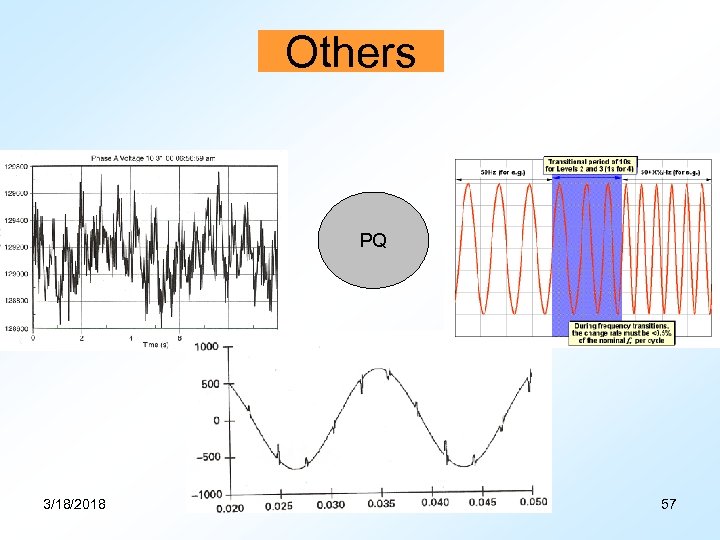 Others Voltage Fluctuation PQ Frequency Variation Notching 3/18/2018 57
 Voltage Unbalance • Deviation of magnitude and/or phase in 3 phase system • Can result in heating of induction motors Notching – Caused by commutation in semiconductor converters 3/18/2018 58
 What is a Transient or Surge? • Transients, commonly called as surges are sub cycle disturbances of very short duration that vary greatly in magnitude. • When transient occurs, thousands of voltage can be generated into the electrical system • A Transient can be classified into two categories, impulsive and oscillatory Duration < 50 ns to 50 ms • . 00000005 seconds to. 002 seconds • . 000005 seconds to. 050 seconds 3/18/2018 59
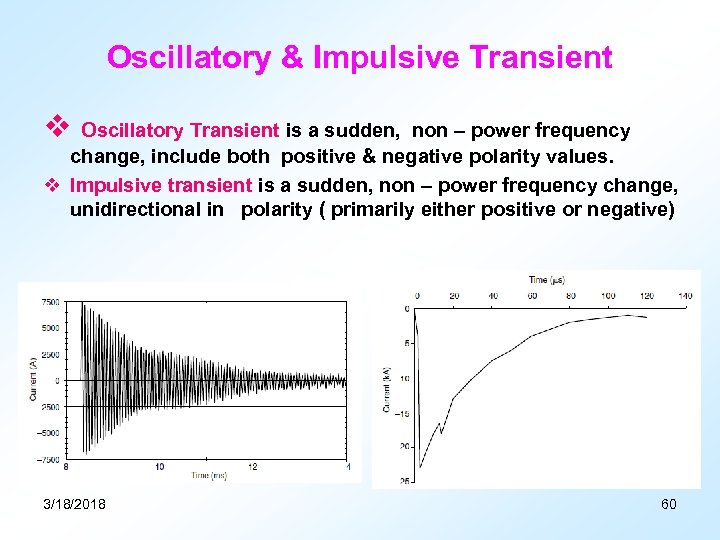 Oscillatory & Impulsive Transient v Oscillatory Transient is a sudden, non – power frequency change, include both positive & negative polarity values. v Impulsive transient is a sudden, non – power frequency change, unidirectional in polarity ( primarily either positive or negative) 3/18/2018 60
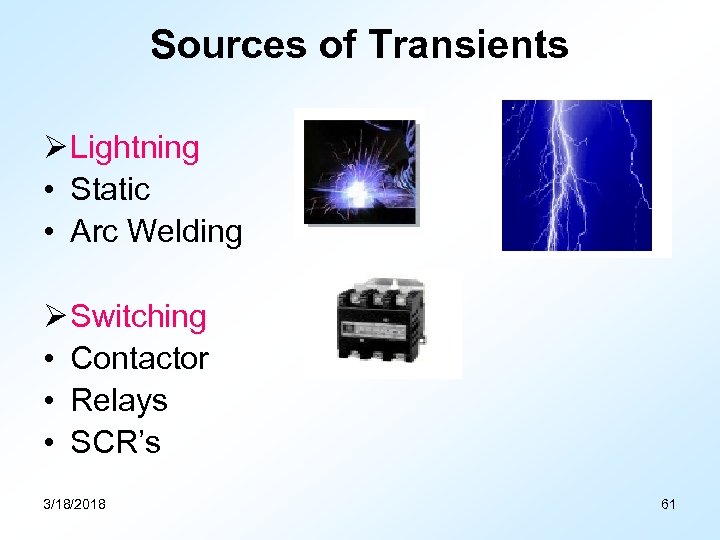 Sources of Transients Ø Lightning • Static • Arc Welding Ø Switching • Contactor • Relays • SCR’s 3/18/2018 61
 Harmonic Indices • Two important indices, THD and TDD, are used to describe the effects of harmonics on power system components and communication systems. • These indices are used to measure the deviation of a periodic waveform containing harmonics from a perfect sine wave. • For a perfect sine wave, the deviation (or the distortion) is zero. 3/18/2018 62
 IEEE 519 -1992 IEEE standard 519 - 1992 specifies the allowable limits for voltage and current distortion at various bus and system voltages. These are given in Tables 1 and 2. The important terminology used in this standard are explained below: • The Point of Common Coupling (PCC) is the location of the harmonic voltage and current distortion to be calculated or measured. • Total Harmonic Distortion (THD) is the total harmonic voltage distortion calculated or measured at PCC. • Total Demand Distortion (TDD) is the percentage of total harmonic current distortion calculated or measured at PCC. 3/18/2018 63
 Total Demand Distortion (TDD) The ratio of the root-mean- square of the harmonic current to the root-meansquare value of the rated or maximum demand fundamental current, expressed as a percent.
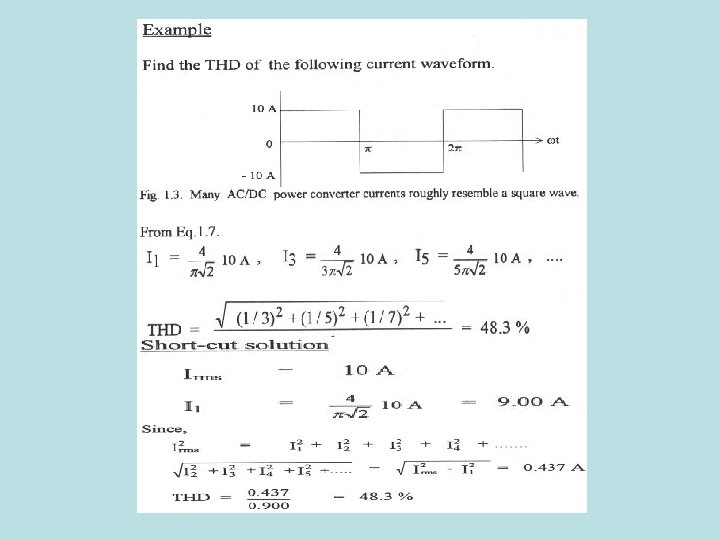
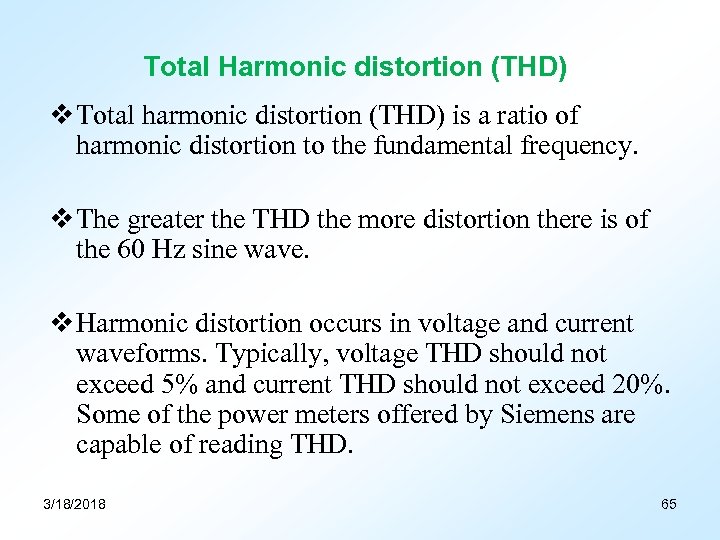 Total Harmonic distortion (THD) v Total harmonic distortion (THD) is a ratio of harmonic distortion to the fundamental frequency. v The greater the THD the more distortion there is of the 60 Hz sine wave. v Harmonic distortion occurs in voltage and current waveforms. Typically, voltage THD should not exceed 5% and current THD should not exceed 20%. Some of the power meters offered by Siemens are capable of reading THD. 3/18/2018 65
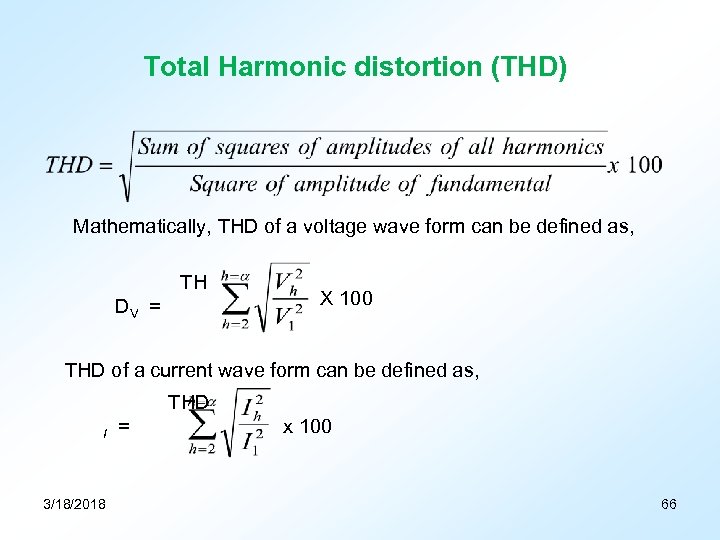 Total Harmonic distortion (THD) Mathematically, THD of a voltage wave form can be defined as, TH DV = X 100 THD of a current wave form can be defined as, THD I 3/18/2018 = x 100 66
 3/18/2018 68
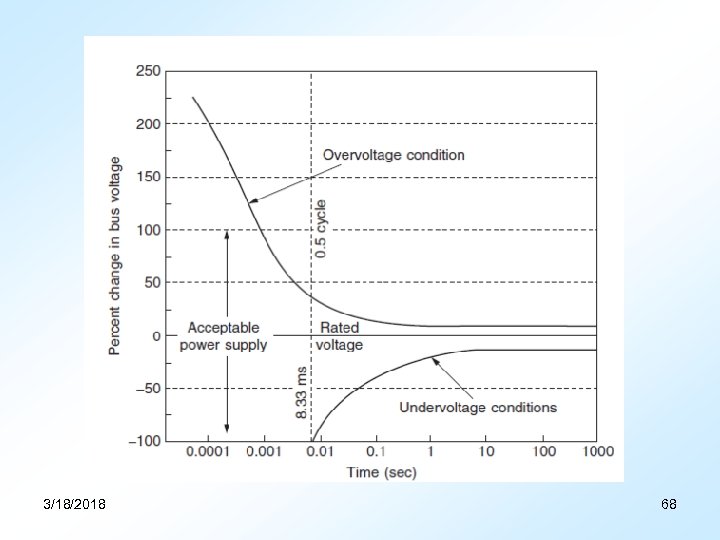
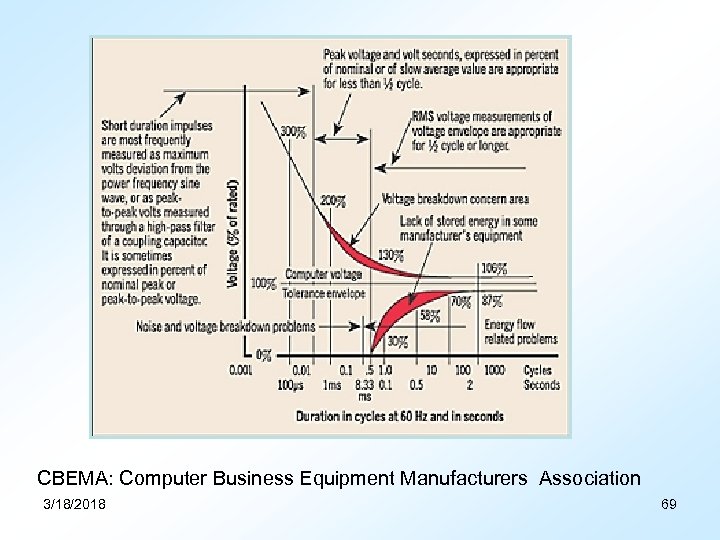 CBEMA: Computer Business Equipment Manufacturers Association 3/18/2018 69
 THANK YOU