


 Скачать презентацию Power Quality Fundamentals and Monitoring Ross M Ignall
497639b8c0baa8cce7c433deb1c3f202.ppt
- Количество слайдов: 137
 Power Quality Fundamentals and Monitoring Ross M. Ignall Systems Applications Manager, Dranetz-BMI rignall@dranetz-bmi. com
 What We Will Cover… - Defining Power Quality and Reliability - PQ References & Fundamentals - Monitoring, Measuring High Reliability Facilities - Case Studies
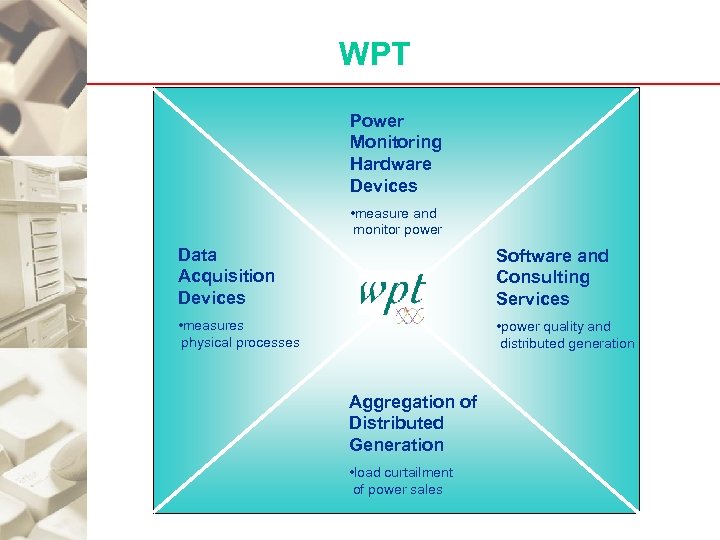 WPT Power Monitoring Hardware Devices • measure and monitor power Data Acquisition Devices Software and Consulting Services • measures physical processes • power quality and distributed generation Aggregation of Distributed Generation • load curtailment of power sales
 Defining Power Quality & Reliability
 What is a Power Quality Problem? “Any occurrence manifested in voltage, current, or frequency deviations that results in failure or mis-operation of end-use equipment. ”
 What Does That Mean? Given the quality of supply do I have to worry about problems with my equipment or systems? It’s dependant on your susceptibility.
 What You Should Be Asking… What is my susceptibility to power problems? What is my economic exposure to such problems? $$$$
 Types Of Power Quality Problems
 Who’s Problem Is It? Customer’s Perspective* * Georgia Power Survey
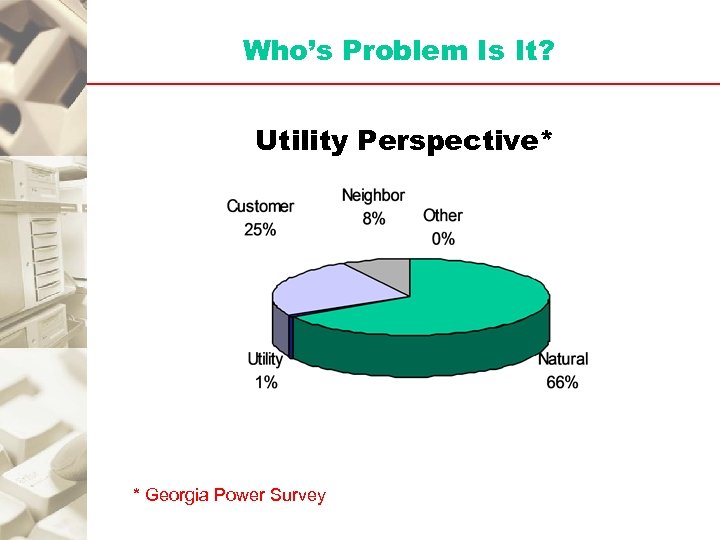 Who’s Problem Is It? Utility Perspective* * Georgia Power Survey
 The Big Picture It’s the complete electrical environment, not just the quality of supply
 What You Should Be Asking… Does my power system have the capacity for my present needs? How about future growth? Be Proactive!
 An Analogy… “Just because I have blank checks doesn’t mean that I have money in the bank to cash them” Ron Rainville, COO, US Data Centers
 Some Factoids
 Power Quality Factoids $50 billion per year in the USA is lost as a result of power quality breakdown. SOURCE: EPRI, 2000 Half of all computer problems and one-third of all data loss can be traced back to the power line. SOURCE: Contingency Planning Research, LAN Times Sandia National Laboratories estimates power quality and reliability problems cost US businesses approx. $150 billion annually in lost data, materials and productivity— 60% are sags In 1999, the amount lost as a result of power quality in the US was five times the amount spent on power quality worldwide
 …The data center houses 45, 000 square-feet of computer floor space. In one database, the company has consolidated $1. 6 trillion of life insurance information. Energy Decisions, June 2001 During power supply shortages, utilities are generally permitted to have line voltage reductions, so-called “brown outs, ” to cope with seasonal power demands…But if equipment is already operating on the low end of nominal voltage then the brown-out may cause excessive heat dissipation in motors and electronic equipment. Building Operation and Management, May 2000
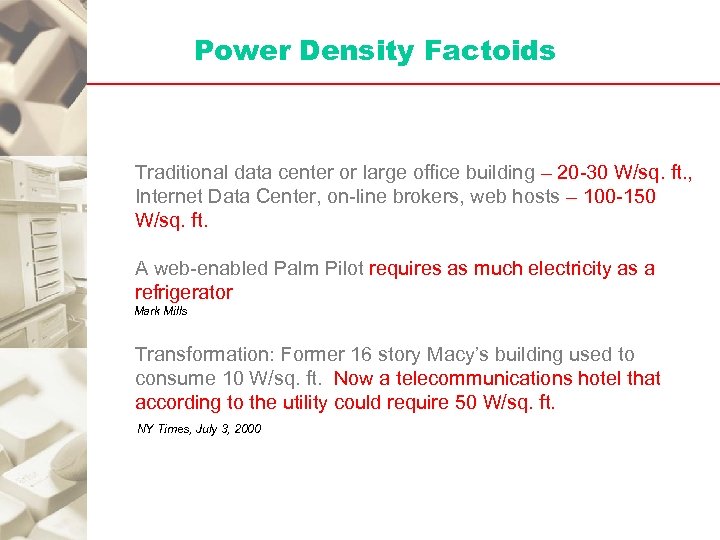 Power Density Factoids Traditional data center or large office building – 20 -30 W/sq. ft. , Internet Data Center, on-line brokers, web hosts – 100 -150 W/sq. ft. A web-enabled Palm Pilot requires as much electricity as a refrigerator Mark Mills Transformation: Former 16 story Macy’s building used to consume 10 W/sq. ft. Now a telecommunications hotel that according to the utility could require 50 W/sq. ft. NY Times, July 3, 2000
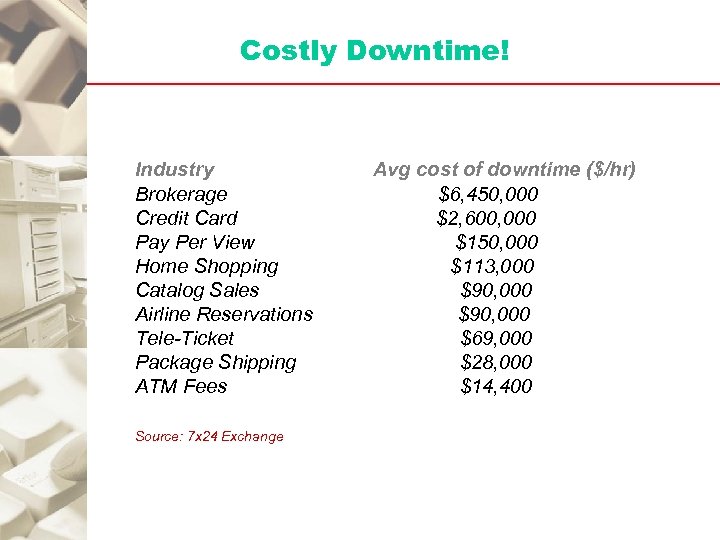 Costly Downtime! Industry Brokerage Credit Card Pay Per View Home Shopping Catalog Sales Airline Reservations Tele-Ticket Package Shipping ATM Fees Source: 7 x 24 Exchange Avg cost of downtime ($/hr) $6, 450, 000 $2, 600, 000 $150, 000 $113, 000 $90, 000 $69, 000 $28, 000 $14, 400
 Introduction to Power Quality
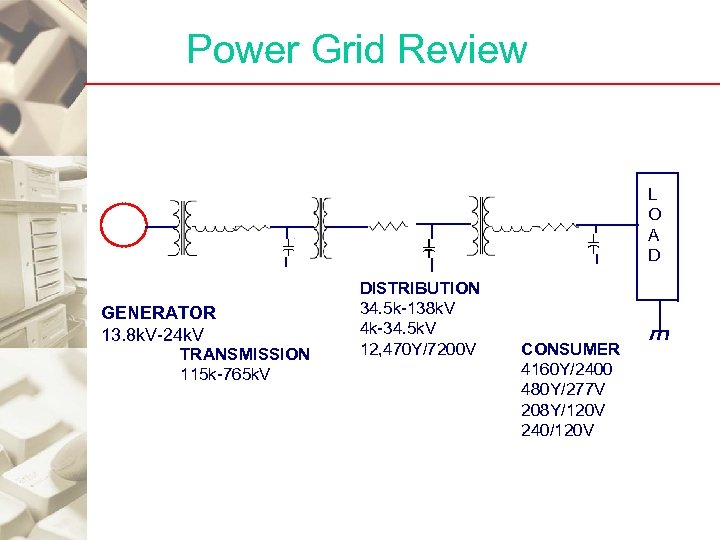 Power Grid Review L O A D GENERATOR 13. 8 k. V-24 k. V TRANSMISSION 115 k-765 k. V DISTRIBUTION 34. 5 k-138 k. V 4 k-34. 5 k. V 12, 470 Y/7200 V CONSUMER 4160 Y/2400 480 Y/277 V 208 Y/120 V 240/120 V
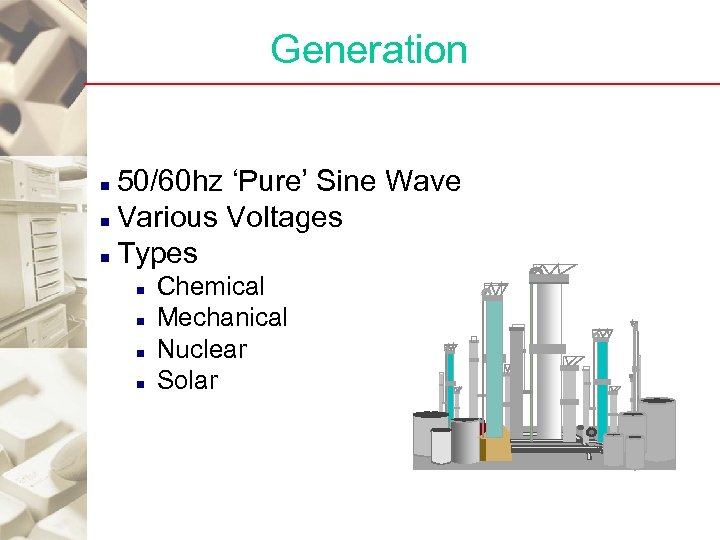 Generation 50/60 hz ‘Pure’ Sine Wave n Various Voltages n Types n n n Chemical Mechanical Nuclear Solar
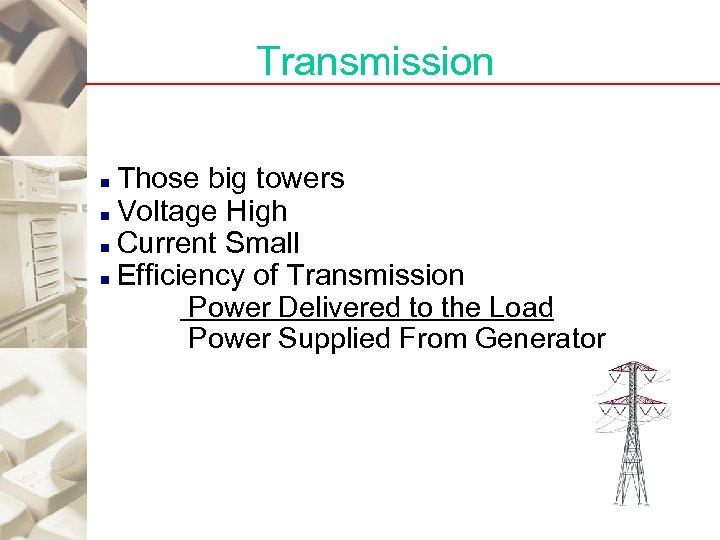 Transmission Those big towers n Voltage High n Current Small n Efficiency of Transmission Power Delivered to the Load Power Supplied From Generator n
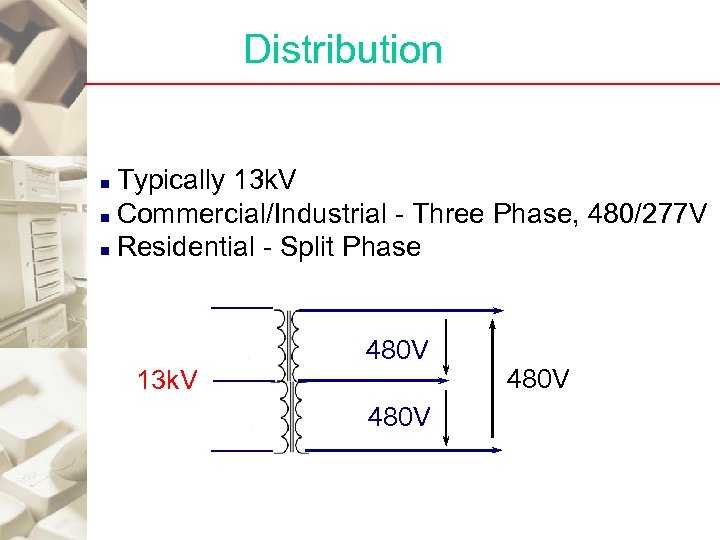 Distribution Typically 13 k. V n Commercial/Industrial - Three Phase, 480/277 V n Residential - Split Phase n 480 V 13 k. V 480 V
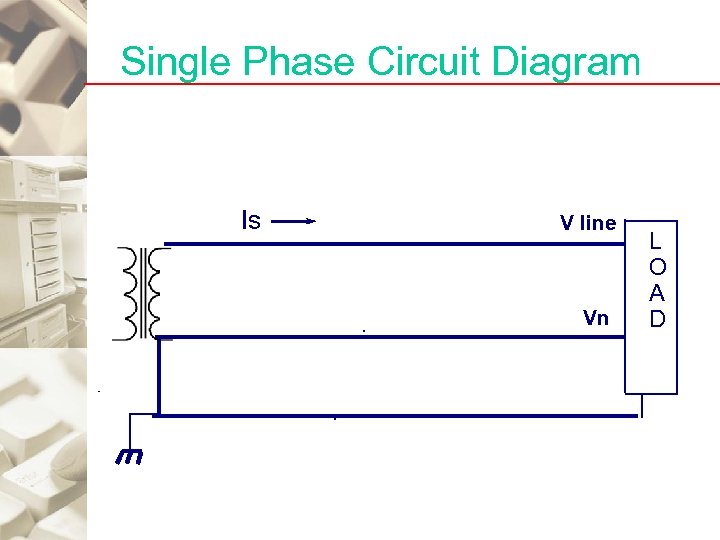 Single Phase Circuit Diagram Is V line Vn L O A D
 Can Wiring and Grounding Affect Power Quality? “That’s one of the things about living in an old house that drives me nuts. Never enough outlets!”
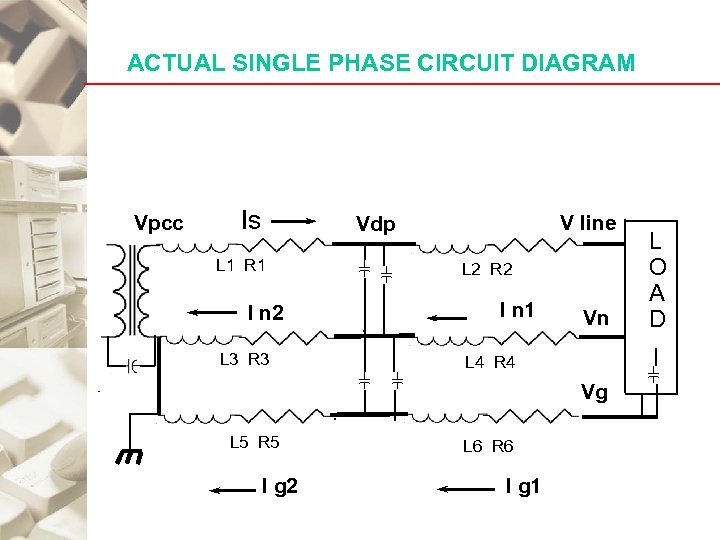 ACTUAL SINGLE PHASE CIRCUIT DIAGRAM Vpcc Is V line Vdp L 1 R 1 l n 2 L 3 R 3 L 2 R 2 I n 1 Vn L 4 R 4 Vg L 5 R 5 I g 2 L 6 R 6 l g 1 L O A D
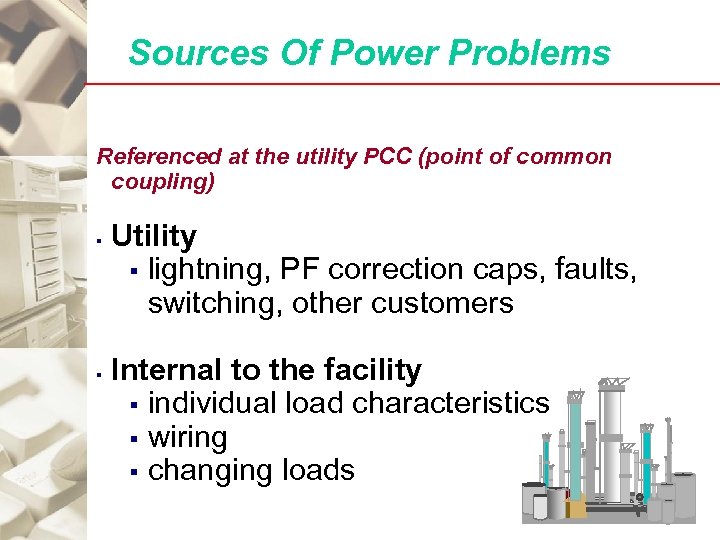 Sources Of Power Problems Referenced at the utility PCC (point of common coupling) § § Utility § lightning, PF correction caps, faults, switching, other customers Internal to the facility § individual load characteristics § wiring § changing loads
 Power Quality References & Terms
 IEEE Standards Coordinating Committee • SCC-22 • Oversees development of all PQ standards in the IEEE • Meet at both Summer and Winter Power Engineering Society meetings • Coordinate standards activities • Progress reports • Avoid overlap and conflicts • Sponsors task forces to develop standards § 1433 Task Force to pull together terms. IEEE & IEC
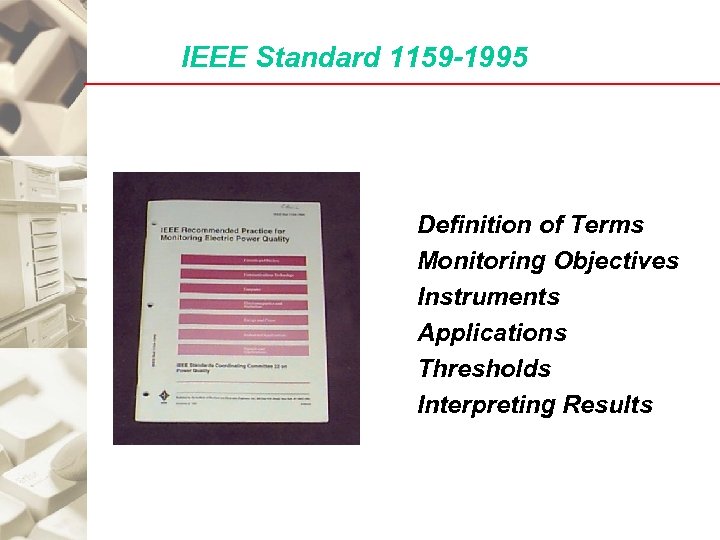 IEEE Standard 1159 -1995 Definition of Terms Monitoring Objectives Instruments Applications Thresholds Interpreting Results
 IEEE 1159 • 1159. x Task Force § § Data Acquisition & Recorder Requirements for 1159 -1995 Combination of 1159. 1 & 1159. 2 Coordination with IEC standards (61000 -4 -30 and revisions) New recommended practice to be developed by July 2001 • 1159. 3 Task Force § Power Quality Data Interchange Format (PQDIF) § Format for the exchange of PQ and other information between applications § Developed by Electrotek Concepts
 IEEE 519 -1992 Recommended Practice For Harmonics § Recommends Limits at the PCC § § Voltage Harmonics Current Harmonics Ongoing work to modify IEEE 519 -1992 § § Limits for within a facility Frequency dependant
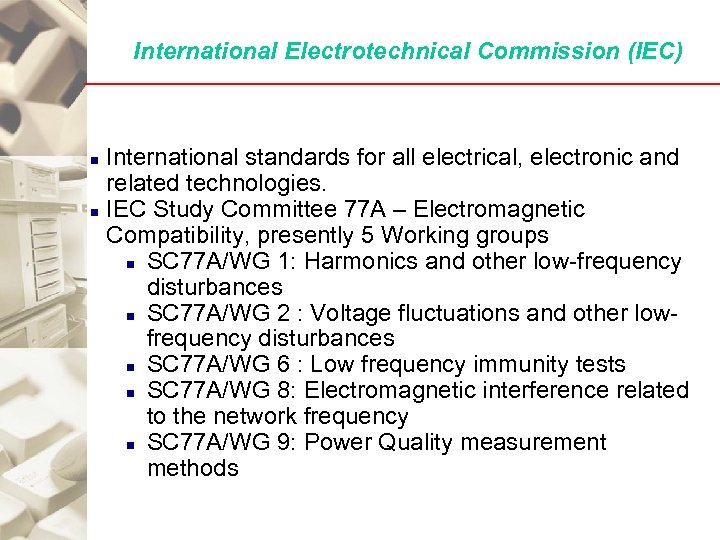 International Electrotechnical Commission (IEC) n n International standards for all electrical, electronic and related technologies. IEC Study Committee 77 A – Electromagnetic Compatibility, presently 5 Working groups n SC 77 A/WG 1: Harmonics and other low-frequency disturbances n SC 77 A/WG 2 : Voltage fluctuations and other lowfrequency disturbances n SC 77 A/WG 6 : Low frequency immunity tests n SC 77 A/WG 8: Electromagnetic interference related to the network frequency n SC 77 A/WG 9: Power Quality measurement methods
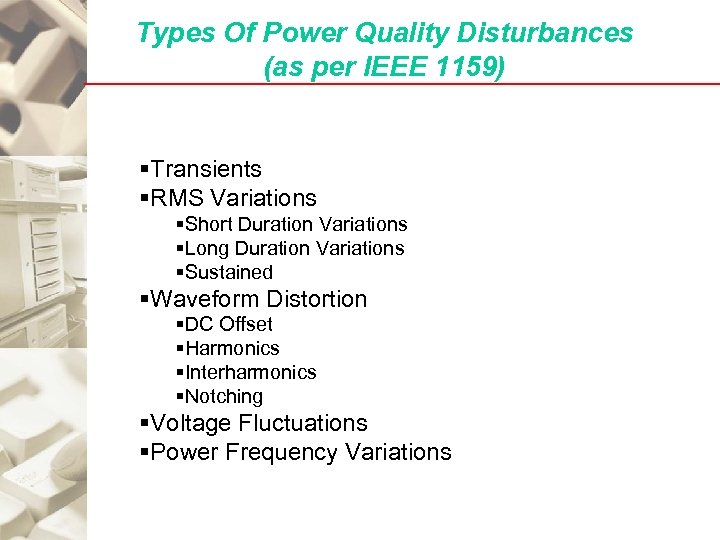 Types Of Power Quality Disturbances (as per IEEE 1159) §Transients §RMS Variations §Short Duration Variations §Long Duration Variations §Sustained §Waveform Distortion §DC Offset §Harmonics §Interharmonics §Notching §Voltage Fluctuations §Power Frequency Variations
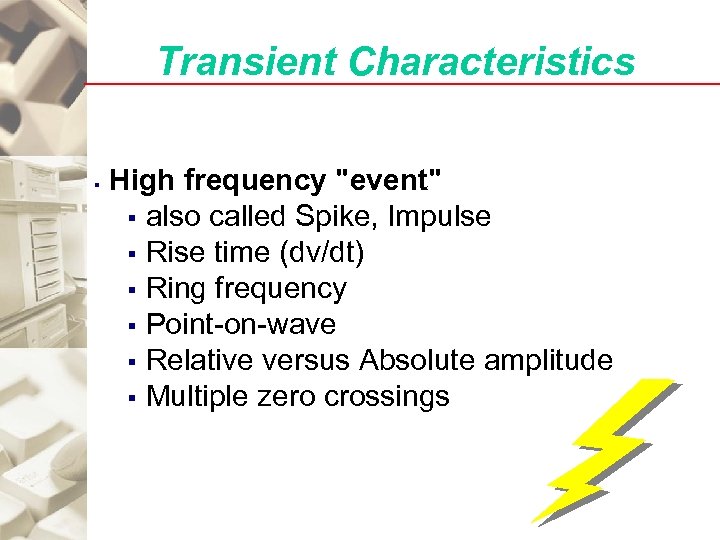 Transient Characteristics § High frequency "event" § also called Spike, Impulse § Rise time (dv/dt) § Ring frequency § Point-on-wave § Relative versus Absolute amplitude § Multiple zero crossings
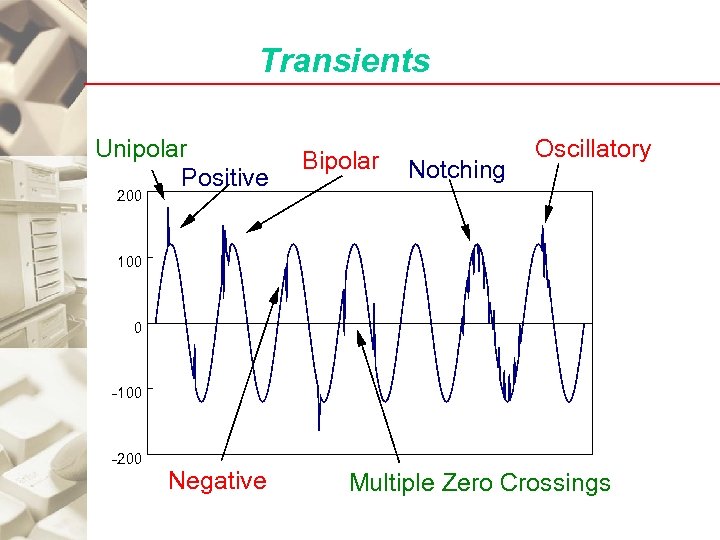 Transients Unipolar Positive Bipolar Notching Oscillatory 200 100 0 -100 -200 Negative Multiple Zero Crossings
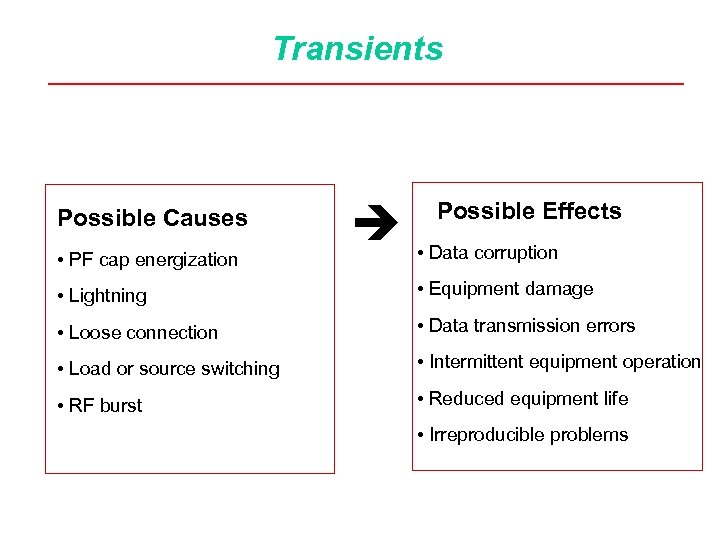 Transients Possible Causes • PF cap energization Possible Effects • Data corruption • Lightning • Equipment damage • Loose connection • Data transmission errors • Load or source switching • Intermittent equipment operation • RF burst • Reduced equipment life • Irreproducible problems
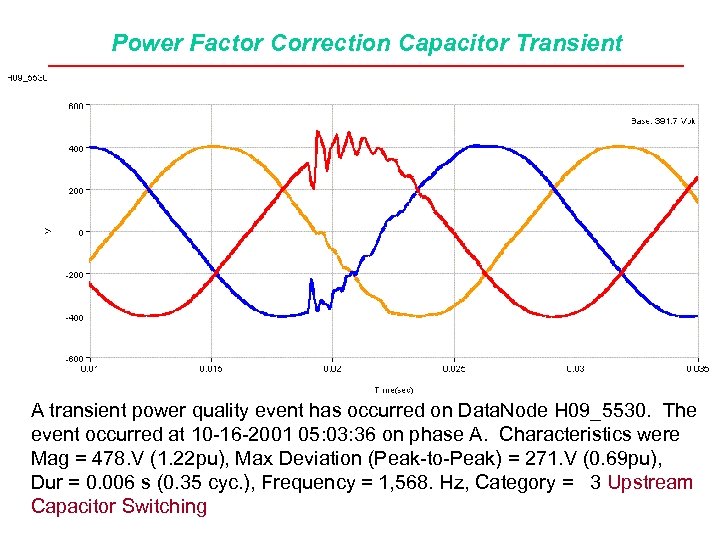 Power Factor Correction Capacitor Transient A transient power quality event has occurred on Data. Node H 09_5530. The event occurred at 10 -16 -2001 05: 03: 36 on phase A. Characteristics were Mag = 478. V (1. 22 pu), Max Deviation (Peak-to-Peak) = 271. V (0. 69 pu), Dur = 0. 006 s (0. 35 cyc. ), Frequency = 1, 568. Hz, Category = 3 Upstream Capacitor Switching
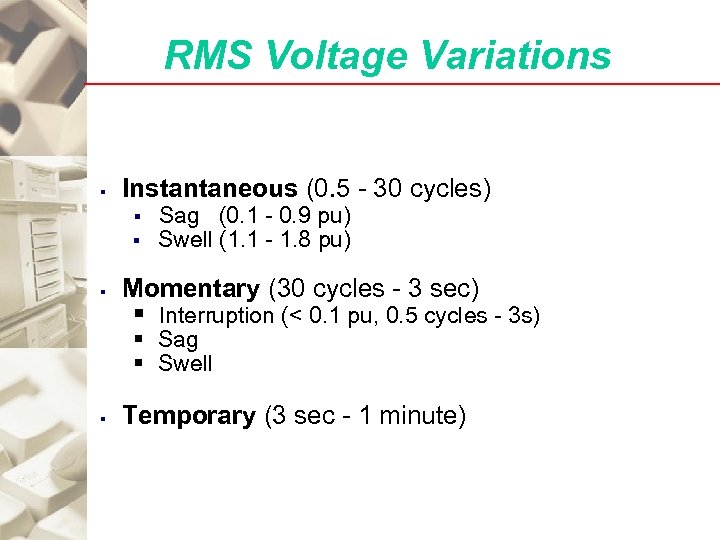 RMS Voltage Variations § Instantaneous (0. 5 - 30 cycles) § § § Sag (0. 1 - 0. 9 pu) Swell (1. 1 - 1. 8 pu) Momentary (30 cycles - 3 sec) § Interruption (< 0. 1 pu, 0. 5 cycles - 3 s) § Sag § Swell § Temporary (3 sec - 1 minute)
 RMS Voltage Variations 200 150 100 50 0 -50 -100 -150 -200 Sag Swell Interruption
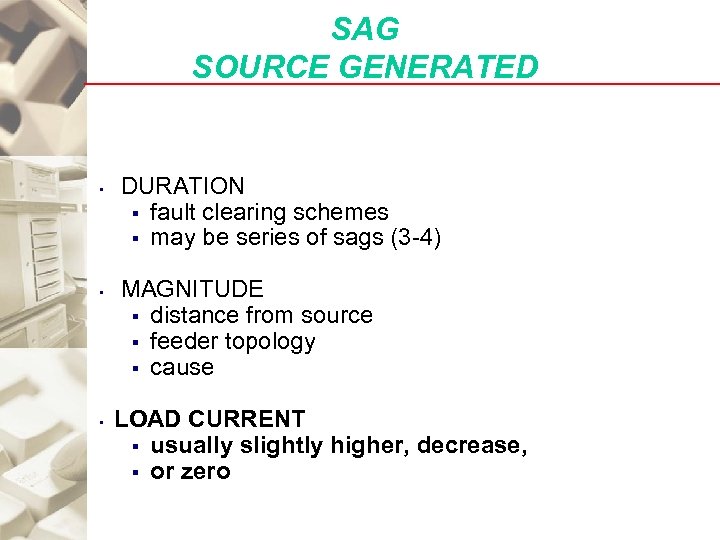 SAG SOURCE GENERATED § § § DURATION § fault clearing schemes § may be series of sags (3 -4) MAGNITUDE § distance from source § feeder topology § cause LOAD CURRENT § usually slightly higher, decrease, § or zero
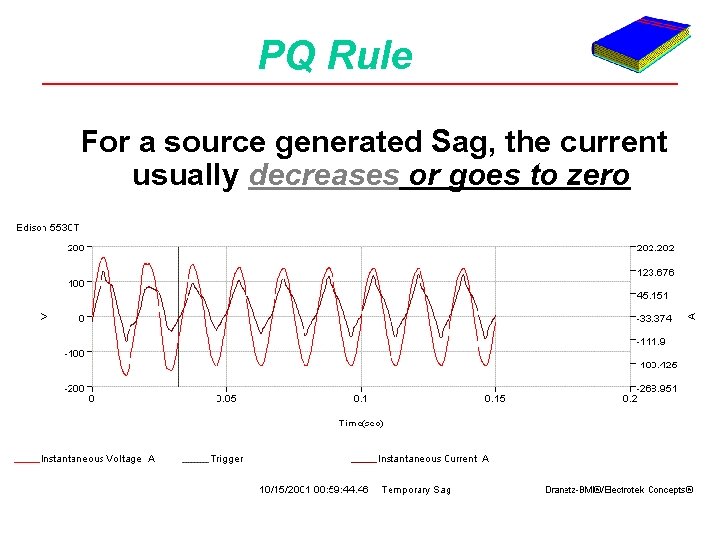 PQ Rule For a source generated Sag, the current usually decreases or goes to zero
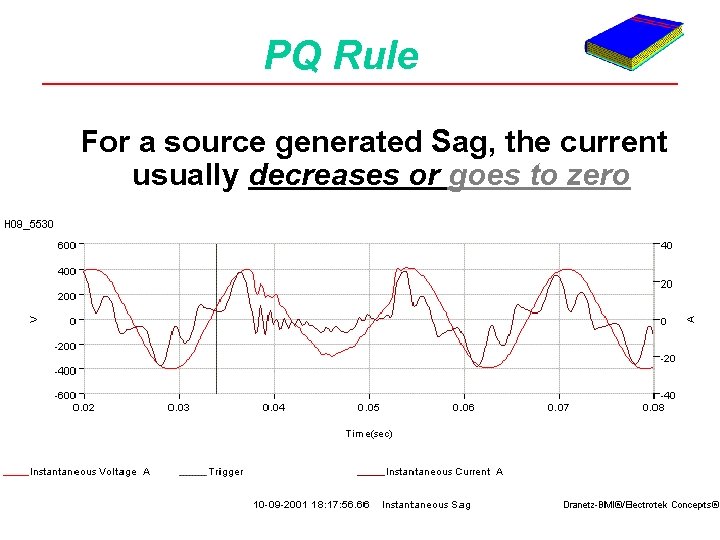 PQ Rule For a source generated Sag, the current usually decreases or goes to zero
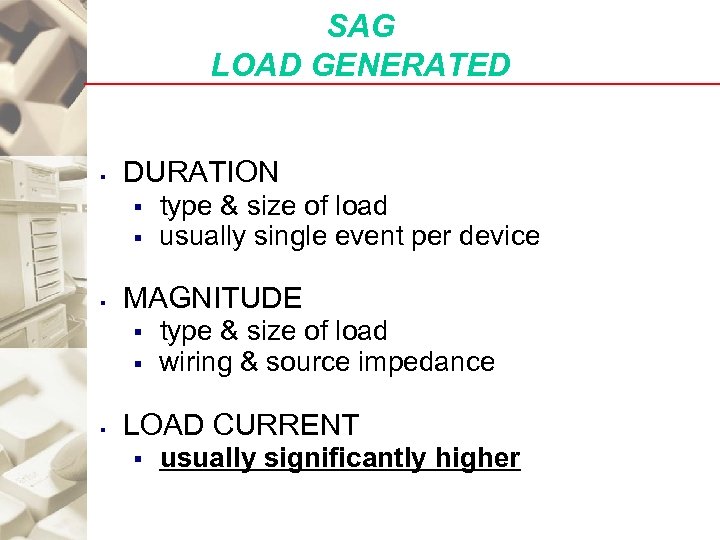 SAG LOAD GENERATED § DURATION § § § MAGNITUDE § § § type & size of load usually single event per device type & size of load wiring & source impedance LOAD CURRENT § usually significantly higher
 PQ Rule For a load generated Sag, the current usually increases significantly.
 Motor Starting - Another Cause of Sags
 Motor Starting – Inrush Current with decay
 SWELLS Sudden change in load § Line-to-ground fault on another phase § Often precede a sag §
 SWELLS when Load Drops Off
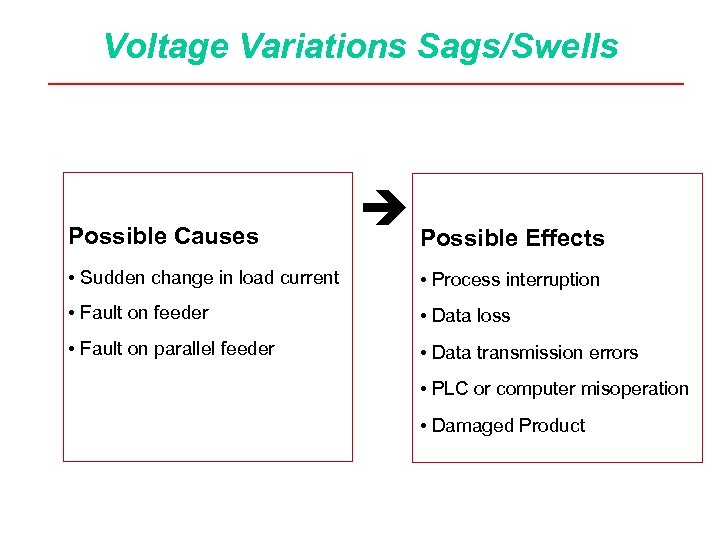 Voltage Variations Sags/Swells Possible Causes Possible Effects • Sudden change in load current • Process interruption • Fault on feeder • Data loss • Fault on parallel feeder • Data transmission errors • PLC or computer misoperation • Damaged Product
 Magnitude & Duration Visualization • CBEMA • ITIC • Equipment Susceptibility • 3 -D Mag-Dur • DISDIP
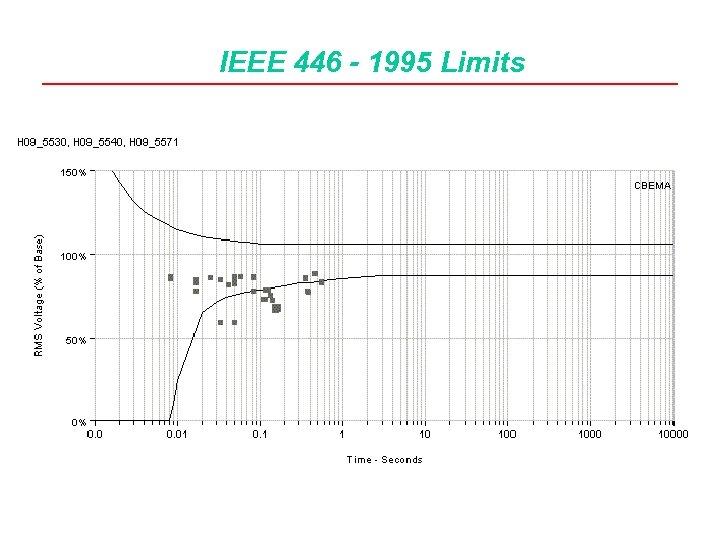 IEEE 446 - 1995 Limits
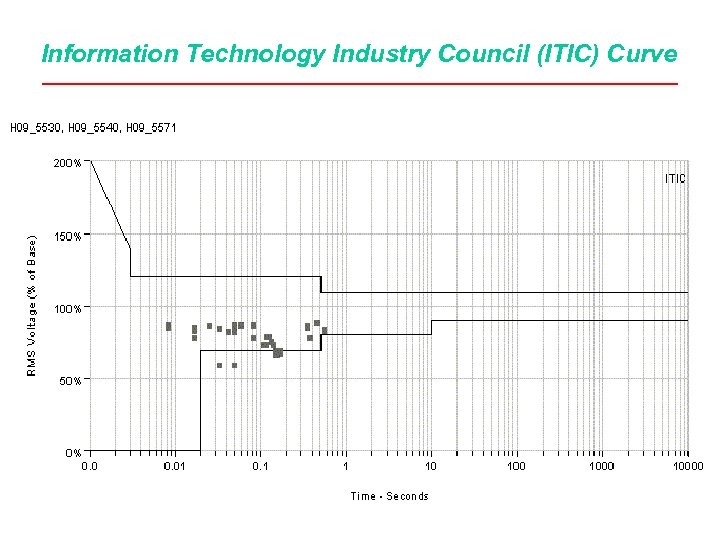 Information Technology Industry Council (ITIC) Curve
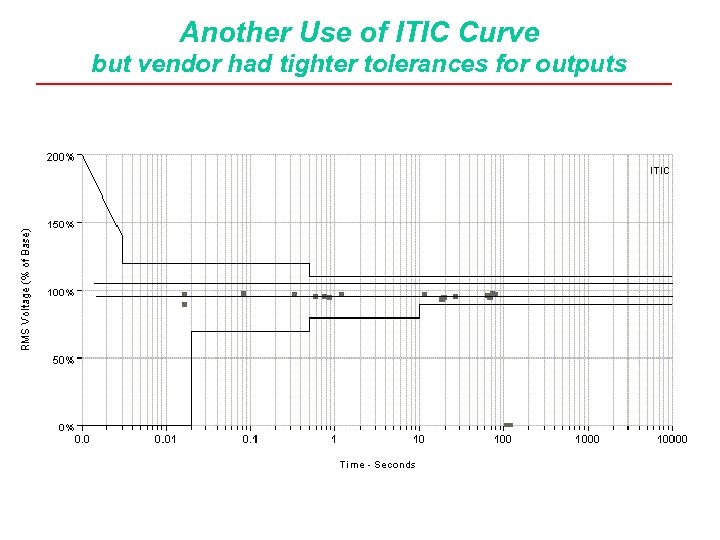 Another Use of ITIC Curve but vendor had tighter tolerances for outputs
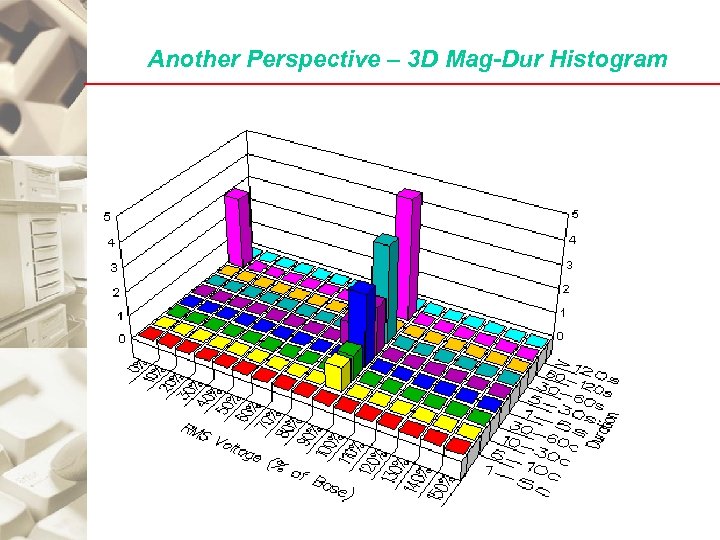 Another Perspective – 3 D Mag-Dur Histogram
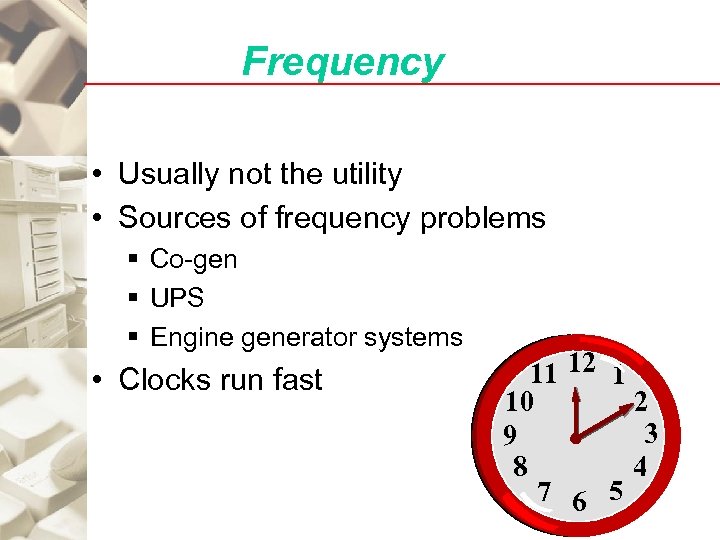 Frequency • Usually not the utility • Sources of frequency problems § Co-gen § UPS § Engine generator systems • Clocks run fast 11 12 1 10 2 3 9 4 8 7 6 5
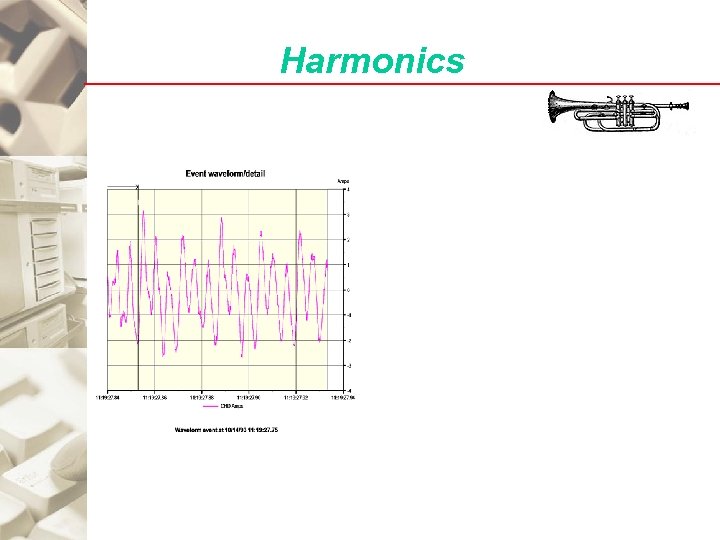 Harmonics
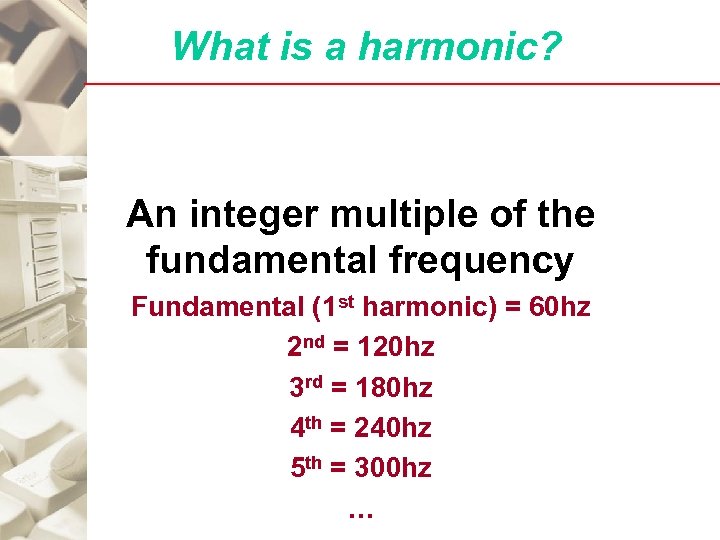 What is a harmonic? An integer multiple of the fundamental frequency Fundamental (1 st harmonic) = 60 hz 2 nd = 120 hz 3 rd = 180 hz 4 th = 240 hz 5 th = 300 hz …
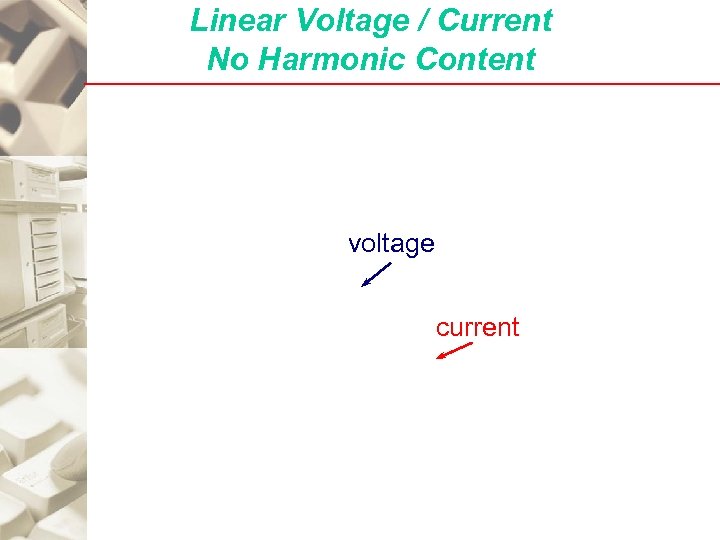 Linear Voltage / Current No Harmonic Content voltage current
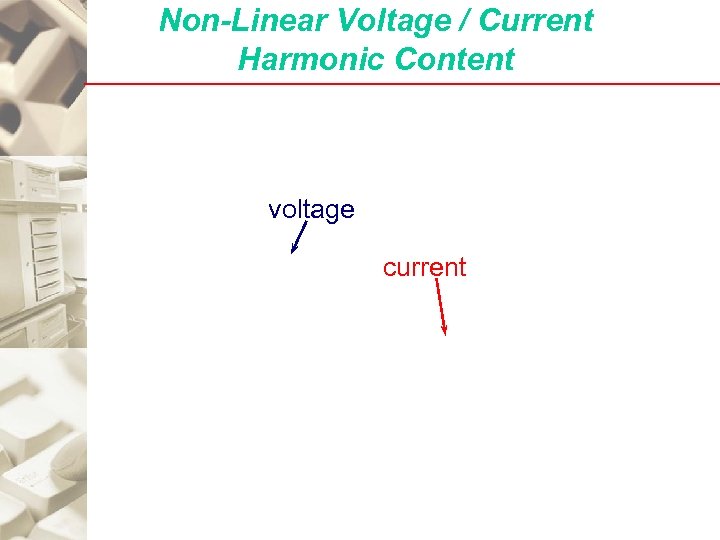 Non-Linear Voltage / Current Harmonic Content voltage current
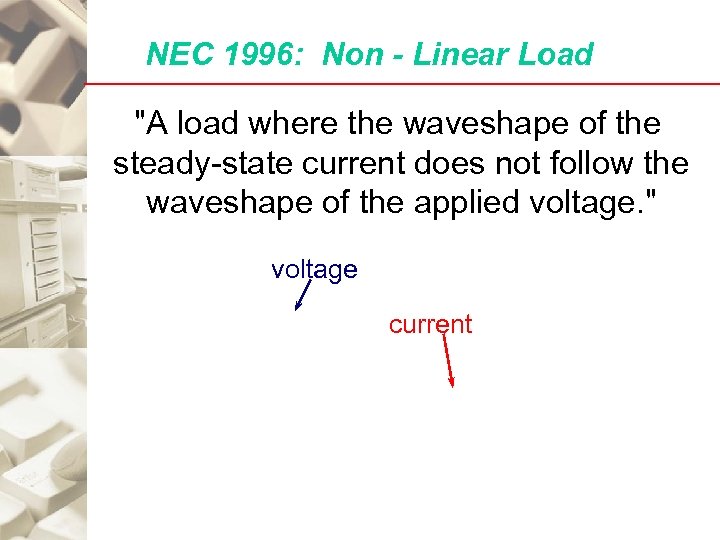 NEC 1996: Non - Linear Load "A load where the waveshape of the steady-state current does not follow the waveshape of the applied voltage. " voltage current
 Harmonics Steady state distortion § Periodic or continuous in nature § § § IEEE-519 -1992 / US harmonics IEC 61000 -3 -2&3 European harmonic limits
 Harmonic Measurements § Total Harmonic Distortion (THD) § Ratio, expressed as % of sum of all harmonics to: § Fundamental (THD) § Total RMS § Load Current (I TDD only) § Individual § § Harmonics 2, 3, 4, 5, 6… 50+ Fourier Transform, FFT, DFT § Interharmonics § Content between integer harmonics
 Composite Waveform
 Harmonic Spectrum
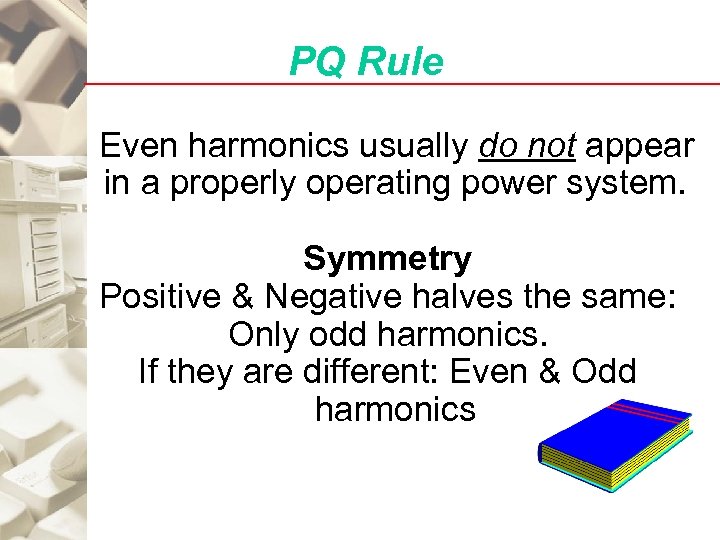 PQ Rule Even harmonics usually do not appear in a properly operating power system. Symmetry Positive & Negative halves the same: Only odd harmonics. If they are different: Even & Odd harmonics
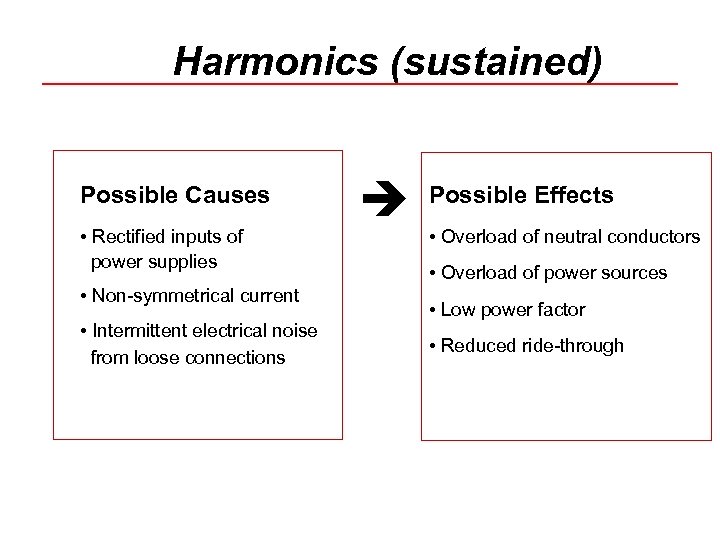 Harmonics (sustained) Possible Causes • Rectified inputs of power supplies • Non-symmetrical current • Intermittent electrical noise from loose connections Possible Effects • Overload of neutral conductors • Overload of power sources • Low power factor • Reduced ride-through
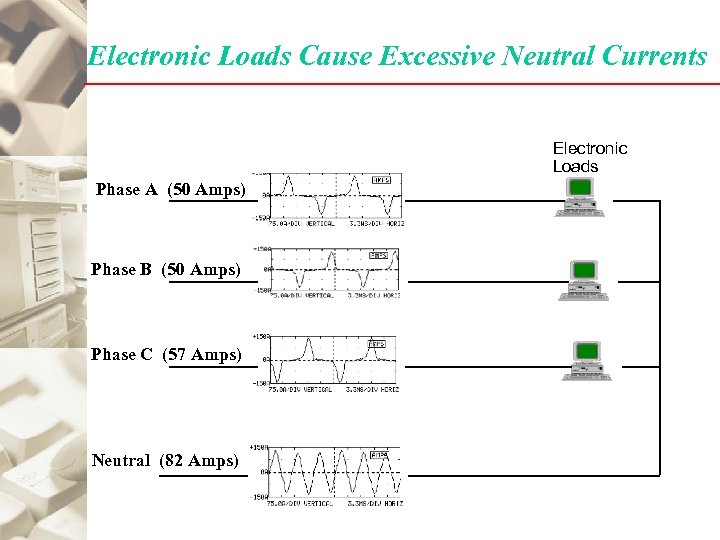 Electronic Loads Cause Excessive Neutral Currents Electronic Loads Phase A (50 Amps) Phase B (50 Amps) Phase C (57 Amps) Neutral (82 Amps)
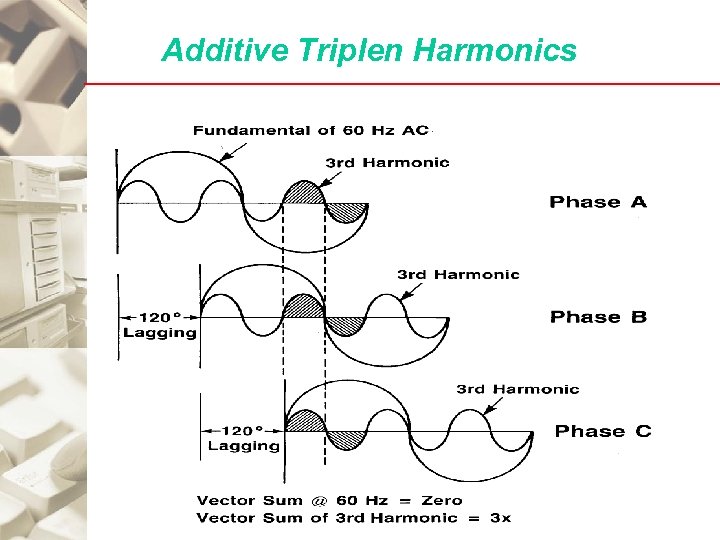 Additive Triplen Harmonics
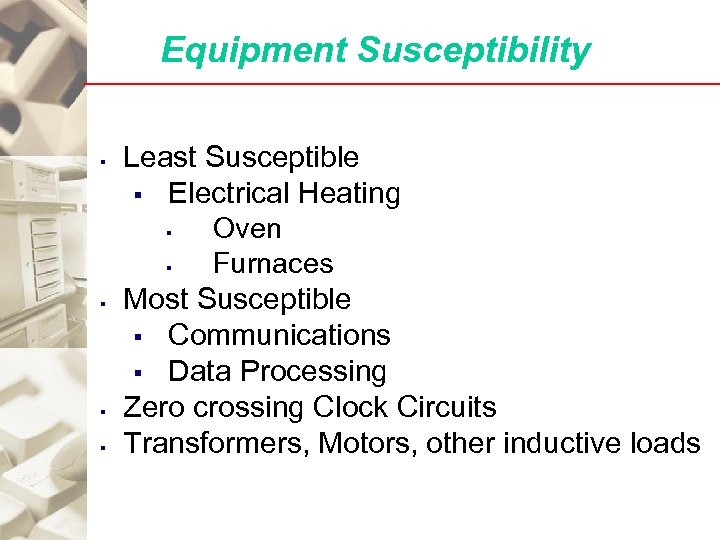 Equipment Susceptibility § § Least Susceptible § Electrical Heating § Oven § Furnaces Most Susceptible § Communications § Data Processing Zero crossing Clock Circuits Transformers, Motors, other inductive loads
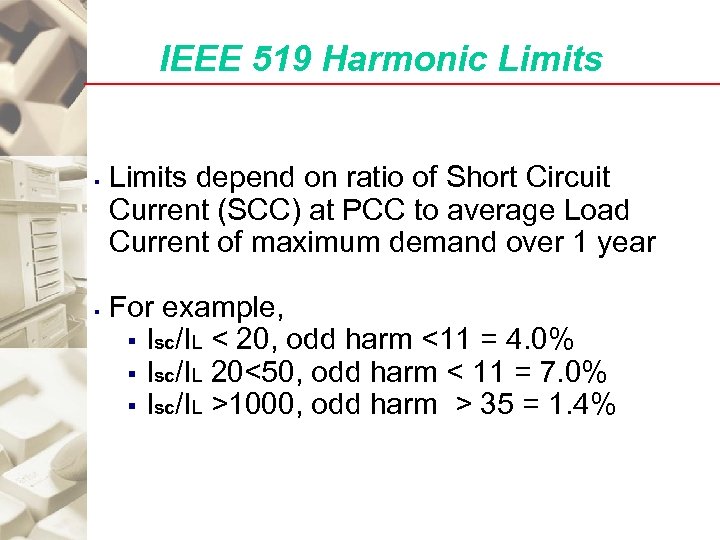 IEEE 519 Harmonic Limits § § Limits depend on ratio of Short Circuit Current (SCC) at PCC to average Load Current of maximum demand over 1 year For example, § Isc/IL < 20, odd harm <11 = 4. 0% § Isc/IL 20<50, odd harm < 11 = 7. 0% § Isc/IL >1000, odd harm > 35 = 1. 4%
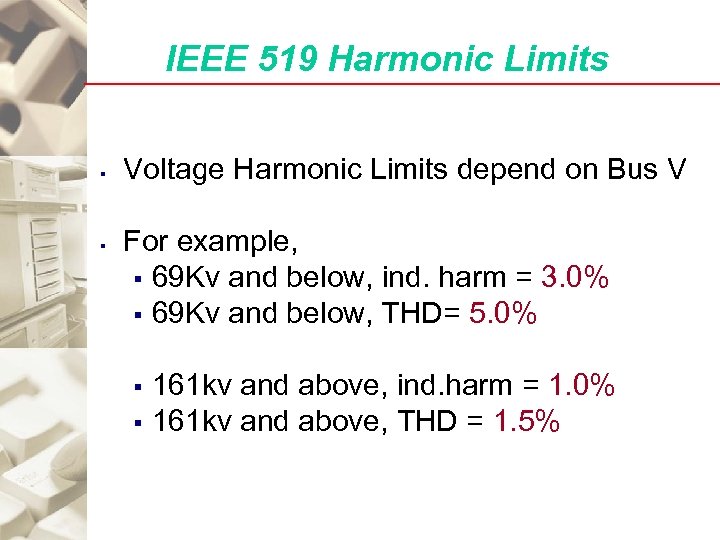 IEEE 519 Harmonic Limits § § Voltage Harmonic Limits depend on Bus V For example, § 69 Kv and below, ind. harm = 3. 0% § 69 Kv and below, THD= 5. 0% 161 kv and above, ind. harm = 1. 0% § 161 kv and above, THD = 1. 5% §
 Harmonics Demo Tool
 Voltage Unbalance Several ways to calculate § Small unbalance can cause motor overheating (3% results in 10% derating) § Caused by § Unequal loading § Unequal source impedance § Unequal source voltage § Unbalanced fault §
 Voltage Fluctuation
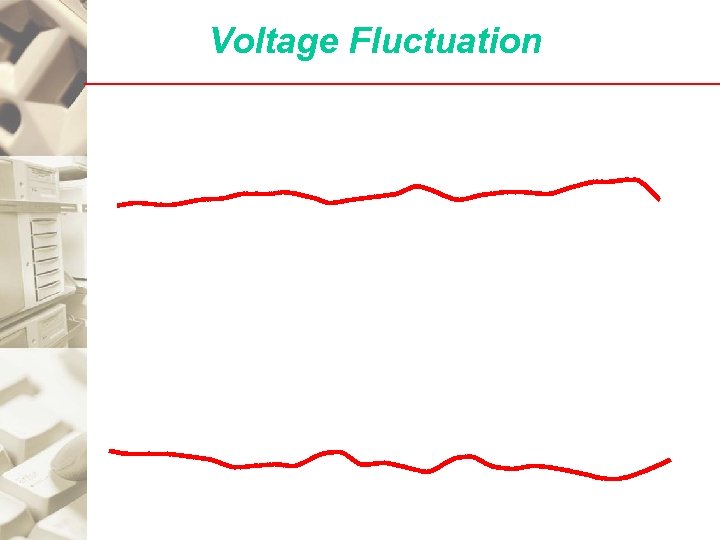
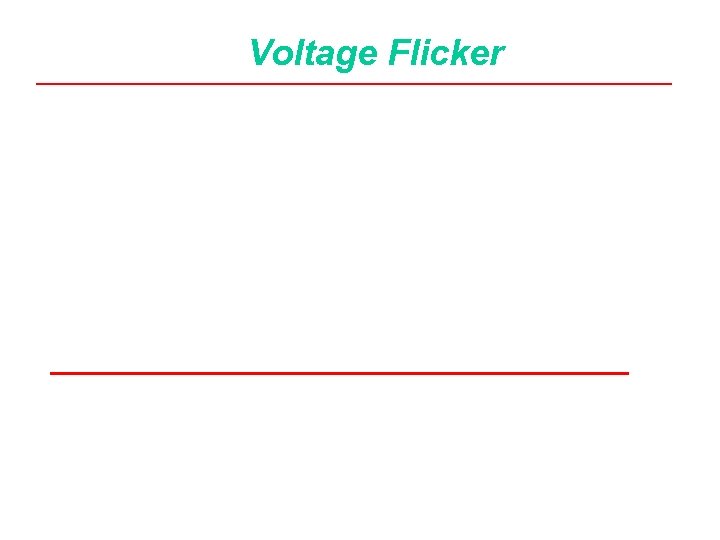
 Voltage Fluctuation § § § Amplitude variation 1 -30 Hz Extent of light flicker depends on § type of lights § amplitude and frequency of variation § person's perception Typical causes § High current loads, like arc furnaces § Windmill-generated power
 Voltage Flicker
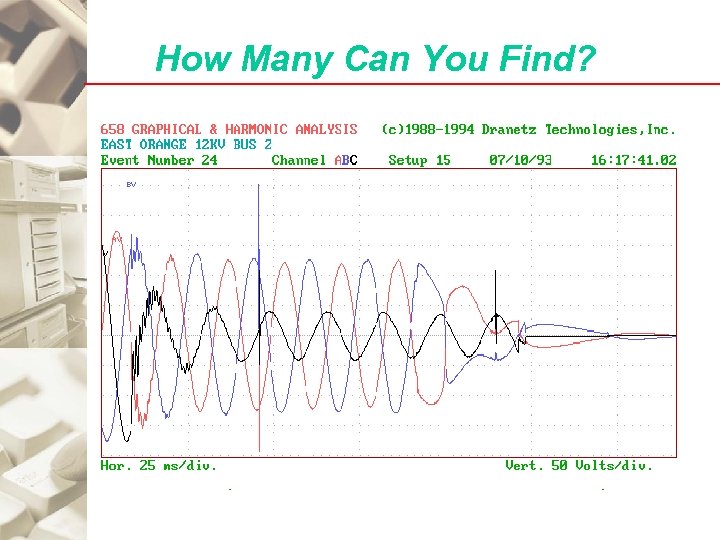 How Many Can You Find?
 Case Study Laser Printer
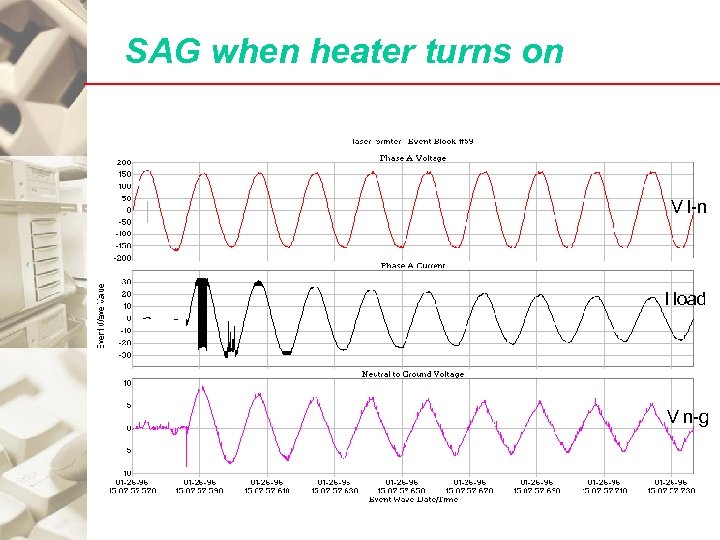
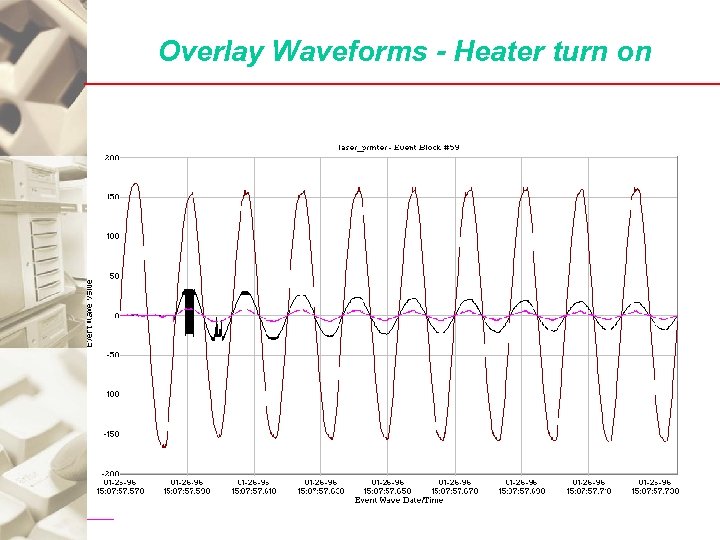
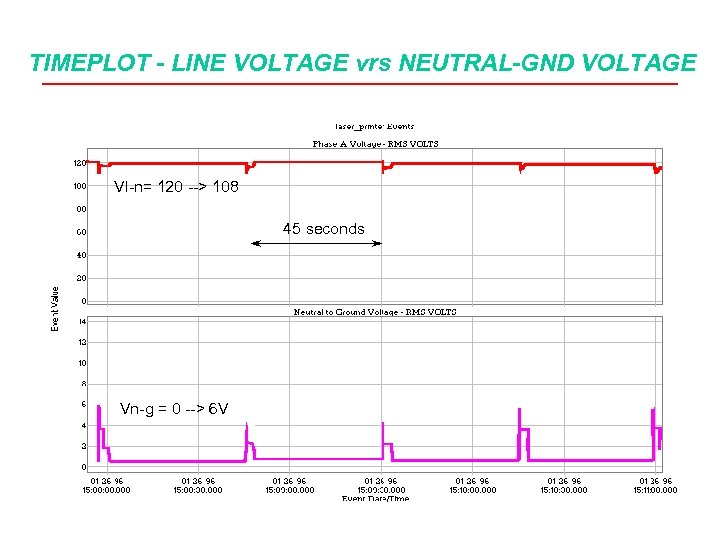 TIMEPLOT - LINE VOLTAGE vrs NEUTRAL-GND VOLTAGE Vl-n= 120 --> 108 45 seconds Vn-g = 0 --> 6 V
 SAG when heater turns on V l-n I load V n-g
 Overlay Waveforms - Heater turn on
 Current Waveform - heater on
 HARMONIC DISTORTION - heater on 2. 3% Harmonics V l-n 4. 4% Harmonics I load Harmonics V n-g
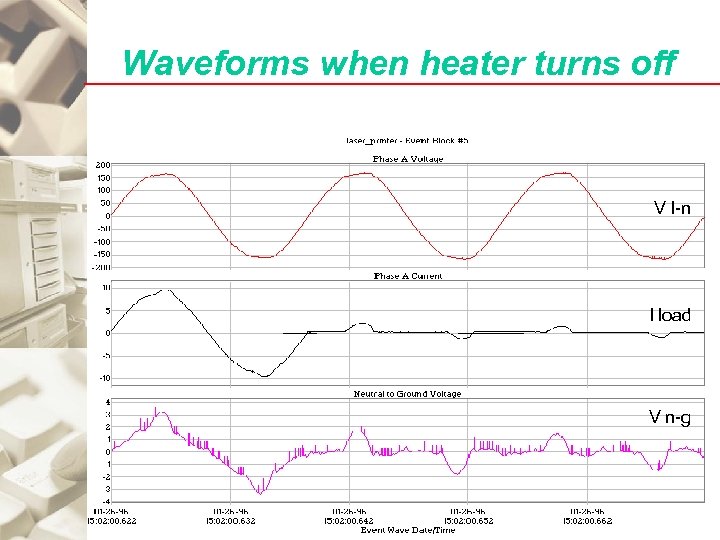 Waveforms when heater turns off V l-n I load V n-g
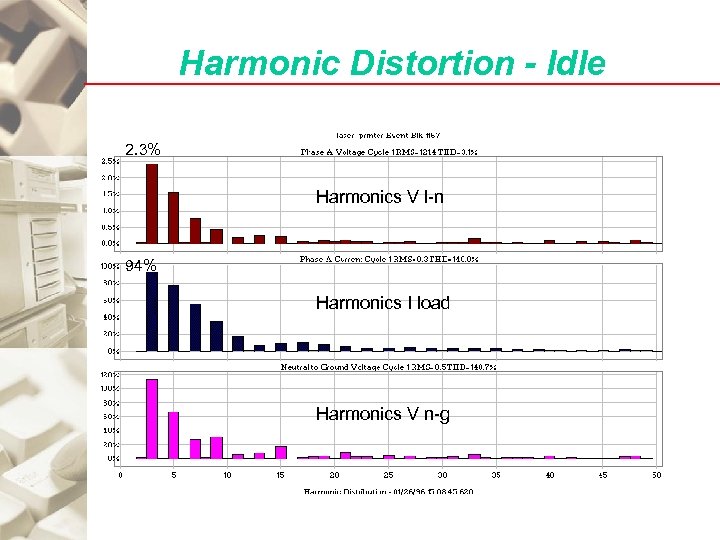 Harmonic Distortion - Idle 2. 3% Harmonics V l-n 94% Harmonics I load Harmonics V n-g
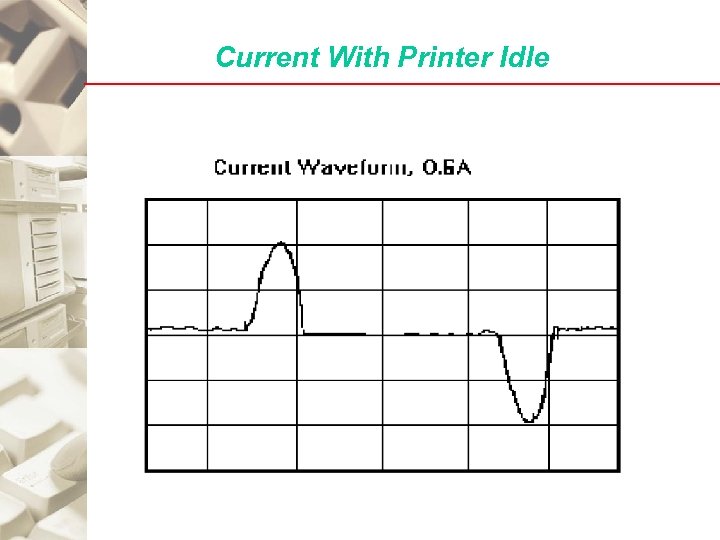 Current With Printer Idle
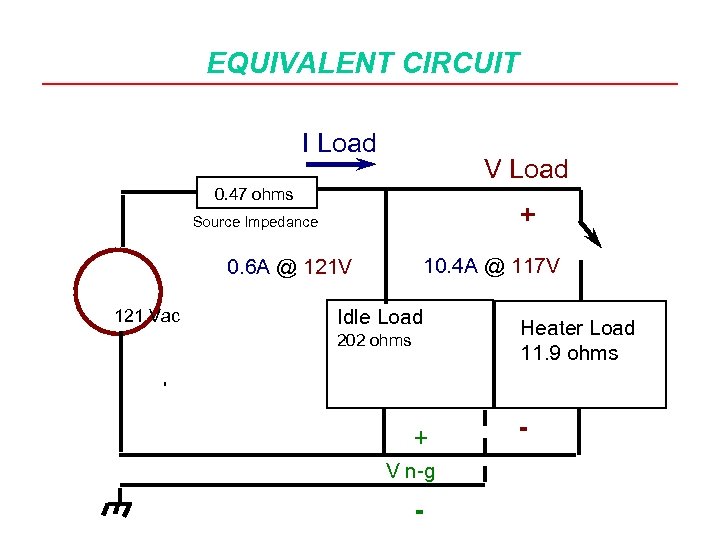 EQUIVALENT CIRCUIT I Load V Load 0. 47 ohms + Source Impedance 10. 4 A @ 117 V 0. 6 A @ 121 V 121 Vac Idle Load 202 ohms + V n-g - Heater Load 11. 9 ohms -
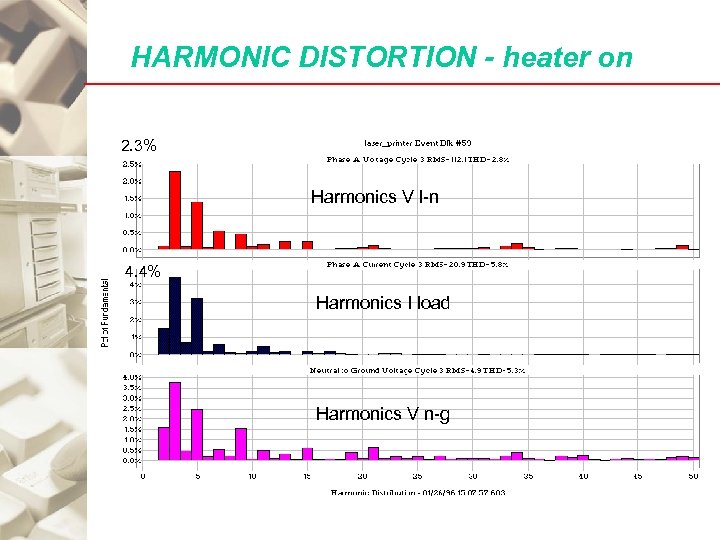
 OBSERVATIONS and PARAMETERS n Nearly Sinusoidal Current – n Low Harmonic Distortion (4%) Voltage and Current In-phase – Power Factor Near One n Flat-topping of Voltage when Idle n Corresponds with Current Pulse
 OBSERVATIONS and PARAMETERS Line Voltage Negative Transient on Turn on – Corresponds with Vn-g Positive Transient n Nearly Constant Repetition Rate n
 SIMILAR SITUATIONS • Coffee Pot • Coke Machine • Heat Pump
 Monitoring, Measuring & Managing High Reliability Facilities
 Why Monitor Your Electrical Supply?

 Paradigm Shift? You may no longer be able to rely on the utility to be your primary source of power! Be Prepared
 Why Monitor Your Electrical Supply? • Quality of supply is of paramount importance • Huge investment in protection & mitigation is not a guarantee! • You have a high economic exposure • Your facility is core to your business or maybe is your business • You already monitor other critical items • Your electrical environment is just as important • You need to balance your needs with available supply • Loading, cost allocation, etc
 You May Already Monitor Your Facility • Traditional Data Center • Building Management Systems (BMS), Human Machine Interface Software (HMI) • Wonderware, Sitescan, ALC, Datatrax, etc • Via Bacnet, Lonworks, Incomm, modbus, etc • Internet Data Center • Network Operations Center (NOC) • HP Open View, etc • Via SNMP
 What You May Already Monitor • Traditional Data Center • UPS - On Bypass, other alarms • Traditionally do not measure quality • Sub Metering • HVAC, Fire, Security • Internet Data Center • Network/System Health • HVAC, Fire, Security • Electrical Supply is often overlooked • Quality of supply, Energy/cost allocation • Power monitoring can interface with existing systems for single point alarming, logging, etc…
 Approaches to Power Monitoring Reactive — Forensic, after the fact. Proactive — Anticipate system dynamics Be Proactive!
 Reactive Approach • Problem Solving, hopefully you’ll find it! • Portable instrumentation typically used
 Proactive Approach • Permanently installed monitoring systems • Anticipate the future – on-line when trouble occurs • Monitor system dynamics • Preventive Maintenance, Trending, identify equipment deterioration Be Proactive!
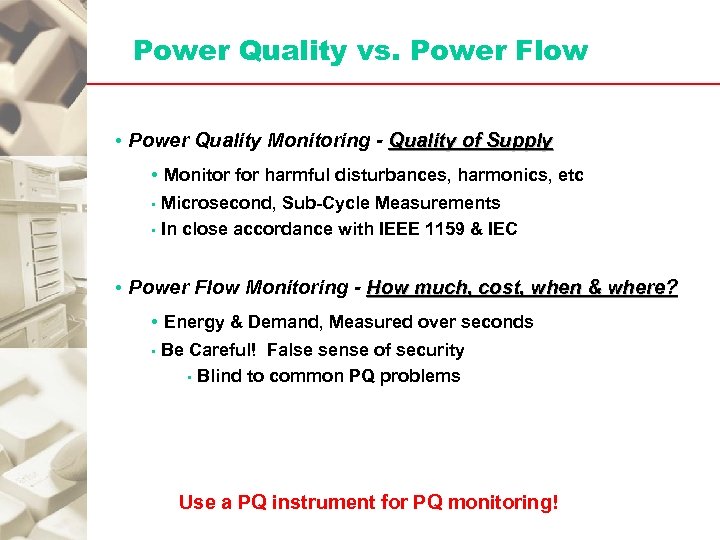 Power Quality vs. Power Flow • Power Quality Monitoring - Quality of Supply • Monitor for harmful disturbances, harmonics, etc • Microsecond, Sub-Cycle Measurements • In close accordance with IEEE 1159 & IEC • Power Flow Monitoring - How much, cost, when & where? • Energy & Demand, Measured over seconds • Be Careful! False sense of security • Blind to common PQ problems Use a PQ instrument for PQ monitoring!
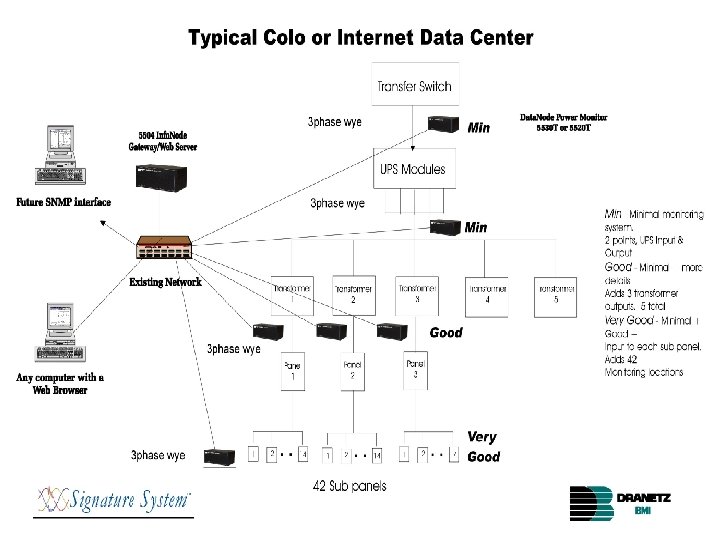
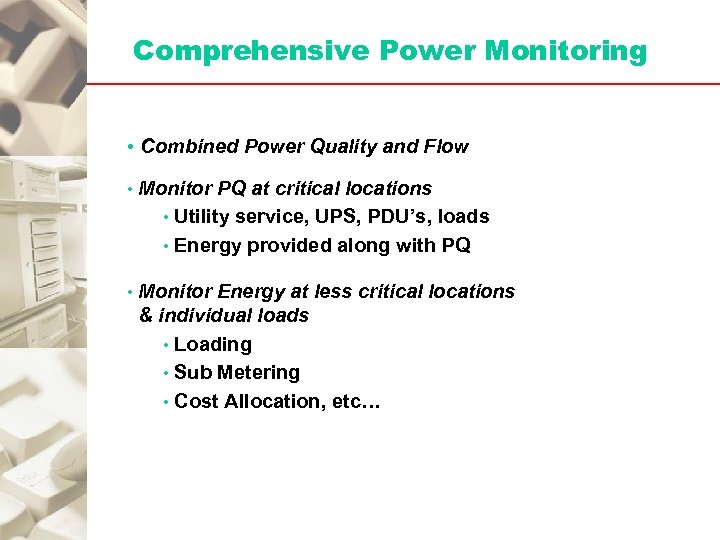 Comprehensive Power Monitoring • Combined Power Quality and Flow • Monitor PQ at critical locations • Utility service, UPS, PDU’s, loads • Energy provided along with PQ • Monitor Energy at less critical locations & individual loads • Loading • Sub Metering • Cost Allocation, etc…
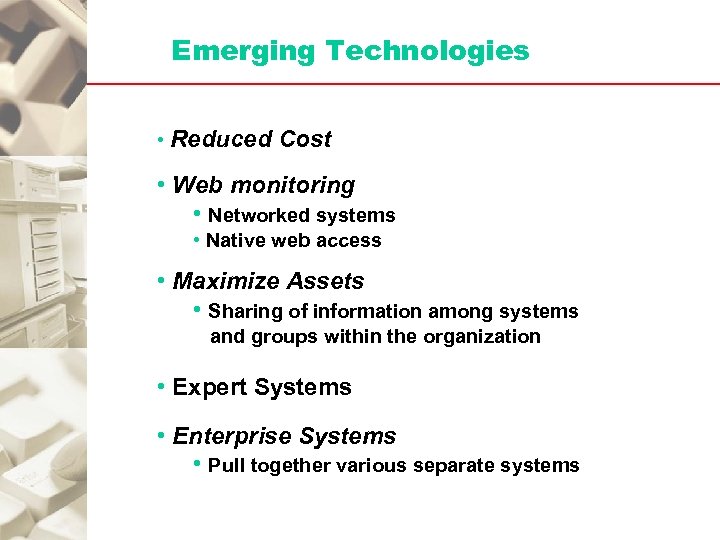 Emerging Technologies • Reduced Cost • Web monitoring • Networked systems • Native web access • Maximize Assets • Sharing of information among systems and groups within the organization • Expert Systems • Enterprise Systems • Pull together various separate systems
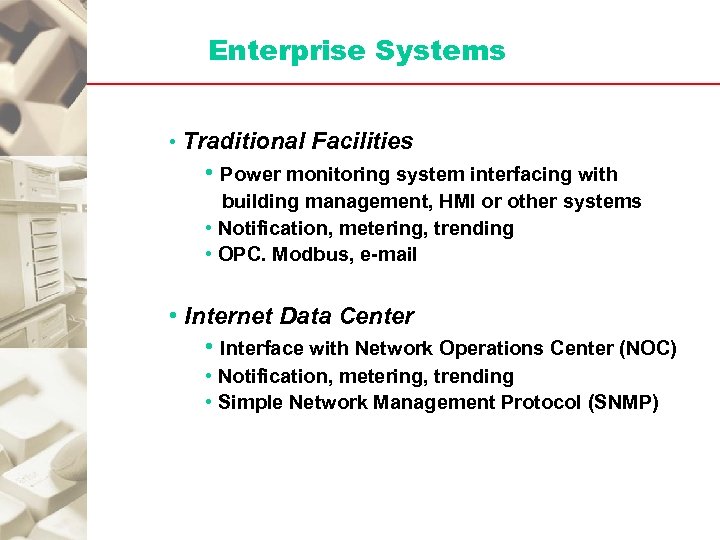 Enterprise Systems • Traditional Facilities • Power monitoring system interfacing with building management, HMI or other systems • Notification, metering, trending • OPC. Modbus, e-mail • Internet Data Center • Interface with Network Operations Center (NOC) • Notification, metering, trending • Simple Network Management Protocol (SNMP)
 Expert Systems • Reduced budgets means less people! • Less expertise • Analysis of Data in order to Identify Problems • Automatic, no user intervention, results embedded in data • Identify certain disturbances and directivity. • Upstream or downstream • Answers Questions Such As… • Was that Sag from the utility or within my facility?
 Expert Systems • UPS Performance Verification • Correlation of Input vs. Output • Verify continued performance over time • Proactively identify downstream problems • Monitor UPS status via analog/contact inputs • Remotely access UPS status signals • Compare recorded data to UPS status
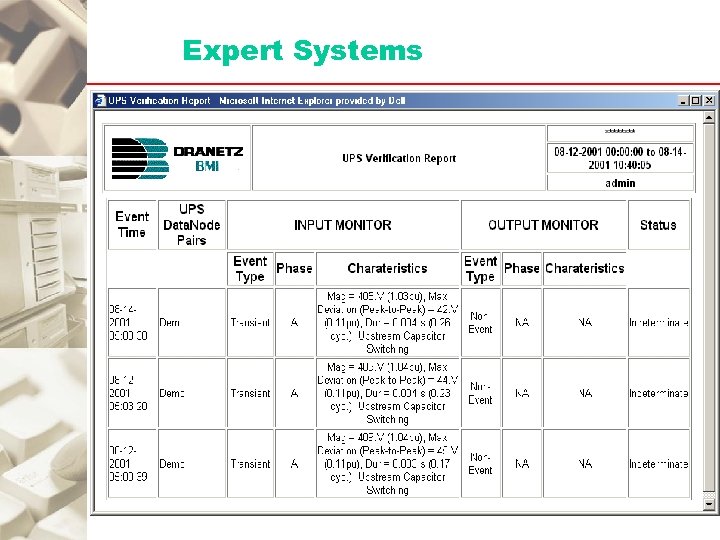 Expert Systems
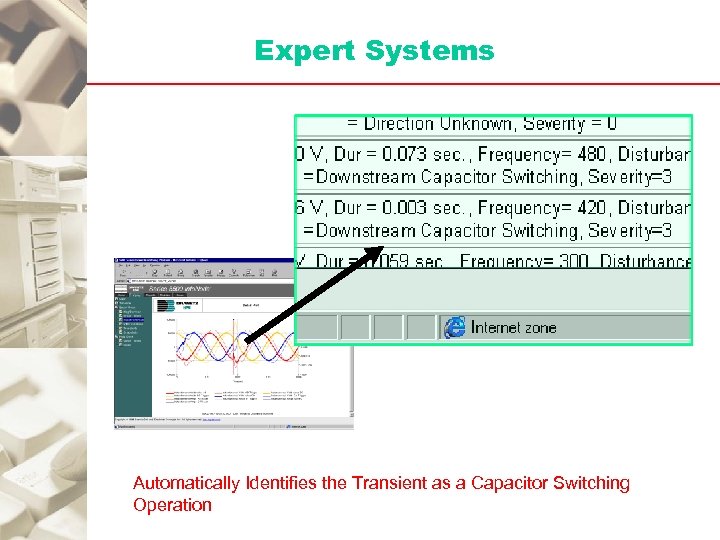 Expert Systems Automatically Identifies the Transient as a Capacitor Switching Operation
 Where To Monitor? • Utility Service Entrance • Evaluate your energy provider • Monitor redundant feeds • UPS Output • Is your UPS working as designed? • Evaluates critical bus as problems could be downstream • PDU/Distribution • Provides the ability to identify the source of a problem. Why did that breaker trip? • Loading/Cost allocation • Actual loads
 Case Study
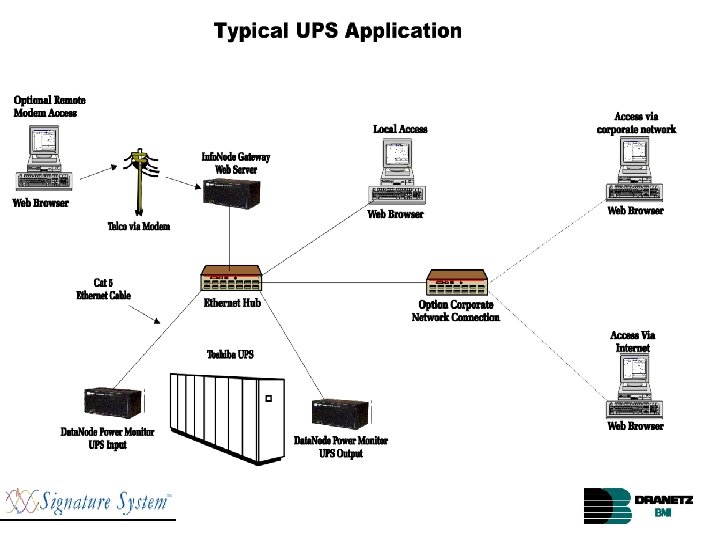
 DHL Airways Call Center • Tempe AZ • Services DHL customers nationwide • Newly Constructed, went online in June 2000 • Toshiba 7000 Series UPS • Three 300 KVA parallel redundant units • Facility manager has nationwide responsibilities • Current Expansion Plans
 DHL Objectives • Benchmark performance • Ensure future reliability • Easily troubleshoot any problems that may occur • Automatic notification • Remotely monitor over DHL network • Since the facility is new and due to its critical nature, monitoring approach was very proactive
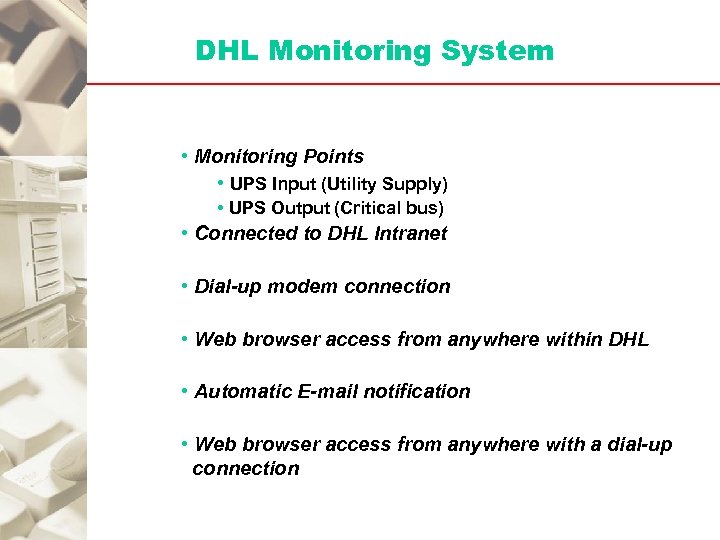 DHL Monitoring System • Monitoring Points • UPS Input (Utility Supply) • UPS Output (Critical bus) • Connected to DHL Intranet • Dial-up modem connection • Web browser access from anywhere within DHL • Automatic E-mail notification • Web browser access from anywhere with a dial-up connection
 Known Problems? • None! • Facility operating as planned • No Outages or other major problems identified • No UPS Alarms
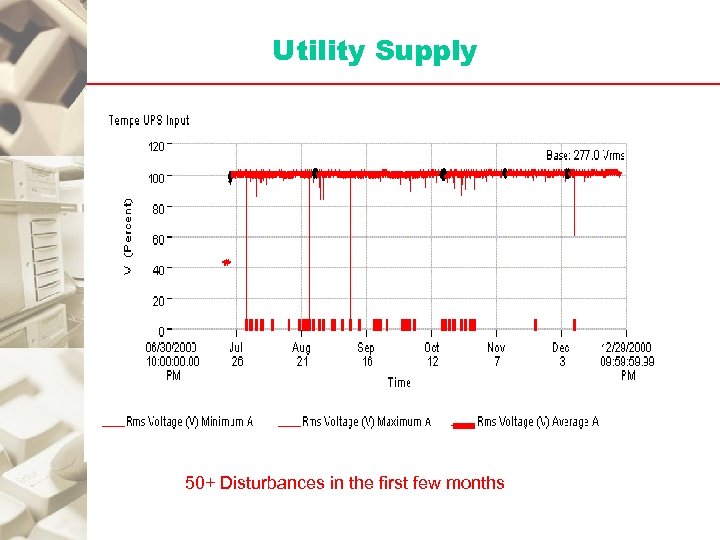 Utility Supply 50+ Disturbances in the first few months
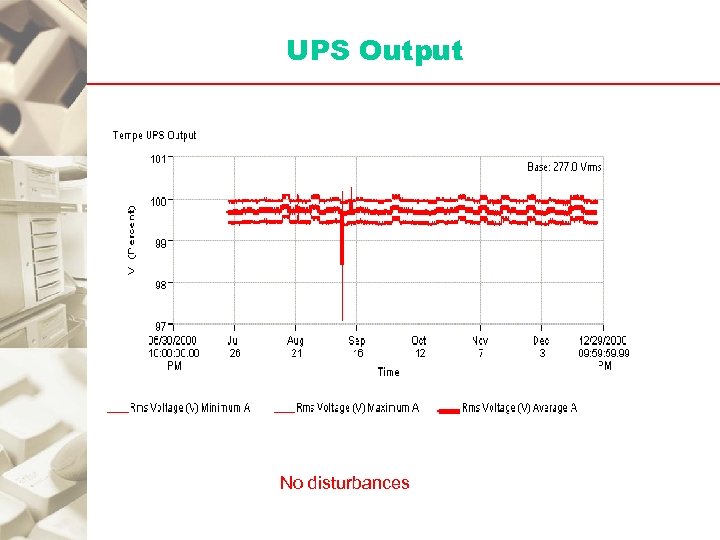 UPS Output No disturbances
 Utility Monitoring Summary • Uncovered problems with the utility supply • 50+ disturbances recorded over a 2 month period. • Sags, transients, waveshape distortion • Results reported to the utility, they did not know • Utility investigation • Faulty relay caused the majority of the disturbances. Corrected
 UPS Output Monitoring Summary • No disturbances on the conditioned UPS output • Output regulated to within manufacturers specifications • UPS mitigated many disturbances on the utility feed • Did what they paid for • Justified the investment
 Conclusion • Being proactive uncovered problems with the utility supply that required correction • Continuous monitoring proved power conditioning equipment worked as design and to manufacturer’s specifications. Protected loads were unaffected • Provided justification to management for power monitoring systems at other key facilities • Load profiling helping to determine power requirements of a planned expansion
 Case Study
 Major Financial Institution • New York City • Worldwide company with several facilities in NY & NJ • 3 UPS Modules • 2 static, 1 rotary
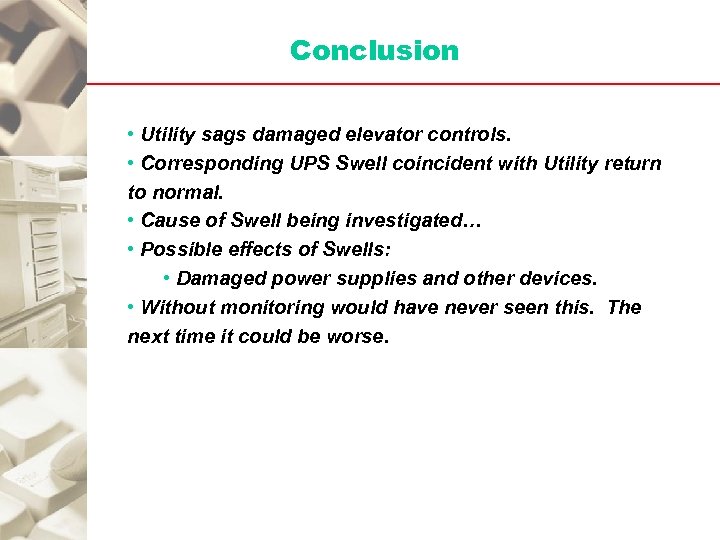
 Problem • Utility Sag • Damaged elevator controls • No UPS alarms • No reported problems with critical systems 02/19/2002 00: 29. 26 PMODULE INPUT Temporary Sag Rms Voltage AB Mag = 366. V (0. 76 pu), Dur = 3. 300 s, Category = 2, Upstream Sag 02/19/2002 00: 29. 26 SYSA Input Temporary Sag Rms Voltage AB Mag = 353. V (0. 73 pu), Dur = 3. 300 s, Category = 2, Upstream Sag 02/19/2002 00: 29. 26 SYSB Input Temporary Sag Rms Voltage AB Mag = 372. V (0. 78 pu), Dur = 3. 300 s, Category = 2, Upstream Sag
 Utility Sag Utility Supply RMS Trend Utility Supply Waveforms
 Corresponding UPS Swell Utility Supply UPS Swell UPS Output
 Conclusion • Utility sags damaged elevator controls. • Corresponding UPS Swell coincident with Utility return to normal. • Cause of Swell being investigated… • Possible effects of Swells: • Damaged power supplies and other devices. • Without monitoring would have never seen this. The next time it could be worse.
 Case Study
 Federal Aviation Administration Air Route Traffic Control Center (ARTCC) Monitoring System
 Simplified Air Traffic Flow ARTCC TRACON Tower Your Flight
 FAA’s Objectives • Monitor critical points throughout each ARTCC • Determine present status of each ARTCC Facility • Is the electrical supply operating within design parameters? • Catch problems before they occur • Change approach from Reactive to Proactive • Correlate power quality to status indicators, panel meters, transfer switch positions, etc
 FAA’s Objectives • Benchmark long term performance in order to improve reliability • Compare measured parameters to simulations • Have web browser access from anywhere within the FAA system • Local ARTCC personnel • OKC Airway Operational Support (AOS) personnel
 Monitoring System • Monitor 15 points for quality of supply & energy • Utility Service • Generators • UPS’s • Key distribution points • Critical Power Centers • In parallel monitor other data such as • Transfer switch & breaker positions • Panel meters • Misc indicators • Web based access to each site via intranet
 Initial Results • Key points operating out of design specs • Ex: Adjust transformer taps • Routine maintenance not always performed as per procedures • Wiring inconsistent with drawings
 Power Quality Fundamentals and Monitoring Thank You! Questions? Ross M. Ignall Systems Applications Manager, Dranetz-BMI rignall@dranetz-bmi. com