


 Скачать презентацию Power Point to accompany Philip Kotler Stewart Adam
7c9c2367a4ed7a6f838a67aa75667d45.ppt
- Количество слайдов: 30
 Power. Point to accompany Philip Kotler, Stewart Adam, Linden Brown & Gary Armstrong Kotler, Brown, Adam & Armstrong: International Marketing 3 e © 2006 Pearson Education Australia
 Chapter 3 The global marketing environment Kotler, Brown, Adam & Armstrong: International Marketing 3 e © 2006 Pearson Education Australia
 Chapter objectives 1. List and discuss the importance of the elements of the marketing organisation’s micro-environment, including the marketing organisation, marketing intermediaries, customers, competitors and publics 2. Explain the broad concept of the organisation’s macro- environment 3. Outline the key changes occurring in the organisation’s macro-environment including shifts in the demographic, economic, technological, political, cultural and natural environments. Kotler, Adam, Brown & Armstrong: International Marketing 3 e © 2006 Pearson Education Australia 3 3
 Micro vs Macro Environments Micro-environment The forces close to the organisation that affect its ability to serve its customers: the organisation, market channel firms, customer markets, competitors and publics Macro-environment The larger societal forces that affect the whole microenvironment: demographic, economic, natural, technological, political forces Kotler, Adam, Brown & Armstrong: International Marketing 3 e © 2006 Pearson Education Australia 4 4
 The Marketing Organisation's Micro-Environment Kotler, Brown, Adam & Armstrong: International Marketing 3 e © 2006 Pearson Education Australia 5
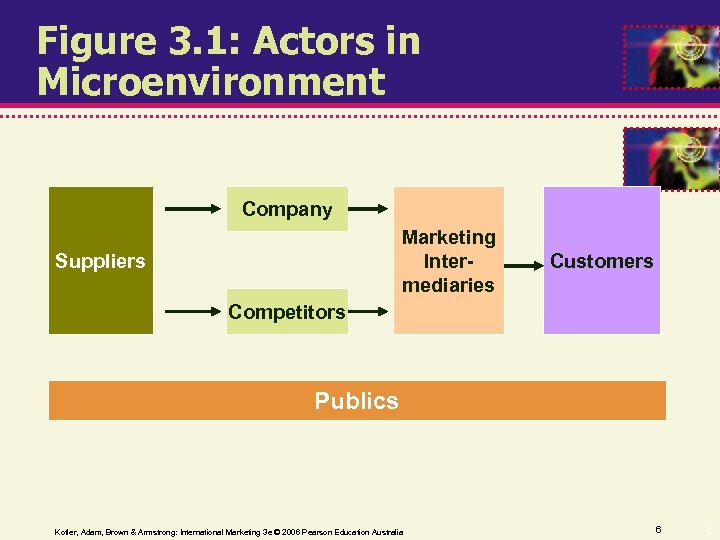 Figure 3. 1: Actors in Microenvironment Company Marketing Intermediaries Suppliers Customers Competitors Publics Kotler, Adam, Brown & Armstrong: International Marketing 3 e © 2006 Pearson Education Australia 6 6
 The Marketing Organisation’s Micro-Environment Marketing management has the task of attracting and building relationships with customers by creating customer value and satisfaction. However, marketing management does not accomplish this task alone. Its success will depend on other actors in the organisation’s micro-environment 1. The Marketing Organisation 2. Suppliers 3. Marketing Intermediaries 4. Customers 5. Competitors 6. Publics Kotler, Adam, Brown & Armstrong: International Marketing 3 e © 2006 Pearson Education Australia 7 7
 The Marketing Organisation Senior management sets the organisation’s mission, objectives, broad strategies and policies. Marketing managers must make decisions within the plans made by senior management. Senior management must approve marketing plans before they can be implemented. In designing marketing plans, marketing management takes other organisation groups into account such as: top management, finance, research and development (R&D), purchasing, manufacturing and accounting. Kotler, Adam, Brown & Armstrong: International Marketing 3 e © 2006 Pearson Education Australia 8 8
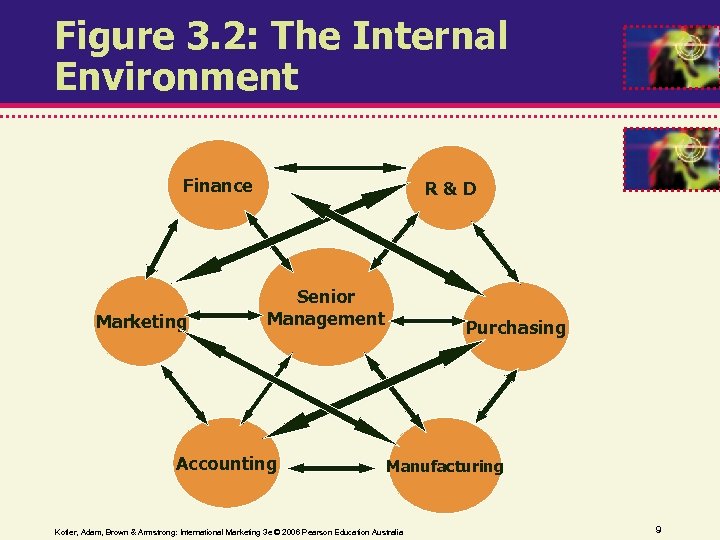 Figure 3. 2: The Internal Environment Finance Marketing R&D Senior Management Accounting Purchasing Manufacturing Kotler, Adam, Brown & Armstrong: International Marketing 3 e © 2006 Pearson Education Australia 9
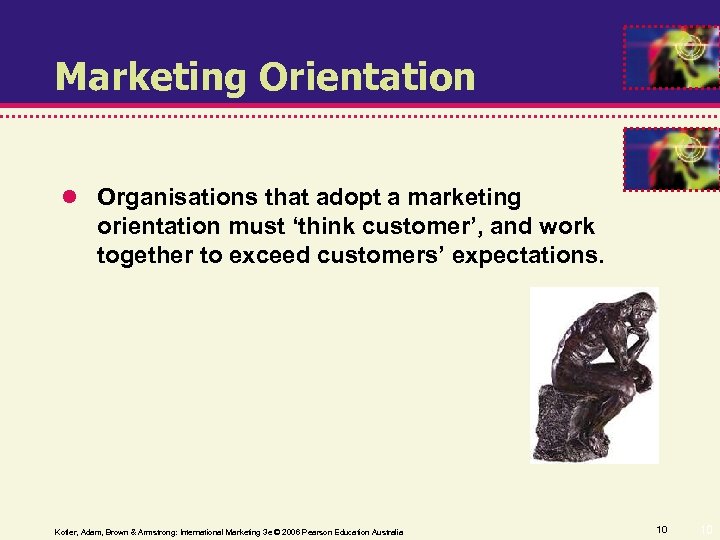 Marketing Orientation Organisations that adopt a marketing orientation must ‘think customer’, and work together to exceed customers’ expectations. Kotler, Adam, Brown & Armstrong: International Marketing 3 e © 2006 Pearson Education Australia 10 10
 Suppliers are an important link in the organisation’s overall customer ‘value delivery system’. Marketing managers must watch for: supply availability. supply shortages or delays, labour strikes price trends of supplies All of the above events can damage customer satisfaction in the long run. Rising supply costs may force price increases that can harm the organisation’s sales volume. Kotler, Adam, Brown & Armstrong: International Marketing 3 e © 2006 Pearson Education Australia 11 11
 Marketing Intermediaries (1) Marketing intermediaries help an organisation to promote, sell and distribute its goods to final buyers. They include: Resellers help the organisation find customers or make sales to them Physical Distribution Firms help the organisation stock and move goods from their points of origin to their destinations. Kotler, Adam, Brown & Armstrong: International Marketing 3 e © 2006 Pearson Education Australia 12 12
 Marketing Intermediaries (2) Marketing Services Agencies are the facilitating agencies—marketing research companies, advertising agencies, media firms, export consulting agencies and marketing consulting firms that help the organisation target and promote its products to the right markets Financial Intermediaries include banks, credit organisations, insurance organisations and other businesses that help to finance transactions or insure against the risks associated with the buying and selling of goods Kotler, Adam, Brown & Armstrong: International Marketing 3 e © 2006 Pearson Education Australia 13 13
 Customers The marketing organisation must study its customer markets closely. The organisation can operate in five types of customer markets: 1. Consumer markets 2. Business markets 3. Reseller markets 4. Government markets 5. International markets Kotler, Adam, Brown & Armstrong: International Marketing 3 e © 2006 Pearson Education Australia 14 14
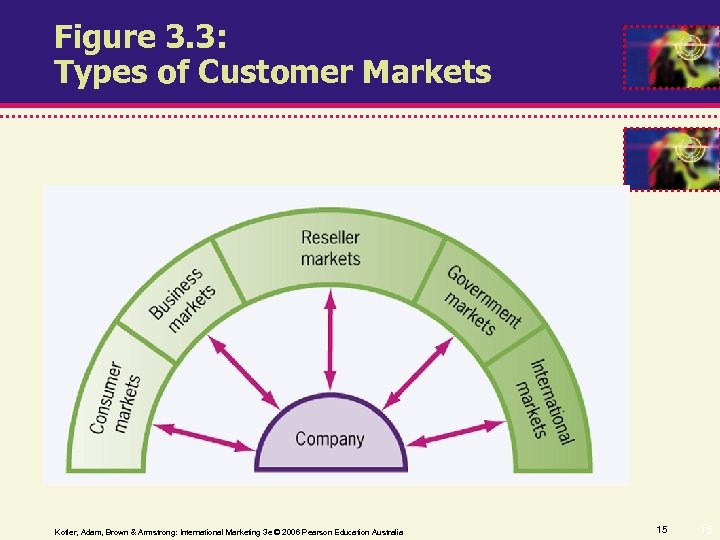 Figure 3. 3: Types of Customer Markets Kotler, Adam, Brown & Armstrong: International Marketing 3 e © 2006 Pearson Education Australia 15 15
 Competitors Every organisation faces a wide range of competitors. The marketing concept states that, to be successful, an organisation must provide greater customer value and satisfaction than its competitors. No single competitive marketing strategy is best for all organisations. Each marketer should consider its own size and industry position compared with those of its competitors. Kotler, Adam, Brown & Armstrong: International Marketing 3 e © 2006 Pearson Education Australia 16 16
 Publics The organisation’s marketing environment also includes various publics. A public is any group that has an actual or potential interest in, or impact on, an organisation’s ability to achieve its objectives. Every organisation is involved with seven types of publics Kotler, Adam, Brown & Armstrong: International Marketing 3 e © 2006 Pearson Education Australia 17 17
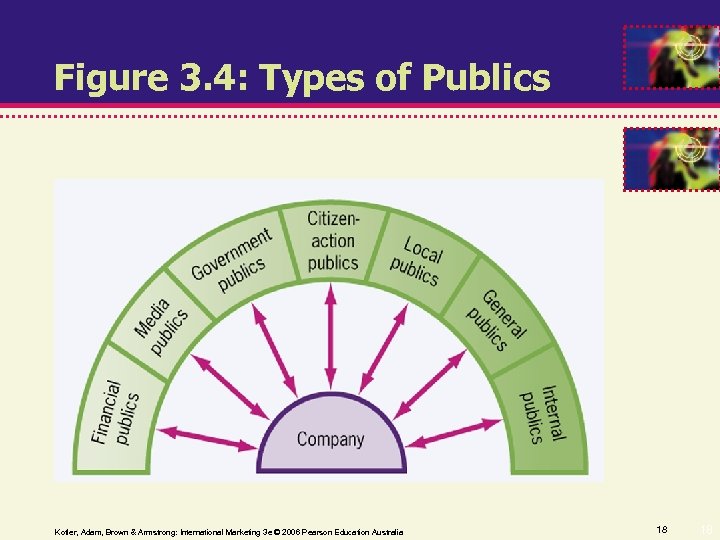 Figure 3. 4: Types of Publics Kotler, Adam, Brown & Armstrong: International Marketing 3 e © 2006 Pearson Education Australia 18 18
 The Marketing Organisation's Macro-Environment Kotler, Brown, Adam & Armstrong: International Marketing 3 e © 2006 Pearson Education Australia 19
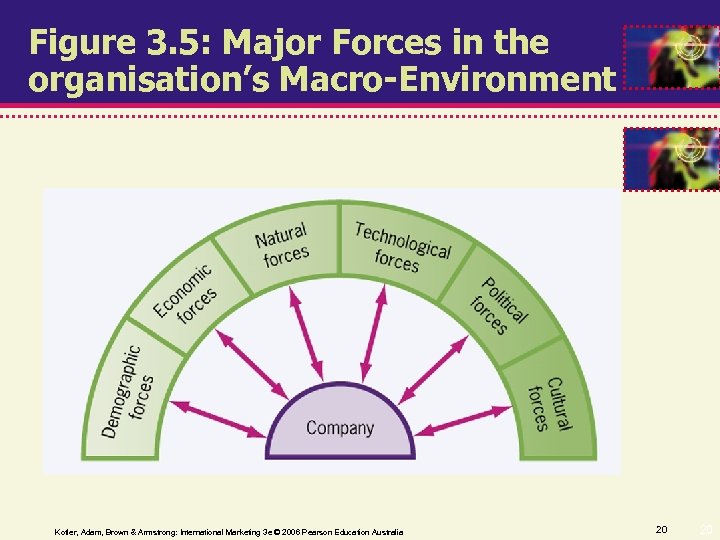 Figure 3. 5: Major Forces in the organisation’s Macro-Environment Kotler, Adam, Brown & Armstrong: International Marketing 3 e © 2006 Pearson Education Australia 20 20
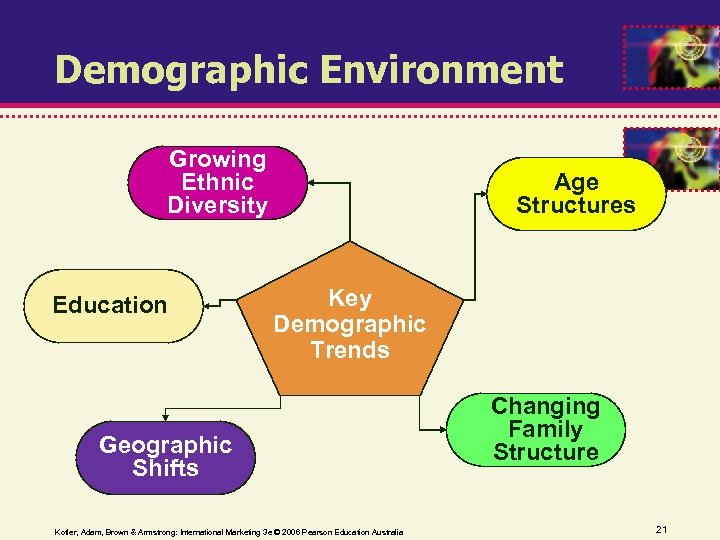 Demographic Environment Growing Ethnic Diversity Education Age Structures Key Demographic Trends Geographic Shifts Kotler, Adam, Brown & Armstrong: International Marketing 3 e © 2006 Pearson Education Australia Changing Family Structure 21
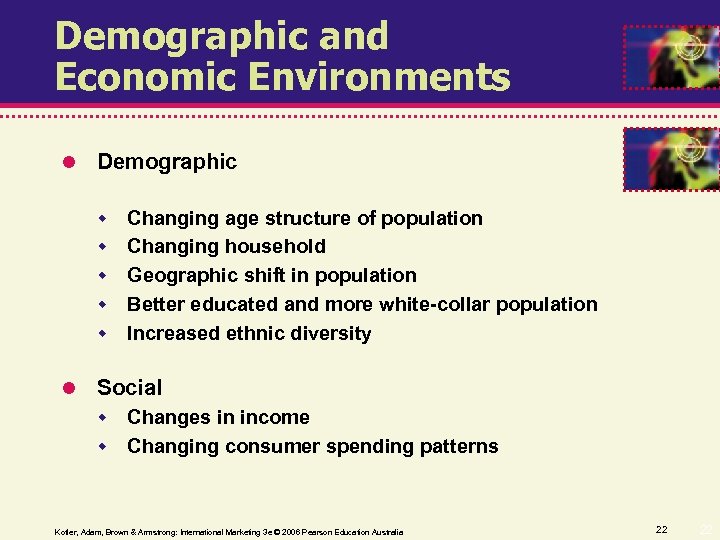 Demographic and Economic Environments Demographic Changing age structure of population Changing household Geographic shift in population Better educated and more white-collar population Increased ethnic diversity Social Changes in income Changing consumer spending patterns Kotler, Adam, Brown & Armstrong: International Marketing 3 e © 2006 Pearson Education Australia 22 22
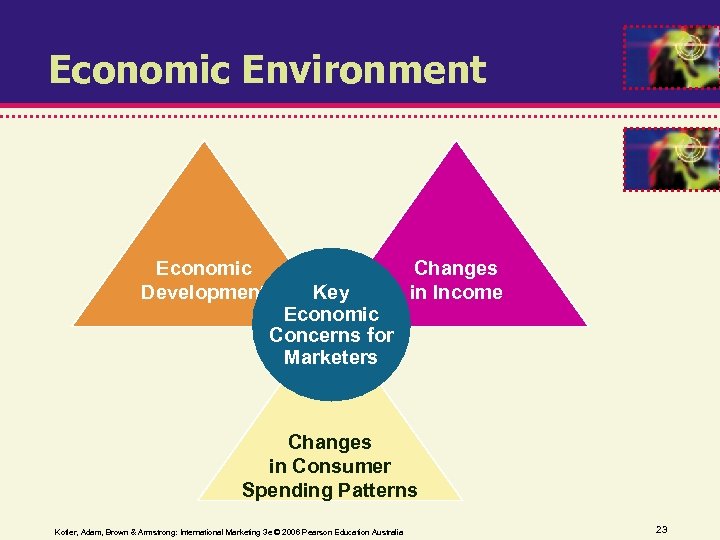 Economic Environment Economic Development Key Economic Concerns for Marketers Changes in Income Changes in Consumer Spending Patterns Kotler, Adam, Brown & Armstrong: International Marketing 3 e © 2006 Pearson Education Australia 23
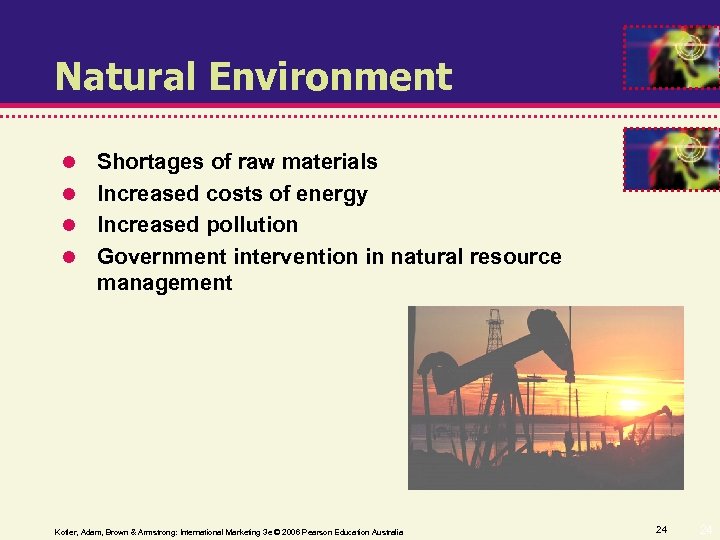 Natural Environment Shortages of raw materials Increased costs of energy Increased pollution Government intervention in natural resource management Kotler, Adam, Brown & Armstrong: International Marketing 3 e © 2006 Pearson Education Australia 24 24
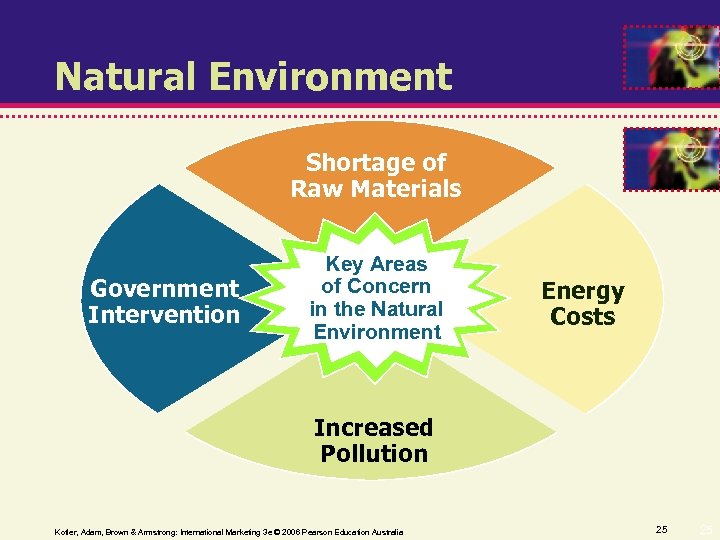 Natural Environment Shortage of Raw Materials Government Intervention Key Areas of Concern in the Natural Environment Energy Costs Increased Pollution Kotler, Adam, Brown & Armstrong: International Marketing 3 e © 2006 Pearson Education Australia 25 25
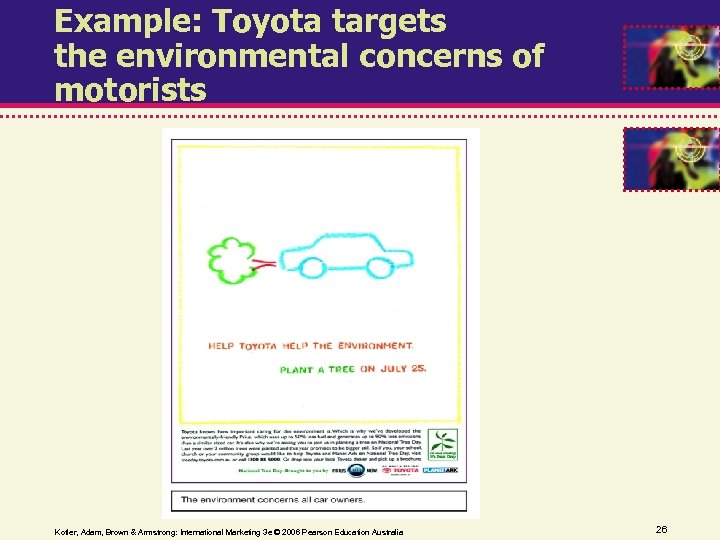 Example: Toyota targets the environmental concerns of motorists Kotler, Adam, Brown & Armstrong: International Marketing 3 e © 2006 Pearson Education Australia 26
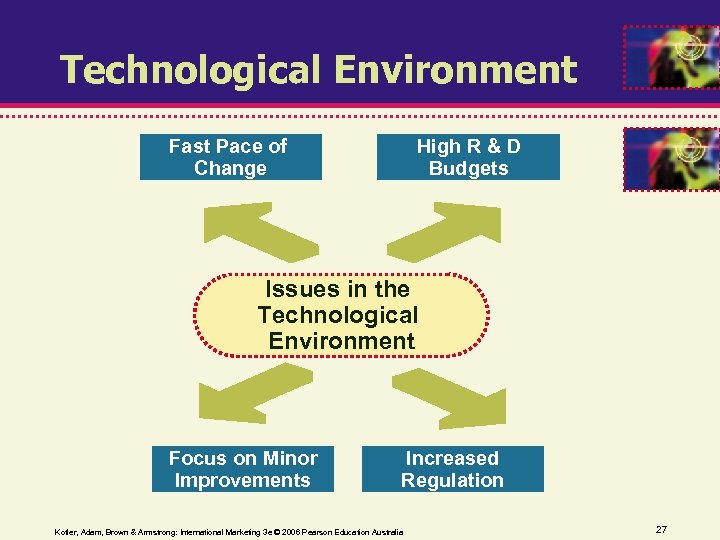 Technological Environment Fast Pace of Change High R & D Budgets Issues in the Technological Environment Focus on Minor Improvements Increased Regulation Kotler, Adam, Brown & Armstrong: International Marketing 3 e © 2006 Pearson Education Australia 27
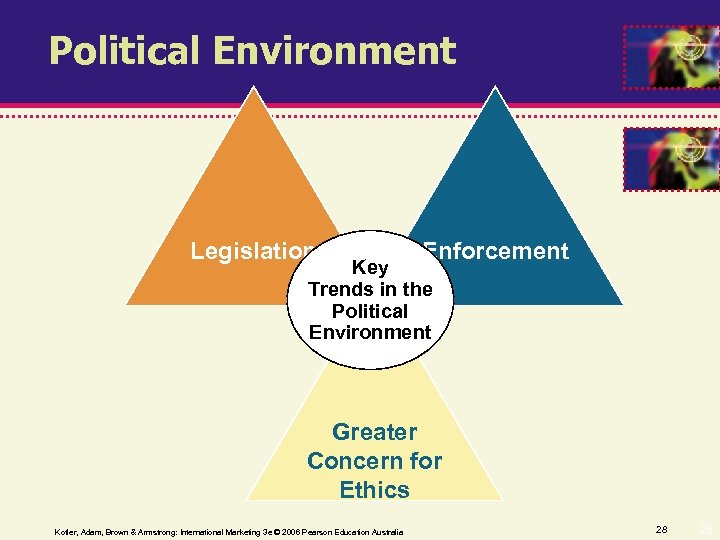 Political Environment Legislation Enforcement Key Trends in the Political Environment Greater Concern for Ethics Kotler, Adam, Brown & Armstrong: International Marketing 3 e © 2006 Pearson Education Australia 28 28
 Cultural Environment The cultural environment is made up of institutions and other forces that affect society’s basic values, perceptions, preferences, and behaviours. People grow up in a particular society that shapes their basic beliefs and values. They absorb a world view that defines their relationships to themselves and others. The following cultural characteristics can affect marketing decisions. Kotler, Adam, Brown & Armstrong: International Marketing 3 e © 2006 Pearson Education Australia 29 29
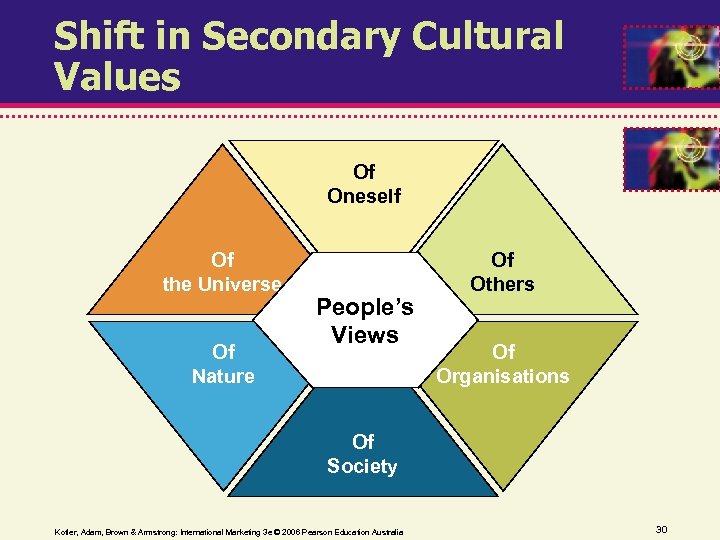 Shift in Secondary Cultural Values Of Oneself Of the Universe Of Nature People’s Views Of Others Of Organisations Of Society Kotler, Adam, Brown & Armstrong: International Marketing 3 e © 2006 Pearson Education Australia 30