


 Скачать презентацию Power Point to accompany Module 4 a Chapter
Module_4a.ppt
- Количество слайдов: 23
 Power. Point to accompany Module 4 a Chapter 5 Diversity management and quality of worklife
 Lecture objectives § Identify the effect of workforce diversity on individual, group and organisational outcomes; § Describe the key theories of diversity and how they can be applied in organisational settings; § Explain the relationship between diversity management and SHRM, and the implications of this relationship; § Discuss ways in which individual differences can be managed as well as ways that a group manager/leader can manage diversity; § Identify how the issues surrounding diversity can be effectively managed. § Discuss employee wellbeing and quality of work life Copyright © 2010 Pearson Australia (a division of Pearson Australia Group Pty Ltd) – 9781442517981/ Härtel l/Human Resource Management/2 nd edition)
 What is Workforce diversity? § Let the students guess. Diversity Copyright © 2010 Pearson Australia (a division of Pearson Australia Group Pty Ltd) – 9781442517981/ Härtel l/Human Resource Management/2 nd edition)
 Definition of workforce diversity § Workforce diversity: Any visible or invisible difference between organisational members § Five types of diversity: 1. Group identity diversity 2. Values and beliefs diversity 3. Skills and knowledge diversity 4. Verbal and non-verbal behavioural diversity 5. Organisational cohort diversity Copyright © 2010 Pearson Australia (a division of Pearson Australia Group Pty Ltd) – 9781442517981/ Härtel l/Human Resource Management/2 nd edition)
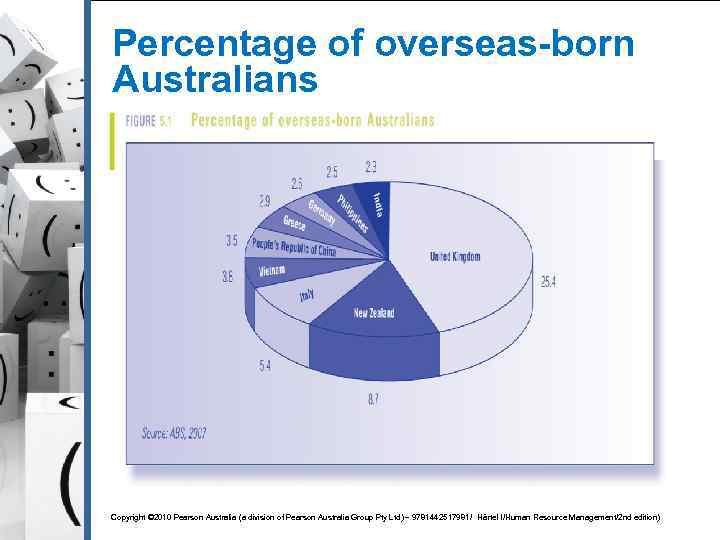 Percentage of overseas-born Australians Copyright © 2010 Pearson Australia (a division of Pearson Australia Group Pty Ltd) – 9781442517981/ Härtel l/Human Resource Management/2 nd edition)
 Hofstede(1980, 2008): Framework of national cultures § Power distance: degree to which people accept an equal or unequal distribution of power in the organisation. § Uncertainty avoidance: degree to which a society takes risks or tolerates uncertain situations. § Individualism/collectivism: independent self versus interdependent self societies § Masculinity/femininity: degree of masculine characteristics as opposed to feminine characteristics § Time orientation: degree to which long- or shortterm consequences are considered. Copyright © 2010 Pearson Australia (a division of Pearson Australia Group Pty Ltd) – 9781442517981/ Härtel l/Human Resource Management/2 nd edition)
 How does diversity enter the workforce? § Diversity enters the workforce in three ways: 1. Legal case for diversity 2. Moral case for diversity 3. Business case for diversity Copyright © 2010 Pearson Australia (a division of Pearson Australia Group Pty Ltd) – 9781442517981/ Härtel l/Human Resource Management/2 nd edition)
 Human Responses to Diversity § Similarity attraction paradigm: humans are inclined to be attracted to others they perceive to be similar § Social identity theory: group members attempt to achieve or maintain a positive self-image as a result of a favourable comparison between their social category and other groups § Social categorisation theory: people tend to categorise themselves and others into various social categories, namely ‘in-group’ and ‘out-group’ membership Copyright © 2010 Pearson Australia (a division of Pearson Australia Group Pty Ltd) – 9781442517981/ Härtel l/Human Resource Management/2 nd edition)
 How HRM Can Discriminate § Discrimination: direct and indirect discrimination § Direct discrimination: a policy or behaviour that purposely treats one group less favourably than another § Indirect discrimination: a policy appears to be nondiscriminatory but in practice results in discrimination. Copyright © 2010 Pearson Australia (a division of Pearson Australia Group Pty Ltd) – 9781442517981/ Härtel l/Human Resource Management/2 nd edition)
 Effects of diversity in the workplace When managed well: When managed poorly: Innovation Empowerment Information sharing Group decision effectiveness Openness to dissimilarity Productivity Discrimination Communication (Hofstede’s study) Power play Conflict Control Copyright © 2010 Pearson Australia (a division of Pearson Australia Group Pty Ltd) – 9781442517981/ Härtel l/Human Resource Management/2 nd edition)
 Diversity management § Diversity management: The planning, organising and controlling of diversity-friendly policies and practices, which is reflected in an open-minded organisational culture and climate § Leadership and workgroup management § § Conflict management, emotion management and dissimilarity openness Individual differences § Dissimilarity openness and cultural knowledge Copyright © 2010 Pearson Australia (a division of Pearson Australia Group Pty Ltd) – 9781442517981/ Härtel l/Human Resource Management/2 nd edition)
 Diversity-oriented HRM § Diversity-open recruitment and selection § § Diversity-open training and development § § To recruit and select the most suitable person(s) for the job regardless of diversity attributes such as gender, race, age or religion Training and development that will foster understanding between all employees as well as provide all employees with equal opportunities to enhance their skills Diversity-open performance evaluations § Can be achieved by including diversity criteria in organisational objectives and the evaluations of individual managers Copyright © 2010 Pearson Australia (a division of Pearson Australia Group Pty Ltd) – 9781442517981/ Härtel l/Human Resource Management/2 nd edition)
 Issues related to workforce diversity § Changes in work and employment patterns § § Accommodating religious practices § § e. g. , working from home e. g. , prayer time Organisations that provide flexible work arrangements so that their employees are able to meet their personal commitments are more likely to attract and retain high-calibre employees Copyright © 2010 Pearson Australia (a division of Pearson Australia Group Pty Ltd) – 9781442517981/ Härtel l/Human Resource Management/2 nd edition)
 HRM, employee wellbeing and quality of worklife § Increasing demands on today’s employees pose difficulties for maintaining employee wellbeing and quality of worklife. § Subjective wellbeing: degree to which individuals experience positive emotions, attitudes, behaviours and cognitions in their lives § Objective wellbeing: degree to which individuals experience positive physical and social states e. g. health, income, employment status and qualification Copyright © 2010 Pearson Australia (a division of Pearson Australia Group Pty Ltd) – 9781442517981/ Härtel l/Human Resource Management/2 nd edition)
 Four attributes of worklife policies and practices § Universalism: Are worklife policies available for everyone at all levels, jobs and locations? § Cultural integration: Are worklife policies embedded in the core values of organisational members? § Negotiability: Is there negotiability between managers and employees with relation to work-life balance? § Boundary blurring: Is employee wellbeing supported through assisting employees to manage the work and non-work boundary? Copyright © 2010 Pearson Australia (a division of Pearson Australia Group Pty Ltd) – 9781442517981/ Härtel l/Human Resource Management/2 nd edition)
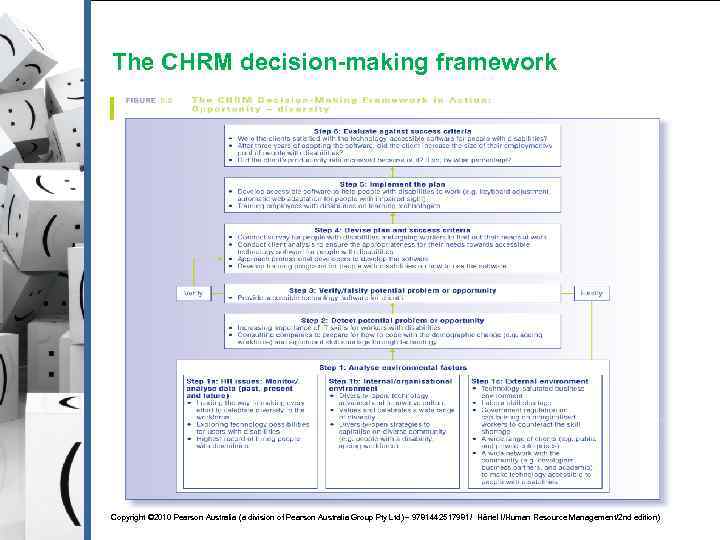 The CHRM decision-making framework Copyright © 2010 Pearson Australia (a division of Pearson Australia Group Pty Ltd) – 9781442517981/ Härtel l/Human Resource Management/2 nd edition)
 Step 1 Analyse environmental factors § Monitor/analyse data (past, present and future): § § Internal/organisational environment: § § Leading the way in making every effort to celebrate diversity in the workforce Diversity-open, technology advanced and innovative culture External environment: § Technology-saturated business environment Copyright © 2010 Pearson Australia (a division of Pearson Australia Group Pty Ltd) – 9781442517981/ Härtel l/Human Resource Management/2 nd edition)
 Step 2 Detect potential problem or opportunity § Increasing importance of IT skills for workers with disabilities § Consulting companies need to prepare to cope with the demographic change (e. g. ageing workforce) and significant skill shortage through technology Copyright © 2010 Pearson Australia (a division of Pearson Australia Group Pty Ltd) – 9781442517981/ Härtel l/Human Resource Management/2 nd edition)
 Step 3 Verify/falsify potential problem or opportunity § Provide technology-accessible software for clients Copyright © 2010 Pearson Australia (a division of Pearson Australia Group Pty Ltd) – 9781442517981/ Härtel l/Human Resource Management/2 nd edition)
 Step 4 Devise plan and success criteria § Conduct survey for people with a disability and ageing workers to find out their needs at work § Conduct client analysis to ensure the appropriateness of the accessible technology software for people with disabilities § Approach professional developers to build the software § Develop training programs to show people with disabilities how to use the software Copyright © 2010 Pearson Australia (a division of Pearson Australia Group Pty Ltd) – 9781442517981/ Härtel l/Human Resource Management/2 nd edition)
 Step 5 Implement the plan § Develop accessible software to help people with a disability to work (e. g. , keyboard adjustment, automatic web adaptation for people with impaired sight) § Training employees with disabilities on learning technologies Copyright © 2010 Pearson Australia (a division of Pearson Australia Group Pty Ltd) – 9781442517981/ Härtel l/Human Resource Management/2 nd edition)
 Step 6 Evaluate against success criteria § Were the clients satisfied with the technologyaccessible software for people with a disability? § After 3 years of adopting the software, did the client increase the size of their employment pool of people with disabilities? § Did client's productivity rate increase because of it? If so, by what percentage? Copyright © 2010 Pearson Australia (a division of Pearson Australia Group Pty Ltd) – 9781442517981/ Härtel l/Human Resource Management/2 nd edition)
 Conclusion § The workforce is becoming increasingly diverse § Managers need to understand embrace diversity, including its effects and implications § Diversity management is a key HRM responsibility § Managers must acknowledge and manage all kinds of diversity, adhering to organisational and legal standards, and ensuring employee wellbeing. Copyright © 2010 Pearson Australia (a division of Pearson Australia Group Pty Ltd) – 9781442517981/ Härtel l/Human Resource Management/2 nd edition)