


 Скачать презентацию Power Point to accompany Chapter 8 Leadership
leadership.ppt
- Количество слайдов: 18
 Power. Point to accompany Chapter 8 Leadership
 What is leadership? Robbins, Judge, Millett, Waters-Marsh, Organisational Behaviour 5 e : © 2008 Pearson Education Australia 2
 Definition of Leadership § A commonly accepted definition of leadership is a process used by an individual to influence a group of members toward a common goal (Bass, 1990; Howell and Costley, 2001). § Maxwell (1993) simply states that leadership is influence. Robbins, Judge, Millett, Waters-Marsh, Organisational Behaviour 5 e : © 2008 Pearson Education Australia 3
 Are there specific traits, behaviors, and situations that affect how one leads? § Every leader is different, and no single theory works for all leaders. Begin to develop your own leadership approach by learning more about the following leadership theories. § Great man § Trait § Behavioral § Contingency § Transactional § Transformational Robbins, Judge, Millett, Waters-Marsh, Organisational Behaviour 5 e : © 2008 Pearson Education Australia 4
 Great Man § Researchers who support the Great Man theory believe that people are born to leadership. This may include members of royalty, high-ranking military officers and industry heads. Today, many people still hold this traditional belief, and even though this theory may sound old-fashioned, research suggests that some people have personality traits, behaviors and knowledge that lend themselves to leadership (Yaverbaum and Sherman, 2008). Studying famous royal, military or industry leaders may provide you with some tools that help you develop your own leadership abilities. Robbins, Judge, Millett, Waters-Marsh, Organisational Behaviour 5 e : © 2008 Pearson Education Australia 5
 Trait Theory: Are Leaders Different from Others? § Similar to the Great Man theory, Trait theory suggests that the characteristics or the personality of a person may make them an effective leader. Several academics believe that potential leaders can be spotted by studying the personality traits of the individual and matching them to the characteristics of actual leaders. Trait theory was almost abandoned by leadership practitioners as leadership research evolved, but in the past few years, there has been a renewed interest and more research related to Trait theory. Robbins, Judge, Millett, Waters-Marsh, Organisational Behaviour 5 e : © 2008 Pearson Education Australia 6
 Trait Theory § Leadership traits include physical or background traits, personal or ability traits and/or task or social traits such as: • Articulate • Committed • Decisive • Determined • Educated • Energetic • Integrity • Intelligence • Persistence • Responsible • Social Status • Self-Confident Robbins, Judge, Millett, Waters-Marsh, Organisational Behaviour 5 e : © 2008 Pearson Education Australia 7
 Behavioral Theories: Do Leaders Behave in Particular Ways? § Behavior theory focuses on what an effective leader “does. ” Leadership is not something you are born with, nor do you need a set of commonly accepted traits. However, effective leadership is dependent on the right behavior. Researchers proposed that for a leader to be effective, their behavior must vary with the situation. In other words, you can learn how to act like a leader. Robbins, Judge, Millett, Waters-Marsh, Organisational Behaviour 5 e : © 2008 Pearson Education Australia 8
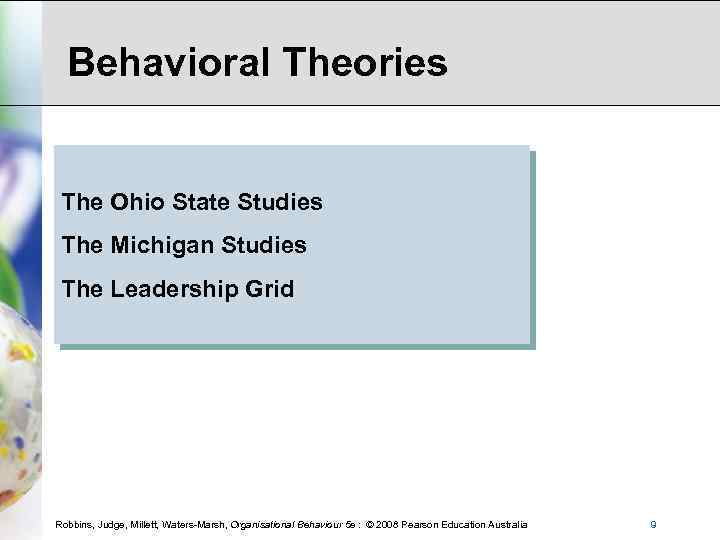 Behavioral Theories The Ohio State Studies The Michigan Studies The Leadership Grid Robbins, Judge, Millett, Waters-Marsh, Organisational Behaviour 5 e : © 2008 Pearson Education Australia 9
 Robbins, Judge, Millett, Waters-Marsh, Organisational Behaviour 5 e : © 2008 Pearson Education Australia 10
 Contingency Theories: Does the Situation Matter? § Situational, or contingency, theories of leadership try to isolate critical situational factors that affect leadership effectiveness. The theories consider the degree of structure in the task being performed, the quality of leader-member relations, the leader’s position power, group norms, information availability, employee acceptance of leader’s decisions, employee maturity, and the clarity of the employee’s role. Robbins, Judge, Millett, Waters-Marsh, Organisational Behaviour 5 e : © 2008 Pearson Education Australia 11
 Situational or contingency theories Fiedler Contingency Model Hersey And Blanchard’s Situational Leadership Theory Path-goal Theory Substitutes for Leadership Robbins, Judge, Millett, Waters-Marsh, Organisational Behaviour 5 e : © 2008 Pearson Education Australia 12
 Transactional Theory. Transactional leadership requires that the leader and follower agree to a contract. The follower is responsible for following orders to perform a task. The leader, in turn, gives rewards for following orders in completing the task. Transactional leadership suggests that people only complete tasks when there are external rewards. § Such leaders guide or motivate their followers in the direction of established goals by clarifying role and task requirements. In some styles of transactional leadership, the leader uses rewarding and recognizing behaviors. This approach results in performance that meets expectations, though rarely does one see results that exceed expectations. In other styles of transactional leadership, the leader emphasizes correction and possible punishment rather than rewards and recognition. Robbins, Judge, Millett, Waters-Marsh, Organisational Behaviour 5 e : © 2008 Pearson Education Australia 13
 Transformational Theory. § Transformational leadership is a process in which the leader engages others, builds trust and creates a connection that increases the motivation and morality in both the leader and the follower. (Northouse, 2001). § A transformational leader focuses on others and their needs in order to help them reach their potential. In many ways, transformational leadership is about a leader’s ability to create a vision related to a goal that has meaning for both the leader and follower. Robbins, Judge, Millett, Waters-Marsh, Organisational Behaviour 5 e : © 2008 Pearson Education Australia 14
 Transformational Theory. § Transformational leaders increase their followers’ self-efficacy, which is an important motivational construct increasing followers’ belief in their capability to organize and execute the actions required to attain a given goal (Shamir, House, & Arthur, 1993). In fact, it is generally accepted in transformational leadership that leaders persuade other members of the organization to provide support for the innovation (Hofstede, 2001). § Transformational leadership theories seem to be the most advanced in the sense that they expand the scope of leadership theory by recognizing the importance of symbolic, emotional and highly motivating behaviors that appeal to follower’s minds and hearts and account for results over and above ordinary leadership. Robbins, Judge, Millett, Waters-Marsh, Organisational Behaviour 5 e : © 2008 Pearson Education Australia 15
 Leadership Practices Inventory by Kouzes and Posner § Kouzes and Posner (1987) also created the Leadership Practices Inventory (LPI), which consists of five transformational leadership aspects. These are defined by Kouzes and Posner (1987) in the following way: § Challenge the Process (CP): Leaders search for opportunities to change the status quo. In other words, they accept challenge, which might be in the form of an innovative new product, a cutting-edge service, and a groundbreaking piece of legislation or the establishment of a new business. In doing so, they experiment and take risks. Because leaders know that risk taking involves mistakes and failures, they accept the inevitable disappointments as learning opportunities. Robbins, Judge, Millett, Waters-Marsh, Organisational Behaviour 5 e : © 2008 Pearson Education Australia 16
 Leadership Practices Inventory by Kouzes and Posner § Inspire a Shared Vision (ISV): Leaders passionately believe that they can make a difference. They envision the future, creating an ideal and unique image of what the organization can become. Through their magnetism and quiet persuasion, leaders enlist others in their dreams. They breathe life into their visions and get people to see exciting possibilities for the future. § Enable Others to Act (EOA): Leaders foster collaboration and build spirited teams. They actively involve others. Leaders understand that mutual respect is what sustains extraordinary efforts; they strive to create an atmosphere of trust and human dignity. They strengthen others, making each person feel capable and powerful. Robbins, Judge, Millett, Waters-Marsh, Organisational Behaviour 5 e : © 2008 Pearson Education Australia 17
 Leadership Practices Inventory by Kouzes and Posner § Model the Way (MW): Leaders establish principles concerning the way people should be treated and the way goals should be pursued. They create standards of excellence and then set an example for others to follow. Because the prospect of complex change can overwhelm people and stifle action, they set interim goals so that people can achieve small goals as they work toward larger objectives. They unravel bureaucracy when it impedes action; they put up signposts when people are unsure of where to go or how to get there; and they create opportunities for victory. § Encourage the Hearth (EH): Accomplishing extraordinary things in organizations is hard work. To keep hope and determination alive, leaders recognize the contributions that individuals make. In every winning team, the members need to share in the rewards of their efforts, so leaders celebrate accomplishments, making people feel like heroes. Robbins, Judge, Millett, Waters-Marsh, Organisational Behaviour 5 e : © 2008 Pearson Education Australia 18