 Скачать презентацию Power Point Presentation by Gail B Wright Professor
8f8f7530e5fe74b4f20919183d398af3.ppt
- Количество слайдов: 54



Power. Point Presentation by Gail B. Wright Professor Emeritus of Accounting Bryant University © Copyright 2007 Thomson South-Western, a part of The Thomson Corporation. Thomson, the Star Logo, and South-Western are trademarks used herein under license. MANAGEMENT ACCOUNTING 8 th EDITION BY HANSEN & MOWEN 7 SUPPORT-DEPARTMENT COST ALLOCATION

LEARNING OBJECTIVES LEARNING GOALS After studying this chapter, you should be able to: 2
LEARNING OBJECTIVES 1. Describe the difference between support departments and producing departments. 2. Calculate single & multiple charging rates for a support department. 3. Allocate support-department costs to producing departments using the direct, sequential, & reciprocal methods. Continued 3
LEARNING OBJECTIVES 4. Compute departmental overhead rates. 5. Describe the allocation of joint costs to products. (Appendix). Click the button to skip Questions to Think About 4

QUESTIONS TO THINK ABOUT: Hamilton & Barry, CPAs Why do you think that the photocopying charges amount to $0. 12 per page? List types of costs incurred & divide them into fixed & variable categories. 5

QUESTIONS TO THINK ABOUT: Hamilton & Barry, CPAs Jan mentioned the security & convenience of in-house photocopying. How to you think the firm might weigh these factors in deciding whether cost of inhouse copying is “worth it”? 6
QUESTIONS TO THINK ABOUT: Hamilton & Barry, CPAs Since the firm as a whole has decided to have an in-house copying department, why are copying costs charged to the individual departments? What purpose does developing supportdepartment charging rates serve? 7
LEARNING OBJECTIVE 1 Describe the difference between support departments and producing departments. 8
LO 1 ALLOCATION: Definition A means of dividing a pool of costs & assigning it to various subunits. 9
LO 1 COST ALLOCATION While cost allocation does not affect total product cost, it will affect pricing & profitability of individual products depending on method used. 10
LO 1 COMMON COSTS: Definition Mutually beneficial costs which occur when the same resource is used in output of 2 or more services or products. 11
LO 1 TYPES OF DEPARTMENTS Producing departments are directly responsible for creating products, services sold. Support departments provide essential support services for producing departments. 12
LO 1 How are overhead costs treated for producing & support departments? Once producing & support departments are identified, overhead costs are traced, not allocated to each department. 13
LO 1 Why can’t a support department have an overhead rate to assign to products? Support departments do not produce salable products. 14
LO 1 CAUSAL FACTORS: Definition Activities within a producing department that provoke the incurrence of support service costs. 15
LO 1 TYPES OF DEPARTMENTS: Examples ¯Manufacturing plant ¯Producing departments (Assembly & Finishing) ¯Support departments (Storeroom, Cafeteria, Maintenance, General Factory) ¯Bank ¯Producing (Auto Loans, Commercial Lending, Personal Banking ¯Support departments (Drive-Thru, Data Processing, Bank Administration) 16
LO 1 How are costs allocated from departments to products? First, support department costs are assigned to producing departments. Then overhead rates are developed to cost products. 17
LO 1 OBJECTIVES OF ALLOCATION ¯To obtain a mutually agreeable price ¯To compute product-line profitability ¯To predict the economic effects of planning & control ¯To value inventory ¯To motivate managers 18
LO 1 COMPETITIVE PRICING ¯Requires understanding costs ¯Overstating leads to loss of business ¯Understating produces losses ¯Leads to evaluating product or service mix ¯Dropping some services ¯Reallocating resources ¯Repricing 19
LEARNING OBJECTIVE 2 Calculate single & multiple charging rates for a support department. 20
LO 2 What kinds of charging rates are used? Companies use either a single charging rate or multiple charging rates. 21
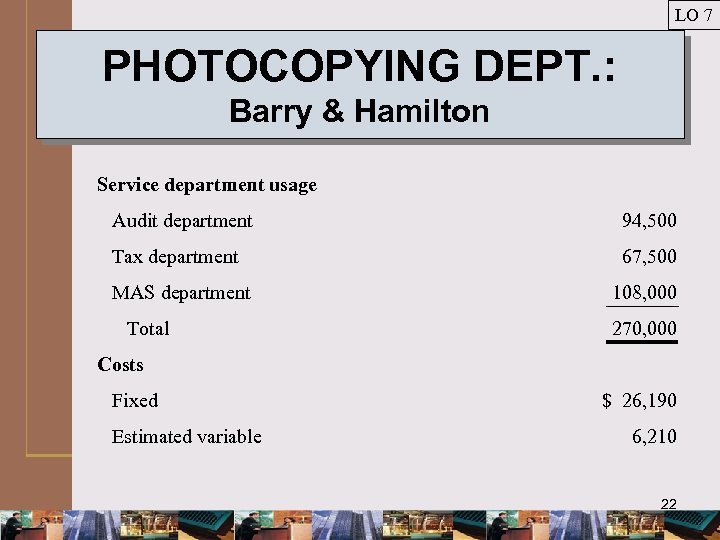
LO 7 PHOTOCOPYING DEPT. : Barry & Hamilton Service department usage Audit department 94, 500 Tax department 67, 500 MAS department Total 108, 000 270, 000 Costs Fixed Estimated variable $ 26, 190 6, 210 22
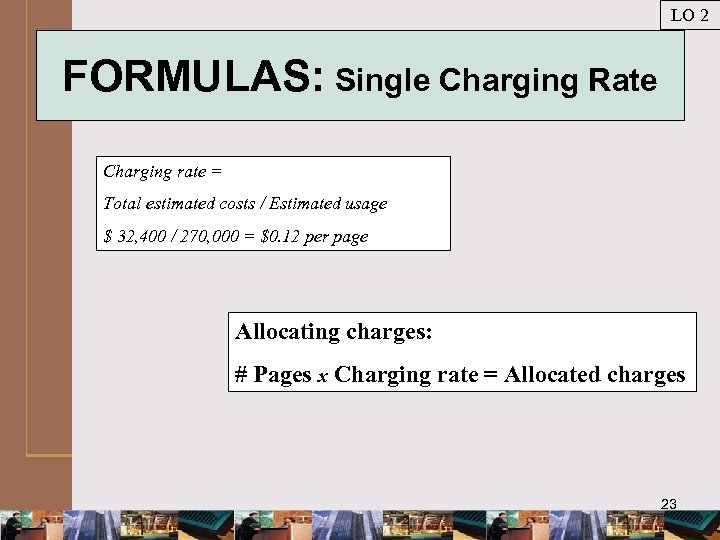
LO 2 FORMULAS: Single Charging Rate Charging rate = Total estimated costs / Estimated usage $ 32, 400 / 270, 000 = $0. 12 per page Allocating charges: # Pages x Charging rate = Allocated charges 23
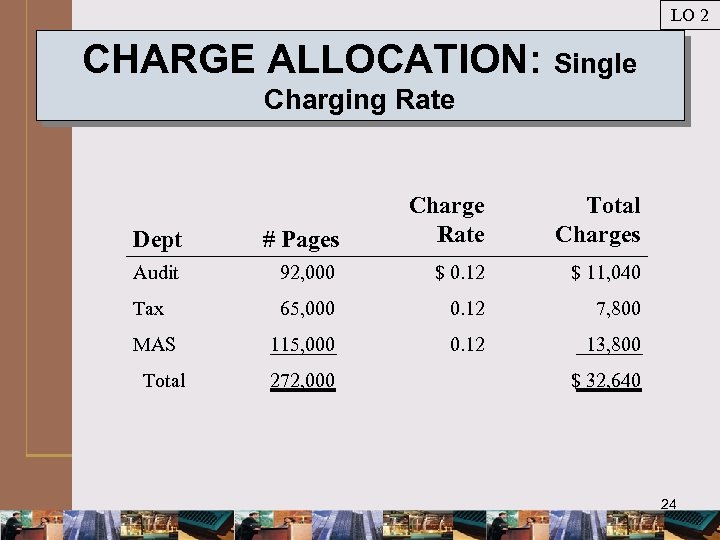
LO 2 CHARGE ALLOCATION: Single Charging Rate Dept # Pages Charge Rate Audit 92, 000 $ 0. 12 $ 11, 040 Tax 65, 000 0. 12 7, 800 115, 000 0. 12 13, 800 MAS Total 272, 000 Total Charges $ 32, 640 24
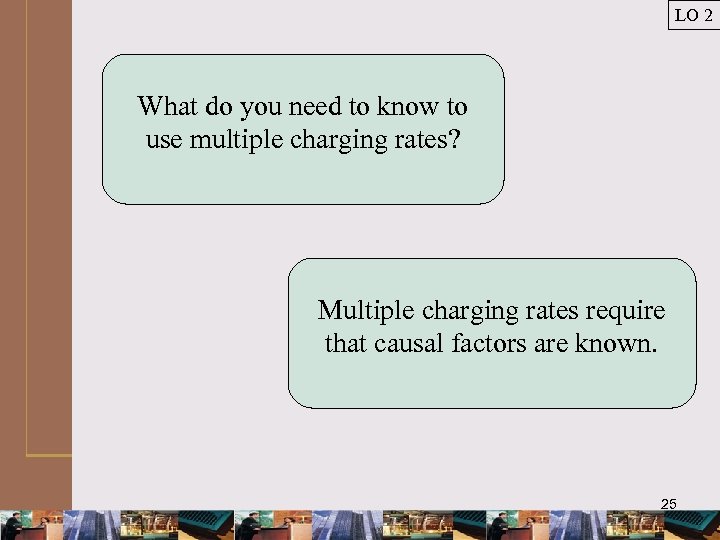
LO 2 What do you need to know to use multiple charging rates? Multiple charging rates require that causal factors are known. 25

LO 2 PHOTOCOPYING DEPT: Causal Factors Causal factor for size & costs of photocopying is monthly peak usage. 26
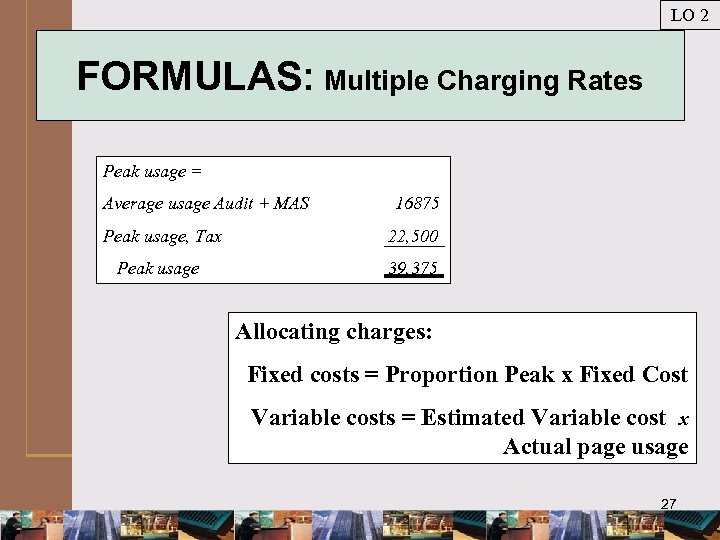
LO 2 FORMULAS: Multiple Charging Rates Peak usage = Average usage Audit + MAS 16875 Peak usage, Tax 22, 500 Peak usage 39, 375 Allocating charges: Fixed costs = Proportion Peak x Fixed Cost Variable costs = Estimated Variable cost x Actual page usage 27
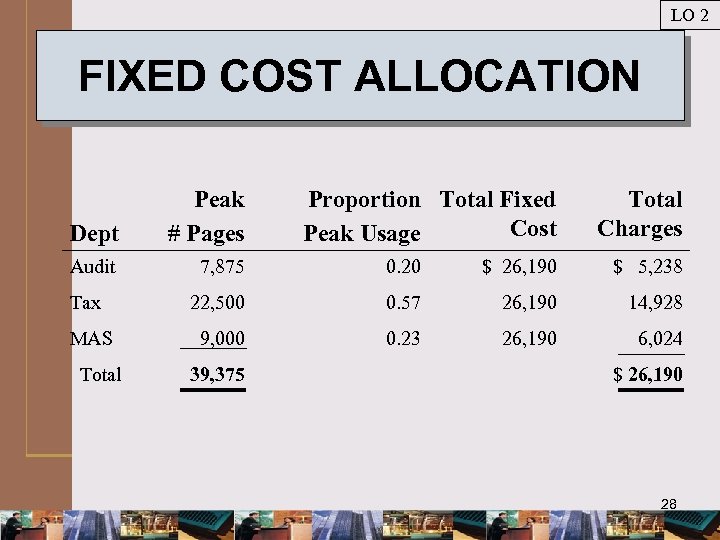
LO 2 FIXED COST ALLOCATION Dept Peak # Pages Audit 7, 875 0. 20 $ 26, 190 $ 5, 238 22, 500 0. 57 26, 190 14, 928 9, 000 0. 23 26, 190 6, 024 Tax MAS Total 39, 375 Proportion Total Fixed Cost Peak Usage Total Charges $ 26, 190 28
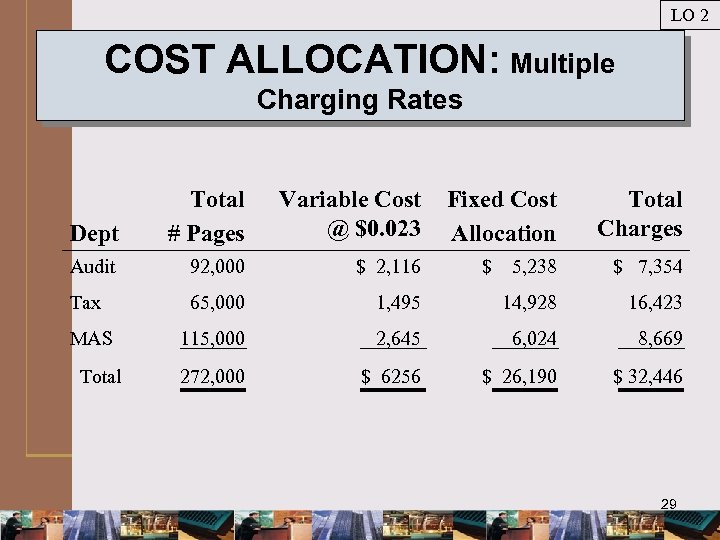
LO 2 COST ALLOCATION: Multiple Charging Rates Dept Total # Pages Variable Cost @ $0. 023 Fixed Cost Allocation Total Charges Audit 92, 000 $ 2, 116 $ 5, 238 $ 7, 354 Tax 65, 000 1, 495 14, 928 16, 423 115, 000 2, 645 6, 024 8, 669 272, 000 $ 6256 $ 26, 190 $ 32, 446 MAS Total 29
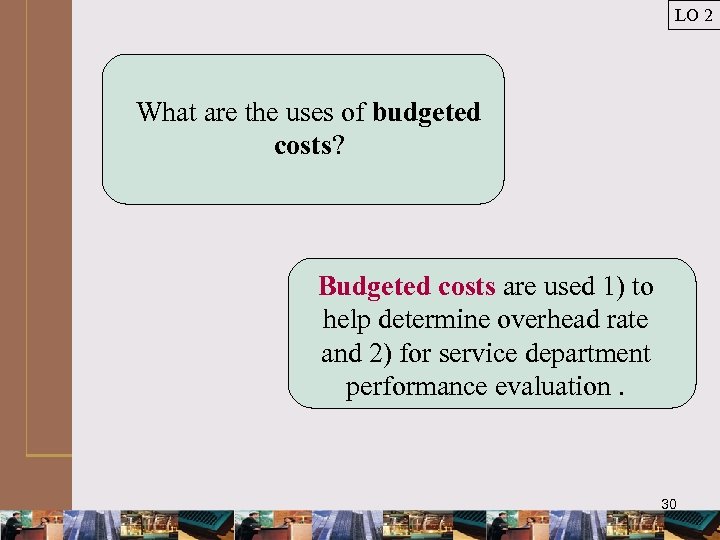
LO 2 What are the uses of budgeted costs? Budgeted costs are used 1) to help determine overhead rate and 2) for service department performance evaluation. 30
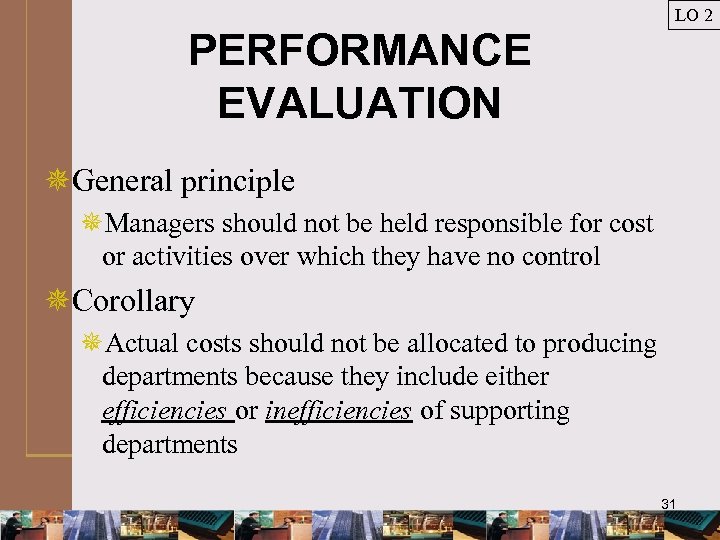
LO 2 PERFORMANCE EVALUATION ¯General principle ¯Managers should not be held responsible for cost or activities over which they have no control ¯Corollary ¯Actual costs should not be allocated to producing departments because they include either efficiencies or inefficiencies of supporting departments 31
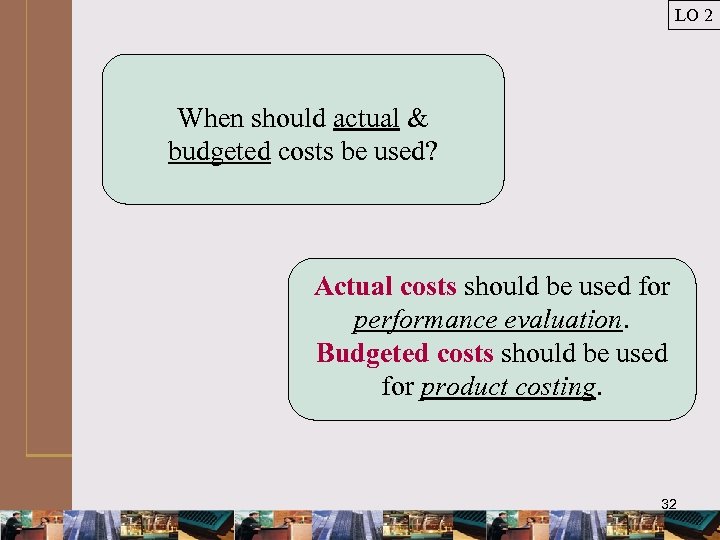
LO 2 When should actual & budgeted costs be used? Actual costs should be used for performance evaluation. Budgeted costs should be used for product costing. 32
LEARNING OBJECTIVE 3 Allocate supportdepartment costs to producing departments using the direct, sequential, & reciprocal methods. 33
LO 3 MULTIPLE SUPPORT DEPARTMENTS When a company has multiple support departments that interact, managers must choose an allocation method. 34
LO 3 ALLOCATION METHODS: Multiple Service Departments ¯Direct allocation method ¯Allocate support department costs only to producing departments ¯Sequential allocation method ¯Allocate support department costs in step-down approach ¯Reciprocal allocation method 35
LO 3 MULTIPLE SUPPORT DEPARTMENTS: Background A factory has the following departments ¯Producing ¯Grinding ¯Assembly ¯Support ¯Power ¯Maintenance 36
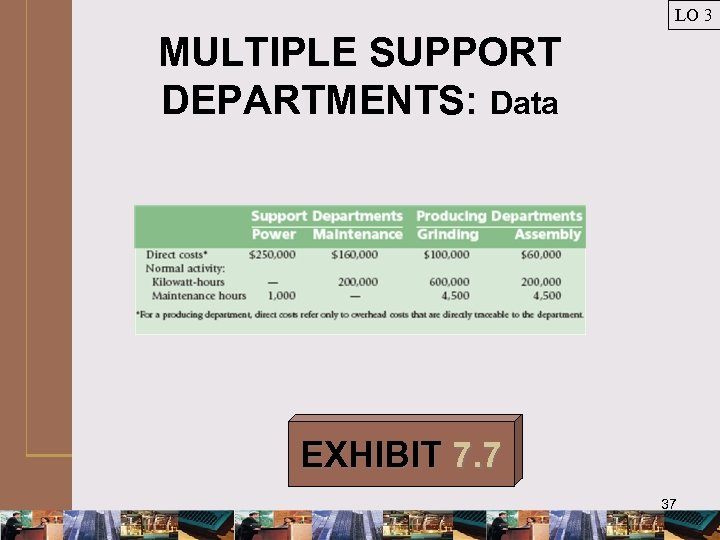
LO 3 MULTIPLE SUPPORT DEPARTMENTS: Data EXHIBIT 7. 7 37
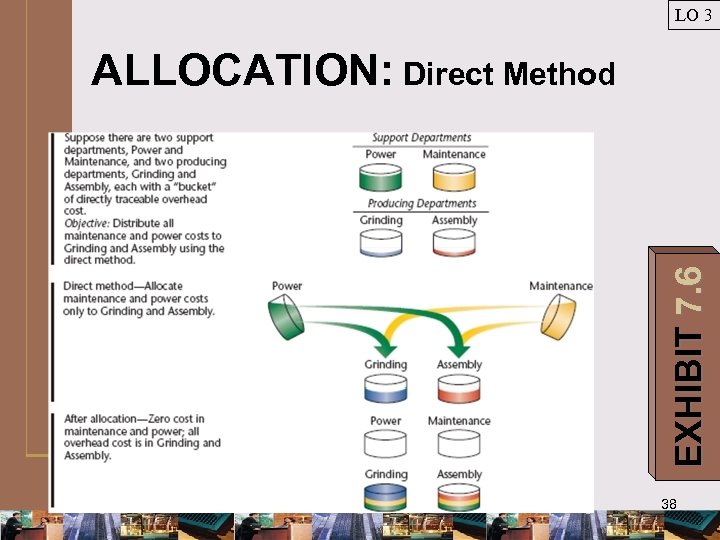
LO 3 EXHIBIT 7. 6 ALLOCATION: Direct Method 38
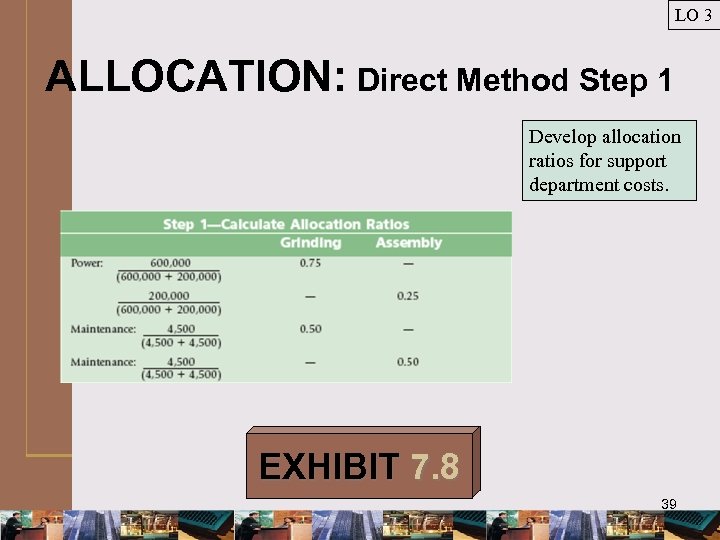
LO 3 ALLOCATION: Direct Method Step 1 Develop allocation ratios for support department costs. EXHIBIT 7. 8 39
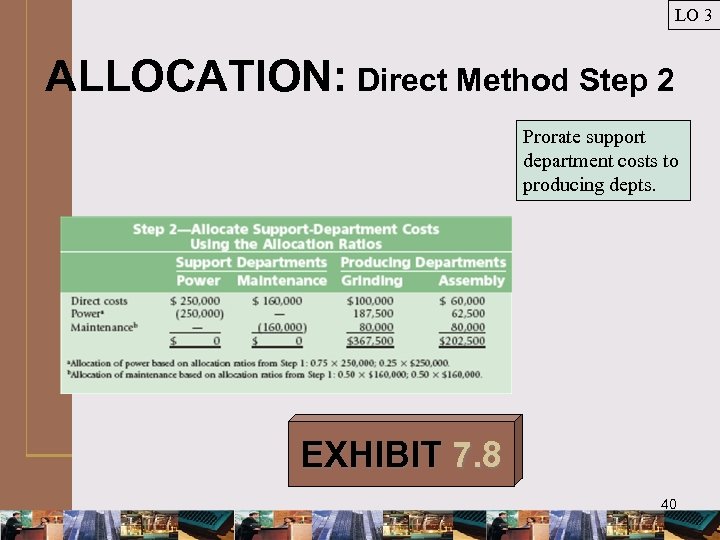
LO 3 ALLOCATION: Direct Method Step 2 Prorate support department costs to producing depts. EXHIBIT 7. 8 40
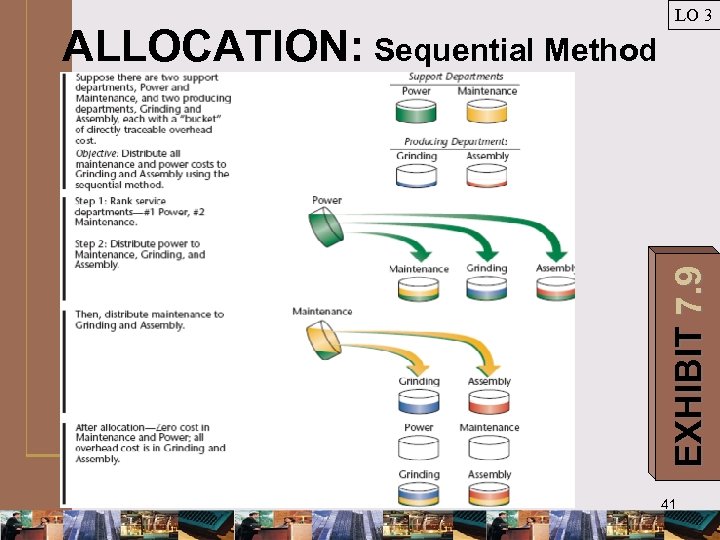
EXHIBIT 7. 9 ALLOCATION: Sequential Method LO 3 41
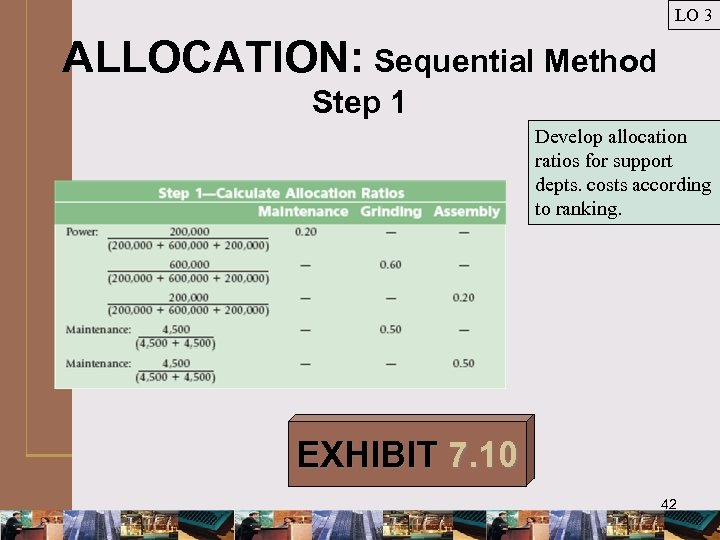
LO 3 ALLOCATION: Sequential Method Step 1 Develop allocation ratios for support depts. costs according to ranking. EXHIBIT 7. 10 42
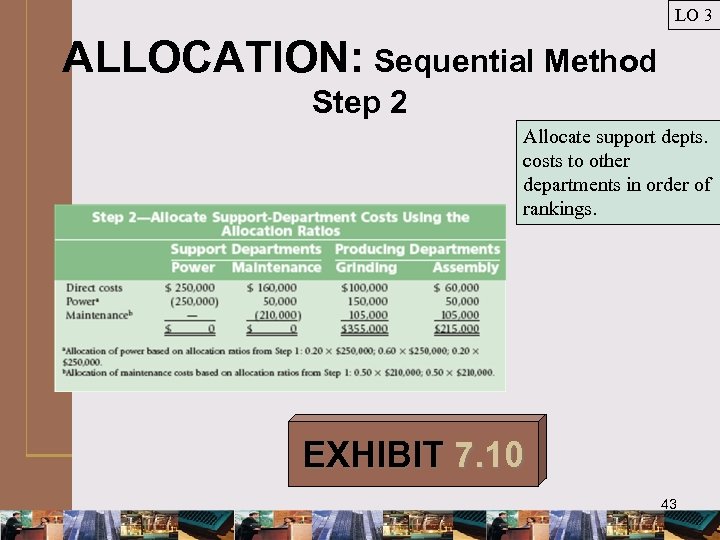
LO 3 ALLOCATION: Sequential Method Step 2 Allocate support depts. costs to other departments in order of rankings. EXHIBIT 7. 10 43
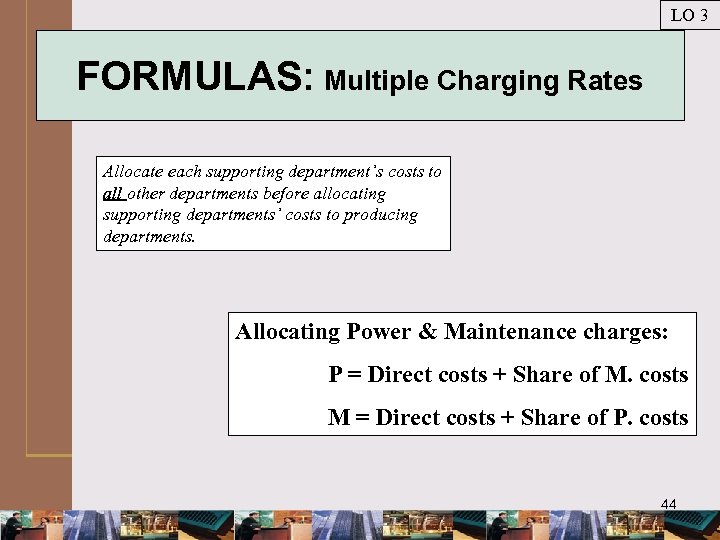
LO 3 FORMULAS: Multiple Charging Rates Allocate each supporting department’s costs to all other departments before allocating supporting departments’ costs to producing departments. Allocating Power & Maintenance charges: P = Direct costs + Share of M. costs M = Direct costs + Share of P. costs 44
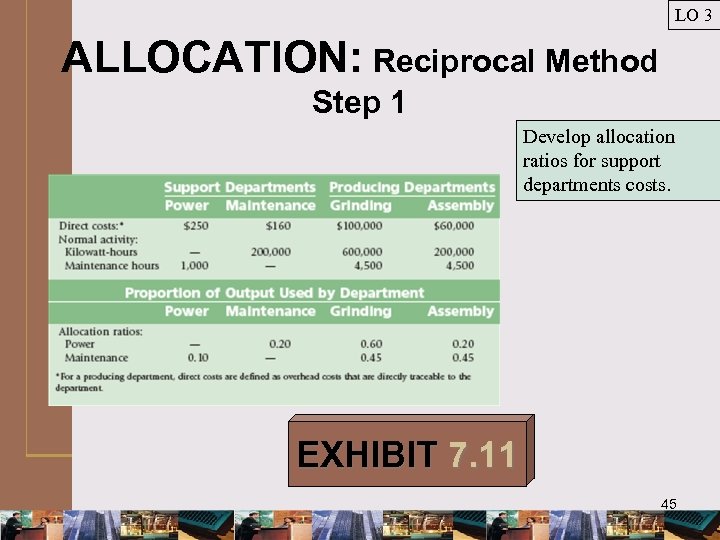
LO 3 ALLOCATION: Reciprocal Method Step 1 Develop allocation ratios for support departments costs. EXHIBIT 7. 11 45
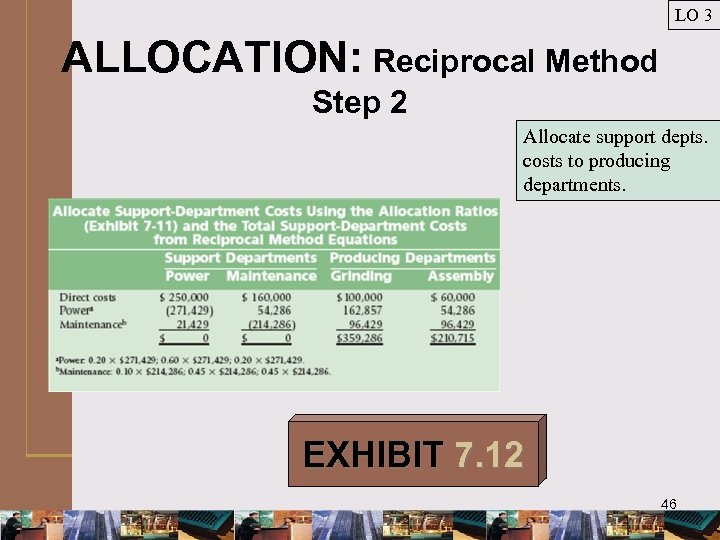
LO 3 ALLOCATION: Reciprocal Method Step 2 Allocate support depts. costs to producing departments. EXHIBIT 7. 12 46
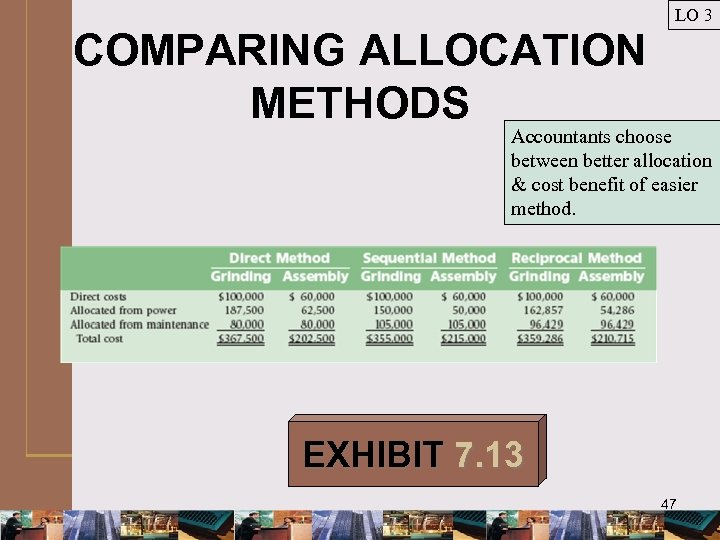
LO 3 COMPARING ALLOCATION METHODS Accountants choose between better allocation & cost benefit of easier method. EXHIBIT 7. 13 47
LEARNING OBJECTIVE 4 Compute departmental overhead rates. 48
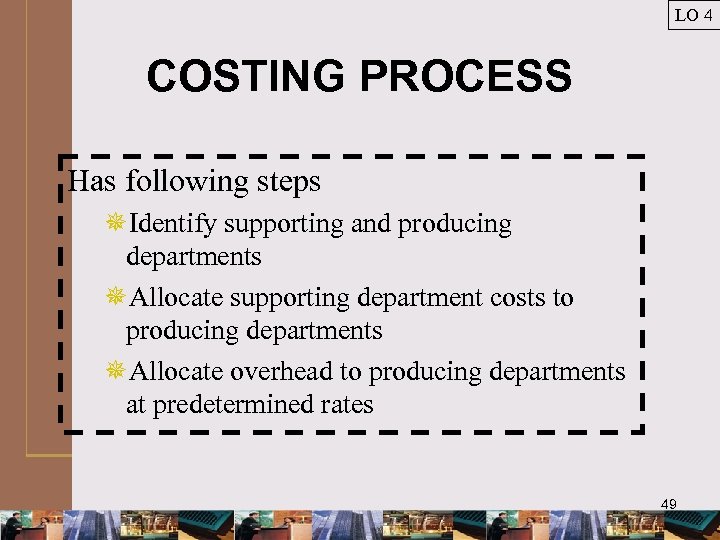
LO 4 COSTING PROCESS Has following steps ¯Identify supporting and producing departments ¯Allocate supporting department costs to producing departments ¯Allocate overhead to producing departments at predetermined rates 49
LEARNING OBJECTIVE 5 Describe the allocation of joint costs to products. (Appendix). 50
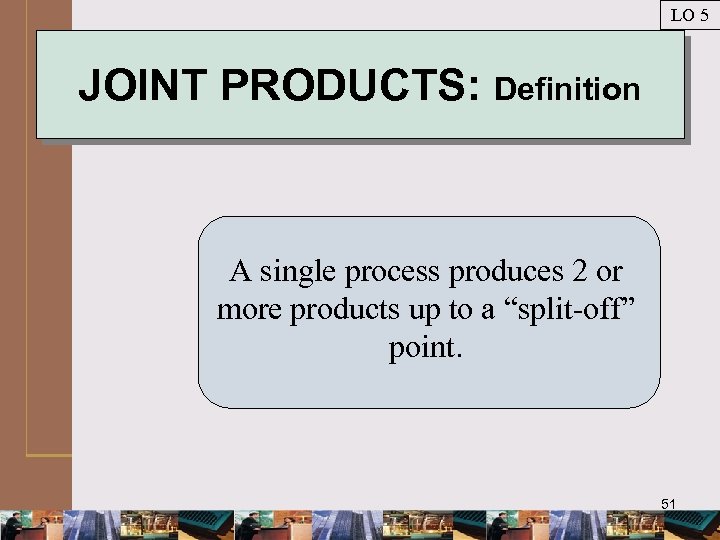
LO 5 JOINT PRODUCTS: Definition A single process produces 2 or more products up to a “split-off” point. 51
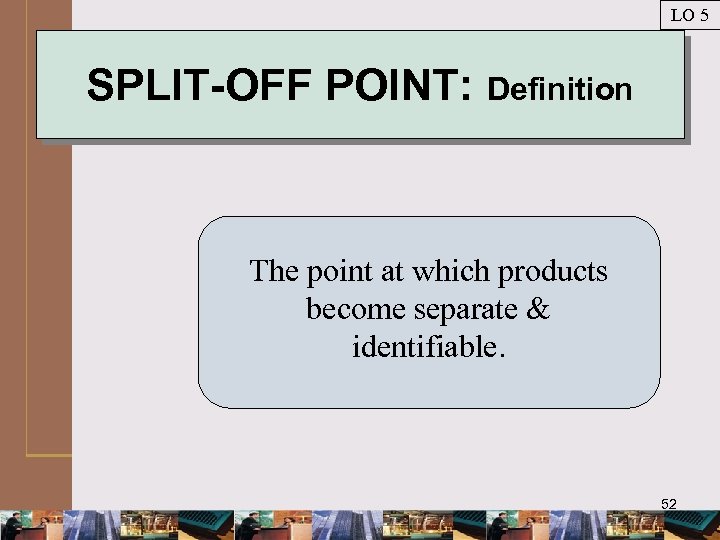
LO 5 SPLIT-OFF POINT: Definition The point at which products become separate & identifiable. 52
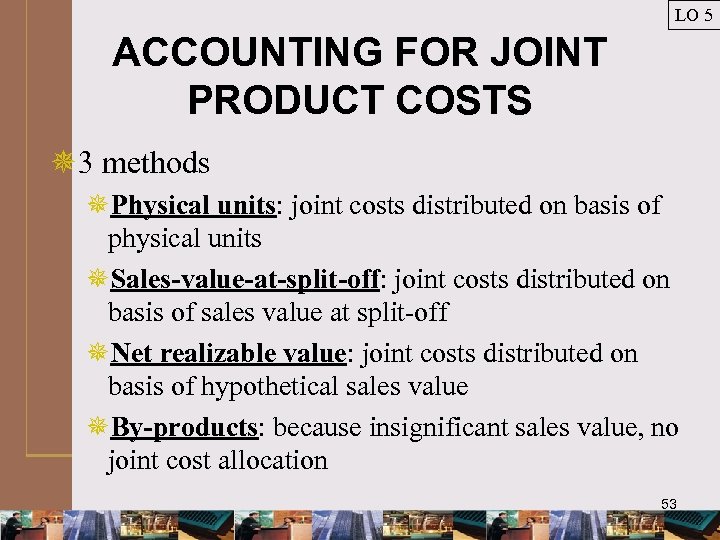
LO 5 ACCOUNTING FOR JOINT PRODUCT COSTS ¯ 3 methods ¯Physical units: joint costs distributed on basis of physical units ¯Sales-value-at-split-off: joint costs distributed on basis of sales value at split-off ¯Net realizable value: joint costs distributed on basis of hypothetical sales value ¯By-products: because insignificant sales value, no joint cost allocation 53

CHAPTER 7 THE END 54
Скачать презентацию Power Point Presentation by Gail B Wright Professor
8f8f7530e5fe74b4f20919183d398af3.ppt