 Скачать презентацию Power Point developed by SOUTHERN VIEW CHAPEL Pastor
165a3bf2e357c1c53962ad38126d5d13.ppt
- Количество слайдов: 139




Power. Point developed by SOUTHERN VIEW CHAPEL Pastor Gary E. Gilley Springfield, IL
BIBLIOLOGY The Doctrine of the Scriptures
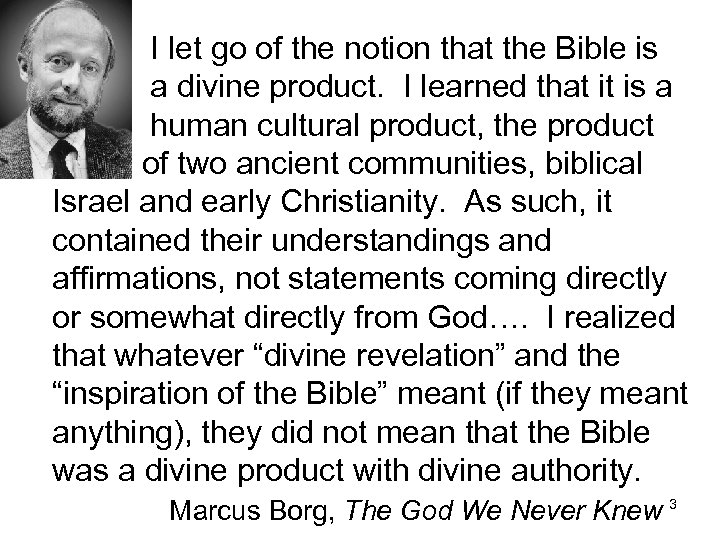
I let go of the notion that the Bible is a divine product. I learned that it is a human cultural product, the product of two ancient communities, biblical Israel and early Christianity. As such, it contained their understandings and affirmations, not statements coming directly or somewhat directly from God…. I realized that whatever “divine revelation” and the “inspiration of the Bible” meant (if they meant anything), they did not mean that the Bible was a divine product with divine authority. Marcus Borg, The God We Never Knew 3
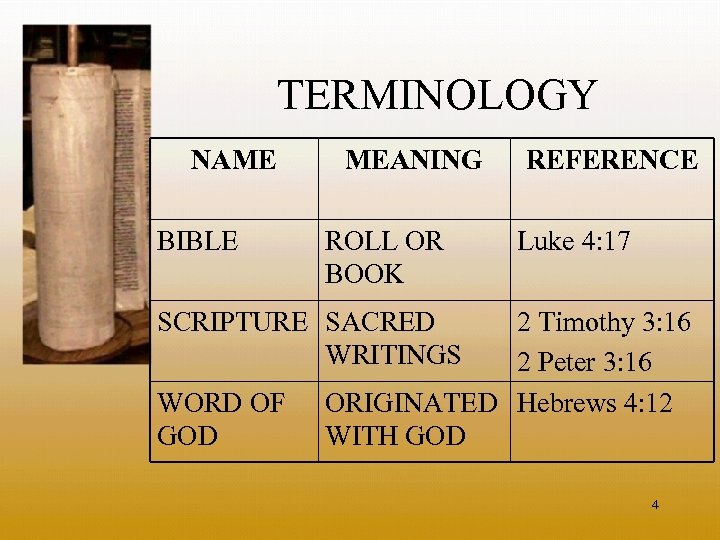
TERMINOLOGY NAME BIBLE MEANING ROLL OR BOOK REFERENCE Luke 4: 17 SCRIPTURE SACRED WRITINGS WORD OF GOD 2 Timothy 3: 16 2 Peter 3: 16 ORIGINATED Hebrews 4: 12 WITH GOD 4
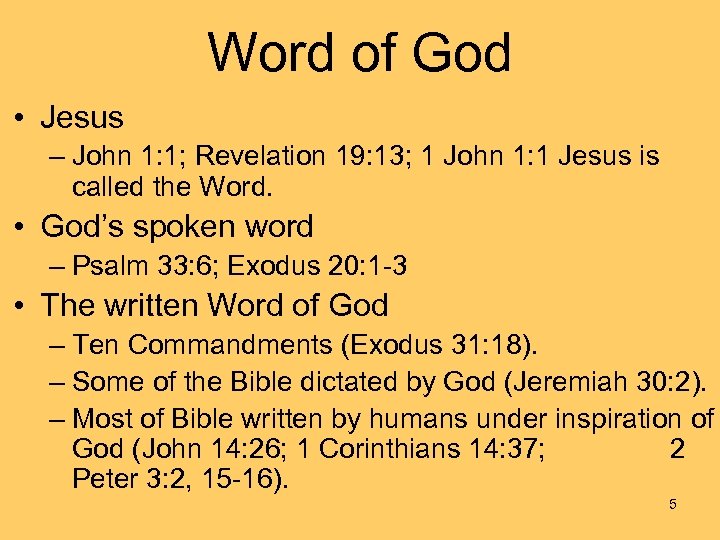
Word of God • Jesus – John 1: 1; Revelation 19: 13; 1 John 1: 1 Jesus is called the Word. • God’s spoken word – Psalm 33: 6; Exodus 20: 1 -3 • The written Word of God – Ten Commandments (Exodus 31: 18). – Some of the Bible dictated by God (Jeremiah 30: 2). – Most of Bible written by humans under inspiration of God (John 14: 26; 1 Corinthians 14: 37; 2 Peter 3: 2, 15 -16). 5
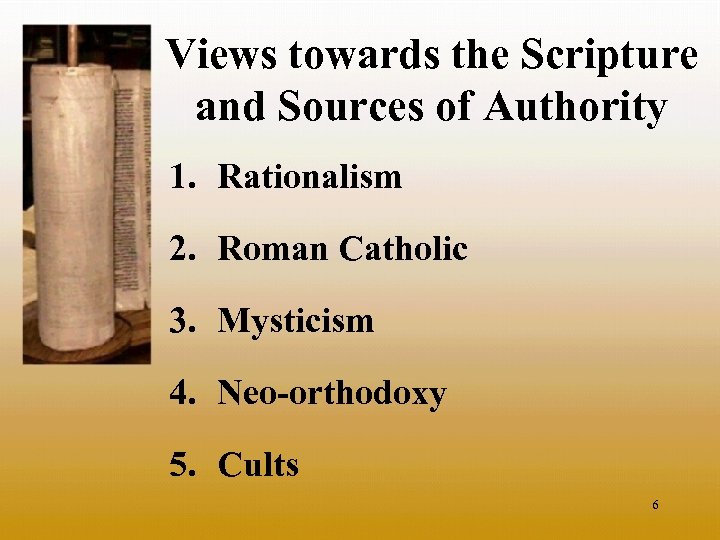
Views towards the Scripture and Sources of Authority 1. Rationalism 2. Roman Catholic 3. Mysticism 4. Neo-orthodoxy 5. Cults 6
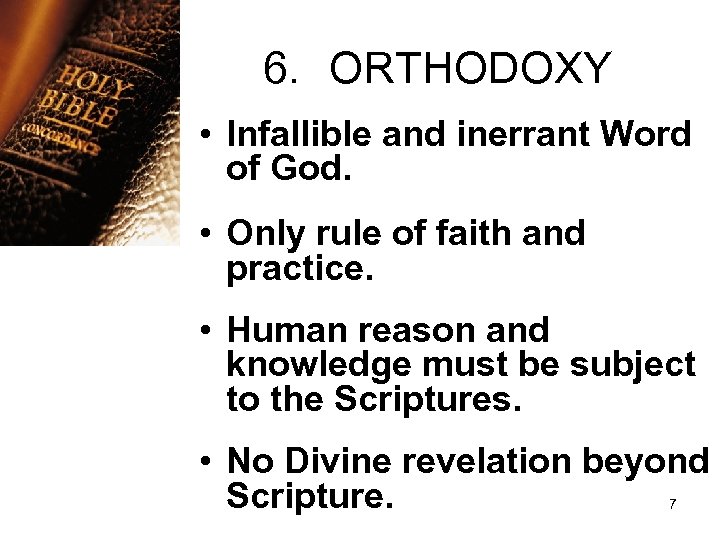
6. ORTHODOXY • Infallible and inerrant Word of God. • Only rule of faith and practice. • Human reason and knowledge must be subject to the Scriptures. • No Divine revelation beyond Scripture. 7
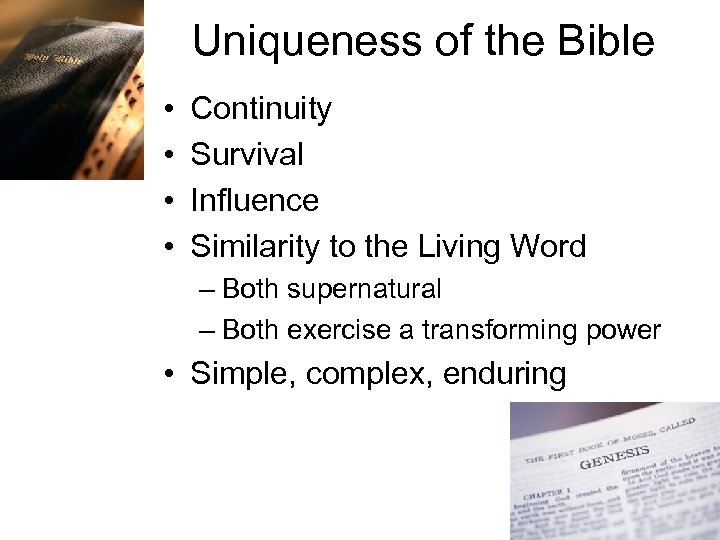
Uniqueness of the Bible • • Continuity Survival Influence Similarity to the Living Word – Both supernatural – Both exercise a transforming power • Simple, complex, enduring 8
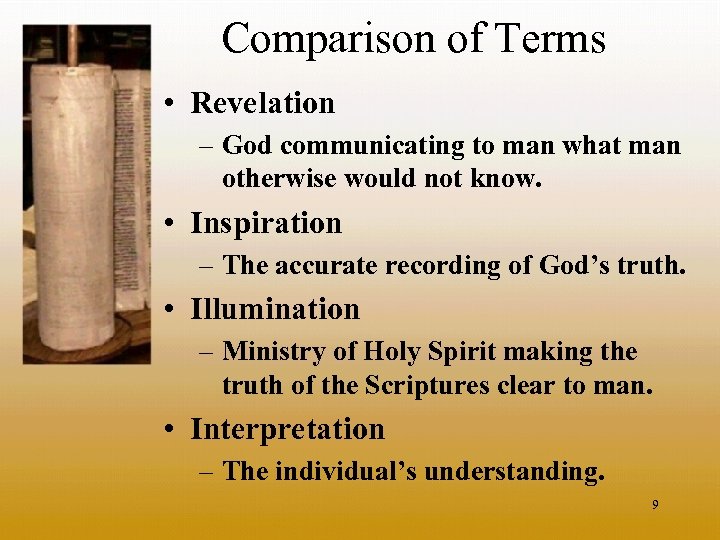
Comparison of Terms • Revelation – God communicating to man what man otherwise would not know. • Inspiration – The accurate recording of God’s truth. • Illumination – Ministry of Holy Spirit making the truth of the Scriptures clear to man. • Interpretation – The individual’s understanding. 9
Revelation Definition: disclosed to others what was before unknown to them. Simply means “unveiling. ” Ryrie 10
Divisions of revelation • General revelation – Nature (Romans 1: 20; Psalm 19: 1, 2) – Conscience (Romans 2: 14, 15) – Providence (Genesis 50: 20; 1 Samuel 2: 6 -10; Acts 2: 22 -23) – Preservation of the universe. (Colossians 1: 17) – Moral nature of mankind. (Genesis 1: 26; Acts 17: 29) 11
• Special revelation – Nation of Israel – Christ (John 1: 14, 18) – The Church (Ephesians 3: 3 -6) – Bible (Romans 15: 4) 12
Inspiration • Definition: – “God’s superintendence of the human authors so that using their own individual personalities, they composed and recorded without error His revelation to man in the words of the original autographs. ” Ryrie 13
Special features • God superintended. • God used human authors. • The product was, in its original manuscripts, without error. 14
EXTENT OF INSPIRATION • To the very words of Scripture. • To every part of the Scripture. – Matthew 5: 18 • To the original autographs. • No error in the original. • Guarantees the accuracy. 15
NATURE OF INSPIRATION • A dual authorship. • The Divine element in complete control, yet unconscious to the human author. • Portions dictated by God. 16
Scriptural evidence for verbal, plenary (complete) inspiration • Source – 2 Timothy 3: 16 • Method – 2 Peter 1: 20 -21 – Men were directed by the Holy Spirit but men spoke and wrote. • Specific commands to write the Word of the Lord: – Exodus 17: 14; 34: 27; Jeremiah 30: 2; 36: 2, 28; 1 Corinthians 14: 37; Revelation 1: 11 17
• Formula of quotation. – Acts 28: 25 • Uses of Scripture by Jesus Christ. – Matthew 5: 17, 18 – Matthew 24: 35 – Luke 24: 27, 44 – Matthew 4: 4, 7, 10 – John 10: 35 18
Writers of Scripture recognized other men’s writings as Scripture: • Daniel 9: 2, 11, 13 • Zechariah 7: 12 • Matthew 2: 15 • 1 Timothy 5: 18 • 2 Peter 3: 15, 16 19
The writers were conscious that they were writing God’s Word. 1 Corinthians 2: 13 20
Inerrancy & Infallibility Difference between: – Infallible includes the idea of trustworthiness. – Inerrant means truthfulness. 21
THE PROOF OF THE DOCTRINE • The witness of the Scripture. – Scripture that affirms the truthfulness of God. • John 3: 33; 17: 3, 8, 17; Romans 3: 4; 1 Thessalonians 1: 9 – Emphasize the abiding character of God. • Matthew 5: 17 -19; John 10: 33 -36 – Scripture in which the argument of the text is based upon a word or form of a word. • Matthew 22: 32; 22: 43 -45; John 8: 58; Galatians 3 • It involves faith. 22
Attitude Toward Difficulties in the Text • We should expect problems. • Difficulty in a doctrine does not prove that the doctrine is untrue. • There are more problems in a strictly human authorship. 23
• Because you or I cannot solve a problem does not mean it cannot be solved. • Seeming defects of the Bible are insignificant compared to excellencies of the Bible. • Difficulties have far more weight with superficial readers. • Difficulties rapidly disappear upon careful and prayerful study. 24
SUFFICIENCY OF SCRIPTURE • Three possible sources of truth. – Humans • Rationalism • Empiricism • Mysticism – Religion – Revelation 25
• Liberalism's view of Scripture. – Schleiermacher (1768 -1834) – Old Liberalism – New Liberalism: The Emergent Church 26
• Reasons for rejection of biblical sufficiency. – The temptation to give people what they want. – The centrality of Scripture has been substituted. – Compromise with worldly thought. 27
• Scripture claims to be the final authority: – 2 Timothy 3: 16 -17 – 2 Peter 1: 3 – Psalm 19 28
Inadequate theories of inspiration • NATURAL • DYNAMIC (mystical) • DICTATION (mechanical) • PARTIAL • CONCEPTUAL 29
• DEGREES of inspiration • NEO-ORTHODOX • ENDORSEMENT • INSPIRED PURPOSE 30
ILLUMINATION n A proper understanding of the Bible depends on two things: 1. Illuminating work of the Holy Spirit. 2. Interpreting work of the reader. 31
DEFINITION n The ministry of the Holy Spirit promised to men which: – Enables the unregenerate man to see the gospel. – Enables those believers who meet certain conditions to understand spiritual truth (Ephesians 1: 18, 19; Colossians 1: 9, 10). 32
AGENT – the Holy Spirit (Romans 8: 15 -16; 1 John 2: 20 -27) n Need for Illumination: 1. Depraved nature (1 Cor 2: 14; John 1: 5; Rom 3: 11 -12). 2. Satanic blindness (2 Cor 4: 3, 4). 3. Fleshly immaturity (1 Cor 3: 1 -3 a; 5: 11 -14). Heb 33
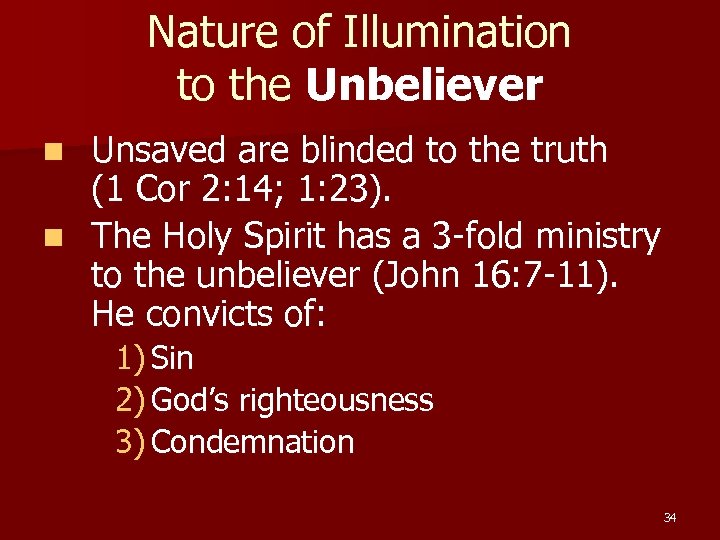
Nature of Illumination to the Unbeliever Unsaved are blinded to the truth (1 Cor 2: 14; 1: 23). n The Holy Spirit has a 3 -fold ministry to the unbeliever (John 16: 7 -11). He convicts of: n 1) Sin 2) God’s righteousness 3) Condemnation 34
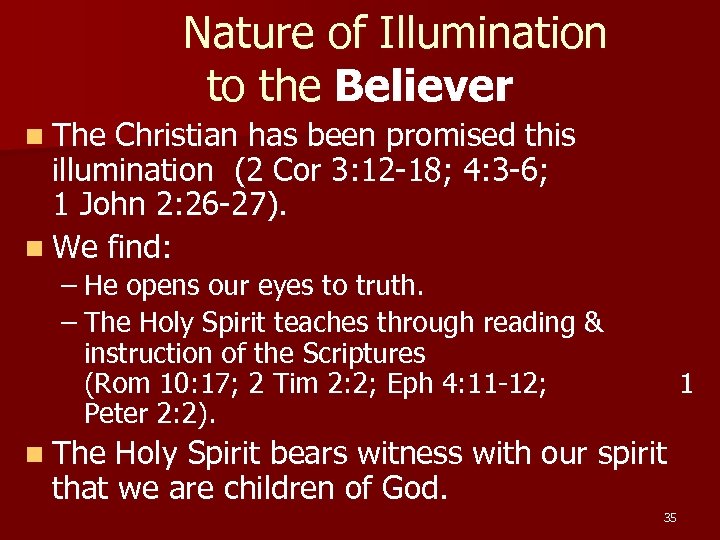
Nature of Illumination to the Believer n The Christian has been promised this illumination (2 Cor 3: 12 -18; 4: 3 -6; 1 John 2: 26 -27). n We find: – He opens our eyes to truth. – The Holy Spirit teaches through reading & instruction of the Scriptures (Rom 10: 17; 2 Tim 2: 2; Eph 4: 11 -12; Peter 2: 2). 1 n The Holy Spirit bears witness with our spirit that we are children of God. 35
HERMENEUTICS
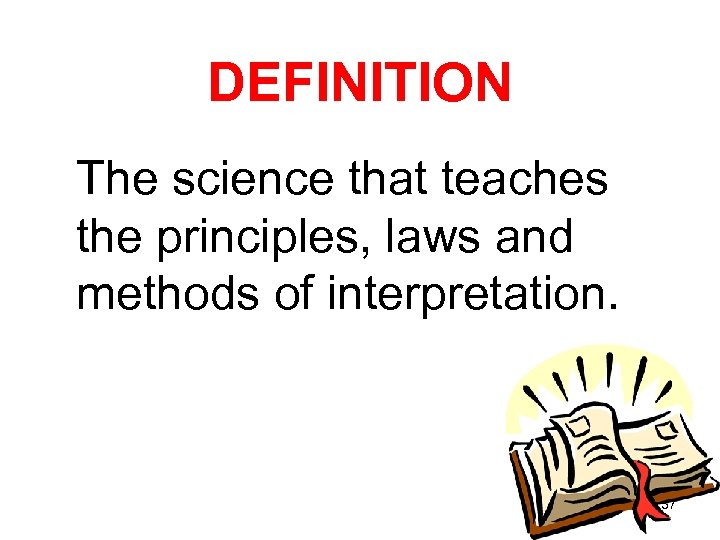
DEFINITION The science that teaches the principles, laws and methods of interpretation. 37
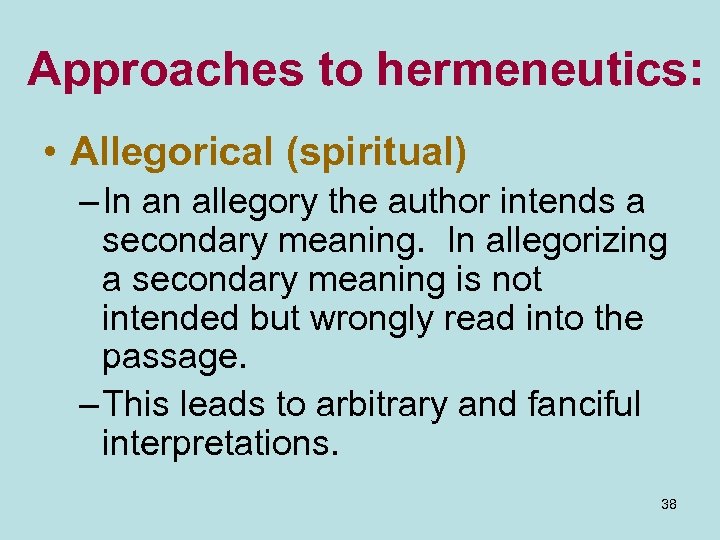
Approaches to hermeneutics: • Allegorical (spiritual) – In an allegory the author intends a secondary meaning. In allegorizing a secondary meaning is not intended but wrongly read into the passage. – This leads to arbitrary and fanciful interpretations. 38
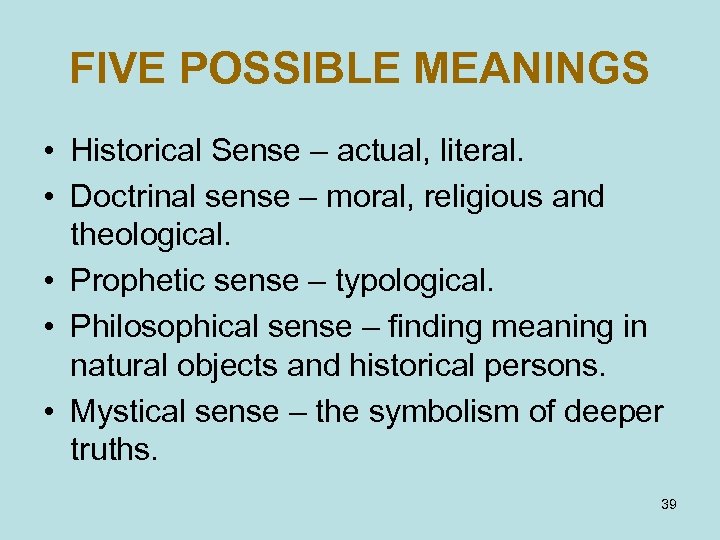
FIVE POSSIBLE MEANINGS • Historical Sense – actual, literal. • Doctrinal sense – moral, religious and theological. • Prophetic sense – typological. • Philosophical sense – finding meaning in natural objects and historical persons. • Mystical sense – the symbolism of deeper truths. 39
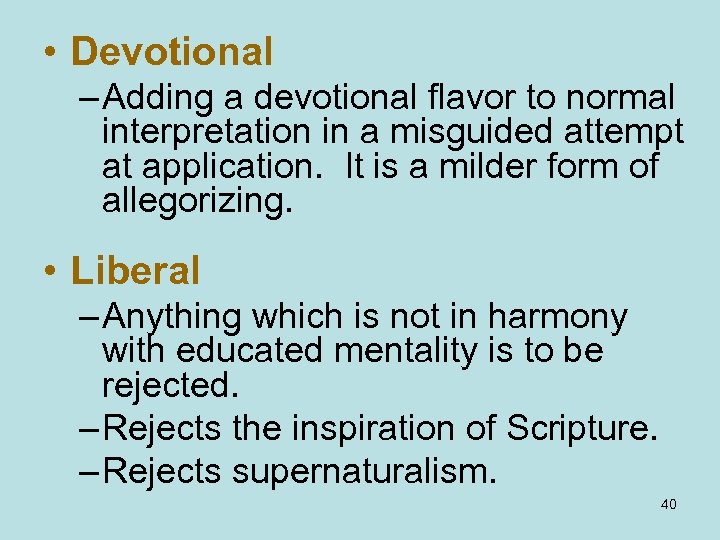
• Devotional – Adding a devotional flavor to normal interpretation in a misguided attempt at application. It is a milder form of allegorizing. • Liberal – Anything which is not in harmony with educated mentality is to be rejected. – Rejects the inspiration of Scripture. – Rejects supernaturalism. 40
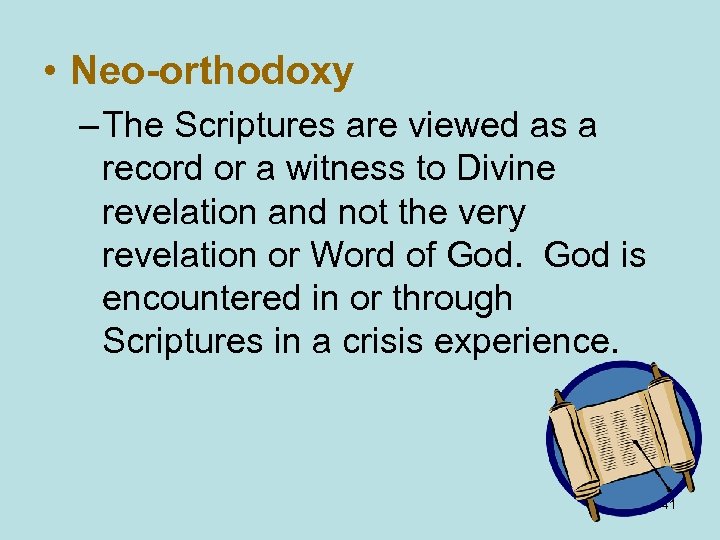
• Neo-orthodoxy – The Scriptures are viewed as a record or a witness to Divine revelation and not the very revelation or Word of God is encountered in or through Scriptures in a crisis experience. 41
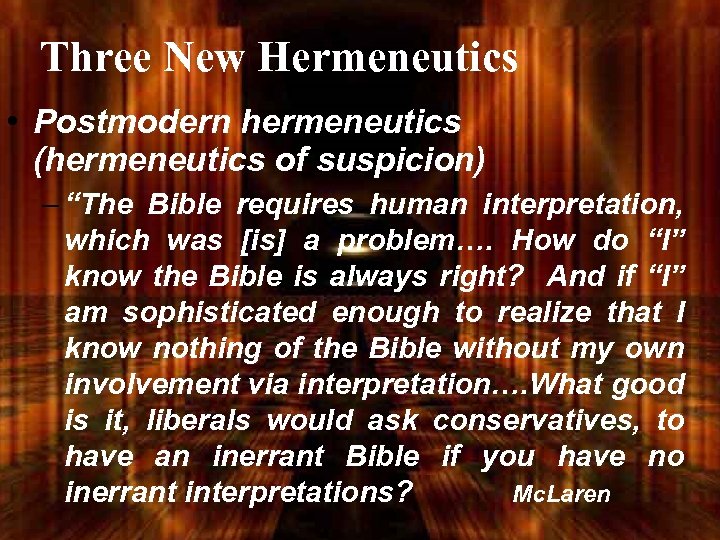
Three New Hermeneutics • Postmodern hermeneutics (hermeneutics of suspicion) – “The Bible requires human interpretation, which was [is] a problem…. How do “I” know the Bible is always right? And if “I” am sophisticated enough to realize that I know nothing of the Bible without my own involvement via interpretation…. What good is it, liberals would ask conservatives, to have an inerrant Bible if you have no inerrant interpretations? Mc. Laren
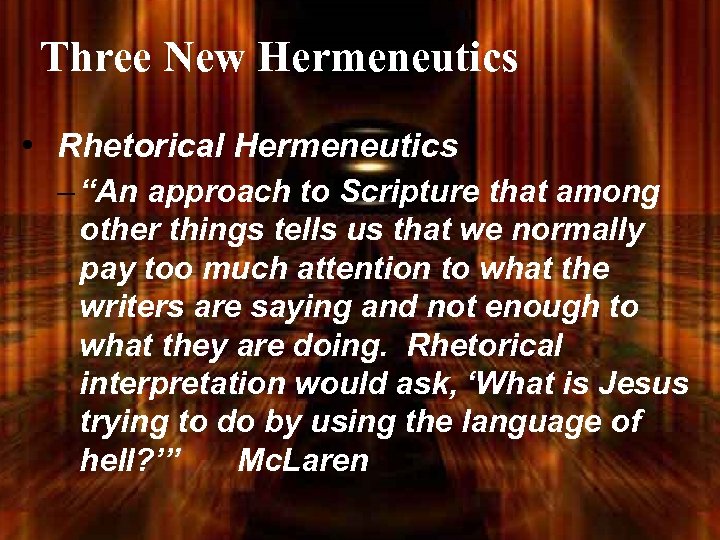
Three New Hermeneutics • Rhetorical Hermeneutics – “An approach to Scripture that among other things tells us that we normally pay too much attention to what the writers are saying and not enough to what they are doing. Rhetorical interpretation would ask, ‘What is Jesus trying to do by using the language of hell? ’” Mc. Laren
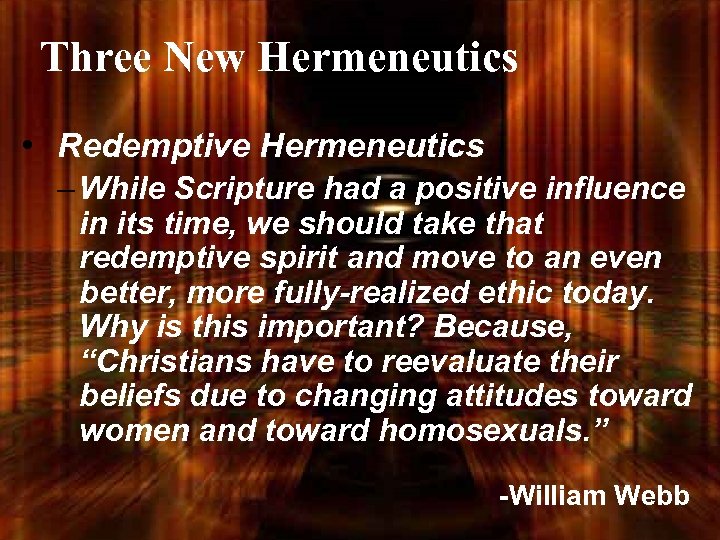
Three New Hermeneutics • Redemptive Hermeneutics – While Scripture had a positive influence in its time, we should take that redemptive spirit and move to an even better, more fully-realized ethic today. Why is this important? Because, “Christians have to reevaluate their beliefs due to changing attitudes toward women and toward homosexuals. ” -William Webb
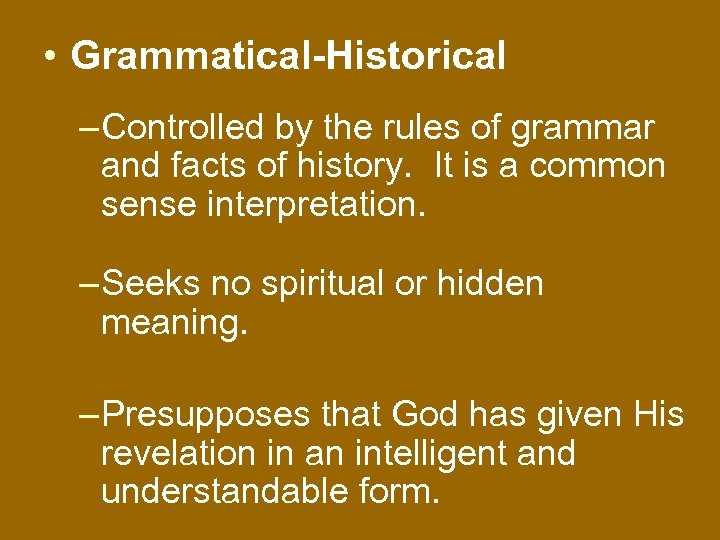
• Grammatical-Historical – Controlled by the rules of grammar and facts of history. It is a common sense interpretation. – Seeks no spiritual or hidden meaning. – Presupposes that God has given His revelation in an intelligent and understandable form.
’ PRINCIPLES OF SCRIPTURAL INTERPRETATION 46
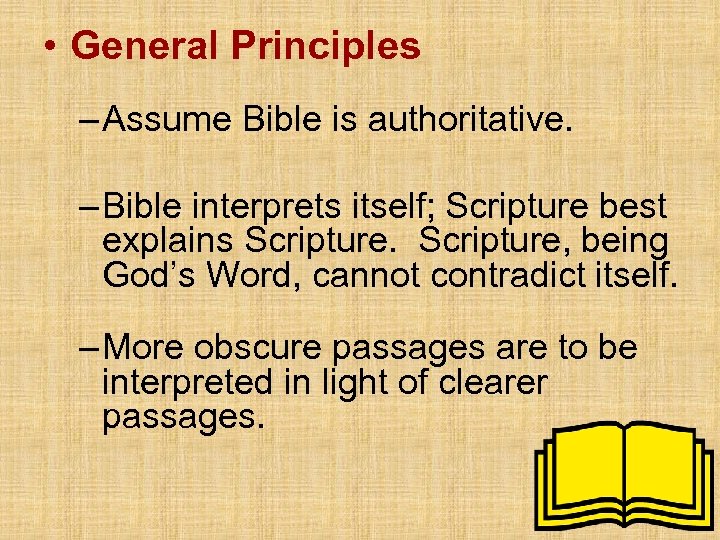
• General Principles – Assume Bible is authoritative. – Bible interprets itself; Scripture best explains Scripture, being God’s Word, cannot contradict itself. – More obscure passages are to be interpreted in light of clearer passages. 47
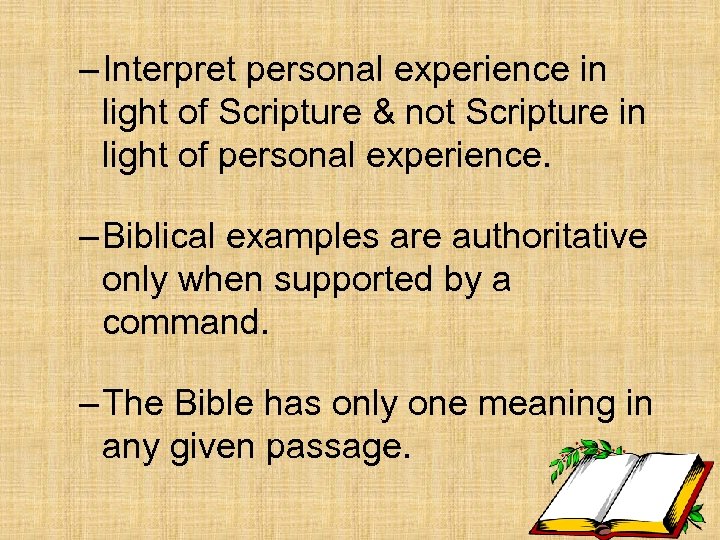
– Interpret personal experience in light of Scripture & not Scripture in light of personal experience. – Biblical examples are authoritative only when supported by a command. – The Bible has only one meaning in any given passage. 48
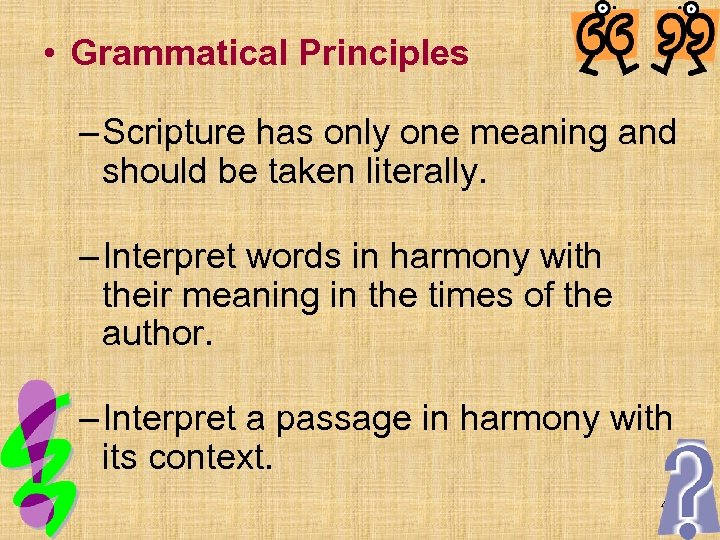
• Grammatical Principles – Scripture has only one meaning and should be taken literally. – Interpret words in harmony with their meaning in the times of the author. – Interpret a passage in harmony with its context. 49
– When an expression is out of character with the thing described, the statement may be considered figurative. – Interpret words of the prophets in their usual, literal and historical sense, unless they clearly have a symbolic meaning. 50
• Historical Principles – Since Scripture originated in a historical context, it can be understood only in light of biblical history. 51
– Though God’s revelation in the Scriptures is progressive, both Old and New Testaments are essential parts of this revelation and form a unit. –Historical facts or events become symbols of spiritual truths only if the Scriptures so designate them. 52
• Theological Principles – When two doctrines in the Bible appear to be contradictory, accept both as scriptural in the confident belief they will resolve themselves into a higher unity. – In areas of life not directly addressed in Scripture, we must develop personal convictions to govern behavior based on biblical principles. 53
How to Study the Bible 1. Observations • Involves reading, recording and reflecting. • Look for themes, repeated words, doctrines, promises, commands, etc. 54
• • Read thoughtfully. Read repeatedly. Read patiently. Read selectively (ask: who, what, where, when, why, and how). 55
• Read diversely. • Read meditatively (“You can’t be holy in a hurry”). • Read prayerfully. • Read purposefully (look for the intend of the author). • Read contextually (view the parts in light of the whole). 56
2. Interpretation • Always keep the context in mind. • Scripture never contradicts Scripture. • Carefully note the recipient. • Make wise use of study tools. 57
3. Application • First, understand the passage. • Ask, “So What. ” • Reflection. • Make life changes. 58
CANONICITY
FUNDAMENTALS • Canon means “rule” or “measuring rod. ” • The Bible is self-authenticating. • The books of Scripture were already God’s Word, men just recognized them as such. • Faith must be expressed. 60
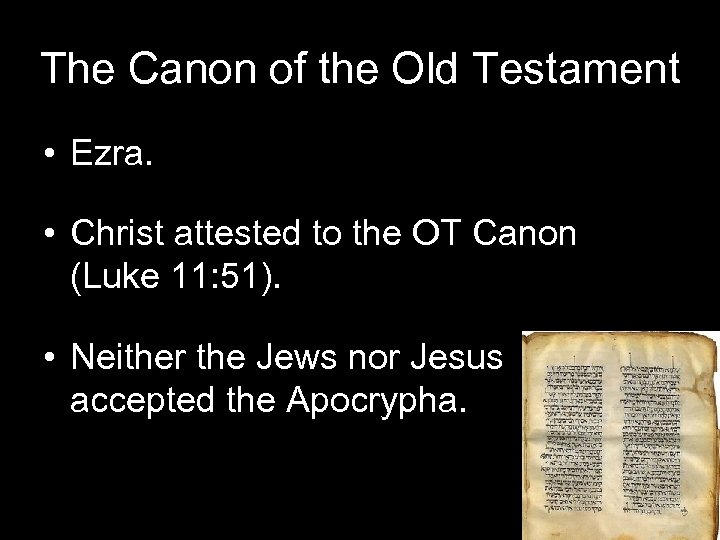
The Canon of the Old Testament • Ezra. • Christ attested to the OT Canon (Luke 11: 51). • Neither the Jews nor Jesus accepted the Apocrypha. 61
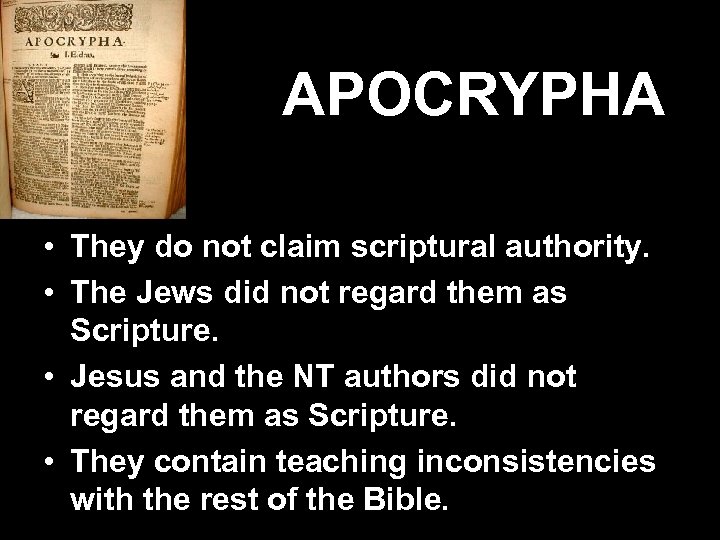
APOCRYPHA • They do not claim scriptural authority. • The Jews did not regard them as Scripture. • Jesus and the NT authors did not regard them as Scripture. • They contain teaching inconsistencies 62 with the rest of the Bible.
Principles for canonicity of NT books Jesus promised to empower His disciples to give His truth to the church. (John 14: 26; 16: 13 -14). 63
• That He gave them His authority is evident in the NT. – Hebrews 1: 1 -2; 2: 3 -4 – 2 Peter 3: 2 – Jude 17 – 1 Corinthians 2: 13; 14: 37 – 2 Corinthians 13: 3; Romans 2: 16 – Galatians 1: 8 -9 – 1 Thessalonians 2: 13; 4: 8; 5: 27 – 2 Thessalonians 3: 6, 14 64
Criteria for acceptance: • Writer’s authority. • Content. • Acceptance by the churches. 65
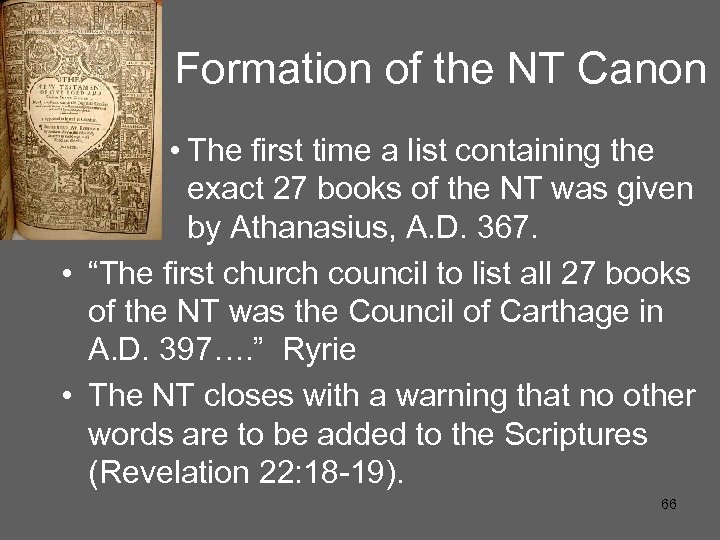
Formation of the NT Canon • The first time a list containing the exact 27 books of the NT was given by Athanasius, A. D. 367. • “The first church council to list all 27 books of the NT was the Council of Carthage in A. D. 397…. ” Ryrie • The NT closes with a warning that no other words are to be added to the Scriptures (Revelation 22: 18 -19). 66
Reliability of present text • • Original copies of the OT. Dead Sea Scrolls Translations More than 5000 manuscripts of the NT exist. • Many of these copies are early (A. D. 135 to 8 th century). • Codex Sinaiticus, Codex Vaticanus, Codex Alexandrius 67
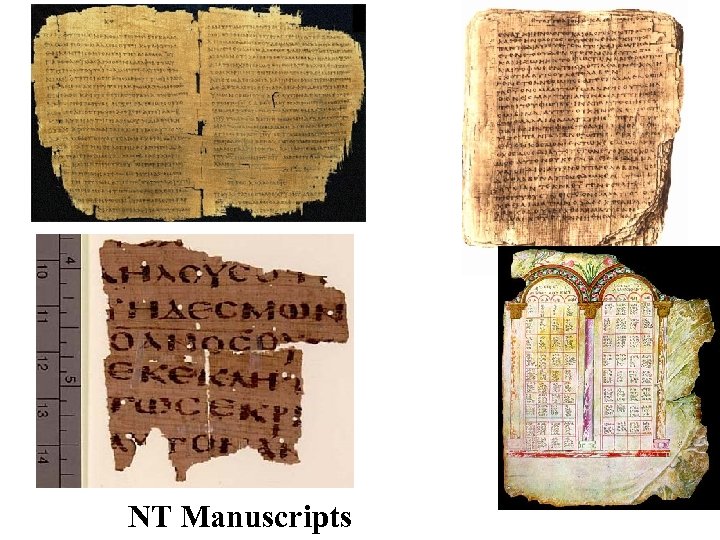
NT Manuscripts 68
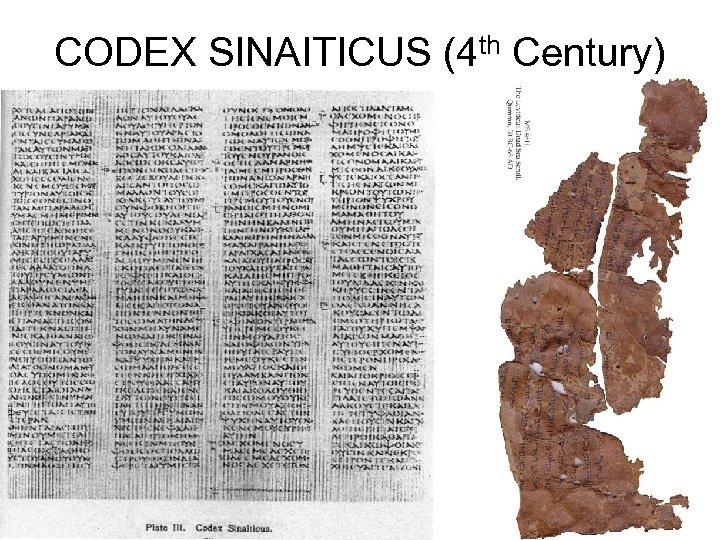
CODEX SINAITICUS (4 th Century) 69
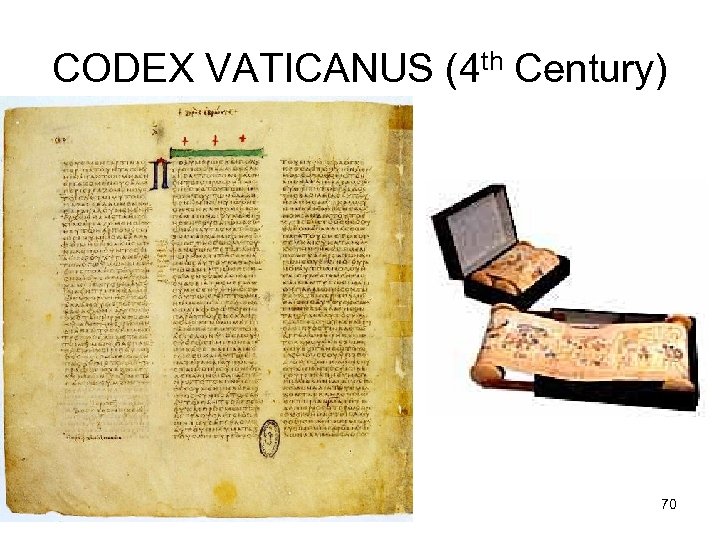
CODEX VATICANUS (4 th Century) 70
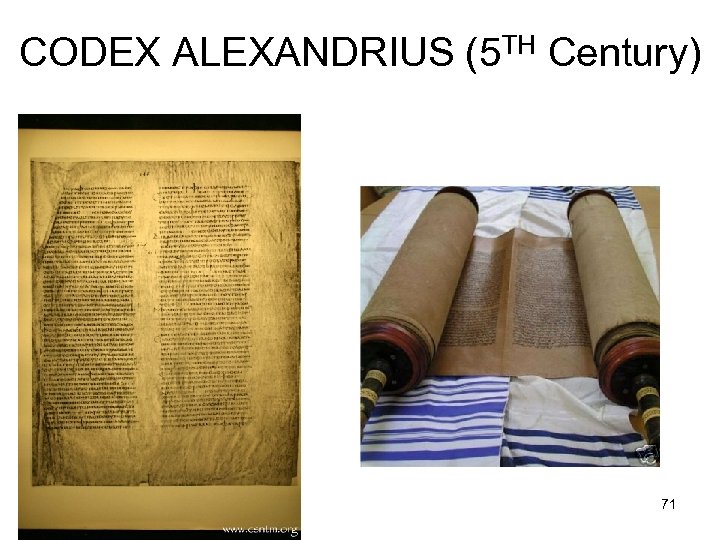
CODEX ALEXANDRIUS (5 TH Century) 71
Biblical Criticism “Biblical/textual criticism examines internal and external evidence in order to arrive at such conclusions as the dates and authorship of books and the legitimacy of textual readings. ” Christopher Cone 72
Two types of textual criticism. • Higher criticism (Liberal criticism seeks to destroy authority). – Address authorship & setting. – Challenges dates & authorship. – Challenges sources for Gospels. – Leads to an undermining of authority and inspiration of Scripture. 73
• Lower criticism – Textual criticism attempts to reconstruct the original wording of the original biblical text. – Disagreement over most reliable manuscripts. – Older English translations (KJV) based on Textus Receptus; newer translations (NASB, NIV, ESV) based on Alexandrian texts. – Textual criticism affirms we possess a biblical text that is accurate and reliable. 74
Ultimately our confidence in the Canon of Scripture on the faithfulness of God, who not only communicated to us through His Word but preserved and presented it to His people. 75
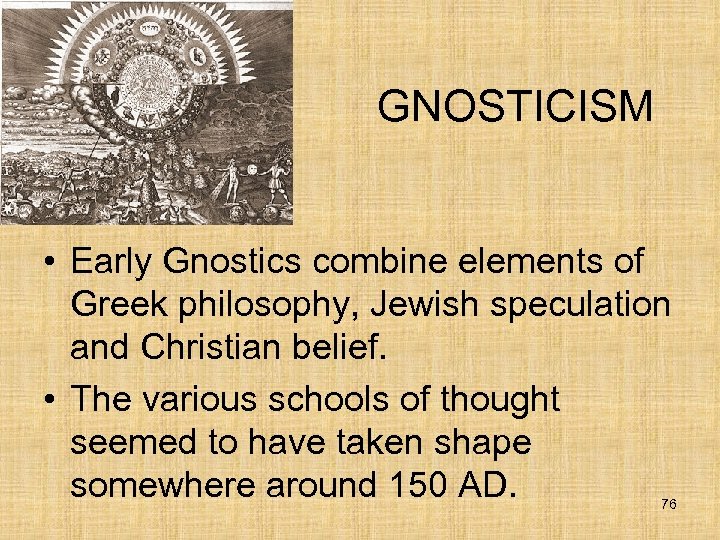
GNOSTICISM • Early Gnostics combine elements of Greek philosophy, Jewish speculation and Christian belief. • The various schools of thought seemed to have taken shape somewhere around 150 AD. 76
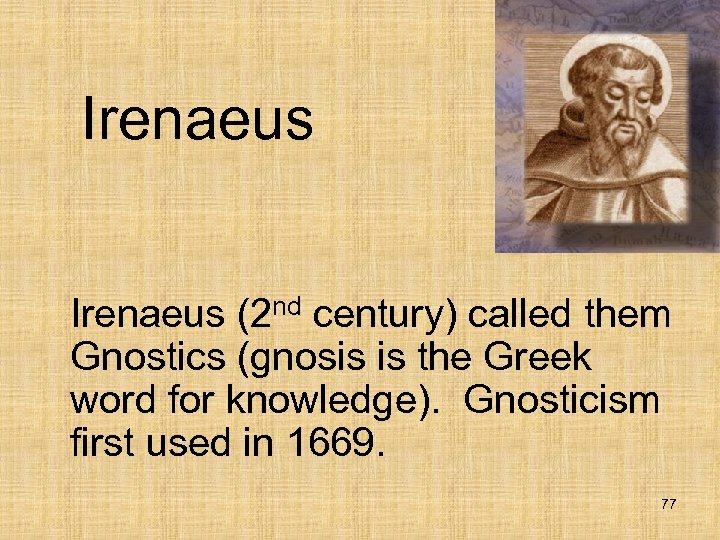
Irenaeus (2 nd century) called them Gnostics (gnosis is the Greek word for knowledge). Gnosticism first used in 1669. 77
Gnostics described themselves: • • • “off-spring of Seth” “the elect” “enlightened ones” “immovable race” “the perfect” Two early leaders were Basilides and Valentinus. 78
Nag Hammadi 1945 • 40 Gnostics writings—best known are: – The Gospel of Judas. – The Gospel of Philip. – The Gospel of Thomas. – The Gospel of Truth. 79
The Da Vinci Code Dan Brown states through his fictional character Teabing: “More than eighty gospels were considered for the New Testament and yet only a relatively few were chosen for inclusion. ” 80
GNOSTICS TEACH • Dualism—all matter is evil and its source in an evil creation. • Salvation—humanity is trapped in the material/human body. • Christ—Christ only appeared to be human. He provides salvation by delivering secret revelations. 81
• God—Gnostics identified the evil god/creator with the God of the OT (Demiurge). • World—physical universe, including human bodies, is inferior and must perish. Human body could not be immortal, Christ could not have been truly human, no bodily resurrection. Salvation is escape from this world. 82
ANIMATION • Definition of animation: – Giving life. – Theological – the vitality of life that is found in the Bible. • Scriptural proof: – Hebrews 4: 12 – Psalm 119 83
Preservation • Scripture – Psalm 119: 152 – Matthew 24: 35 – 1 Peter 1: 23 -25 John 10: 35 Isaiah 40: 8 • Theological presuppositions – It only makes sense that His word has to be preserved. – God sets forth the truth so that it always tests our faith. 84
CLARITY (PERSPICUITY) • Definition: – “The Bible is written in such a way that its teachings are able to be understood by all who will read it seeking God’s help and being willing to follow it. ” -Grudem 85
Eight aspects of perspicuity: • Clear enough for the simplest person to live by (Psalm 19: 7 b). • Deep enough for reading of the highest intellectual ability. • Scripture is clear in essential matters (e. g. John 3: 16). • Any obscurity is the fault of finite and sinful mankind. 86
• Interpreters of Scripture are to use normal means. • Even an unsaved person can understand the plain teachings of Scripture on an external level. • The Holy Spirit must illumine the mind of the reader. • Every Christian has the privilege to read and interpret the Bible for himself, his faith rests on the authority of Scripture and not the authority of the church. 87
BIBLICAL COVENANTS
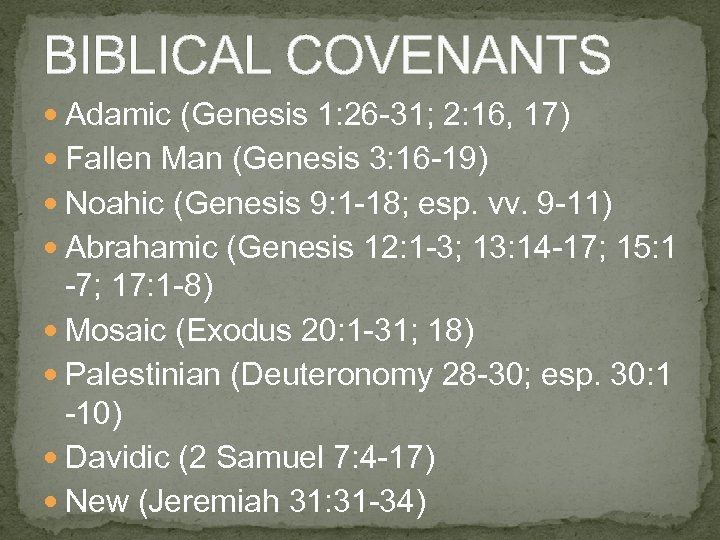
BIBLICAL COVENANTS Adamic (Genesis 1: 26 -31; 2: 16, 17) Fallen Man (Genesis 3: 16 -19) Noahic (Genesis 9: 1 -18; esp. vv. 9 -11) Abrahamic (Genesis 12: 1 -3; 13: 14 -17; 15: 1 -7; 17: 1 -8) Mosaic (Exodus 20: 1 -31; 18) Palestinian (Deuteronomy 28 -30; esp. 30: 1 -10) Davidic (2 Samuel 7: 4 -17) New (Jeremiah 31: 31 -34)
• Definition: – An arrangement or agreement. – “A covenant is an unchangeable divinely imposed legal agreement between God and man that stipulates the conditions of their relationship. ” Grudem • Two Classifications: – Conditional covenants. – Unconditional covenants. 90
ADAMIC • Conditional covenant “with Adam in which life and blessing or death and cursing were made to depend on the faithfulness of Adam. Human failure followed and the terms of the covenant were executed in righteousness. ” Chafer • Genesis 1: 26 -31; 2: 16, 17 91
COVENANT WITH FALLEN MAN • “This is an unconditional covenant in which God declares to man what his lot in life will be because of his sin. ” Chafer • Genesis 3: 16 -19 92
NOAHIC COVENANT • An unconditional covenant that promised mankind that the world would never again be destroyed by water. • Genesis 9: 1 -18 (v. 9 -11) 93
ABRAHAMIC COVENANT • Genesis 12: 1 -3; 13: 14 -17; 15: 1 -7; 17: 1 -8 • Provisions – Individual promise made to Abraham that he would become a great nation, emphasis on his descendents (“seed”) (13: 16). – National promise to Abraham’s seed, emphasis on the land (13: 14 -15). – Universal promise – blessing for all nations (12: 3). • Character – Unconditional, eternal covenant (Gen 13: 15; 17: 7 -8). 94
MOSAIC COVENANT • Conditional: God is saying if you keep my commandments I will bless you, if you do not I will curse you. • Exodus 20: 1 -31 • Deuteronomy 27 -28 • Deuteronomy 28: 63 -68 95
PALESTINIAN COVENANT • Importance (Deuteronomy 29 -30) – Reaffirms to Israel title deed to Palestine. – Pointed to the Mosaic covenant. – Confirms/enlarges provisions of Abrahamic Covenant. 96
PALESTINIAN COVENANT • Provisions (Deuteronomy 30: 1 -10) – Nation removed for unfaithfulness. – Repentance of the nation. – Israel restored to land. – Israel converted as nation. – Israel’s enemies judged. – Israel will receive full blessing. 97
PALESTINIAN COVENANT • Character – Unconditional (Ezekiel 16: 60) – Eternal (Ezekiel 16: 60) – Conditional blessings (Deut 30: 10) – Amplification of Abrahamic Covenant 98
DAVIDIC COVENANT • Guarantees Israel a King and a Kingdom. • Provisions (2 Sam 7: 8 -17) – David promised royal lineage, throne, Kingdom enduring forever (v. 13). – God reserved right to interrupt. • 2 Samuel 7: 14, 15; Psalm 89: 20 -37 – Cannot be broken (v. 16). – Christ will sit on this throne. • Luke 1: 31 -33 – Eternal, unconditional covenant. • Psalm 89, Isaiah 55: 3; Ezekiel 37: 25; Luke 1: 31 -33 99
THE NEW COVENANT Guarantees Israel that God will work with them, new heart – based on blood – anticipates death of Christ. – Jeremiah 30 -33 100
THE NEW COVENANT Provisions – New heart. • Jeremiah 31: 33 – Indwelling of Holy Spirit. • Jeremiah 31: 33; 2 Cor 3: 3 -6 – Restore favor and blessings of God. • Hosea 2: 18, 20 – Unique knowledge of God. • Jeremiah 31: 34 101
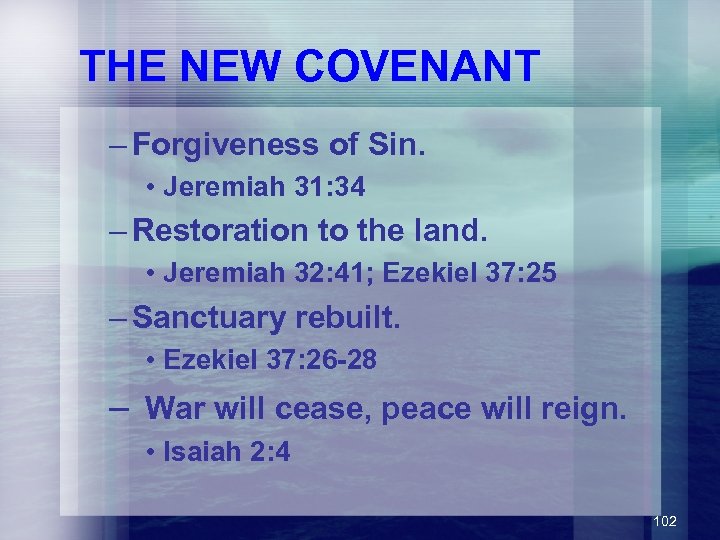
THE NEW COVENANT – Forgiveness of Sin. • Jeremiah 31: 34 – Restoration to the land. • Jeremiah 32: 41; Ezekiel 37: 25 – Sanctuary rebuilt. • Ezekiel 37: 26 -28 – War will cease, peace will reign. • Isaiah 2: 4 102
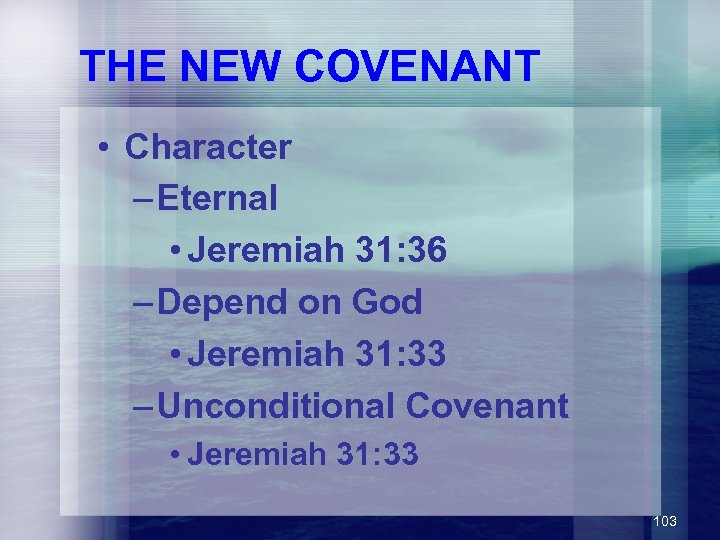
THE NEW COVENANT • Character – Eternal • Jeremiah 31: 36 – Depend on God • Jeremiah 31: 33 – Unconditional Covenant • Jeremiah 31: 33 103
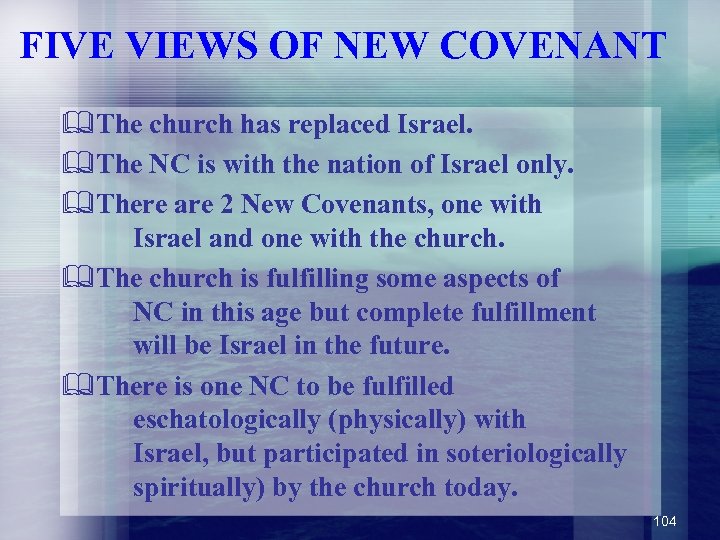
FIVE VIEWS OF NEW COVENANT &The church has replaced Israel. &The NC is with the nation of Israel only. &There are 2 New Covenants, one with Israel and one with the church. &The church is fulfilling some aspects of NC in this age but complete fulfillment will be Israel in the future. &There is one NC to be fulfilled eschatologically (physically) with Israel, but participated in soteriologically spiritually) by the church today. 104
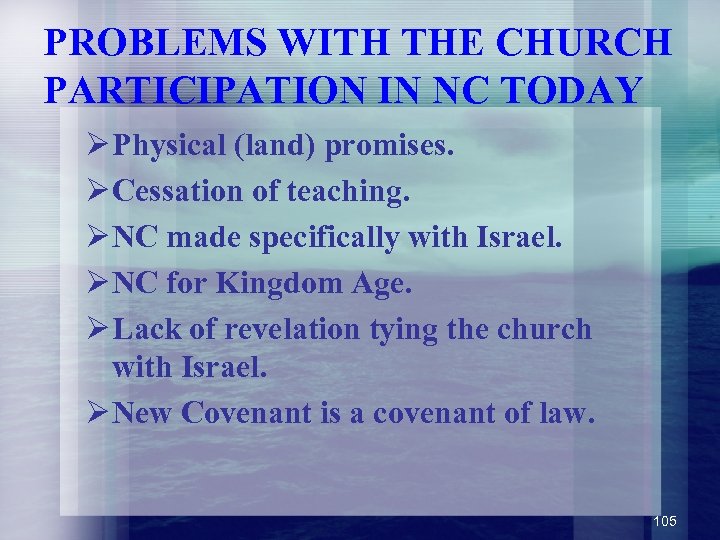
PROBLEMS WITH THE CHURCH PARTICIPATION IN NC TODAY Ø Physical (land) promises. Ø Cessation of teaching. Ø NC made specifically with Israel. Ø NC for Kingdom Age. Ø Lack of revelation tying the church with Israel. Ø New Covenant is a covenant of law. 105
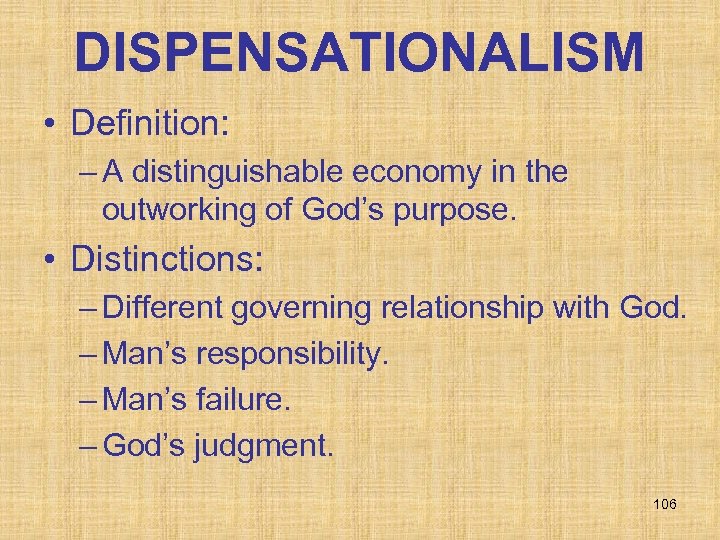
DISPENSATIONALISM • Definition: – A distinguishable economy in the outworking of God’s purpose. • Distinctions: – Different governing relationship with God. – Man’s responsibility. – Man’s failure. – God’s judgment. 106
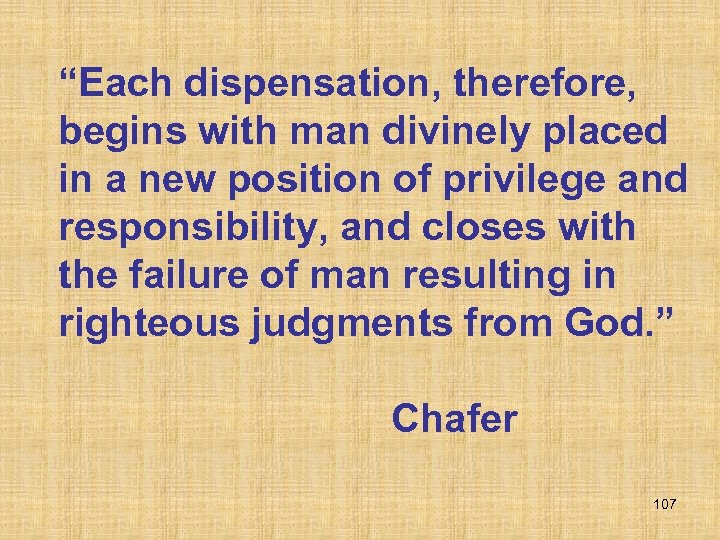
“Each dispensation, therefore, begins with man divinely placed in a new position of privilege and responsibility, and closes with the failure of man resulting in righteous judgments from God. ” Chafer 107
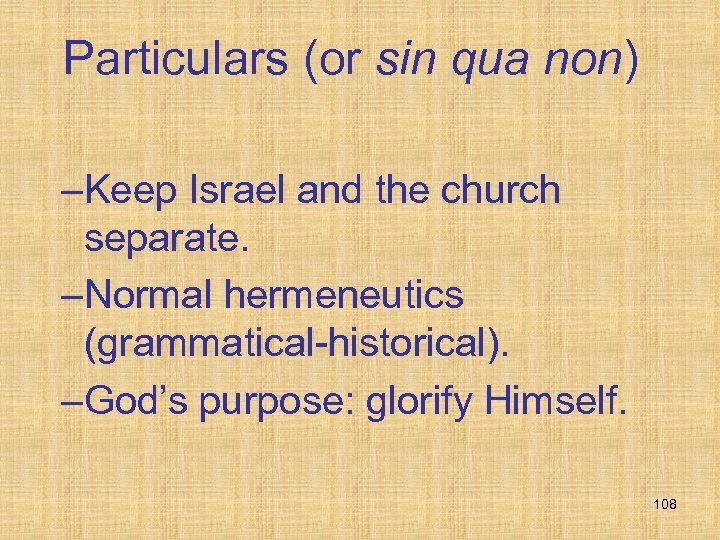
Particulars (or sin qua non) –Keep Israel and the church separate. –Normal hermeneutics (grammatical-historical). –God’s purpose: glorify Himself. 108
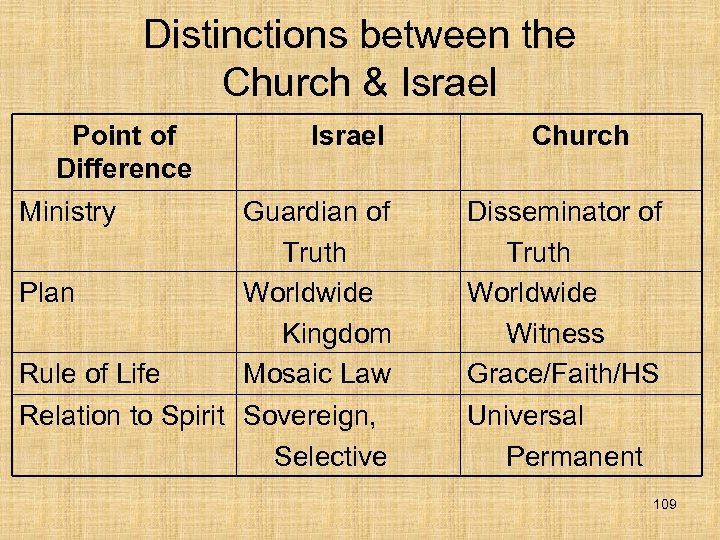
Distinctions between the Church & Israel Point of Difference Ministry Israel Guardian of Truth Plan Worldwide Kingdom Rule of Life Mosaic Law Relation to Spirit Sovereign, Selective Church Disseminator of Truth Worldwide Witness Grace/Faith/HS Universal Permanent 109
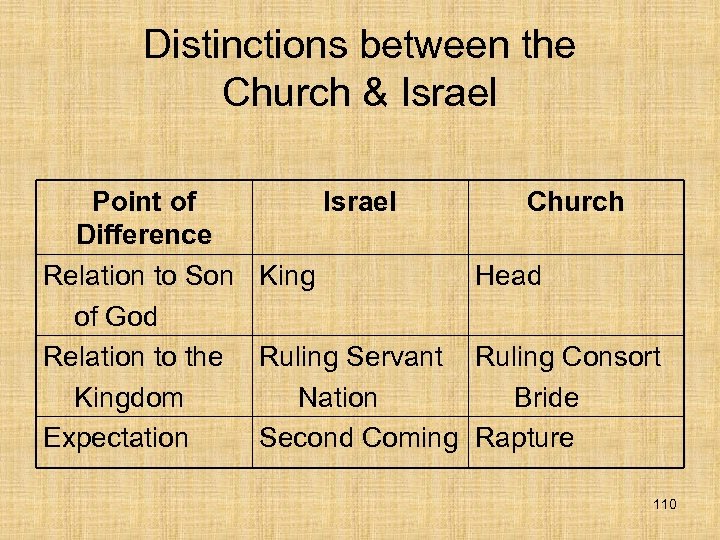
Distinctions between the Church & Israel Point of Israel Church Difference Relation to Son King Head of God Relation to the Ruling Servant Ruling Consort Kingdom Nation Bride Expectation Second Coming Rapture 110
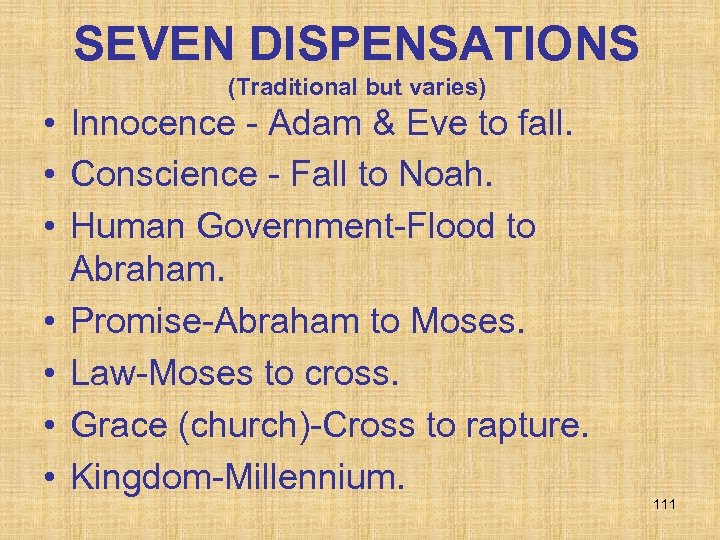
SEVEN DISPENSATIONS (Traditional but varies) • Innocence - Adam & Eve to fall. • Conscience - Fall to Noah. • Human Government-Flood to Abraham. • Promise-Abraham to Moses. • Law-Moses to cross. • Grace (church)-Cross to rapture. • Kingdom-Millennium. 111
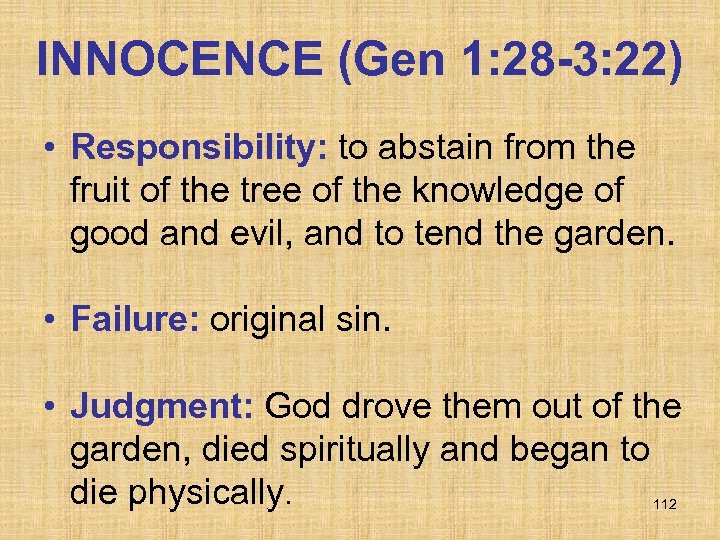
INNOCENCE (Gen 1: 28 -3: 22) • Responsibility: to abstain from the fruit of the tree of the knowledge of good and evil, and to tend the garden. • Failure: original sin. • Judgment: God drove them out of the garden, died spiritually and began to die physically. 112
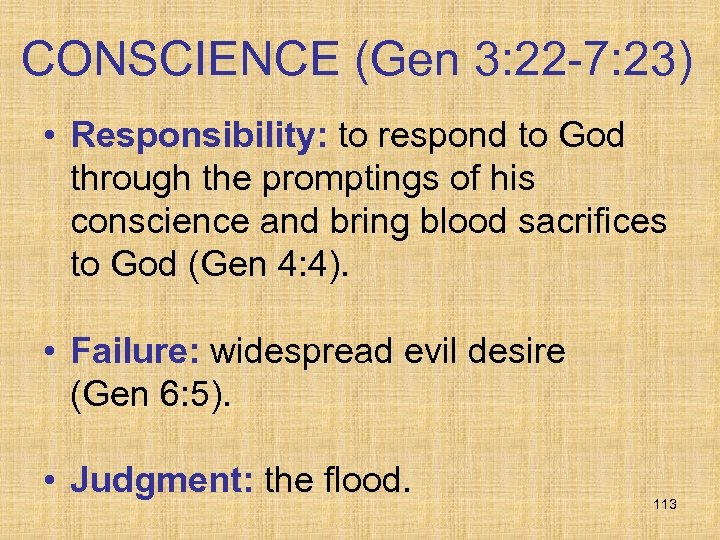
CONSCIENCE (Gen 3: 22 -7: 23) • Responsibility: to respond to God through the promptings of his conscience and bring blood sacrifices to God (Gen 4: 4). • Failure: widespread evil desire (Gen 6: 5). • Judgment: the flood. 113
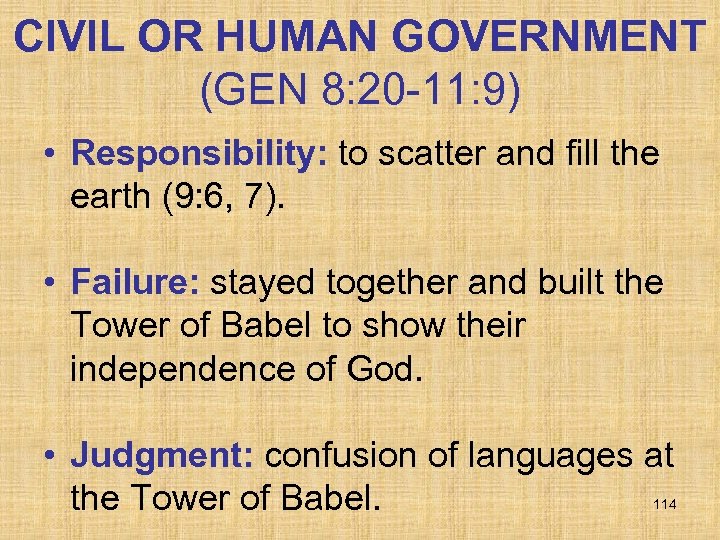
CIVIL OR HUMAN GOVERNMENT (GEN 8: 20 -11: 9) • Responsibility: to scatter and fill the earth (9: 6, 7). • Failure: stayed together and built the Tower of Babel to show their independence of God. • Judgment: confusion of languages at the Tower of Babel. 114
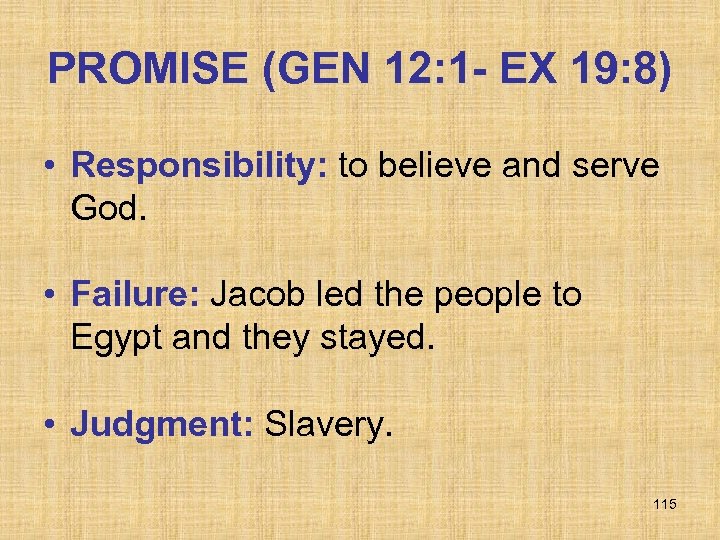
PROMISE (GEN 12: 1 - EX 19: 8) • Responsibility: to believe and serve God. • Failure: Jacob led the people to Egypt and they stayed. • Judgment: Slavery. 115
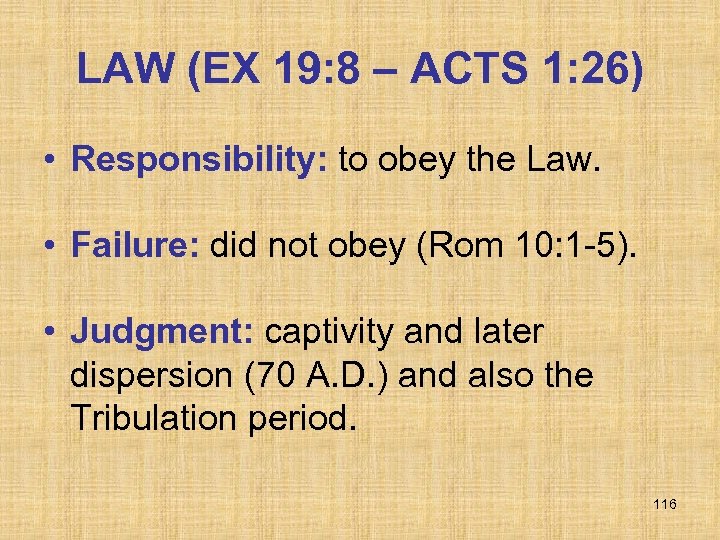
LAW (EX 19: 8 – ACTS 1: 26) • Responsibility: to obey the Law. • Failure: did not obey (Rom 10: 1 -5). • Judgment: captivity and later dispersion (70 A. D. ) and also the Tribulation period. 116
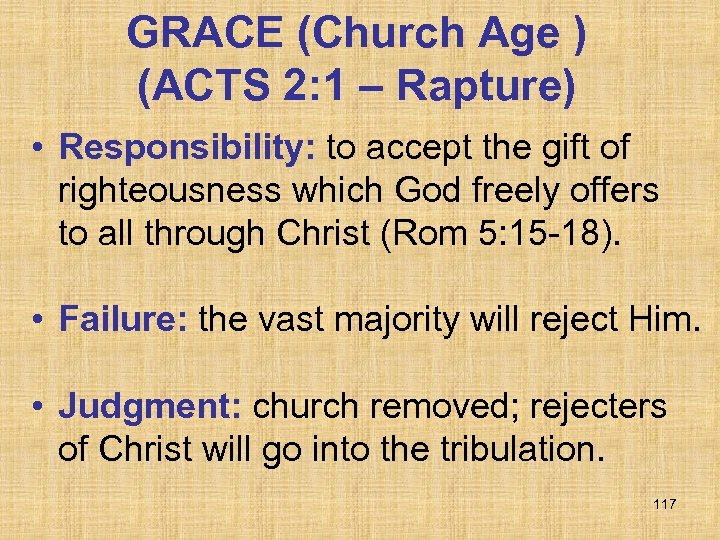
GRACE (Church Age ) (ACTS 2: 1 – Rapture) • Responsibility: to accept the gift of righteousness which God freely offers to all through Christ (Rom 5: 15 -18). • Failure: the vast majority will reject Him. • Judgment: church removed; rejecters of Christ will go into the tribulation. 117
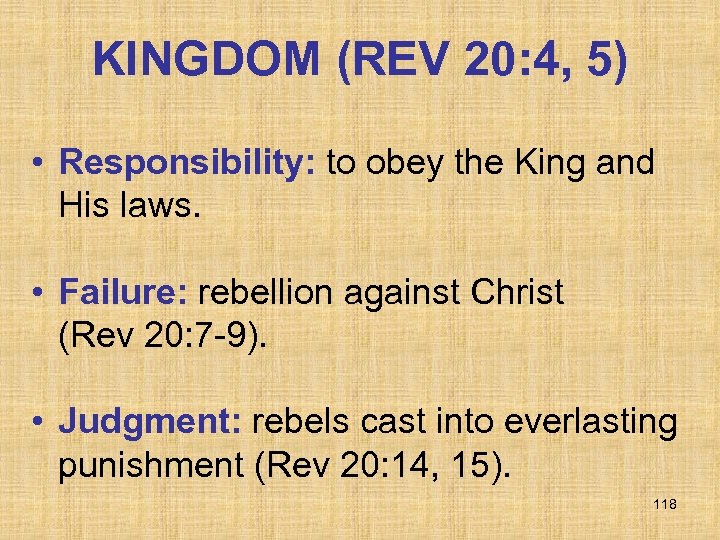
KINGDOM (REV 20: 4, 5) • Responsibility: to obey the King and His laws. • Failure: rebellion against Christ (Rev 20: 7 -9). • Judgment: rebels cast into everlasting punishment (Rev 20: 14, 15). 118
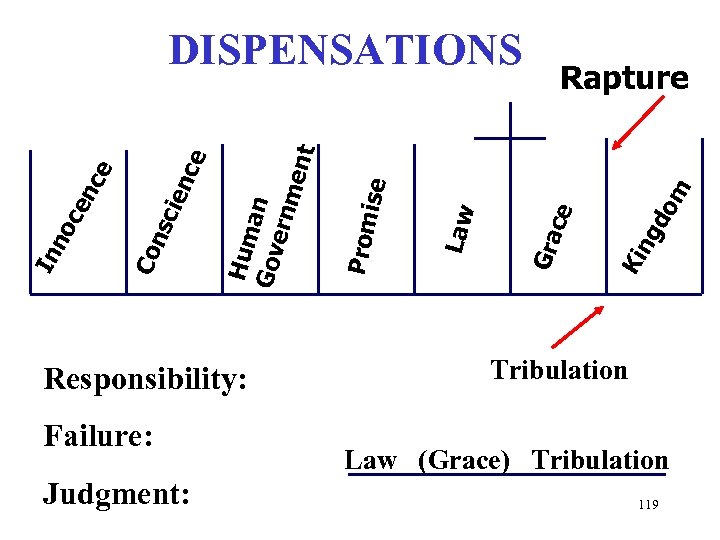
Responsibility: Failure: Judgment: Rapture m ng do Ki ce Gra Law Prom ise t Hum Gov an ernm en ien nsc Co In no ce nc e ce DISPENSATIONS Tribulation Law (Grace) Tribulation 119
COVENANT THEOLOGY
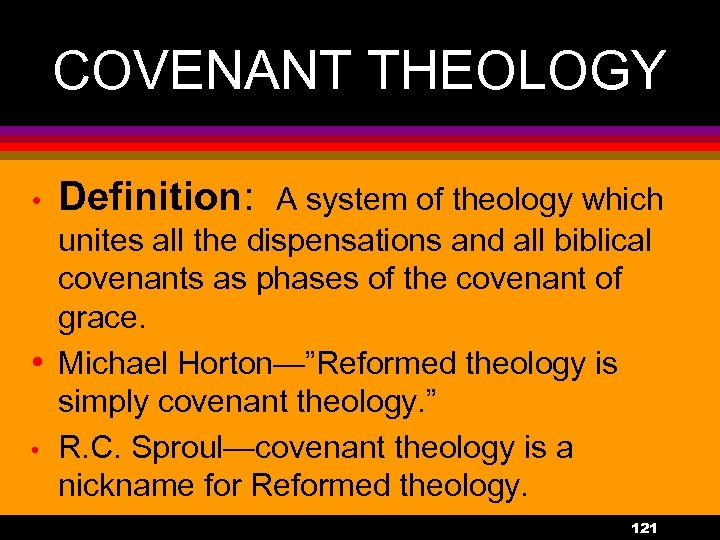
COVENANT THEOLOGY Definition: A system of theology which unites all the dispensations and all biblical covenants as phases of the covenant of grace. • Michael Horton—”Reformed theology is simply covenant theology. ” • R. C. Sproul—covenant theology is a nickname for Reformed theology. • 121
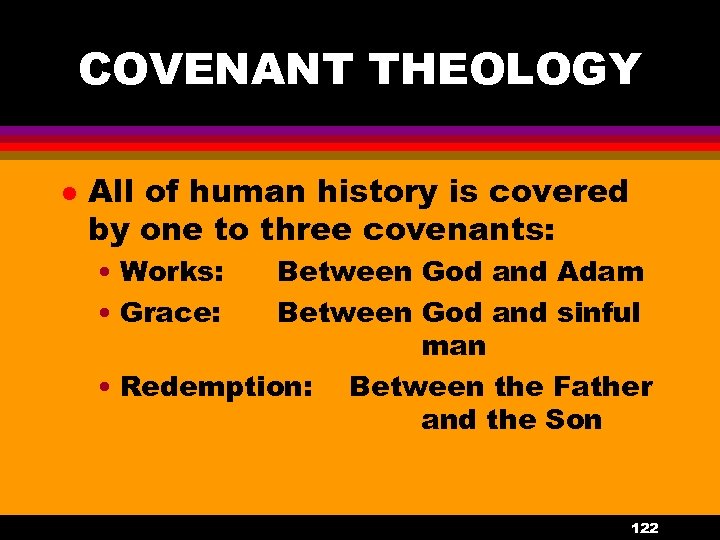
COVENANT THEOLOGY l All of human history is covered by one to three covenants: • Works: • Grace: Between God and Adam Between God and sinful man • Redemption: Between the Father and the Son 122
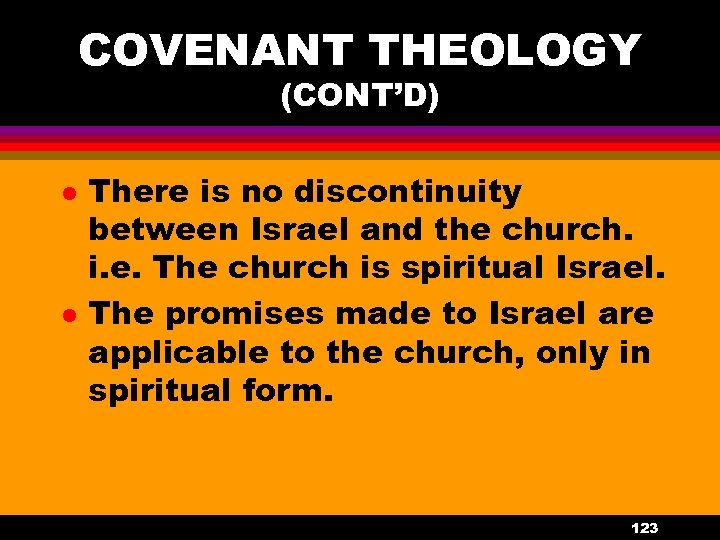
COVENANT THEOLOGY (CONT’D) l l There is no discontinuity between Israel and the church. i. e. The church is spiritual Israel. The promises made to Israel are applicable to the church, only in spiritual form. 123
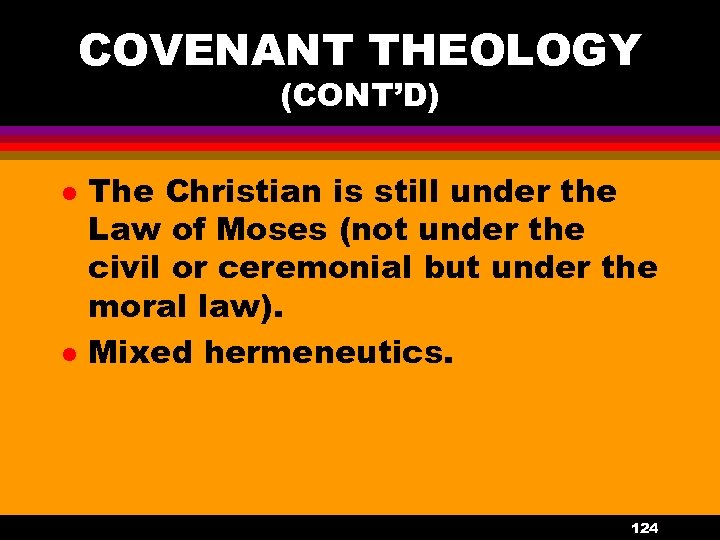
COVENANT THEOLOGY (CONT’D) l l The Christian is still under the Law of Moses (not under the civil or ceremonial but under the moral law). Mixed hermeneutics. 124
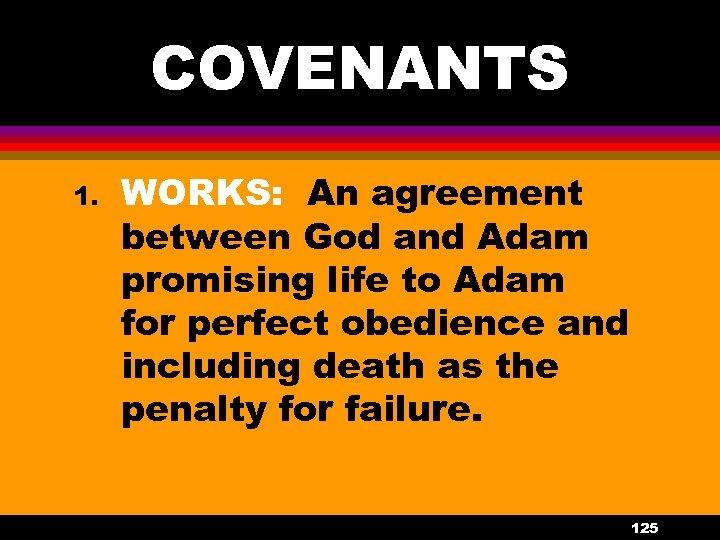
COVENANTS 1. WORKS: An agreement between God and Adam promising life to Adam for perfect obedience and including death as the penalty for failure. 125
COVENANTS 2. GRACE: The gracious agreement between the offended God and the offending but elect sinner, in which God promises salvation through faith in Christ and the sinner accepts this believingly, promising a life of faith and obedience. 126
COVENANTS 3. REDEMPTION: Made in eternity past and became the basis for the covenant of grace. This covenant of redemption is the agreement between the Father giving the Son as Head and Redeemer of the elect, and the Son, voluntarily taking the place of those whom the Father had given Him. 127
KEY DISTINCTIONS 1. 2. Covenant theology is not based upon direct revelation but upon reason and logic. Nowhere does Scripture speak of these covenants directly. Covenant theologians see little distinction between biblical living in the OT and NT, or between Israel and the church. 128
KEY DISTINCTIONS 3. 4. They do not use literal hermeneutics in areas of prophecy. The church, not literal Israel, is the recipient of the covenant promises. Thus, the church is spiritual Israel. C. T. rejects the land promise given to Abraham. 129
KEY DISTINCTIONS 5. Under Covenant Theology the distinction between Law and grace as a rule of life is blurred. 130
l l An individual is brought into the covenant of grace at baptism but is not saved at that point and can fall away. “The New Testament lays before us a vast array of conditions for final salvation: repentance, faith, perseverance demonstrated in love toward God and neighbor. ” Horton 131
KEY DISTINCTIONS 6. Reformed Christians are represented in all three major eschatological camps (premillennialism, postmillennialism and amillennialism). 132
CONTRASTS between COVENANT THEOLOGY and DISPENSATIONALISM n Covenant theologian Louis Berkhof recognizes two major dispensations: that of the OT & NT. n Four other dispensations (which he calls covenants): 1) Garden, 2) Noah, 3) Abraham, 4) Israel. 133
“On points where we differ, there is a tendency for the dispensationalist to be literalistic where the nondispensationalist tends to interpret the Bible figuratively. ” John Gerstner 134
“The theory is based on a literal interpretation of the prophetic delineations of the future of Israel and the kingdom of God, which is entirely untenable. ” Louis Berkhoff 135
COVENANT & DISPENSATIONAL THEOLOGY DIFFERS IS EVERY AREA OF THEOLOGY n Christology – Christ sits presently on David’s throne, signifying the kingdom age has begun. n Pneumatology – Holy Spirit’s ministry is the same in OT and NT. n Angelology – Satan and demons are chained at this time. n Soteriology – Salvation of humans is the overriding them of entire Bible. 136
n Ecclesiology – Origin of the church. ”The church is the community of all believers for all time. ” Grudem – Members of the church. – Church & Israel. 137
–Church and the kingdom “The church has now become the true Israel of God and will receive all the blessings promised to Israel in the Old Testament. ” Grudem 138
n Eschatology – Amillennialists believe the millennium is now in process of realization. Postmillennialists teach that the church age will eventually become the kingdom through the preaching of the gospel. n Bibliology – A mix of grammaticalhistorical and allegorical hermeneutics. 139
Скачать презентацию Power Point developed by SOUTHERN VIEW CHAPEL Pastor
165a3bf2e357c1c53962ad38126d5d13.ppt