 Скачать презентацию Power Notes Introduction to Accounting and Business Learning
959fb7296031c53aa74ffe3aa6d7b60c.ppt
- Количество слайдов: 147



Power Notes Introduction to Accounting and Business Learning Objectives 1. 2. 3. 4. 5. 6. 7. 8. 9. Nature of a Business The Role of Accounting in Business Ethics Profession of Accounting Generally Accepted Accounting Principles Assets, Liabilities, and Owner’s Equity Business Transactions Financial Statements Financial Analysis and Interpretation
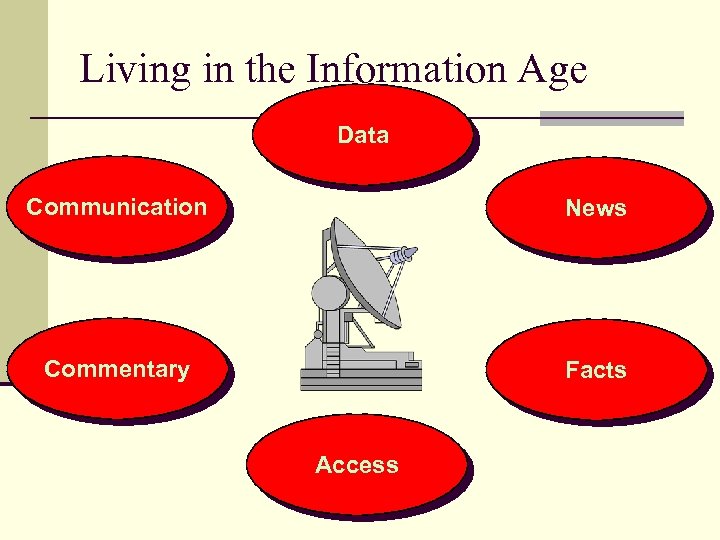
Living in the Information Age Data Communication News Commentary Facts Access
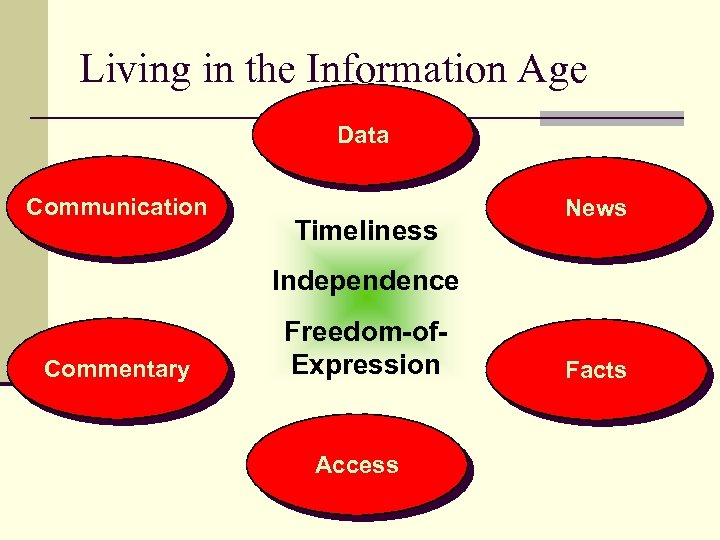
Living in the Information Age Data Communication Timeliness News Independence Commentary Freedom-of. Expression Access Facts
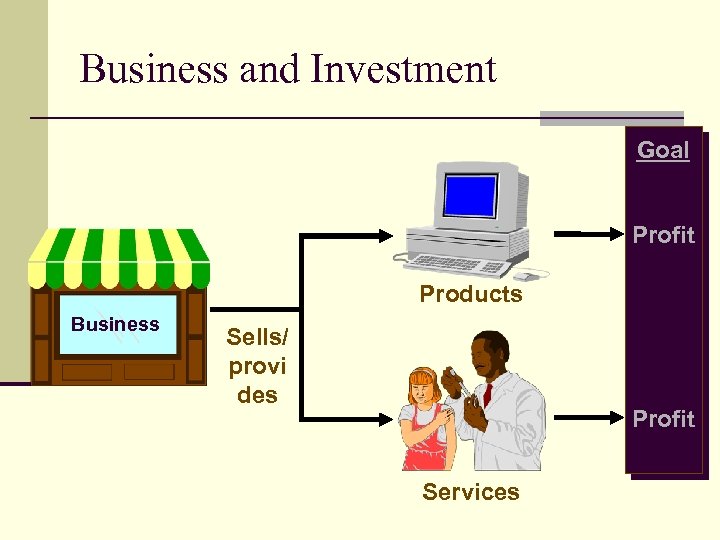
Business and Investment Goal Profit Products Business Sells/ provi des Profit Services
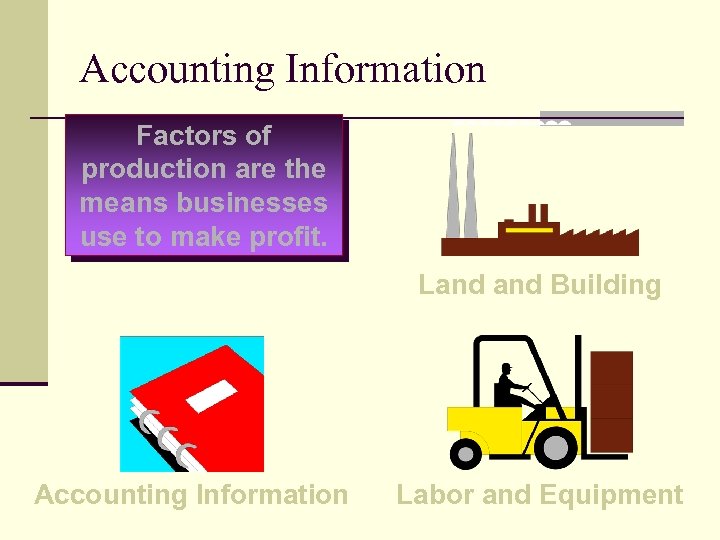
Accounting Information Factors of production are the means businesses use to make profit. Land Building Accounting Information Labor and Equipment
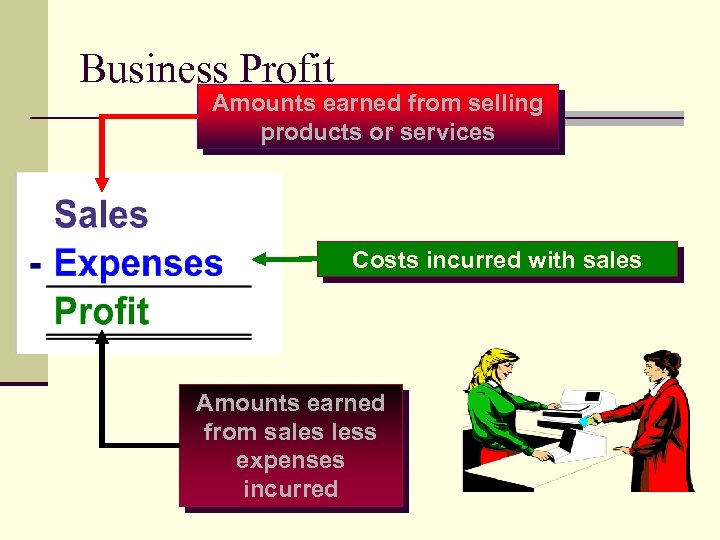
Business Profit Amounts earned from selling products or services Costs incurred with sales Amounts earned from sales less expenses incurred
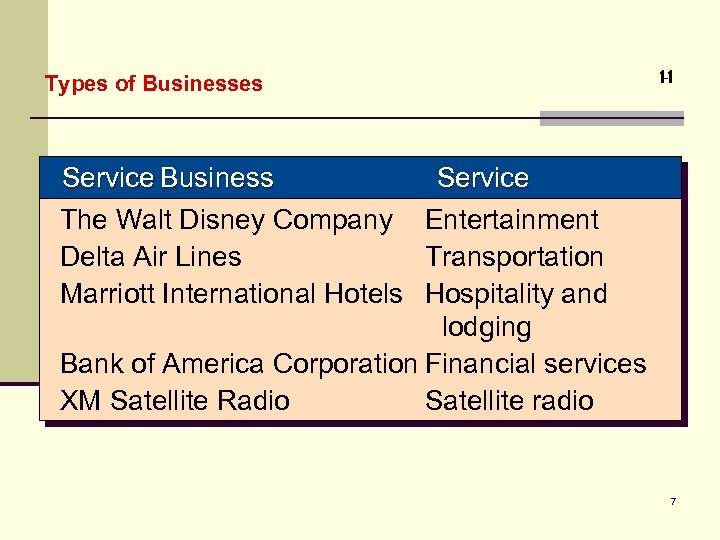
Types of Businesses 1 -1 Service Business Service The Walt Disney Company Entertainment Delta Air Lines Transportation Marriott International Hotels Hospitality and lodging Bank of America Corporation Financial services XM Satellite Radio Satellite radio 7
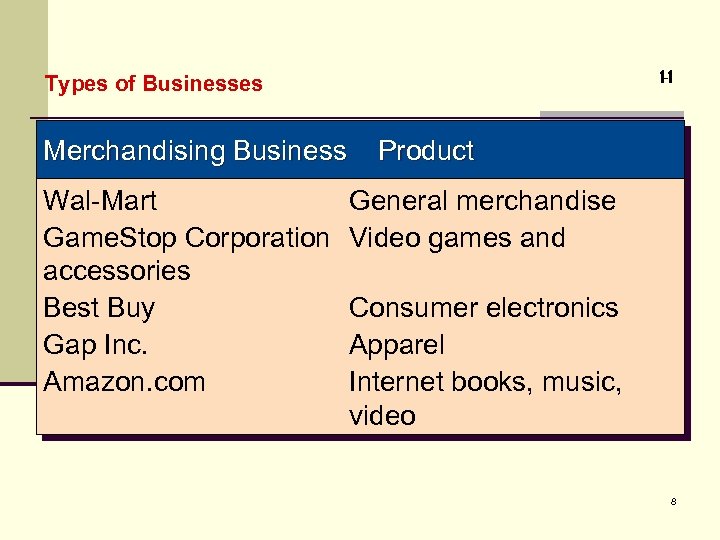
1 -1 Types of Businesses Merchandising Business Wal-Mart Game. Stop Corporation accessories Best Buy Gap Inc. Amazon. com Product General merchandise Video games and Consumer electronics Apparel Internet books, music, video 8
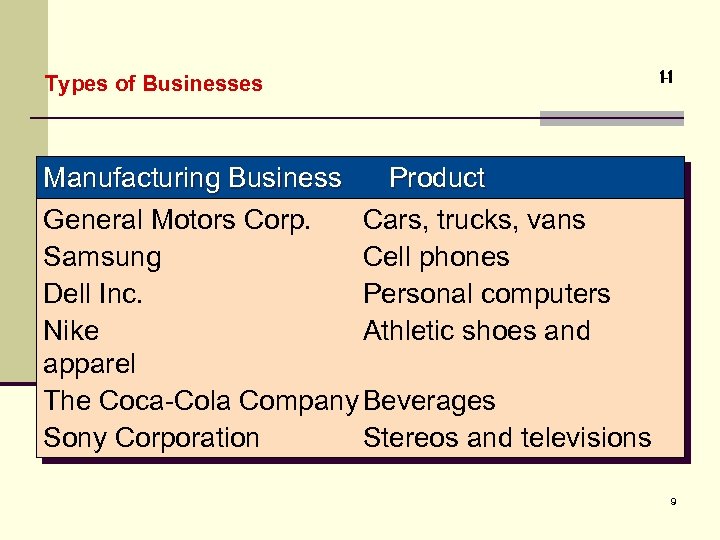
Types of Businesses 1 -1 Manufacturing Business Product General Motors Corp. Cars, trucks, vans Samsung Cell phones Dell Inc. Personal computers Nike Athletic shoes and apparel The Coca-Cola Company Beverages Sony Corporation Stereos and televisions 9
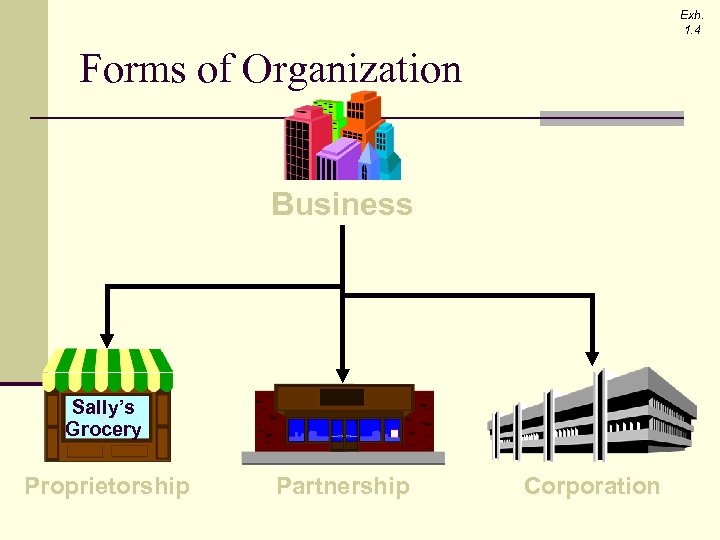
Exh. 1. 4 Forms of Organization Business Sally’s Grocery Law Offices Proprietorship Partnership Corporation
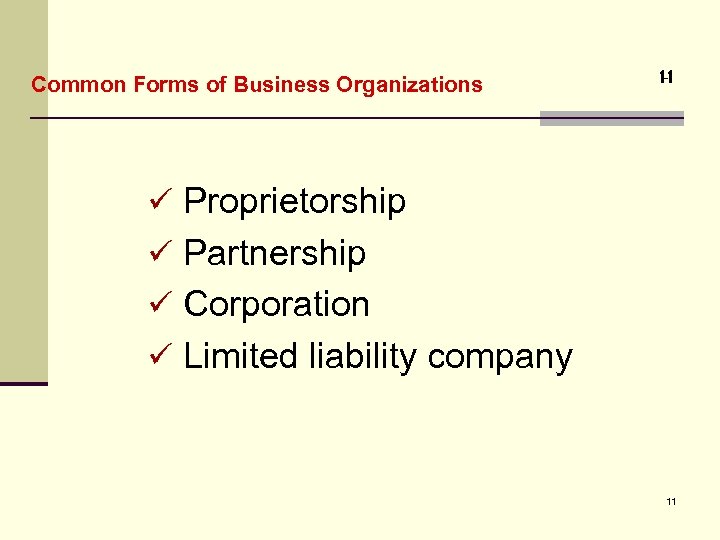
Common Forms of Business Organizations 1 -1 ü Proprietorship ü Partnership ü Corporation ü Limited liability company 11
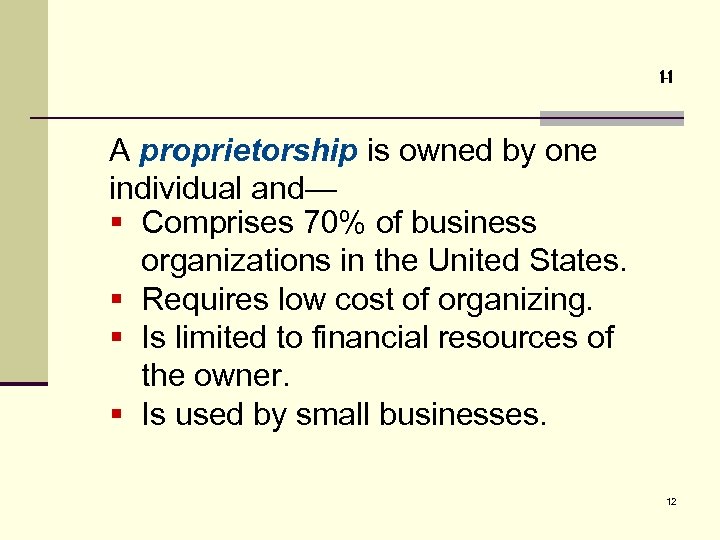
1 -1 A proprietorship is owned by one individual and— § Comprises 70% of business organizations in the United States. § Requires low cost of organizing. § Is limited to financial resources of the owner. § Is used by small businesses. 12
1 -1 A partnership is similar to a proprietorship except that it is owned by two or more individuals and— § Comprises 10% of business organizations in the United States. § Combines the skills and resources of more than one person. 13
1 -1 A corporation is organized under state or federal statues as a separate legal taxable entity and— § Generates 90% of the total dollars of business receipts received. § Comprises 20% of the businesses. Continued 14
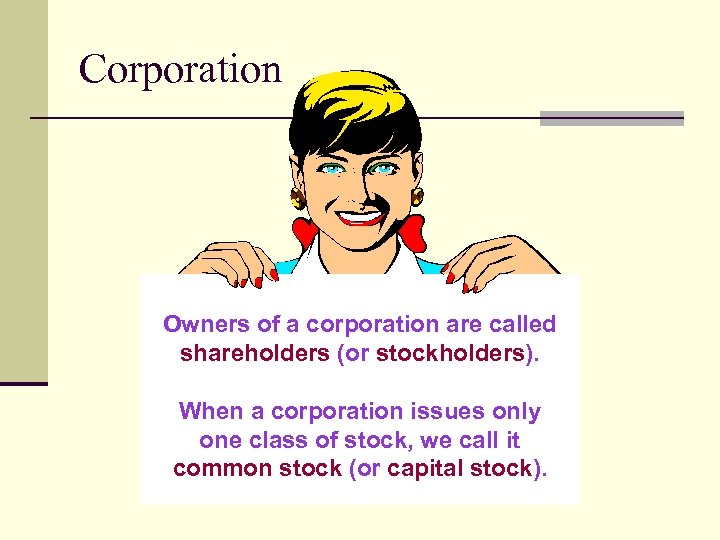
Corporation Owners of a corporation are called shareholders (or stockholders). When a corporation issues only one class of stock, we call it common stock (or capital stock).
1 -1 § Includes ownership divided into shares of stock, sold to shareholders (stockholders). § Is able to obtain large amounts of resources by issuing stock. § Is used by large businesses. 16
1 -1 A limited liability company (LLC) combines attributes of a partnership and a corporation in that it is organized as a corporation. However, a limited liability corporation can elect to be taxed as a partnership and— § Is a popular alternative to a partnership. § Has tax and liability advantages to the owners. 17
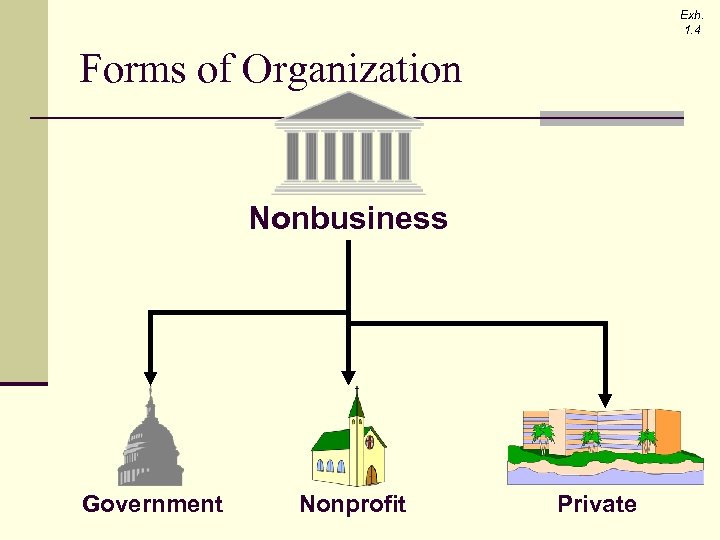
Exh. 1. 4 Forms of Organization Nonbusiness Government Nonprofit Private
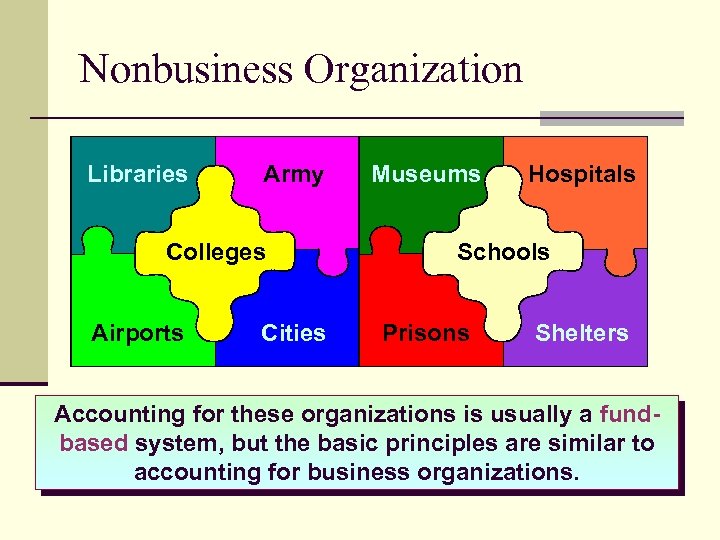
Nonbusiness Organization Libraries Army Colleges Airports Cities Museums Hospitals Schools Prisons Shelters Accounting for these organizations is usually a fundbased system, but the basic principles are similar to accounting for business organizations.
1 The Role of Accounting in Business Accounting can be defined as an information system that provides reports to users about the economic activities and condition of a business. 20
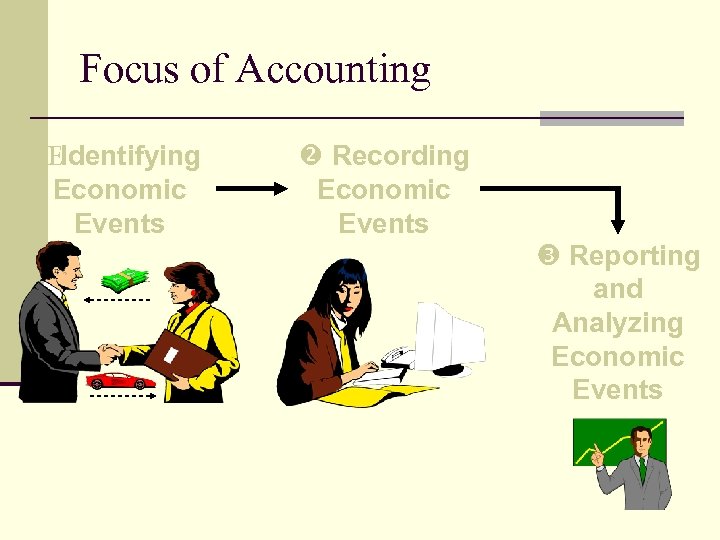
Focus of Accounting ŒIdentifying Economic Events Recording Economic Events Reporting and Analyzing Economic Events
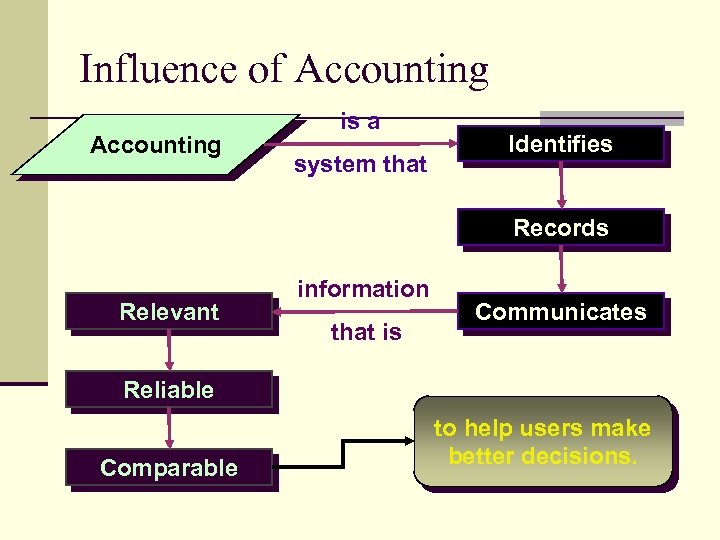
Influence of Accounting is a system that Identifies Records Relevant information that is Communicates Reliable Comparable to help users make better decisions.
1 The process by which accounting provides information to users is as follows: • • • Identify users. Assess users’ informational needs. Design the accounting information system to meet users’ needs. Record economic data about business activities and events. Prepare accounting reports for users. 23
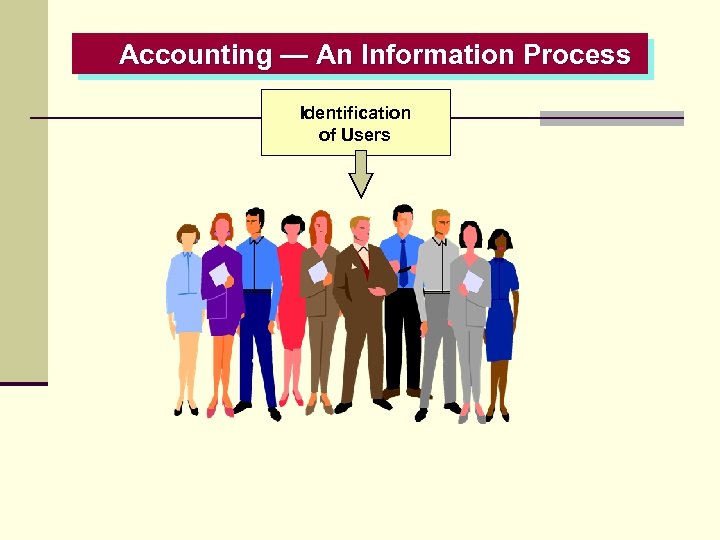
Accounting — An Information Process Identification of Users
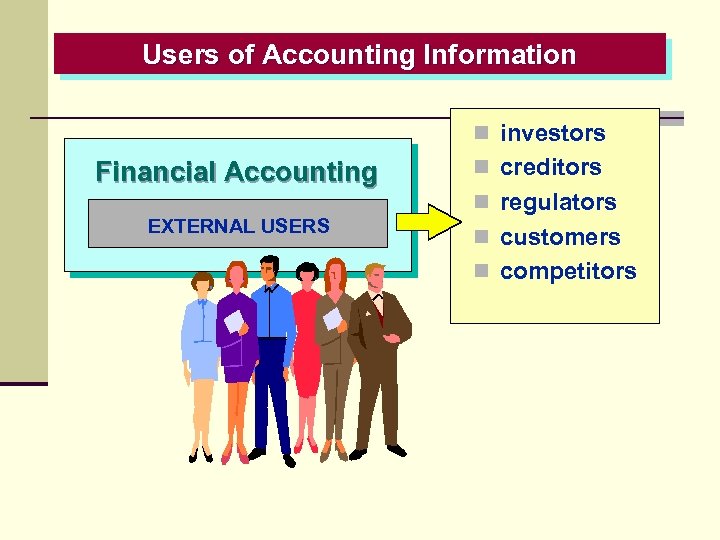
Users of Accounting Information n investors Financial Accounting EXTERNAL USERS n creditors n regulators n customers n competitors
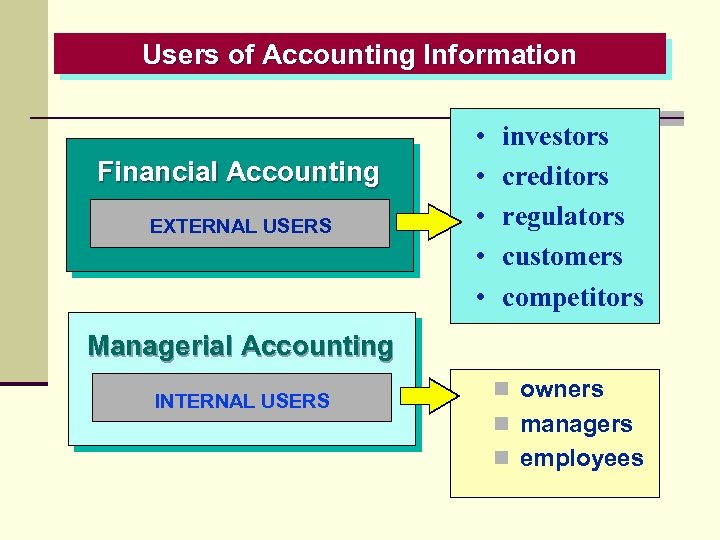
Users of Accounting Information Financial Accounting EXTERNAL USERS • • • investors creditors regulators customers competitors Managerial Accounting INTERNAL USERS n owners n managers n employees
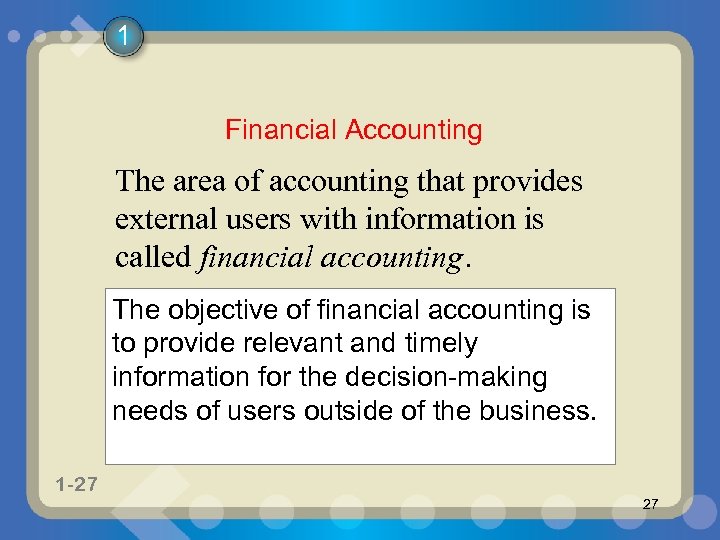
1 Financial Accounting The area of accounting that provides external users with information is called financial accounting. The objective of financial accounting is to provide relevant and timely information for the decision-making needs of users outside of the business. 1 -27 27
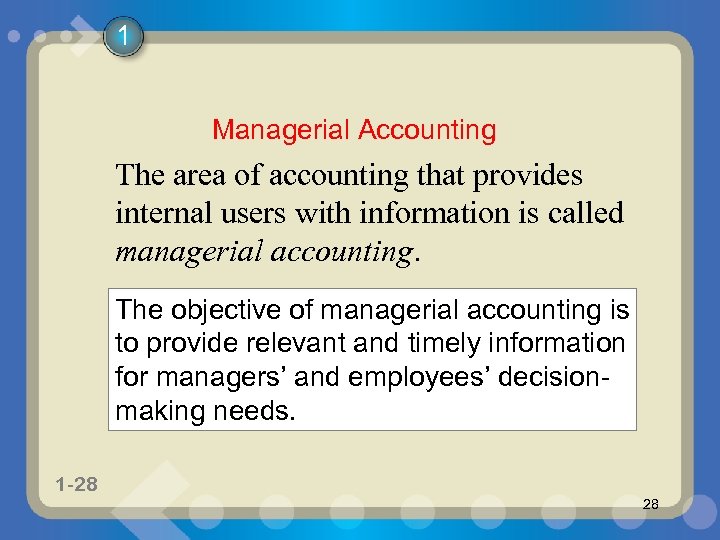
1 Managerial Accounting The area of accounting that provides internal users with information is called managerial accounting. The objective of managerial accounting is to provide relevant and timely information for managers’ and employees’ decisionmaking needs. 1 -28 28
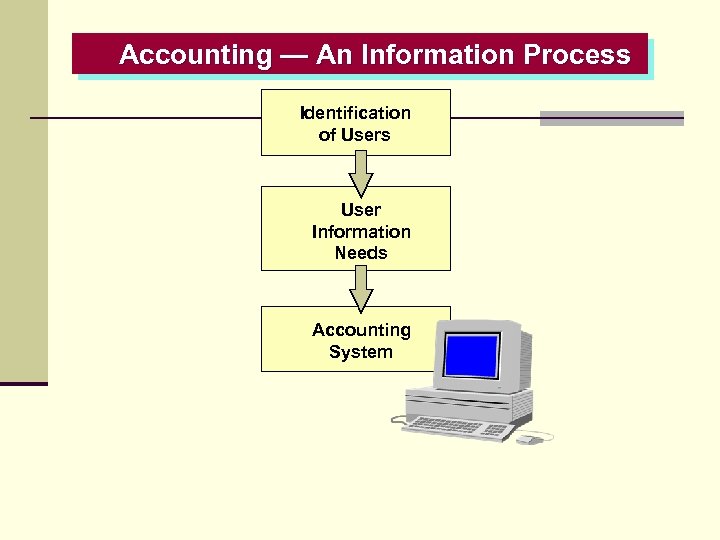
Accounting — An Information Process Identification of Users User Information Needs Accounting System
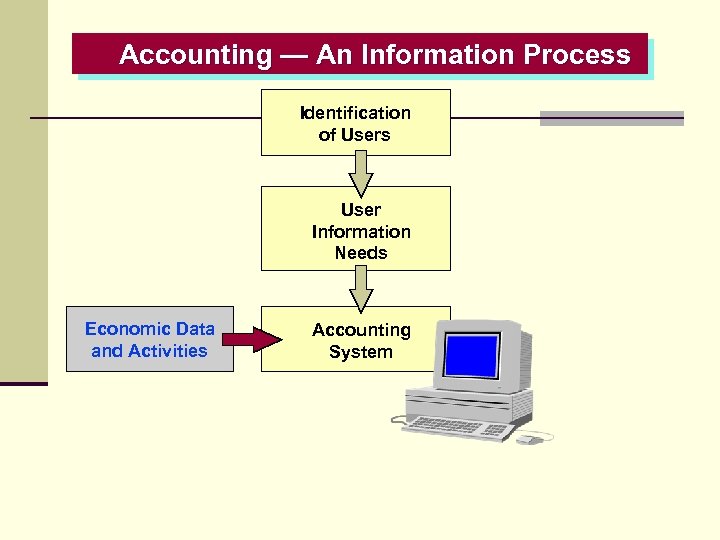
Accounting — An Information Process Identification of Users User Information Needs Economic Data and Activities Accounting System
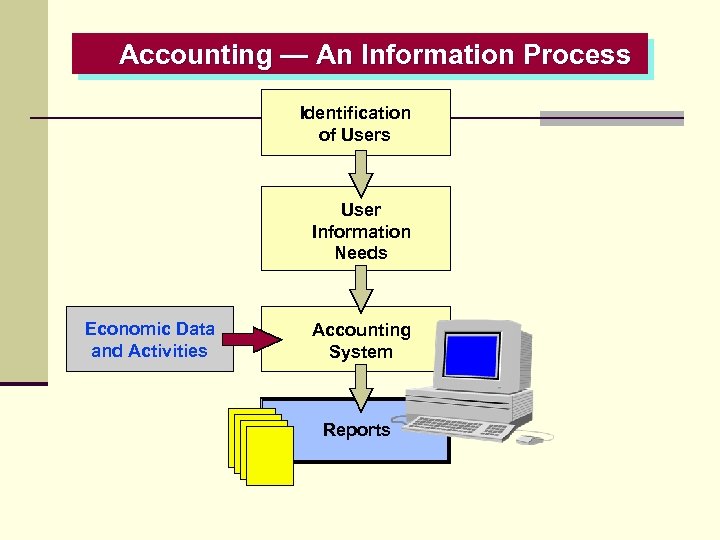
Accounting — An Information Process Identification of Users User Information Needs Economic Data and Activities Accounting System Reports
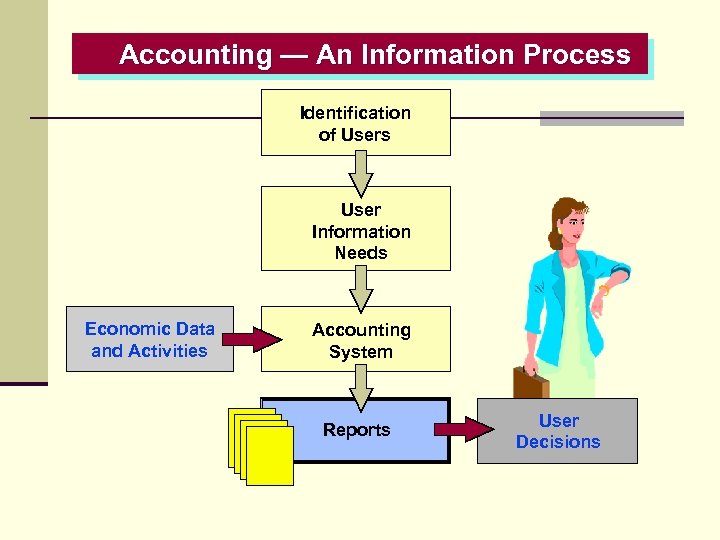
Accounting — An Information Process Identification of Users User Information Needs Economic Data and Activities Accounting System Reports User Decisions
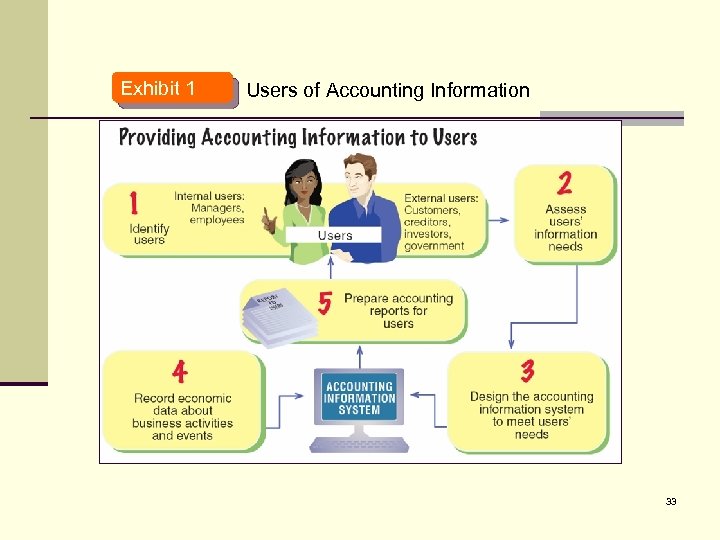
1 Exhibit 1 Users of Accounting Information 33
1 Role of Ethics in Accounting and Business Ethics are moral principles that guide the conduct of individuals. 34
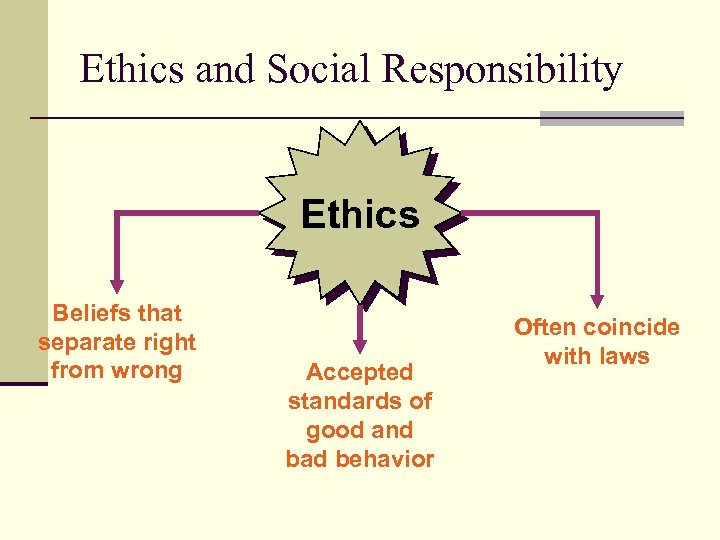
Ethics and Social Responsibility Ethics Beliefs that separate right from wrong Accepted standards of good and bad behavior Often coincide with laws
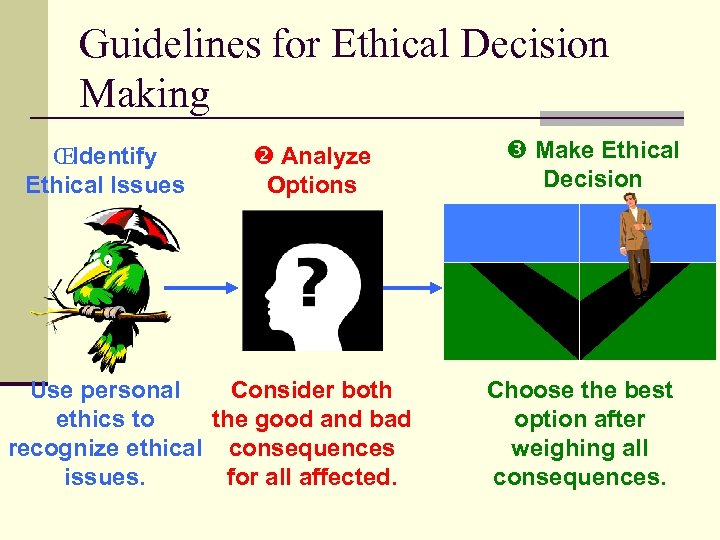
Guidelines for Ethical Decision Making ŒIdentify Ethical Issues Analyze Options Use personal Consider both ethics to the good and bad recognize ethical consequences issues. for all affected. Make Ethical Decision Choose the best option after weighing all consequences.
2 Business Entity Concept Under the business entity concept, the activities of a business are recorded separately from the activities of its owners, creditors, or other businesses. 37
2 Cost Concept Under the cost concept, amounts are initially recorded in the accounting records at their cost or purchase price. 38
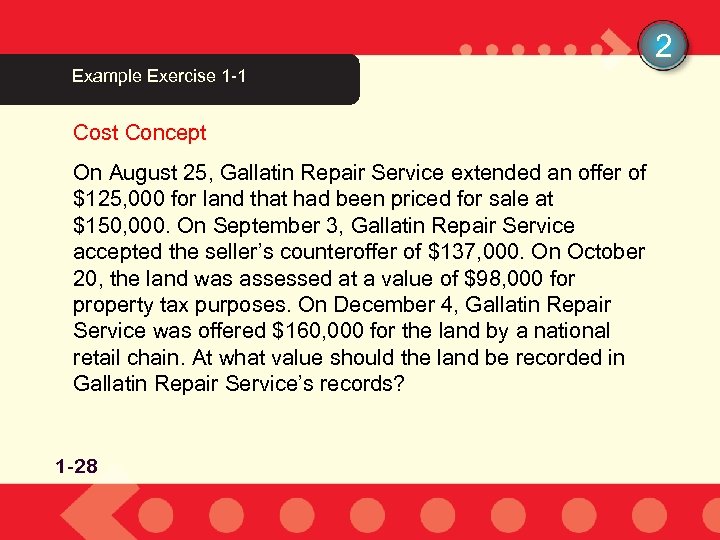
2 Example Exercise 1 -1 Cost Concept On August 25, Gallatin Repair Service extended an offer of $125, 000 for land that had been priced for sale at $150, 000. On September 3, Gallatin Repair Service accepted the seller’s counteroffer of $137, 000. On October 20, the land was assessed at a value of $98, 000 for property tax purposes. On December 4, Gallatin Repair Service was offered $160, 000 for the land by a national retail chain. At what value should the land be recorded in Gallatin Repair Service’s records? 1 -28 39
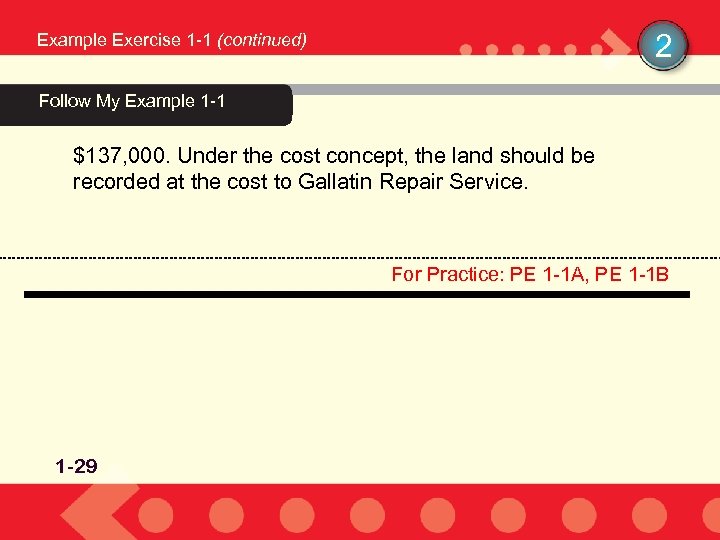
2 Example Exercise 1 -1 (continued) Follow My Example 1 -1 $137, 000. Under the cost concept, the land should be recorded at the cost to Gallatin Repair Service. For Practice: PE 1 -1 A, PE 1 -1 B 1 -29 40
2 Objectivity Concept The objectivity concept requires that the amounts recorded in the accounting records be based on objective evidence. 41
2 Unit of Measure Concept The unit of measure concept requires that economic data be recorded in dollars. 42
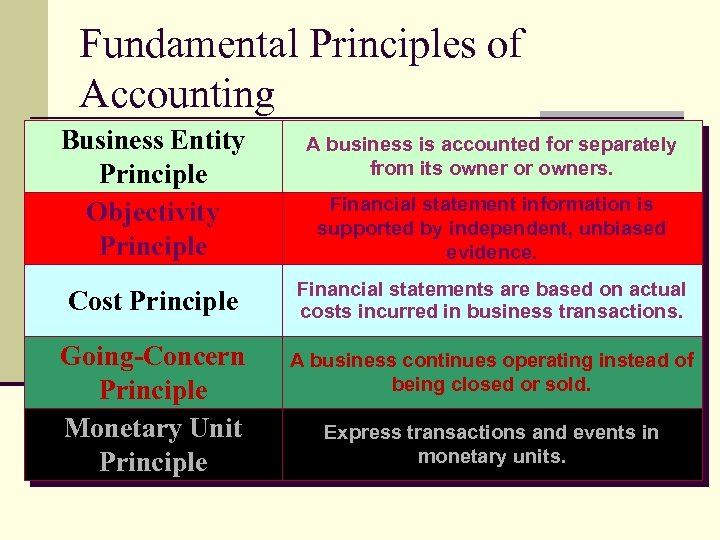
Fundamental Principles of Accounting Business Entity Principle Objectivity Principle A business is accounted for separately from its owner or owners. Cost Principle Financial statements are based on actual costs incurred in business transactions. Going-Concern Principle Monetary Unit Principle A business continues operating instead of being closed or sold. Financial statement information is supported by independent, unbiased evidence. Express transactions and events in monetary units.
The Accounting Equation Resources What are an organization’s resources called?
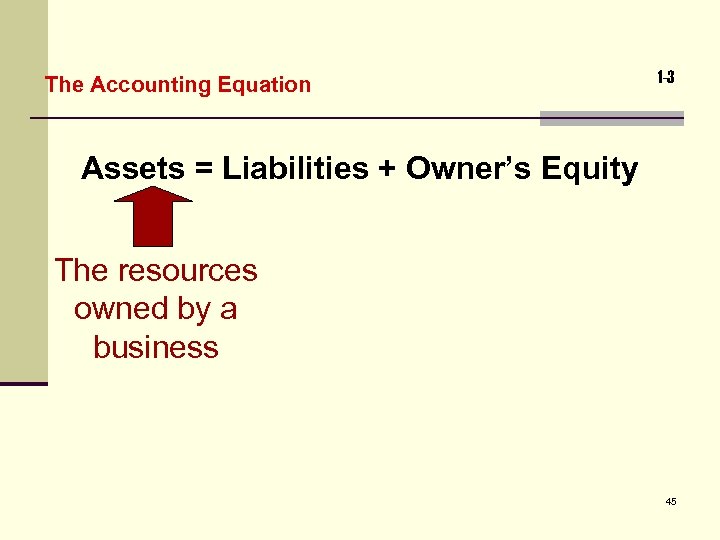
The Accounting Equation 1 -3 Assets = Liabilities + Owner’s Equity The resources owned by a business 45
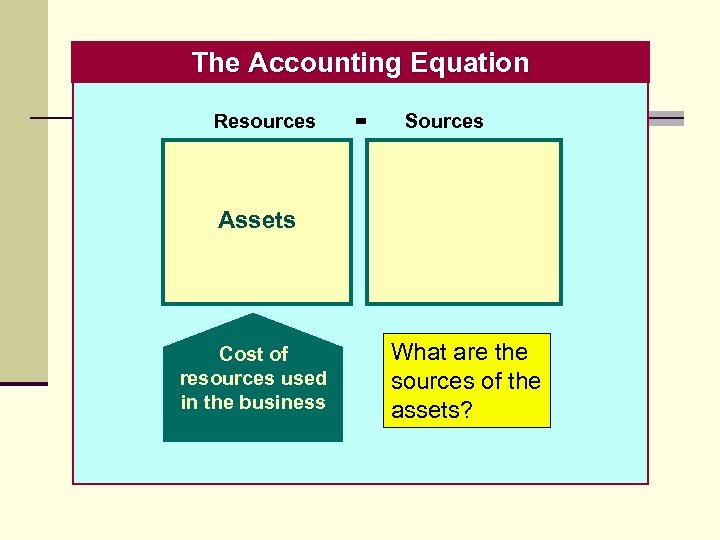
The Accounting Equation Resources = Sources Assets Cost of resources used in the business What are the sources of the assets?
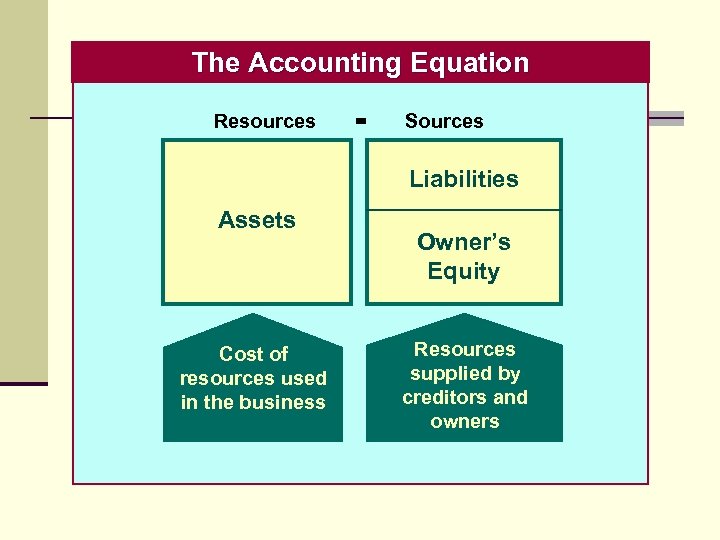
The Accounting Equation Resources = Sources Liabilities Assets Cost of resources used in the business Owner’s Equity Resources supplied by creditors and owners
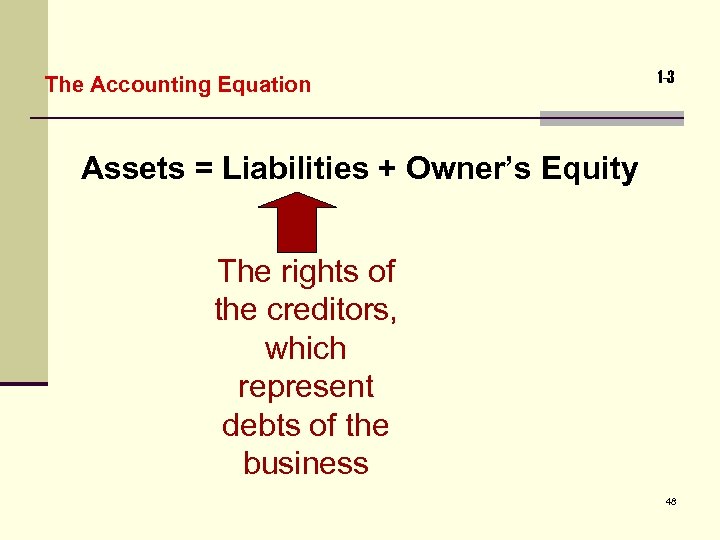
The Accounting Equation 1 -3 Assets = Liabilities + Owner’s Equity The rights of the creditors, which represent debts of the business 48
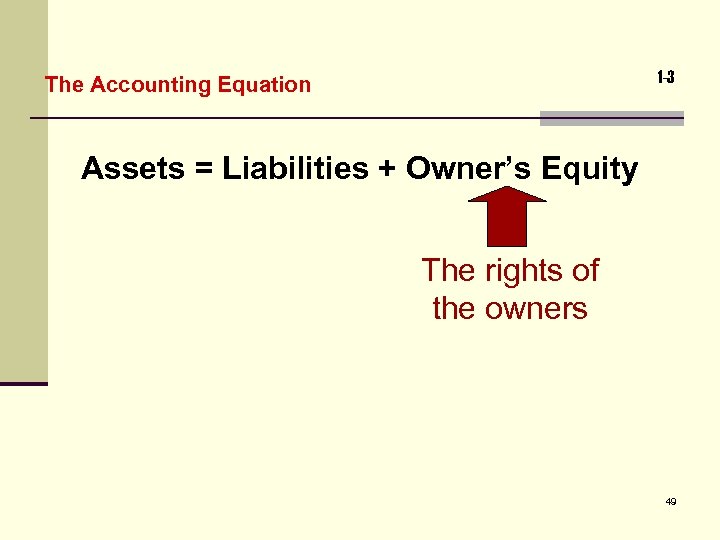
1 -3 The Accounting Equation Assets = Liabilities + Owner’s Equity The rights of the owners 49
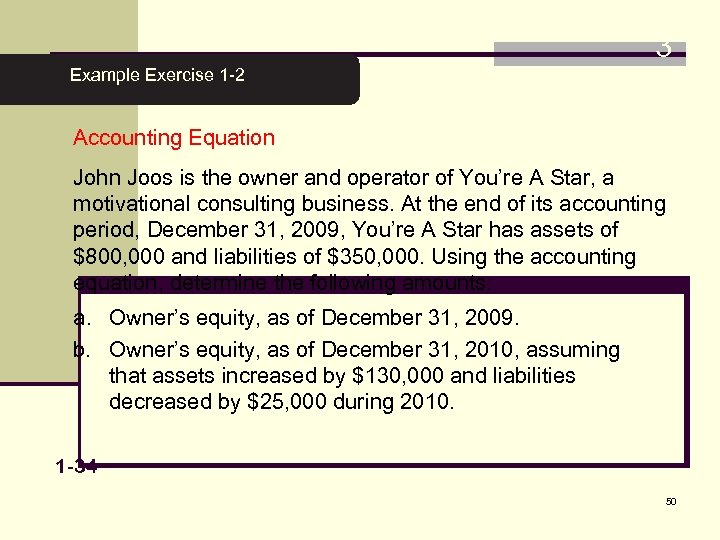
3 Example Exercise 1 -2 Accounting Equation John Joos is the owner and operator of You’re A Star, a motivational consulting business. At the end of its accounting period, December 31, 2009, You’re A Star has assets of $800, 000 and liabilities of $350, 000. Using the accounting equation, determine the following amounts: a. Owner’s equity, as of December 31, 2009. b. Owner’s equity, as of December 31, 2010, assuming that assets increased by $130, 000 and liabilities decreased by $25, 000 during 2010. 1 -34 50
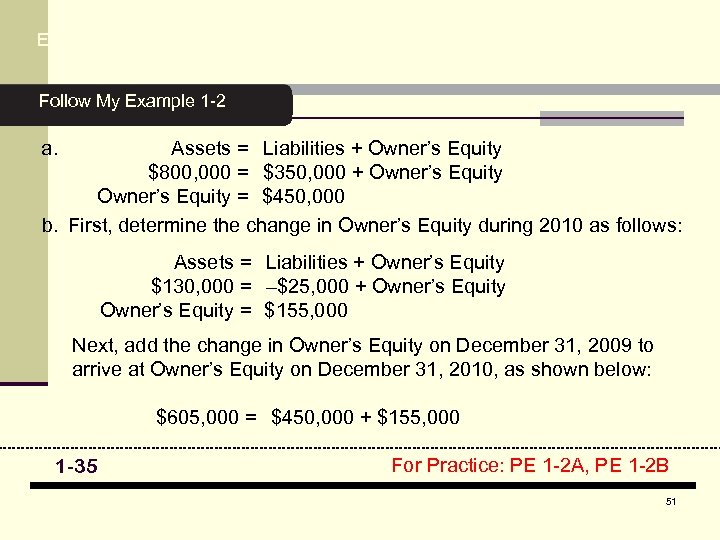
3 Example Exercise 1 -2 (continued) Follow My Example 1 -2 a. Assets = Liabilities + Owner’s Equity $800, 000 = $350, 000 + Owner’s Equity = $450, 000 b. First, determine the change in Owner’s Equity during 2010 as follows: Assets = Liabilities + Owner’s Equity $130, 000 = –$25, 000 + Owner’s Equity = $155, 000 Next, add the change in Owner’s Equity on December 31, 2009 to arrive at Owner’s Equity on December 31, 2010, as shown below: $605, 000 = $450, 000 + $155, 000 Example Exercise 1 -2 continued 1 -35 For Practice: PE 1 -2 A, PE 1 -2 B 51
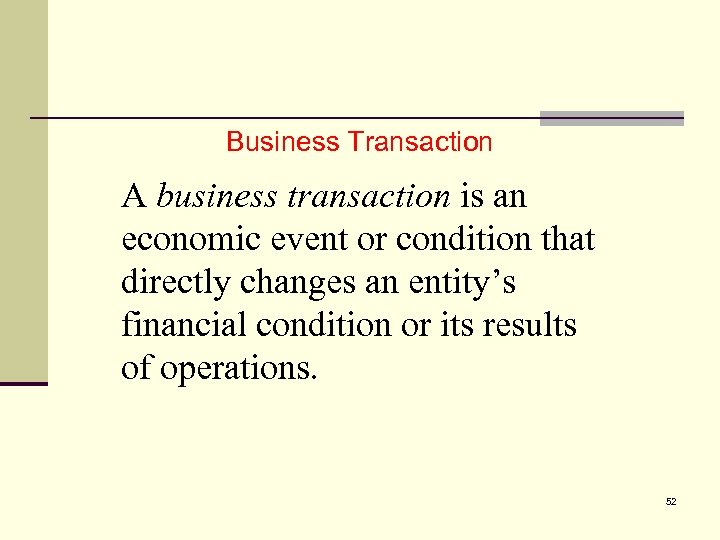
4 Business Transaction A business transaction is an economic event or condition that directly changes an entity’s financial condition or its results of operations. 52
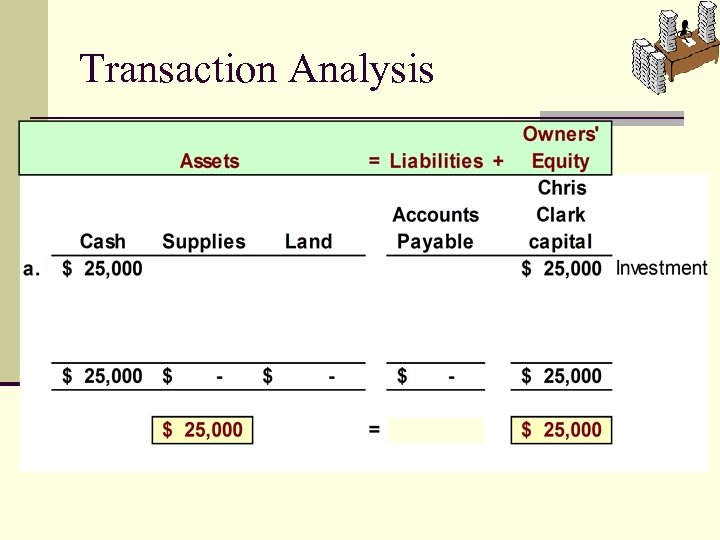
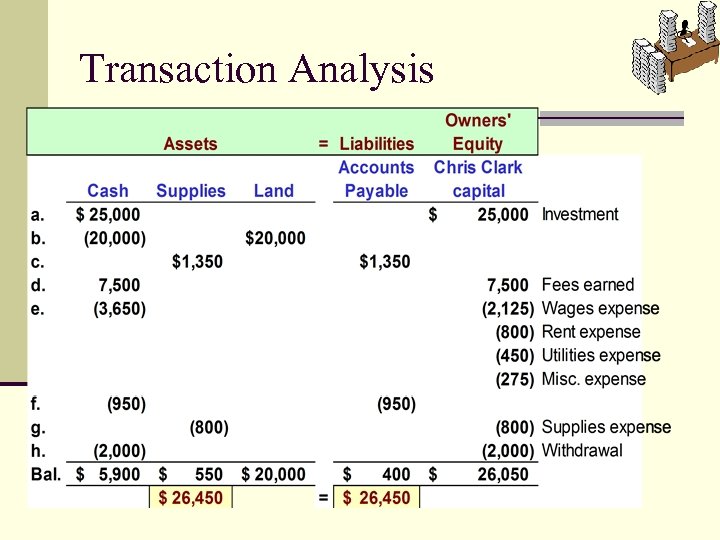
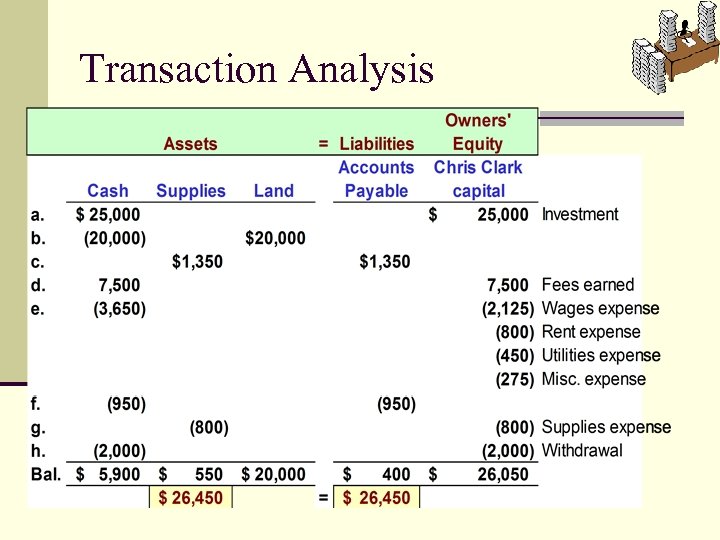
4 Transaction A On November 1, 2009, Chris Clark deposits $25, 000 in a bank account in the name of Net. Solutions. 53
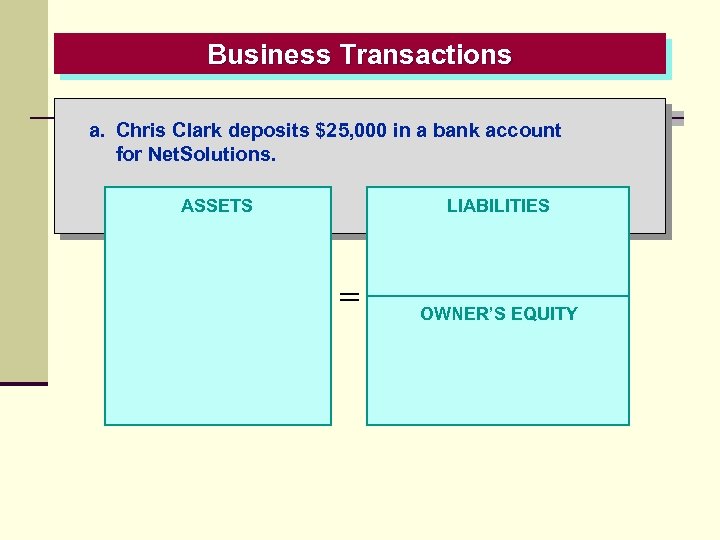
Business Transactions a. Chris Clark deposits $25, 000 in a bank account for Net. Solutions. LIABILITIES ASSETS = OWNER’S EQUITY
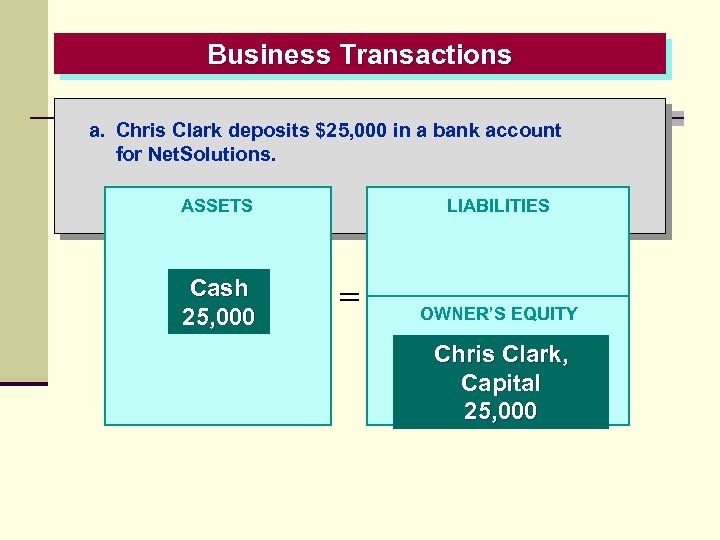
Business Transactions a. Chris Clark deposits $25, 000 in a bank account for Net. Solutions. LIABILITIES ASSETS Cash 25, 000 = OWNER’S EQUITY Chris Clark, Capital 25, 000
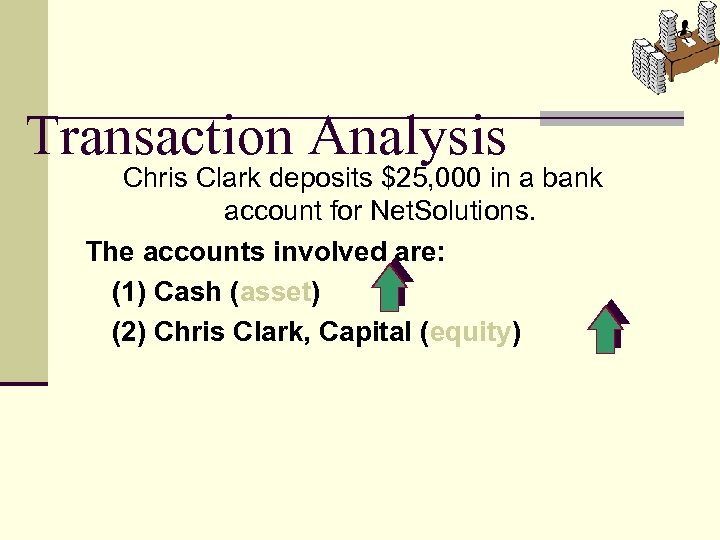
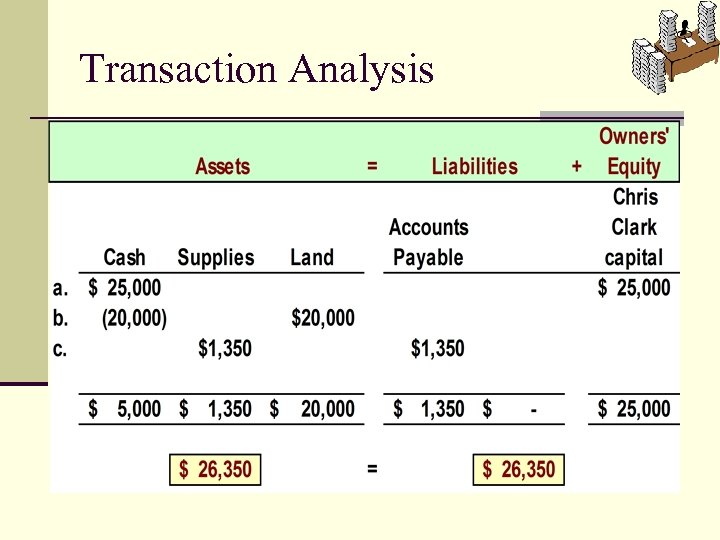
Transaction Analysis Chris Clark deposits $25, 000 in a bank account for Net. Solutions. The accounts involved are: (1) Cash (asset) (2) Chris Clark, Capital (equity)
Transaction Analysis
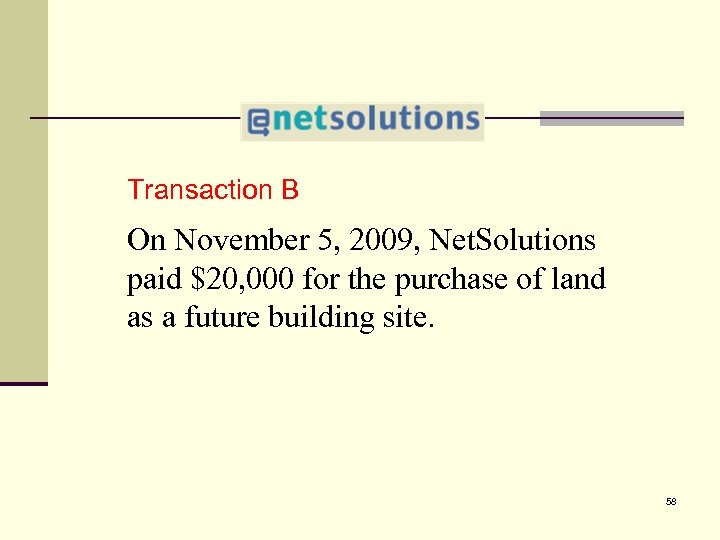
4 Transaction B On November 5, 2009, Net. Solutions paid $20, 000 for the purchase of land as a future building site. 58
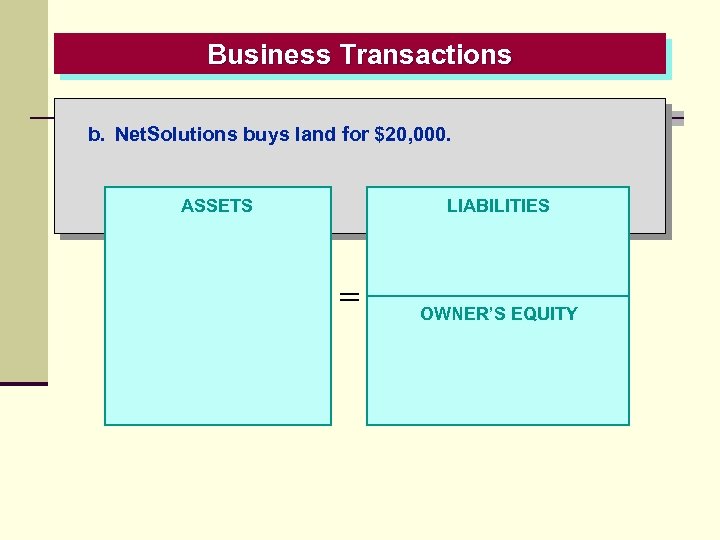
Business Transactions b. Net. Solutions buys land for $20, 000. LIABILITIES ASSETS = OWNER’S EQUITY
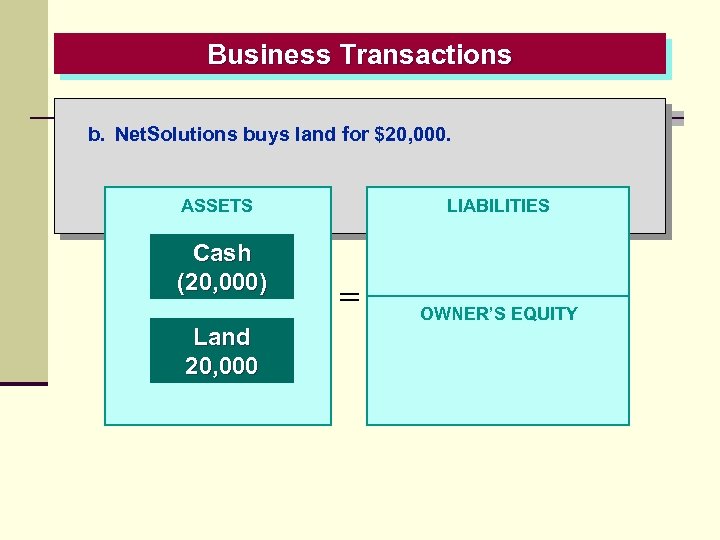
Business Transactions b. Net. Solutions buys land for $20, 000. LIABILITIES ASSETS Cash (20, 000) Land 20, 000 = OWNER’S EQUITY
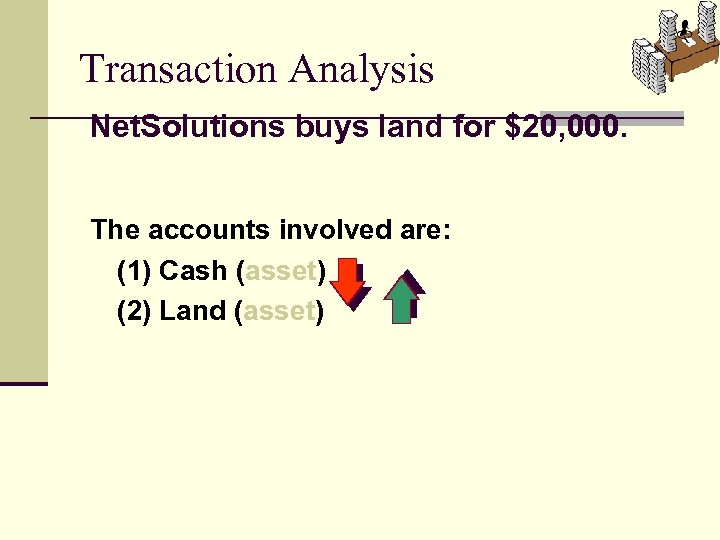
Transaction Analysis Net. Solutions buys land for $20, 000. The accounts involved are: (1) Cash (asset) (2) Land (asset)
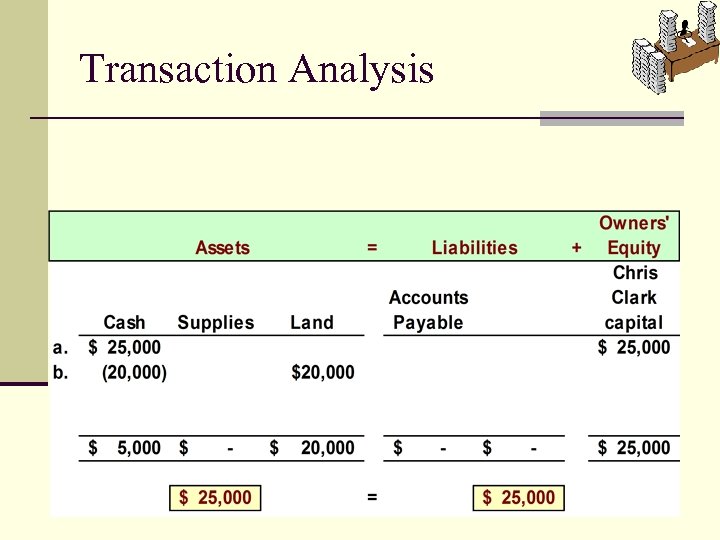
Transaction Analysis
4 Transaction C On November 10, 2009, Net. Solutions purchased supplies for $1, 350 and agreed to pay the supplier in the near future. 63
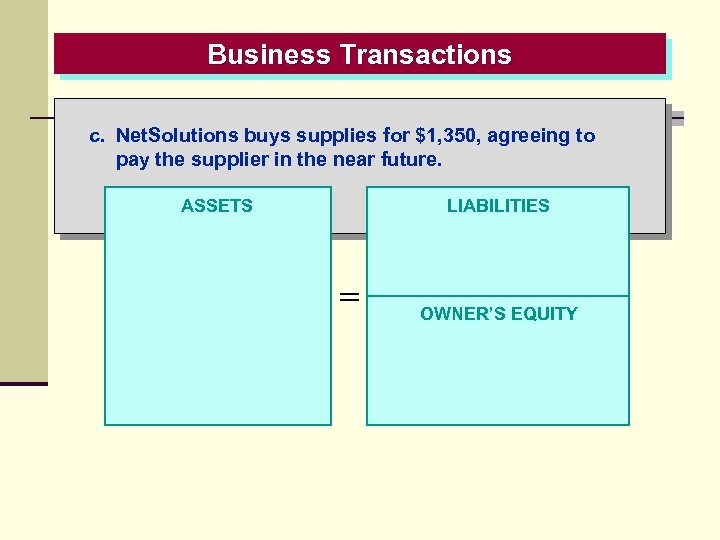
Business Transactions c. Net. Solutions buys supplies for $1, 350, agreeing to pay the supplier in the near future. LIABILITIES ASSETS = OWNER’S EQUITY
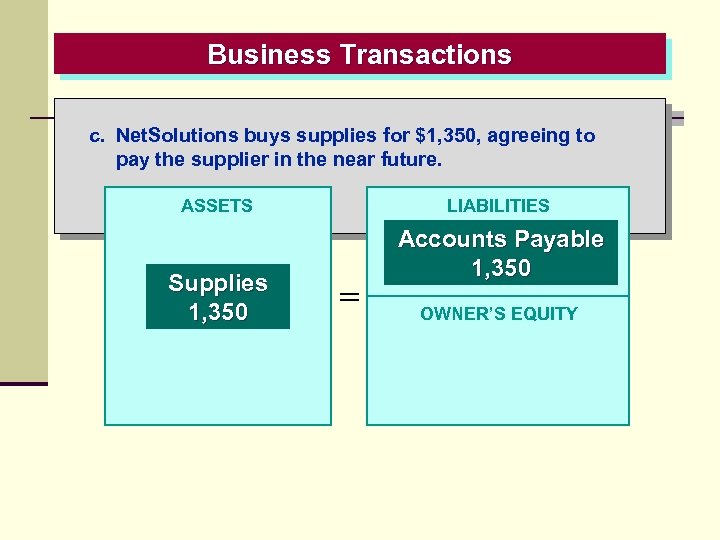
Business Transactions c. Net. Solutions buys supplies for $1, 350, agreeing to pay the supplier in the near future. LIABILITIES ASSETS Supplies 1, 350 = Accounts Payable 1, 350 OWNER’S EQUITY
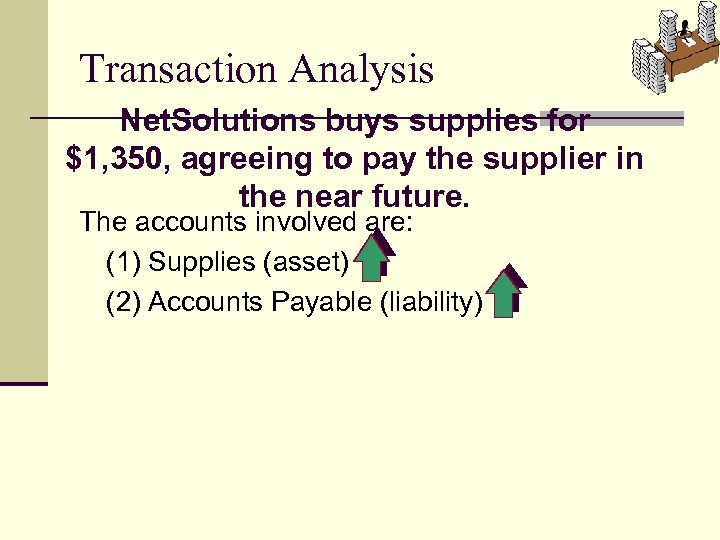
Transaction Analysis Net. Solutions buys supplies for $1, 350, agreeing to pay the supplier in the near future. The accounts involved are: (1) Supplies (asset) (2) Accounts Payable (liability)
Transaction Analysis
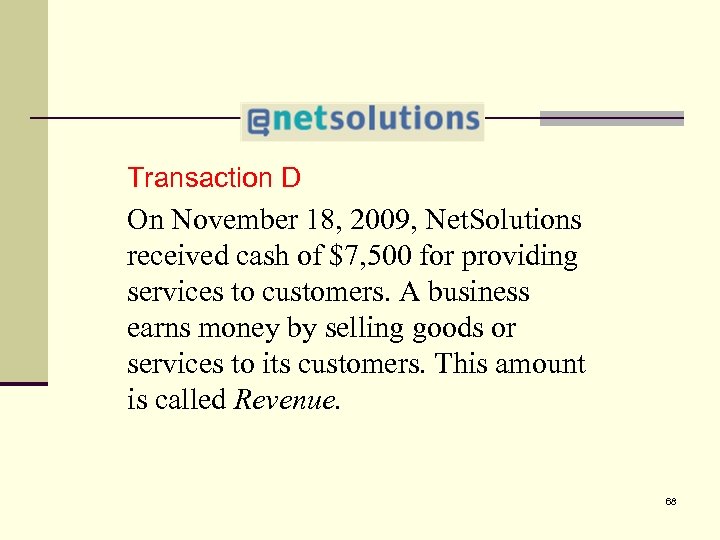
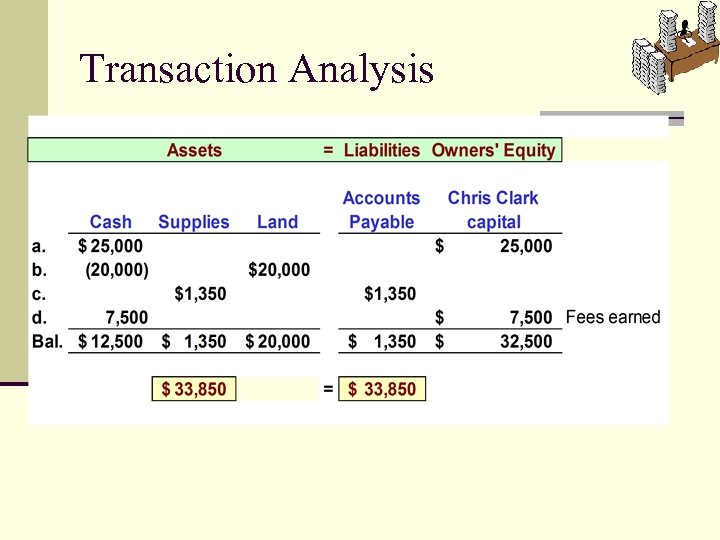
4 Transaction D On November 18, 2009, Net. Solutions received cash of $7, 500 for providing services to customers. A business earns money by selling goods or services to its customers. This amount is called Revenue. 68
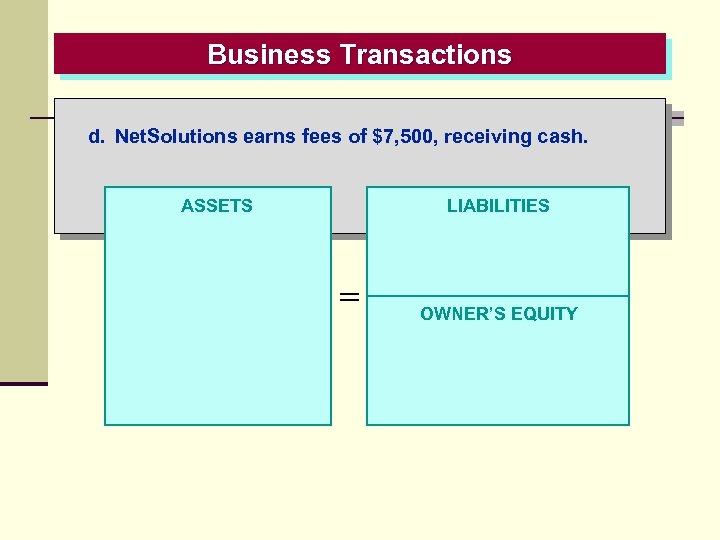
Business Transactions d. Net. Solutions earns fees of $7, 500, receiving cash. LIABILITIES ASSETS = OWNER’S EQUITY
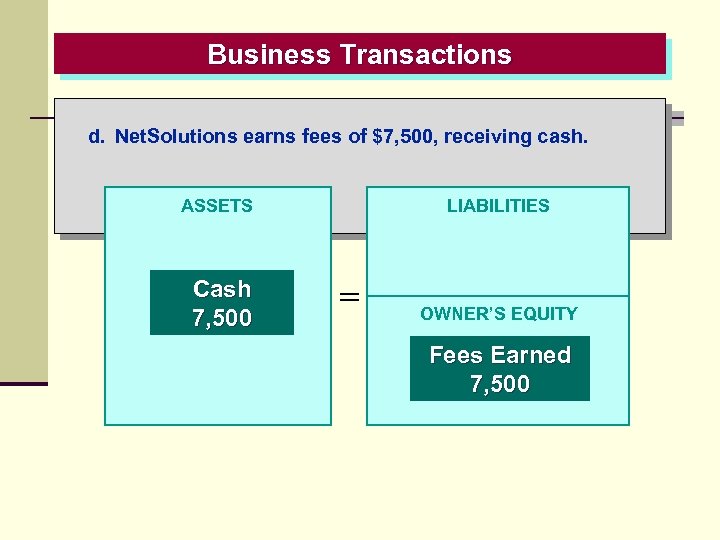
Business Transactions d. Net. Solutions earns fees of $7, 500, receiving cash. LIABILITIES ASSETS Cash 7, 500 = OWNER’S EQUITY Fees Earned 7, 500
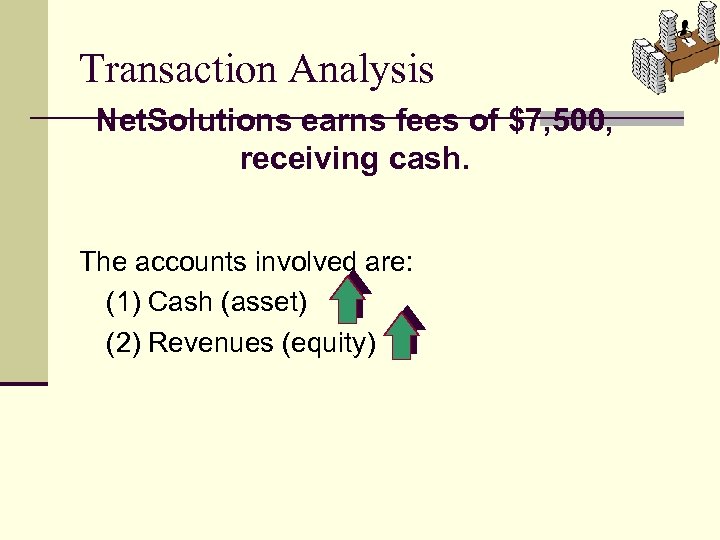
Transaction Analysis Net. Solutions earns fees of $7, 500, receiving cash. The accounts involved are: (1) Cash (asset) (2) Revenues (equity)
Transaction Analysis
4 Expenses During the month, Net. Solutions spent cash or used up other assets in earning revenue. Assets used in this process of earning revenue are called expenses. 73
4 Transaction E On November 30, 2009, Net. Solutions paid the following expenses during the month: wages, $2, 125; rent, $800; utilities, $450; and miscellaneous, $275. 74
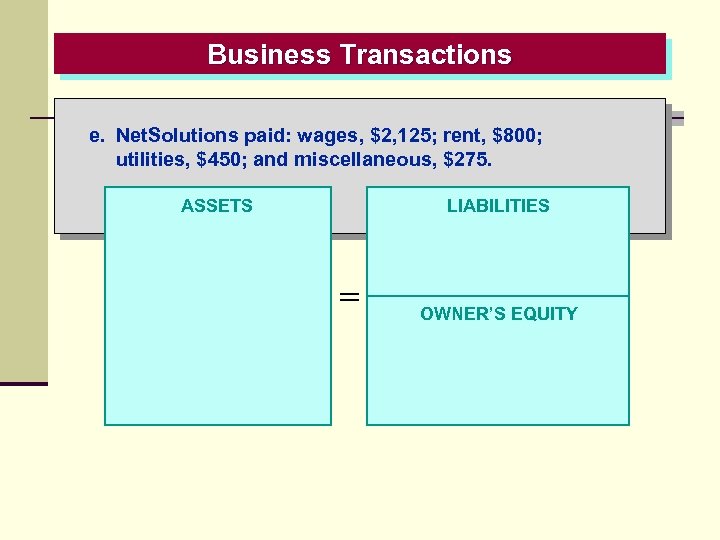
Business Transactions e. Net. Solutions paid: wages, $2, 125; rent, $800; utilities, $450; and miscellaneous, $275. LIABILITIES ASSETS = OWNER’S EQUITY
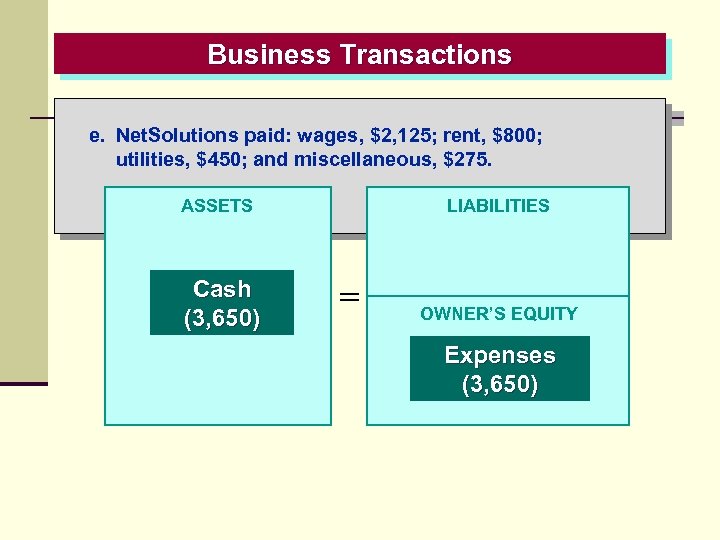
Business Transactions e. Net. Solutions paid: wages, $2, 125; rent, $800; utilities, $450; and miscellaneous, $275. LIABILITIES ASSETS Cash (3, 650) = OWNER’S EQUITY Expenses (3, 650)
Transaction Analysis Net. Solutions paid: wages, $2, 125; rent, $800; utilities, $450; and miscellaneous, $275. The accounts involved are: (1) Cash (asset) (2) Expenses (equity)
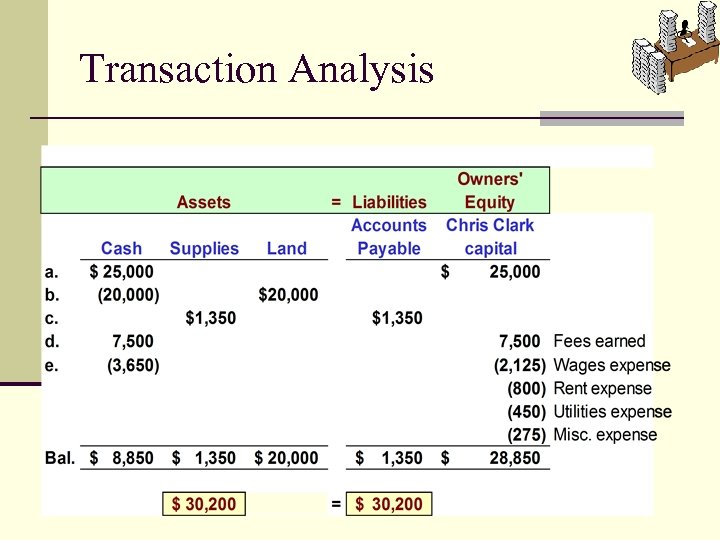
Transaction Analysis
4 Transaction F On November 30, 2009, Net. Solutions paid creditors on account, $950. 79
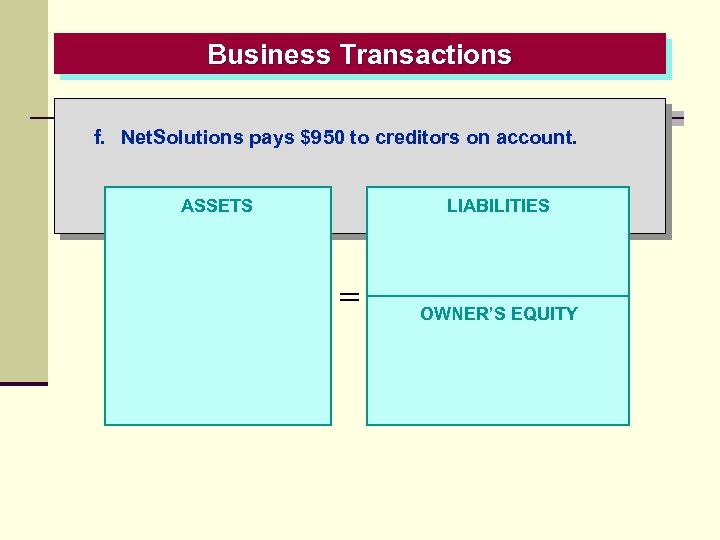
Business Transactions f. Net. Solutions pays $950 to creditors on account. LIABILITIES ASSETS = OWNER’S EQUITY
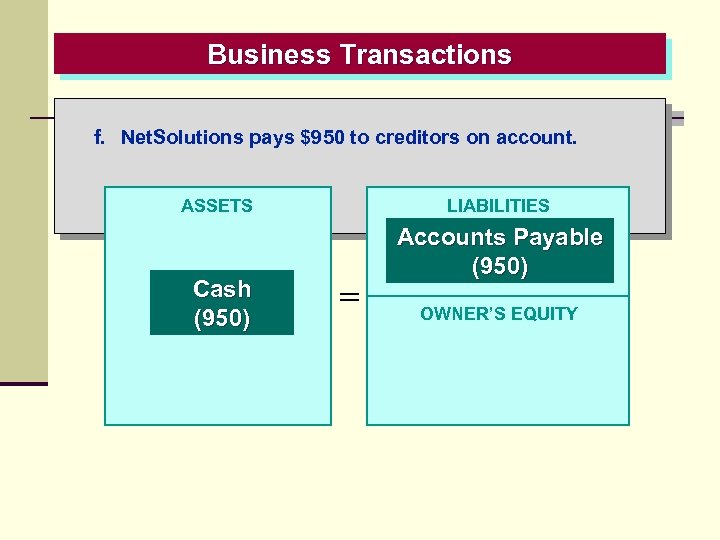
Business Transactions f. Net. Solutions pays $950 to creditors on account. LIABILITIES ASSETS Cash (950) = Accounts Payable (950) OWNER’S EQUITY
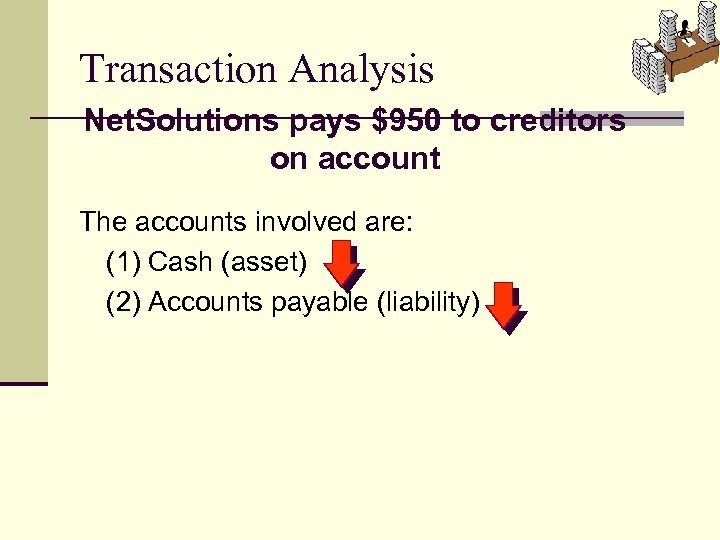
Transaction Analysis Net. Solutions pays $950 to creditors on account The accounts involved are: (1) Cash (asset) (2) Accounts payable (liability)
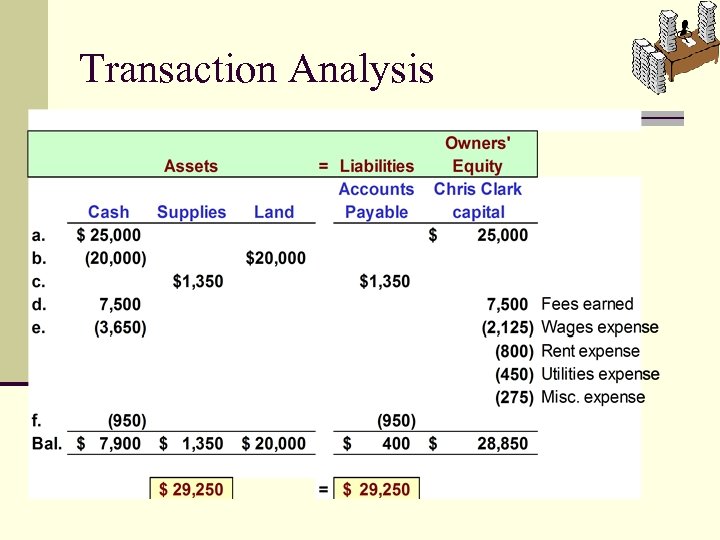
Transaction Analysis
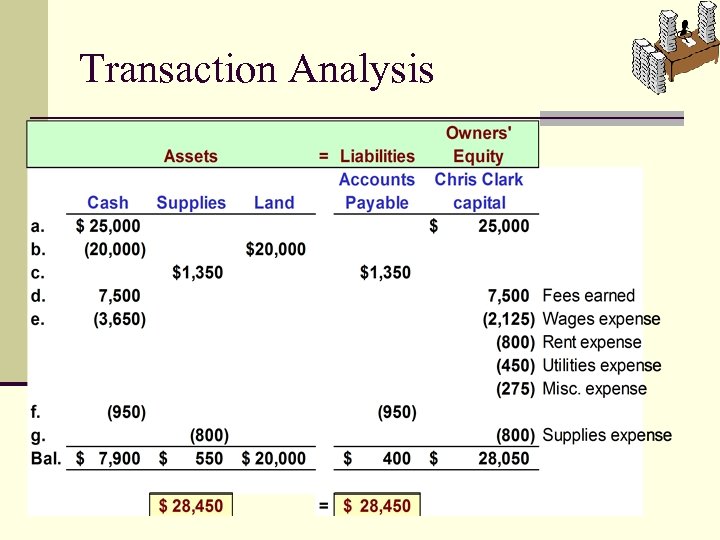
4 Transaction G On November 30, 2009, Chris Clark determined that the cost of supplies on hand at the end of the period was $550. 84
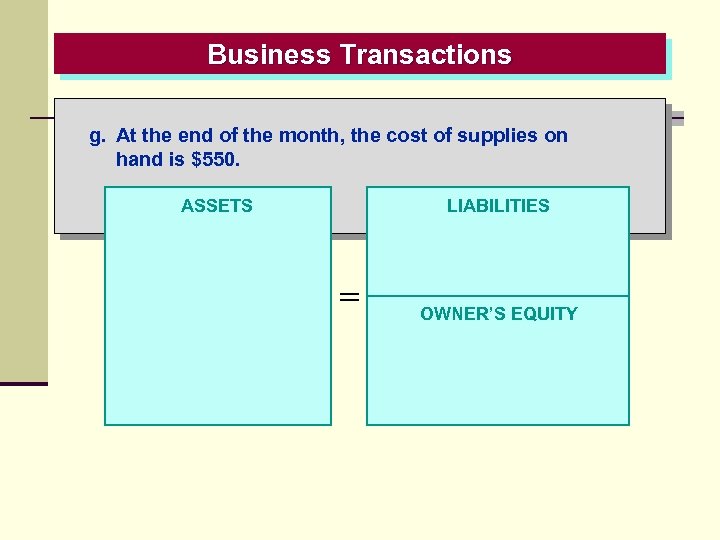
Business Transactions g. At the end of the month, the cost of supplies on hand is $550. LIABILITIES ASSETS = OWNER’S EQUITY
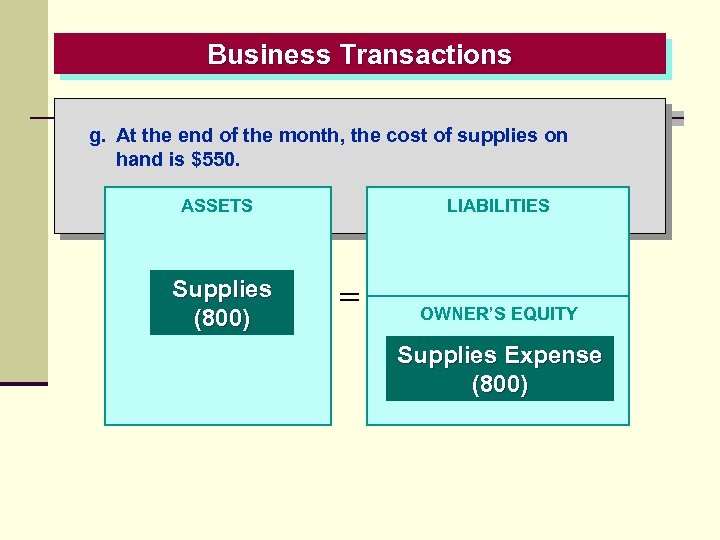
Business Transactions g. At the end of the month, the cost of supplies on hand is $550. LIABILITIES ASSETS Supplies (800) = OWNER’S EQUITY Supplies Expense (800)
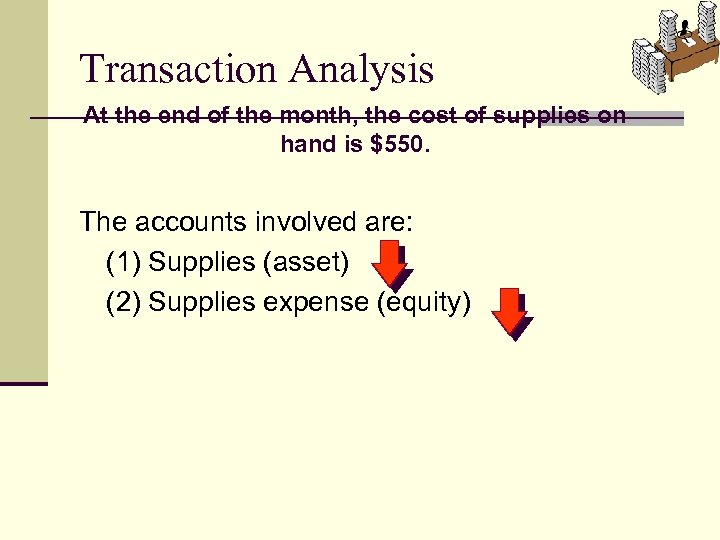
Transaction Analysis At the end of the month, the cost of supplies on hand is $550. The accounts involved are: (1) Supplies (asset) (2) Supplies expense (equity)
Transaction Analysis
4 Transaction H On November 30, 2009, Chris Clark withdrew $2, 000 from Net. Solutions for personal use. 89
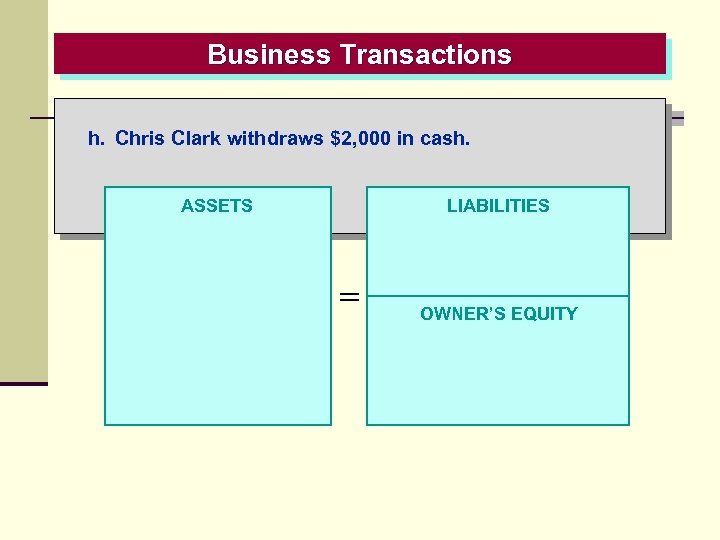
Business Transactions h. Chris Clark withdraws $2, 000 in cash. LIABILITIES ASSETS = OWNER’S EQUITY
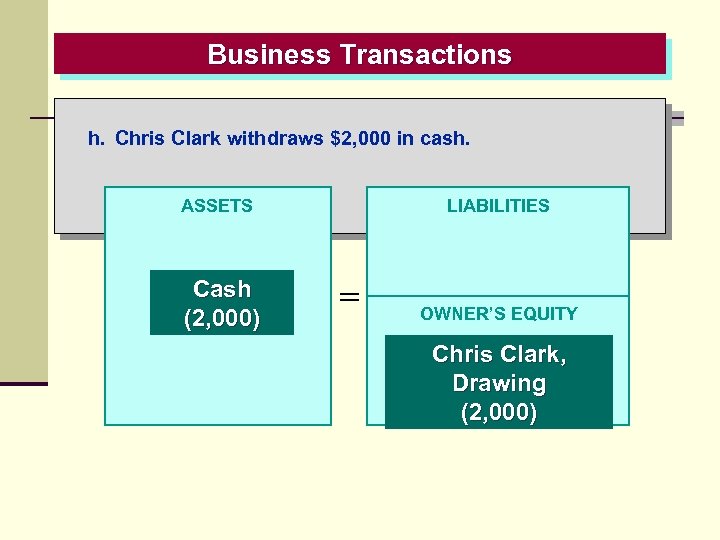
Business Transactions h. Chris Clark withdraws $2, 000 in cash. LIABILITIES ASSETS Cash (2, 000) = OWNER’S EQUITY Chris Clark, Drawing (2, 000)
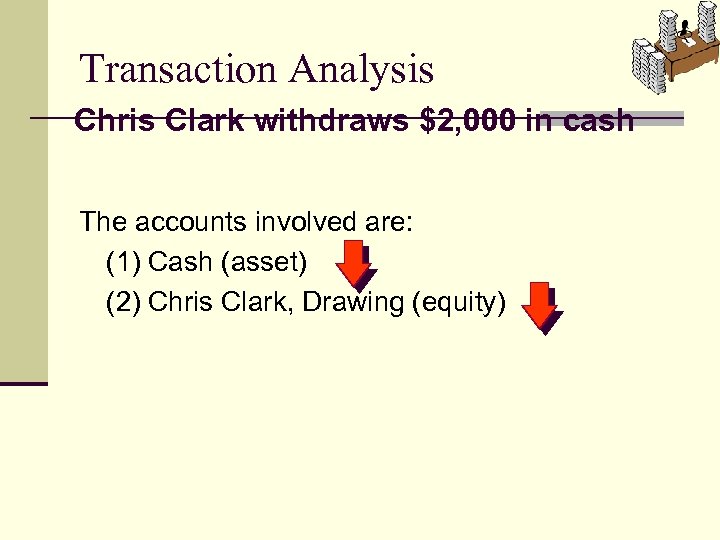
Transaction Analysis Chris Clark withdraws $2, 000 in cash The accounts involved are: (1) Cash (asset) (2) Chris Clark, Drawing (equity)
Transaction Analysis
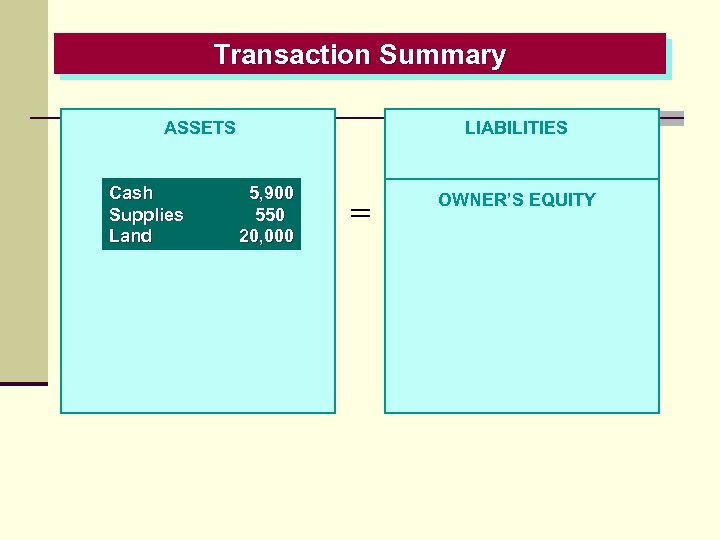
Transaction Summary LIABILITIES ASSETS Cash Supplies Land 5, 900 550 20, 000 = OWNER’S EQUITY
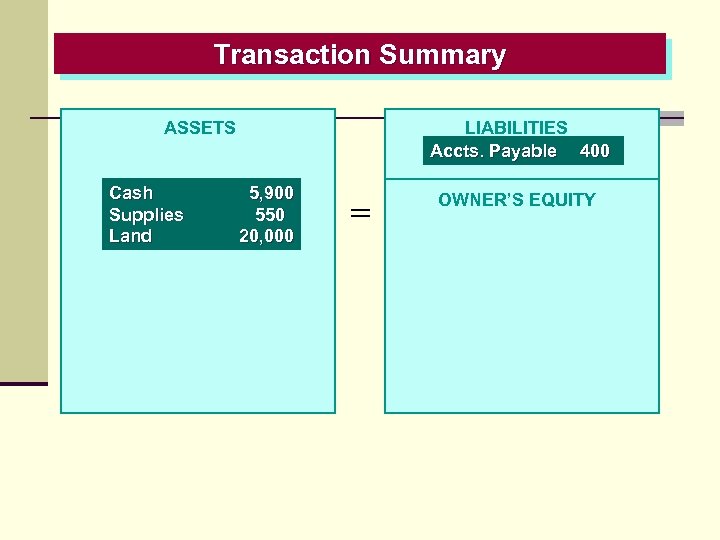
Transaction Summary LIABILITIES Accts. Payable 400 ASSETS Cash Supplies Land 5, 900 550 20, 000 = OWNER’S EQUITY
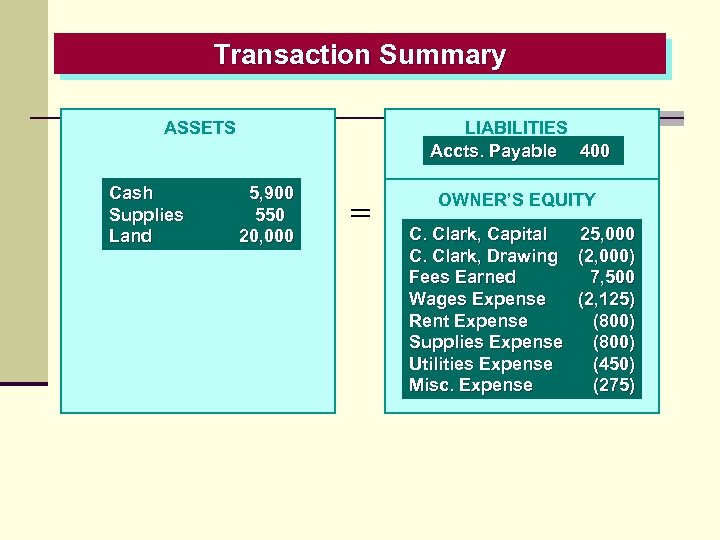
Transaction Summary LIABILITIES Accts. Payable 400 ASSETS Cash Supplies Land 5, 900 550 20, 000 = OWNER’S EQUITY C. Clark, Capital 25, 000 C. Clark, Drawing (2, 000) Fees Earned 7, 500 Wages Expense (2, 125) Rent Expense (800) Supplies Expense (800) Utilities Expense (450) Misc. Expense (275)
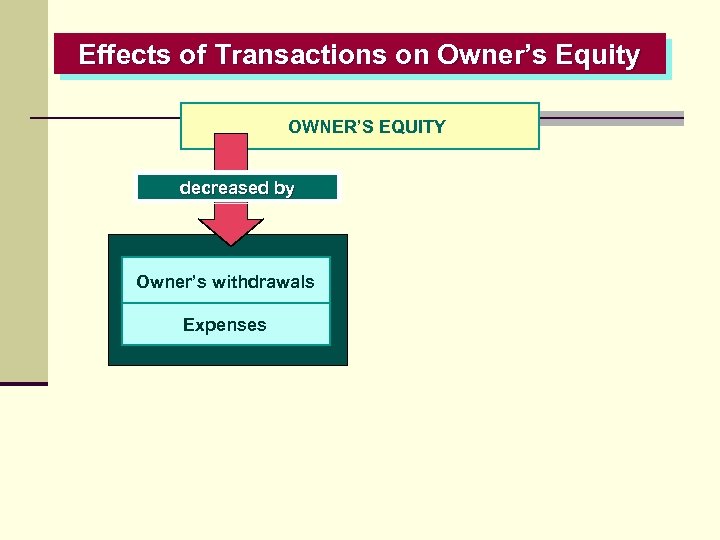
Effects of Transactions on Owner’s Equity OWNER’S EQUITY decreased by Owner’s withdrawals Expenses
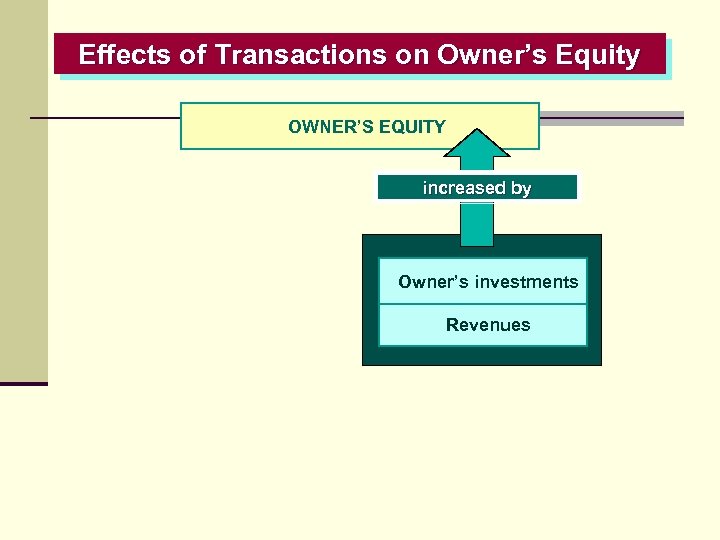
Effects of Transactions on Owner’s Equity OWNER’S EQUITY increased by Owner’s investments Revenues
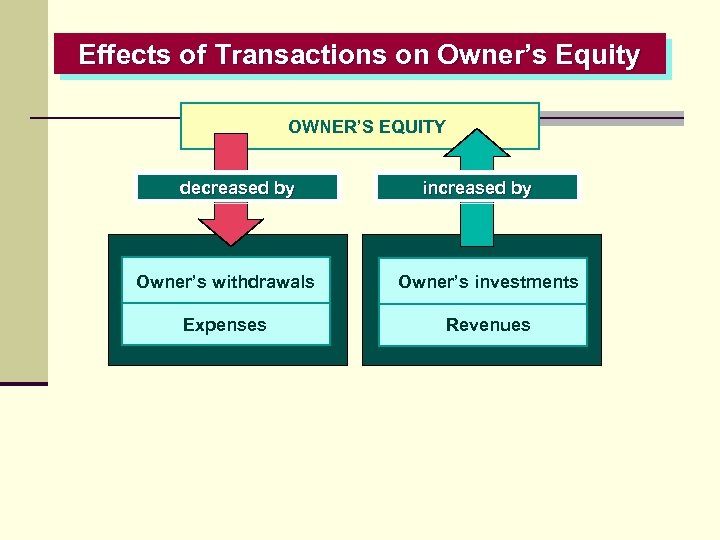
Effects of Transactions on Owner’s Equity OWNER’S EQUITY decreased by increased by Owner’s withdrawals Owner’s investments Expenses Revenues
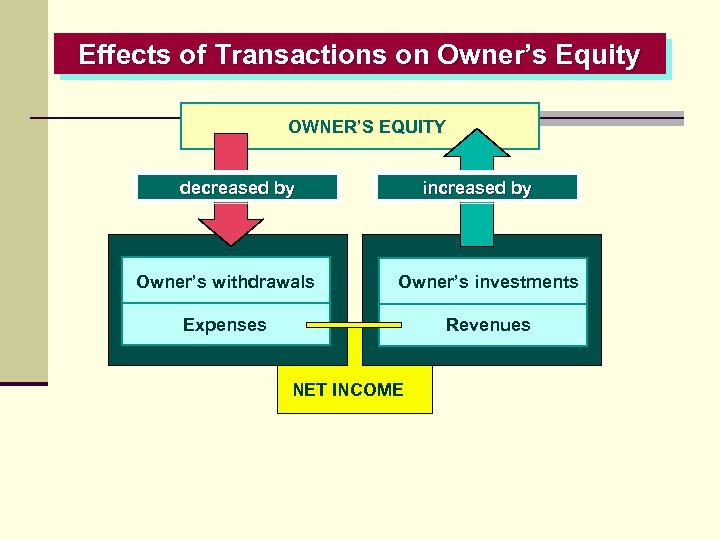
Effects of Transactions on Owner’s Equity OWNER’S EQUITY decreased by increased by Owner’s withdrawals Owner’s investments Expenses Revenues NET INCOME
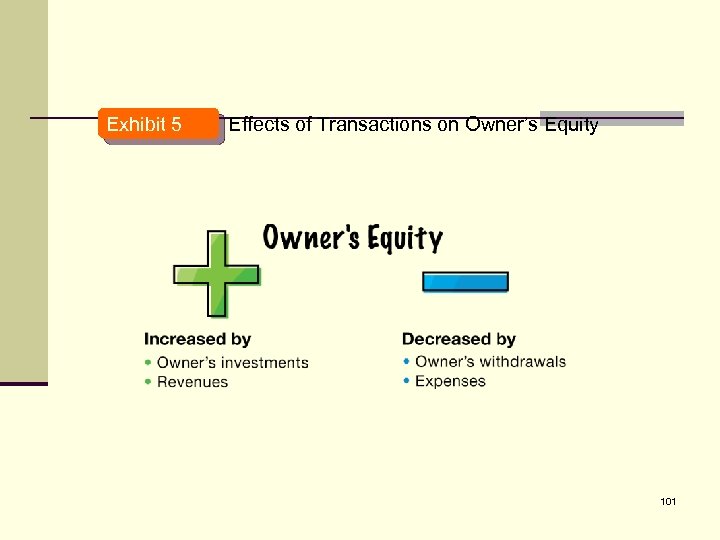
4 Exhibit 5 Effects of Transactions on Owner’s Equity 101
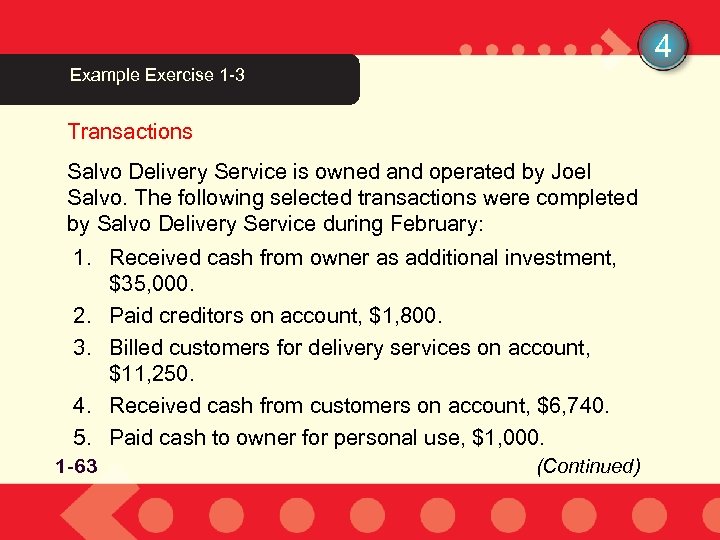
4 Example Exercise 1 -3 Transactions Salvo Delivery Service is owned and operated by Joel Salvo. The following selected transactions were completed by Salvo Delivery Service during February: 1. Received cash from owner as additional investment, $35, 000. 2. Paid creditors on account, $1, 800. 3. Billed customers for delivery services on account, $11, 250. 4. Received cash from customers on account, $6, 740. 5. Paid cash to owner for personal use, $1, 000. 1 -63 (Continued) 102
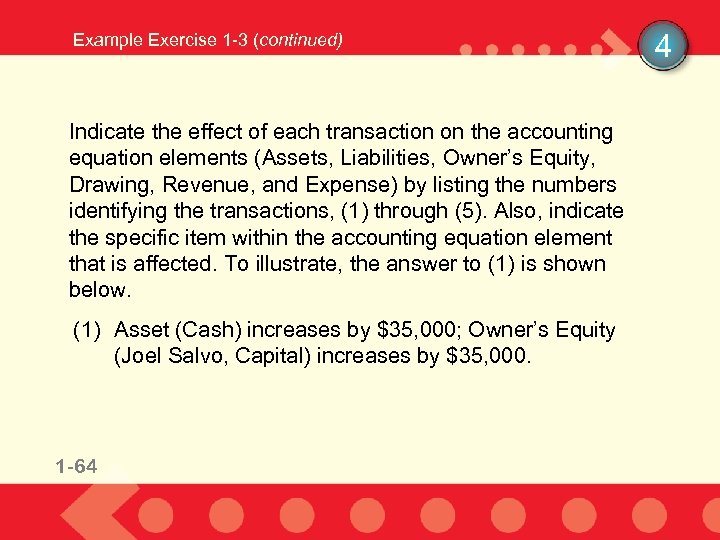
Example Exercise 1 -3 (continued) 4 Indicate the effect of each transaction on the accounting equation elements (Assets, Liabilities, Owner’s Equity, Drawing, Revenue, and Expense) by listing the numbers identifying the transactions, (1) through (5). Also, indicate the specific item within the accounting equation element that is affected. To illustrate, the answer to (1) is shown below. (1) Asset (Cash) increases by $35, 000; Owner’s Equity (Joel Salvo, Capital) increases by $35, 000. 1 -64 103
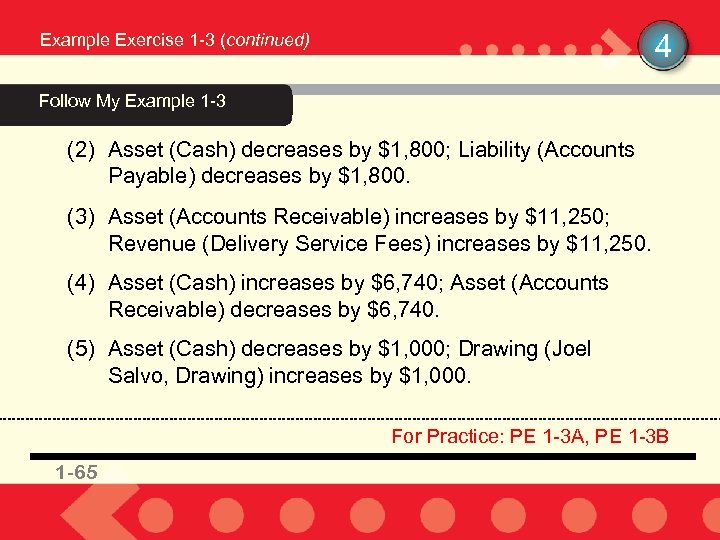
4 Example Exercise 1 -3 (continued) Follow My Example 1 -3 (2) Asset (Cash) decreases by $1, 800; Liability (Accounts Payable) decreases by $1, 800. (3) Asset (Accounts Receivable) increases by $11, 250; Revenue (Delivery Service Fees) increases by $11, 250. (4) Asset (Cash) increases by $6, 740; Asset (Accounts Receivable) decreases by $6, 740. (5) Asset (Cash) decreases by $1, 000; Drawing (Joel Salvo, Drawing) increases by $1, 000. For Practice: PE 1 -3 A, PE 1 -3 B 1 -65 104
5 Financial Statements After transactions have been recorded and summarized, reports are prepared for users. The accounting reports providing this information are called financial statements. 105
5 Income Statement The income statement reports the revenues and expenses for a period of time, based on the matching concept. 106
5 Matching Concept The matching concept is applied by matching the expenses with the revenue generated during a period by those expenses. 107
5 The excess of revenue over the expenses is called net income or net profit. If the expenses exceed the revenue, the excess is a net loss. 108
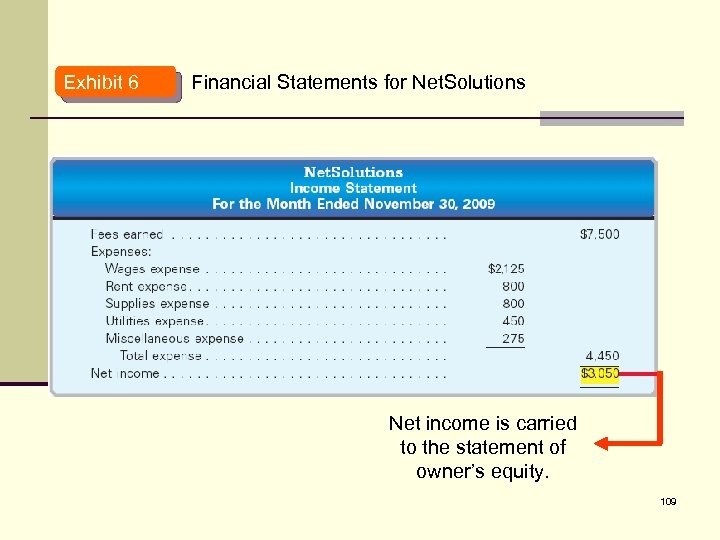
5 Exhibit 6 Financial Statements for Net. Solutions Net income is carried to the statement of owner’s equity. 109
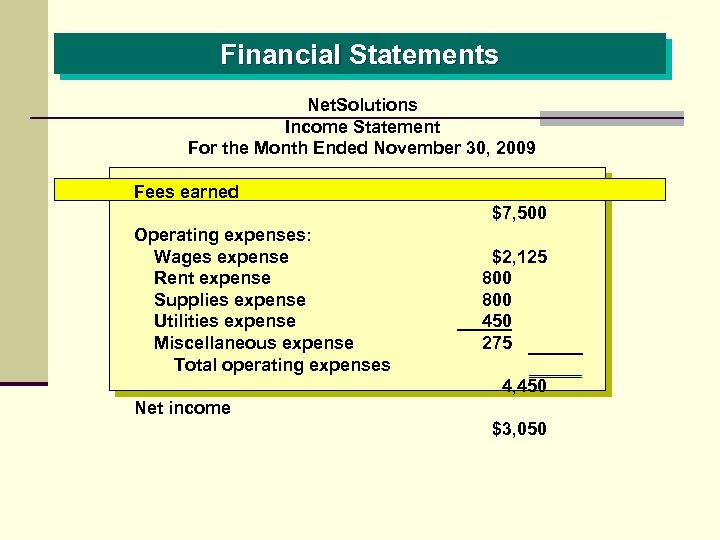
Financial Statements Net. Solutions Income Statement For the Month Ended November 30, 2009 Fees earned $7, 500 Operating expenses: Wages expense Rent expense Supplies expense Utilities expense Miscellaneous expense Total operating expenses $2, 125 800 450 275 4, 450 Net income $3, 050
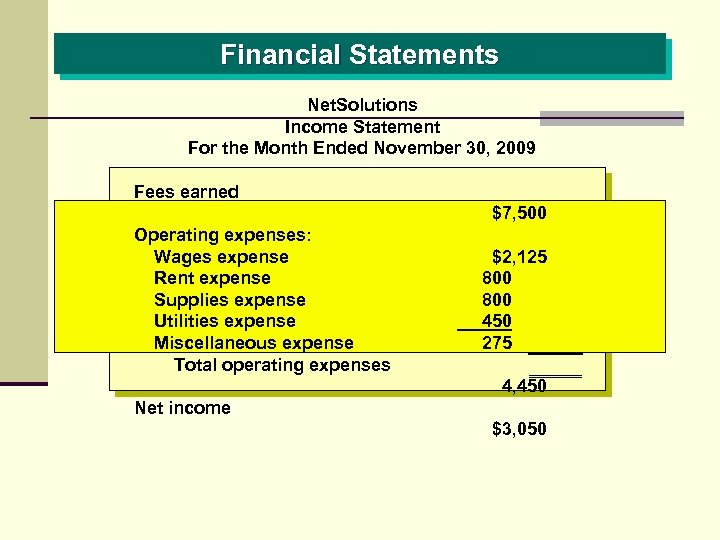
Financial Statements Net. Solutions Income Statement For the Month Ended November 30, 2009 Fees earned $7, 500 Operating expenses: Wages expense Rent expense Supplies expense Utilities expense Miscellaneous expense Total operating expenses $2, 125 800 450 275 4, 450 Net income $3, 050
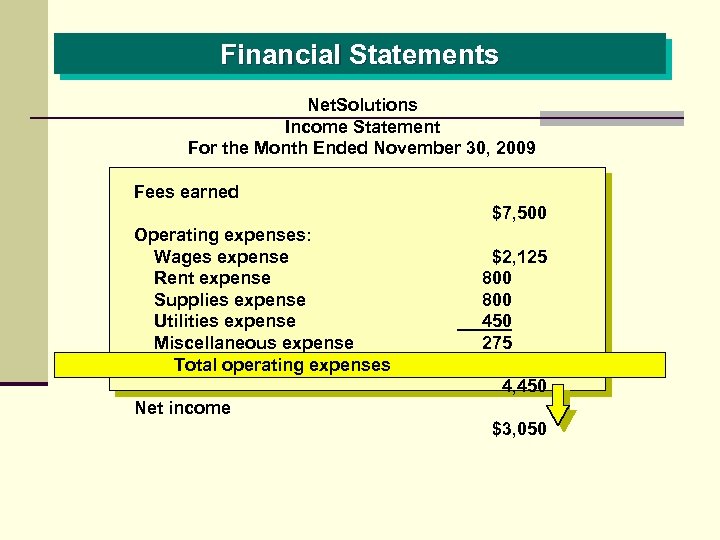
Financial Statements Net. Solutions Income Statement For the Month Ended November 30, 2009 Fees earned $7, 500 Operating expenses: Wages expense Rent expense Supplies expense Utilities expense Miscellaneous expense Total operating expenses $2, 125 800 450 275 4, 450 Net income $3, 050
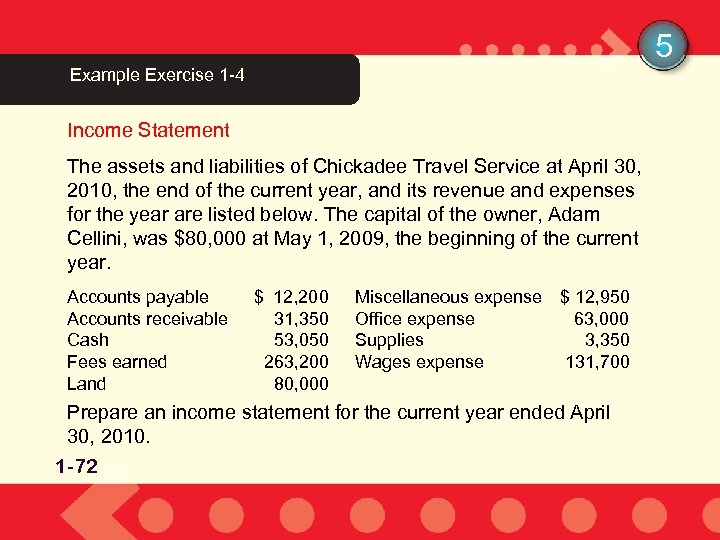
5 Example Exercise 1 -4 Income Statement The assets and liabilities of Chickadee Travel Service at April 30, 2010, the end of the current year, and its revenue and expenses for the year are listed below. The capital of the owner, Adam Cellini, was $80, 000 at May 1, 2009, the beginning of the current year. Accounts payable Accounts receivable Cash Fees earned Land $ 12, 200 31, 350 53, 050 263, 200 80, 000 Miscellaneous expense $ 12, 950 Office expense 63, 000 Supplies 3, 350 Wages expense 131, 700 Prepare an income statement for the current year ended April 30, 2010. 1 -72 113
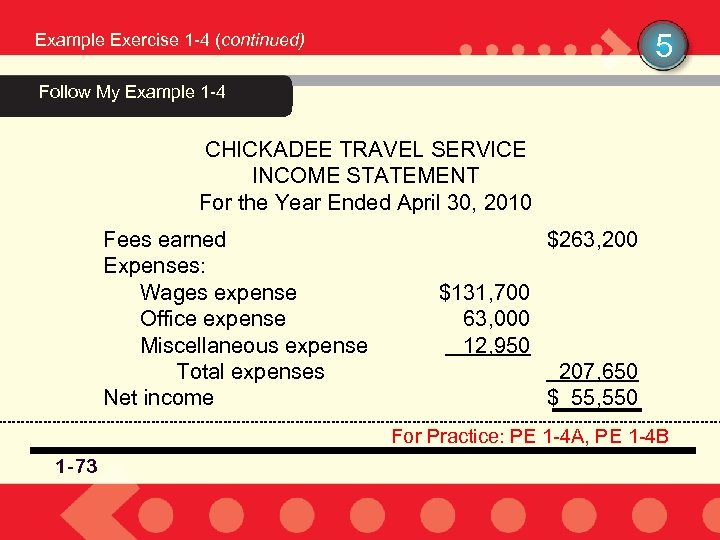
5 Example Exercise 1 -4 (continued) Follow My Example 1 -3 Follow My Example 1 -4 CHICKADEE TRAVEL SERVICE INCOME STATEMENT For the Year Ended April 30, 2010 Fees earned Expenses: Wages expense Office expense Miscellaneous expense Total expenses Net income $263, 200 $131, 700 63, 000 12, 950 207, 650 $ 55, 550 For Practice: PE 1 -4 A, PE 1 -4 B 1 -73 114
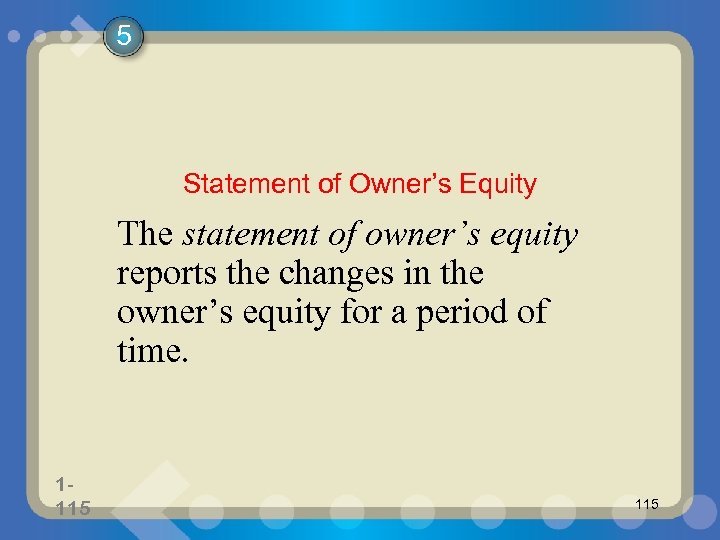
5 Statement of Owner’s Equity The statement of owner’s equity reports the changes in the owner’s equity for a period of time. 11115 115
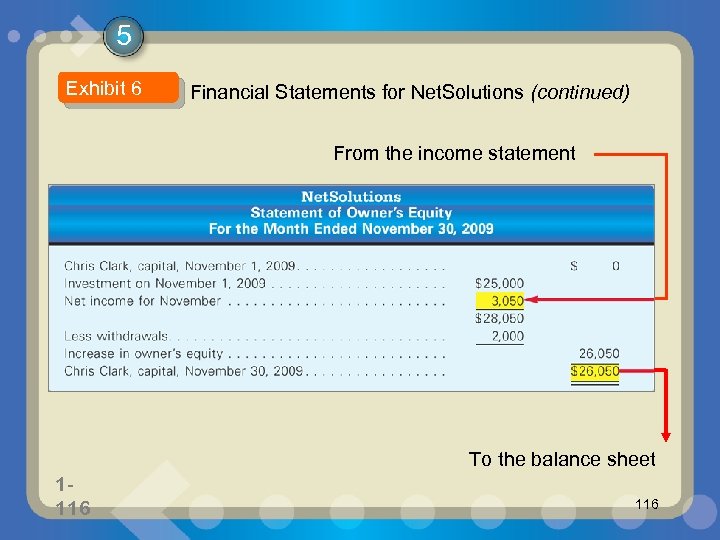
5 Exhibit 6 Financial Statements for Net. Solutions (continued) From the income statement To the balance sheet 11116 116
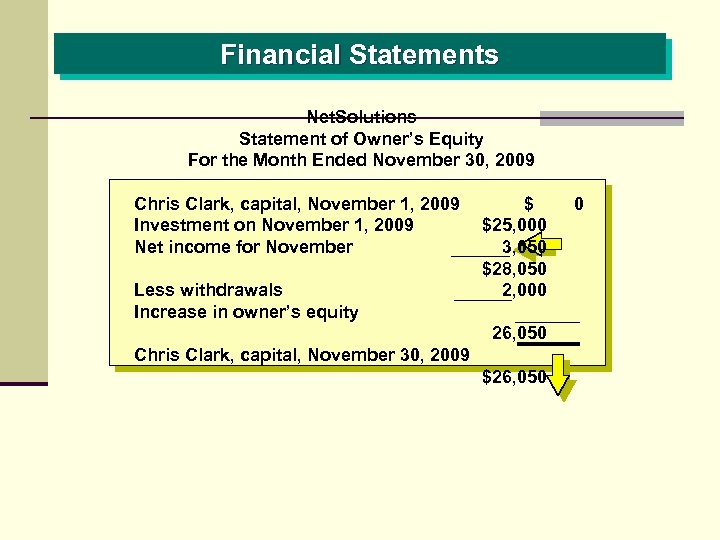
Financial Statements Net. Solutions Statement of Owner’s Equity For the Month Ended November 30, 2009 Chris Clark, capital, November 1, 2009 Investment on November 1, 2009 Net income for November Less withdrawals Increase in owner’s equity $ $25, 000 3, 050 $28, 050 2, 000 26, 050 Chris Clark, capital, November 30, 2009 $26, 050 0
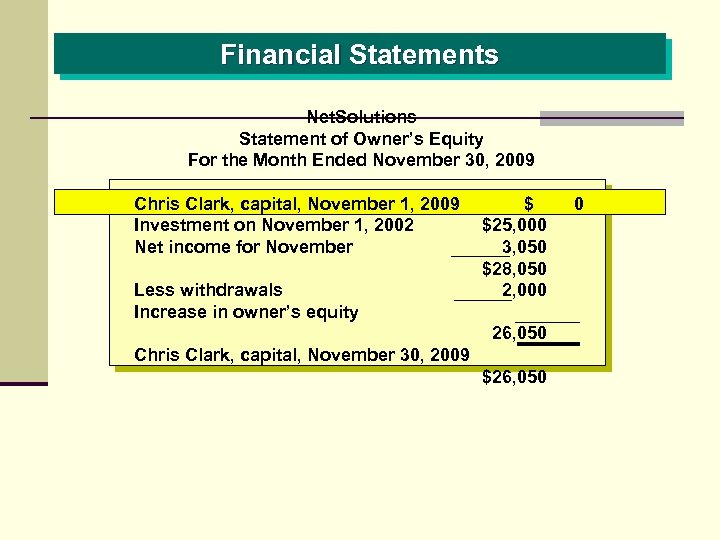
Financial Statements Net. Solutions Statement of Owner’s Equity For the Month Ended November 30, 2009 Chris Clark, capital, November 1, 2009 Investment on November 1, 2002 Net income for November Less withdrawals Increase in owner’s equity $ $25, 000 3, 050 $28, 050 2, 000 26, 050 Chris Clark, capital, November 30, 2009 $26, 050 0
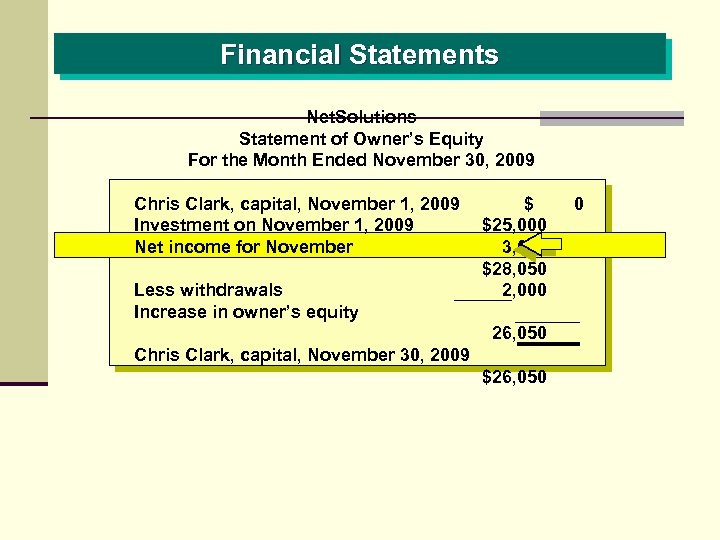
Financial Statements Net. Solutions Statement of Owner’s Equity For the Month Ended November 30, 2009 Chris Clark, capital, November 1, 2009 Investment on November 1, 2009 Net income for November Less withdrawals Increase in owner’s equity $ $25, 000 3, 050 $28, 050 2, 000 26, 050 Chris Clark, capital, November 30, 2009 $26, 050 0
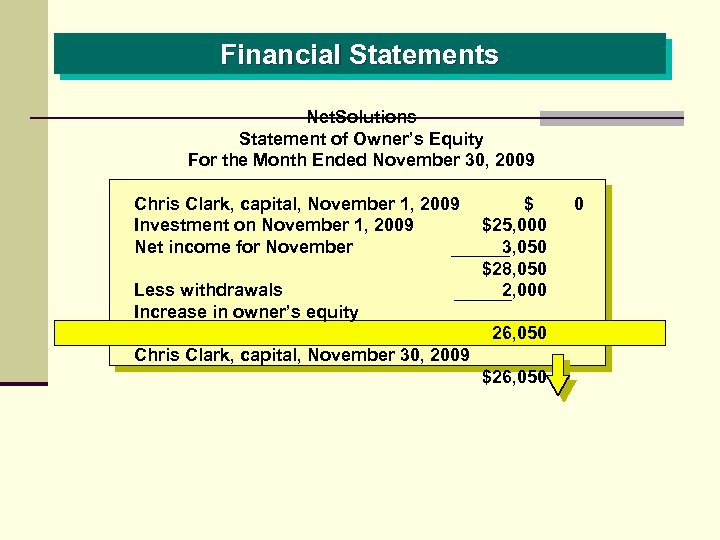
Financial Statements Net. Solutions Statement of Owner’s Equity For the Month Ended November 30, 2009 Chris Clark, capital, November 1, 2009 Investment on November 1, 2009 Net income for November Less withdrawals Increase in owner’s equity $ $25, 000 3, 050 $28, 050 2, 000 26, 050 Chris Clark, capital, November 30, 2009 $26, 050 0
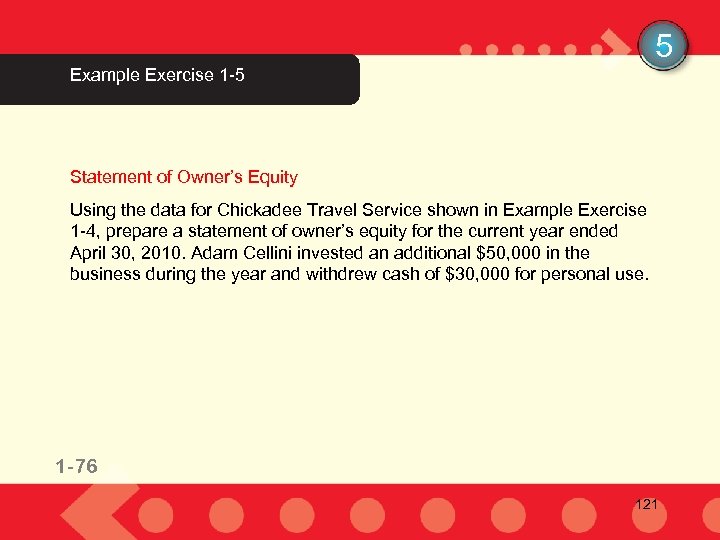
5 Example Exercise 1 -5 Statement of Owner’s Equity Using the data for Chickadee Travel Service shown in Example Exercise 1 -4, prepare a statement of owner’s equity for the current year ended April 30, 2010. Adam Cellini invested an additional $50, 000 in the business during the year and withdrew cash of $30, 000 for personal use. 1 -76 121
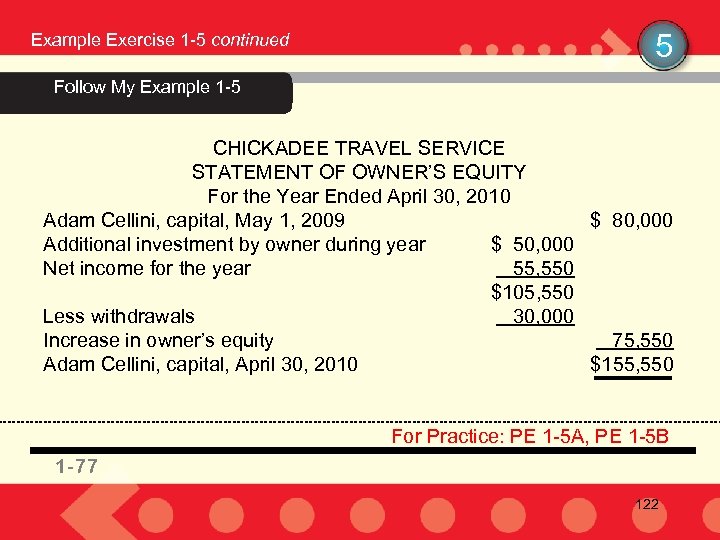
Example Exercise 1 -5 continued 5 Follow My Example 1 -5 CHICKADEE TRAVEL SERVICE STATEMENT OF OWNER’S EQUITY For the Year Ended April 30, 2010 Adam Cellini, capital, May 1, 2009 $ 80, 000 Additional investment by owner during year $ 50, 000 Net income for the year 55, 550 $105, 550 Less withdrawals 30, 000 Increase in owner’s equity 75, 550 Adam Cellini, capital, April 30, 2010 $155, 550 For Practice: PE 1 -5 A, PE 1 -5 B 1 -77 122
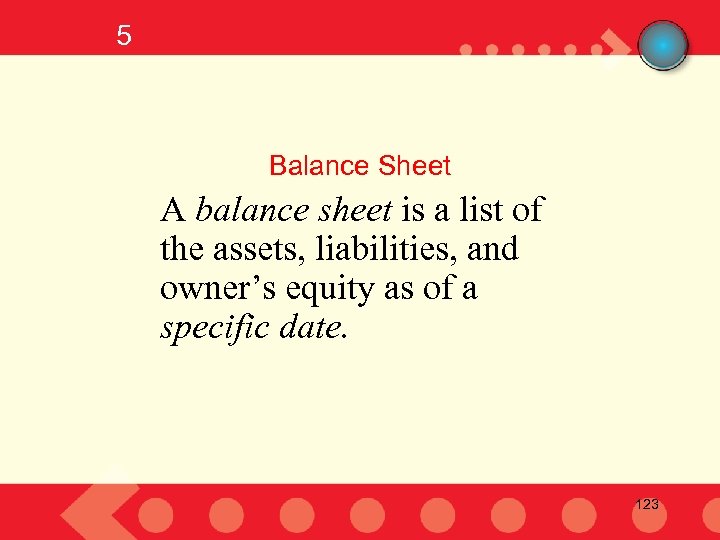
5 Balance Sheet A balance sheet is a list of the assets, liabilities, and owner’s equity as of a specific date. 123
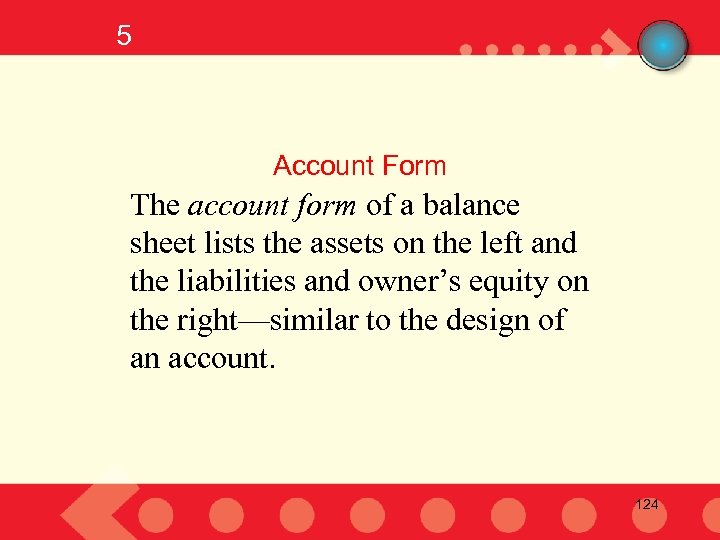
5 Account Form The account form of a balance sheet lists the assets on the left and the liabilities and owner’s equity on the right—similar to the design of an account. 124
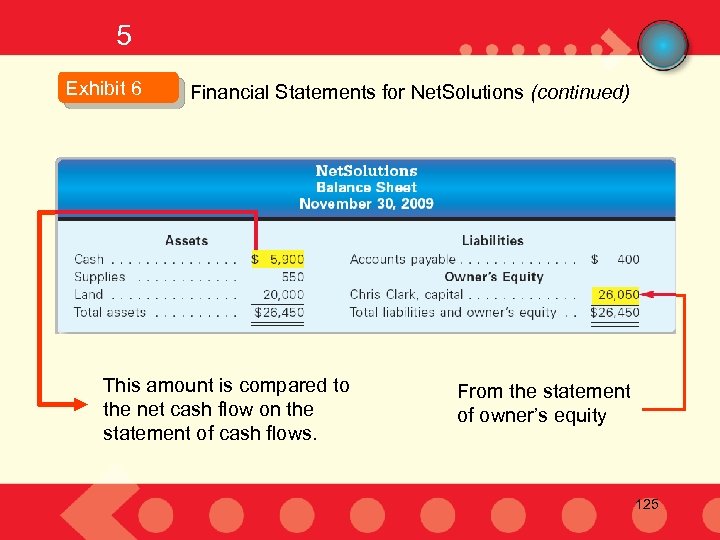
5 Exhibit 6 Financial Statements for Net. Solutions (continued) This amount is compared to the net cash flow on the statement of cash flows. From the statement of owner’s equity 125
5 Example Exercise 1 -6 Balance Sheet Using the data for Chickadee Travel Service shown in Example Exercises 1 -4 and 1 -5, prepare the balance sheet as of April 30, 2010. 1 -81 126
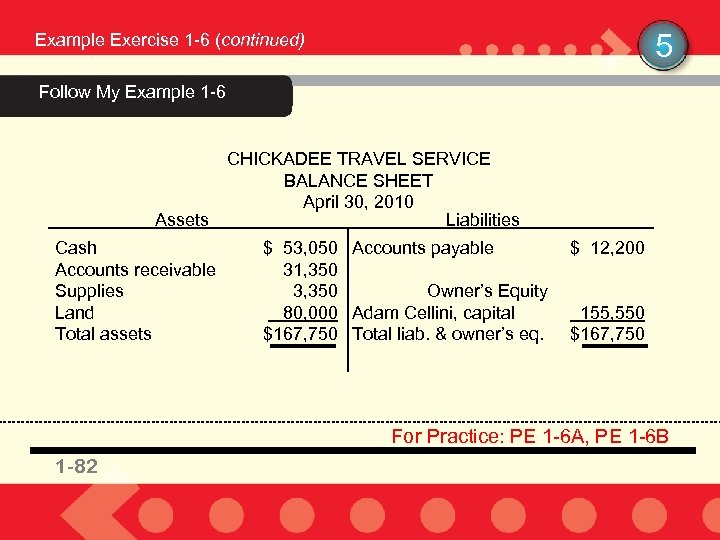
5 Example Exercise 1 -6 (continued) Follow My Example 1 -3 Follow My Example 1 -6 CHICKADEE TRAVEL SERVICE BALANCE SHEET April 30, 2010 Assets Liabilities Cash Accounts receivable Supplies Land Total assets $ 53, 050 Accounts payable 31, 350 3, 350 Owner’s Equity 80, 000 Adam Cellini, capital $167, 750 Total liab. & owner’s eq. $ 12, 200 155, 550 $167, 750 For Practice: PE 1 -6 A, PE 1 -6 B 1 -82 127
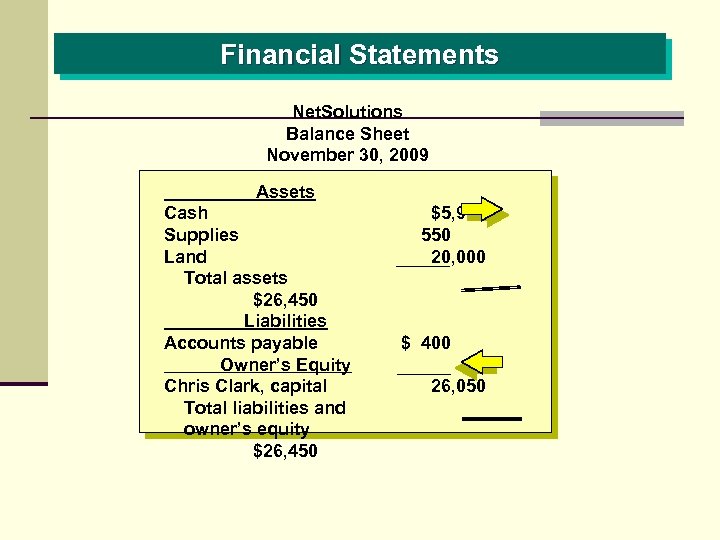
Financial Statements Net. Solutions Balance Sheet November 30, 2009 Assets Cash Supplies Land Total assets $26, 450 Liabilities Accounts payable Owner’s Equity Chris Clark, capital Total liabilities and owner’s equity $26, 450 $5, 900 550 20, 000 $ 400 26, 050
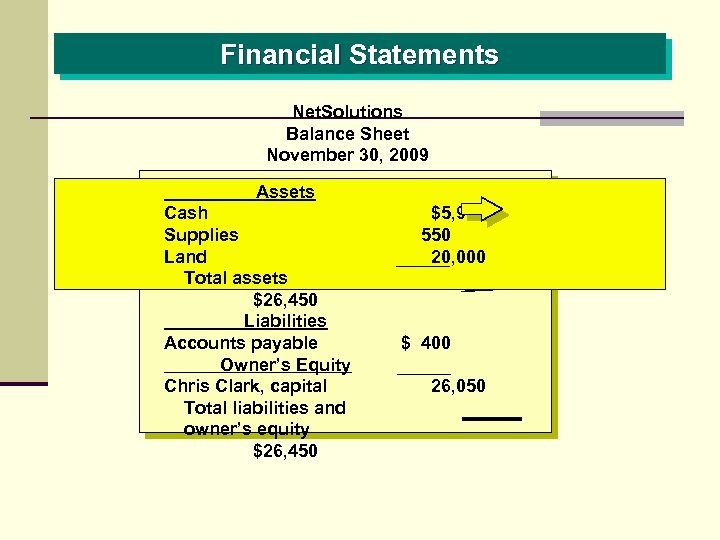
Financial Statements Net. Solutions Balance Sheet November 30, 2009 Assets Cash Supplies Land Total assets $26, 450 Liabilities Accounts payable Owner’s Equity Chris Clark, capital Total liabilities and owner’s equity $26, 450 $5, 900 550 20, 000 $ 400 26, 050
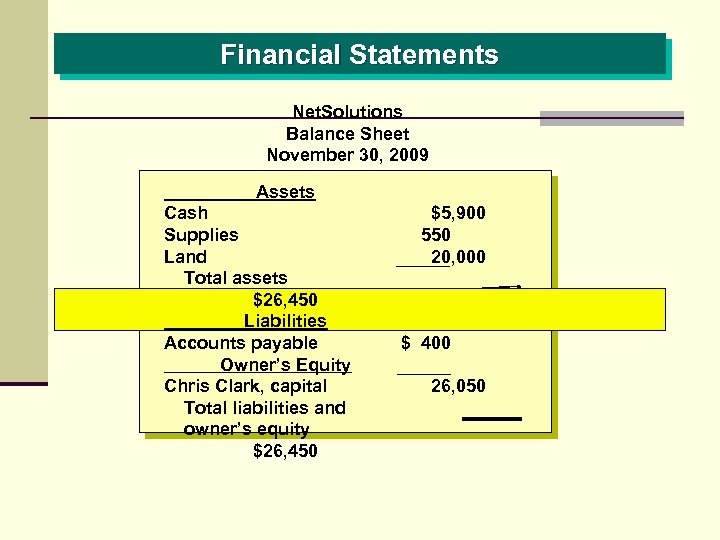
Financial Statements Net. Solutions Balance Sheet November 30, 2009 Assets Cash Supplies Land Total assets $26, 450 Liabilities Accounts payable Owner’s Equity Chris Clark, capital Total liabilities and owner’s equity $26, 450 $5, 900 550 20, 000 $ 400 26, 050
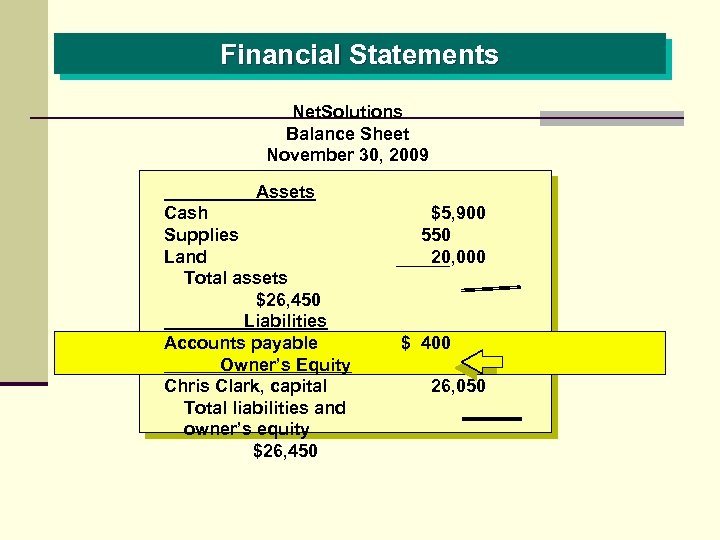
Financial Statements Net. Solutions Balance Sheet November 30, 2009 Assets Cash Supplies Land Total assets $26, 450 Liabilities Accounts payable Owner’s Equity Chris Clark, capital Total liabilities and owner’s equity $26, 450 $5, 900 550 20, 000 $ 400 26, 050
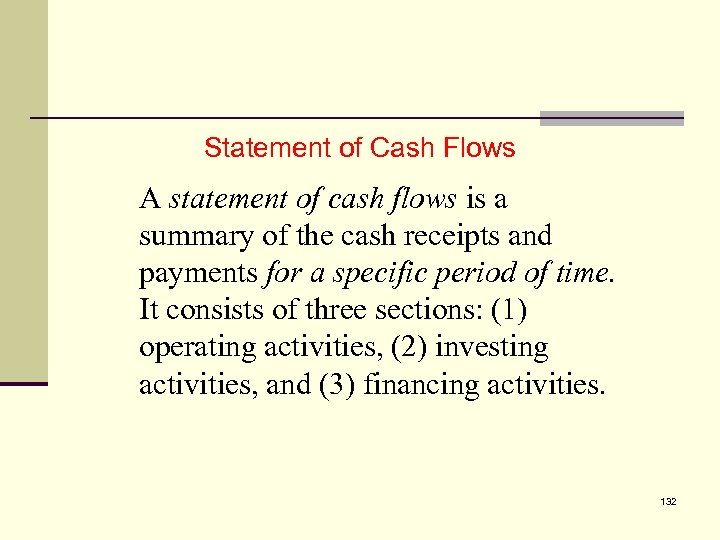
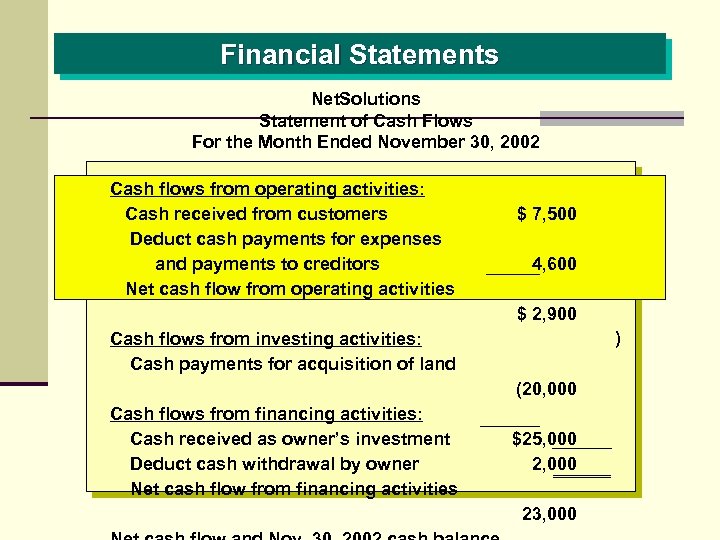
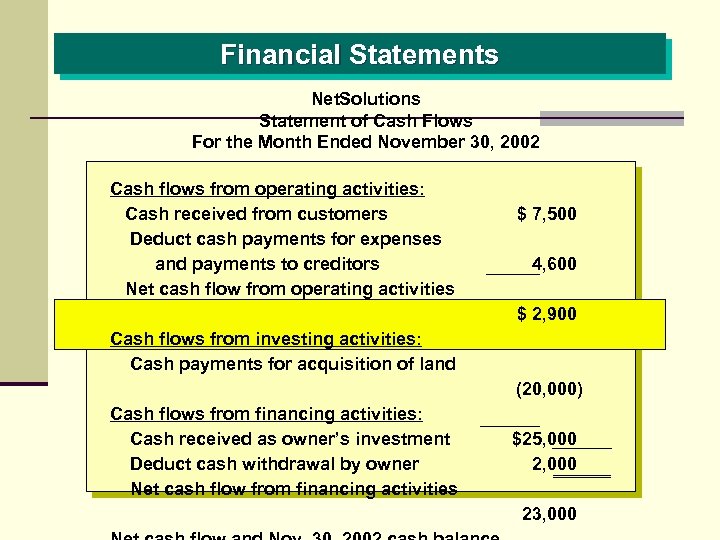
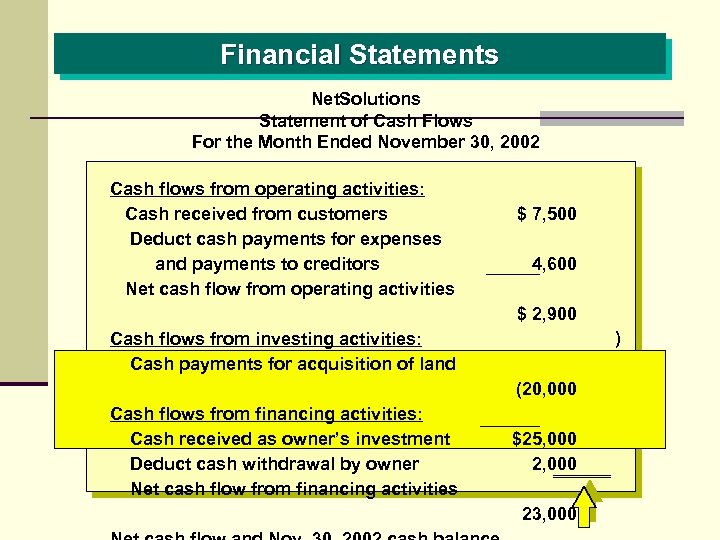
5 Statement of Cash Flows A statement of cash flows is a summary of the cash receipts and payments for a specific period of time. It consists of three sections: (1) operating activities, (2) investing activities, and (3) financing activities. 132
5 Operating Activities The cash flows from operating activities section reports a summary of cash receipts and cash payments from operations. 133
5 Investing Activities The cash flows from investing activities section reports the cash transactions for the acquisition and sale of relatively permanent assets. 134
5 Financing Activities The cash flows from financing activities section reports the cash transactions related to cash investments by the owner, borrowings, and withdrawals by the owner. 135
Transaction Analysis
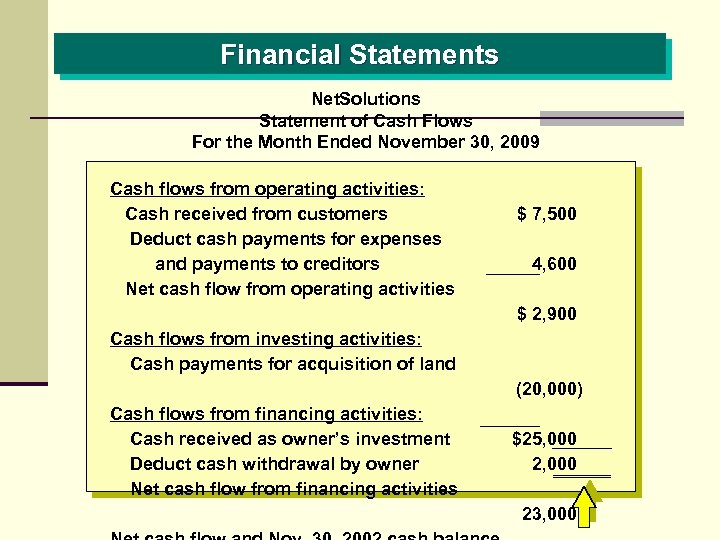
Financial Statements Net. Solutions Statement of Cash Flows For the Month Ended November 30, 2009 Cash flows from operating activities: Cash received from customers Deduct cash payments for expenses and payments to creditors Net cash flow from operating activities $ 7, 500 4, 600 $ 2, 900 Cash flows from investing activities: Cash payments for acquisition of land (20, 000) Cash flows from financing activities: Cash received as owner’s investment Deduct cash withdrawal by owner Net cash flow from financing activities $25, 000 23, 000
Financial Statements Net. Solutions Statement of Cash Flows For the Month Ended November 30, 2002 Cash flows from operating activities: Cash received from customers Deduct cash payments for expenses and payments to creditors Net cash flow from operating activities $ 7, 500 4, 600 $ 2, 900 ) Cash flows from investing activities: Cash payments for acquisition of land (20, 000 Cash flows from financing activities: Cash received as owner’s investment Deduct cash withdrawal by owner Net cash flow from financing activities $25, 000 23, 000
Financial Statements Net. Solutions Statement of Cash Flows For the Month Ended November 30, 2002 Cash flows from operating activities: Cash received from customers Deduct cash payments for expenses and payments to creditors Net cash flow from operating activities $ 7, 500 4, 600 $ 2, 900 ) Cash flows from investing activities: Cash payments for acquisition of land (20, 000) Cash flows from financing activities: Cash received as owner’s investment Deduct cash withdrawal by owner Net cash flow from financing activities $25, 000 23, 000
Financial Statements Net. Solutions Statement of Cash Flows For the Month Ended November 30, 2002 Cash flows from operating activities: Cash received from customers Deduct cash payments for expenses and payments to creditors Net cash flow from operating activities $ 7, 500 4, 600 $ 2, 900 ) Cash flows from investing activities: Cash payments for acquisition of land (20, 000 Cash flows from financing activities: Cash received as owner’s investment Deduct cash withdrawal by owner Net cash flow from financing activities $25, 000 23, 000
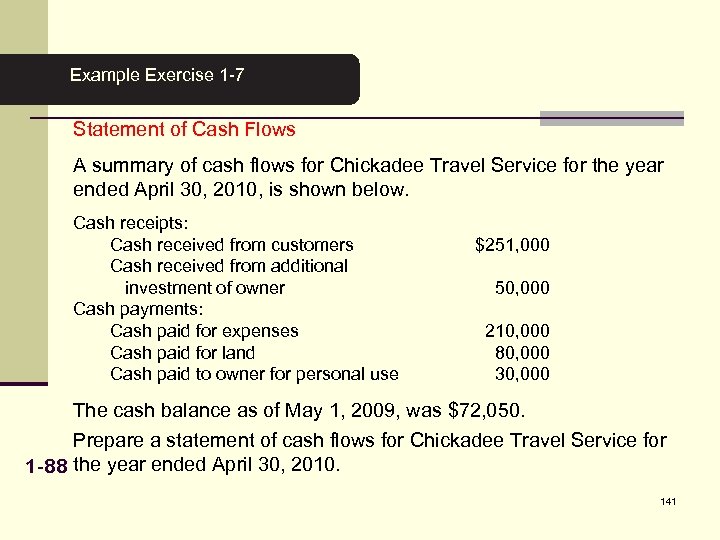
5 Example Exercise 1 -7 Statement of Cash Flows A summary of cash flows for Chickadee Travel Service for the year ended April 30, 2010, is shown below. Cash receipts: Cash received from customers Cash received from additional investment of owner Cash payments: Cash paid for expenses Cash paid for land Cash paid to owner for personal use $251, 000 50, 000 210, 000 80, 000 30, 000 The cash balance as of May 1, 2009, was $72, 050. Prepare a statement of cash flows for Chickadee Travel Service for 1 -88 the year ended April 30, 2010. 141
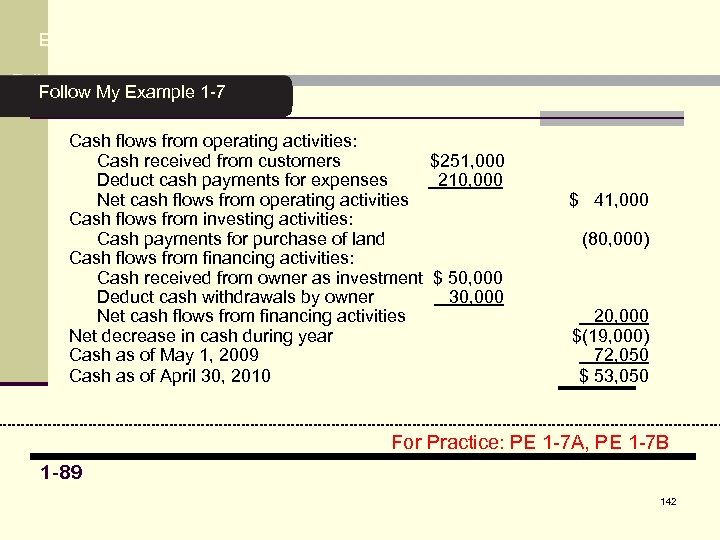
5 Example Exercise 1 -7 (continued) Follow My Example 1 -3 Follow My Example 1 -7 Cash flows from operating activities: Cash received from customers $251, 000 Deduct cash payments for expenses 210, 000 Net cash flows from operating activities Cash flows from investing activities: Cash payments for purchase of land Cash flows from financing activities: Cash received from owner as investment $ 50, 000 Deduct cash withdrawals by owner 30, 000 Net cash flows from financing activities Net decrease in cash during year Cash as of May 1, 2009 Cash as of April 30, 2010 $ 41, 000 (80, 000) 20, 000 $(19, 000) 72, 050 $ 53, 050 For Practice: PE 1 -7 A, PE 1 -7 B 1 -89 142
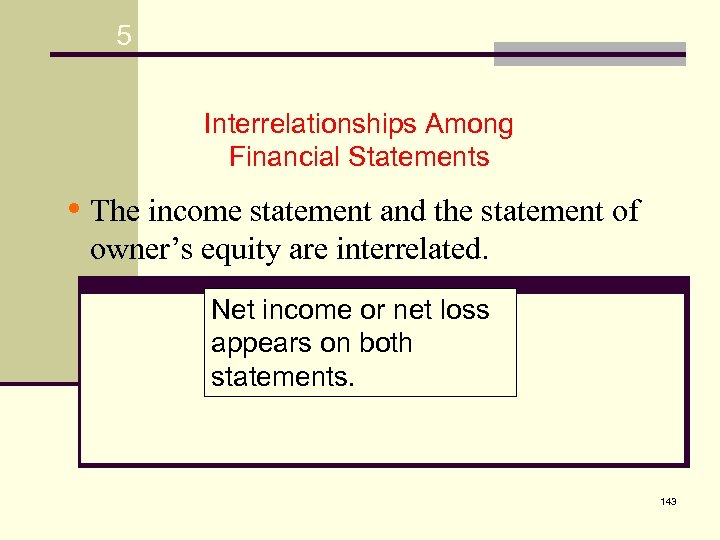
5 Interrelationships Among Financial Statements • The income statement and the statement of owner’s equity are interrelated. Net income or net loss appears on both statements. 143
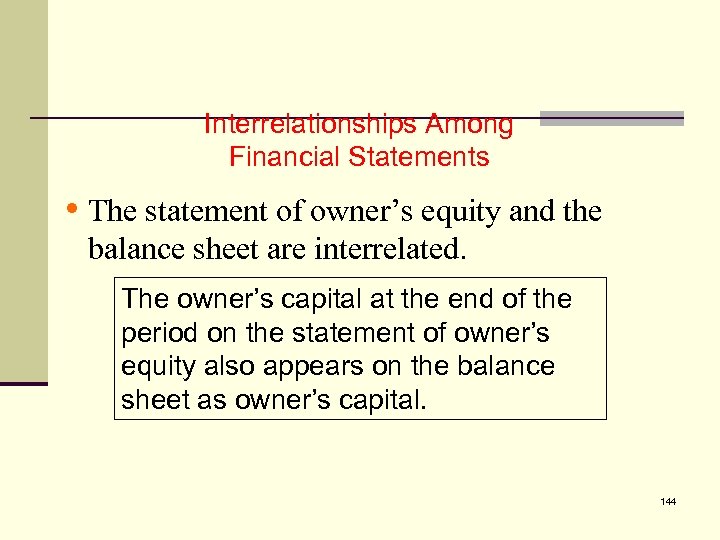
5 Interrelationships Among Financial Statements • The statement of owner’s equity and the balance sheet are interrelated. The owner’s capital at the end of the period on the statement of owner’s equity also appears on the balance sheet as owner’s capital. 144
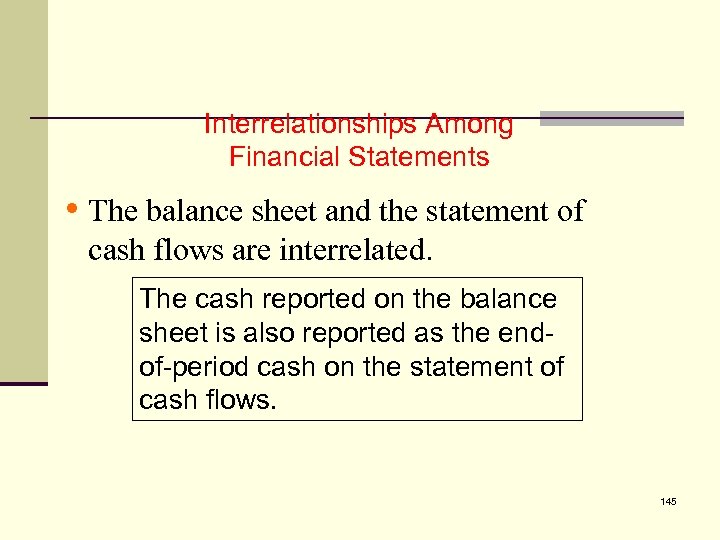
5 Interrelationships Among Financial Statements • The balance sheet and the statement of cash flows are interrelated. The cash reported on the balance sheet is also reported as the endof-period cash on the statement of cash flows. 145
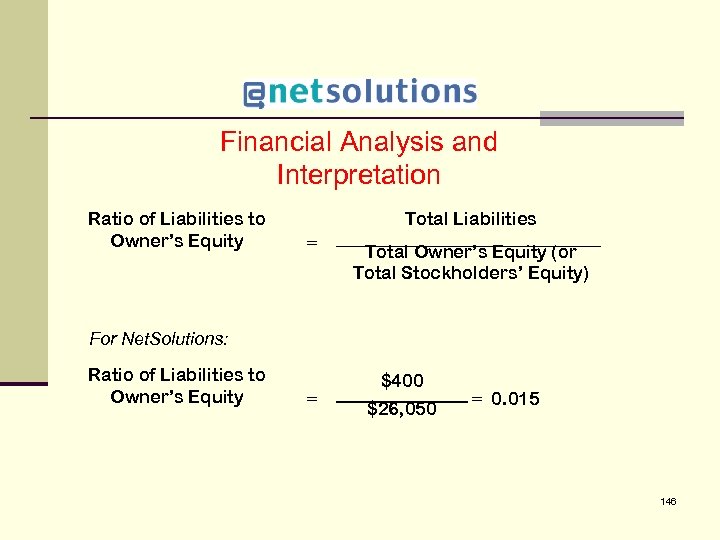
5 Financial Analysis and Interpretation Ratio of Liabilities to Owner’s Equity Total Liabilities = Total Owner’s Equity (or Total Stockholders’ Equity) For Net. Solutions: Ratio of Liabilities to Owner’s Equity = $400 $26, 050 = 0. 015 146

147
Скачать презентацию Power Notes Introduction to Accounting and Business Learning
959fb7296031c53aa74ffe3aa6d7b60c.ppt