


 Скачать презентацию POWER CHOICE An Introduction to Political Science
66d260ac9f459125e39b610b11a2ce30.ppt
- Количество слайдов: 143
 POWER & CHOICE An Introduction to Political Science 12 th Edition W. Phillips Shively, University of Minnesota Power. Point Supplement Richard P. Farkas, De. Paul University 1
 The purpose of education is to replace an empty mind with an open one. Malcolm Forbes 2
 Comparative Politics = Comparing the internal structure & behavior of political systems 3
 Student Requirements § Diligent reading of ALL assignments read before class lecture. . . § Regular attendance absences are costly and reflect poorly. . . § Participation in classroom dialogue think, connect, articulate, question § § Always bring “clicker” Office visits recommended … 4
 Chapter 1 The Idea of Politics 5
 POLITICS § § Use of power Production of public choice “… the world has proved to be a strange and wonderful place. ” “… one thing that has remained constant is a faith in people’s capacity to shape their futures through politics. ” 6
 Avenues for Analysis § “best conducted eclectically” § § behaviors institutions policies § “state” as organizer of politics § 7
 More Guidelines … § § § see both sides of any question keep our emotions in low key be precise about the meaning of the words we use be open to borrowing from other academic disciplines recognize need for broad principles 8
 “POLITICS” social process § rivalry & cooperation § making of a decision § binding on a group § POLITICS is a social process involving rivalry and cooperation culminating in the making of a decision binding on a group. 9
 … or the use of power to make a common decision for a group of people 10
 POWER § Politics ALWAYS involves the exercise of power § Power = ability of one person to cause another to do what the first wishes 11
 “POWER” § § … means by which power is exercised coercion persuasion construction of incentives authority can be the basis of one’s power if those governed accept the relationship … other sources possible 12
 Think about your “feeling” about the following terms … § administer, manage § manipulate, force § direct, lead § order, control 13
 POWER & CHOICE 1. Making common decisions (choice) A way to work out rationally the best common solution to a common problem 2. Exercise of power Ability to get someone to do what you want Contrast: Implicit vs. Manifest power 14
 Approaching “politics” … § § As public choice … emphasizes the options and decisions located throughout the system & the attempt to meet needs As power … emphasizes the management of persons in the system Example: the university classroom 15
 “state” “sovereign state” § § § The political entity whose government has ultimate authority to make decisions binding upon all those within the boundaries of that entity … country not what Americans call “states” 16
 Kinds of Approaches … § “Interpretive political scientists” historical, philosophical aspects built from detailed, non-numerical cases § “Behavioralists” look for broad patterns across many cases using statistical analysis of numerical data 17
 “Theory” § § § Thinking about politics invites broad generalization and abstraction We pursue generalization through theory A theory is a statement linking specific instances to broader principles 18
 Normative & Empirical Analysis § normative: systematic thoughts about what § OUGHT TO BE empirical: systematic examination of what IS 19
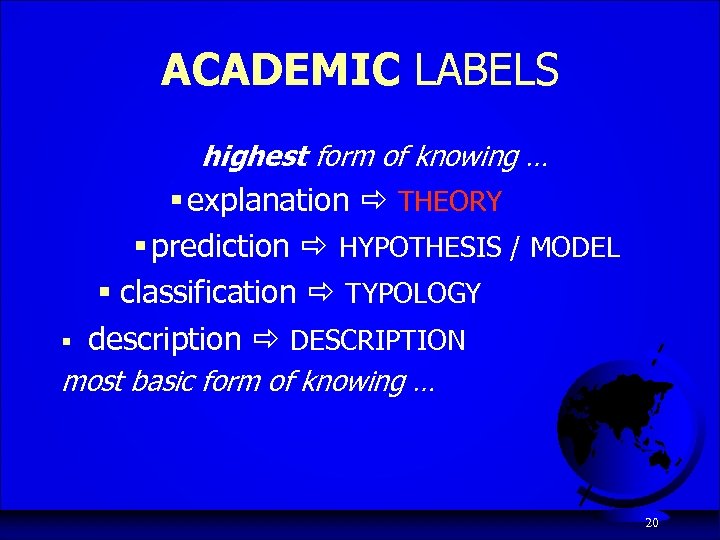 ACADEMIC LABELS highest form of knowing … § § explanation THEORY § prediction HYPOTHESIS / MODEL § classification TYPOLOGY description DESCRIPTION most basic form of knowing … 20
 HOW We Know. . . When the METHODOLOGY is sound … § § § when the process is carefully planned when the terms are clear when the observations and measurements are precise 21
 “Falsifiability” “Testability” § Possible that the statement is FALSE? Can the statement be tested? § “causation” vs. “correlation” 22
 Political Science as a Discipline § § § American political behavior American political institutions American public policy Comparative politics International politics Political theory § many other schemes for dividing Political Science exist 23
 Chapter 3 The Modern State 24
 “unit of analysis” “level of analysis” § § § § group / family / friends organizations neighborhoods towns / cities regions / sections / districts “sovereign” states multi-state organizations global 25
 Development of the State History, Napoleon & the “modern” state § Colonialism brought elsewhere § Hand & glove evolution: *complex industry & commerce needed the state & the state was invented; *commerce & industry made controlling and taxing people easier enhancing the evolution of the state § 26
 Review … § § § Need to generate “public goods” Government decisions on WHAT? Government need for revenue to PAY Creation of identity that could mobilize masses Result: CONTROL by state 27
 Public Goods § emphasizes needs & choice … § something that benefits all members of the community but that no one can be prevented from using § test: whether it is impossible to deny it to any member of the group; if a public good is available to any, it is available to all 28
 “state” “sovereign state” § § § The political entity whose government has ultimate authority to make decisions binding upon all those within the boundaries of that entity … country not what Americans call “states” 29
 “nation” § § § Ethno-cultural identity of a group Common culture, language, history, religion, physical and/or behavioral characteristics, race, images, myths … a people Commonness found “in the blood” Essentially: emotional attachment 30
 nation vs. state § § key: boundaries … “nation-state” “multi-state nation” “multi-national state” allegiance / identity to state: PATRIOTISM allegiance / identity to nation: NATIONALISM 31
 More State – Nation Distinctions “State” as level of analysis vs. local § “State” as political identity § “State” as government authority § “Nation” as identity, based upon culture Congruence? tension? (state vs. nation) § inclusive vs. exclusive rational vs. emotional integrating vs. disintegrating 32
 GOVERNMENT and the State § § § The state’s principle actor is the government = a group of people who have the ultimate authority to act on behalf of the state theory of the autonomous state = state acts without prodding from people in conflict or decision-making civil society = organized and active part of society that is not controlled by government and whose objectives are self-identified “the natural counterweight to government” in affairs of the state 33
 Challenges to the STATE “State-building” Problems that transcend boundaries … “globalization” environment trade, economics, finance security communication 34
 More challenges … § § § Civil society: issues below the state radar Pressures from “parts” seeking authority (autonomy) Questions about “original” boundaries; “our land” “Failed States” “Transitional States” 35
 Alternatives … to the state § Regional integration: European Union, NAFTA -- “macro-states” § United Nations Organization § Communications world culture § “Emerging” (? ) International Law 36
 Examples: State-building § § common 21 st century phenomenon! Nigeria (text) state vs. nation European Union (text) institution-building Iraq, Slovakia, Bosnia, Kosovo, Palestine, Palau, Ukraine, Puerto Rico, other … 37
 Chapter 2 Modern Ideologies & Political Philosophy 38
 “Ideology” § § philosophy: coherent set of ideas about what ought to be (normative) 19 th century idea: people should determine their political fate § ideology = philosophy + instructions what people should do to make it happen § “isms” 39
 Uses of Ideology § § § Simplify processing of ideas: filter Connect people to other people Umbrella for mobilization Shorthand for packaging pol. ideas Glue that ties ideas together Guide decisions ideology NOT static ! 40
 AMERICAN confusion! American ideologies: “loosely organized, inconsistent, untidy” … no internal coherence … constantly migrating shaped by squeezing into coalitions rather than by any intellectual reasoning 41
 AMERICAN liberalism = government needs to be active in the assistance it provides to those in need; in course, providing services § aggressively defends freedom of expression § classically suspect of “elites” exercising power § 42
 AMERICAN conservatism = § § § government should shrink from activities and permit authority to devolve. . . maintain an efficient, minimally regulated economy; fiscal prudence advocate common morality & common spirituality 43
 “Classic” Ideologies Who Should Make Decisions? § LIBERALISM develop individual capacities to the fullest American liberalism & conservatism = variants § § CONSERVATISM tradition, maintain ordered community, press for common values SOCIALISM liberalism but … FASCISM conservatism but … COMMUNISM depends on normative vs. empirical 44
 Origins of Classic Liberalism § § § invented by intellectuals result of general artistic & scientific restlessness practical pressures from large scale commerce & industry 45
 Principles … classic liberalism § § People must be maximally responsible for their own actions and circumstances Liberals see politics as choice As many choices as possible should be kept private The sphere of politics should be limited Champion: John Stuart Mill 46
 Origins of Modern Conservatism § § reaction to the advent of Liberalism rationale for maintaining traditional European political structures rationale for maintaining centralization of power and military establishments caution about transfer of political responsibility to the common man 47
 Principles of Modern Conservatism § § § People must be maximally responsible for their own actions and circumstances belief that society is MORE than the sum of the individuals in it greatest good possible in community order, structure, community and all things that reinforce and maintain it web of social responsibilities Champion: Edmund Burke 48
 st 21 § § § Century Ideologies tendency to “blend” commitments “post-material issues” & objectives (the environment) neo-liberalism & globalization (economics) historical & religious sources of ideas … (fundamentalism) relevance of class comfort with welfare state 49
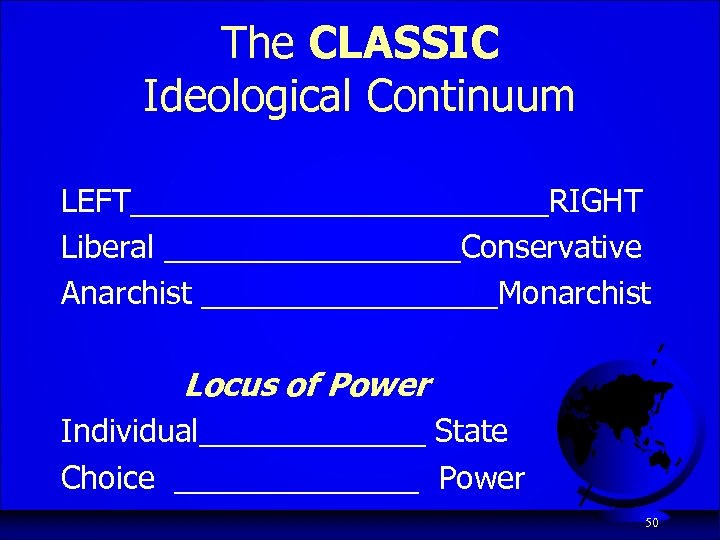 The CLASSIC Ideological Continuum LEFT____________RIGHT Liberal _________Conservative Anarchist _________Monarchist Locus of Power Individual_______ State Choice _______ Power 50
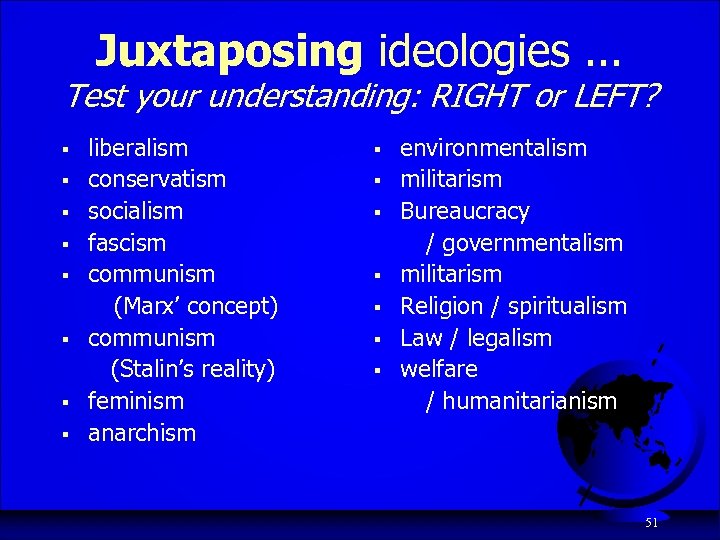 Juxtaposing ideologies. . . Test your understanding: RIGHT or LEFT? § § § § liberalism conservatism socialism fascism communism (Marx’ concept) communism (Stalin’s reality) feminism anarchism § § § § environmentalism militarism Bureaucracy / governmentalism militarism Religion / spiritualism Law / legalism welfare / humanitarianism 51
 American awkwardness … Your text and large numbers of Americans and American scholars will suggest that “nationalism” is a “passionate identification” with the state. It is more useful, but not always possible, to use the terms in a way that enables comparative politics to differentiate identities found in many parts of our world. This is the distinction offered on the previous slide. 52
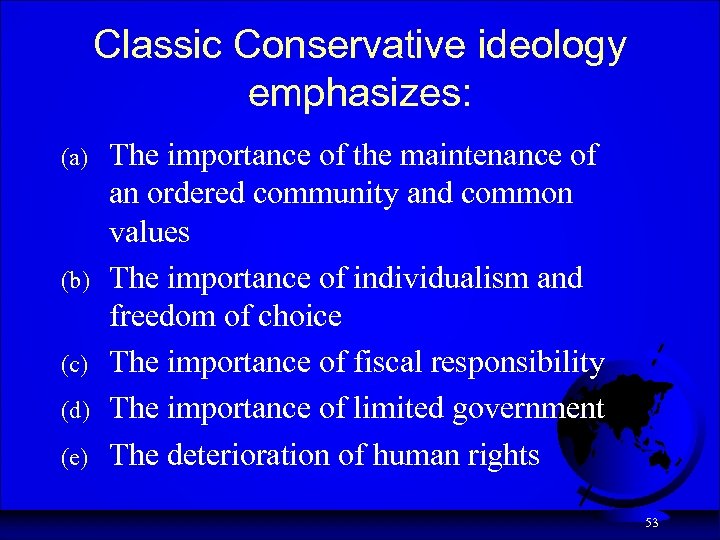 Classic Conservative ideology emphasizes: (a) (b) (c) (d) (e) The importance of the maintenance of an ordered community and common values The importance of individualism and freedom of choice The importance of fiscal responsibility The importance of limited government The deterioration of human rights 53
 Chapter 4 Policies of the State 54
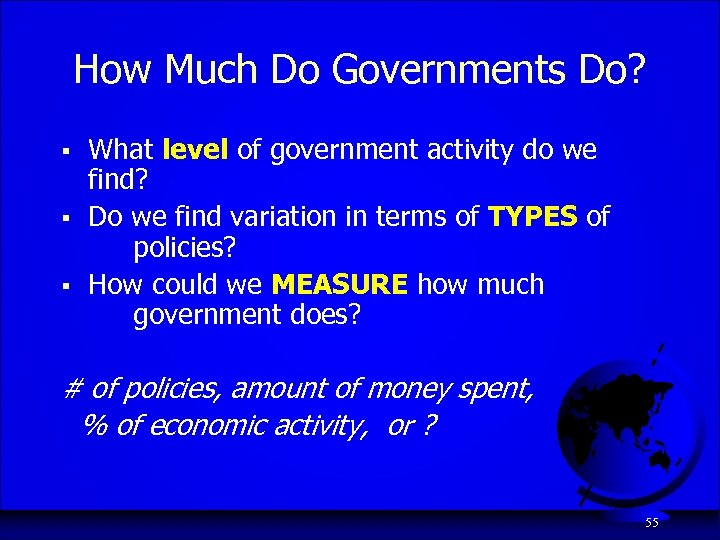 How Much Do Governments Do? § § § What level of government activity do we find? Do we find variation in terms of TYPES of policies? How could we MEASURE how much government does? # of policies, amount of money spent, % of economic activity, or ? 55
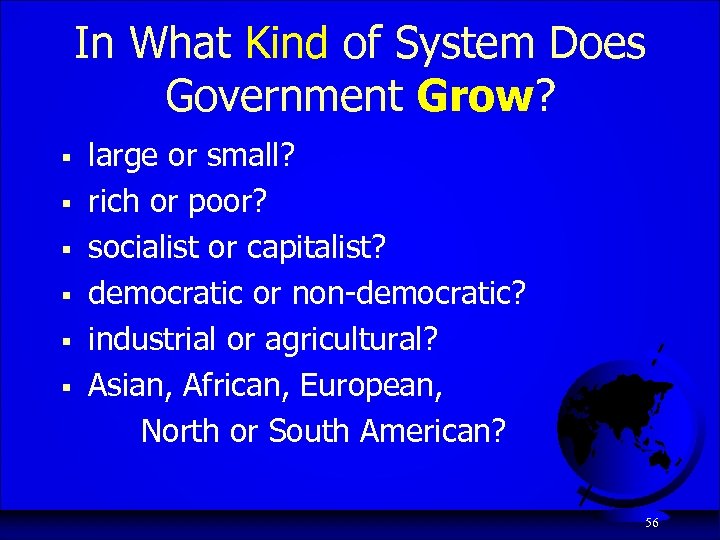 In What Kind of System Does Government Grow? § § § large or small? rich or poor? socialist or capitalist? democratic or non-democratic? industrial or agricultural? Asian, African, European, North or South American? 56
 How Big Is Government? Why? Growth of government linked to: § § § Rise in wealth, revenue, capacity Demands by the citizens “Natural” bureaucratic tendencies World more complicated place Electoral politics choice or power perspective? 57
 Labeling what Governments Do § § One scheme transfer resources provide subsidies regulate administer § § Second scheme rule-making rule-application rule adjudication “capabilities”(functions) extractive distributive symbolic responsive 58
 KINDS of policies made … variations and rankings § § § § Education Defense Technology Health Social welfare Industrial Agricultural Consumer § § § § Tax Environmental Transportation Energy Social control Fiscal/monetary Political design other 59
 Other Queries … § § § Does type of political system impact on what policy areas receive attention? What other variables could account for differences? Relationship: how POWER is distributed and resulting policy choices … § Solid analysis of policy requires both choice and power perspectives 60
 Challenges of Policy-making § Demographics & Aging your decision? § “Economic” vs. “Human” Development your decision? § AIDS in Africa your decision? Examine the basis for your positions … 61
 Chapter 6 What Lies Behind Policy: Questions of Justice and Effectiveness 62
 Concept Review … § EMPIRICAL – examines what IS § NORMATIVE – examines what OUGHT TO BE Keep in focus with this chapter! 63
 CHOICES: Justice How do we judge political systems? … evaluate political systems? Is one a normative question; the other an empirical question? JUSTICE & FAIRNESS same thing? “people should be treated as they deserve” 64
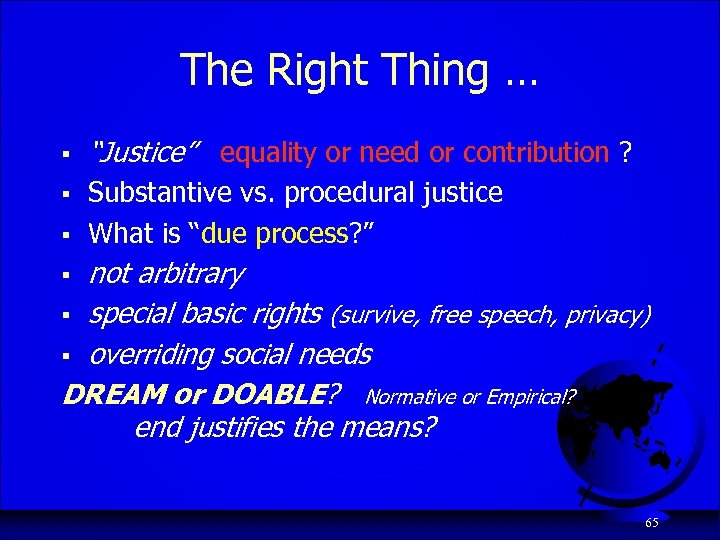 The Right Thing … § “Justice” equality or need or contribution ? § Substantive vs. procedural justice What is “due process? ” § not arbitrary § special basic rights (survive, free speech, privacy) § overriding social needs DREAM or DOABLE? Normative or Empirical? end justifies the means? § 65
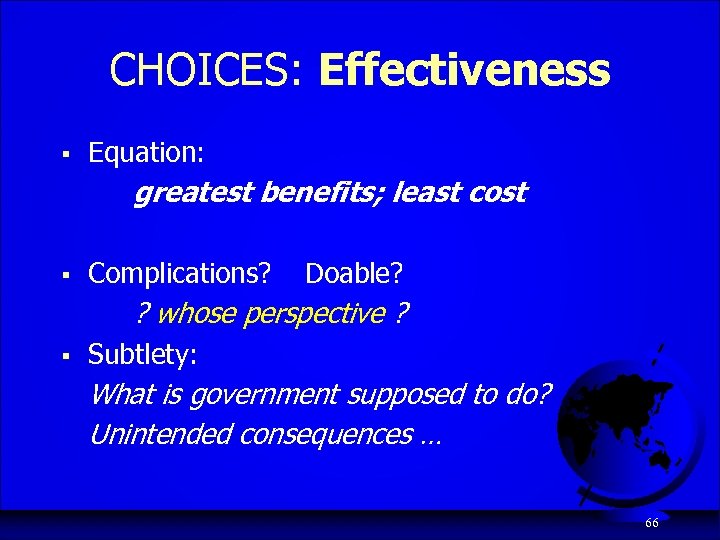 CHOICES: Effectiveness § Equation: greatest benefits; least cost § Complications? Doable? ? whose perspective ? § Subtlety: What is government supposed to do? Unintended consequences … 66
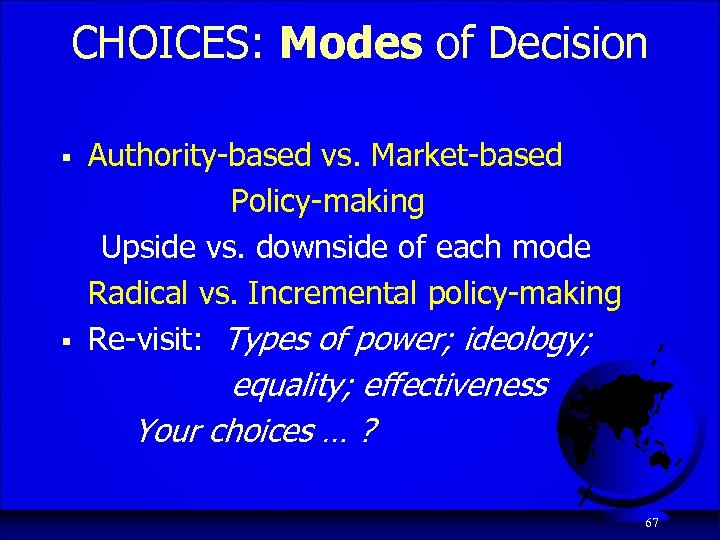 CHOICES: Modes of Decision § § Authority-based vs. Market-based Policy-making Upside vs. downside of each mode Radical vs. Incremental policy-making Re-visit: Types of power; ideology; equality; effectiveness Your choices … ? 67
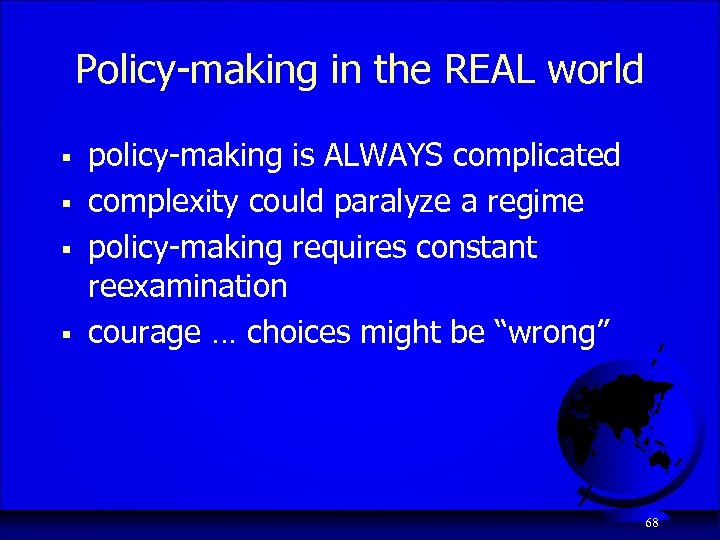 Policy-making in the REAL world § § policy-making is ALWAYS complicated complexity could paralyze a regime policy-making requires constant reexamination courage … choices might be “wrong” 68
 Political Choice & Implications § § Need-based Scholarships / “Affirmative Action” Water Pollution Children as a “Collective Good” Gender-based Pension payments 69
 Chapter 8 How Individuals Relate to the State, and the State to the Individual 70
 AUTHORITY § § § Power to make policies based upon an institutionalized mechanism, procedure or by coercive force -- examples …? Any limits to governmental authority? Gov. authority = efficient & powerful once established, requires little investment § Authority, if widely accepted, is easier to exercise 71
 LEGITIMACY § Belief by a large number of citizens that a particular government properly has authority Individual or collective agreement that (1) a person or group has the right to issue certain sorts of commands and (2) that those commands shall be obeyed. § normative and tentative perception! § 72
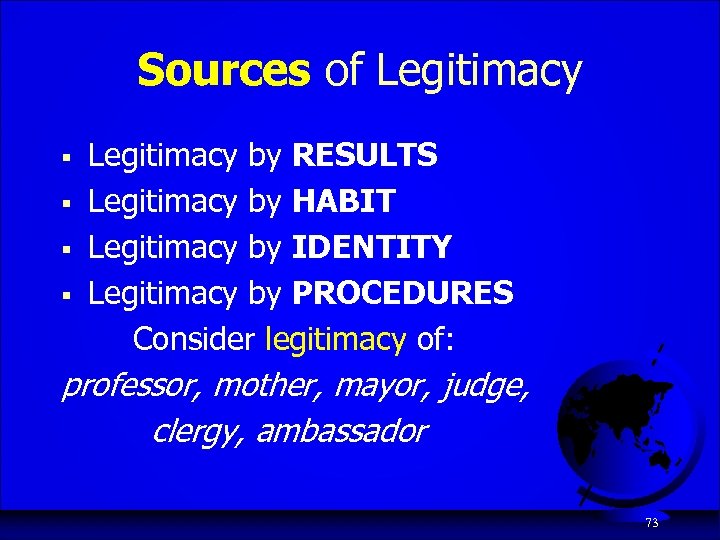 Sources of Legitimacy § § Legitimacy by RESULTS Legitimacy by HABIT Legitimacy by IDENTITY Legitimacy by PROCEDURES Consider legitimacy of: professor, mother, mayor, judge, clergy, ambassador 73
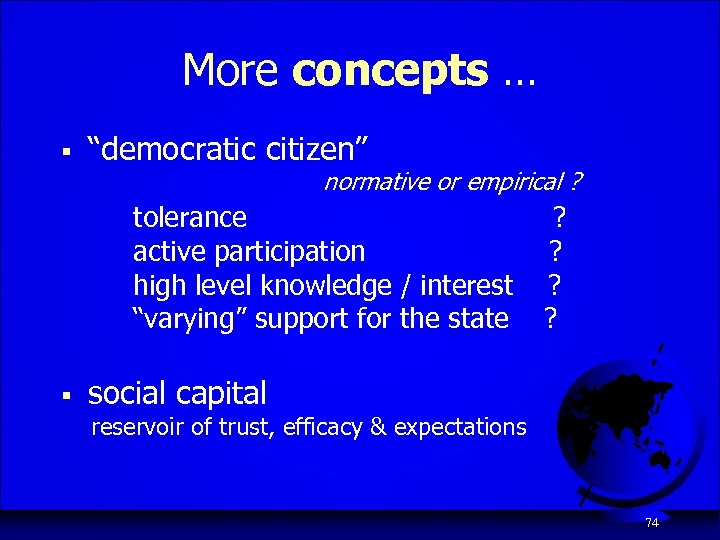 More concepts … § “democratic citizen” normative or empirical ? tolerance active participation high level knowledge / interest “varying” support for the state § ? ? social capital reservoir of trust, efficacy & expectations 74
 More concepts … § political culture texture of political society § religion & political culture § political socialization process of political learning “agents” of socialization 75
 Authority & Legitimacy: Cases § German case facts trends meaning. . . § US contrast trends causes. . . 76
 Chapter 9 Constitutions and the Design of Government 77
 Designs of Government constitution = set of rules by which power is distributed among the offices of government variations in formality … virtue of vagueness principles of constitutional design: § § § limit break with tradition amendability (flexibility over time) incentive compatibility 78
 Distribution of Power § § § geographic concentration of power (a) centralized or de-centralized (b) federal or unitary focus: revenue and/or services? conceptual difference: (a) vs. (b) … four combinations centralized federal; de-centralized federal; centralized unitary; de-centralized unitary 79
 “constitutionalism” form & function § § § commitment to rules, rights, laws law constructed from constitutional values constitutionalism = faithful adherence to the letter and spirit of the constitution 80
 Examples § Text: United Kingdom, Russia § Other cases worth investigating: Bosnia, European Union, Costa Rica 81
 Chapter 10 Elections 82
 The appeal of elections § § § “elections” ooze legitimacy … invite respectability … cause many to assume democracy … illuminate “choice” … demonstrate “participation” … actually serve many non-democratic objectives 83
 Elections § § functions: select leaders / policies mobilize; build support tough questions: Is the outcome in doubt? Are the choices significantly different? Do the mechanics of the elections reinforce or undermine the citizens’ choices? 84
 Types § choosing leadership or policies typical labels: “election” “referendum” § Electoral systems: SMDP vs. PR ? mechanics, advantages, biases ? 85
 Single member district plurality § § § § SMDP: name provides detail … Political system divided into districts One winner in each district Winner is the candidate with the largest number of votes Upside: direct link – leader to constituency Downside: lost voices of losers Upside/downside: distribution of voters = crucial 86
 Proportional Representation § § § PR: name provides detail … a political system has x number of representatives to be elected. all political parties create a composite list of their candidates (for all the seats) if a political party gets ALL the votes, it gets all the seats if it gets a percentage of the votes, it gets that percentage of the seats 87
 PR § Upside: the pattern of votes cast by citizens is reflected in the elected representatives; minorities have a voice and all votes “count” wherever they may be located § Downside: because names are taken from the party lists (top to bottom order), folks in one place may not perceive that they have a specific representative to whom they can turn for service; party loyalty is much more important to the leader in a PR system 88
 Other dimensions … § Referendum … more “democratic? ” § more power, more choice? more problems … ? Participation … more “democratic? ” more power, more choice? more problems … ? 89
 Electoral Participation § § Who? logic? reasoning? “paradox of voting” no one who is sensible should vote How much is “best? ” comparing … Bases for choices: long vs. short term party, race, gender, age, region, language, ethnicity, economic role, other ? 90
 Examples § § Text: Israel Nigeria Others worth investigating: Bosnia Iraq Mexico 91
 Chapter 11 Parties: A Linking and Leading Mechanism in Politics 92
 Political Parties § A group of officials or would-be officials who are linked to a sizable group of citizens in an organization designed to ensure that its officials gain or retain power. § FUNCTIONS: “linking & leading” 93
 Specific functions: § What does a “political party” do? or would like to be able to do … mobilization recruitment socialization source of political identity “channel of control” 94
 Form & Function of Parties § Organizational structure ? impact on function § Financial structure: sources of revenue government: “public funds” foreign governments private: individuals, groups, businesses shadowy sources 95
 Parties … § § “Iron Law of Oligarchy” Party systems: Dominant Party Systems Two Party Systems Multi-Party Systems § Mass vs. Ideological Party systems nature of appeal to members … § Examples: China; Canada 96
 Chapter 12 Structured Conflict: Interest Groups and Politics 97
 Interest Groups § Definition: “workhorses of political advocacy” alternate vehicle for representation Barriers to effectiveness: poor organization priority voices (“disproportionate voices”) interest distortion § Variation: (a) degree of organization (b) degree of direct involvement in government § 98
 Collective Action Logic of Collective Action collective goods vs. costs factors that could draw membership to interest groups § § size selective incentives coercion relative muscle 99
 Types, types § § § Sectoral Institutional Promotional Interest articulation & interest aggregation Anomic, revolutionary, other … 100
 Tactics § § § § control of information & expertise electoral support & activity use of economic power campaign contributions public information campaigns violence & disruption litigation 101
 Mechanics PLURALISM *competitive political environment *level playing field for competing interest groups § NEO-CORPORATISM *government solicits and institutionalizes some voices, some interest groups *preferential treatment ? Ombudsman power & choice. . . § 102
 Examples: complexities, hybrids, combinations § France § Japan § European Union (text) (contrast) 103
 Chapter 14 National Decision-making Institutions: Parliamentary Government 104
 PARLIAMENTARY GOVERNMENT Characteristics § § § Elected parliament (often large) Sovereign Executive power in the Cabinet power ONLY as long as retains “confidence” (commands a majority of votes) Cabinet members remain in parliament PM can “dissolve” parliament 105
 Some structural details § § Head of State: formal, symbolic position If a single party emerges from an election with a majority of seats, it will identify its leadership as the PM and cabinet; if a coalition is formed to establish a majority, a combination of leaders from various coalition partners will be positioned in the cabinet 106
 Cabinet management & control § § § Policy agenda Debates (real or ? ) Voting (pre-ordained ? ) Policy coherence … Policy clarity … Policy boldness … 107
 Functions of PARLIAMENT § § § becomes the forum for public debate government policies are scrutinized in advance of becoming policies monitors the administration of policies insures accountability via question time enhances transparency by exposing the policy process testing ground for leadership 108
 “Representation” § § § DELEGATE mirror constituent views … upside – downside? TRUSTEE invest in official’s judgment upside – downside? What’s wrong with a “mix” or ambiguity? 109
 Special features § Accountability … “Question time” must answer questions put to the leadership! § Parliamentary committees: not generally autonomous / weak § Curbs & limits on Parliament consensus parliamentarism federal systems autocratic systems 110
 Advantages … Disadvantages “power” (exec & leg power) is united enabling more quick and responsive policy-making § policy-making responsibility CLEAR ------------------------§ majority (coalition) CONTROL; § minority vulnerable/ignored § non-regular turnover … instability possible § added problems with “minority cabinet” § 111
 Chapter 15 National Decision-making Institutions: Presidential Government 112
 Presidential Government § § § executive & legislature elected separately shared responsibility … competition, conflict role of parties different / less party discipline different parties may occupy leg / exec. & leg. claims of “representation” cabinet tied to executive; not linked to legislative success 113
 Pres. & Parl. Systems Compared § § § § policy leadership identifying policy “responsibility” making “comprehensive” policy recruiting leadership review & control flexibility & fixed terms separation: symbolic - political responsibilities constitutional review 114
 Characteristics: Presidential Systems § § § Presidential policy leadership Unclear policy responsibility Less comprehensive policy Different kinds of leaders Problems with review & control No division of symbolic and power aspects of the executive office 115
 For discussion: Greenstein’s Six Qualities of Leadership § § § proficiency as a public communicator organizational capacity political skill vision cognitive style emotional intelligence either system have edge? 116
 Examples: Ch. 14 & 15 § Parliamentary: India & Germany § Presidential: France & Mexico § § ? New insight into American system ? What is the suggested relationship between constitutions, power and resources? 117
 Chapter 7 Democracy and Autocracy 118
 Democracy defined § regime in which all fully qualified citizens vote at regular intervals to choose, from among alternative candidates, the people who will be in charge of setting a state’s policies § any ambiguity in this definition? more than or less than thing? 119
 Democracy What is the “democratic bargain? ” § § accept possibility of losing expect to get something from the political process More characteristics: critically appraise … fragile, rich states/poor states, longevity, sustainability, greater dignity for all citizens, strong protection against arbitrary treatment 120
 “Democracy” VALUES Tolerance Obligation Voice Constraint Transparency Legitimacy 121
 Trend? § “Overall, there has been a clear movement toward democracy” § Third Wave -- wave of democratization Transitions in Central & East Europe § Where is the threshold when new systems have ENOUGH of the characteristics to be considered democracies? 122
 Causes or catalysts? § § fatigue of authoritarian regimes international pressure protection from arbitrary treatment desire for economic development 123
 Lessons learned … § § § creation of democracy and/or continuation of democracy are NOT necessarily natural or normal democracies are harder to sustain importance of pacts (deal between democratizers and those replaced) 124
 § § sudden changes (often not predicted) economic crisis as stimulant relationship: prosperity & democracy? freedom & democracy? capitalism & democracy? ? Participation, ? Pluralism, ? Tolerance 125
 Autocracy § regime in which those who hold power did not gain power by any regular constitutional process and are not responsible in their exercise of power to any formal set of rules § are you comfortable with the level of focus and clarity of this concept? § Autocracy vs. Democracy distinct categories or continuum? 126
 Autocratic government § § § “Dictatorship, ” “authoritarian, ” “autocratic” ? Stability in democracy vs. autocracy MILITARY Governments “Coup” fragile short-lived: lack of legitimacy ineptitude internal disunity 127
 One Party States more common than military government -- one political PARTY: one avenue to power; one lever for exercising power § § links -- government to people arena for debate -- limited facilitates leadership transition relatively stable 128
 Monarchies § regime where the power to rule is inherited through descent in a family § most exist in the Middle East & Asia § in “constitutional” monarchies, the power of the monarch is generally limited to symbolic functions 129
 Theocracies § § regime ruled by a set of religious leaders who derive their power from their positions in a religion; legitimacy stems from the religious faith of the governed structures and procedures vary but a quality of all-knowing, un-challengable infallibility is common 130
 Democracy vs. Autocracy § § Economic growth Quality of life Power: exercised more by ? Choice: more evident and frequent in ? 131
 Lessons of history … TEXT EXAMPLES – § Spain § Peru § Iran OTHER EXAMPLES -- Vatican, Iraq, Cuba, Switzerland, Japan Do revolutions bring democracy ? 132
 LAW § § § rules laid down by government, binding all members of the state, including members of the government itself sets society’s norms and rules for behavior sets rules by which individuals and groups must relate to each other 133
 The LAW § Composite rules that reinforce the ‘community’ of people by uniform application of those rules § ? Relationship: law & “freedom” ? LAW without authority (“international law”) Courts: interpreting & adjudicating § § prioritizing rules in the face of conflicts … 134
 Legal Systems § Case law; Code law blending pattern; convergence § Religious law: Sharia § Perspectives … thinking comparatively contrast boundaries of the above … law as power; law as choice 135
 Modes of social control: law The law could be understood as a mechanism by which government manages the governed; that is, as it exercises power. An earlier chapter introduced concepts of fairness and efficiency. Two models of social control follow (“line” and “cloud”). Examine in terms of those criteria: how arbitrary vs. how cost effective … 136
 The LINE § § Western systems of law require specificity, precision, clarity of rules In a composite sense, laws specify the “line” between what one can and cannot do In Western systems, persons are encouraged to ‘use’ all the latitude they are given As a consequence, elaborates systems must be put in place to “guard” the line i. e. social control 137
 The CLOUD § § § In Communist systems (and elsewhere) rules are presented to the public in purposively ambiguous terms Against the law to engage in “anti-system behavior; ” or “hooliganism” The “line” designating what you can or cannot do is embedded in a cloud that you cannot see into … Result: given the uncertainty, you do not do anything that could be judged illegal Consequence: highly efficient social control citizens self-restraining their behaviors 138
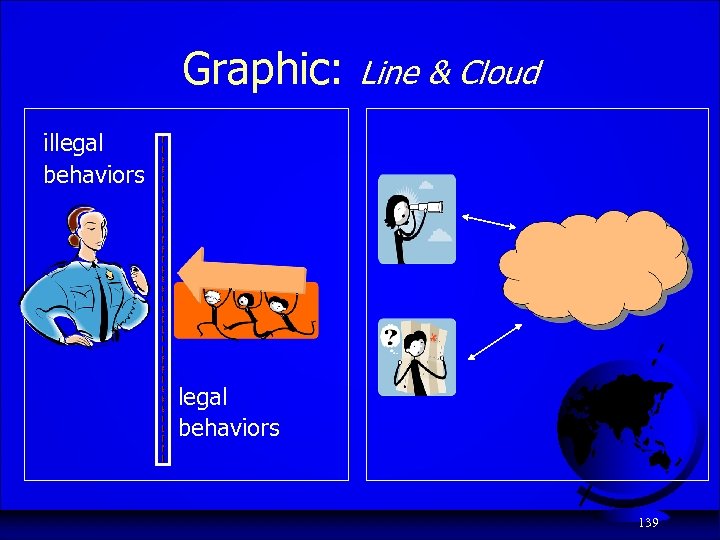 Graphic: Line & Cloud illegal behaviors ` legal behaviors 139
 The BIG Picture Drawing thoughts from the whole text … 140
 Seminal Questions § § § Who has POWER? How do they exercise it? Who has choice? How is it framed? How does the dynamic relationship between POWER & CHOICE inform us about our world? 141
 Final thought … Shively “This book has emphasized the analysis of politics … I hope you will also remember the importance of passion and belief …” § Farkas POWER & CHOICE provides you with all the tools you need to approach the complex political world of the 21 st Century. § 142
 Homeostasis vs. flexibility 1. 2. 3. 4. political systems change (adapt) bureaucracy often most affected once change imposed, bureaucracy reacts homeostasis is the “natural” impulse to return procedures, policies, behaviors to their previous “steady-state. ” 5. essentially, to minimize the impact of change Correlation: larger the bureaucracy, greater homeostatic tendency 143