


 Скачать презентацию POWER as a political phenomenon Questions What is
Power&Politics-1.ppt
- Количество слайдов: 31
 POWER as a political phenomenon Questions What is power? The variety of definitions Structure of political power Forms of political power State power as the main form of political power Legitimacy of political power
 Power is a fundamental part of society and politics, one of the key concepts in a history of thought about political phenomena. In spite of its long history, on an analytical level, there’s a notable lack of agreement about its specific definition.
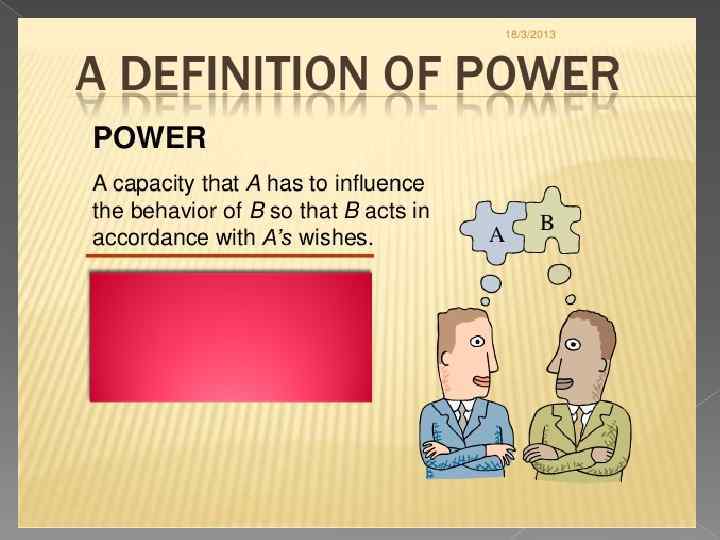
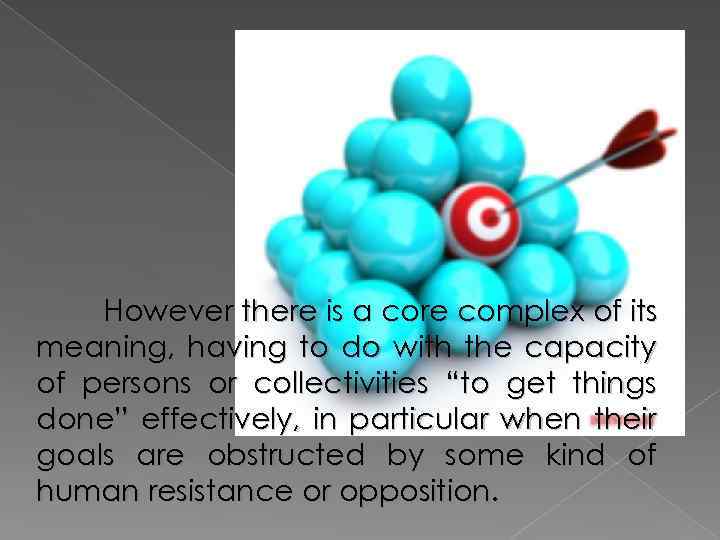 However there is a core complex of its meaning, having to do with the capacity of persons or collectivities “to get things done” effectively, in particular when their goals are obstructed by some kind of human resistance or opposition.
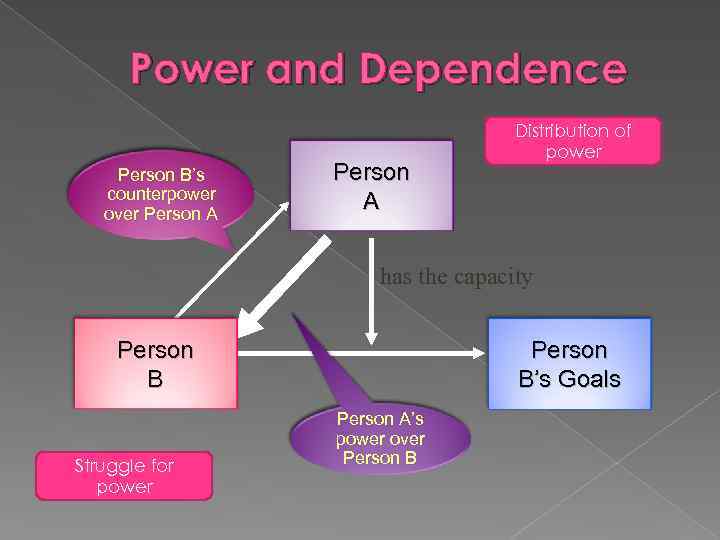 Power and Dependence Person B’s counterpower over Person A Distribution of power has the capacity Person B’s Goals Person B Struggle for power Person A’s power over Person B
 Political power is the ability to shape and control the political behavior of others and to lead and guide their behavior in the direction desired by the person, group, or institution wielding the political power. Political power is the capacity to influence, condition, mold, and control human behavior for the accomplishment of political objectives. That is to say, political power is the ability of one political actor (e. g. , an individual citizen, a family, an interest group, a political action committee, a political party, or a government) to effect a desired change in the behavior of other political actors, persuading or forcing the latter to act in a manner they would not act in the absence of the former's impact on the situation.
 Definitions of power Power is the probability that one actor within a social relationships will be in a position to carry out his own will despite resistance, regardless of the basis on which this probability rests. by Max Weber
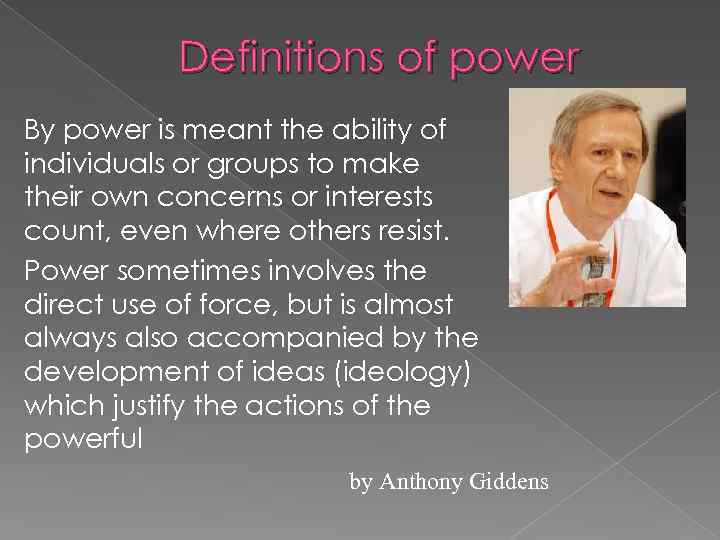 Definitions of power By power is meant the ability of individuals or groups to make their own concerns or interests count, even where others resist. Power sometimes involves the direct use of force, but is almost always also accompanied by the development of ideas (ideology) which justify the actions of the powerful by Anthony Giddens
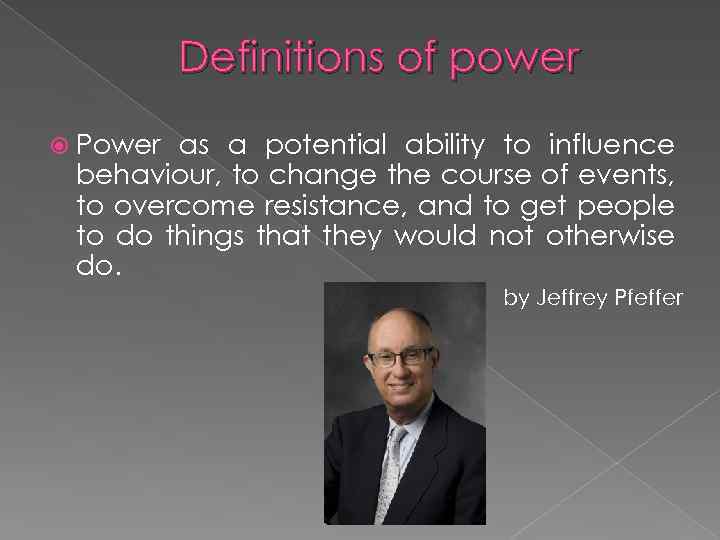 Definitions of power Power as a potential ability to influence behaviour, to change the course of events, to overcome resistance, and to get people to do things that they would not otherwise do. by Jeffrey Pfeffer
 Definitions of power Power is the ability to get an individual or group to do something – to get the person or group to change in some way. The person who possesses power has ability to manipulate or change others. H. Arendt/P. Morris
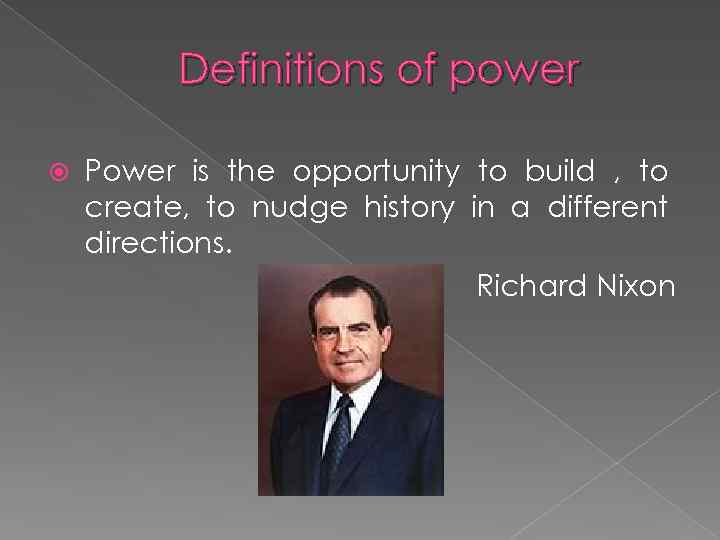 Definitions of power Power is the opportunity to build , to create, to nudge history in a different directions. Richard Nixon
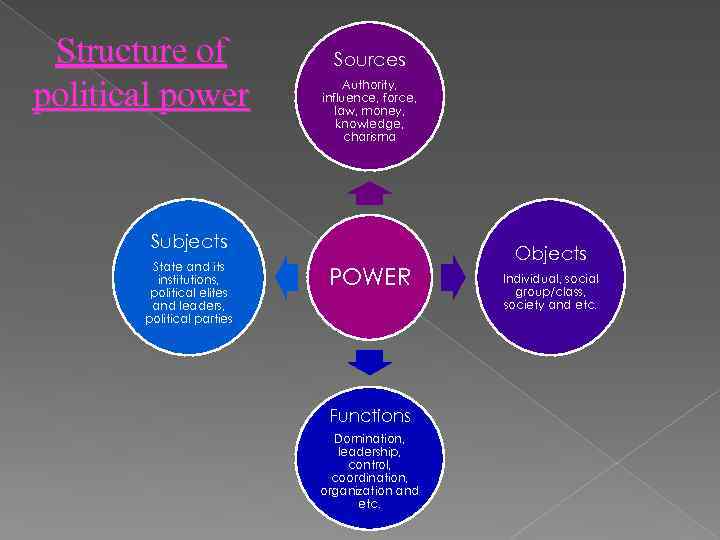 Structure of political power Sources Authority, influence, force, law, money, knowledge, charisma Subjects State and its institutions, political elites and leaders, political parties POWER Functions Domination, leadership, control, coordination, organization and etc. Objects Individual, social group/class, society and etc.
 5 principal forms of power
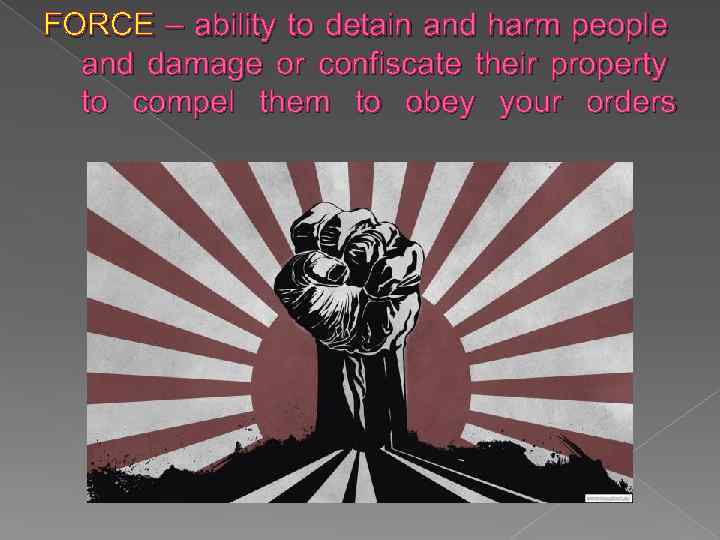 FORCE – ability to detain and harm people and damage or confiscate their property to compel them to obey your orders
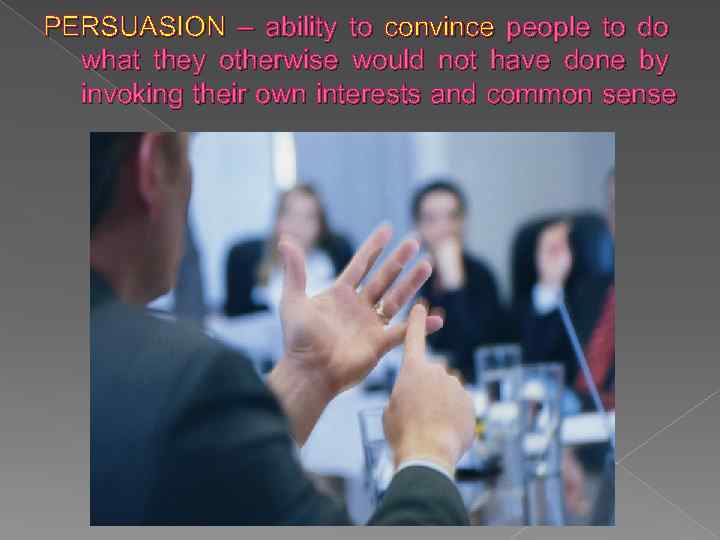 PERSUASION – ability to convince people to do what they otherwise would not have done by invoking their own interests and common sense
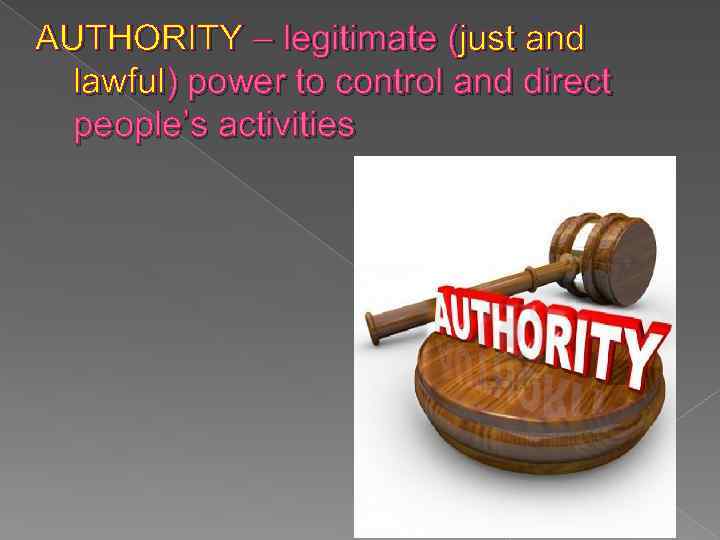 AUTHORITY – legitimate (just and lawful) power to control and direct people’s activities
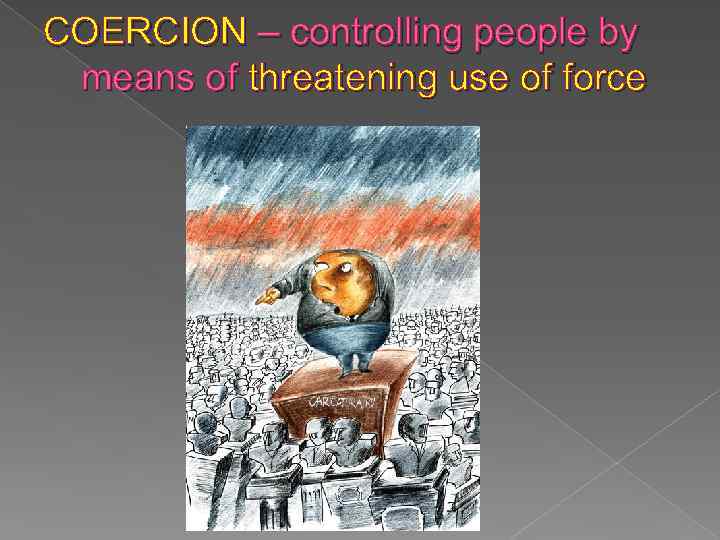 COERCION – controlling people by means of threatening use of force
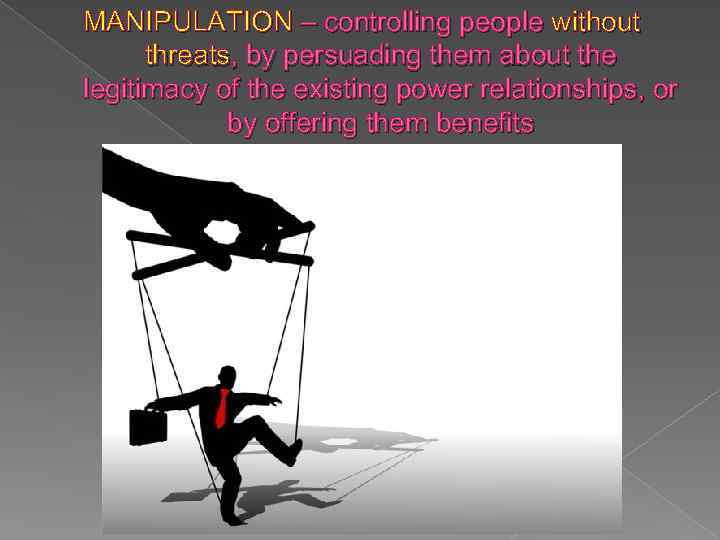 MANIPULATION – controlling people without threats, by persuading them about the legitimacy of the existing power relationships, or by offering them benefits
 Legitimate power
 Legitimate political authority is the legitimate right of the government to govern the entire society, the widely recognized right of the government to adopt and enforce public-policy decisions for and in the name of the entire political community.
 Political legitimacy exists in a political community, or society, when most citizens (1) perceive the government as having the moral as well as legal right to make and enforce decisions binding on the whole community, (2) see the decisions themselves as being legitimate, and (3) consider it the duty of all citizens to voluntarily comply with these decisions, thereby substantially reducing the government's need to employ armed force or expend other resources to compel or induce compliance.
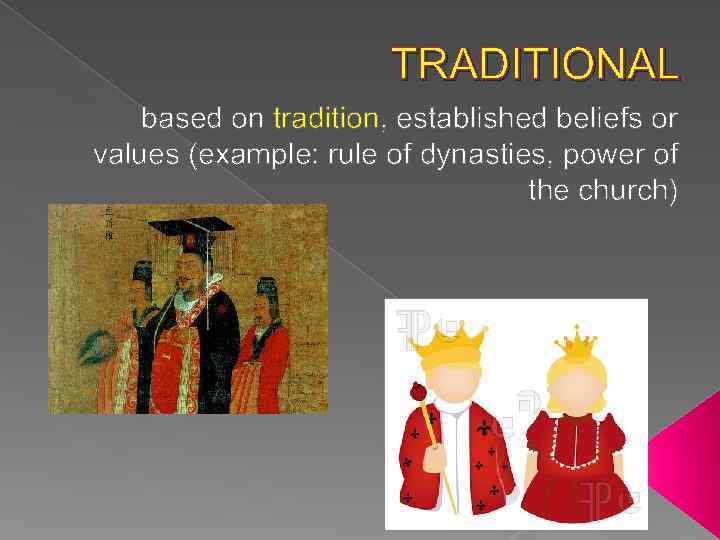 TRADITIONAL based on tradition, established beliefs or values (example: rule of dynasties, power of the church)
 LEGAL-RATIONAL based on formal arrangements (rules, laws, constitutions). The main type practiced in contemporary politics
 CHARISMATIC* based on the extraordinary personal qualities of a leader, or on the influence of an idea or a cause *from ancient Greek word “charisma”, meaning “gift”, gift of the gap, gift of glory
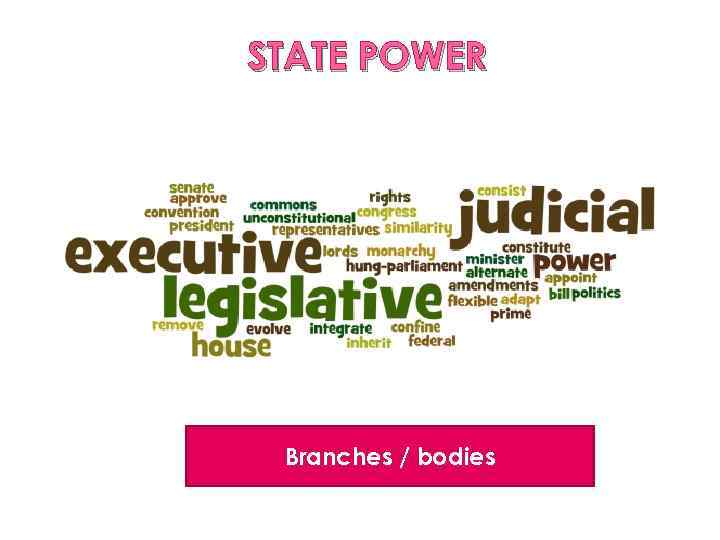 STATE POWER Branches / bodies
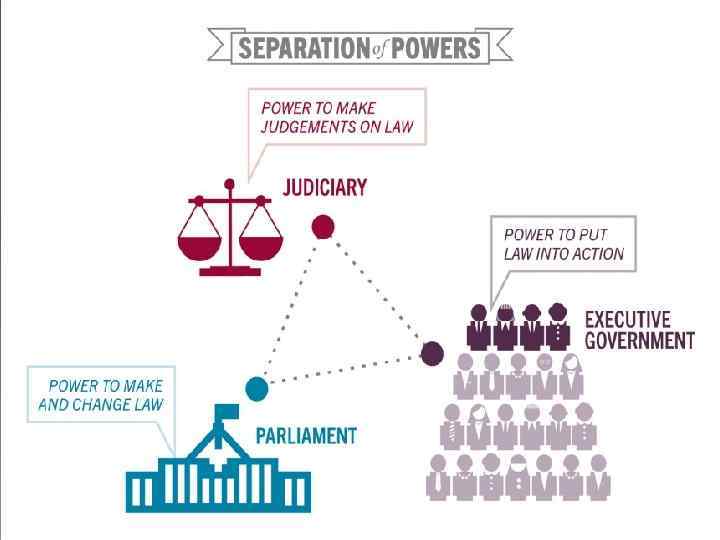
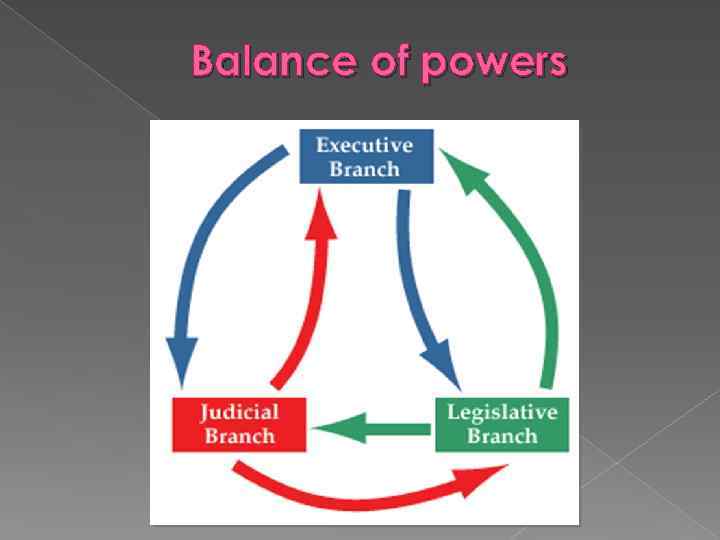 Balance of powers
 Sources 1. French, J. R. P. J r. A formal theory of social power. Psychol. Rev. , 1956. 2. Lasswell, H. D. , & Ka p l a n , A. Power and Society. New Haven : Yale Univ. Press, 1950 3. http: //www. jstor. org/stable/10. 2307/ 985582 4. http: //www. unc. edu/~fbaum/teaching/ articles/Dahl_Power_1957. pdf