


 Скачать презентацию Poverty in the UK David Gordon Professor of
ba00f8dc000c00ec95a3654fc9a0e6fc.ppt
- Количество слайдов: 38
 Poverty in the UK David Gordon Professor of Social Justice Townsend Centre for International Poverty Research University of Bristol Poverty and Social Exclusion in Scotland the UK New Register House Dome, Scotland’s People Centre, 2 Princes St, Edinburgh EH 1 3 YY Wednesday 20 August 2014
 Web Site http: //www. poverty. ac. uk Web Site http: //www. bristol. ac. uk/poverty
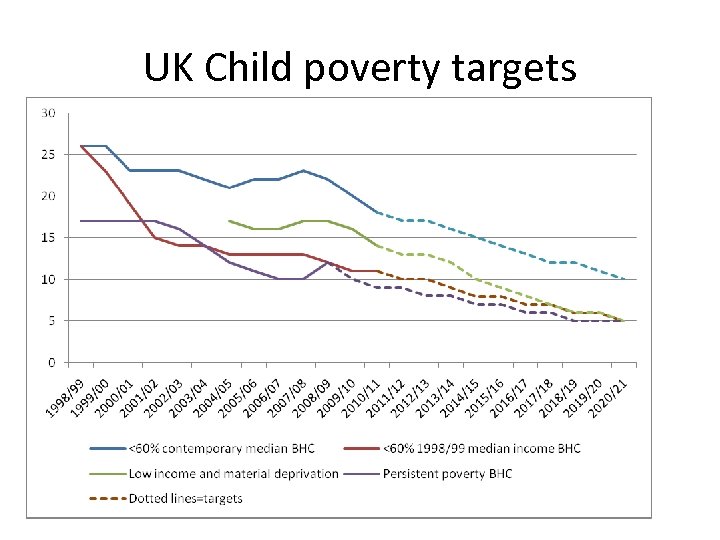 UK Child poverty targets
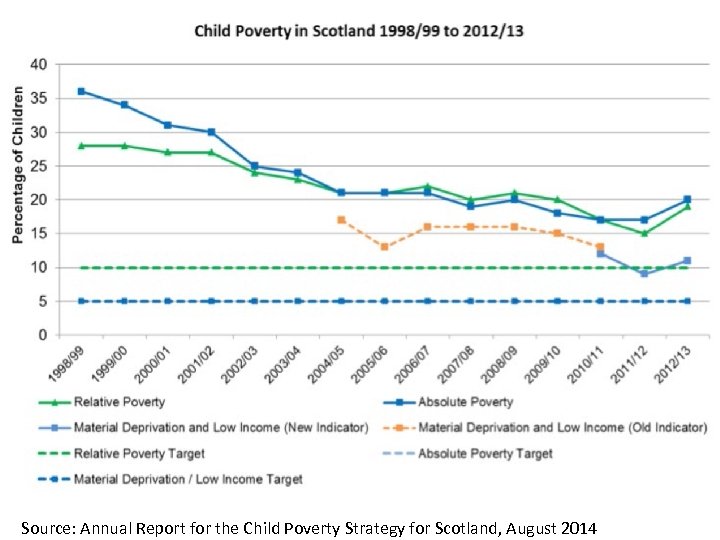 Source: Annual Report for the Child Poverty Strategy for Scotland, August 2014
 The Problem “The government’s draft child poverty strategy is a missed opportunity. The farce of ministers proving unable to agree on how to measure poverty after rubbishing existing measures is particularly lamentable. The government’s approach falls far short of what is needed to reduce, yet alone end child poverty in our country. Our new research shows that the gap between the objective of making child poverty history and the reality is becoming ever wider. This is not just an issue for the current government. Politicians from all parties say they are committed to the 2020 targets. Willing the ends without the means today merely becomes a broken promise tomorrow. ” Alan Milburn – Chair of the independent Social Mobility and Child Poverty (SMCP) Commission (9 th June 2014) https: //www. gov. uk/government/organisations/social-mobility-and-child-poverty-commission
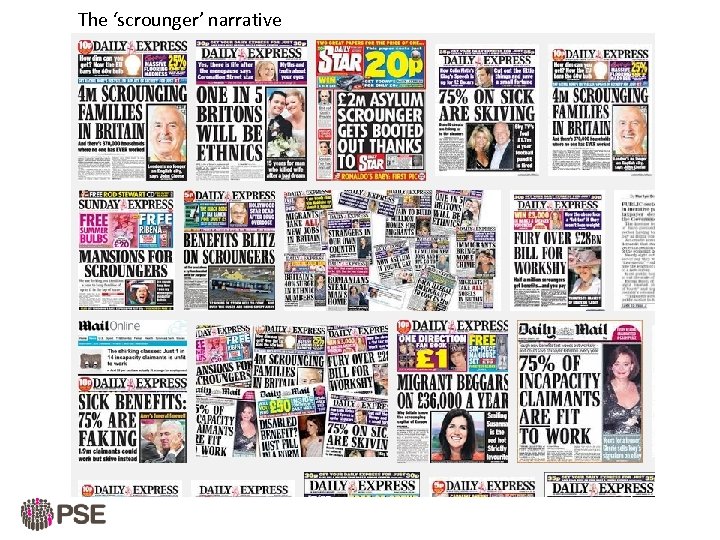 The ‘scrounger’ narrative
 Many people have worked on the PSE Project People to thank… UK and International Advisory Groups Dr Aya Abe Dr Petra Böhnke Prof Julio Boltvinik Prof Bjorn Hallerod Dr Daniel He-chiun Liou Prof Brian Nolan Bryan Perry Prof Veli-Matti Ritakallio Pedro Sáinz Prof Peter Saunders Dr Gemma Wright Madior Fall Melissa Wong David Mc. Lennan Paul Tyrer, jill Morton, Anne Mac. Donald Nuala Gormley, Sam Coope Tim Crosier Prof Danny Dorling Prof Mike Harmer Prof Stephen Jenkins Jane Lewis Jean Martin Peter Matejic, Rachel Councell Prof Monica Mc. Williams Polly Toynbee Prof Robert Walker Alison Garnham Prof Ros Edwards June Burrough NIPSSR, Japan University of Hamburg, Germany El Colegio de México, Mexico University of Gothenburg, Sweden Asia University, Taiwan University College Dublin Ministry of Social Development, New Zealand University of Turku, Finland Instituto Brasileiro de Geografia e Estatística, Chile University of New South Wales, Australia University of Oxford AFRISTAT University of New South Wales, Australia University of Oxford The Scottish Government ex Cabinet Office University of Oxford The Welsh Government London School of Economics Colebrooke Centre for Evidence & Implementation ex Office for National Statistics Department for Work and Pensions Northern Ireland Human Rights Commission The Guardian University of Oxford Child Poverty Action Group University of Southampton The Pieran Centre
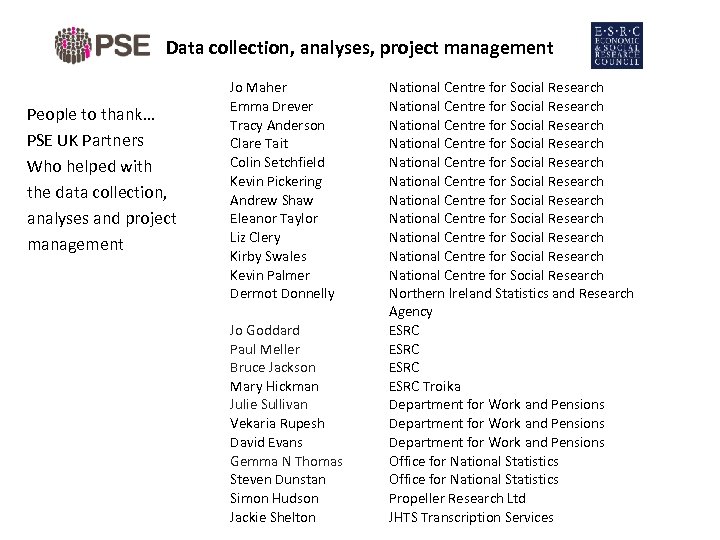 Data collection, analyses, project management People to thank… PSE UK Partners Who helped with the data collection, analyses and project management Jo Maher Emma Drever Tracy Anderson Clare Tait Colin Setchfield Kevin Pickering Andrew Shaw Eleanor Taylor Liz Clery Kirby Swales Kevin Palmer Dermot Donnelly Jo Goddard Paul Meller Bruce Jackson Mary Hickman Julie Sullivan Vekaria Rupesh David Evans Gemma N Thomas Steven Dunstan Simon Hudson Jackie Shelton National Centre for Social Research National Centre for Social Research National Centre for Social Research Northern Ireland Statistics and Research Agency ESRC Troika Department for Work and Pensions Office for National Statistics Propeller Research Ltd JHTS Transcription Services
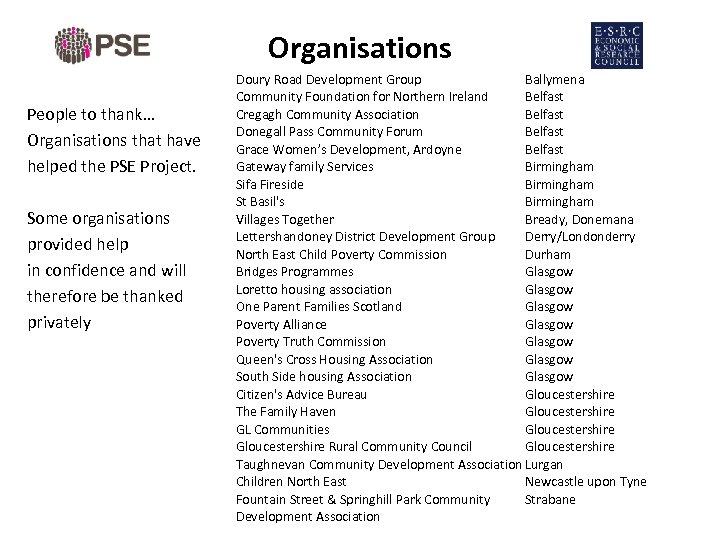 Organisations People to thank… Organisations that have helped the PSE Project. Some organisations provided help in confidence and will therefore be thanked privately Doury Road Development Group Ballymena Community Foundation for Northern Ireland Belfast Cregagh Community Association Belfast Donegall Pass Community Forum Belfast Grace Women’s Development, Ardoyne Belfast Gateway family Services Birmingham Sifa Fireside Birmingham St Basil's Birmingham Villages Together Bready, Donemana Lettershandoney District Development Group Derry/Londonderry North East Child Poverty Commission Durham Bridges Programmes Glasgow Loretto housing association Glasgow One Parent Families Scotland Glasgow Poverty Alliance Glasgow Poverty Truth Commission Glasgow Queen's Cross Housing Association Glasgow South Side housing Association Glasgow Citizen's Advice Bureau Gloucestershire The Family Haven Gloucestershire GL Communities Gloucestershire Rural Community Council Gloucestershire Taughnevan Community Development Association Lurgan Children North East Newcastle upon Tyne Fountain Street & Springhill Park Community Strabane Development Association
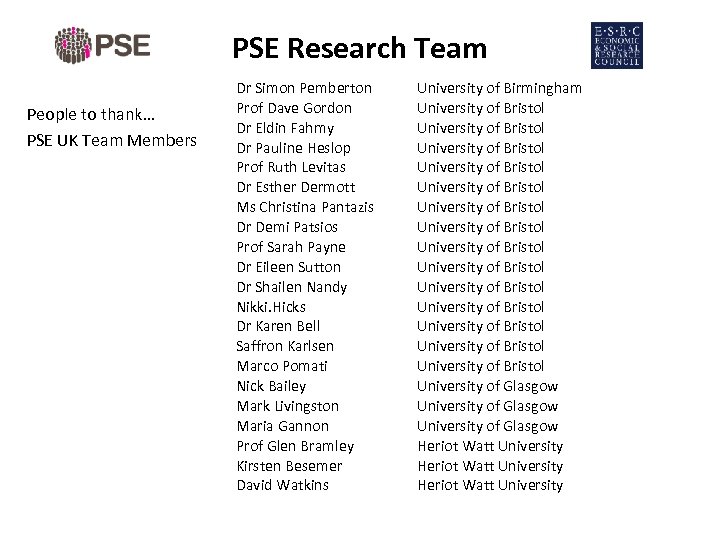 PSE Research Team People to thank… PSE UK Team Members Dr Simon Pemberton Prof Dave Gordon Dr Eldin Fahmy Dr Pauline Heslop Prof Ruth Levitas Dr Esther Dermott Ms Christina Pantazis Dr Demi Patsios Prof Sarah Payne Dr Eileen Sutton Dr Shailen Nandy Nikki. Hicks Dr Karen Bell Saffron Karlsen Marco Pomati Nick Bailey Mark Livingston Maria Gannon Prof Glen Bramley Kirsten Besemer David Watkins University of Birmingham University of Bristol University of Bristol University of Bristol University of Bristol University of Glasgow Heriot Watt University
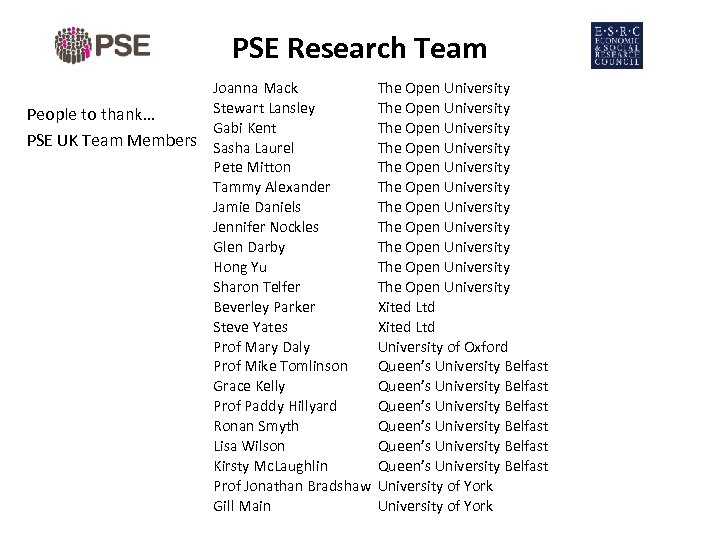 PSE Research Team Joanna Mack Stewart Lansley People to thank… Gabi Kent PSE UK Team Members Sasha Laurel Pete Mitton Tammy Alexander Jamie Daniels Jennifer Nockles Glen Darby Hong Yu Sharon Telfer Beverley Parker Steve Yates Prof Mary Daly Prof Mike Tomlinson Grace Kelly Prof Paddy Hillyard Ronan Smyth Lisa Wilson Kirsty Mc. Laughlin Prof Jonathan Bradshaw Gill Main The Open University The Open University The Open University Xited Ltd University of Oxford Queen’s University Belfast Queen’s University Belfast University of York
 The research grant • Funded by the ESRC & Scottish Government • The UK’s largest ever research project on poverty, social exclusion and living standards • Started April 2010 • Ended June 2014
 The research aims 1. To improve the measurement of poverty, deprivation, social exclusion and standard of living. 2. To measure the change in the nature and extent of poverty and social exclusion over the past ten years. 3. To produce policy-relevant results about the causes and outcomes of poverty and social exclusion.
 Background Every decade since the late 1960 s, UK social scientists have attempted to carry out an independent poverty survey to test out new ideas and incorporate current state of the art methods into UK poverty research. • 1968 -69 Poverty in the UK survey (Peter Townsend and colleagues), • 1983 Poor Britain survey (Joanna Mack, Stewart Lansley) • 1990 Breadline Britain survey (Joanna Mack, Stewart Lansley) • 1999 Poverty and Social Exclusion Survey (Jonathan Bradshaw and colleagues) and its 2002 counterpart in Northern Ireland (Paddy Hillyard and colleagues) • 2012 Poverty and Social Exclusion in the UK
 Survey Data Omnibus Survey: Necessities of Life – A systematic random achieved sample of adults (16+) of over 1, 900 interviews in Britain and Northern Ireland. Main Survey: Poverty & Social Exclusion – A follow-up survey to the 2010/11 Family Resources Survey (circa 47, 000 households). The main survey in Britain has an achieved sample of over 4, 000 households and 9, 500 individuals – with approximately 1, 000 households in the ‘ethnic’ strata and 1, 000 households in Scotland. In Northern Ireland, the achieved sample was just under be 1, 000 households and over 2, 000 individuals. The survey was divided into a household questionnaire which was answered by the Household Reference Person (HRP) and an individual questionnaire which was answered by all adult household members (aged 18 and over).
 Qualitative Data British Impoverishment Study, The qualitative study, Life on a Low Income in Austere times sought to provide insights into the experiences of poverty during the recent recession and ongoing programme of austerity. The project collected 62 video/audio testimonies during 2012 -2013, in Birmingham, Glasgow and Gloucestershire. Northern Ireland Family Solidarity Study, a qualitative survey of 50 parents to explore the role of family in coping with poverty. The study had a material focus – examining the extent to which resources are transferred among family members (both nuclear and extended) - and it also explores family cultures and relationships as factors affecting poverty and social exclusion. This helps to understand the extent and limits of family solidarity
 Dissemination A major website – www. poverty. ac. uk Full results of the 2012 Survey Comparisons with the earlier surveys in 1983, 1990 and 1999 Development of new graphic visualisation tools enabling access to more complex datasets and richer comparisons between datasets across time Video clips of what it means to live in poverty for key groups in 2012 (e. g. young, elderly, unemployed, disabled) and comparisons from the two broadcast documentary series accompanying the 1983 and 1990 surveys (Breadline Britain and Breadline Britain in the 1990 s( to illustrate changing circumstances and attitudes
 Survey Development Rigorous qualitative & quantitative methods were used in developing and analysing the survey questionnaire; 1) Systematic literature reviews 2) Focus groups 3) Expert review 4) Cognitive interviews 5) Survey pilots 6) Behaviour coding As far as possible comparability was maintained with UK & EU official poverty measures.
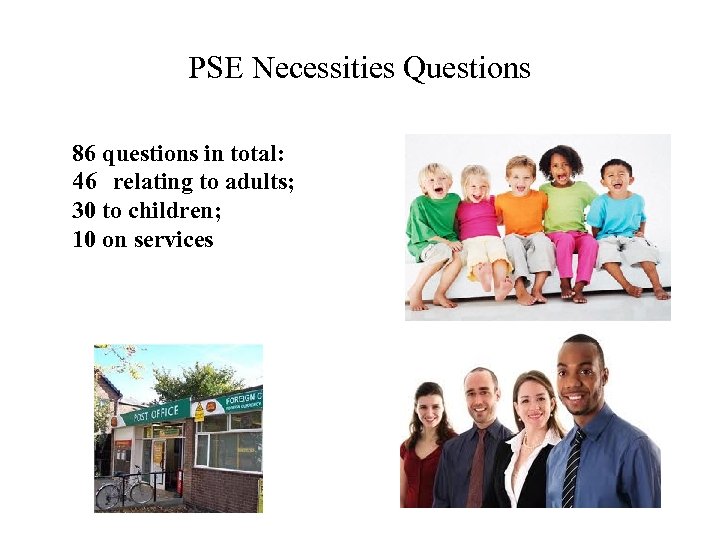 PSE Necessities Questions 86 questions in total: 46 relating to adults; 30 to children; 10 on services
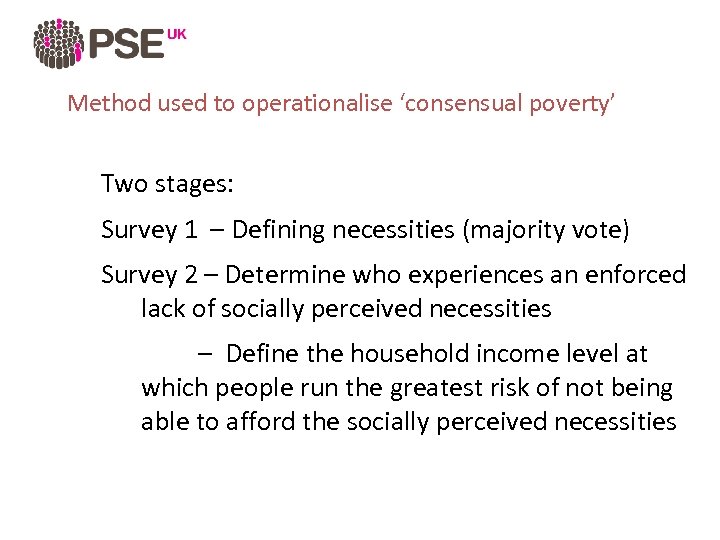 Method used to operationalise ‘consensual poverty’ Two stages: Survey 1 – Defining necessities (majority vote) Survey 2 – Determine who experiences an enforced lack of socially perceived necessities – Define the household income level at which people run the greatest risk of not being able to afford the socially perceived necessities
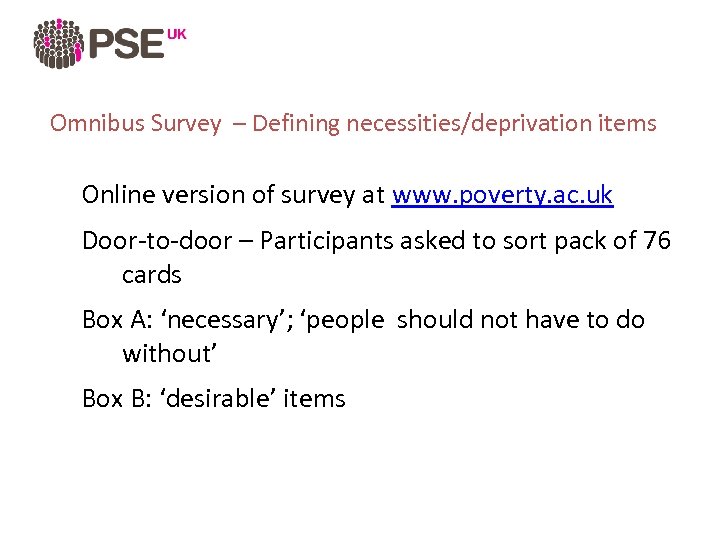 Omnibus Survey – Defining necessities/deprivation items Online version of survey at www. poverty. ac. uk Door-to-door – Participants asked to sort pack of 76 cards Box A: ‘necessary’; ‘people should not have to do without’ Box B: ‘desirable’ items
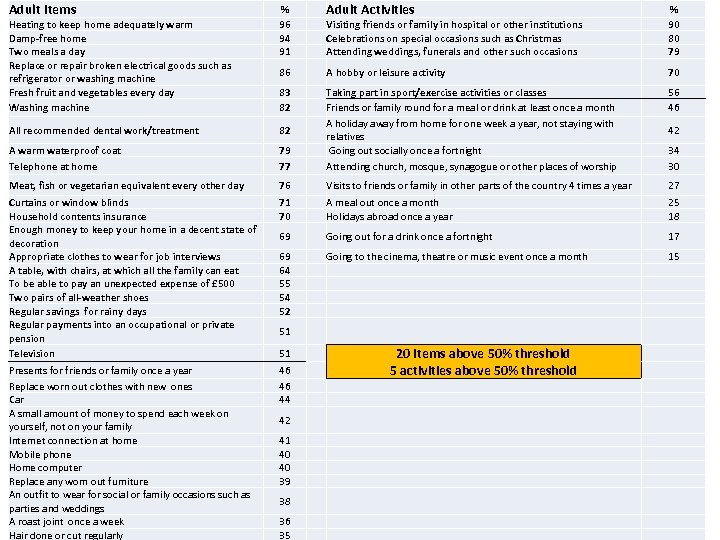 Adult Items Heating to keep home adequately warm Damp-free home Two meals a day Replace or repair broken electrical goods such as refrigerator or washing machine Fresh fruit and vegetables every day Washing machine % 96 94 91 Adult Activities Visiting friends or family in hospital or other institutions Celebrations on special occasions such as Christmas Attending weddings, funerals and other such occasions % 90 80 79 86 A hobby or leisure activity 70 83 82 56 46 All recommended dental work/treatment 82 A warm waterproof coat Telephone at home 79 77 Taking part in sport/exercise activities or classes Friends or family round for a meal or drink at least once a month A holiday away from home for one week a year, not staying with relatives Going out socially once a fortnight Attending church, mosque, synagogue or other places of worship Meat, fish or vegetarian equivalent every other day 76 Visits to friends or family in other parts of the country 4 times a year 27 Curtains or window blinds Household contents insurance Enough money to keep your home in a decent state of decoration Appropriate clothes to wear for job interviews A table, with chairs, at which all the family can eat To be able to pay an unexpected expense of £ 500 Two pairs of all-weather shoes Regular savings for rainy days Regular payments into an occupational or private pension Television 71 70 A meal out once a month Holidays abroad once a year 25 18 69 Going out for a drink once a fortnight 17 69 64 55 54 52 Going to the cinema, theatre or music event once a month 15 Presents for friends or family once a year Replace worn out clothes with new ones Car A small amount of money to spend each week on yourself, not on your family Internet connection at home Mobile phone Home computer Replace any worn out furniture An outfit to wear for social or family occasions such as parties and weddings A roast joint once a week Hair done or cut regularly 46 46 44 51 51 42 41 40 40 39 38 36 35 20 items above 50% threshold 5 activities above 50% threshold 42 34 30
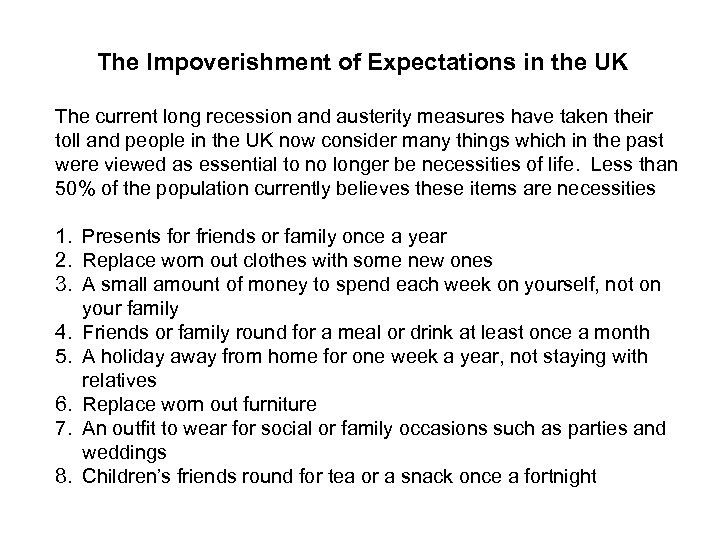 The Impoverishment of Expectations in the UK The current long recession and austerity measures have taken their toll and people in the UK now consider many things which in the past were viewed as essential to no longer be necessities of life. Less than 50% of the population currently believes these items are necessities 1. Presents for friends or family once a year 2. Replace worn out clothes with some new ones 3. A small amount of money to spend each week on yourself, not on your family 4. Friends or family round for a meal or drink at least once a month 5. A holiday away from home for one week a year, not staying with relatives 6. Replace worn out furniture 7. An outfit to wear for social or family occasions such as parties and weddings 8. Children’s friends round for tea or a snack once a fortnight
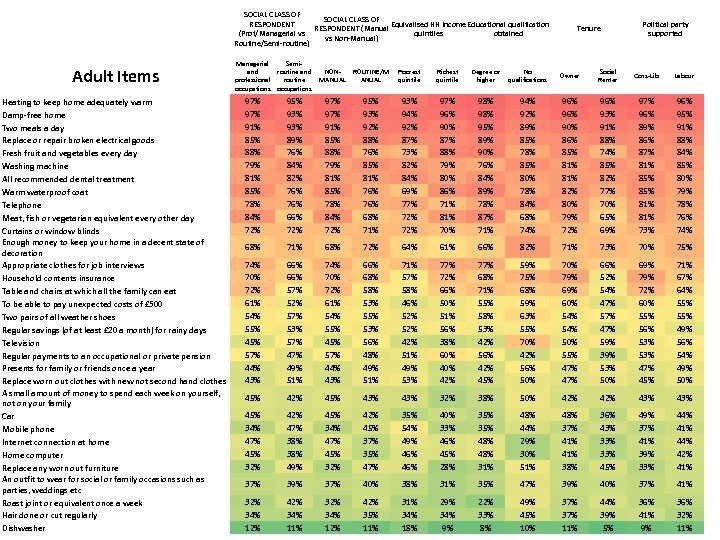 SOCIAL CLASS OF RESPONDENT Equivalised HH Income Educational qualification RESPONDENT (Manual (Prof/Managerial vs quintiles obtained vs Non-Manual) Routine/Semi-routine) Adult Items Heating to keep home adequately warm Damp-free home Two meals a day Replace or repair broken electrical goods Fresh fruit and vegetables every day Washing machine All recommended dental treatment Warm waterproof coat Telephone Meat, fish or vegetarian equivalent every other day Curtains or window blinds Enough money to keep your home in a decent state of decoration Appropriate clothes for job interviews Household contents insurance Table and chairs at which all the family can eat To be able to pay unexpected costs of £ 500 Two pairs of all weather shoes Regular savings (of at least £ 20 a month) for rainy days Television Regular payments to an occupational or private pension Presents for family or friends once a year Replace worn out clothes with new not second hand clothes A small amount of money to spend each week on yourself, not on your family Car Mobile phone Internet connection at home Home computer Replace any worn out furniture An outfit to wear for social or family occasions such as parties, weddings etc Roast joint or equivalent once a week Hair done or cut regularly Dishwasher Managerial Semiand routine and NONprofessional routine MANUAL occupations ROUTINE/M ANUAL Poorest quintile Richest quintile Degree or No higher qualifications Tenure Political party supported Owner Social Renter Cons-Lib Labour 97% 91% 85% 88% 79% 81% 85% 78% 84% 72% 95% 93% 89% 76% 84% 82% 76% 66% 72% 97% 91% 85% 88% 79% 81% 85% 78% 84% 72% 95% 93% 92% 88% 76% 85% 81% 76% 68% 71% 93% 94% 92% 87% 73% 82% 84% 69% 77% 72% 97% 96% 90% 87% 88% 79% 80% 86% 71% 81% 70% 98% 95% 89% 90% 76% 84% 89% 78% 87% 71% 94% 92% 89% 85% 78% 85% 80% 78% 84% 68% 74% 96% 90% 86% 85% 81% 82% 80% 79% 72% 96% 93% 91% 88% 74% 85% 82% 77% 70% 65% 69% 97% 96% 89% 86% 87% 81% 85% 81% 73% 96% 95% 91% 88% 84% 85% 80% 79% 78% 76% 74% 68% 71% 68% 72% 64% 61% 66% 82% 71% 73% 70% 75% 74% 70% 72% 61% 54% 55% 45% 57% 44% 43% 66% 57% 52% 57% 53% 57% 49% 51% 74% 70% 72% 61% 54% 55% 45% 57% 44% 43% 66% 68% 53% 55% 53% 56% 48% 49% 51% 71% 57% 58% 46% 52% 42% 51% 49% 53% 77% 72% 66% 50% 51% 56% 38% 60% 42% 77% 68% 71% 55% 58% 53% 42% 56% 42% 45% 59% 75% 68% 59% 63% 55% 70% 42% 56% 50% 79% 60% 54% 50% 55% 47% 66% 52% 54% 47% 57% 47% 59% 39% 53% 50% 69% 72% 60% 55% 56% 53% 47% 45% 71% 67% 64% 55% 49% 56% 54% 49% 50% 45% 42% 45% 43% 32% 38% 50% 42% 43% 45% 34% 47% 45% 32% 47% 38% 49% 45% 34% 47% 45% 32% 45% 37% 35% 47% 35% 54% 49% 46% 40% 33% 46% 45% 28% 35% 48% 31% 48% 44% 29% 30% 51% 48% 37% 41% 38% 36% 43% 33% 45% 49% 37% 41% 39% 33% 44% 41% 44% 42% 41% 37% 39% 37% 40% 38% 31% 35% 47% 39% 40% 37% 41% 32% 34% 12% 42% 34% 11% 32% 34% 12% 42% 35% 11% 34% 18% 29% 34% 9% 22% 33% 8% 49% 45% 10% 37% 11% 44% 39% 5% 36% 41% 9% 36% 32% 11%
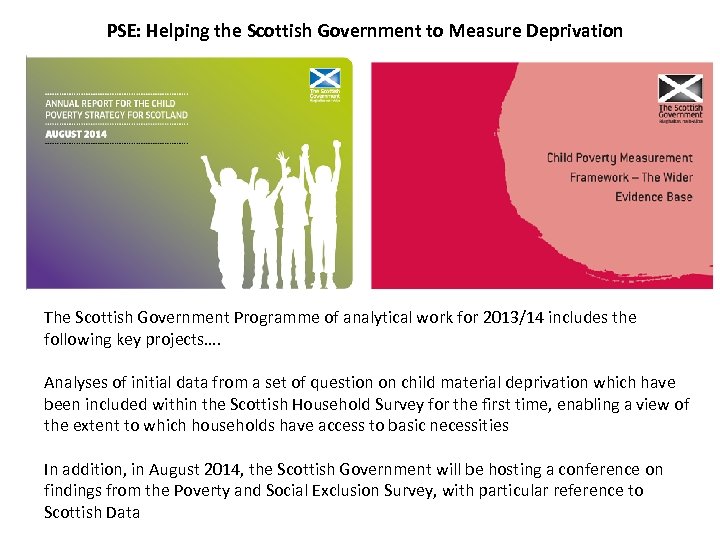 PSE: Helping the Scottish Government to Measure Deprivation The Scottish Government Programme of analytical work for 2013/14 includes the following key projects…. Analyses of initial data from a set of question on child material deprivation which have been included within the Scottish Household Survey for the first time, enabling a view of the extent to which households have access to basic necessities In addition, in August 2014, the Scottish Government will be hosting a conference on findings from the Poverty and Social Exclusion Survey, with particular reference to Scottish Data
 Poverty in the UK
 PSEUK Headline findings Almost 18 million people cannot afford adequate housing conditions; 12 million people are too poor to engage in common social activities; one in three people cannot afford to heat their homes adequately in the winter and four million children and adults aren’t properly fed by today’s standards. One in every six (17 per cent) adults in paid work are poor The percentage of households who fall below society’s minimum standard of living has increased from 14 per cent to 33 per cent over the last 30 years, despite the size of the economy doubling.
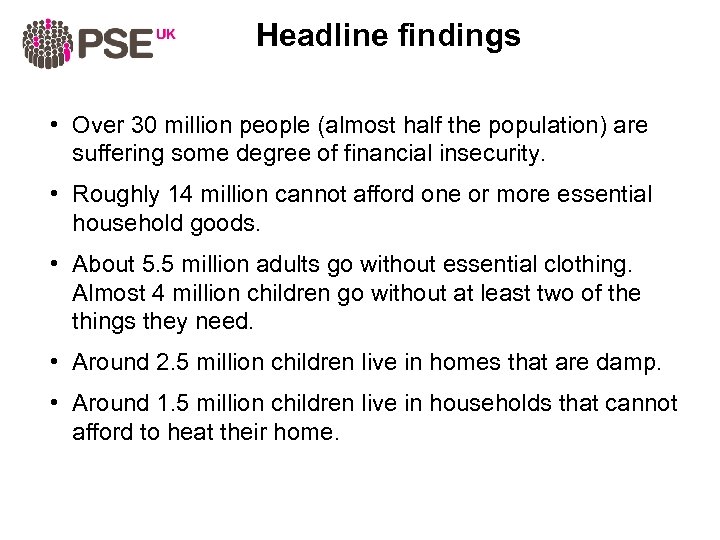 Headline findings • Over 30 million people (almost half the population) are suffering some degree of financial insecurity. • Roughly 14 million cannot afford one or more essential household goods. • About 5. 5 million adults go without essential clothing. Almost 4 million children go without at least two of the things they need. • Around 2. 5 million children live in homes that are damp. • Around 1. 5 million children live in households that cannot afford to heat their home.
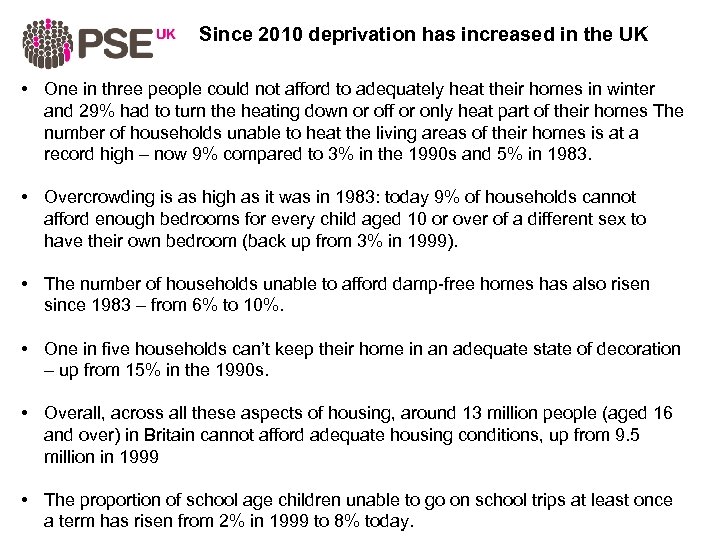 Since 2010 deprivation has increased in the UK • One in three people could not afford to adequately heat their homes in winter and 29% had to turn the heating down or off or only heat part of their homes The number of households unable to heat the living areas of their homes is at a record high – now 9% compared to 3% in the 1990 s and 5% in 1983. • Overcrowding is as high as it was in 1983: today 9% of households cannot afford enough bedrooms for every child aged 10 or over of a different sex to have their own bedroom (back up from 3% in 1999). • The number of households unable to afford damp-free homes has also risen since 1983 – from 6% to 10%. • One in five households can’t keep their home in an adequate state of decoration – up from 15% in the 1990 s. • Overall, across all these aspects of housing, around 13 million people (aged 16 and over) in Britain cannot afford adequate housing conditions, up from 9. 5 million in 1999 • The proportion of school age children unable to go on school trips at least once a term has risen from 2% in 1999 to 8% today.
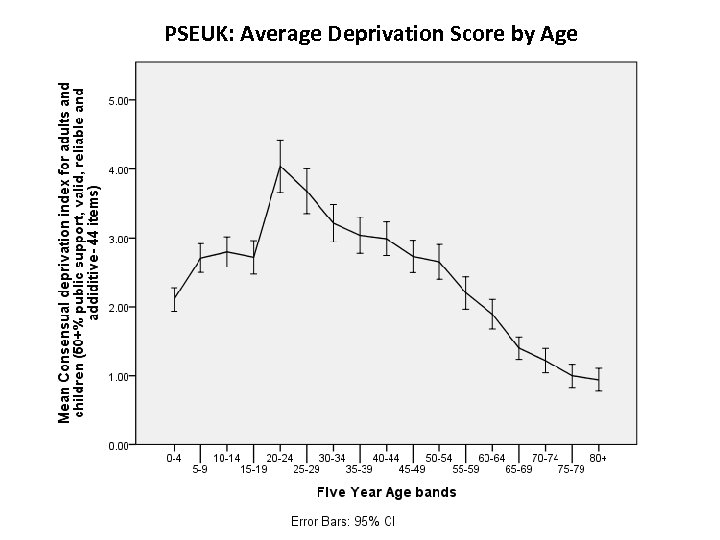 PSEUK: Average Deprivation Score by Age
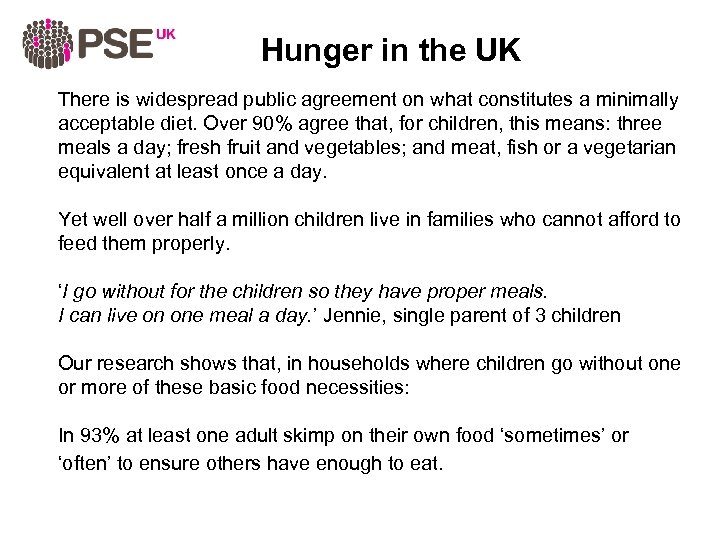 Hunger in the UK There is widespread public agreement on what constitutes a minimally acceptable diet. Over 90% agree that, for children, this means: three meals a day; fresh fruit and vegetables; and meat, fish or a vegetarian equivalent at least once a day. Yet well over half a million children live in families who cannot afford to feed them properly. ‘I go without for the children so they have proper meals. I can live on one meal a day. ’ Jennie, single parent of 3 children Our research shows that, in households where children go without one or more of these basic food necessities: In 93% at least one adult skimp on their own food ‘sometimes’ or ‘often’ to ensure others have enough to eat.
 Drawing the Poverty Line
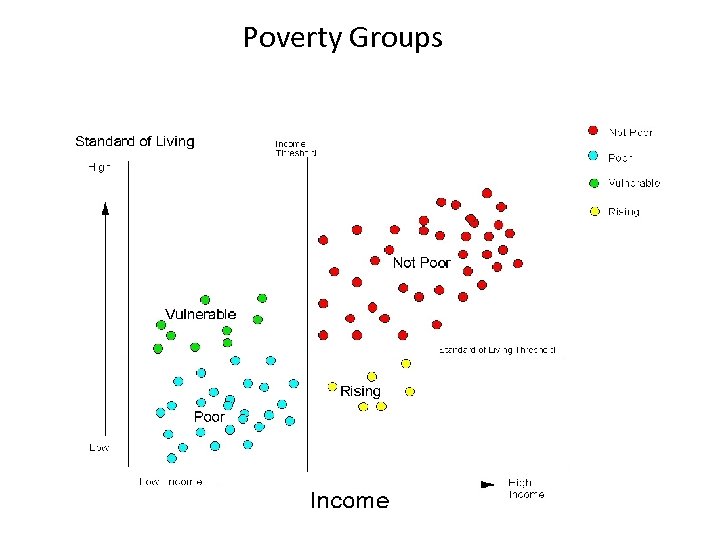 Poverty Groups
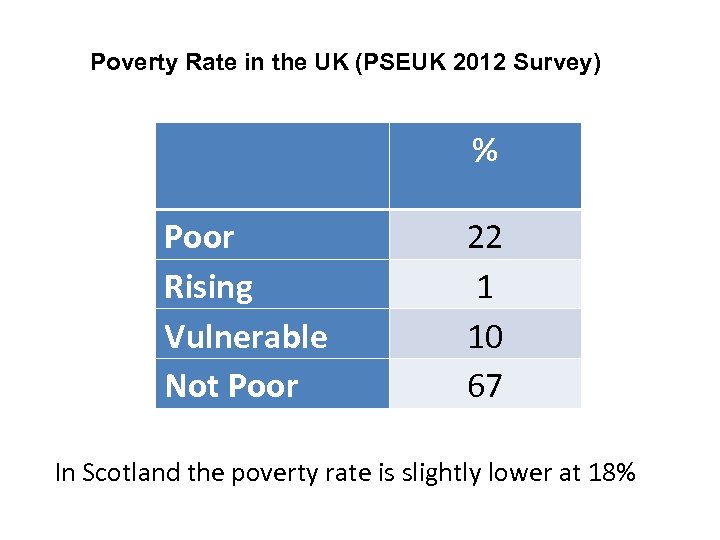 Poverty Rate in the UK (PSEUK 2012 Survey) Poor Rising Vulnerable Not Poor % 22 1 10 67 In Scotland the poverty rate is slightly lower at 18%
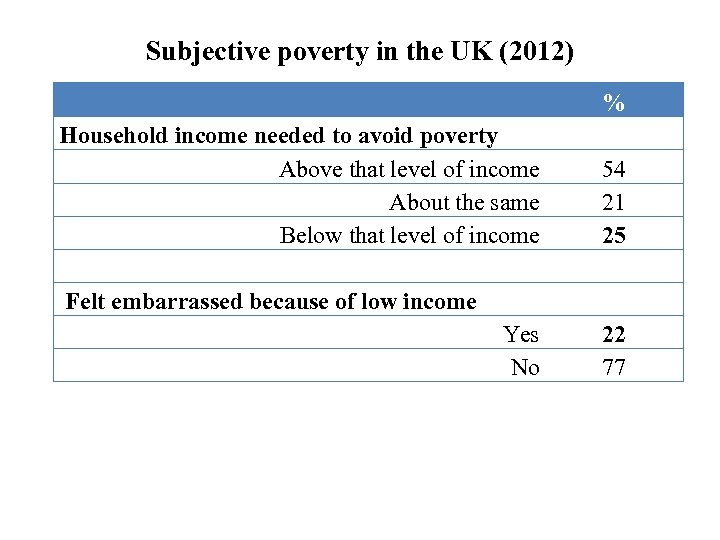 Subjective poverty in the UK (2012) Household income needed to avoid poverty Above that level of income About the same Below that level of income Felt embarrassed because of low income Yes No % 54 21 25 22 77
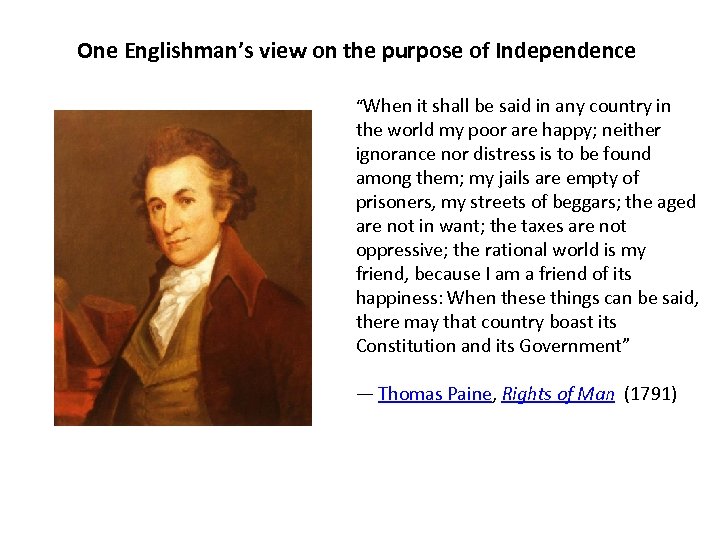 One Englishman’s view on the purpose of Independence “When it shall be said in any country in the world my poor are happy; neither ignorance nor distress is to be found among them; my jails are empty of prisoners, my streets of beggars; the aged are not in want; the taxes are not oppressive; the rational world is my friend, because I am a friend of its happiness: When these things can be said, there may that country boast its Constitution and its Government” ― Thomas Paine, Rights of Man (1791)