


 Скачать презентацию Poverty Alleviation in a Decentralized System Poverty
52f2d97ddb612e2cd9898c27ad4e9d66.ppt
- Количество слайдов: 5
 Poverty Alleviation in a Decentralized System • Poverty alleviation: general versus local public good? • Local responsiveness to poverty might vary depending on local priorities • Better information at the local level calls for local administration of social programs • In a decentralized system poverty alleviation is ideally centrally mandated, centrally financed, locally managed 1/5
 Poverty Alleviation in Hungary the role of the CG • LGs have broad mandate in social assistance (Act on Social Assistance) • Unclear mandate with respect to long-term poverty, especially regarding • the long-term unemployed • the Roma 2/5
 Poverty Alleviation in Hungary financing • CG has transferred responsibilities without ensuring adequate funding • centrally mandated services interpreted as ‘optional’ • ‘ 3200 social policies’ (the amount of benefits, and access to institutional social services is unequal across the country) • General purpose transfers are not the best tools to protect the poor 3/5
 Poverty Alleviation in Hungary the role of LGs • Local administration is effective in targeting cash and in-kind benefits • Fragmented LG system and limited incentives for cooperation in service delivery results in fragmented (and hence costly) institutional care system 4/5
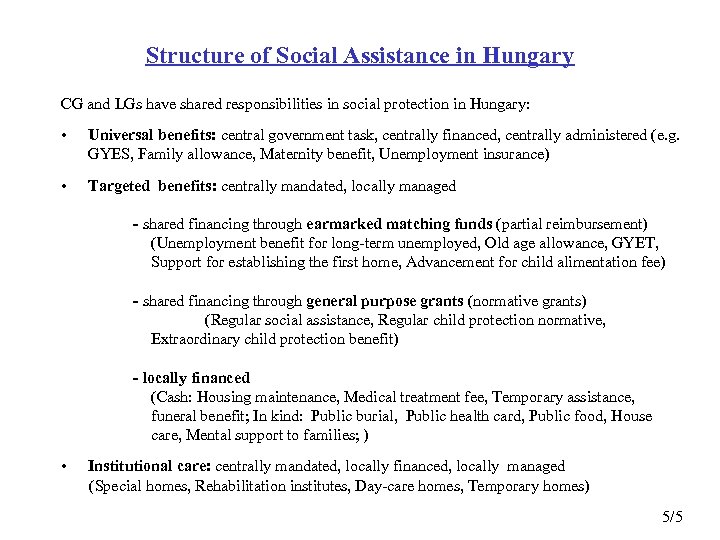 Structure of Social Assistance in Hungary CG and LGs have shared responsibilities in social protection in Hungary: • Universal benefits: central government task, centrally financed, centrally administered (e. g. GYES, Family allowance, Maternity benefit, Unemployment insurance) • Targeted benefits: centrally mandated, locally managed - shared financing through earmarked matching funds (partial reimbursement) (Unemployment benefit for long-term unemployed, Old age allowance, GYET, Support for establishing the first home, Advancement for child alimentation fee) - shared financing through general purpose grants (normative grants) (Regular social assistance, Regular child protection normative, Extraordinary child protection benefit) - locally financed (Cash: Housing maintenance, Medical treatment fee, Temporary assistance, funeral benefit; In kind: Public burial, Public health card, Public food, House care, Mental support to families; ) • Institutional care: centrally mandated, locally financed, locally managed (Special homes, Rehabilitation institutes, Day-care homes, Temporary homes) 5/5