 Скачать презентацию POU POE Devices as Final Barriers Joseph F
9e6fa0263f9217fd456d6911b82cd9c8.ppt
- Количество слайдов: 64



POU/POE Devices as Final Barriers Joseph F. Harrison, P. E. , CWS-VI Technical Director Water Quality Association jharrison@wqa. org
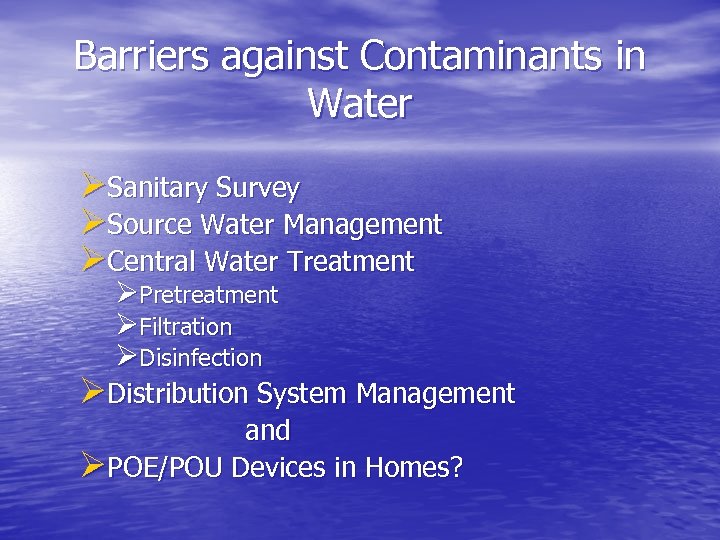
Barriers against Contaminants in Water ØSanitary Survey ØSource Water Management ØCentral Water Treatment ØPretreatment ØFiltration ØDisinfection ØDistribution System Management and ØPOE/POU Devices in Homes?
Why the Final Barrier?
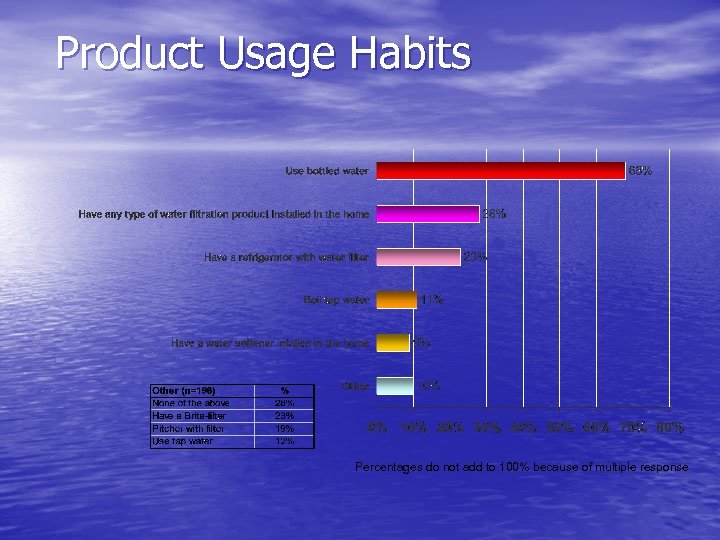
Product Usage Habits Percentages do not add to 100% because of multiple response
POU/POE as a Final Barrier Ø Aesthetic Concerns Ø Treatment Effects • DBP Levels • Process Changes, Lead & Copper Levels Ø Distribution Related Effects • Corrosion Products • Microbial Intrusions • Endemic Diseases • Security Issues Ø MCL Vs MCLG
POU/POE Technologies ØPOU & POE technologies –mostly miniaturized versions of central treatment ØSeveral different technologies usually available for the treatment of any contaminant ØMany small & large companies involved in POU and POE water treatment ØStandards & Certification programs provide higher level of confidence and credibility now than in prior years
History of POU and POE Products ØAesthetic enhancement – historical ØSlow evolution to health related claims ØANSI/NSF Standards in 1980’s ØANSI accredited testing and certification – NSF, UL, WQA ØState certifications – IA, WI, CA ØAutomatic water quality monitors and end of life indicators– 1990’s
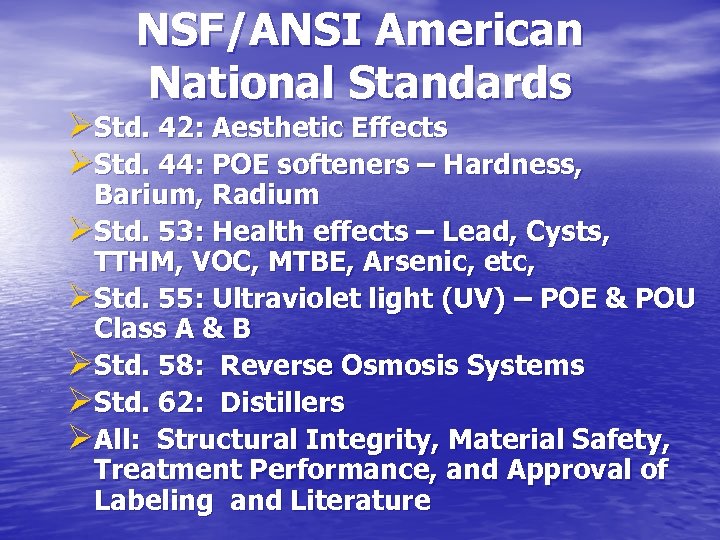
NSF/ANSI American National Standards ØStd. 42: Aesthetic Effects ØStd. 44: POE softeners – Hardness, Barium, Radium ØStd. 53: Health effects – Lead, Cysts, TTHM, VOC, MTBE, Arsenic, etc, ØStd. 55: Ultraviolet light (UV) – POE & POU Class A & B ØStd. 58: Reverse Osmosis Systems ØStd. 62: Distillers ØAll: Structural Integrity, Material Safety, Treatment Performance, and Approval of Labeling and Literature
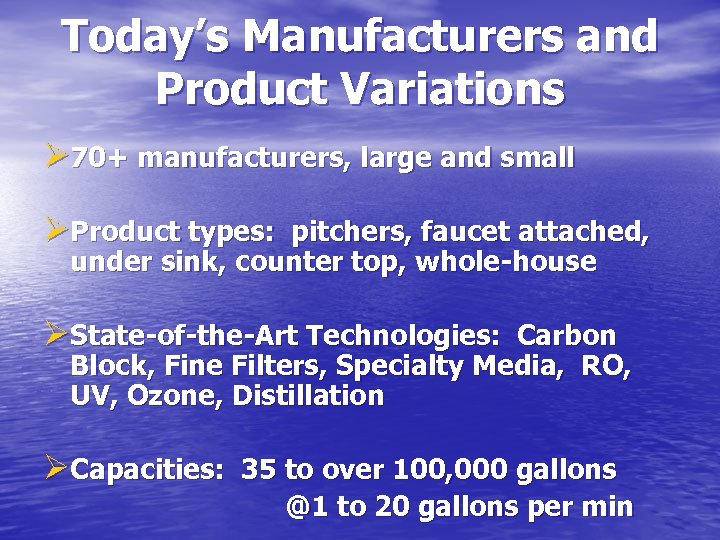
Today’s Manufacturers and Product Variations Ø 70+ manufacturers, large and small ØProduct types: pitchers, faucet attached, under sink, counter top, whole-house ØState-of-the-Art Technologies: Carbon Block, Fine Filters, Specialty Media, RO, UV, Ozone, Distillation ØCapacities: 35 to over 100, 000 gallons @1 to 20 gallons per min
Types of Products ØPersonal water bottle ØPour through pitcher ØCountertop Units connected to sink faucet ØFaucet attached filters ØPlumbed-in units with separate faucet ØShower Filters ØWhole-house water treatment Devices (POE)
Contaminants Reduced by these Devices ØParticulates ØInorganics ØRadium & Other Radionuclides ØVolatile Organic Chemicals ØSynthetic Organic Chemicals ØMicrobials
INORGANICS
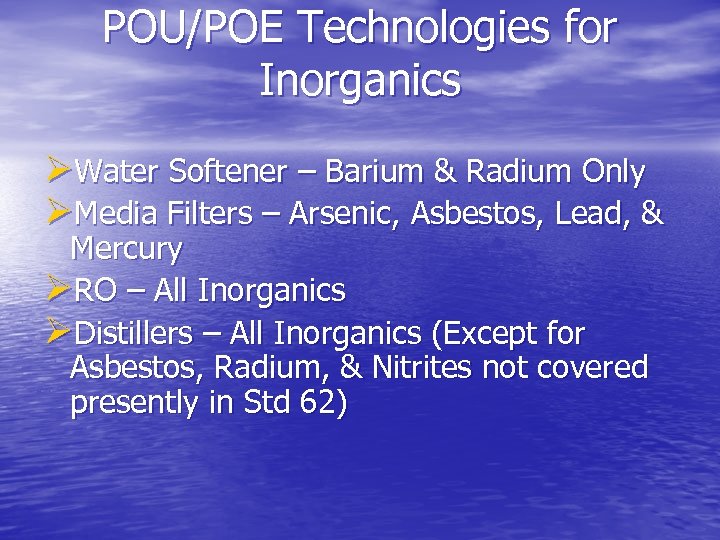
POU/POE Technologies for Inorganics ØWater Softener – Barium & Radium Only ØMedia Filters – Arsenic, Asbestos, Lead, & Mercury ØRO – All Inorganics ØDistillers – All Inorganics (Except for Asbestos, Radium, & Nitrites not covered presently in Std 62)
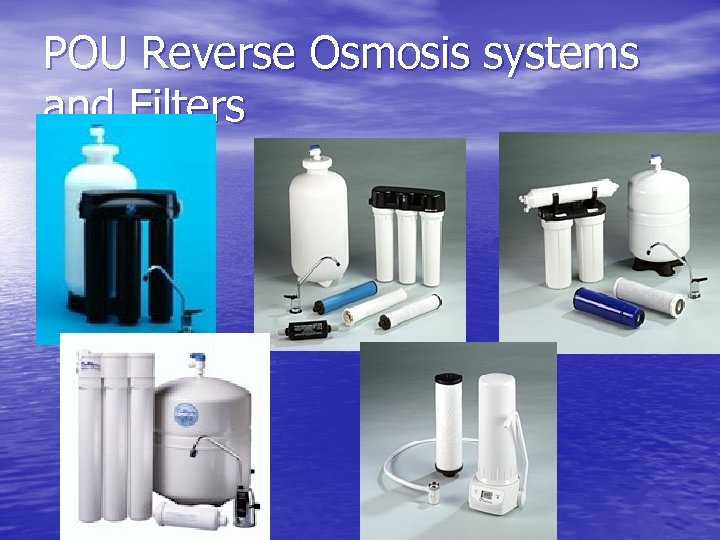
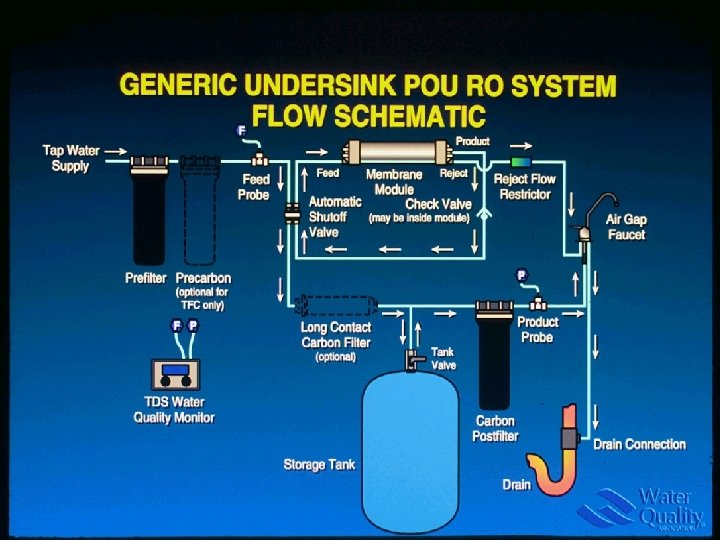
POU Reverse Osmosis systems and Filters
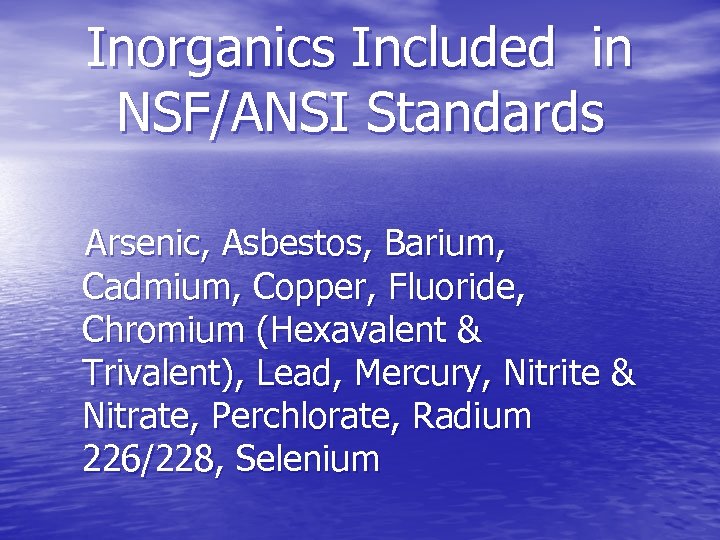
Inorganics Included in NSF/ANSI Standards Arsenic, Asbestos, Barium, Cadmium, Copper, Fluoride, Chromium (Hexavalent & Trivalent), Lead, Mercury, Nitrite & Nitrate, Perchlorate, Radium 226/228, Selenium
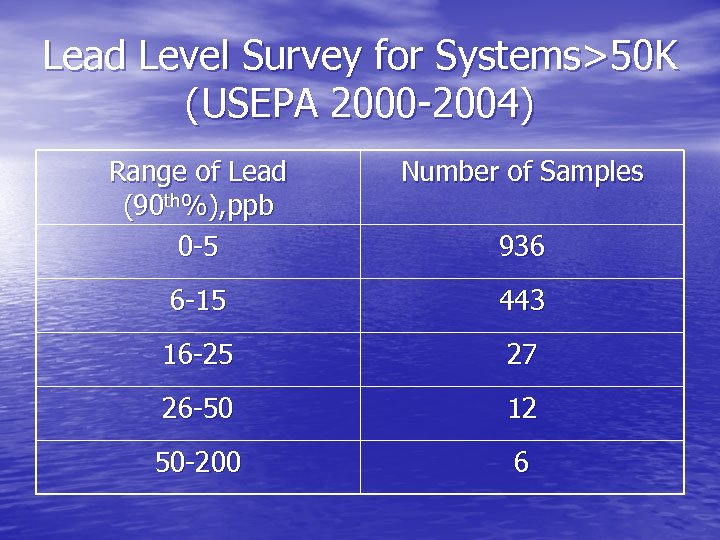
Lead Level Survey for Systems>50 K (USEPA 2000 -2004) Range of Lead (90 th%), ppb 0 -5 Number of Samples 6 -15 443 16 -25 27 26 -50 12 50 -200 6 936
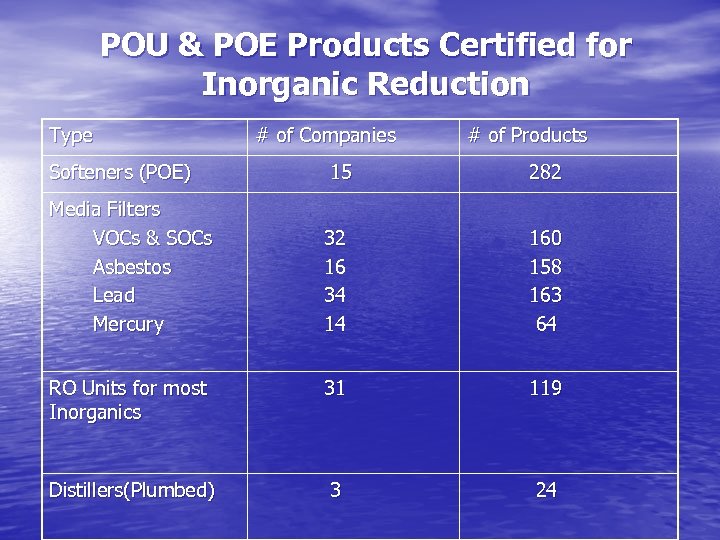
POU & POE Products Certified for Inorganic Reduction Type Softeners (POE) Media Filters VOCs & SOCs Asbestos Lead Mercury # of Companies 15 # of Products 282 32 16 34 14 160 158 163 64 RO Units for most Inorganics 31 119 Distillers(Plumbed) 3 24
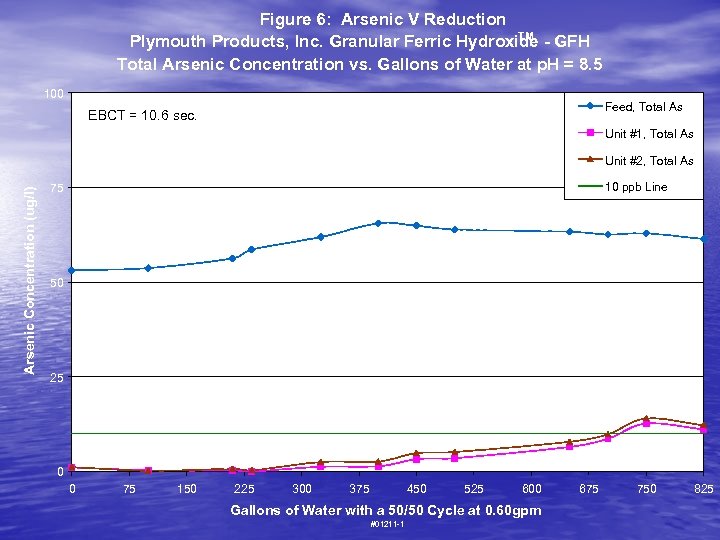
Figure 6: Arsenic V Reduction TM Plymouth Products, Inc. Granular Ferric Hydroxide - GFH Total Arsenic Concentration vs. Gallons of Water at p. H = 8. 5 100 Feed, Total As EBCT = 10. 6 sec. Unit #1, Total As Arsenic Concentration (ug/l) Unit #2, Total As 10 ppb Line 75 50 25 0 0 75 150 225 300 375 450 525 600 Gallons of Water with a 50/50 Cycle at 0. 60 gpm #01211 -1 675 750 825
RADIONUCLIDES
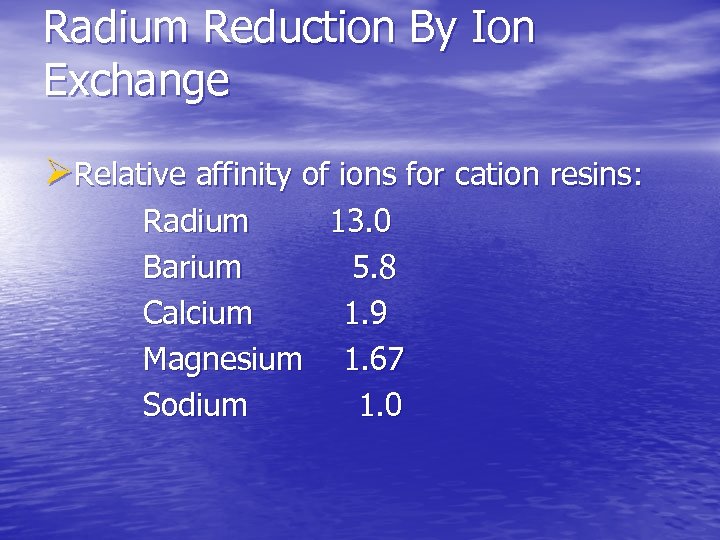
Radium Reduction By Ion Exchange ØRelative affinity of ions for cation resins: Radium 13. 0 Barium 5. 8 Calcium 1. 9 Magnesium 1. 67 Sodium 1. 0
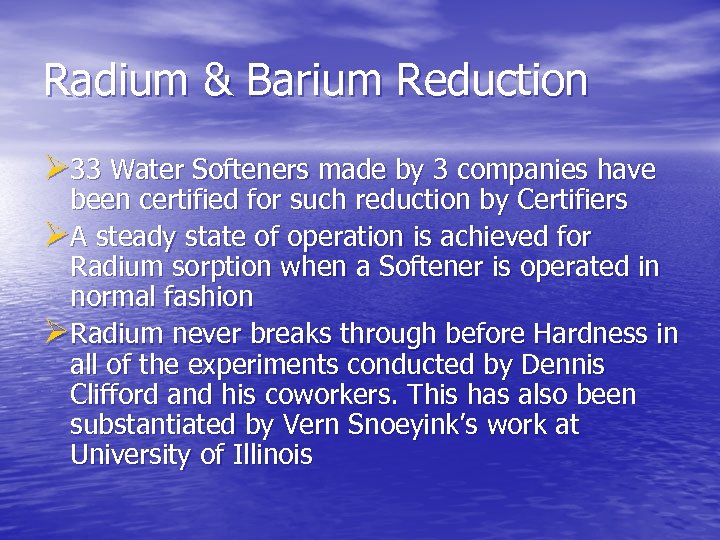
Radium & Barium Reduction Ø 33 Water Softeners made by 3 companies have been certified for such reduction by Certifiers ØA steady state of operation is achieved for Radium sorption when a Softener is operated in normal fashion ØRadium never breaks through before Hardness in all of the experiments conducted by Dennis Clifford and his coworkers. This has also been substantiated by Vern Snoeyink’s work at University of Illinois
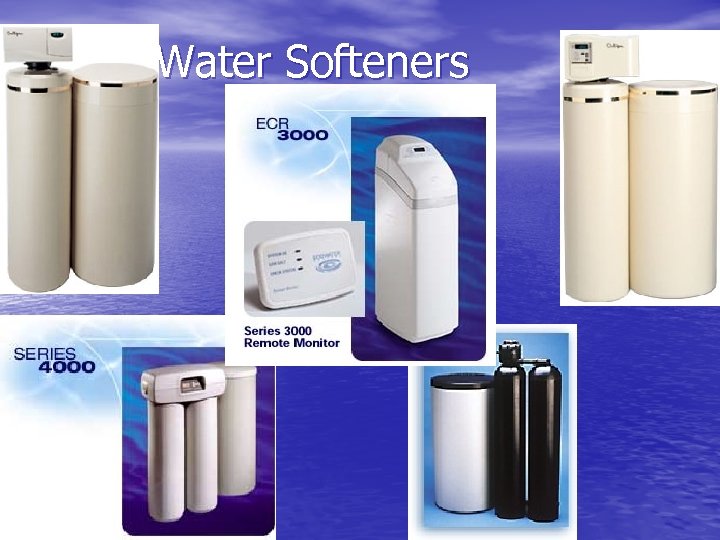
POE Water Softeners
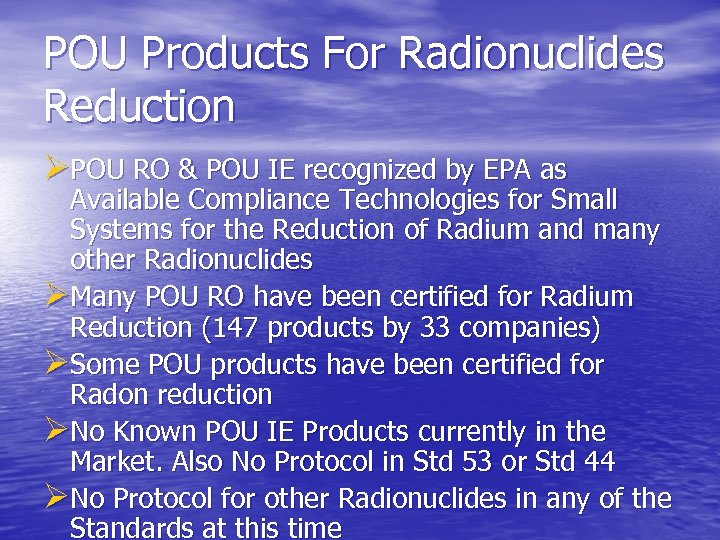
POU Products For Radionuclides Reduction ØPOU RO & POU IE recognized by EPA as Available Compliance Technologies for Small Systems for the Reduction of Radium and many other Radionuclides ØMany POU RO have been certified for Radium Reduction (147 products by 33 companies) ØSome POU products have been certified for Radon reduction ØNo Known POU IE Products currently in the Market. Also No Protocol in Std 53 or Std 44 ØNo Protocol for other Radionuclides in any of the Standards at this time
ORGANICS
Disinfection Byproducts
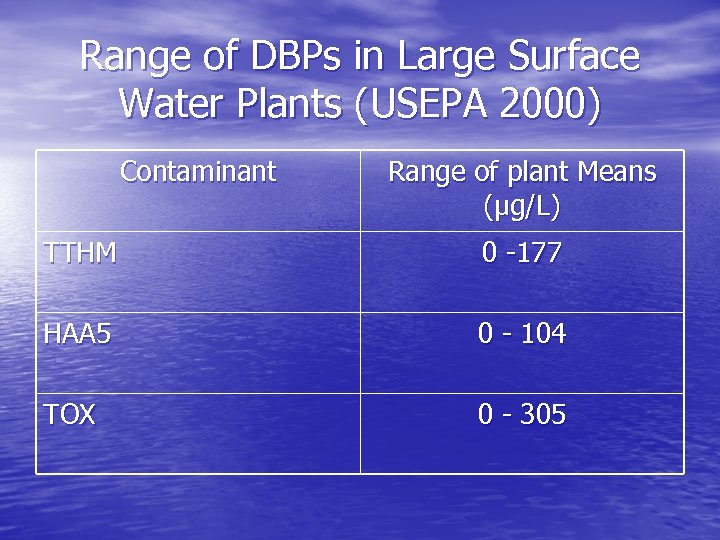
Range of DBPs in Large Surface Water Plants (USEPA 2000) Contaminant Range of plant Means (µg/L) TTHM 0 -177 HAA 5 0 - 104 TOX 0 - 305
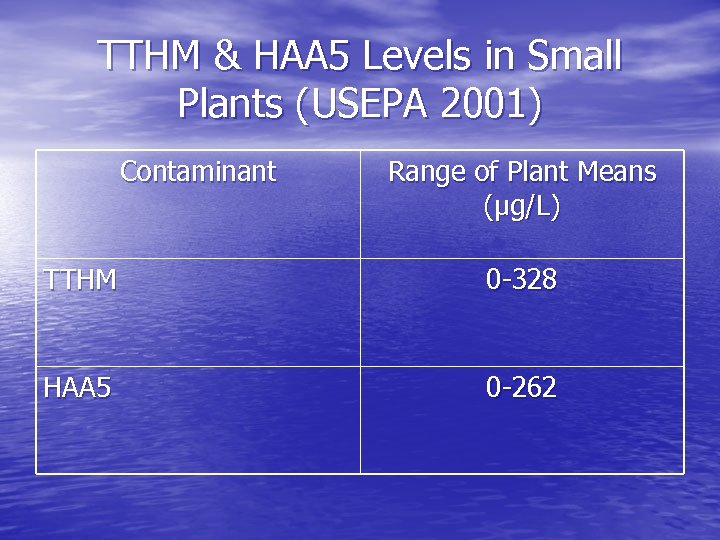
TTHM & HAA 5 Levels in Small Plants (USEPA 2001) Contaminant Range of Plant Means (µg/L) TTHM 0 -328 HAA 5 0 -262
Volatile Organics Ø EPA’s limitation is to use only POE for VOC Reduction from a compliance point of view due to concerns about dermal and inhalation related risks Ø There are no POE unit however tested and certified for VOC Reduction by any of the testing and certification organizations at this time Ø Use of Certified POU units while not fully protective, does reduce at least that portion of the risk associated with consumption
Synthetic Organics Reductions Included in Standard 53 Ø Chloroform Reduction has been substantiated as a surrogate for these synthetic organics: Alachlor, Atrazine, Carbofuron, 2, 4 -D, Dibromochloropropane, Dinoseb, Endrin, Ethylene Dibromide, Heptachlor Epoxide, Hexachlorocyclopentadiene, Lindane, Methoxychlor, Pentachlorophenol, Simazine, 2, 4, 5 -TP (Silvex) --Plus 34 other Volatile Organic Chemicals (VOCs) Ø The following can be tested by themselves separately: Chlordane, PCBs, Toxaphene
Products Certified for Organics ØFor such VOC & SOC Reduction Claims: 25 companies and 115 POU products ØFor Chlordane, PCBs, & Toxaphene Reduction Claims: 7 companies and 45 POU products
Surrogate Testing With Chloroform Ø 300 ppb chloroform in the influent water to be reduced to below 15 ppb in the effluent water during the entire test. Ø A unit with an end of life indicator is tested to remove contaminants for 120% of its claimed life. Ø A unit without an end of life indicator is tested to remove contaminants for 200% of its claimed life. Ø An example of an actual test of a unit with a claimed life of 500 gal with a shut off device is shown here next:
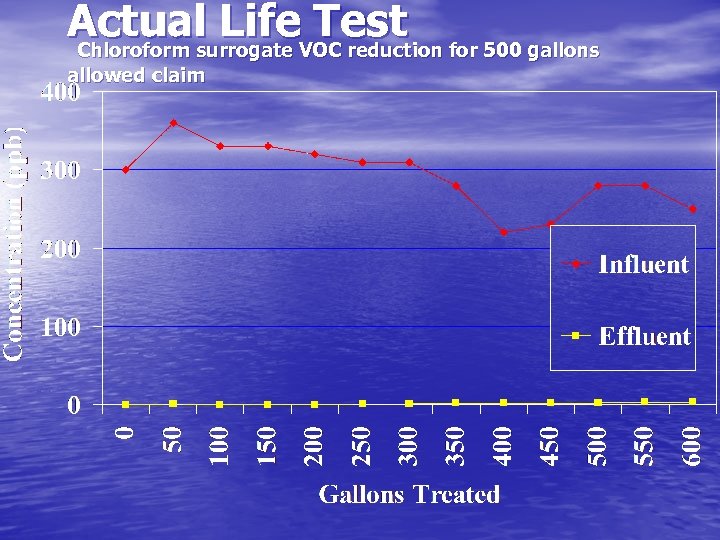
Actual Life. VOC reduction for 500 gallons Test Chloroform surrogate allowed claim
MICROBIOLOGICAL CONTAMINANTS
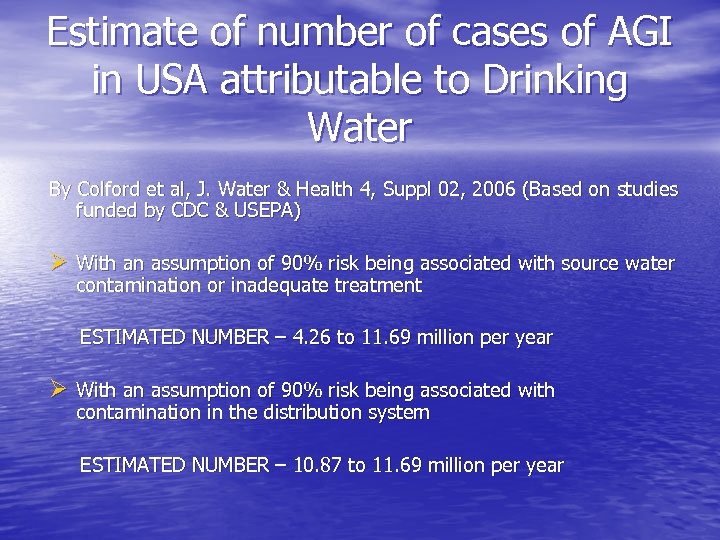
Estimate of number of cases of AGI in USA attributable to Drinking Water By Colford et al, J. Water & Health 4, Suppl 02, 2006 (Based on studies funded by CDC & USEPA) Ø With an assumption of 90% risk being associated with source water contamination or inadequate treatment ESTIMATED NUMBER – 4. 26 to 11. 69 million per year Ø With an assumption of 90% risk being associated with contamination in the distribution system ESTIMATED NUMBER – 10. 87 to 11. 69 million per year
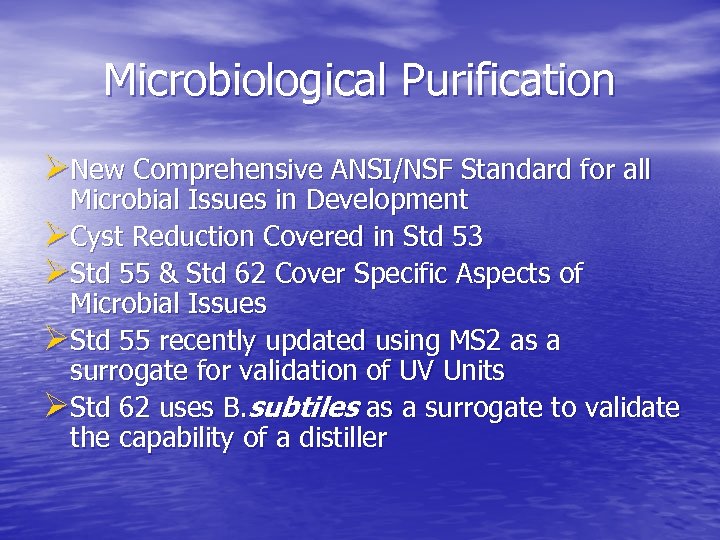
Microbiological Purification ØNew Comprehensive ANSI/NSF Standard for all Microbial Issues in Development ØCyst Reduction Covered in Std 53 ØStd 55 & Std 62 Cover Specific Aspects of Microbial Issues ØStd 55 recently updated using MS 2 as a surrogate for validation of UV Units ØStd 62 uses B. subtiles as a surrogate to validate the capability of a distiller
EPA Guide Standard & Protocol ØDrafted in 1987. Covers Halogenated Resin, UV, and Ceramic Filters. Has become the reference Guide in this area ØUses Raoultella terrigena, a mixture of polio & simian rota viruses, and Giardia (Crypto) Cysts as Test Organisms ØRequires reduction of 6 logs of bacteria, 4 logs of viruses, and 3 logs of cysts under a set of operating conditions of water quality and sequence of cycles and sampling
Standard 55 – UV Units ØUses MS 2 Bacteriophage and Verifies the UV Dose at the set point to be no less than 40 m. J/sqcm for Class A Performance. Requires the use of UV Sensors for sounding an alarm when not effective ØThis Dose level has been universally accepted as capable of yielding more than 4 log Inactivation of Viruses (except adeno), 6 logs of bacteria, and 3 logs of Crypto & Giardia ØUnits certified for Class B are to be offered only for Aesthetic Improvement
UV Units Certified by NSF Intl Ø 17 POE products made by 5 companies have been listed as of now. Ø 3 POU Products by one company carry such certification ØCertified POE Products have been verified to be operable at flow rates ranging from 8 to 18 gpm, appropriate for single home point of entry applications
Purifier Protocol Testing ØOutside the Standard Related Activity, NSF and many Universities such as U of AZ and U of S FL offer Performance Tests using the Guide Protocol as the general Basis ØShown are the Actual Data from tests done by U of AZ on a POU Distiller Product & a POU UV Product
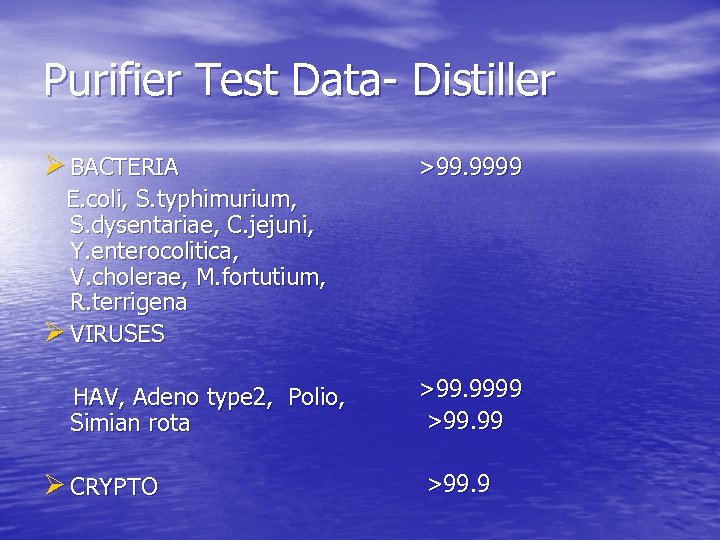
Purifier Test Data- Distiller Ø BACTERIA >99. 9999 E. coli, S. typhimurium, S. dysentariae, C. jejuni, Y. enterocolitica, V. cholerae, M. fortutium, R. terrigena Ø VIRUSES HAV, Adeno type 2, Polio, Simian rota Ø CRYPTO >99. 9999 >99. 9
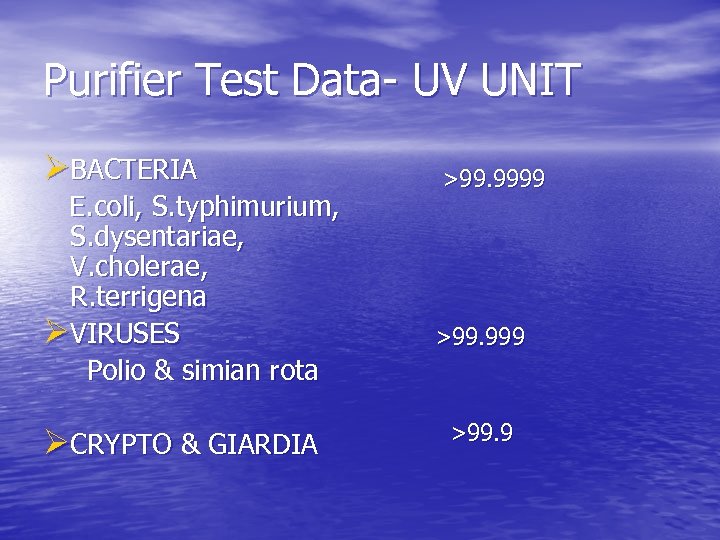
Purifier Test Data- UV UNIT ØBACTERIA E. coli, S. typhimurium, S. dysentariae, V. cholerae, R. terrigena ØVIRUSES Polio & simian rota ØCRYPTO & GIARDIA >99. 9999 >99. 9
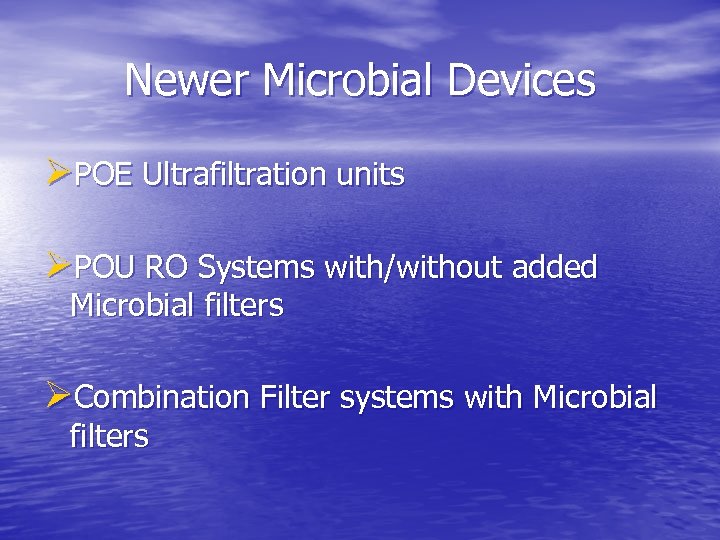
Newer Microbial Devices ØPOE Ultrafiltration units ØPOU RO Systems with/without added Microbial filters ØCombination Filter systems with Microbial filters
MCL Vs MCLG
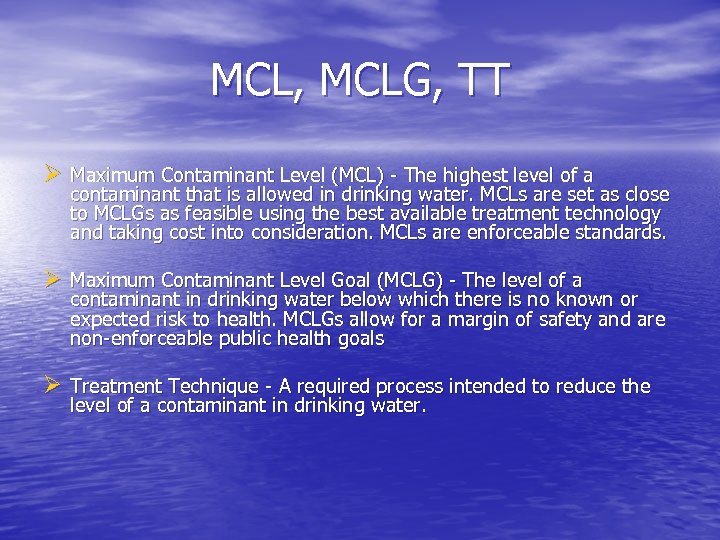
MCL, MCLG, TT Ø Maximum Contaminant Level (MCL) - The highest level of a contaminant that is allowed in drinking water. MCLs are set as close to MCLGs as feasible using the best available treatment technology and taking cost into consideration. MCLs are enforceable standards. Ø Maximum Contaminant Level Goal (MCLG) - The level of a contaminant in drinking water below which there is no known or expected risk to health. MCLGs allow for a margin of safety and are non-enforceable public health goals Ø Treatment Technique - A required process intended to reduce the level of a contaminant in drinking water.
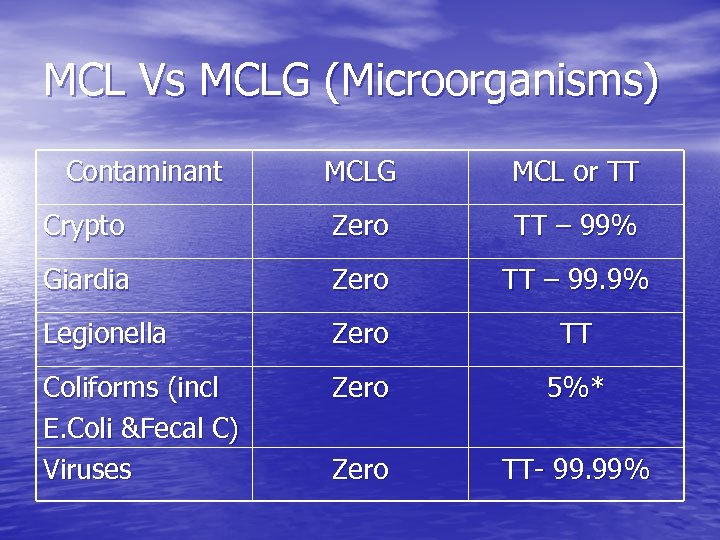
MCL Vs MCLG (Microorganisms) Contaminant MCLG MCL or TT Crypto Zero TT – 99% Giardia Zero TT – 99. 9% Legionella Zero TT Coliforms (incl E. Coli &Fecal C) Viruses Zero 5%* Zero TT- 99. 99%
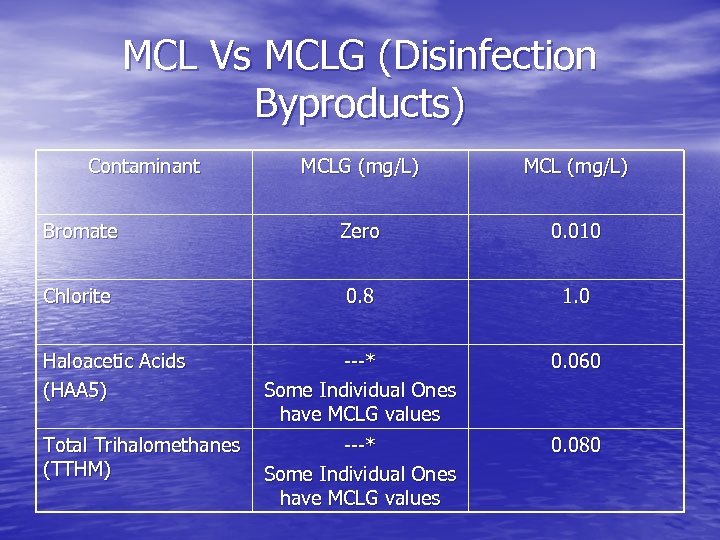
MCL Vs MCLG (Disinfection Byproducts) Contaminant MCLG (mg/L) MCL (mg/L) Bromate Zero 0. 010 Chlorite 0. 8 1. 0 Haloacetic Acids (HAA 5) ---* Some Individual Ones have MCLG values 0. 060 Total Trihalomethanes (TTHM) ---* Some Individual Ones have MCLG values 0. 080
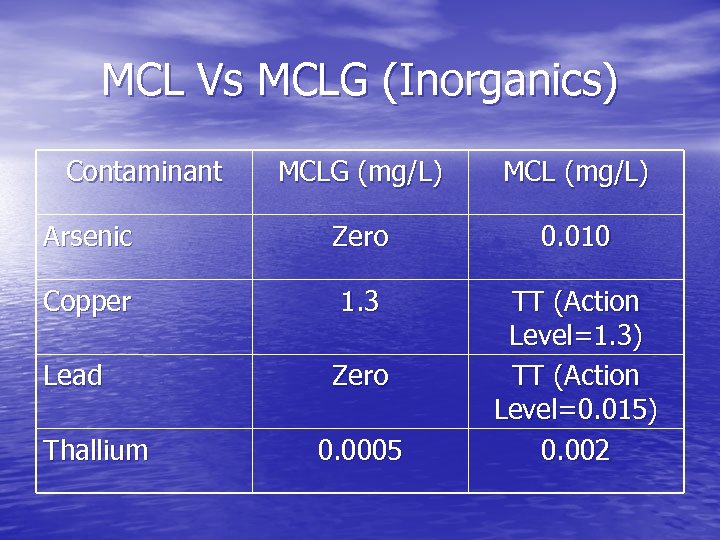
MCL Vs MCLG (Inorganics) Contaminant MCLG (mg/L) MCL (mg/L) Arsenic Zero 0. 010 Copper 1. 3 Lead Zero TT (Action Level=1. 3) TT (Action Level=0. 015) 0. 002 Thallium 0. 0005
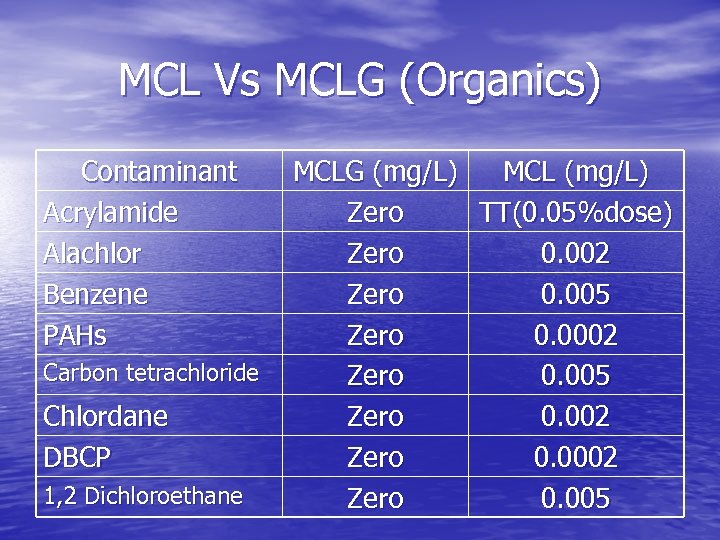
MCL Vs MCLG (Organics) Contaminant Acrylamide Alachlor Benzene PAHs Carbon tetrachloride Chlordane DBCP 1, 2 Dichloroethane MCLG (mg/L) MCL (mg/L) Zero TT(0. 05%dose) Zero 0. 002 Zero 0. 005
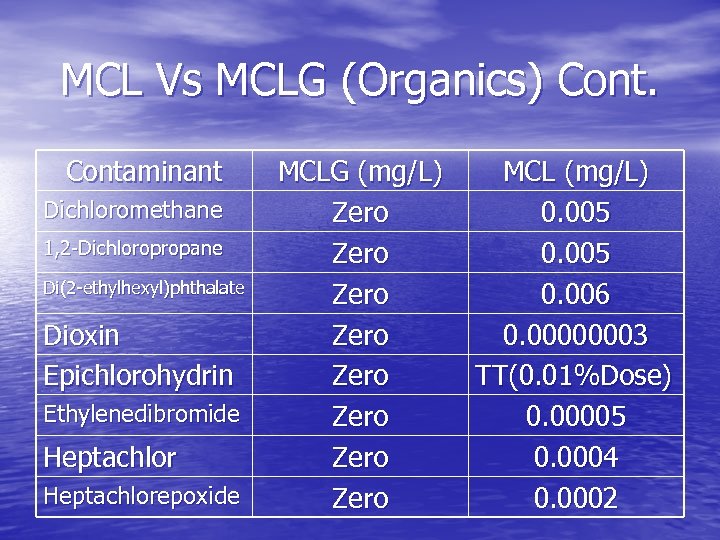
MCL Vs MCLG (Organics) Contaminant Dichloromethane 1, 2 -Dichloropropane Di(2 -ethylhexyl)phthalate Dioxin Epichlorohydrin Ethylenedibromide Heptachlorepoxide MCLG (mg/L) Zero Zero MCL (mg/L) 0. 005 0. 006 0. 00000003 TT(0. 01%Dose) 0. 00005 0. 0004 0. 0002
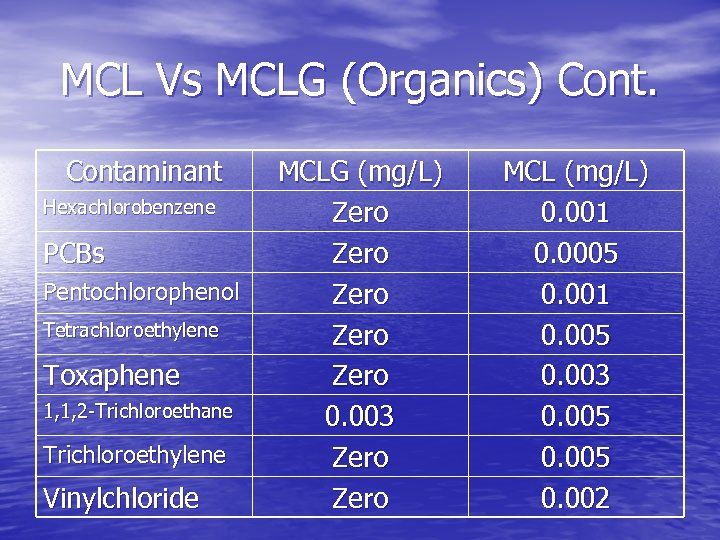
MCL Vs MCLG (Organics) Contaminant Hexachlorobenzene PCBs Pentochlorophenol Tetrachloroethylene Toxaphene 1, 1, 2 -Trichloroethane Trichloroethylene Vinylchloride MCLG (mg/L) Zero Zero 0. 003 Zero MCL (mg/L) 0. 001 0. 0005 0. 001 0. 005 0. 003 0. 005 0. 002
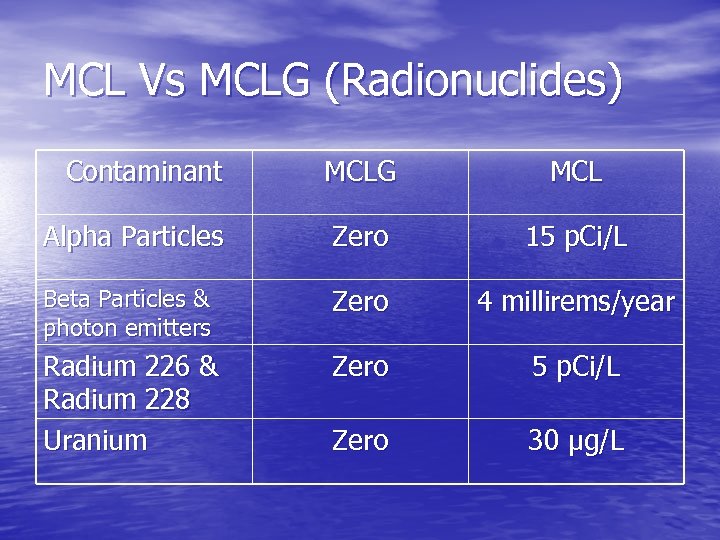
MCL Vs MCLG (Radionuclides) Contaminant MCLG MCL Alpha Particles Zero 15 p. Ci/L Beta Particles & photon emitters Zero 4 millirems/year Radium 226 & Radium 228 Uranium Zero 5 p. Ci/L Zero 30 µg/L
Needs in this Area ØActual Tests showing the reduction from MCL to MCLG for different contaminants ØProtocols for use by certifiers ØIncorporation into present ANSI/NSF standards or development of new Standards
Examples of POU/POE as Final Barriers
Carbon Block Filter ØAssumption: Tested & Certified for lead, cyst, and VOC reduction ØBarrier to synthetic & volatile organics, lead, and protozoan cysts AND a partial barrier to bacteria and viruses even though not claimed ØNot a barrier to most other inorganics or radionuclides
RO System with Carbon Filter ØAssumption: Tested & Certified for reduction of several Inorganics, Radionuclides, Cysts, and VOC ØBarrier to all tested inorganics, radionuclides, protozoan cysts, many synthetic and volatile organics. Also a probable barrier to several other inorganics, bacteria, and viruses ØNot a proven barrier against all microbials and some organics
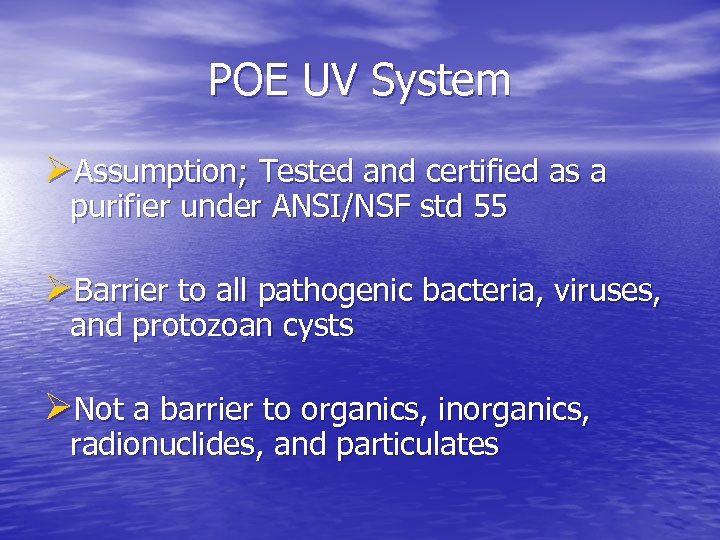
POE UV System ØAssumption; Tested and certified as a purifier under ANSI/NSF std 55 ØBarrier to all pathogenic bacteria, viruses, and protozoan cysts ØNot a barrier to organics, inorganics, radionuclides, and particulates
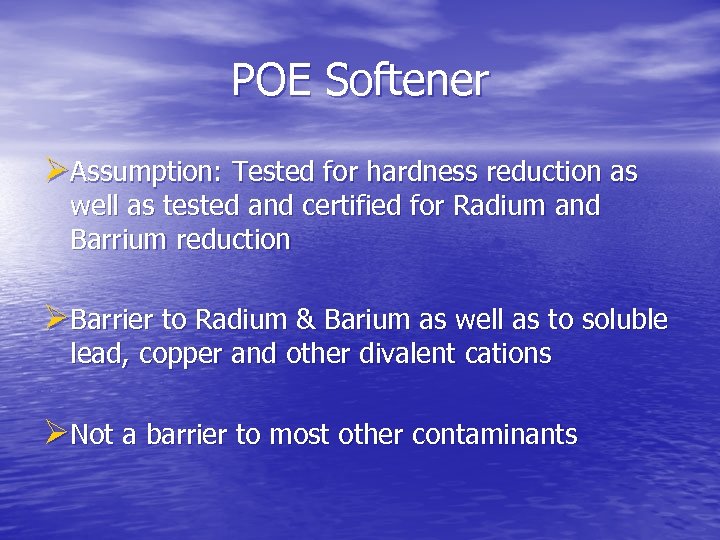
POE Softener ØAssumption: Tested for hardness reduction as well as tested and certified for Radium and Barrium reduction ØBarrier to Radium & Barium as well as to soluble lead, copper and other divalent cations ØNot a barrier to most other contaminants
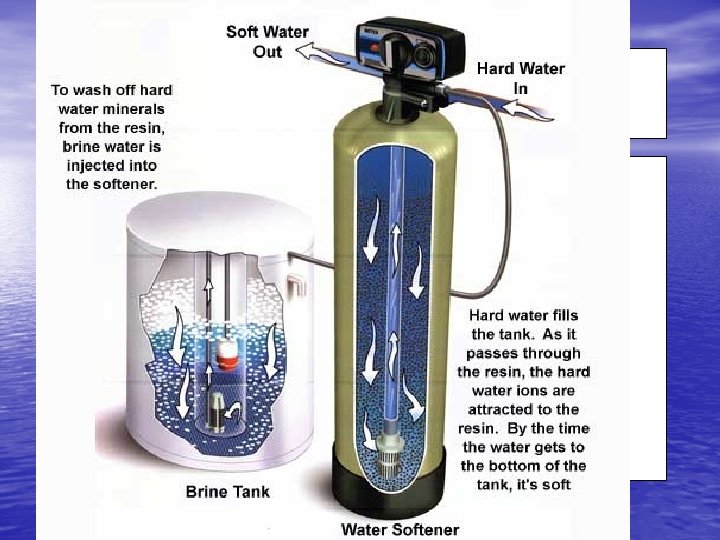
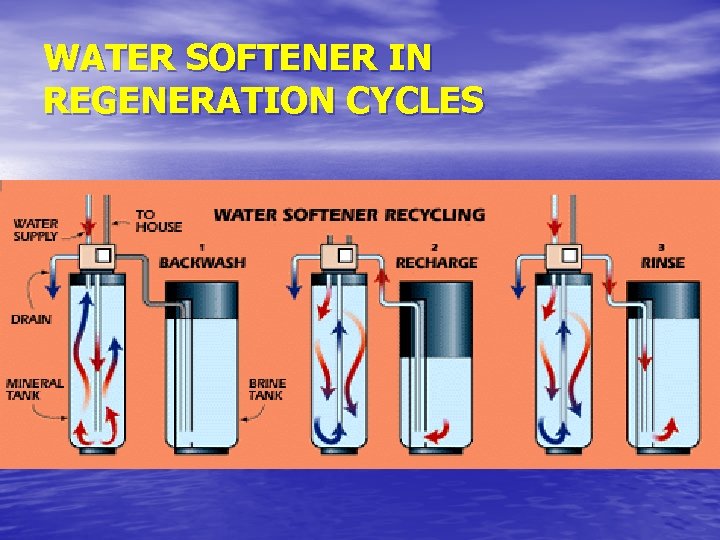
WATER SOFTENER IN REGENERATION CYCLES
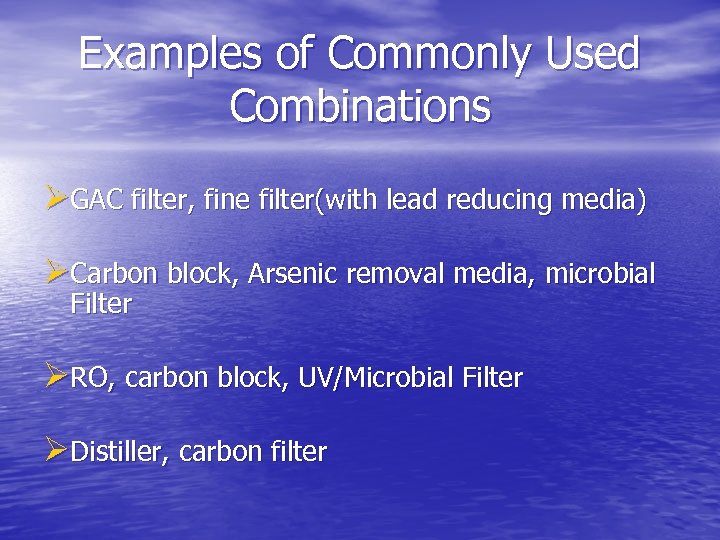
Examples of Commonly Used Combinations ØGAC filter, fine filter(with lead reducing media) ØCarbon block, Arsenic removal media, microbial Filter ØRO, carbon block, UV/Microbial Filter ØDistiller, carbon filter
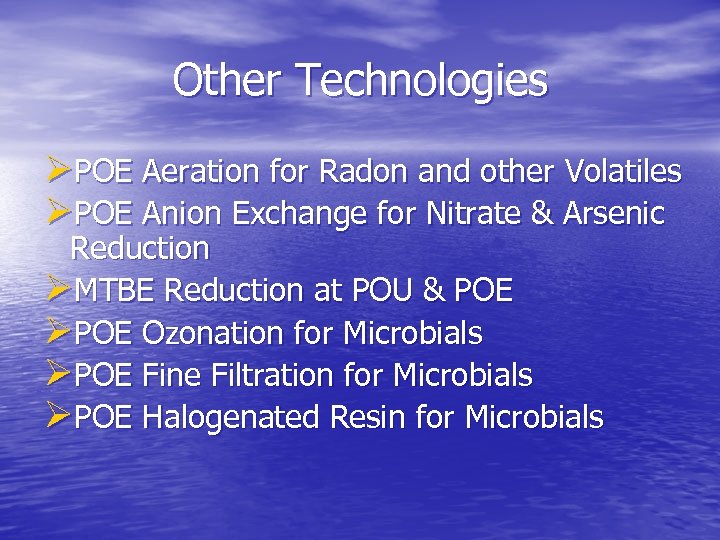
Other Technologies ØPOE Aeration for Radon and other Volatiles ØPOE Anion Exchange for Nitrate & Arsenic Reduction ØMTBE Reduction at POU & POE ØPOE Ozonation for Microbials ØPOE Fine Filtration for Microbials ØPOE Halogenated Resin for Microbials
POU/POE as a Final Barrier Ø Aesthetic Concerns Ø Treatment Effects • DBP Levels • Process Changes, Lead & Copper Levels Ø Distribution Related Effects • Corrosion Products • Microbial Intrusions • Endemic Diseases • Security Issues Ø MCL Vs MCLG
Скачать презентацию POU POE Devices as Final Barriers Joseph F
9e6fa0263f9217fd456d6911b82cd9c8.ppt