


 Скачать презентацию Potential Role of Automated Patient Safety Reporting Systems
0da8fa92ace6ec3e10dd9088c38b8720.ppt
- Количество слайдов: 22
 Potential Role of Automated Patient Safety Reporting Systems in Vermont Hospitals Kenneth E. Thorpe, Ph. D. Robert W. Woodruff Professor and Chair Department of Health Policy and Management Rollins School of Public Health Emory University kthorpe@sph. emory. edu
 Major Opportunity Greater than 50% of the $17 - $29 billion national cost associated with medical errors is preventable. Source: Thomas EJ, Studdert DM, Newhouse JP et al. 1999. Costs of medical injuries in Utah and Colorado. Inquiry. 36: 255 -64.
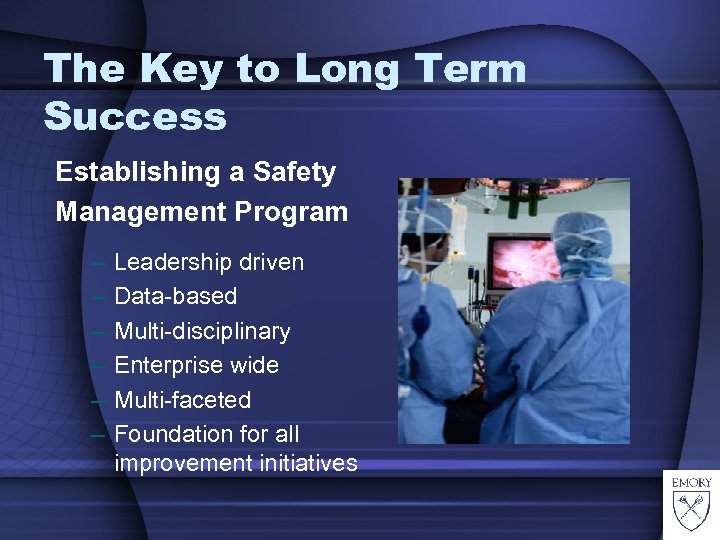 The Key to Long Term Success Establishing a Safety Management Program – – – Leadership driven Data-based Multi-disciplinary Enterprise wide Multi-faceted Foundation for all improvement initiatives
 The Opportunity On average existing patient safety interventions have identified, 10 -15% of a hospital’s annual operating budget being spent on resources associated with medical errors and ineffective and failed processes that occur in the care delivery process
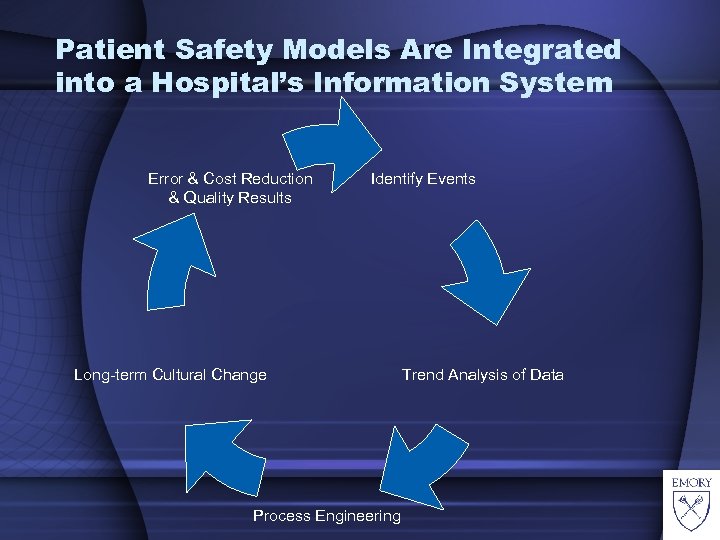 Patient Safety Models Are Integrated into a Hospital’s Information System Error & Cost Reduction & Quality Results Identify Events Long-term Cultural Change Process Engineering Trend Analysis of Data
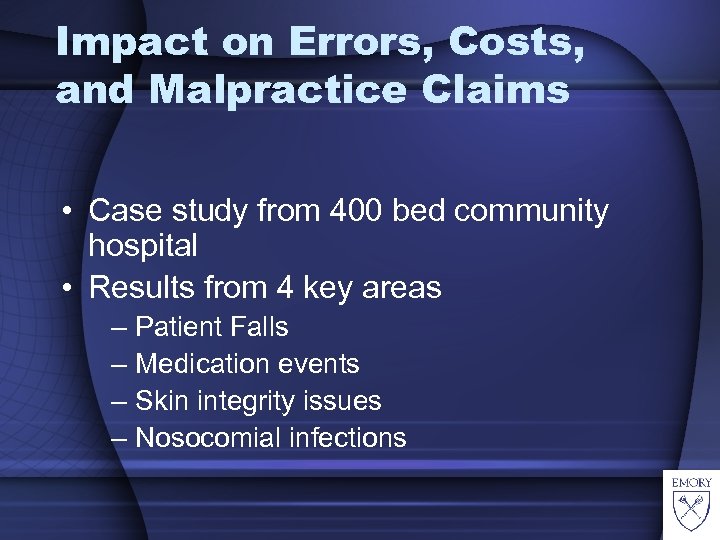 Impact on Errors, Costs, and Malpractice Claims • Case study from 400 bed community hospital • Results from 4 key areas – Patient Falls – Medication events – Skin integrity issues – Nosocomial infections
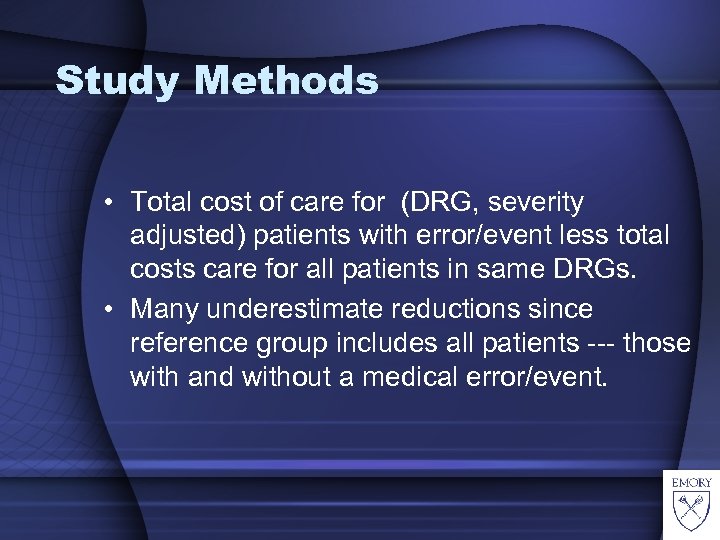 Study Methods • Total cost of care for (DRG, severity adjusted) patients with error/event less total costs care for all patients in same DRGs. • Many underestimate reductions since reference group includes all patients --- those with and without a medical error/event.
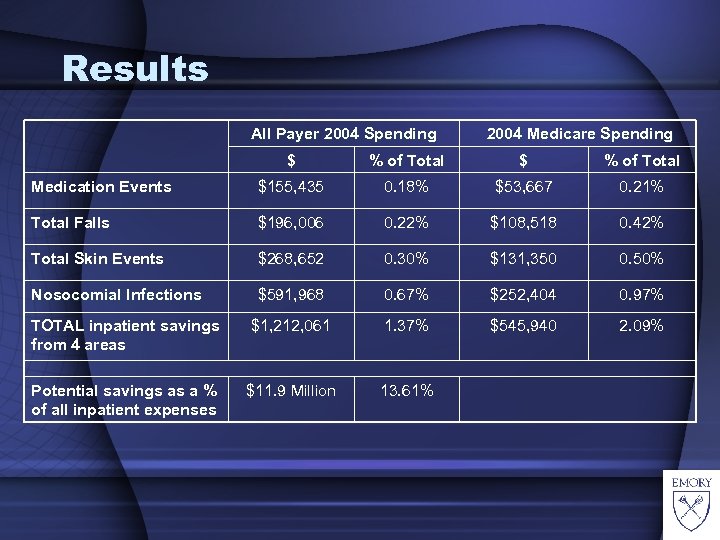 Results All Payer 2004 Spending 2004 Medicare Spending $ % of Total Medication Events $155, 435 0. 18% $53, 667 0. 21% Total Falls $196, 006 0. 22% $108, 518 0. 42% Total Skin Events $268, 652 0. 30% $131, 350 0. 50% Nosocomial Infections $591, 968 0. 67% $252, 404 0. 97% TOTAL inpatient savings from 4 areas $1, 212, 061 1. 37% $545, 940 2. 09% Potential savings as a % of all inpatient expenses $11. 9 Million 13. 61%
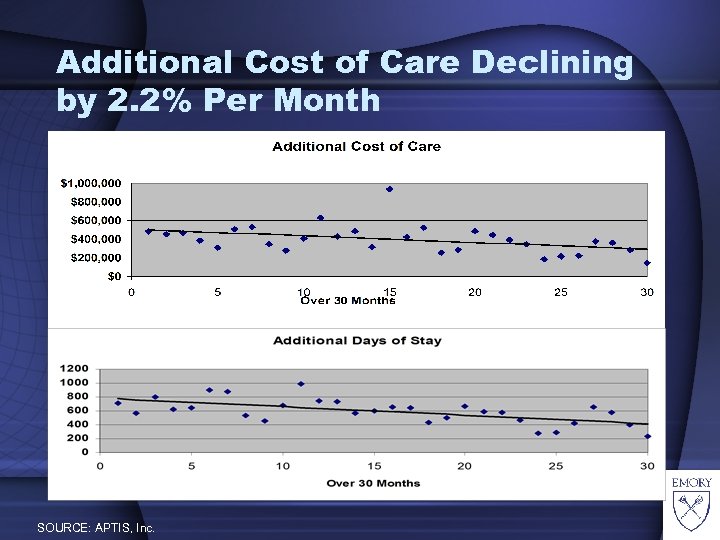 Additional Cost of Care Declining by 2. 2% Per Month SOURCE: APTIS, Inc.
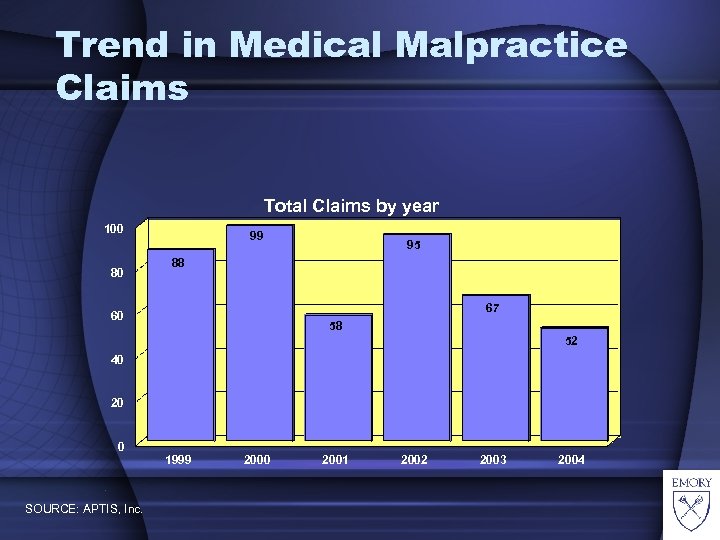 Trend in Medical Malpractice Claims Total Claims by year 100 80 99 95 88 67 60 58 52 40 20 0 . SOURCE: APTIS, Inc. 1999 2000 2001 2002 2003 2004
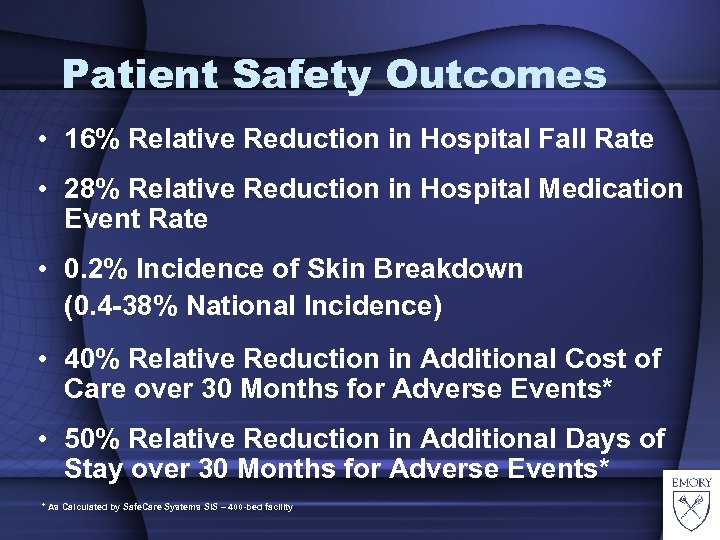 Patient Safety Outcomes • 16% Relative Reduction in Hospital Fall Rate • 28% Relative Reduction in Hospital Medication Event Rate • 0. 2% Incidence of Skin Breakdown (0. 4 -38% National Incidence) • 40% Relative Reduction in Additional Cost of Care over 30 Months for Adverse Events* • 50% Relative Reduction in Additional Days of Stay over 30 Months for Adverse Events* * As Calculated by Safe. Care Systems SIS – 400 -bed facility
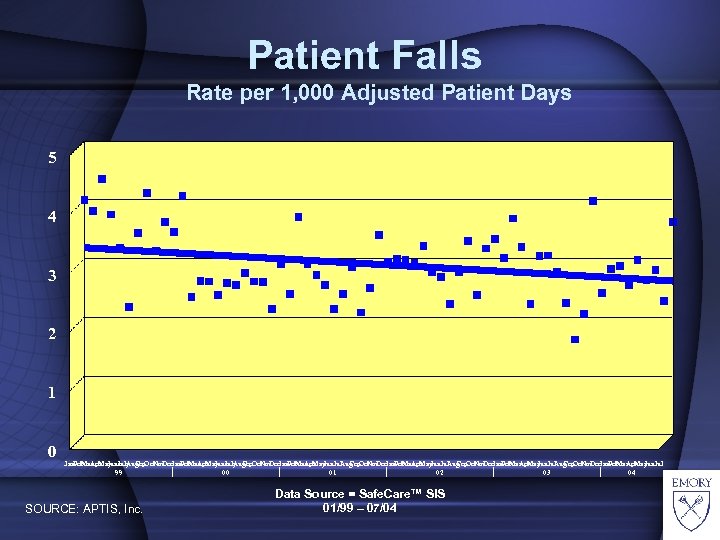 Patient Falls Rate per 1, 000 Adjusted Patient Days 5 4 3 2 1 0 Jan Mar pr June Aug Oct ov ec Feb ar pr Jun Aug Oct ov Jan Mar pr Jun Feb A May July Sep N Dec Feb A May July Sep N D Jan M A May Jul Sep N Dec Feb A May Jul 99 00 01 02 03 04 SOURCE: APTIS, Inc. Data Source = Safe. Care™ SIS 01/99 – 07/04
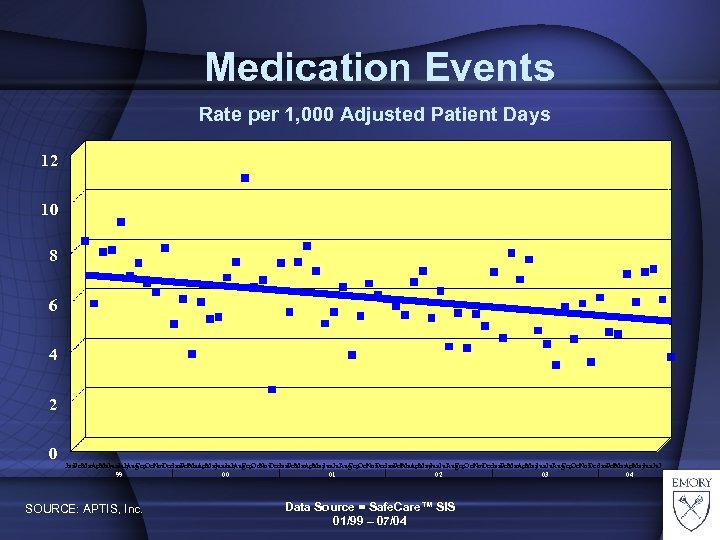 Medication Events Rate per 1, 000 Adjusted Patient Days 12 10 8 6 4 2 0 Jan Mar pr June Aug Oct ov ec Feb ar pr June Aug Oct ov Jan Mar pr Jun Aug Oct ov ec Feb ar pr Jun Feb A May July Sep N D Jan M A May July Sep N Dec Feb A May Jul Sep N D Jan M A May Jul 99 00 01 02 03 04 SOURCE: APTIS, Inc. Data Source = Safe. Care™ SIS 01/99 – 07/04
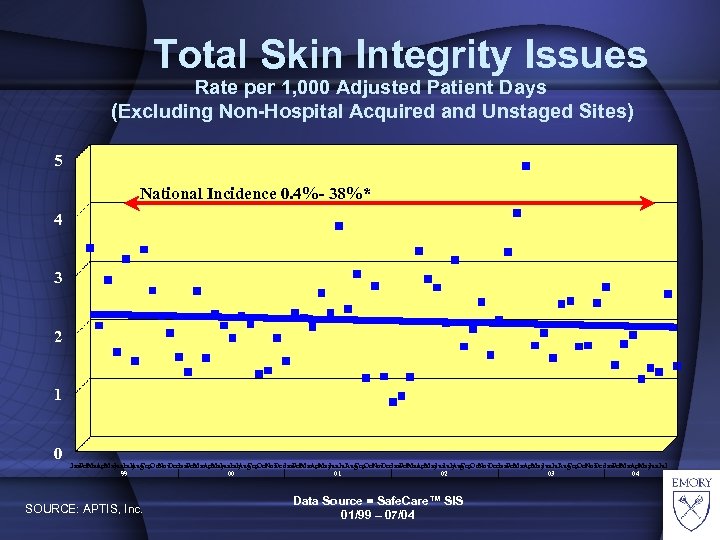 Total Skin Integrity Issues Rate per 1, 000 Adjusted Patient Days (Excluding Non-Hospital Acquired and Unstaged Sites) 5 National Incidence 0. 4%- 38%* 4 3 2 1 0 Jan Mar pr June Aug Oct ov ec Feb ar pr June Aug Oct ov Jan Mar pr Jun Aug Oct ov ec Feb ar pr Jun uly ug Oct ov ec Feb ar pr Jun Aug Oct ov ec Feb ar pr Jun Feb A May July Sep N D Jan M A May July Sep N Dec Feb A May Jul Sep N D Jan M A May J A Sep N D Jan M A May Jul 99 00 01 02 03 04 SOURCE: APTIS, Inc. Data Source = Safe. Care™ SIS 01/99 – 07/04
 SOURCE: APTIS, Inc.
 SOURCE: APTIS, Inc.
 SOURCE: APTIS, Inc.
 SOURCE: APTIS, Inc.
 SOURCE: APTIS, Inc.
 SOURCE: APTIS, Inc.
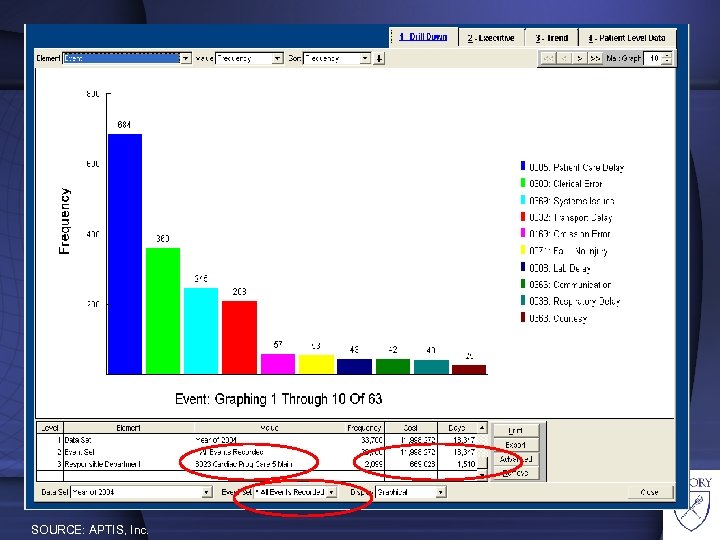 SOURCE: APTIS, Inc.
 Safe. Care Safety Information System Key Benefits Identifies the safety opportunities Manages the organization’s response Measures the effectiveness of QI initiatives Quantifies the cost savings