


 Скачать презентацию Potential Impacts of Climate Change on Cement Industry
1f6a68cc79b2e0aa2c7e4f0f35c5a6e5.ppt
- Количество слайдов: 25
 Potential Impacts of Climate Change on Cement Industry PCA MTC Steering Committee, May 2008
 Climate Change Impact Among other things, we have to face the fact that whether we agree that a crisis of rapid climate change exists, the political drive is pushing this to reality and regulation is eminent. We have to be prepared! What do we need to Know? • What is coming - requirements • What are our emissions • What are our options, specific to our operations and location • How much will it cost • Which is the best application • How easy is implementation
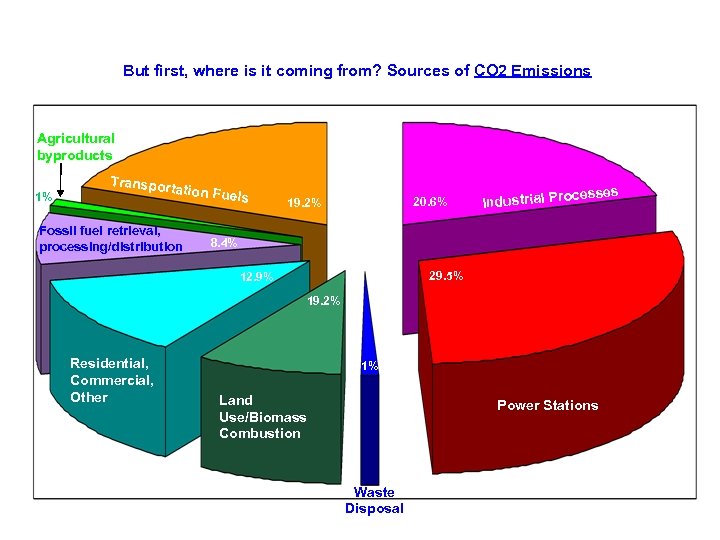 But first, where is it coming from? Sources of CO 2 Emissions Agricultural byproducts 1% Transpor tation Fu els Fossil fuel retrieval, processing/distribution 20. 6% 19. 2% cesses Industrial Pro 8. 4% 29. 5% 12. 9% 19. 2% Residential, Commercial, Other 1% Land Use/Biomass Combustion Power Stations Waste Disposal
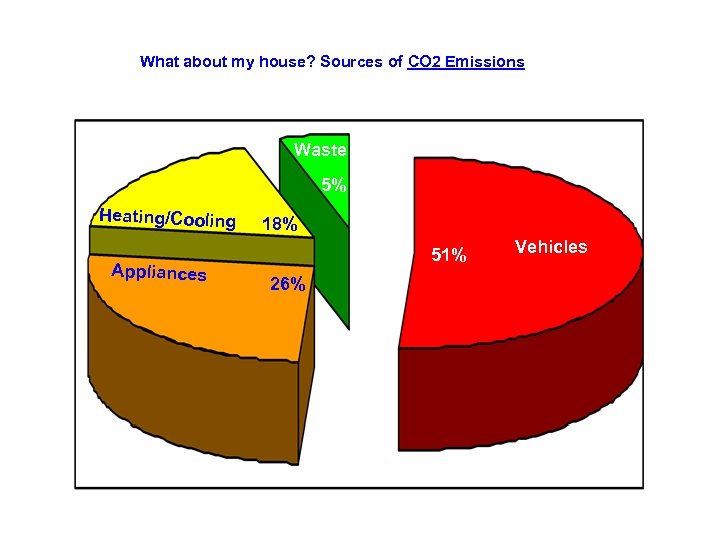 What about my house? Sources of CO 2 Emissions Waste 5% Heating/Cooling Appliances 18% 51% 26% Vehicles
 What is coming – Definitions and requirements Definitions • Greenhouse gases (GHG) Not Just CO 2 : • Carbon dioxide (CO 2), Methane, Nitrous oxide (N 2 O, not NOx), hydrofluorocarbons, perfluorocarbons and Sulfur hexafluoride • Carbon Credits – Tons of carbon emissions “granted” to each facility, similar to a permitted emission limit except it decreases over time Carbon Credits Example : A Cement operation emits 2, 000 tons of carbon Dioxide per year If the law says they will reduce CO 2 by 25% over time : Plant receives 1, 500, 000 carbon credits 2, 000 tons CO 2 per year X 75% = 1, 500, 000 carbon credits
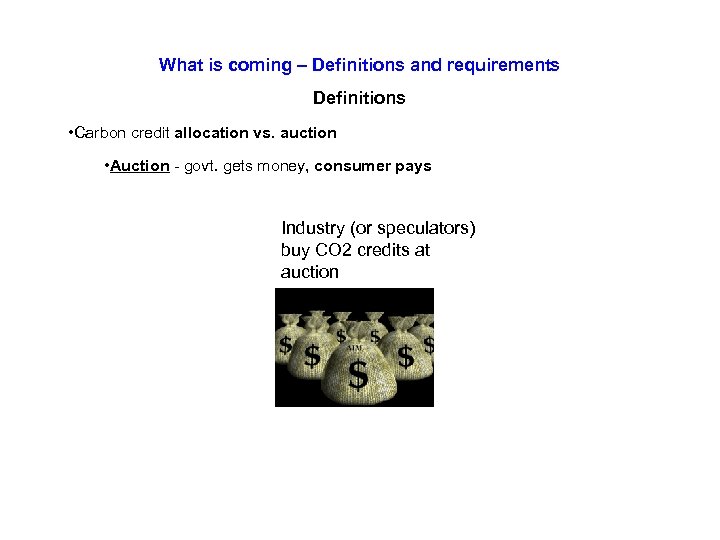 What is coming – Definitions and requirements Definitions • Carbon credit allocation vs. auction • Auction - govt. gets money, consumer pays Industry (or speculators) buy CO 2 credits at auction
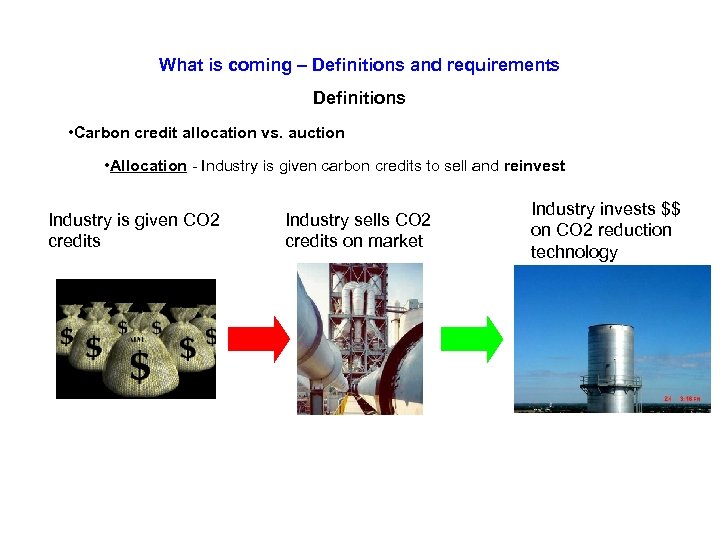 What is coming – Definitions and requirements Definitions • Carbon credit allocation vs. auction • Allocation - Industry is given carbon credits to sell and reinvest Industry is given CO 2 credits Industry sells CO 2 credits on market Industry invests $$ on CO 2 reduction technology
 What is coming – Definitions and requirements Definitions • Cap and trade • Maximum emissions (cap) set for facilities with reductions over time • Carbon credits granted (or auctioned) to company to be sold as commodity (trade). Seller uses money to invest in CO 2 reduction technology Carbon Trade Example : Brand X receives 1, 500, 000 carbon credits can reduce CO 2 by 30%. The Market price is $30 per carbon credit when Brand X sells : 1, 500, 000 carbon credits X 30% reduction = 450, 000 credits for sale $30 per credit X 450, 000 x 3 years = $40, 500, 000 $40. 5 Million to invest in CO 2 reduction technology
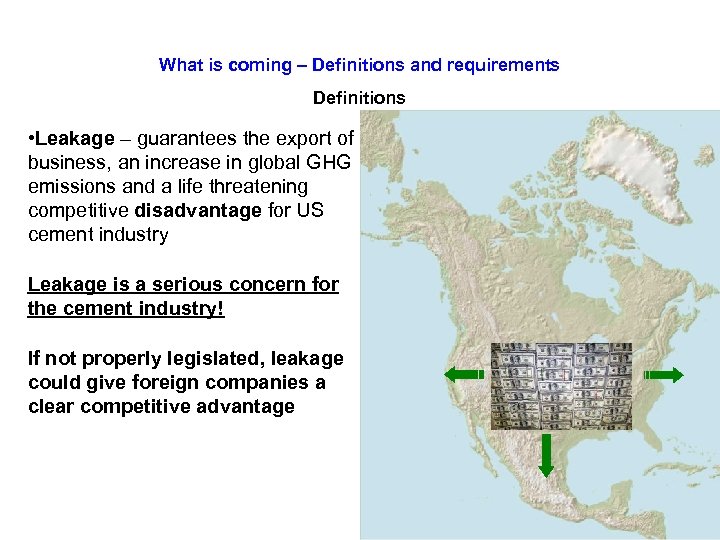 What is coming – Definitions and requirements Definitions • Leakage – guarantees the export of business, an increase in global GHG emissions and a life threatening competitive disadvantage for US cement industry Leakage is a serious concern for the cement industry! If not properly legislated, leakage could give foreign companies a clear competitive advantage
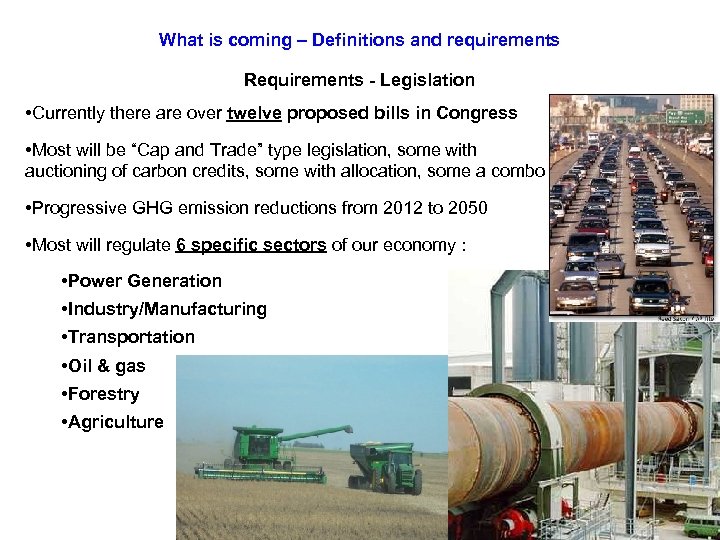 What is coming – Definitions and requirements Requirements - Legislation • Currently there are over twelve proposed bills in Congress • Most will be “Cap and Trade” type legislation, some with auctioning of carbon credits, some with allocation, some a combo • Progressive GHG emission reductions from 2012 to 2050 • Most will regulate 6 specific sectors of our economy : • Power Generation • Industry/Manufacturing • Transportation • Oil & gas • Forestry • Agriculture
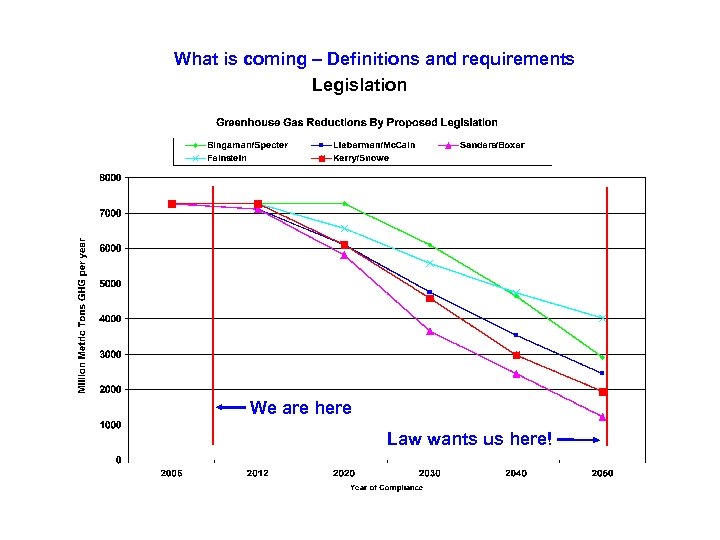 What is coming – Definitions and requirements Legislation We are here Law wants us here!
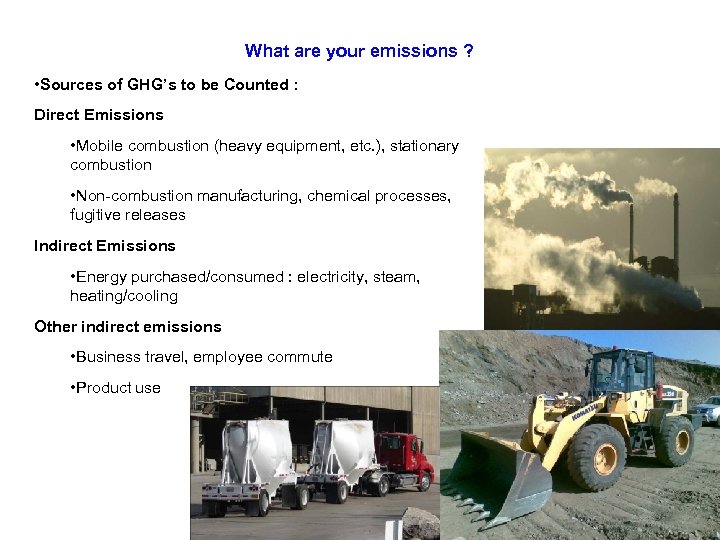 What are your emissions ? • Sources of GHG’s to be Counted : Direct Emissions • Mobile combustion (heavy equipment, etc. ), stationary combustion • Non-combustion manufacturing, chemical processes, fugitive releases Indirect Emissions • Energy purchased/consumed : electricity, steam, heating/cooling Other indirect emissions • Business travel, employee commute • Product use
 What are our options ? • More blended cements – Type IP, slag blends, other additions • Carbon neutral fuels, renewable fuels (bio mass, bio fuels) • Energy efficiency measures – Pyro-process and electrical efficiencies • Carbon dioxide capture and storage (CCS) – complex process to capture CO 2 from fuel process or stack and put it underground • Hybrid cement energy facilities – utilization of waste heat • Use of non-cement binders (e. g. geopolymers), with lower specific CO 2 emissions Last 3 items are expensive, not practical right now – short-term measures will have to be used while new technologies are being developed
 What are our options (contd. )? Blended cements : • Limestone, Slags, Fly Ash, Silica Fume and other additives Caution : • DOT / customer acceptance, Consistent product, Added metals, Color and quality variations Carbon dioxide capture and storage (CCS) : • Goodbye CO 2, Site considerations based on capability to sequester CO 2, Experience from enhanced oil recovery Caution : • Co$$$$t to capture, CO 2 – Hello again? , Who owns the rights? , Public acceptance, Regulations and regulatory authority?
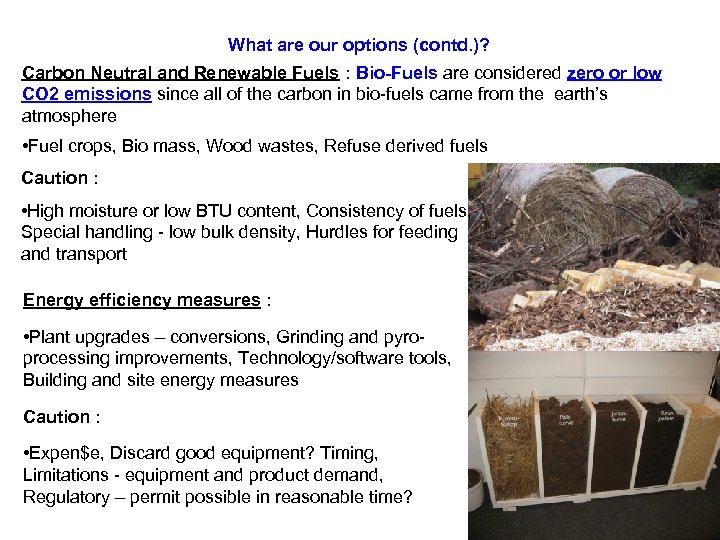 What are our options (contd. )? Carbon Neutral and Renewable Fuels : Bio-Fuels are considered zero or low CO 2 emissions since all of the carbon in bio-fuels came from the earth’s atmosphere • Fuel crops, Bio mass, Wood wastes, Refuse derived fuels Caution : • High moisture or low BTU content, Consistency of fuels, Special handling - low bulk density, Hurdles for feeding and transport Energy efficiency measures : • Plant upgrades – conversions, Grinding and pyroprocessing improvements, Technology/software tools, Building and site energy measures Caution : • Expen$e, Discard good equipment? Timing, Limitations - equipment and product demand, Regulatory – permit possible in reasonable time?
 Assembly Bill 32 (AB 32) - California Climate Change Regulation • Very Aggressive and Stand Alone • California producers are vulnerable to a competitive disadvantage if implemented before other states are under similar regulation • Preventing leakage difficult or impossible with international law Goals : • Reduce GHG emissions to 1990 levels by 2020 (25% reduction) • 80 % reduction below 1990 levels by 2050
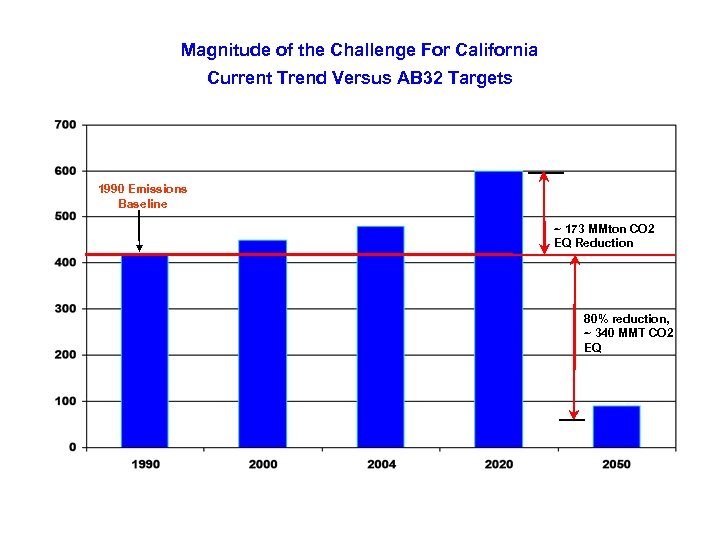 Magnitude of the Challenge For California Current Trend Versus AB 32 Targets 1990 Emissions Baseline ~ 173 MMton CO 2 EQ Reduction 80% reduction, ~ 340 MMT CO 2 EQ
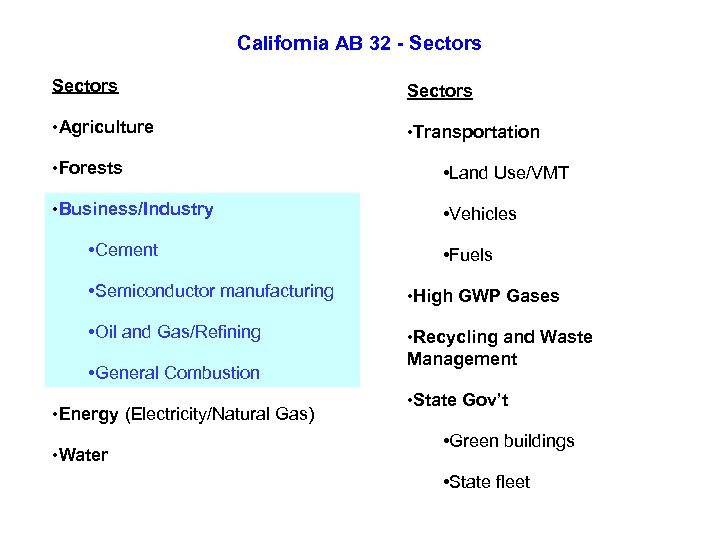 California AB 32 - Sectors • Agriculture • Transportation • Forests • Land Use/VMT • Business/Industry • Vehicles • Cement • Fuels • Semiconductor manufacturing • High GWP Gases • Oil and Gas/Refining • Recycling and Waste Management • General Combustion • Energy (Electricity/Natural Gas) • Water • State Gov’t • Green buildings • State fleet
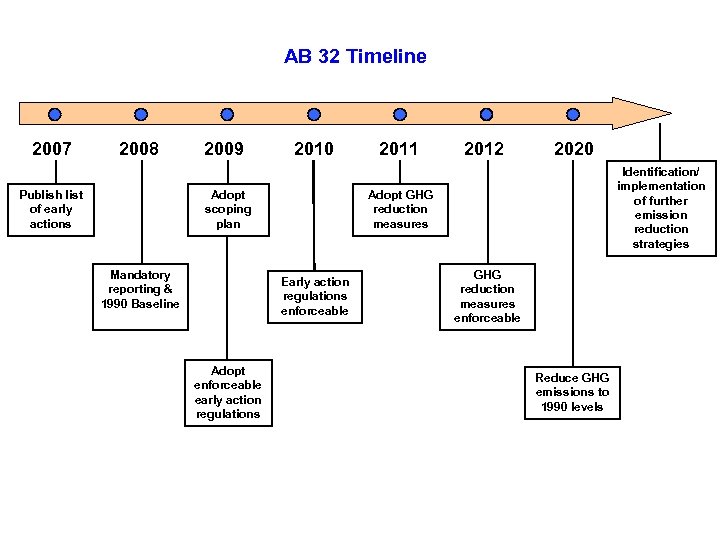 AB 32 Timeline 2007 2008 Publish list of early actions 2009 2010 Adopt scoping plan Mandatory reporting & 1990 Baseline 2012 2020 Identification/ implementation of further emission reduction strategies Adopt GHG reduction measures Early action regulations enforceable Adopt enforceable early action regulations 2011 GHG reduction measures enforceable Reduce GHG emissions to 1990 levels
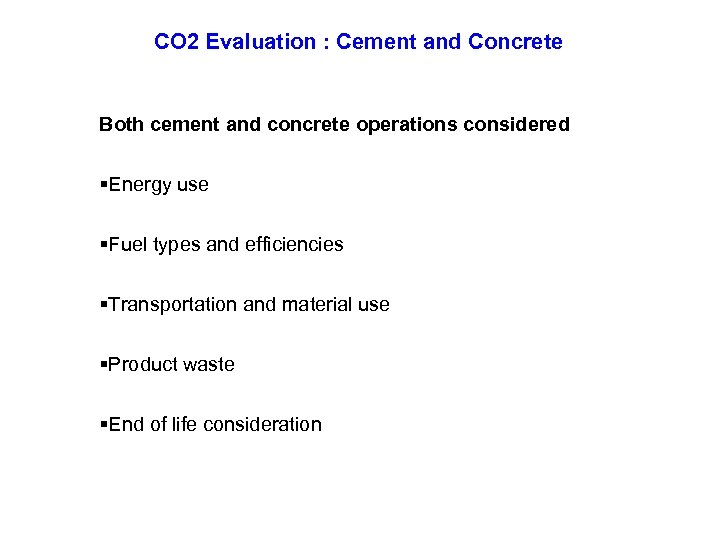 CO 2 Evaluation : Cement and Concrete Both cement and concrete operations considered §Energy use §Fuel types and efficiencies §Transportation and material use §Product waste §End of life consideration
 General Information : Concrete and Cement in California Cement operations : § 11 cement plants, cement 14 kilns in CA § 3 in Northern CA, 8 in Southern CA § Over 1, 700 employees § 11. 3 MMT Clinker, 11. 6 MMT Cement Concrete Operations : • Over 400 - 500 established concrete batch plants in CA • Many more temporary batch plants • 75% of cement distributed to concrete batch plants • 25% distributed to other businesses
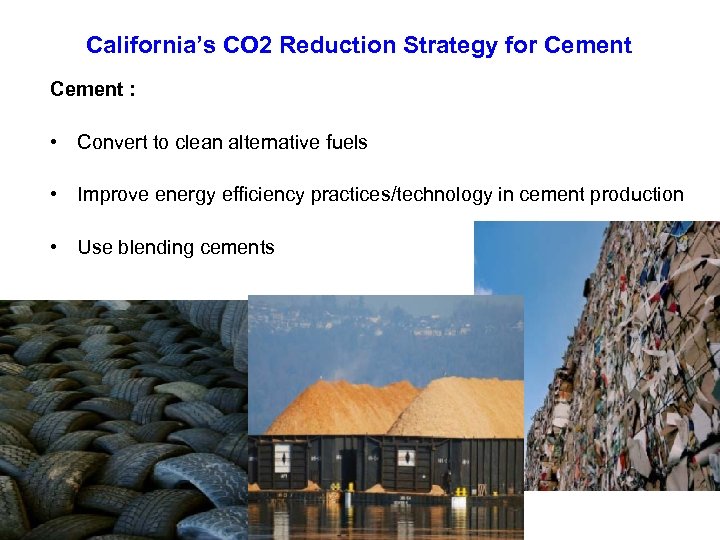 California’s CO 2 Reduction Strategy for Cement : • Convert to clean alternative fuels • Improve energy efficiency practices/technology in cement production • Use blending cements
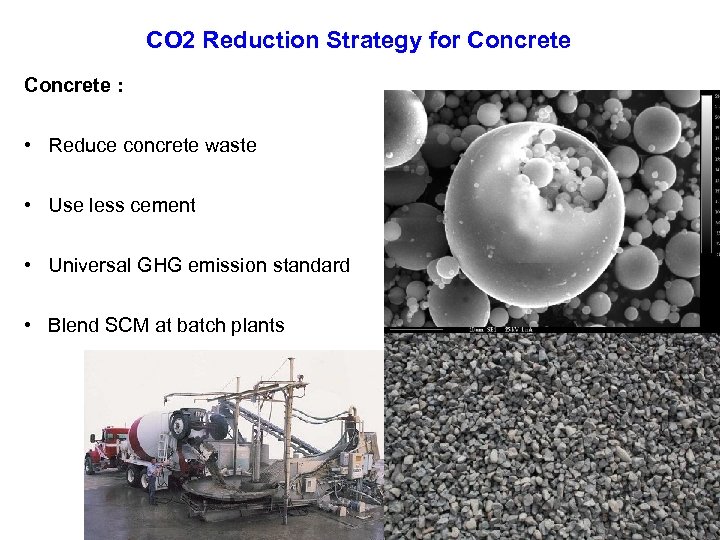 CO 2 Reduction Strategy for Concrete : • Reduce concrete waste • Use less cement • Universal GHG emission standard • Blend SCM at batch plants
 How Will Climate Change Impact The Cement Industry? Conclusion • We have to be prepared – Don’t wait for law, start now! • Get involved and provide input into regulations (PCA, etc. ) • Know your emissions – Carbon Inventory, don’t stop at the plant • Know your options for each facility – find the best fit • Long –range planning starts now
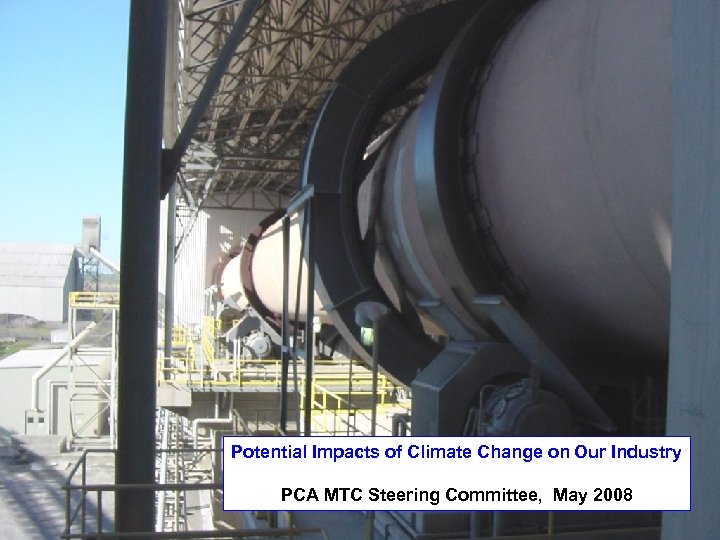 Potential Impacts of Climate Change on Our Industry PCA MTC Steering Committee, May 2008