


 Скачать презентацию Potential for Technology Transfer in Hungary Miklós Székely
075a86d692801ca5aa150096e475ef9e.ppt
- Количество слайдов: 15
 Potential for Technology Transfer in Hungary Miklós Székely Renewable energy and climate policy expert 11 October 2016
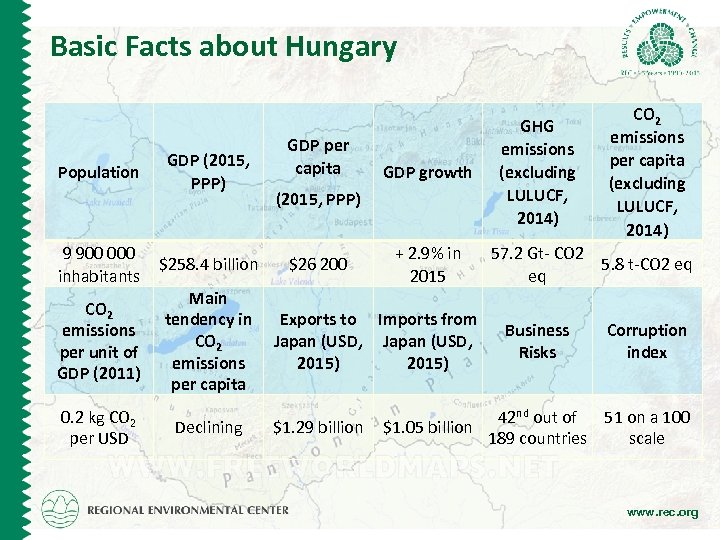 Basic Facts about Hungary Population 9 900 000 inhabitants CO 2 emissions per unit of GDP (2011) 0. 2 kg CO 2 per USD GDP (2015, PPP) $258. 4 billion Main tendency in CO 2 emissions per capita Declining GDP per capita GDP growth (2015, PPP) $26 200 + 2. 9% in 2015 Exports to Imports from Japan (USD, 2015) $1. 29 billion GHG emissions (excluding LULUCF, 2014) CO 2 emissions per capita (excluding LULUCF, 2014) 57. 2 Gt- CO 2 5. 8 t-CO 2 eq eq Business Risks Corruption index 42 nd out of 51 on a 100 $1. 05 billion 189 countries scale www. rec. org
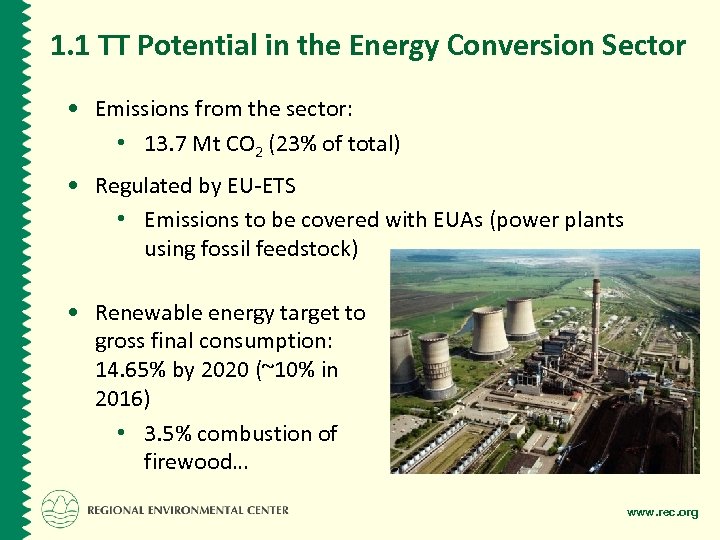 1. 1 TT Potential in the Energy Conversion Sector • Emissions from the sector: • 13. 7 Mt CO 2 (23% of total) • Regulated by EU-ETS • Emissions to be covered with EUAs (power plants using fossil feedstock) • Renewable energy target to gross final consumption: 14. 65% by 2020 (~10% in 2016) • 3. 5% combustion of firewood… www. rec. org
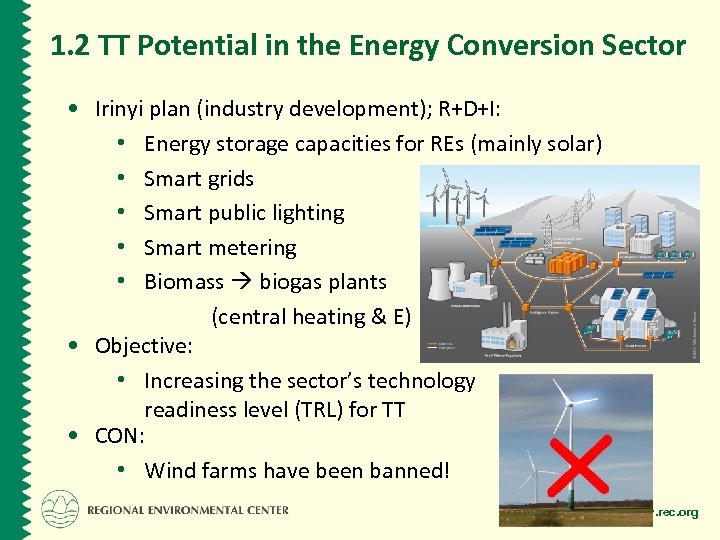 1. 2 TT Potential in the Energy Conversion Sector • Irinyi plan (industry development); R+D+I: • Energy storage capacities for REs (mainly solar) • Smart grids • Smart public lighting • Smart metering • Biomass biogas plants (central heating & E) • Objective: • Increasing the sector’s technology readiness level (TRL) for TT • CON: • Wind farms have been banned! www. rec. org
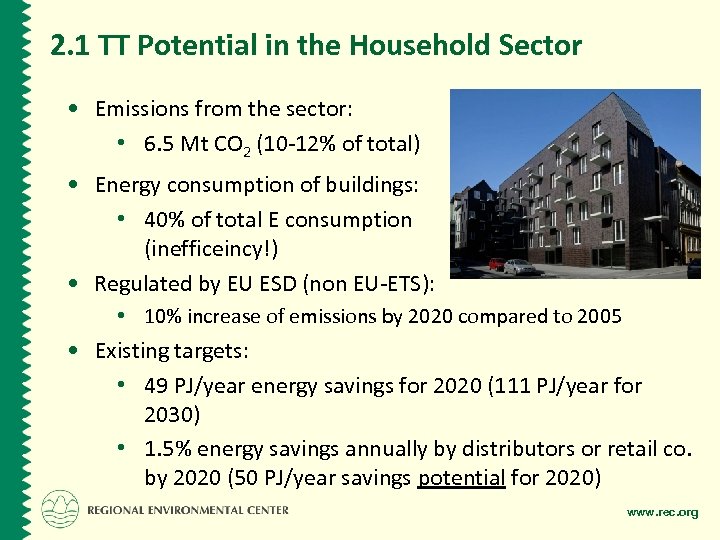 2. 1 TT Potential in the Household Sector • Emissions from the sector: • 6. 5 Mt CO 2 (10 -12% of total) • Energy consumption of buildings: • 40% of total E consumption (inefficeincy!) • Regulated by EU ESD (non EU-ETS): • 10% increase of emissions by 2020 compared to 2005 • Existing targets: • 49 PJ/year energy savings for 2020 (111 PJ/year for 2030) • 1. 5% energy savings annually by distributors or retail co. by 2020 (50 PJ/year savings potential for 2020) www. rec. org
 2. 2 TT Potential in the Household Sector • Family Homemaking Support Scheme (FHSS): • Boosting new housing construction by 35 -40% • New buildings (7/2006 decree, 2010/31/EU): • doors, walls and ceilings have to save 40% more energy than current appliances by 2020 nearzero energy efficiency public and private buildings partly achieved by using RE • TT potential in energy efficient housing appliances • Weak implementation of the 1. 5% annual energy savings rule www. rec. org
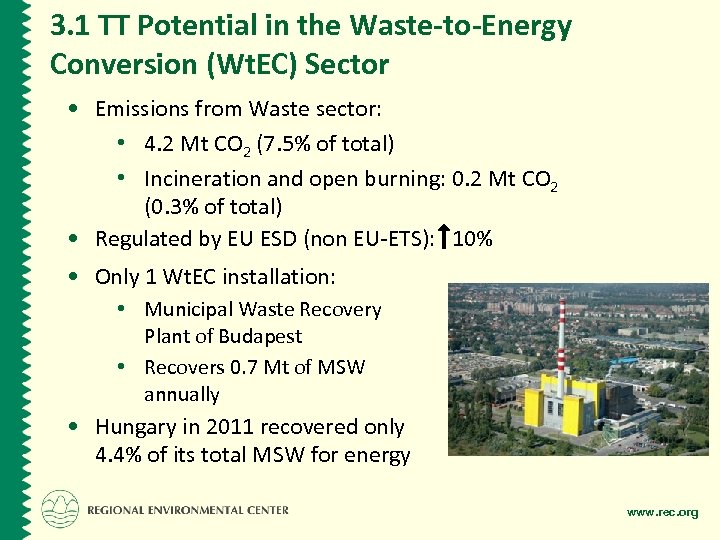 3. 1 TT Potential in the Waste-to-Energy Conversion (Wt. EC) Sector • Emissions from Waste sector: • 4. 2 Mt CO 2 (7. 5% of total) • Incineration and open burning: 0. 2 Mt CO 2 (0. 3% of total) • Regulated by EU ESD (non EU-ETS): 10% • Only 1 Wt. EC installation: • Municipal Waste Recovery Plant of Budapest • Recovers 0. 7 Mt of MSW annually • Hungary in 2011 recovered only 4. 4% of its total MSW for energy www. rec. org
 3. 2 TT Potential in the Waste-to-Energy Conversion (Wt. EC) Sector • The National Waste Management Public Service Action Plan: • To reduce waste disposal from the current 50% 10% by 2030 increase Wt. EC rate • Irinyi Plan (R+D+I; TT potential): • Pyrolysis for the recovery of food and livestock waste • Gasification of solid wastes for energy • A second Wt. EC to be built with a 0. 25 Mt/year of MSW recovery capacity with an additional 60 000 tons/year sewage sludge combustion potential www. rec. org
 4. 1 TT Potential at Municipality Level • Emissions of municipalities: • Collapse of heavy industry in ’ 90 s & heating modernization emission reduction • Transport is the largest polluter: 27% increase by 2014 to 1990’s levels (3% higher than EU ave. ) • Housing sector is also a noticable emitter • Each Hungarian municipality has to develop its environmental program; tasks and regulations on: • • air pollution abatement energy management waste and wastewater treatment public transportation and traffic www. rec. org
 4. 2 TT Potential at Municipality Level • European Covenant of Mayors for Climate & Energy (CMCE): • 31 Hungarian member municipalities with 20% to 30% GHG reduction targets by 2020 • Elaboration of Sustainable Energy Action Plan (SEAP), now called Sustainable Energy and Climate Action Plan (SECAP) helping to penetrate low carbon technologies • Association of Climate Friendly Municipalities: • 33 member municipalities • Focusing on the need for horizontal climate adaptation actions www. rec. org
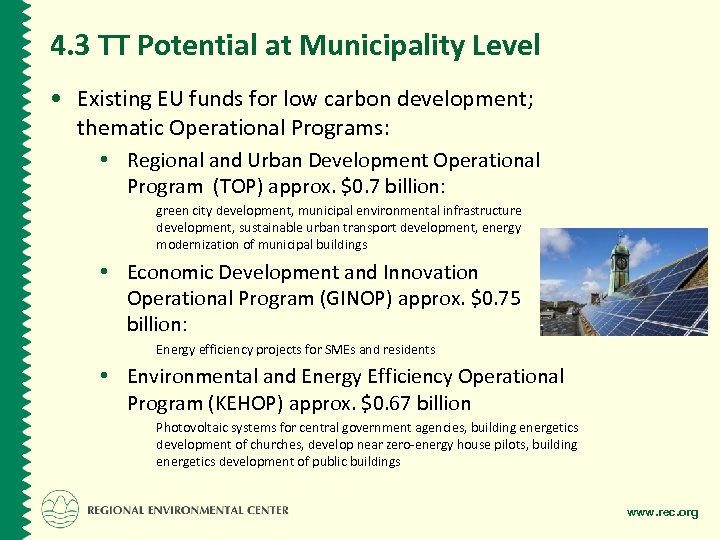 4. 3 TT Potential at Municipality Level • Existing EU funds for low carbon development; thematic Operational Programs: • Regional and Urban Development Operational Program (TOP) approx. $0. 7 billion: green city development, municipal environmental infrastructure development, sustainable urban transport development, energy modernization of municipal buildings • Economic Development and Innovation Operational Program (GINOP) approx. $0. 75 billion: Energy efficiency projects for SMEs and residents • Environmental and Energy Efficiency Operational Program (KEHOP) approx. $0. 67 billion Photovoltaic systems for central government agencies, building energetics development of churches, develop near zero-energy house pilots, building energetics development of public buildings www. rec. org
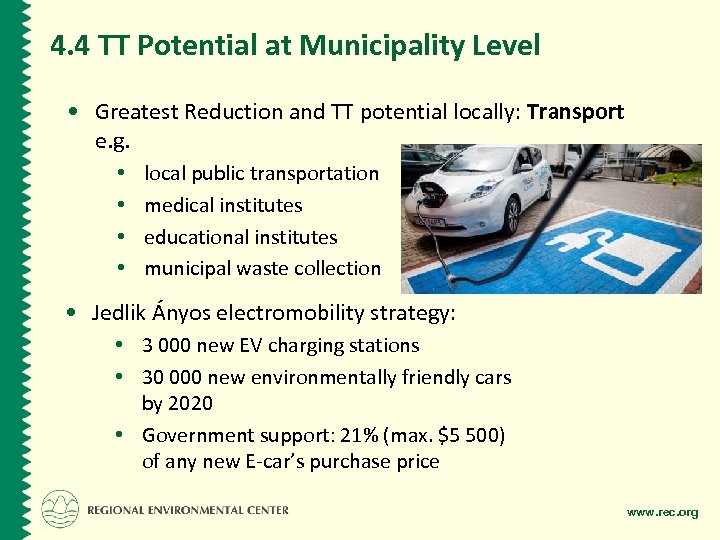 4. 4 TT Potential at Municipality Level • Greatest Reduction and TT potential locally: Transport e. g. • • local public transportation medical institutes educational institutes municipal waste collection • Jedlik Ányos electromobility strategy: • 3 000 new EV charging stations • 30 000 new environmentally friendly cars by 2020 • Government support: 21% (max. $5 500) of any new E-car’s purchase price www. rec. org
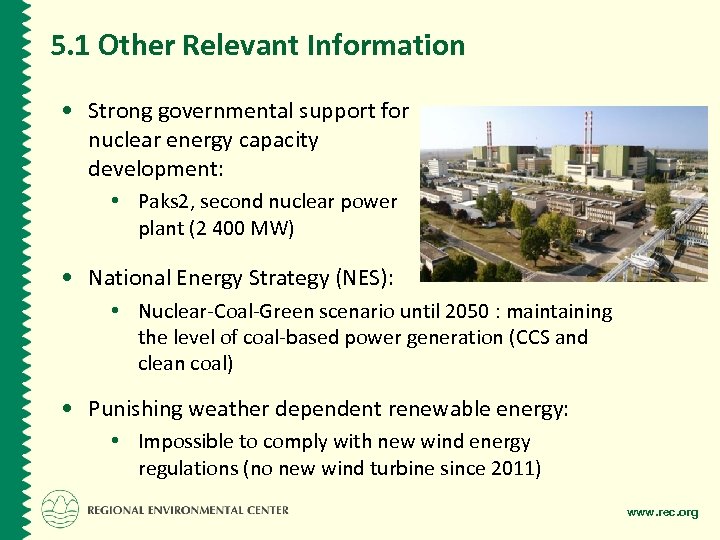 5. 1 Other Relevant Information • Strong governmental support for nuclear energy capacity development: • Paks 2, second nuclear power plant (2 400 MW) • National Energy Strategy (NES): • Nuclear-Coal-Green scenario until 2050 : maintaining the level of coal-based power generation (CCS and clean coal) • Punishing weather dependent renewable energy: • Impossible to comply with new wind energy regulations (no new wind turbine since 2011) www. rec. org
 5. 2 Other Relevant Information • Green Economy Financing System (cca. $18. 5 M) and Economy Greening System (cca. $20 M) funds are also available for residents and investors to carry out energy efficiency projects: • Backed by revenues from selling EUAs • Hungarian Investment Promotion Agency (HIPA) • Business incubation for projects of foreign investors • National Research, Development and Innovation Office (NKFI): • Managing R+D+I & International Technology Transfer www. rec. org
 Thank you for your kind attention! Email: miklos. szekely@novenergia. com www. rec. org