


 Скачать презентацию Potency and Safety Standards for Plasma Derivatives Mei-ying
c0ee7e757422930df818e50ae7f2351f.ppt
- Количество слайдов: 27
 Potency and Safety Standards for Plasma Derivatives Mei-ying W Yu, Ph. D DH/OBRR/CBER/FDA 90 th Blood Products Advisory Committee August 16, 2007
 Outline • Introduction • Potency Standards for Clotting Factors • Potency and Safety Standards for Immune Globulin and Albumin Products • Safety Standards for In-Process Control • Standards under Development
 Introduction (I) • Division of Hematology (DH) in CBER/FDA has primary responsibility for the scientific evaluation of manufactured biologic products derived from blood or plasma and their analogs from recombinant DNA technology. • To ensure their safety and effectiveness, DH personnel have actively participated in developing and establishing CBER/FDA, WHO global potency and safety standards through close collaboration with WHO collaborative centers (e. g. , NIBSC and PEI), EDQM (Ph Eur), and industry. (NIBSC: National Institute for Biological Standards and Control; PEI: Paul Ehrlich Institute; EDQM: European Directorate for the Quality of Medicines and Healthcare; Ph Eur: Pharmacopoeia European)
 Introduction (II) • CBER/FDA standards are available to IND sponsors or licensed manufacturers – for setting minimum potency requirements or maximum limits of final-container products – for lot release testing of final-container products – For in-process control testing
 Potency Standards for Clotting Factors
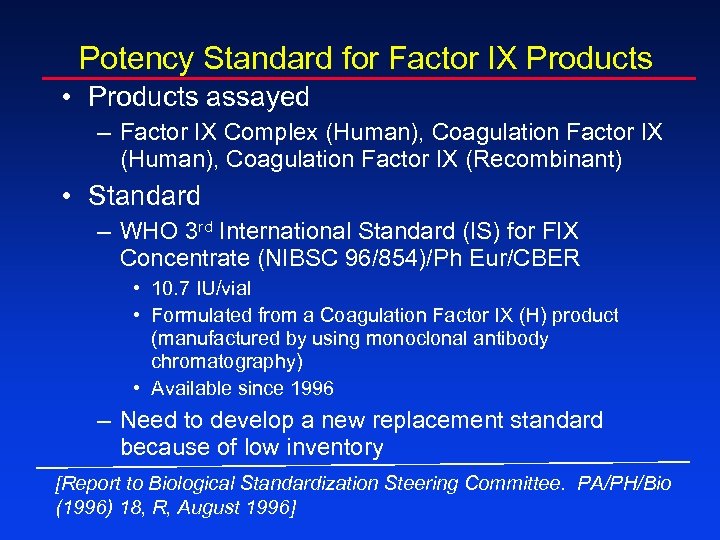 Potency Standard for Factor IX Products • Products assayed – Factor IX Complex (Human), Coagulation Factor IX (Recombinant) • Standard – WHO 3 rd International Standard (IS) for FIX Concentrate (NIBSC 96/854)/Ph Eur/CBER • 10. 7 IU/vial • Formulated from a Coagulation Factor IX (H) product (manufactured by using monoclonal antibody chromatography) • Available since 1996 – Need to develop a new replacement standard because of low inventory [Report to Biological Standardization Steering Committee. PA/PH/Bio (1996) 18, R, August 1996]
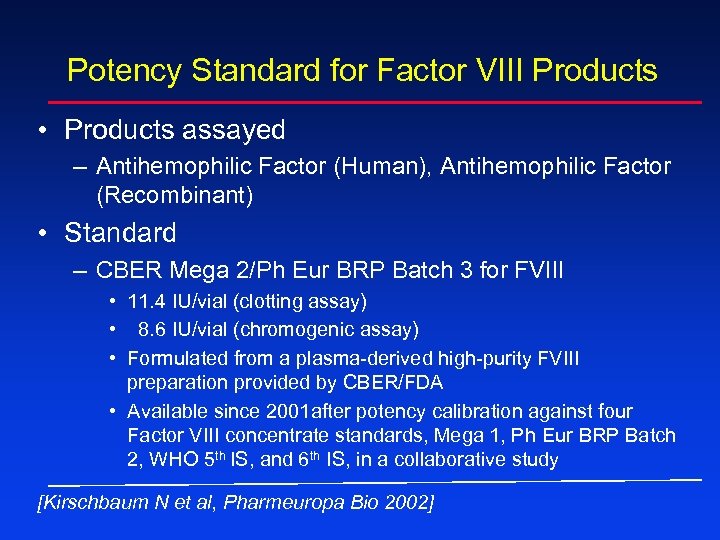 Potency Standard for Factor VIII Products • Products assayed – Antihemophilic Factor (Human), Antihemophilic Factor (Recombinant) • Standard – CBER Mega 2/Ph Eur BRP Batch 3 for FVIII • 11. 4 IU/vial (clotting assay) • 8. 6 IU/vial (chromogenic assay) • Formulated from a plasma-derived high-purity FVIII preparation provided by CBER/FDA • Available since 2001 after potency calibration against four Factor VIII concentrate standards, Mega 1, Ph Eur BRP Batch 2, WHO 5 th IS, and 6 th IS, in a collaborative study [Kirschbaum N et al, Pharmeuropa Bio 2002]
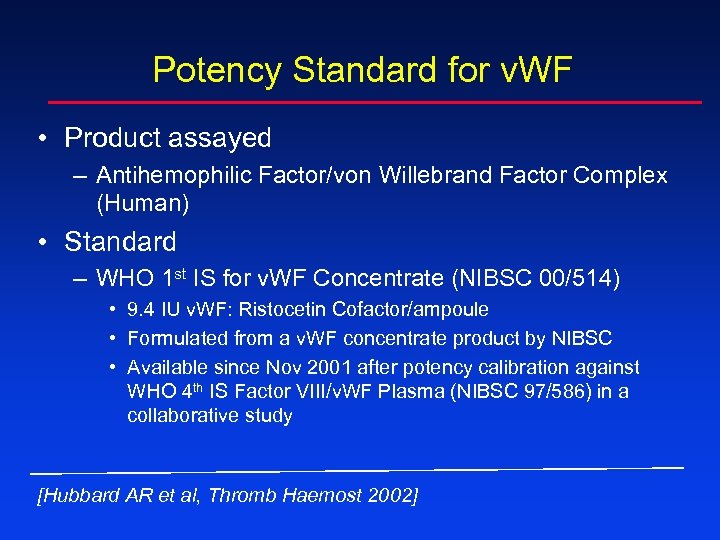 Potency Standard for v. WF • Product assayed – Antihemophilic Factor/von Willebrand Factor Complex (Human) • Standard – WHO 1 st IS for v. WF Concentrate (NIBSC 00/514) • 9. 4 IU v. WF: Ristocetin Cofactor/ampoule • Formulated from a v. WF concentrate product by NIBSC • Available since Nov 2001 after potency calibration against WHO 4 th IS Factor VIII/v. WF Plasma (NIBSC 97/586) in a collaborative study [Hubbard AR et al, Thromb Haemost 2002]
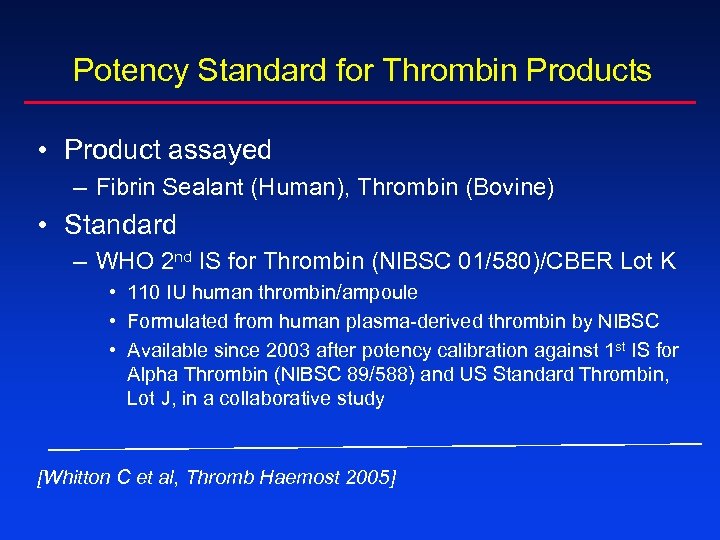 Potency Standard for Thrombin Products • Product assayed – Fibrin Sealant (Human), Thrombin (Bovine) • Standard – WHO 2 nd IS for Thrombin (NIBSC 01/580)/CBER Lot K • 110 IU human thrombin/ampoule • Formulated from human plasma-derived thrombin by NIBSC • Available since 2003 after potency calibration against 1 st IS for Alpha Thrombin (NIBSC 89/588) and US Standard Thrombin, Lot J, in a collaborative study [Whitton C et al, Thromb Haemost 2005]
 Potency and Safety Standards for Immune Globulins and Albumin
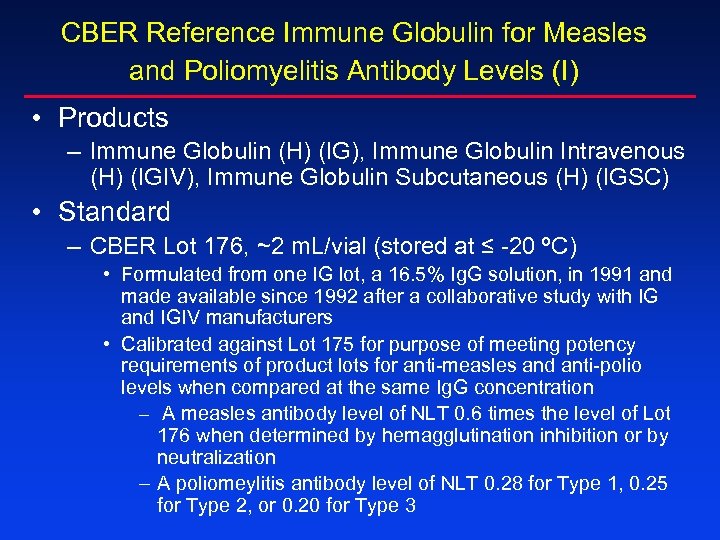 CBER Reference Immune Globulin for Measles and Poliomyelitis Antibody Levels (I) • Products – Immune Globulin (H) (IG), Immune Globulin Intravenous (H) (IGIV), Immune Globulin Subcutaneous (H) (IGSC) • Standard – CBER Lot 176, ~2 m. L/vial (stored at ≤ -20 ºC) • Formulated from one IG lot, a 16. 5% Ig. G solution, in 1991 and made available since 1992 after a collaborative study with IG and IGIV manufacturers • Calibrated against Lot 175 for purpose of meeting potency requirements of product lots for anti-measles and anti-polio levels when compared at the same Ig. G concentration – A measles antibody level of NLT 0. 6 times the level of Lot 176 when determined by hemagglutination inhibition or by neutralization – A poliomeylitis antibody level of NLT 0. 28 for Type 1, 0. 25 for Type 2, or 0. 20 for Type 3
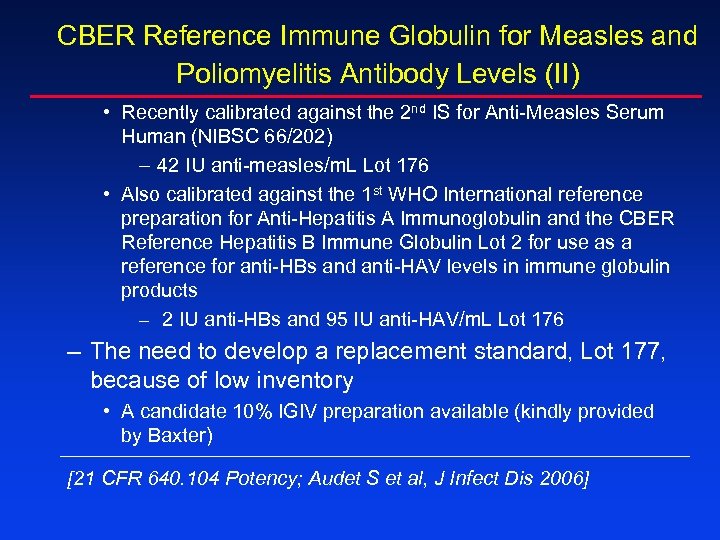 CBER Reference Immune Globulin for Measles and Poliomyelitis Antibody Levels (II) • Recently calibrated against the 2 nd IS for Anti-Measles Serum Human (NIBSC 66/202) – 42 IU anti-measles/m. L Lot 176 • Also calibrated against the 1 st WHO International reference preparation for Anti-Hepatitis A Immunoglobulin and the CBER Reference Hepatitis B Immune Globulin Lot 2 for use as a reference for anti-HBs and anti-HAV levels in immune globulin products – 2 IU anti-HBs and 95 IU anti-HAV/m. L Lot 176 – The need to develop a replacement standard, Lot 177, because of low inventory • A candidate 10% IGIV preparation available (kindly provided by Baxter) [21 CFR 640. 104 Potency; Audet S et al, J Infect Dis 2006]
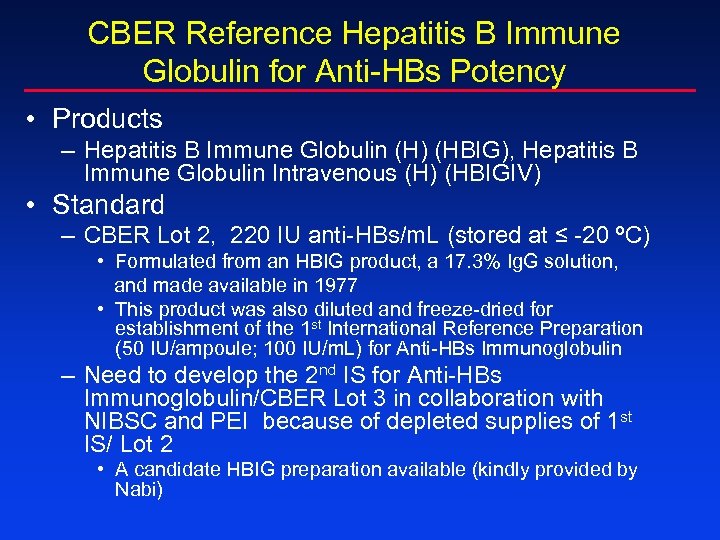 CBER Reference Hepatitis B Immune Globulin for Anti-HBs Potency • Products – Hepatitis B Immune Globulin (H) (HBIG), Hepatitis B Immune Globulin Intravenous (H) (HBIGIV) • Standard – CBER Lot 2, 220 IU anti-HBs/m. L (stored at ≤ -20 ºC) • Formulated from an HBIG product, a 17. 3% Ig. G solution, and made available in 1977 • This product was also diluted and freeze-dried for establishment of the 1 st International Reference Preparation (50 IU/ampoule; 100 IU/m. L) for Anti-HBs Immunoglobulin – Need to develop the 2 nd IS for Anti-HBs Immunoglobulin/CBER Lot 3 in collaboration with NIBSC and PEI because of depleted supplies of 1 st IS/ Lot 2 • A candidate HBIG preparation available (kindly provided by Nabi)
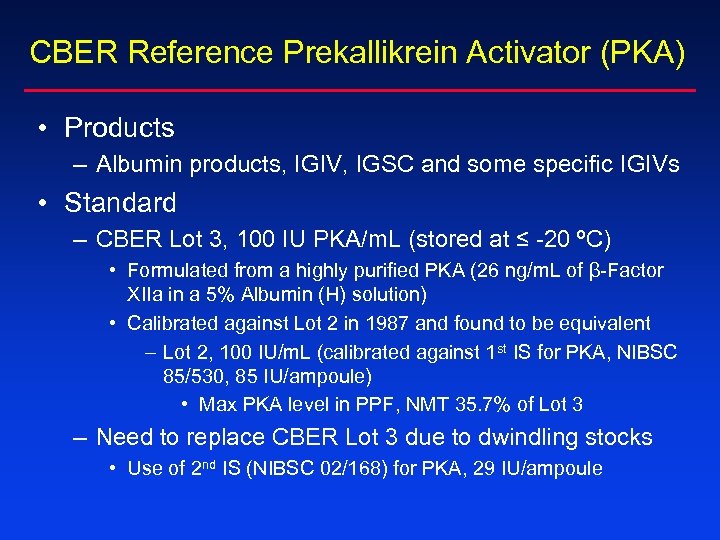 CBER Reference Prekallikrein Activator (PKA) • Products – Albumin products, IGIV, IGSC and some specific IGIVs • Standard – CBER Lot 3, 100 IU PKA/m. L (stored at ≤ -20 ºC) • Formulated from a highly purified PKA (26 ng/m. L of β-Factor XIIa in a 5% Albumin (H) solution) • Calibrated against Lot 2 in 1987 and found to be equivalent – Lot 2, 100 IU/m. L (calibrated against 1 st IS for PKA, NIBSC 85/530, 85 IU/ampoule) • Max PKA level in PPF, NMT 35. 7% of Lot 3 – Need to replace CBER Lot 3 due to dwindling stocks • Use of 2 nd IS (NIBSC 02/168) for PKA, 29 IU/ampoule
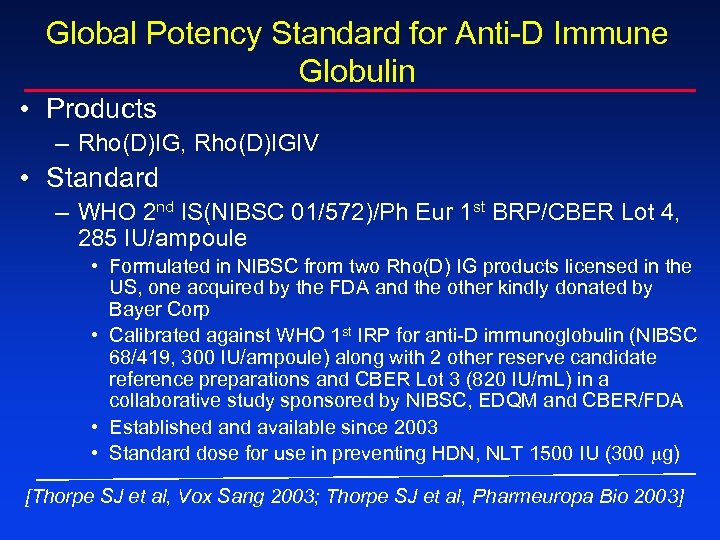 Global Potency Standard for Anti-D Immune Globulin • Products – Rho(D)IG, Rho(D)IGIV • Standard – WHO 2 nd IS(NIBSC 01/572)/Ph Eur 1 st BRP/CBER Lot 4, 285 IU/ampoule • Formulated in NIBSC from two Rho(D) IG products licensed in the US, one acquired by the FDA and the other kindly donated by Bayer Corp • Calibrated against WHO 1 st IRP for anti-D immunoglobulin (NIBSC 68/419, 300 IU/ampoule) along with 2 other reserve candidate reference preparations and CBER Lot 3 (820 IU/m. L) in a collaborative study sponsored by NIBSC, EDQM and CBER/FDA • Established and available since 2003 • Standard dose for use in preventing HDN, NLT 1500 IU (300 g) [Thorpe SJ et al, Vox Sang 2003; Thorpe SJ et al, Pharmeuropa Bio 2003]
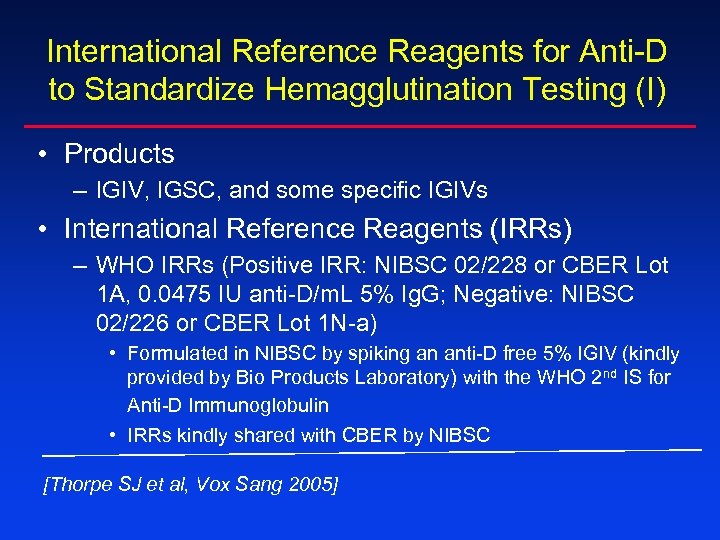 International Reference Reagents for Anti-D to Standardize Hemagglutination Testing (I) • Products – IGIV, IGSC, and some specific IGIVs • International Reference Reagents (IRRs) – WHO IRRs (Positive IRR: NIBSC 02/228 or CBER Lot 1 A, 0. 0475 IU anti-D/m. L 5% Ig. G; Negative: NIBSC 02/226 or CBER Lot 1 N-a) • Formulated in NIBSC by spiking an anti-D free 5% IGIV (kindly provided by Bio Products Laboratory) with the WHO 2 nd IS for Anti-D Immunoglobulin • IRRs kindly shared with CBER by NIBSC [Thorpe SJ et al, Vox Sang 2005]
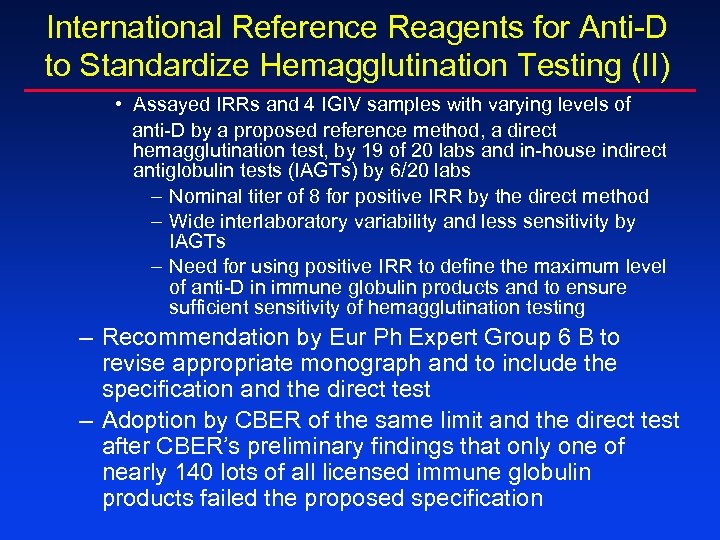 International Reference Reagents for Anti-D to Standardize Hemagglutination Testing (II) • Assayed IRRs and 4 IGIV samples with varying levels of anti-D by a proposed reference method, a direct hemagglutination test, by 19 of 20 labs and in-house indirect antiglobulin tests (IAGTs) by 6/20 labs – Nominal titer of 8 for positive IRR by the direct method – Wide interlaboratory variability and less sensitivity by IAGTs – Need for using positive IRR to define the maximum level of anti-D in immune globulin products and to ensure sufficient sensitivity of hemagglutination testing – Recommendation by Eur Ph Expert Group 6 B to revise appropriate monograph and to include the specification and the direct test – Adoption by CBER of the same limit and the direct test after CBER’s preliminary findings that only one of nearly 140 lots of all licensed immune globulin products failed the proposed specification
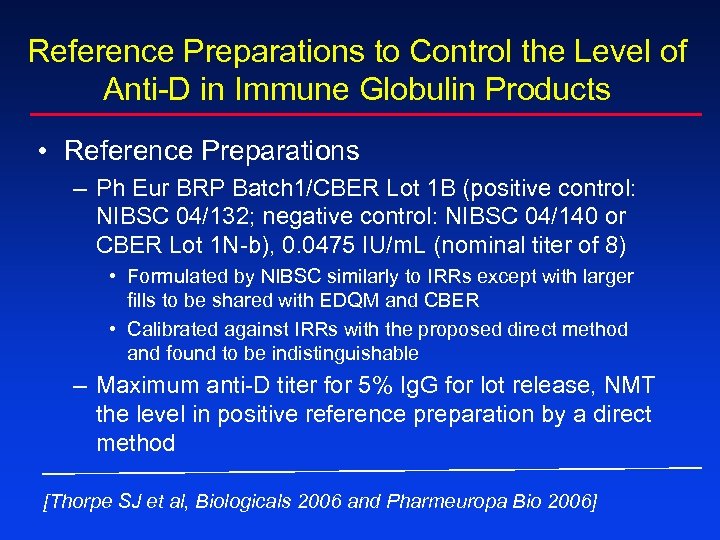 Reference Preparations to Control the Level of Anti-D in Immune Globulin Products • Reference Preparations – Ph Eur BRP Batch 1/CBER Lot 1 B (positive control: NIBSC 04/132; negative control: NIBSC 04/140 or CBER Lot 1 N-b), 0. 0475 IU/m. L (nominal titer of 8) • Formulated by NIBSC similarly to IRRs except with larger fills to be shared with EDQM and CBER • Calibrated against IRRs with the proposed direct method and found to be indistinguishable – Maximum anti-D titer for 5% Ig. G for lot release, NMT the level in positive reference preparation by a direct method [Thorpe SJ et al, Biologicals 2006 and Pharmeuropa Bio 2006]
 Safety Standards for In-Process Control
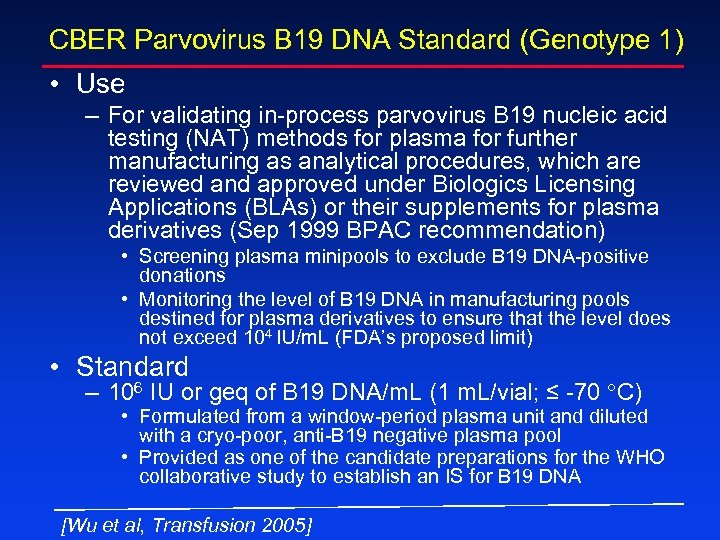 CBER Parvovirus B 19 DNA Standard (Genotype 1) • Use – For validating in-process parvovirus B 19 nucleic acid testing (NAT) methods for plasma for further manufacturing as analytical procedures, which are reviewed and approved under Biologics Licensing Applications (BLAs) or their supplements for plasma derivatives (Sep 1999 BPAC recommendation) • Screening plasma minipools to exclude B 19 DNA-positive donations • Monitoring the level of B 19 DNA in manufacturing pools destined for plasma derivatives to ensure that the level does not exceed 104 IU/m. L (FDA’s proposed limit) • Standard – 106 IU or geq of B 19 DNA/m. L (1 m. L/vial; ≤ -70 C) • Formulated from a window-period plasma unit and diluted with a cryo-poor, anti-B 19 negative plasma pool • Provided as one of the candidate preparations for the WHO collaborative study to establish an IS for B 19 DNA [Wu et al, Transfusion 2005]
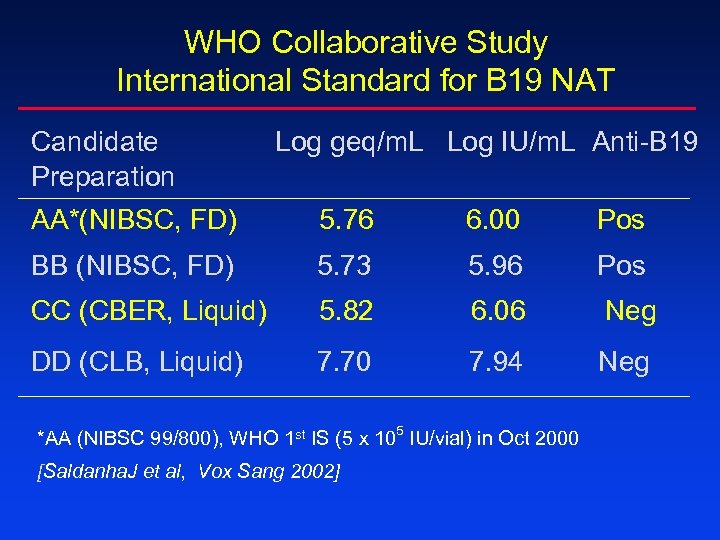 WHO Collaborative Study International Standard for B 19 NAT Candidate Preparation Log geq/m. L Log IU/m. L Anti-B 19 AA*(NIBSC, FD) 5. 76 6. 00 Pos BB (NIBSC, FD) 5. 73 5. 96 Pos CC (CBER, Liquid) 5. 82 6. 06 Neg DD (CLB, Liquid) 7. 70 7. 94 Neg *AA (NIBSC 99/800), WHO 1 st IS (5 x 10⁵ IU/vial) in Oct 2000 [Saldanha. J et al, Vox Sang 2002]
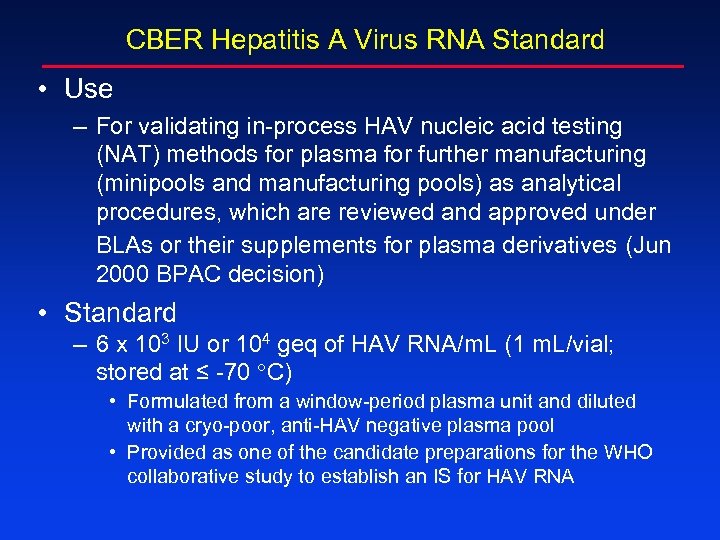 CBER Hepatitis A Virus RNA Standard • Use – For validating in-process HAV nucleic acid testing (NAT) methods for plasma for further manufacturing (minipools and manufacturing pools) as analytical procedures, which are reviewed and approved under BLAs or their supplements for plasma derivatives (Jun 2000 BPAC decision) • Standard – 6 x 10³ IU or 104 geq of HAV RNA/m. L (1 m. L/vial; stored at ≤ -70 C) • Formulated from a window-period plasma unit and diluted with a cryo-poor, anti-HAV negative plasma pool • Provided as one of the candidate preparations for the WHO collaborative study to establish an IS for HAV RNA
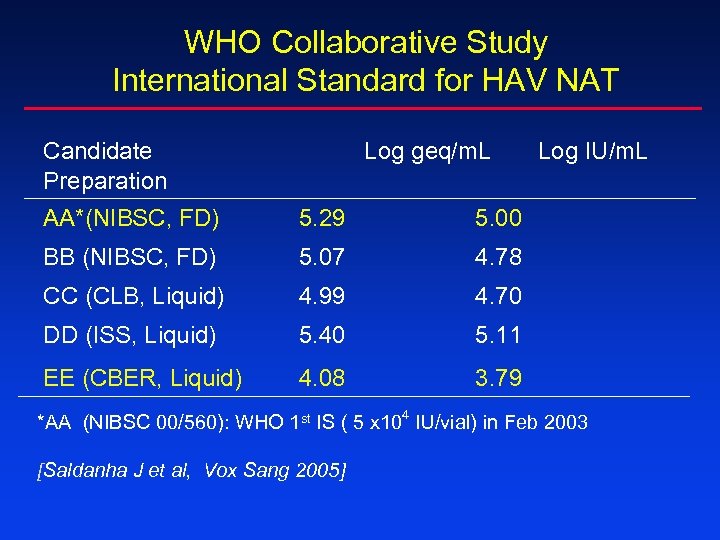 WHO Collaborative Study International Standard for HAV NAT Candidate Preparation Log geq/m. L AA*(NIBSC, FD) 5. 29 5. 00 BB (NIBSC, FD) 5. 07 4. 78 CC (CLB, Liquid) 4. 99 4. 70 DD (ISS, Liquid) 5. 40 5. 11 EE (CBER, Liquid) 4. 08 Log IU/m. L 3. 79 *AA (NIBSC 00/560): WHO 1 st IS ( 5 x 10⁴ IU/vial) in Feb 2003 [Saldanha J et al, Vox Sang 2005]
 Potency and Safety Standards Under Development
 Potency and Safety Standards under Development (I) 1. WHO 2 nd IS for Anti-HBs Immunoglobulin/CBER Lot 3, in collaboration with Dr. Morag Ferguson of NIBSC – A candidate 5% HBIG preparation available (kindly provided by Nabi Biopharmaceuticals) 2. CBER Reference Immune Globulin, Lot 177 – A candidate 10% IGIV preparation available (kindly provided by Baxter Bio. Science) 3. Global Reference Preparations for Anti-A and Anti-B Hemagglutinins to control their levels in immune globulin products and to standardize hemagglutination testing, in collaboration with Dr. Susan Thorpe of NIBSC and Dr. Marie-Emmanuelle Behr-Gross of EDQM – A candidate negative 5% IGIV preparation derived from type AB plasma donations available (Kindly provided by Baxter Bio. Science) – A candidate positive IGIV preparation is being formulated by Dr. Susan Thorpe
 Potency and Safety Standards under Development (II) 4. Parvovirus B 19 Genotype Panel containing all 3 B 19 genotypes, in collaboration with Dr. Sally Baylis of NIBSC – Need to detect all B 19 strains (recently classified into 3 genotypes because of genetic diversity) by B 19 NAT – High-titer, window-period donations of both genotypes 2 and 3 available (kindly provided by Baxter Bio. Science and Talecris Biotherapeutics to NIBSC and CBER) – Negative plasma donations totaling ~20 liters (not detectable by NAT for HIV, HCV, HBV, B 19, HAV, WNV as well as negative by EIA for anti-B 19 Ig. G) available (kindly provided by National Genetics Institute) • Formulation of a negative plasma pool used as a negative panel member and a diluent for viral stocks 5. WHO 4 th IS for Factor IX Concentrate, in collaboration with Dr. Elaine Gray of NIBSC
 Conclusion • DH personnel in CBER/FDA will continue active participation in developing biological standards when needed and in testing candidate materials, in collaboration with WHO collaborative centers, EDQM, and industry to ensure the safety and effectiveness of plasma-derived products and their analogs.