


 Скачать презентацию Poster 18 -019 Hôpital CORENTIN CELTON Institut national
4cae25e5dfadada34eb91c1cc2da3c7a.ppt
- Количество слайдов: 1
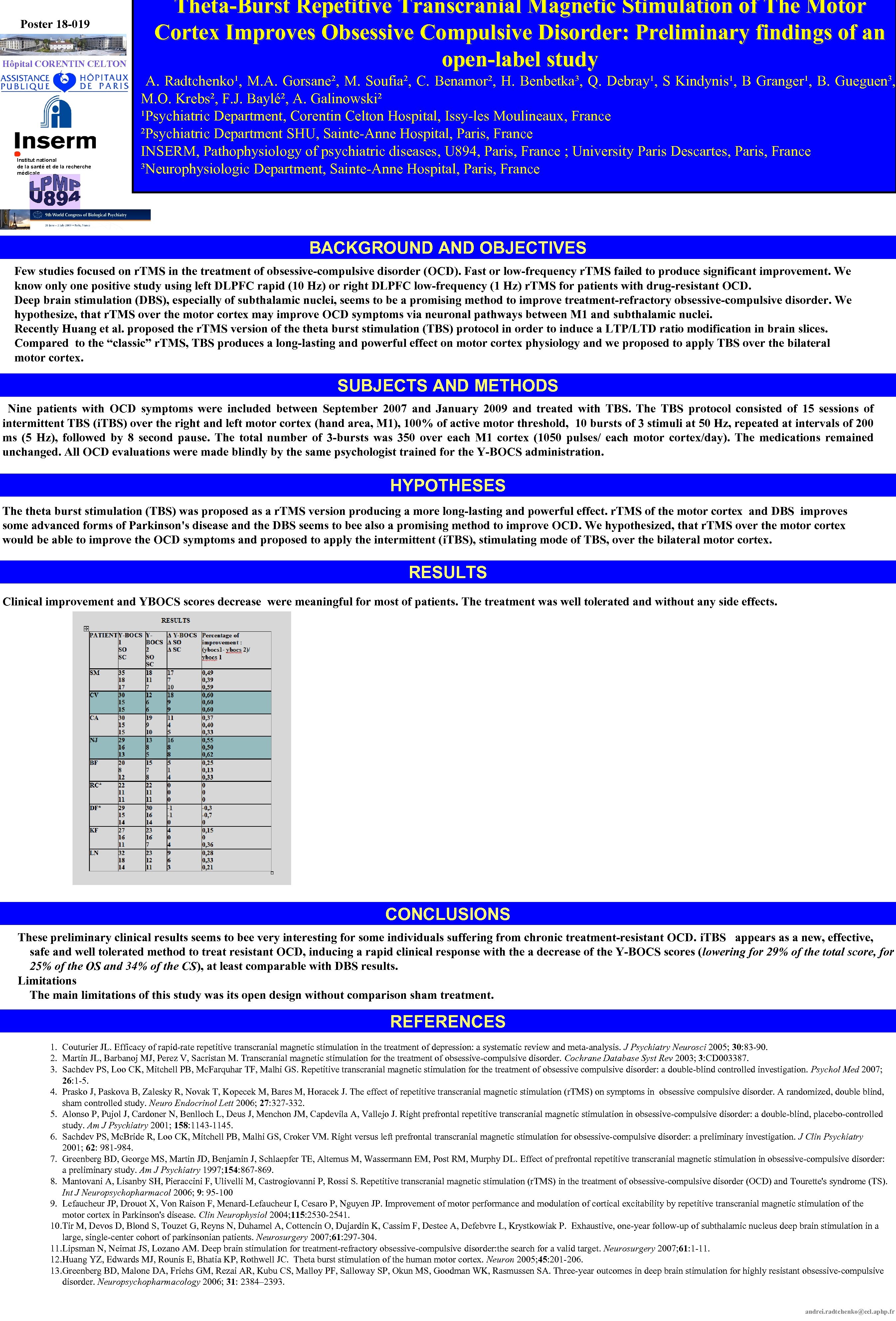 Poster 18 -019 Hôpital CORENTIN CELTON Institut national de la santé et de la recherche médicale Theta-Burst Repetitive Transcranial Magnetic Stimulation of The Motor Cortex Improves Obsessive Compulsive Disorder: Preliminary findings of an open-label study A. Radtchenko¹, M. A. Gorsane², M. Soufia², C. Benamor², H. Benbetka³, Q. Debray¹, S Kindynis¹, B Granger¹, B. Gueguen³, M. O. Krebs², F. J. Baylé², A. Galinowski² ¹Psychiatric Department, Corentin Celton Hospital, Issy-les Moulineaux, France ²Psychiatric Department SHU, Sainte-Anne Hospital, Paris, France INSERM, Pathophysiology of psychiatric diseases, U 894, Paris, France ; University Paris Descartes, Paris, France ³Neurophysiologic Department, Sainte-Anne Hospital, Paris, France BACKGROUND AND OBJECTIVES Few studies focused on r. TMS in the treatment of obsessive-compulsive disorder (OCD). Fast or low-frequency r. TMS failed to produce significant improvement. We know only one positive study using left DLPFC rapid (10 Hz) or right DLPFC low-frequency (1 Hz) r. TMS for patients with drug-resistant OCD. Deep brain stimulation (DBS), especially of subthalamic nuclei, seems to be a promising method to improve treatment-refractory obsessive-compulsive disorder. We hypothesize, that r. TMS over the motor cortex may improve OCD symptoms via neuronal pathways between M 1 and subthalamic nuclei. Recently Huang et al. proposed the r. TMS version of theta burst stimulation (TBS) protocol in order to induce a LTP/LTD ratio modification in brain slices. Compared to the “classic” r. TMS, TBS produces a long-lasting and powerful effect on motor cortex physiology and we proposed to apply TBS over the bilateral motor cortex. SUBJECTS AND METHODS Nine patients with OCD symptoms were included between September 2007 and January 2009 and treated with TBS. The TBS protocol consisted of 15 sessions of intermittent TBS (i. TBS) over the right and left motor cortex (hand area, M 1), 100% of active motor threshold, 10 bursts of 3 stimuli at 50 Hz, repeated at intervals of 200 ms (5 Hz), followed by 8 second pause. The total number of 3 -bursts was 350 over each M 1 cortex (1050 pulses/ each motor cortex/day). The medications remained unchanged. All OCD evaluations were made blindly by the same psychologist trained for the Y-BOCS administration. HYPOTHESES The theta burst stimulation (TBS) was proposed as a r. TMS version producing a more long-lasting and powerful effect. r. TMS of the motor cortex and DBS improves some advanced forms of Parkinson's disease and the DBS seems to bee also a promising method to improve OCD. We hypothesized, that r. TMS over the motor cortex would be able to improve the OCD symptoms and proposed to apply the intermittent (i. TBS), stimulating mode of TBS, over the bilateral motor cortex. RESULTS Clinical improvement and YBOCS scores decrease were meaningful for most of patients. The treatment was well tolerated and without any side effects. CONCLUSIONS These preliminary clinical results seems to bee very interesting for some individuals suffering from chronic treatment-resistant OCD. i. TBS appears as a new, effective, safe and well tolerated method to treat resistant OCD, inducing a rapid clinical response with the a decrease of the Y-BOCS scores (lowering for 29% of the total score, for 25% of the OS and 34% of the CS), at least comparable with DBS results. Limitations The main limitations of this study was its open design without comparison sham treatment. REFERENCES 1. Couturier JL. Efficacy of rapid-rate repetitive transcranial magnetic stimulation in the treatment of depression: a systematic review and meta-analysis. J Psychiatry Neurosci 2005; 30: 83 -90. 2. Martin JL, Barbanoj MJ, Perez V, Sacristan M. Transcranial magnetic stimulation for the treatment of obsessive-compulsive disorder. Cochrane Database Syst Rev 2003; 3: CD 003387. 3. Sachdev PS, Loo CK, Mitchell PB, Mc. Farquhar TF, Malhi GS. Repetitive transcranial magnetic stimulation for the treatment of obsessive compulsive disorder: a double-blind controlled investigation. Psychol Med 2007; 26: 1 -5. 4. Prasko J, Paskova B, Zalesky R, Novak T, Kopecek M, Bares M, Horacek J. The effect of repetitive transcranial magnetic stimulation (r. TMS) on symptoms in obsessive compulsive disorder. A randomized, double blind, sham controlled study. Neuro Endocrinol Lett 2006; 27: 327 -332. 5. Alonso P, Pujol J, Cardoner N, Benlloch L, Deus J, Menchon JM, Capdevila A, Vallejo J. Right prefrontal repetitive transcranial magnetic stimulation in obsessive-compulsive disorder: a double-blind, placebo-controlled study. Am J Psychiatry 2001; 158: 1143 -1145. 6. Sachdev PS, Mc. Bride R, Loo CK, Mitchell PB, Malhi GS, Croker VM. Right versus left prefrontal transcranial magnetic stimulation for obsessive-compulsive disorder: a preliminary investigation. J Clin Psychiatry 2001; 62: 981 -984. 7. Greenberg BD, George MS, Martin JD, Benjamin J, Schlaepfer TE, Altemus M, Wassermann EM, Post RM, Murphy DL. Effect of prefrontal repetitive transcranial magnetic stimulation in obsessive-compulsive disorder: a preliminary study. Am J Psychiatry 1997; 154: 867 -869. 8. Mantovani A, Lisanby SH, Pieraccini F, Ulivelli M, Castrogiovanni P, Rossi S. Repetitive transcranial magnetic stimulation (r. TMS) in the treatment of obsessive-compulsive disorder (OCD) and Tourette's syndrome (TS). Int J Neuropsychopharmacol 2006; 9: 95 -100 9. Lefaucheur JP, Drouot X, Von Raison F, Menard-Lefaucheur I, Cesaro P, Nguyen JP. Improvement of motor performance and modulation of cortical excitability by repetitive transcranial magnetic stimulation of the motor cortex in Parkinson's disease. Clin Neurophysiol 2004; 115: 2530 -2541. 10. Tir M, Devos D, Blond S, Touzet G, Reyns N, Duhamel A, Cottencin O, Dujardin K, Cassim F, Destee A, Defebvre L, Krystkowiak P. Exhaustive, one-year follow-up of subthalamic nucleus deep brain stimulation in a large, single-center cohort of parkinsonian patients. Neurosurgery 2007; 61: 297 -304. 11. Lipsman N, Neimat JS, Lozano AM. Deep brain stimulation for treatment-refractory obsessive-compulsive disorder: the search for a valid target. Neurosurgery 2007; 61: 1 -11. 12. Huang YZ, Edwards MJ, Rounis E, Bhatia KP, Rothwell JC. Theta burst stimulation of the human motor cortex. Neuron 2005; 45: 201 -206. 13. Greenberg BD, Malone DA, Friehs GM, Rezai AR, Kubu CS, Malloy PF, Salloway SP, Okun MS, Goodman WK, Rasmussen SA. Three-year outcomes in deep brain stimulation for highly resistant obsessive-compulsive disorder. Neuropsychopharmacology 2006; 31: 2384– 2393. andrei. radtchenko@ccl. aphp. fr