


 Скачать презентацию Post War America Postwar Economic Anxieties
3e0a5d30a6df8efceff512f5a4adf007.ppt
- Количество слайдов: 128
 Post War America
 Postwar Economic Anxieties • Many worried that with the war over, the U. S. would sink back into another Great Depression. • Inflation shot up with the release of price controls, gross national product sank, and labor strikes swept the nation. • Congress passed the Taft-Hartley Act which outlawed “closed” shop (union membership was a prerequisite for employment), made unions liable for damages and required that union leaders take non-Communist oaths. • Operation Dixie--Labor tried to unionize southern textile and steel workers and failed
 • To forestall an economic downturn, the Democratic administration sold war factories and other government installations to private businesses cheaply • The Employment Act was passed in 1946, which made it government policy to “promote maximum employment, production, and purchasing power” • The Council of Economic Advisors would provide the president with data to make that policy a reality.
 GI Bill of Rights • It also passed the Servicemen’s Readjustment Act of 1944, better known as the GI Bill, which allowed all servicemen to have free college education once they returned from the war. • 2 million took advantage • Also allowed veterans to receive loans • This availability of funding helped with post war economic expansion
 The Long Economic Boom, 1950 -1970 • The middle class more than doubled while people now wanted two cars in every garage • Over 90% of American families owned a television. • Much of the prosperity of the 50 s and 60 s rested on defense spending military projects. (permanent war related economy) • Rapid growth in industries like aerospace, plastics, and electronics
 • Even though this new affluence did not touch everyone, it did touch many. 60%=middle class • Farmers upped their output tremendously due to new technology in fertilizers. The farming population shrank while production soared.
 The Smiling Sunbelt • Immigration also led to the growth of a fifteenstate region in the southern half of the U. S. • Immigrants came for more opportunities, such as in California’s electronics industry of the aerospace complexes of Texas and Florida. • Federal dollars poured into the Sunbelt (some $125 million) • Air-conditioning made southern living bearable
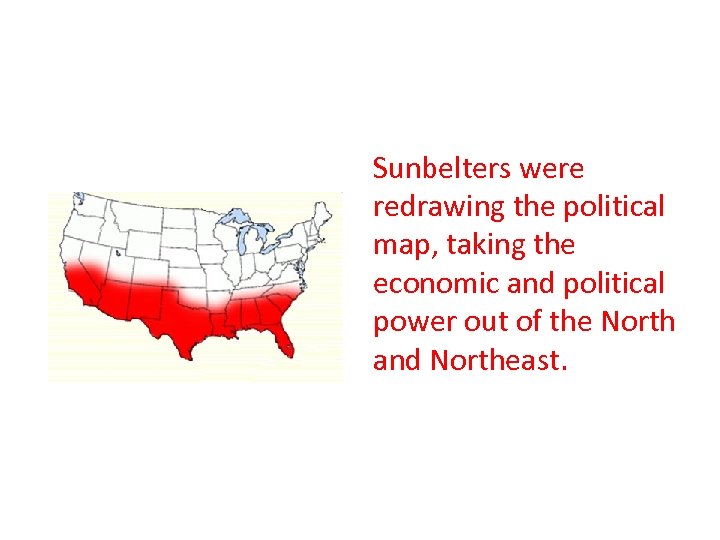 Sunbelters were redrawing the political map, taking the economic and political power out of the North and Northeast.
 White Flight • Whites in cities fled to the suburbs • Federal agencies such as the Federal Housing Authority & the Veteran’s Administration, provided loans • By 1960, 1/4 Americans lived in the suburbs. • Highway expansion connected the areas • Residents of inner cities often did not qualify for FHA loans as their financial status was considered to be too risky
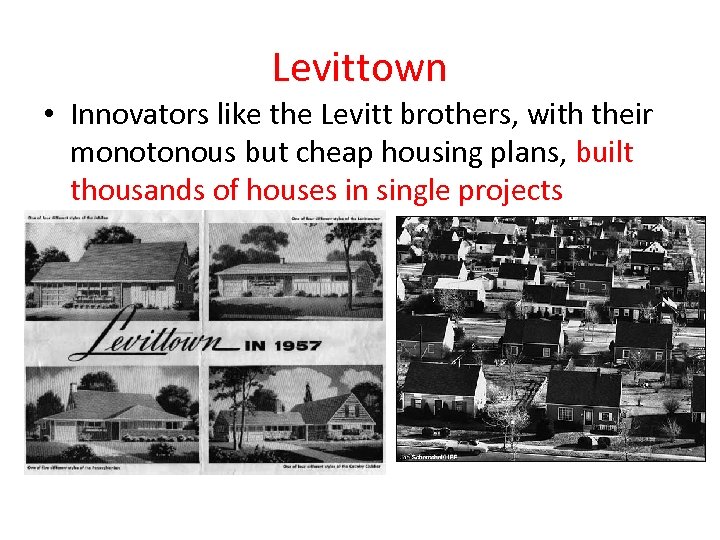 Levittown • Innovators like the Levitt brothers, with their monotonous but cheap housing plans, built thousands of houses in single projects
 The Postwar Baby Boom • After the war, many soldiers returned to their sweethearts and married them, then had babies, creating a “Baby Boom” that is still being felt today. • 50 million babies in 15 years (78 million? ) • As the children grew up collectively, they put strains on respective markets, such as manufacturers of baby products in the 1940 s and 50 s, teenage clothing designers in the 60 s, and the job market in the 70 s and 80 s. • In the future, they will place enormous strains on the Social Security system.
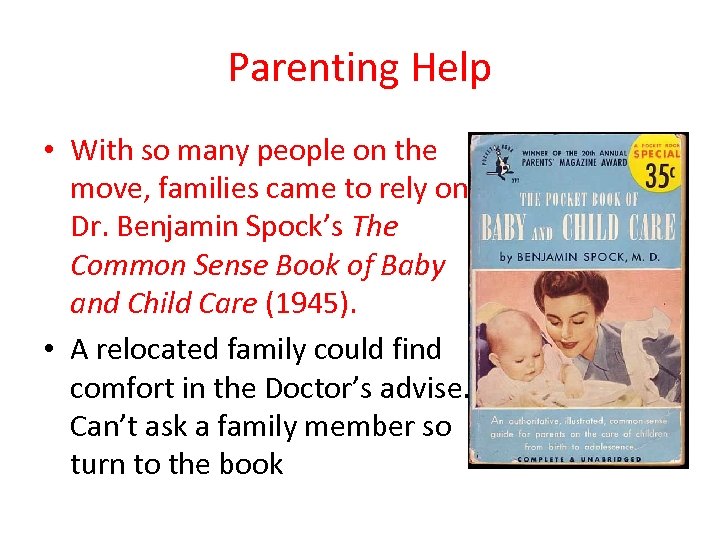 Parenting Help • With so many people on the move, families came to rely on Dr. Benjamin Spock’s The Common Sense Book of Baby and Child Care (1945). • A relocated family could find comfort in the Doctor’s advise. Can’t ask a family member so turn to the book
 Truman: the “Gutty” Man from Missouri • Truman at first approached his burdens with humility, but he gradually evolved into a confident, cocky politician. • His cabinet was made up of the old “Missouri gang, ” which composed of Truman’s friends from when he was a senator from Missouri. • Often, Truman would stick to a wrong decision just to prove his decisiveness and power of command. “If you can’t stand the heat…”
 Shaping the Postwar World • Meeting at Bretton Woods, New Hampshire, in 1944, the Western Allies established the International Monetary Fund (IMF) to encourage world trade by regulating the currency exchange rates. • Groups as UNESCO (U. N. Educational, Scientific, and Cultural Organization), FAO (Food and Agricultural Organization), and WHO (World Health Organization), bringing benefits to people all over the globe.
 United Nations • April 25, 1945 • The member nations drew up a charter similar to that of the old League of Nations, formed a Security Council to be headed by five permanent powers (China, USSR, Britain, France, and USA) that had veto powers, and was set up in NYC. • The Senate overwhelmingly approved the UN by a vote of 89 to 2.
 America Begins to Rearm • The 1947 National Security Act created the Department of Defense • Pentagon and headed by a new cabinet position, the secretary of defense, under which served civilian secretaries of the army, navy, and air force. • The National Security Act also formed the National Security Council (NSC) to advice the president on security matters • The Central Intelligence Agency (CIA) coordinated government’s foreign fact-gathering
 American Patriotism • The “Voice of America, ” a radio broadcast, began beaming in 1948 • Congress resurrected the military draft, (Selective Service System), which redefined many young people’s career choices and persuaded them to go to college.
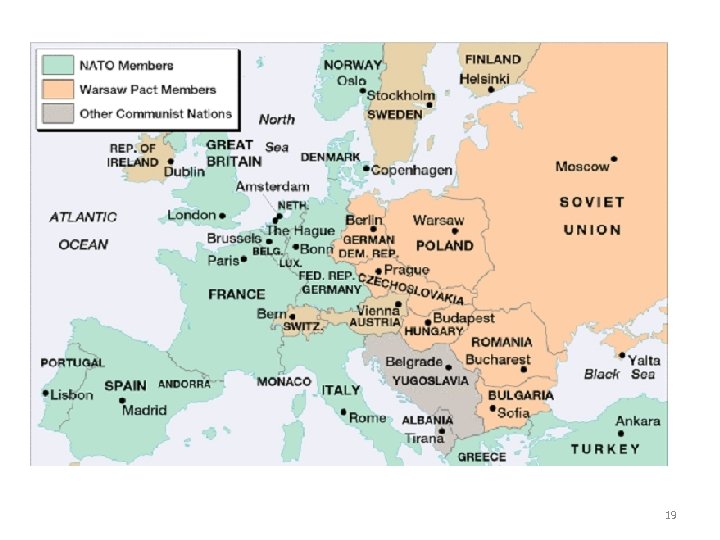
 North Atlantic Treaty Organization • The U. S. joined Britain, France, Belgium, the Netherlands, and Luxembourg (an attack on one member an attack on all), despite the U. S. ’s traditionally not involving itself in entangling alliances. • In response, the USSR formed the Warsaw Pact, its own alliance system. • NATO’s membership grew with the 1952 admissions of Greece and Turkey, and again when West Germany joined in 1955.
 19
19
 1948 election • Republicans : Thomas E. Dewey • Democrats: Truman again when war-hero Dwight D. Eisenhower refused to be chosen. • The Democratic Party split • Southern Democrats (“Dixiecrats”): J. Strom Thurmond on a State’s Rights Party ticket. • Progressive Party: Former vice president Henry A. Wallace
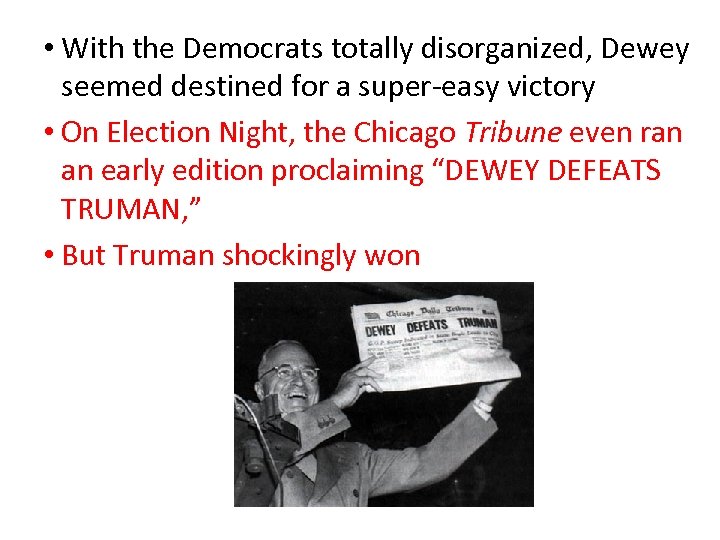 • With the Democrats totally disorganized, Dewey seemed destined for a super-easy victory • On Election Night, the Chicago Tribune even ran an early edition proclaiming “DEWEY DEFEATS TRUMAN, ” • But Truman shockingly won
 Allies Become Enemies • The war had forced the USSR and USA to forget their political differences temporarily • The US was still suspicious of Stalin (after all he had been allies at one time with Hitler) • Stalin was angry that the allies had delayed their attack on Germany • Stalin was also angry that the US had kept the atomic bomb a secret 22
 The UN Becomes a Battleground • The purpose of the United Nations was an international organization to settle disputes and maintain peace • 50 nations signed the UN charter on June 26, 1945 • The UN provided a forum that allowed the superpowers to spread their influence 23
 Stalin Broke His Promise • In February 1945 (Yalta Conference), Stalin promised to allow free elections in Poland • By July 1945, the Soviet Union had gone back on their word and was limiting democracies in many Eastern European nations • Stalin wanted to dominate Eastern Europe so there would not be any invasions coming from the west 24
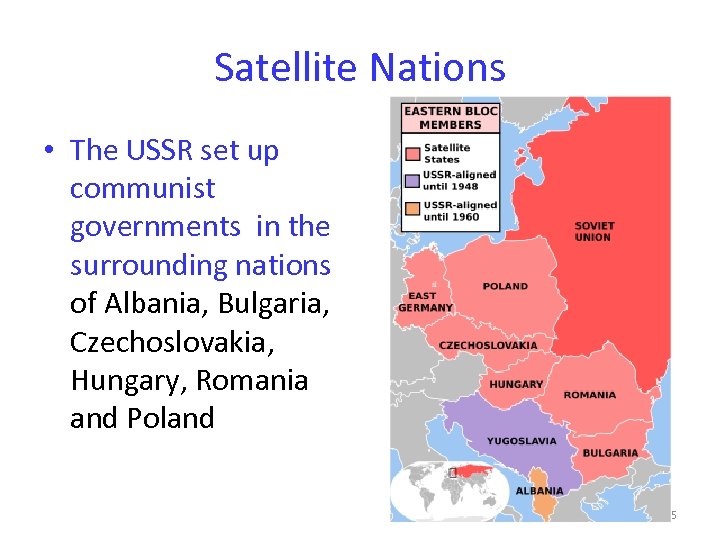 Satellite Nations • The USSR set up communist governments in the surrounding nations of Albania, Bulgaria, Czechoslovakia, Hungary, Romania and Poland 25
 The Containment Policy • By early 1946, President Truman had enough of communist expansion and made a new foreign policy (Diplomat George Kennan developed the concept of containment to deal with Russia) • His goal was to prevent communism from taking over any more countries • Europe became divided into 2 parts – Democratic Western Europe – Communist Eastern Europe 26
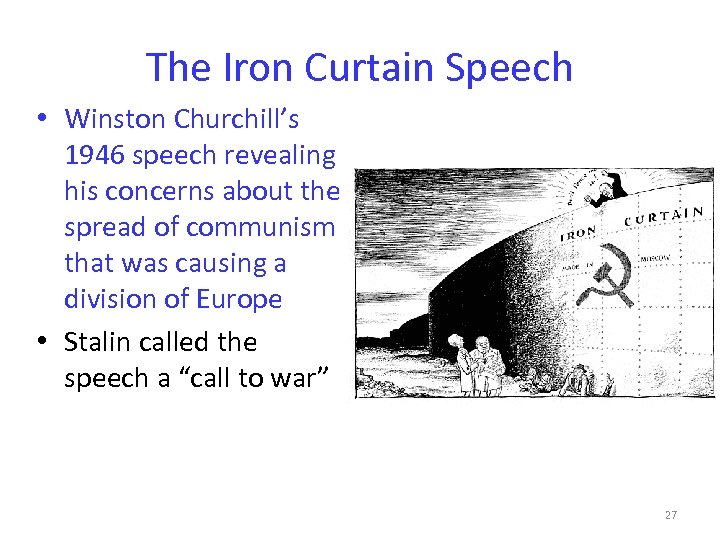 The Iron Curtain Speech • Winston Churchill’s 1946 speech revealing his concerns about the spread of communism that was causing a division of Europe • Stalin called the speech a “call to war” 27
 What is the Cold War? • Conflict between the US and Soviet Union • Neither nation directly confronted the other on a battlefield (no shots fired, a political conflict) • The tensions between these 2 nations were evident in their foreign policies and global interactions • It lasted from 1945 until the end of the Soviet Union in 1991 28
 The Truman Doctrine • Britain had been helping Greece and Turkey fight off soviet influence , but Britain was too damaged from the war to continue Truman asked Congress for $400 million to help these countries fight communism • The Truman Doctrine said, “it must be the policy of the US to support free peoples who are resisting subjugation by armed minorities or by outside pressures. ” • In other words…We will help nations that are trying to fight off communism 29
 The Marshall Plan • Western Europe was in shambles after the war • In June 1947, Secretary of State George Marshall proposed that the US provide aid to all European nations that needed it • It claimed to be a plan “not directed against any country or doctrine but against hunger, poverty and chaos” • The US sent $13 billion in aid to 16 nations 30
 31
31
 Germany Causes Problems • In 1948, Britain, France, and the US decided to combine their occupied zones in Germany into 1 nation • Their portions of Berlin were surrounded by the Soviet controlled area • In an attempt to cut the western nations off from their portions of Berlin, in June 1948, Stalin closed all highways and railways into West Berlin 32
 The Berlin Airlift • Residents in West Berlin only had enough supplies to last a few weeks • In an attempt to block the Soviet blockade, American and British planes dropped supplies into the western part of the city for 327 days • After 277, 000 flights, 2. 3 million tons of supplies were delivered to West Berlin • By May 1949, the Soviets lifted the blockade 33
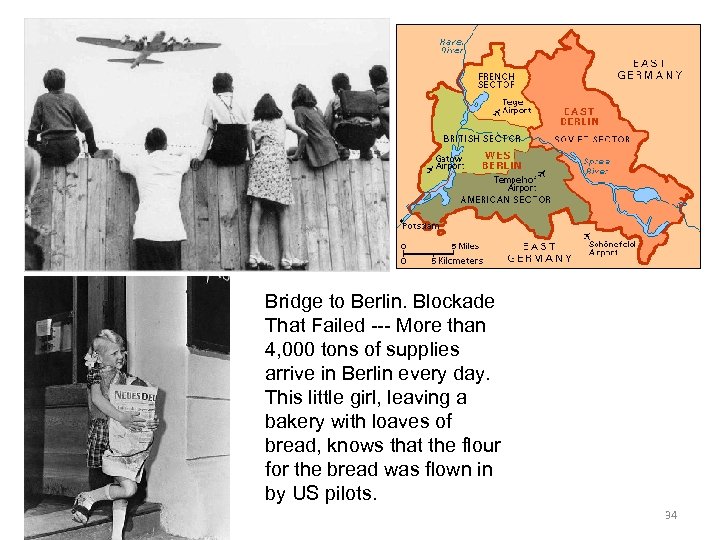 Bridge to Berlin. Blockade That Failed --- More than 4, 000 tons of supplies arrive in Berlin every day. This little girl, leaving a bakery with loaves of bread, knows that the flour for the bread was flown in by US pilots. 34
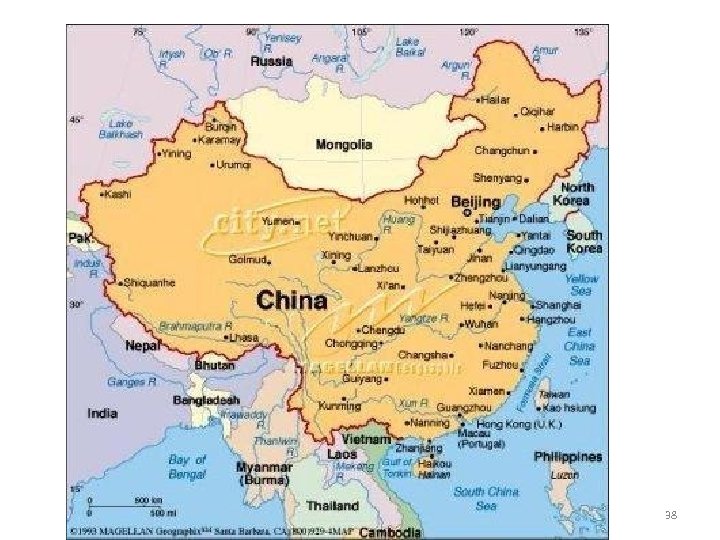
 China Falls to Communism • America had supported the Chinese nationalist government led by Chiang Kai-shek in their fight against communism ($3 billion in aid) • However, many nationalist government policies undermined the people’s support • The Communists, led by Mao Zedong, had the support of the large peasant population 35
 Nationalists Led by Chiang-Kaishek • Ruled in Southern and eastern China • Relied on aid from US • Struggled with inflation and a failing economy • Suffered from weak leadership and poor morals Communists Led by Mao Zedong • Ruled in northern China • Relied on financial aid from the Soviet Union • Attracted peasant support with promises of land reform • Benefitted from an experienced guerilla army and highly motivated leadership 36
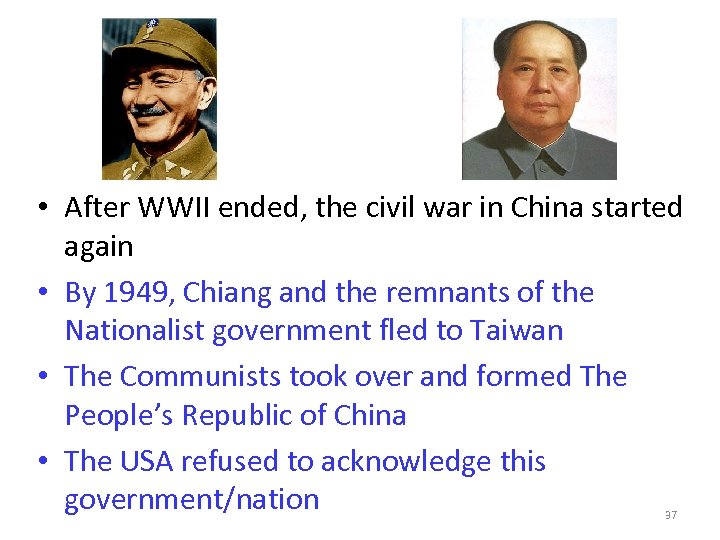 • After WWII ended, the civil war in China started again • By 1949, Chiang and the remnants of the Nationalist government fled to Taiwan • The Communists took over and formed The People’s Republic of China • The USA refused to acknowledge this government/nation 37
 38
38
 Truman Under Fire • The Truman doctrine had failed to contain communism in China • Critics wanted to know why the US only sent the nationalists financial support and not military support • If containing communism was so important in Europe, why wasn’t containment also important in Asia? ? 39
 NSC-68 • Remembering that the League of Nations had failed from inactivity, Truman ordered U. S. military spending to be quadrupled, National Security Council Memorandum Number 68, or NSC-68. • This document was key because it reflected the almost limitless possibility that pervaded American society. • Truman also used a Soviet absence from the UN to label North Korea as an aggressor and send UN troops to fight against the aggressors.
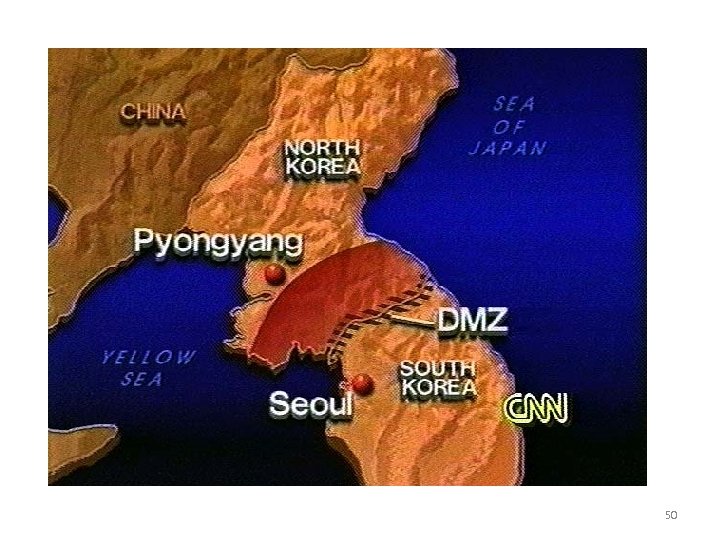
 The Korean War • When Japan surrendered in 1945, they gave the Soviet army control of North Korea (north of the 38 th parallel). • In 1948, The Republic of Korea (South Korea) was formed in the zone controlled by the US • Communist controlled Korea was called The People’s Republic of Korea 41
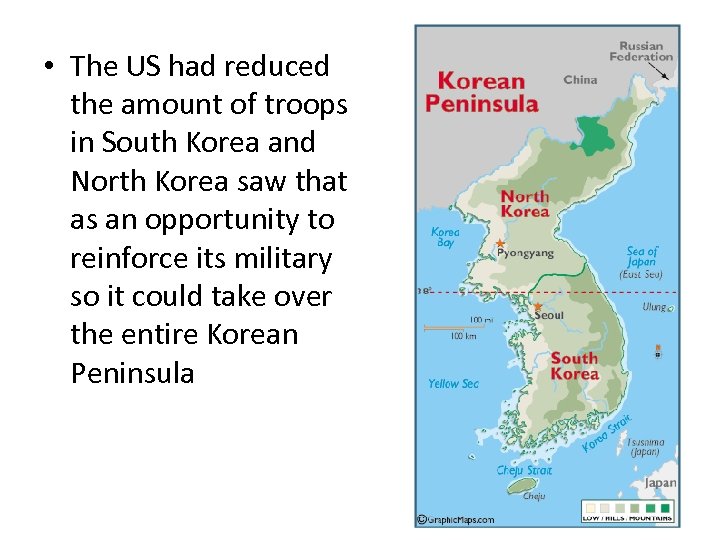 • The US had reduced the amount of troops in South Korea and North Korea saw that as an opportunity to reinforce its military so it could take over the entire Korean Peninsula 42
 • On June 25, 1950, the North Koreans crossed the 38 th parallel and started the Korean War Conflict • The UN met to determine the course of action • The Soviet Union was protesting the Chinese Nationalist government in Taiwan and did not attend the UN meeting • The UN Council voted to use military action against North Korea 43
 • The UN sent 520, 000 troops to South Korea (90% of those were American) • South Korea contributed another 590, 000 soldiers • General Douglas Mac. Arthur was in charge of the troops • By September 1950, the North Koreans had pushed the UN forces back to the southern coast 44
 • Mac. Arthur launched a massive counterattack and invasion at Inchon • This pushed the North Koreans back past the 38 th parallel • However, the Communist Chinese government sent an additional 300, 000 soldiers to help the North Koreans • This reinforcement pushed the UN forces back behind the 38 th parallel 45
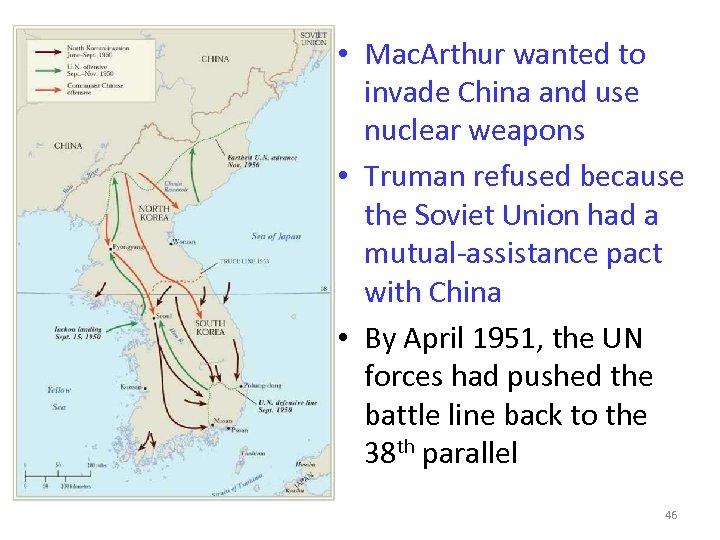 • Mac. Arthur wanted to invade China and use nuclear weapons • Truman refused because the Soviet Union had a mutual-assistance pact with China • By April 1951, the UN forces had pushed the battle line back to the 38 th parallel 46
 Power Struggle • Mac. Arthur continued to push for an invasion of China and used the media to gain support for his plan (going over the President’s authority) • Truman, as Commander in Chief of the military, could not allow this kind of insubordination and fired Mac. Arthur 47
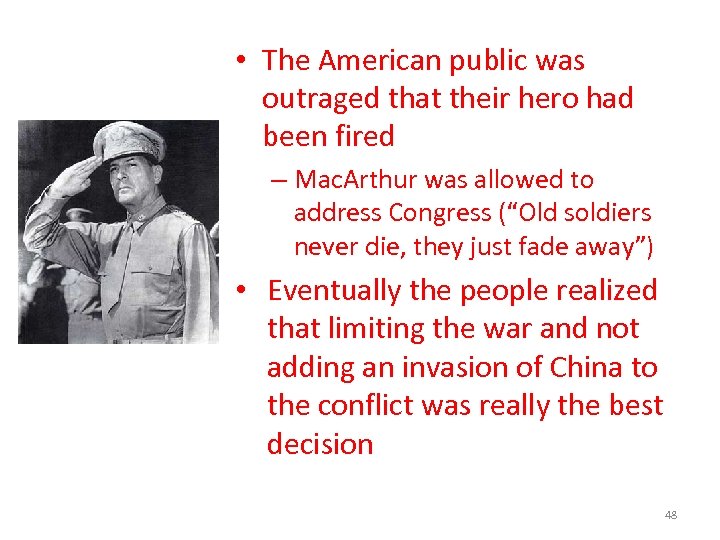 • The American public was outraged that their hero had been fired – Mac. Arthur was allowed to address Congress (“Old soldiers never die, they just fade away”) • Eventually the people realized that limiting the war and not adding an invasion of China to the conflict was really the best decision 48
 The End of the Korean War • The Soviet Union unexpectedly suggested a cease fire on June 23, 1951 • 1. Cease fire line would be at the 38 th parallel • 2. The formation of a demilitarized zone • Negotiations for the release of POW’s took another year • In July 1953, the armistice was signed to end the war (under the Eisenhower admin) 49
 50
50
 The Legacy • Communism had been contained without using nuclear weapons, but Korea was still divided into 2 nations • The war had cost 54, 000 lives and totaled $67 billion • The high cost of the war resulted in the Republicans winning the election of 1952. • War hero, Dwight D. Eisenhower became president 51
 Fear of Communism Spreads • The Communist party in the US claimed about 80, 000 members • During the Cold War, Americans were afraid the loyalty of the American Communists was to the Soviet Union • The fall of China and North Korea made Americans even more fearful of a communist takeover • A new Red Scare took place after WWII 52
 The Loyalty Review Board • In March 1947, President Truman issued an executive order that established a Federal Employee Loyalty Program to investigate government employees and dismiss those who were disloyal • 3. 2 million employees were investigated, 212 were fired • 2, 900 resigned because they felt the investigation violated their constitutional rights 53
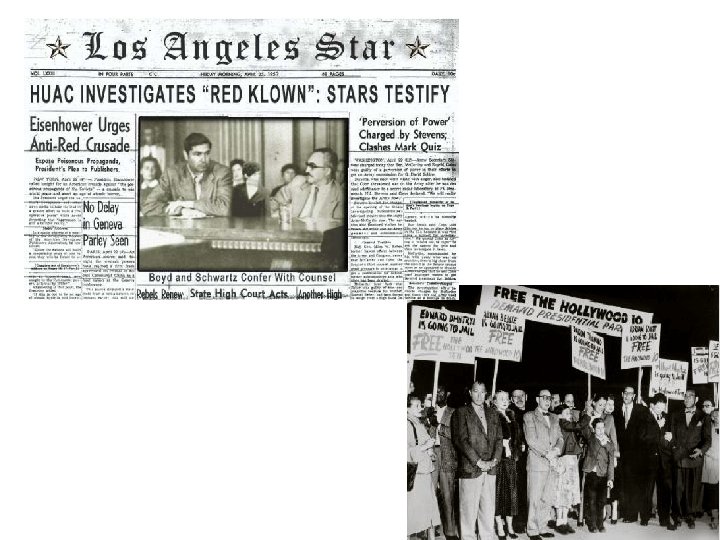
 HUAC • House Un-American Activities Committee • Investigated Hollywood for its communist influence (WWII propaganda films) • 43 “friendly” witnesses from Hollywood supported the idea of Communist infiltration • 10 witnesses refused to cooperate believing that the HUAC hearings were unconstitutional 54
 The Hollywood Ten • Because they refused to answer HUAC questions, they were sent to prison • In addition, Hollywood blacklisted people in the industry that were thought to have a communist background • 500 actors, directors, writers, and producers were unable to find work; their careers were ruined 55
 56
56
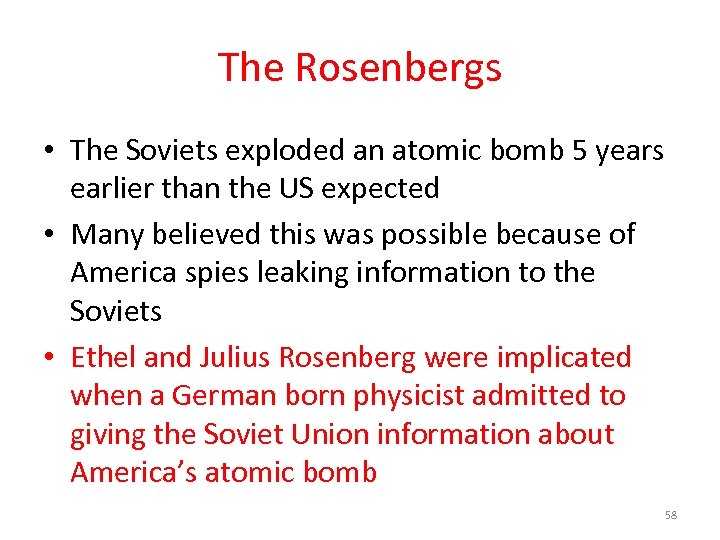
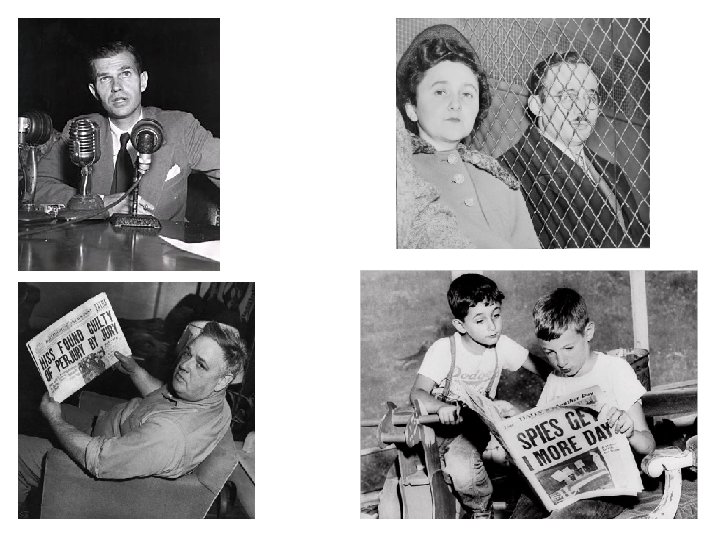
 Soviet Spies? ? ? • In 1948, Alger Hiss was accused of being a Soviet (by another former spy) • Whittaker Chambers provided “evidence” that Hiss’ typewriter had been used to create government documents • The jury convicted Hiss of perjury • Hiss claimed that Chambers had forged the documents • Soviet documents released in the 1990’s seem to prove Hiss’ guilt 57
 The Rosenbergs • The Soviets exploded an atomic bomb 5 years earlier than the US expected • Many believed this was possible because of America spies leaking information to the Soviets • Ethel and Julius Rosenberg were implicated when a German born physicist admitted to giving the Soviet Union information about America’s atomic bomb 58
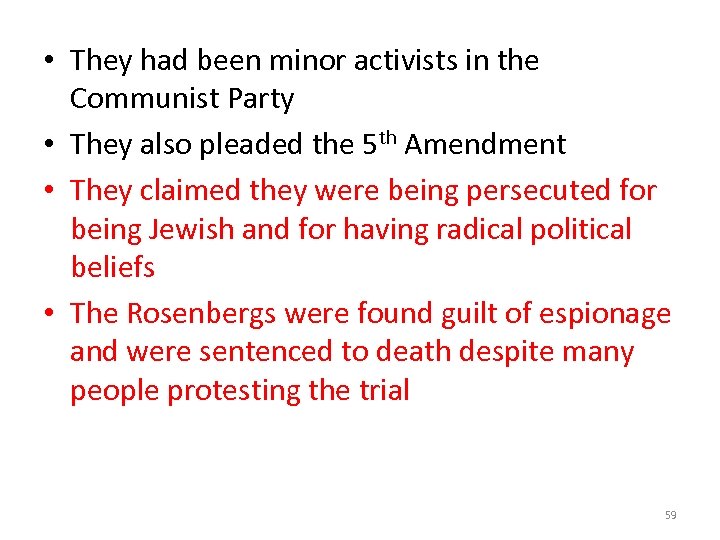 • They had been minor activists in the Communist Party • They also pleaded the 5 th Amendment • They claimed they were being persecuted for being Jewish and for having radical political beliefs • The Rosenbergs were found guilt of espionage and were sentenced to death despite many people protesting the trial 59
 • They had been minor activists in the Communist Party • They also pleaded the 5 th Amendment • They claimed they were being persecuted for being Jewish and for having radical political beliefs • The Rosenbergs were found guilt of espionage and were sentenced to death despite many people protesting the trial 60
 61
61
 Nuclear Arms Race • After the Soviet Union tested its atomic bomb, Truman had to decide if the US needed a stronger weapon…just in case • Scientists began to develop the hydrogen bomb (H Bomb) which was 67 times more powerful than the atomic bomb dropped on Hiroshima (moral dilemma) • The US tested its H bomb on Nov. 1, 1952 • The USSR tested theirs in August 1953 62
 The Eisenhower Era 1952 -1960
 The 1952 Election • Democrats chose Adlai E. Stevenson • Republicans chose World War II hero Dwight D. Eisenhower to run for president and anticommunist Richard M. Nixon to be his running mate. • Grandfatherly Eisenhower was a war hero and liked by everyone, so he left the rough part of campaigning to Nixon, who attacked Stevenson as soft against Communists, corrupt, and weak in the Korean situation.
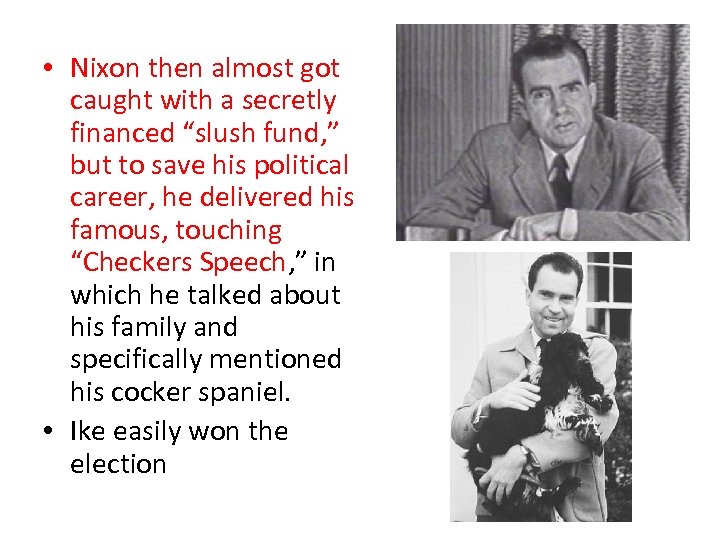 • Nixon then almost got caught with a secretly financed “slush fund, ” but to save his political career, he delivered his famous, touching “Checkers Speech, ” in which he talked about his family and specifically mentioned his cocker spaniel. • Ike easily won the election
 The Advent of Politics and TV • The “Checkers speech” showed the awesome power of television, since Nixon had pleaded on national TV • Later, Eisenhower agreed to go into studio and answer some brief “questions, ” which were later spliced in and edited to make it look like he had answered questions from a live audience, when he didn’t.
 Containment in Korea • True to his campaign promise, he flew to Korea to help move along peace negotiations • Seven months later, after threatening to use nuclear weapons, an armistice was finally signed • 54, 000 Americans had died, and tens of billions of dollars had been wasted in the effort, but American’s took a little comfort in knowing that Communism had been “contained
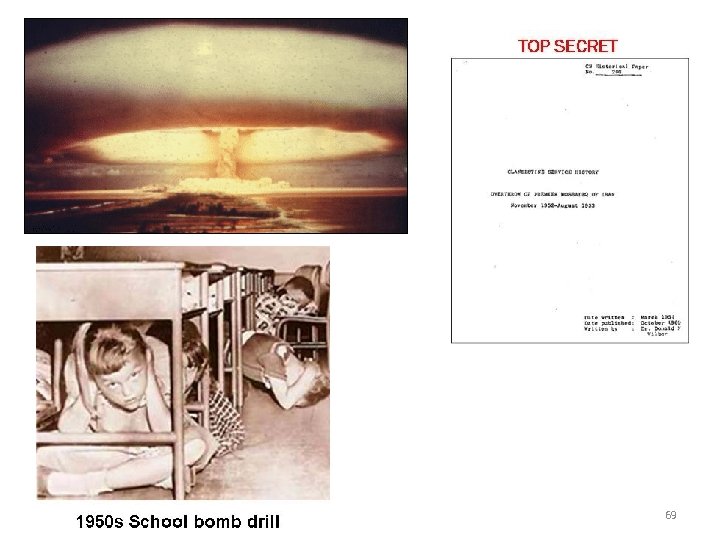
 Brinkmanship • Under the Eisenhower administration, Secretary of State John Foster Dulles advocated the US using all of its force (including nuclear weapons) against any aggressor • The US was willing to go the edge of all out war (brinkmanship) • The US scaled back on the army and navy and increased the air force and the arsenal of nuclear weapons • The USSR followed that example as well 68
 69
69
 “Ike” Takes Command • Eisenhower had been an excellent commander and leader who was able to make cooperation possible between anyone, so he seemed to be a perfect leader for Americans weary of two decades of depression, war, and nuclear standoff. • He served that aspect of his job well, but he could have used his popularity to champion civil rights more than he actually did.
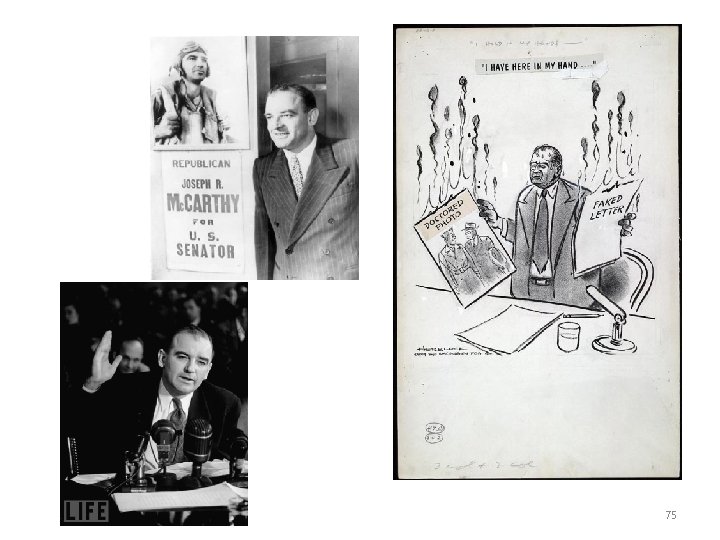
 Mc. Carthyism • The most famous crusader against closet communists was led by Wisconsin Senator, Joseph Mc. Carthy • He knew he needed a ploy to get re-elected in 1952, so he charged that Communists were taking over the government • He made many unsupported accusations of disloyalty 71
 • At various times, he claimed to have the names of 57, 81, and 205 known communists in the State Department (although he never produced a single name). He blamed the Democrats for this. • He was careful to only make his accusations in the Senate (he had immunity & could not be charged with slander • Republicans hoped if Americans believed they were purging the nation of communists, they would be re-elected 72
 • Eisenhower privately loathed Mc. Carthy, but the president did little to stop the anti-red, since it appeared that most Americans supported his actions • His zeal led him to purge important Asian experts in the State Department, men who could have advised a better course of action in Vietnam.
 Mc. Carthy Goes Too Far • Mc. Carthy accused the US military of being infiltrated by communists • In a televised senate hearing, the public saw Mc. Carthy bullying the witnesses • Mc. Carthy was condemned by the senate for improper conduct and bringing dishonor to the Senate • 3 years later, Mc. Carthy died, humiliated 74
 75
75
 Civil Rights Movement
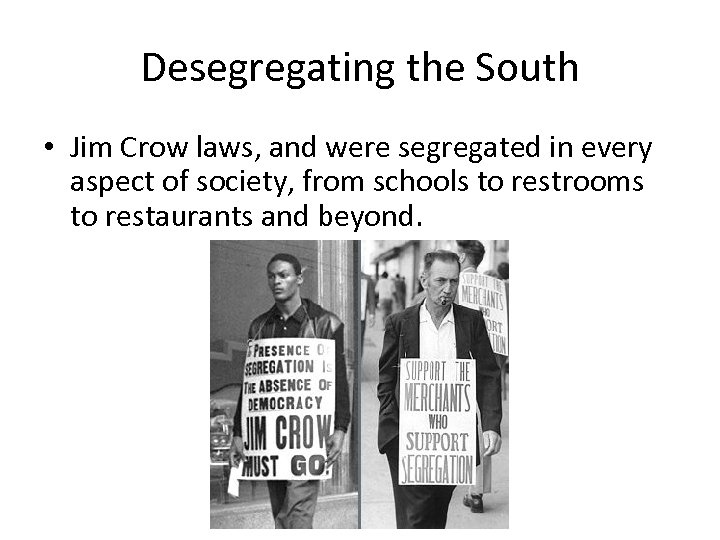 Desegregating the South • Jim Crow laws, and were segregated in every aspect of society, from schools to restrooms to restaurants and beyond.
 • Only about 20% of the eligible Blacks could vote, due to intimidation, discrimination, poll taxes, and other schemes meant to keep Black suffrage down. • Where the law proved sufficient to enforce such oppression, vigilante justice in the form of lynchings did the job, and the White murderers were rarely caught and convicted.
 An American Dilemma • In his 1944 novel, Swedish scholar Gunnar Myrdal had exposed the hypocrisy of American life, noting how while “every man [was] created equal, ” Blacks were certainly treated worse than Whites. • Even though Jackie Robinson had cracked the racial barrier by signing with the Brooklyn Dodgers in 1947, the nation’s conscience still paid little attention to the suffering of Blacks, thus prolonging their pain.
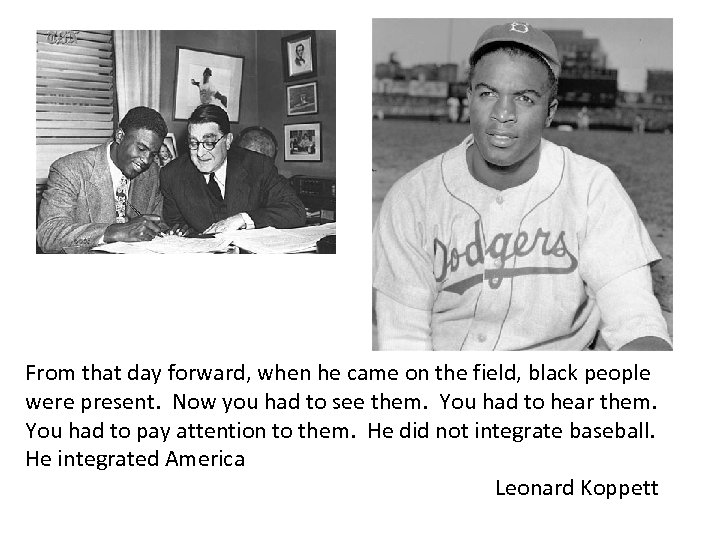 From that day forward, when he came on the field, black people were present. Now you had to see them. You had to hear them. You had to pay attention to them. He did not integrate baseball. He integrated America Leonard Koppett
 Letting Their Voices Be Heard • The 1950 case of Sweatt vs. Painter, where the Supreme Court ruled that separate professional schools for Blacks failed to meet the test of equality • Protestors as Rosa Parks, who in December 1955, refused to give up a bus seat in the “Whites only” section • Pacifist leaders like Martin Luther King, Jr. , who believed in peaceful methods of civil rights protests
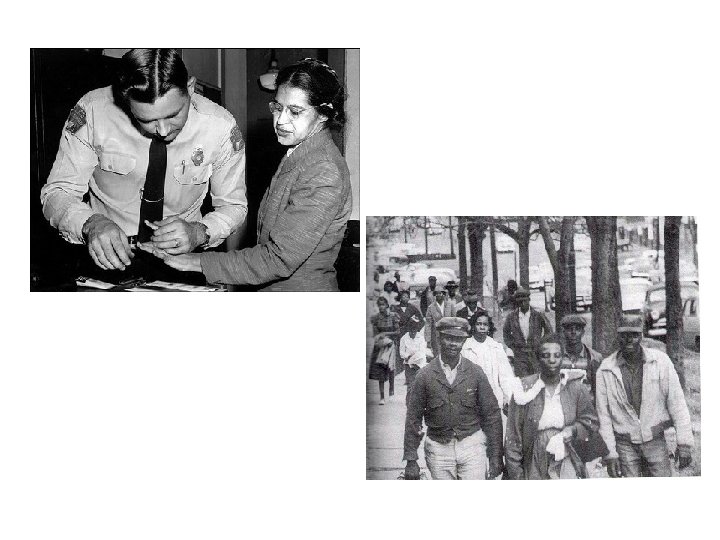
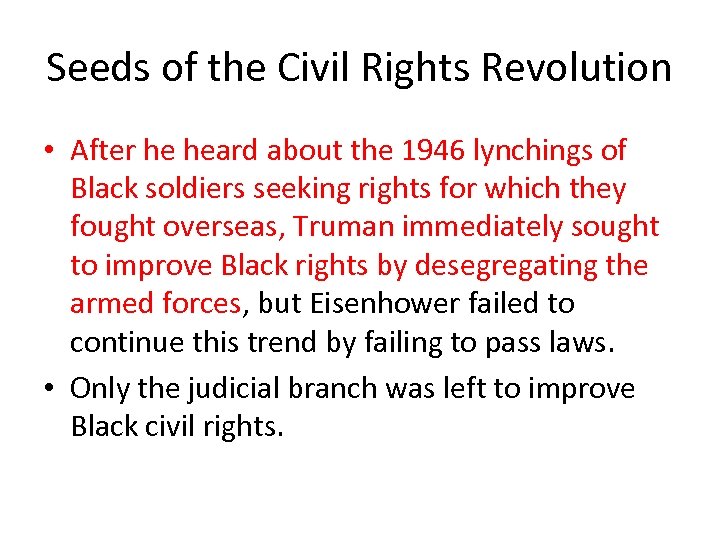 Seeds of the Civil Rights Revolution • After he heard about the 1946 lynchings of Black soldiers seeking rights for which they fought overseas, Truman immediately sought to improve Black rights by desegregating the armed forces, but Eisenhower failed to continue this trend by failing to pass laws. • Only the judicial branch was left to improve Black civil rights.
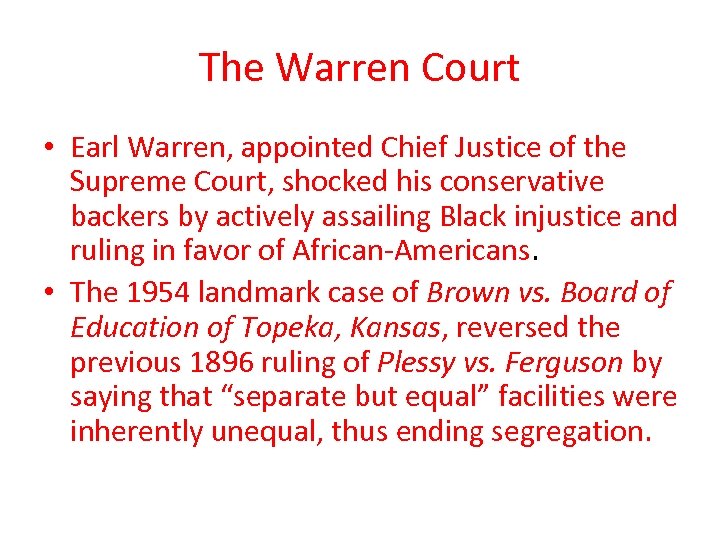 The Warren Court • Earl Warren, appointed Chief Justice of the Supreme Court, shocked his conservative backers by actively assailing Black injustice and ruling in favor of African-Americans. • The 1954 landmark case of Brown vs. Board of Education of Topeka, Kansas, reversed the previous 1896 ruling of Plessy vs. Ferguson by saying that “separate but equal” facilities were inherently unequal, thus ending segregation.
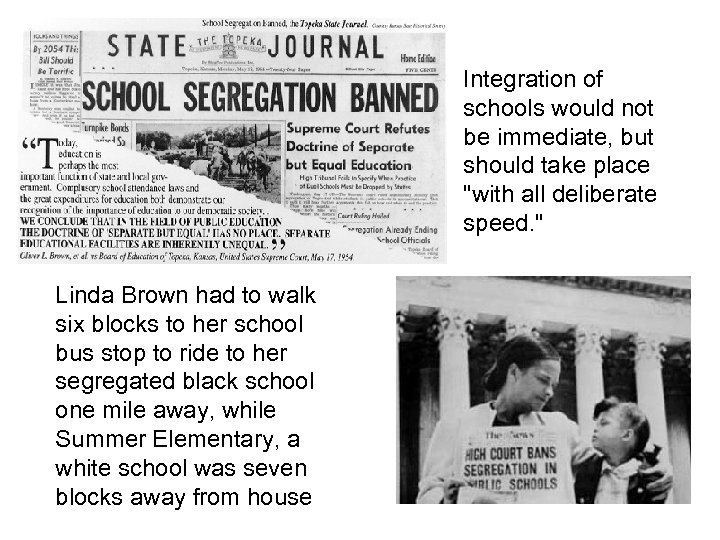 Integration of schools would not be immediate, but should take place "with all deliberate speed. " Linda Brown had to walk six blocks to her school bus stop to ride to her segregated black school one mile away, while Summer Elementary, a white school was seven blocks away from house
 Opposition to the Brown Decision • Border States usually obeyed this new ruling, states in the Deep South did everything they could to delay it and disobey it 1. Diverting funds to private schools 2. Signing and “Declaration of Constitutional Principles” that promised not to desegregate 3. Physically preventing Blacks to integrate. • Ten years after the ruling, fewer than 2% of eligible Black students sat in the same classrooms as whites.
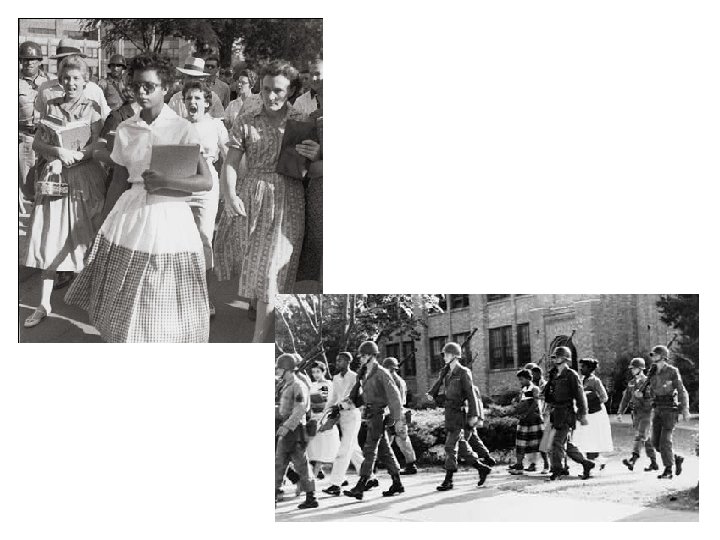
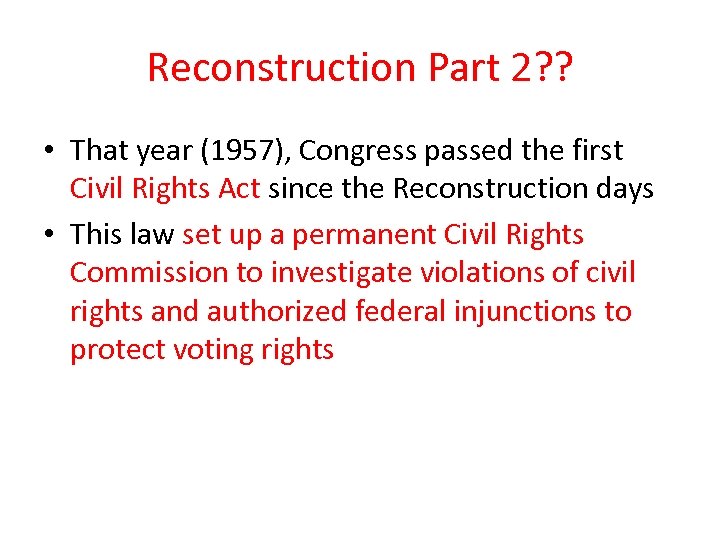
 Crisis at Little Rock • Eisenhower refused to issue a statement acknowledging the Supreme Court’s ruling, and he even privately complained about this new end to segregation • In September 1957, the governor of Arkansas, mobilized the National Guard to prevent nine Black students from enrolling in Little Rock’s Central High School, Ike sent troops to escort the children to their classes.
 Reconstruction Part 2? ? • That year (1957), Congress passed the first Civil Rights Act since the Reconstruction days • This law set up a permanent Civil Rights Commission to investigate violations of civil rights and authorized federal injunctions to protect voting rights
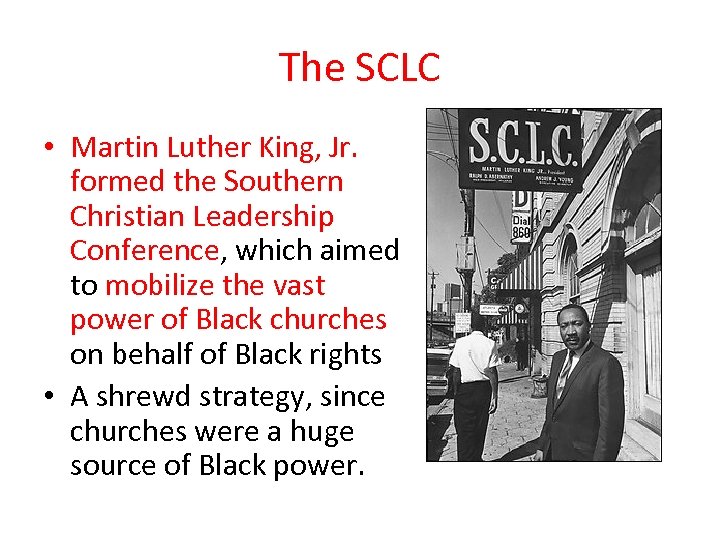 The SCLC • Martin Luther King, Jr. formed the Southern Christian Leadership Conference, which aimed to mobilize the vast power of Black churches on behalf of Black rights • A shrewd strategy, since churches were a huge source of Black power.
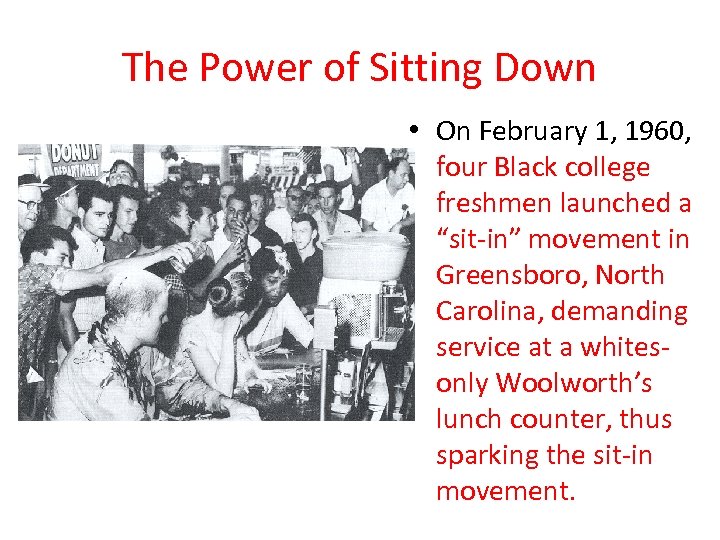 The Power of Sitting Down • On February 1, 1960, four Black college freshmen launched a “sit-in” movement in Greensboro, North Carolina, demanding service at a whitesonly Woolworth’s lunch counter, thus sparking the sit-in movement.
 SNCC • In April 1960, southern Black students formed the Student Non-Violent Coordinating Committee, or SNCC, to give more focus and force to their civil rights efforts.
 Eisenhower Republicanism at Home • Eisenhower came into the White House pledging a policy of “dynamic conservatism, ” which stated that he would be liberal with people but conservative with their money. • Ike decreased government spending by decreasing military spending, trying to transfer control of offshore oil fields to the states, and trying to curb the TVA’s by setting up a private company to take their places.
 • Eisenhower also cracked down on illegal Mexican immigration that cut down on the success of the bracero program by rounding up 1 million Mexicans and returning them to their native country in 1954. • With Indians, though, Ike proposed ending the FDR-style treatment toward Indians and reverting to a Dawes Severalty Act-style policy toward Native Americans, but due to protest and resistance, this was disbanded. • Eisenhower kept many of the New Deal programs, like Social Security and unemployment insurance
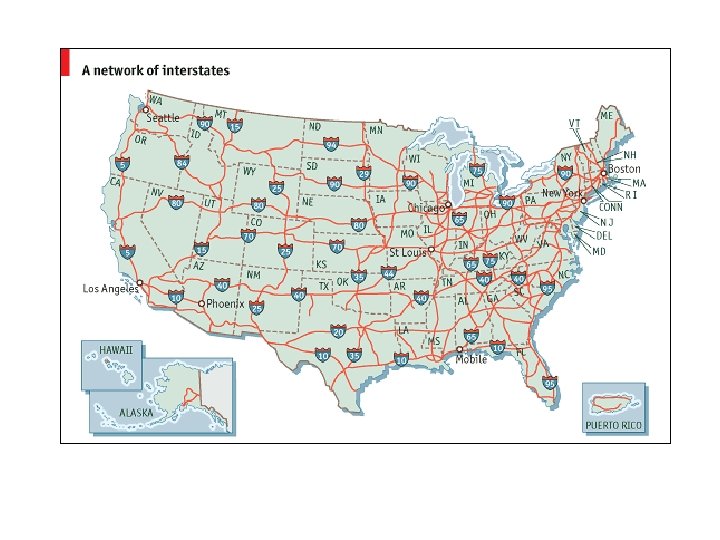
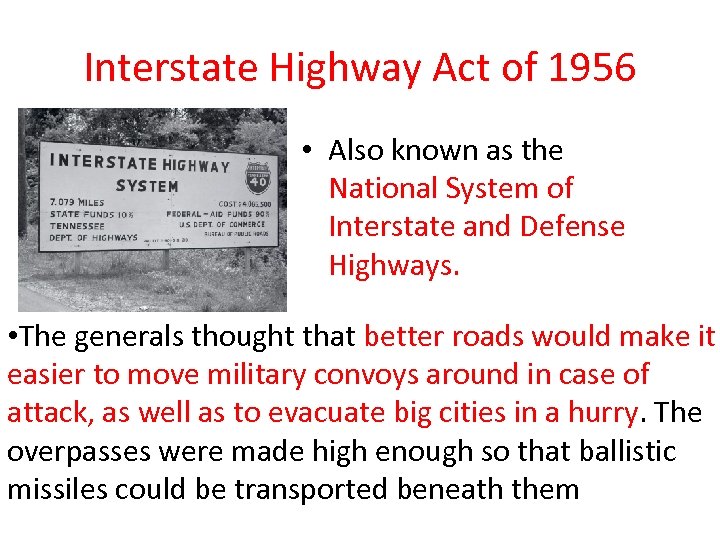 Interstate Highway Act of 1956 • Also known as the National System of Interstate and Defense Highways. • The generals thought that better roads would make it easier to move military convoys around in case of attack, as well as to evacuate big cities in a hurry. The overpasses were made high enough so that ballistic missiles could be transported beneath them
 A “New Look” at Foreign Policy • Secretary of State John Foster Dulles stated that the policy of containment was not enough • The U. S. was going to push back Communism and liberate the peoples under it • He would tone down defense spending by building a fleet of superbombers called Strategic Air Command, which could drop massive nuclear bombs in any retaliation.
 No Open Skies • Ike tried to thaw the Cold War by appealing for peace to new Soviet Premier Nikita Khrushchev at the 1955 Geneva Conference • The Soviet leader rejected such proposals, along with one for “open skies. ”
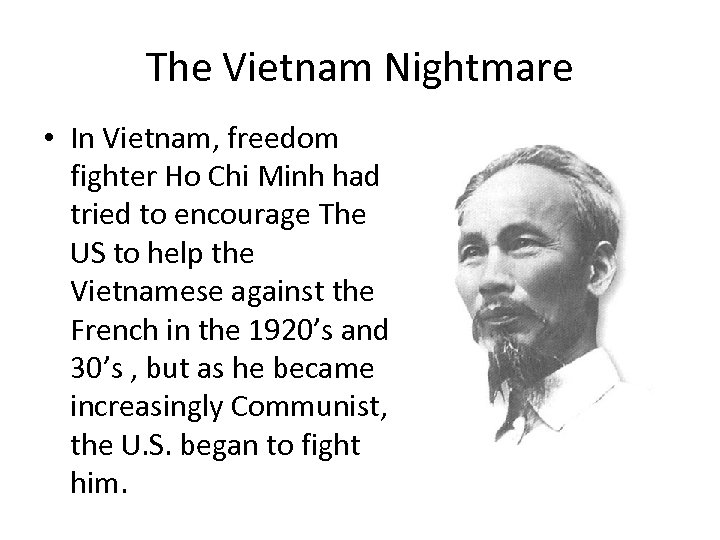 The Vietnam Nightmare • In Vietnam, freedom fighter Ho Chi Minh had tried to encourage The US to help the Vietnamese against the French in the 1920’s and 30’s , but as he became increasingly Communist, the U. S. began to fight him.
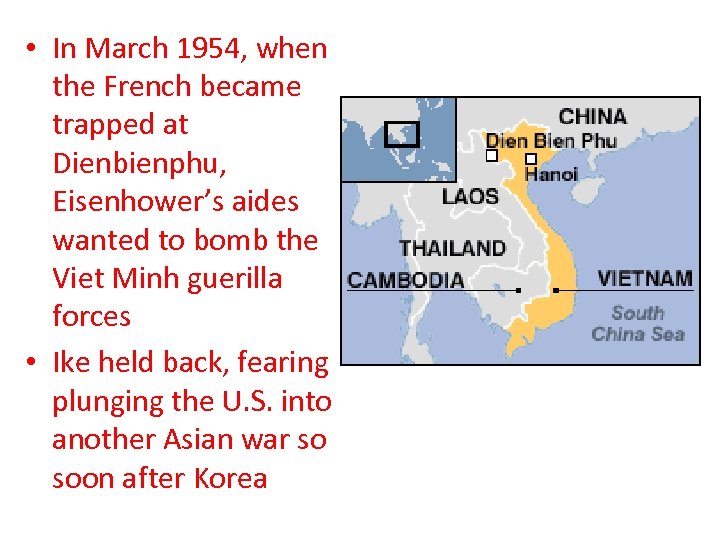 • In March 1954, when the French became trapped at Dienbienphu, Eisenhower’s aides wanted to bomb the Viet Minh guerilla forces • Ike held back, fearing plunging the U. S. into another Asian war so soon after Korea
 • After the Vietnamese won, Vietnam was split at the 17 th parallel, supposedly temporarily. • Ho Chi Minh was supposed to allow free elections, but soon, Vietnam became clearly split between a Communist north and a pro. Western south. • Secretary Dulles created the Southeast Asian Treaty Organization to emulate NATO, but this provided little help.
 A False Lull in Europe • In 1955, the USSR formed the Warsaw Pact to counteract NATO • The Cold War did seem to be thawing a bit, as Eisenhower pressed for reduction of arms, and the Soviets were surprisingly cooperative • Khrushchev publicly denounced Stalin’s brutality.
 Helping Hungary? • In 1956, when the Hungarians revolted against the USSR and appealed to the USA for help • America did nothing, earning the scorn of the bitter freedom fighters • Did the Truman Doctrine not apply to satellite nations? Sec. of State Dulles’ plan to “roll back” communism had to be abandoned • America was criticized for not using nuclear force —was it practical in such a minor conflict?
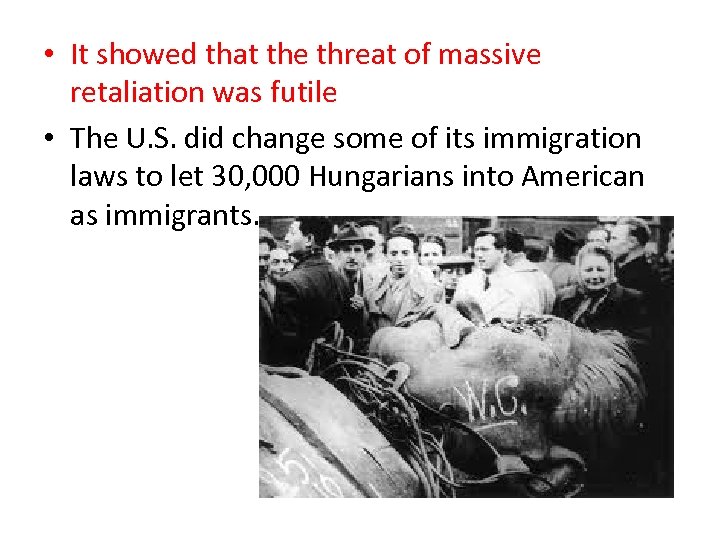 • It showed that the threat of massive retaliation was futile • The U. S. did change some of its immigration laws to let 30, 000 Hungarians into American as immigrants.
 Menaces in the Middle East • In 1953, to protect oil supplies in the Middle East, the CIA engineered a coup in Iran that installed the youthful shah, Mohammed Reza Pahlevi, as ruler of the nation • Protecting the oil for the time being but earning the wrath of Arabs that would be repaid in the 70 s.
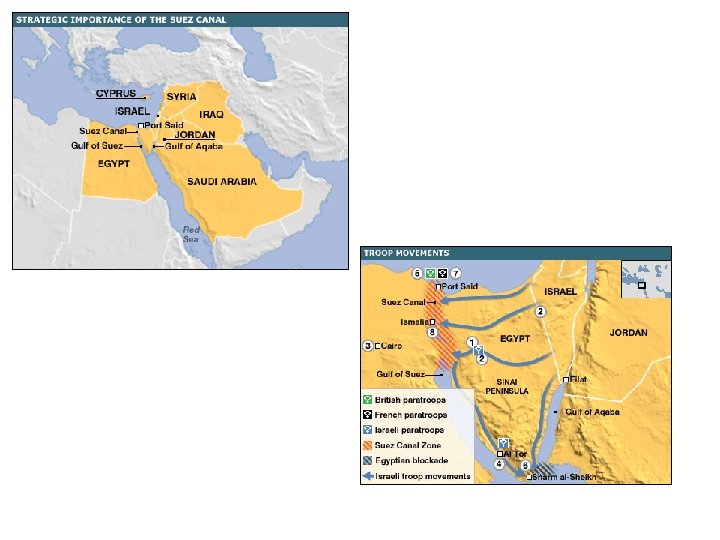
 The Suez Canal Crisis • President Gamal Abdel Nasser, of Egypt, needed money to build a dam in the upper Nile • He flirted openly with the Soviet side as well as the U. S. and Britain • Upon seeing this blatant Communist association, Secretary of State Dulles dramatically withdrew his offer, thus forcing Nasser to nationalize the dam. • Egypt took over the Suez Canal although it was owned by France and Great Britain
 • Late in October 1956, Britain, France, and Israel suddenly attacked Egypt, thinking that the U. S. would supply them with needed oil, as had been the case in WWII • Eisenhower did not, and the attackers had to withdraw. • The Suez crisis marked the last time the U. S. could brandish its “oil weapon. ”
 OPEC • In 1960, Saudi Arabia, Kuwait, Iraq, Iran, and Venezuela joined to form the Organization of Petroleum Exporting Countries
 Voters Still Like Ike in 1956 • In 1956, Eisenhower again ran against Stevenson and won easily by a landslide. • The GOP called itself the “party of peace” while the Democrats assaulted Ike’s health, since he had a heart attack in 1955 and a major abdominal operation in ’ 56. • The Democrats did win the House and Senate.
 Round Two for Ike • A drastic labor-reform bill in 1959 grew from recurrent strikes in critical industries. • Teamster chief “Dave” Beck was sent to prison for embezzlement, and his successor, James R. Hoffa’s appointment got the Teamsters expelled out of the AF of L-CIO. • Hoffa was later jailed for jury tampering and then disappeared in prison, allegedly murdered by some gangsters that he had crossed.
 Watching Labor • The 1959 Landrum-Griffin Act was designed to bring labor leaders to book for financial shenanigans and prevent bullying tactics. • Anti-laborites forced into the bill bans against “secondary boycotts” and certain types of picketing.
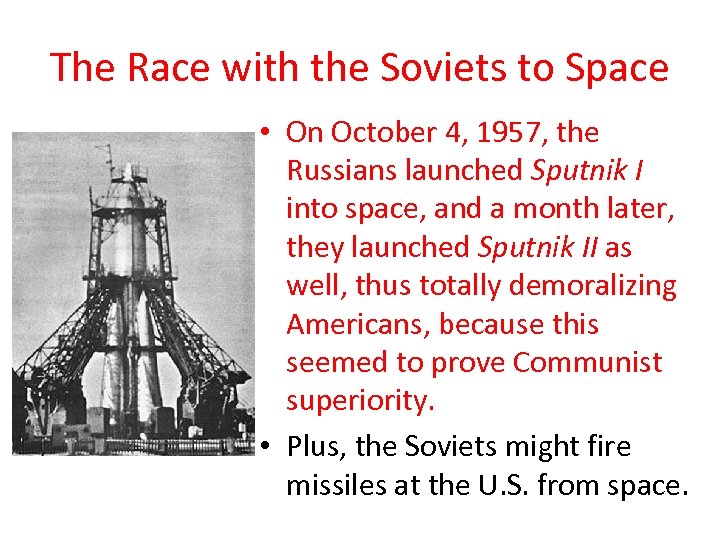 The Race with the Soviets to Space • On October 4, 1957, the Russians launched Sputnik I into space, and a month later, they launched Sputnik II as well, thus totally demoralizing Americans, because this seemed to prove Communist superiority. • Plus, the Soviets might fire missiles at the U. S. from space.
 Catching Up to the Russians • Four months after Sputnik I, the U. S. sent its own satellite (weighing only 2. 5 lbs) into space • The apparent U. S. lack of technology sent concerns over U. S. education, since American children seemed to be learning less advanced information than Soviet kids. • The 1958 National Defense and Education Act (NDEA) gave $887 million in loads to needy college students and grants for the improvement of schools.
 The Continuing Cold War • Humanity-minded scientists called for an end to atmospheric nuclear testing, lest future generations be deformed and mutated. • Attempts to regularize such suspensions were unsuccessful. • However, in 1959, Khrushchev was invited by Ike to America for talks, and when he arrived in New York, he immediately talked about disarmament but gave no means of how to do it.
 Spying over the skies • After the Soviet Union rejected Eisenhower’s proposal for an open skies policy, the CIA started to make secret high altitude flights over Russian territory • The U-2 spy planes took detailed photographs of missile sites and troop locations • The secret was very secret and Eisenhower was going to call of the spy program. Sec. of State Dulles convinced the President to authorize one last flight 116
 Gary Powers and the U-2 incident • On May 1, 1960, Francis Gary Powers was shot down over Soviet air space and was sentenced to 10 years in prison • Eisenhower first tried to deny the incident, but the Soviets had proof • The President promised to call off the program but would not apologize for the flights • Tensions escalated between the 2 super powers 117
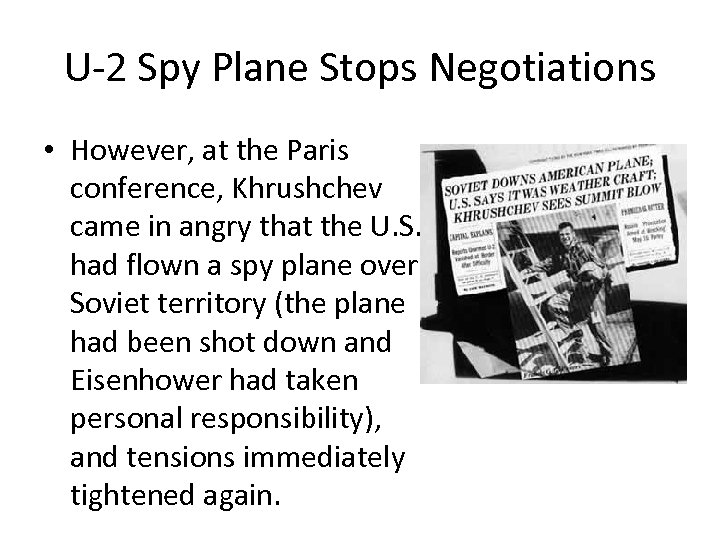 U-2 Spy Plane Stops Negotiations • However, at the Paris conference, Khrushchev came in angry that the U. S. had flown a spy plane over Soviet territory (the plane had been shot down and Eisenhower had taken personal responsibility), and tensions immediately tightened again.
 Cuba’s Castro-ism Spells Communism • Latin American nations resented the United States’ giving billions of dollars to Europe compared to millions to Latin America, and the U. S. ’s constant intervention (Guatemala, 1954), as well as its support of cold dictators who claimed to be fighting communism.
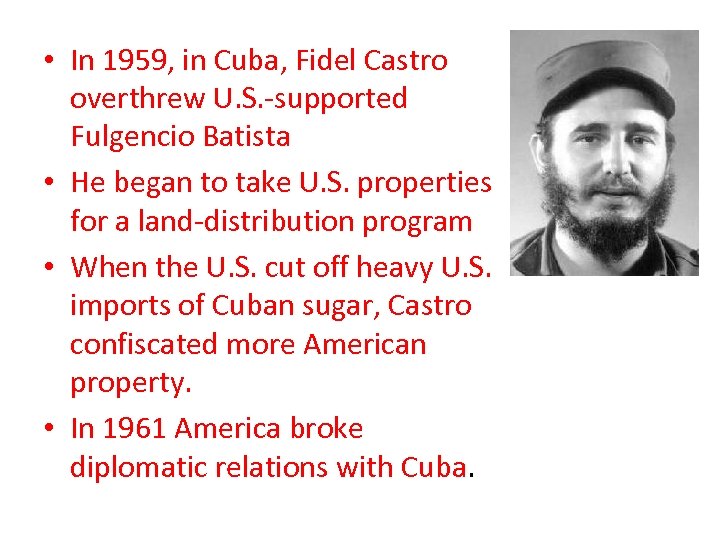 • In 1959, in Cuba, Fidel Castro overthrew U. S. -supported Fulgencio Batista • He began to take U. S. properties for a land-distribution program • When the U. S. cut off heavy U. S. imports of Cuban sugar, Castro confiscated more American property. • In 1961 America broke diplomatic relations with Cuba.
 • Khrushchev threatened to launch missiles at the U. S. if it attacked Cuba • Finally, Eisenhower proposed a “Marshall Plan” for Latin America, which gave $500 million to the area, but many Latin American felt that it was too little too late.
 Kennedy Challenges Nixon for the Presidency • The Republicans chose Richard Nixon, gifted party leader to some, ruthless opportunist to others, in 1960 with Henry Cabot Lodge Jr. as his running mate • John F. Kennedy surprisingly won for the Democrats and had Lyndon B. Johnson as his running mate
 The Presidential Issues of 1960 • Kennedy was attacked because he was the first Catholic presidential candidate ever, but defended himself and encouraged Catholics to vote for him, and if he lost votes from the South due to his religion, he got them back from the North due to the bitter Catholics there. • In four nationally televised debates, JFK held his own and looked more charismatic, perhaps helping him to win the election by a comfortable margin, becoming the youngest president elected (but not served) ever.
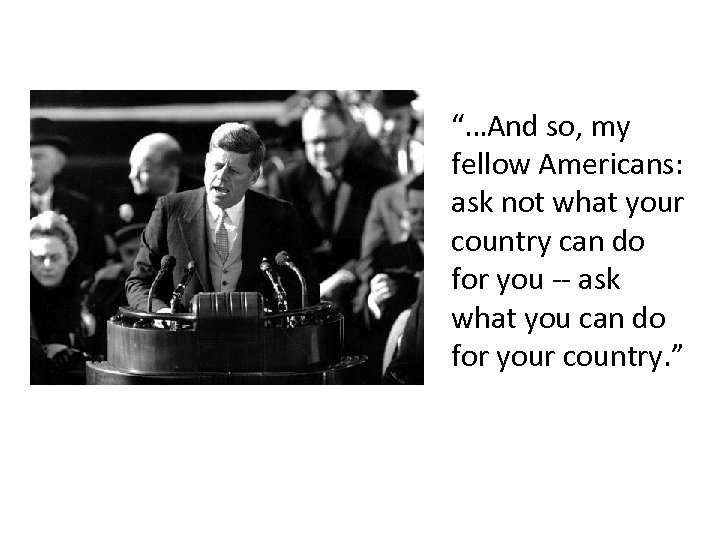 “…And so, my fellow Americans: ask not what your country can do for you -- ask what you can do for your country. ”
 An Old General Fades Away • Eisenhower had his critics, but he was appreciated more and more for ending one war and keeping the U. S. out of others. • Even though the 1951 -passed 22 nd Amendment had limited him to two terms as president, Ike displayed more vigor and controlled Congress more during his second term. • In 1959, Alaska and Hawaii became the 49 th and 50 th states to join the Union.
 Changing Economic Patterns • The economy really sprouted during the 50 s, and the invention of the transistor exploded the electronics field, especially in computers, helping such companies as International Business Machines (IBM) expand prosper. • Aerospace industries progressed, as the Boeing company made the first passenger-jet airplane (adapted from the superbombers of the Strategic Air Command), the 707.
 • In 1956, “white-collar” workers outnumbered “blue collar” workers for the first time, meaning that the industrial era was passing on. • Women appeared more and more in the workplace, despite the stereotypical role of women as housewives that was being portrayed on TV shows such as “Ozzie and Harriet” and “Leave It to Beaver. ” • More than 40 million new jobs were created.
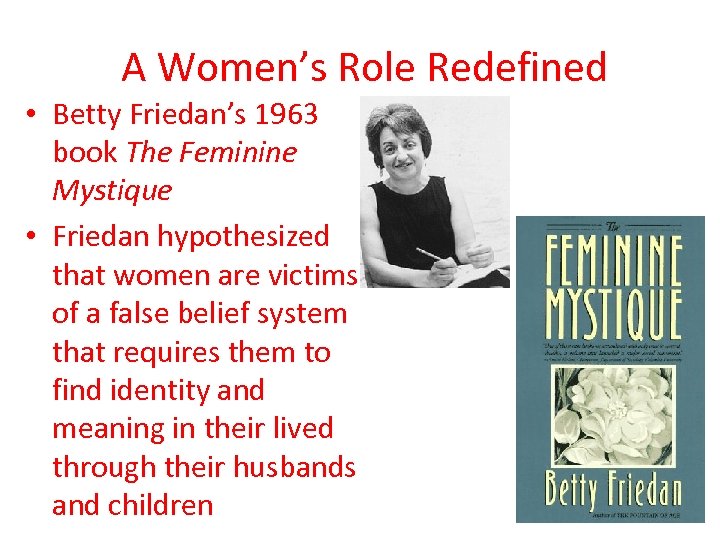 A Women’s Role Redefined • Betty Friedan’s 1963 book The Feminine Mystique • Friedan hypothesized that women are victims of a false belief system that requires them to find identity and meaning in their lived through their husbands and children