


 Скачать презентацию Post-Travel Health Consultation Dr Peter A Leggat MD
74b439bc1725343eb316a4c26d2b7619.ppt
- Количество слайдов: 37
 Post-Travel Health Consultation Dr Peter A. Leggat MD, Ph. D, Dr. PH, FAFPHM, FACTM, FFTM Associate Professor School of Public Health and Tropical Medicine James Cook University & Visiting Professor School of Public Health University of the Witwatersrand
 About the author l Dr Peter Leggat has co-ordinated the Australian postgraduate course in travel medicine since 1993. He has also been on the faculty of the South African travel medicine course, conducted since 2000, and the Worldwise New Zealand Travel Health update programs since 1998. Dr Leggat has assisted in the development of travel medicine programs in several countries and also the Certificate of Knowledge examination for the International Society of Travel Medicine.
 Objectives of the session l l Review statistics Briefly review the sorts of problems travelers have abroad Examine why it may be important to see travelers if they are unwell on return and what policies may be applicable in practice Document some important aspects of the post-travel history and examination
 Some References Steffen et al. Manual of Travel Medicine and Health. Decker, 2003 Sec 4. l Leggat et al. Primer of Travel Medicine. ACTM Publications, 2002 Ch. 19. l
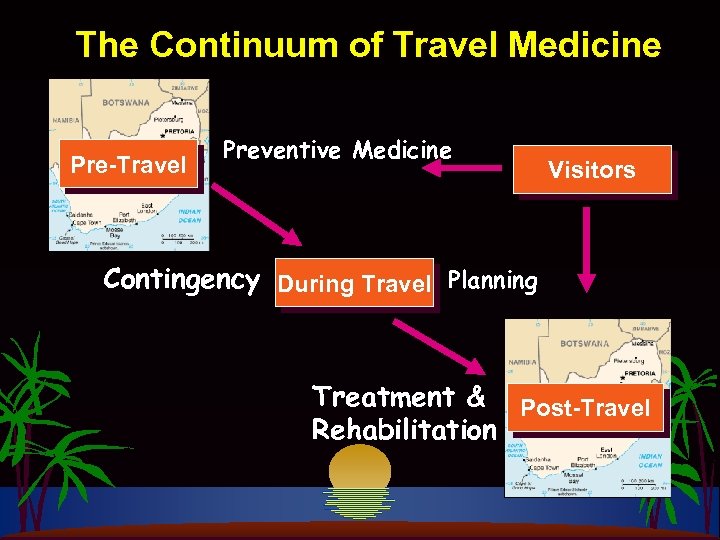 The Continuum of Travel Medicine Pre-Travel Preventive Medicine Visitors Contingency During Travel Planning Treatment & Post-Travel Rehabilitation
 The Good News l Most travelers report no major problems whilst travelling and most are asymptomatic on return
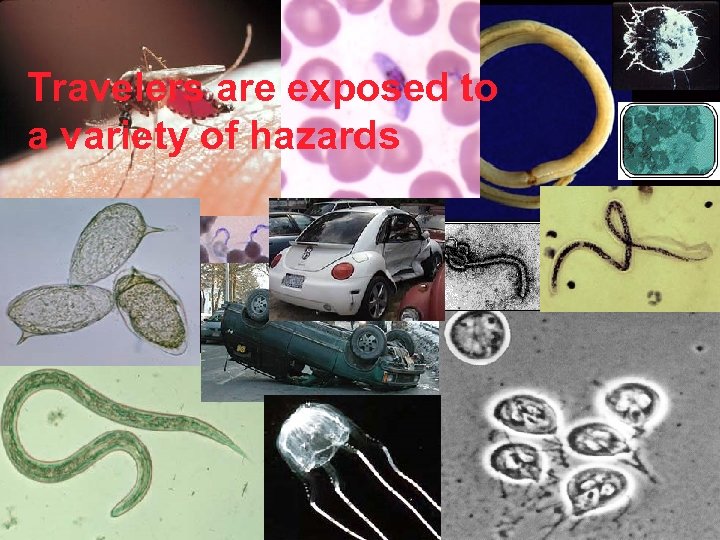 Travelers are exposed to a variety of hazards
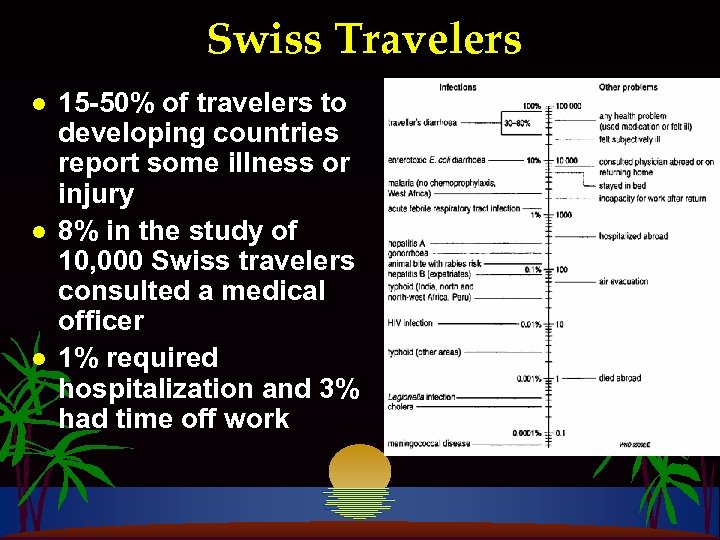 Swiss Travelers l l l 15 -50% of travelers to developing countries report some illness or injury 8% in the study of 10, 000 Swiss travelers consulted a medical officer 1% required hospitalization and 3% had time off work
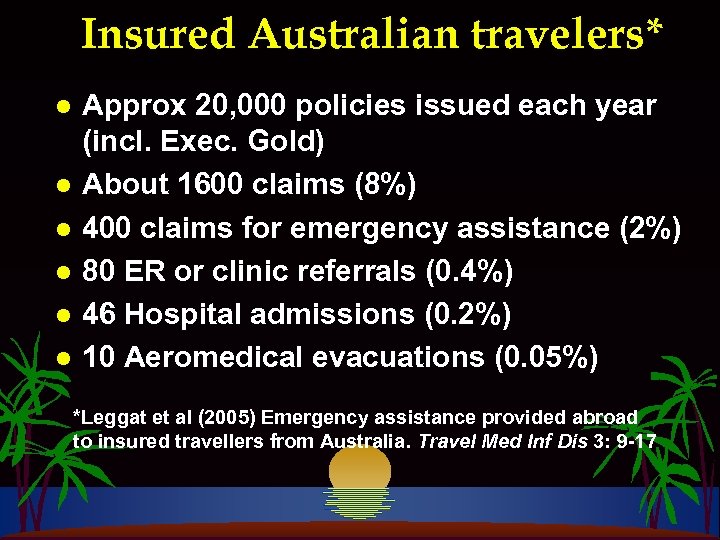 Insured Australian travelers* l l l Approx 20, 000 policies issued each year (incl. Exec. Gold) About 1600 claims (8%) 400 claims for emergency assistance (2%) 80 ER or clinic referrals (0. 4%) 46 Hospital admissions (0. 2%) 10 Aeromedical evacuations (0. 05%) *Leggat et al (2005) Emergency assistance provided abroad to insured travellers from Australia. Travel Med Inf Dis 3: 9 -17
 Common things occur commonly l l l l Gastrointestinal-diarrhoeal diseases effecting 20 -40% or more of short term travelers Respiratory tract infection Cutaneous infections Trauma and injuries (accidents- commonest cause of preventable death) Sexually transmitted infections Dental problems Others (remember malaria)
 Post-Travel Consultation l Many travel related problems are self-limiting l Why might it be important to see travelers who have an illness post-travel?
 The traveler may have a life threatening infections l l l l Malaria due to P. Falciparum Viral hepatitis Typhoid Amoebiasis/Amoebic liver abscess Legionnaire’s disease Melioidosis Rabies Others
 Travelers may have infections that pose a risk to public health l l l l Dengue (2 -5 days) Lassa, Ebola and others (3 -21 days) Japanese Encephalitis (3 -7 days) Yellow fever (3 -6 days) Typhoid (1 -2 days) Malaria (Pv-10 days to year-relapses; Pf 10 -28 days) SARS (2 -10 days) Others
 It is important to develop policies in travel medicine l Policy and procedures, including – Policy of follow-up of travelers – Policy on notifiable diseases – Policy on reporting adverse reactions – Policy on “eradication” treatment
 Policy on follow-up of travelers Do you see travellers l Symptomatic on return? l Symptomatic whilst aboard? l Asymptomatic abroad and asymptomatic now? l To complete immunization courses?
 It is important that the clinic have a written policy It is essential that travellers who become ill on return seek medical attention as soon as possible l The traveller should be advised to inform the clinic that they have been or are currently traveling l It is also important to ask if patients: l “Have you been traveling recently? ”
 Policy on reporting notifiable diseases and adverse reaction l l Is it a notifiable disease? Early liaison concerning suspected cases and formal notification to public health units Keep a list of notifiable diseases and reporting forms Document and report any possible serious adverse reactions to immunisations and chemoprophylaxic and other medications experienced by traveller whilst abroad Is the traveler part of a clinical trial?
 Travel medicine has assumed a major role in monitoring global trends in infectious disease, especially emerging infectious diseases
 Travel medicine networks l Geo. Sentinel (ISTM/CDC) – May provide early warning of outbreak amongst travelers returning to disparate locations Trop. Net Europ l WHO l Local networks l Other networks l
 Eradication Policy Do you prescribe empiric “eradication” treatment? l If so, what groups of travelers? l
 Eradication “Treatment” l l l Malaria - primaquine (check G 6 PD deficiency), (tafenoquine) Deworming agent for soil transmitted “roundworms” (consider strongyloides) Deworming agent for “flatworms”praziquantel Deworming agent for filariasis albendazole Antiprotozoal agent - giardiasis Others (? )
 Groups where eradication treatment may be considered Medium to long term travelers or overseas workers l Those travellers at high risk of infection l Those where diagnosis suggestive but investigations inconclusive l Where required by authorities-refugees l Even when on preventive measures! l
 Occasionally preventive measures do fail Immunizations and chemoprophylactic agents and personal protective measures are not 100% protective l Variable compliance with preventive advice l Incorrect/insufficient advice/health intelligence l
 Post-travel Consultation History l Examination l Investigations l
 Screening History l l Are they symptomatic now or have been? Risk assessment - leading to specific history of possible exposures, e. g. schistosomiasis, zoonotic disease, sexual history, recently been diving, have they been bitten? Is there correspondence in relation to treatment abroad? Travel history can be important in terms of working out possible incubation period and differential diagnosis
 Screening History l Prophylaxis and compliance - was the prophylaxis appropriate? l Could it be a pre-existing condition? l Could it be related to an occupational/recreational exposure?
 Screening Examination Post-travel physical examination for most short term travelers is usually unremarkable for disease, but may be useful for assessment of injuries l Signs of “tropical” disease can be subtle and can be missed unless specifically looked for, e. g. rashes, eschar, jaundice l Abnormalities unrelated to travel l
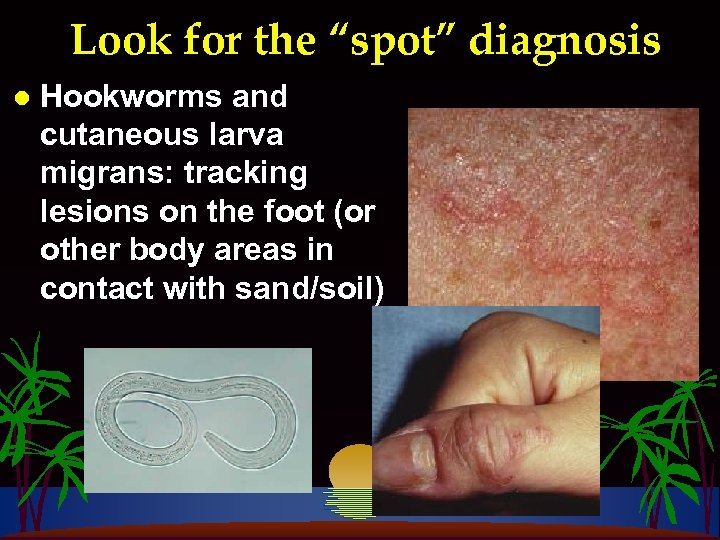 Look for the “spot” diagnosis l Hookworms and cutaneous larva migrans: tracking lesions on the foot (or other body areas in contact with sand/soil)
 Look for the “spot”diagnosis Leishmaniasis: non-healing skin ulcers/lesions, especially on exposed areas and been to endemic areas l Eschars-may be associated with rickettsial infectious such as scrub typhus l Skin infection: bacterial and fungal (ask for occupational and recreational history) l Others l
 Screening Examination l l l When sending specimens to lab, document current medications, history, what you think Liaise with lab if unsure what tests available Stool microscopy M/C/S, O/C/P-most diarrhoeal disease bacterial>>parasitic>viral Urine tests-dipstick urinalysis, “terminal” urine for ova of S. haematobium Full Blood Count and differentialeosinophilia, anaemia, thrombocytopenia
 Screening Examination l l l Rapid tests, e. g. Immunochromographic tests (ICT)-often used for initial screening for malaria, Bancroftian filariasis, (dengue), etc Serological investigations, e. g. schistosomiasis, filariasis Blood films for malaria HIV/STI serology TB screening-useful if you can compare with pre-travel
 Does the traveler have diarrhea? Most travelers’ diarrhea is brief, self -limiting and non-inflammatory (about 4 days in duration) l About 20% of travelers have fever and/or bloody diarrhea l Enterotoxigenic Escherichia Coli is probably the most frequent pathogen in about 40 -75 of cases l
 Travelers’ diarrhea Inflammatory diarrhea may be caused by Campylobacter, Shigella or Salmonella infection l Fever, cramping abdominal pain, pus and/or blood in the stool l Quinolone antibiotics often employed (some resistance) l Remember amoebic dysentery and giardiasis l
 Travelers’ diarrhea Persistent diarrhea may be giardiasis, which may need treatment with tinidazole or metronidazole l Chronic diarrhea may need further investigation and referral l
 Does the traveler have fever? l Possible serious infectious disease causes in travelers returning from tropical regions: – Malaria-great mimicker – Hepatitis A – Enteric fever (incl typhoid) – Dengue fever – Others
 Has the traveler been injured abroad? Need to document extent of injuries l Are they covered by any insurance or superannuation policy? l Arrange for any further treatment and follow-up l Liaise with airlines if further travel required l Arrange for assessment for rehabilitation as necessary l
 Post-Travel Consultation It is important to elicit a history of travel. l Many short term travelers will present with illness when they get back, following the incubation period. l Investigation and management of some post-travel illnesses will be urgent because they are life threatening and/or a threat to public health. l