 Скачать презентацию Post Thrombolysis Care and Complications Gill Cluckie Clinical
b440cdf3d5cf8d00777fc421be717305.ppt
- Количество слайдов: 19



Post Thrombolysis Care and Complications Gill Cluckie Clinical lead, stroke Guy’s and St. Thomas’ NHS Foundation Trust
Essential Care § § § 1: 1 Nursing for the first 24 hours? Bed Rest for 24 hours? Appropriate equipment at the patients bedside, EG, cardiac monitor, suction, drip stand pump, oxygen, emergency equipment
Observations § Consistent and full neurological observations: - Every 15 mins for 2 hours - half hourly for 6 hours - hourly for 16 hours § MRC grading for limb power § NIHSS trained staff to identify significant clinical changes
Things to Remember § § § No heparin, warfarin, anti-platelets Swallow assessment Do not pass NG Tube until 24 hours No arterial punctures or central lines Avoid catheterisation. If essential, 30 mins after completion of thrombolysis § NO SHAVING!!
Complications § § Blood Pressure Management Intracranial Haemorrhage Anaphylaxis Extra-Cranial Haemorrhage
Blood Pressure § Strict BP control to prevent increased risk of intra-cranial haemorrhage – less than 180/100 mm. Hg § If either reading is above limit, recheck in 5 minutes § If 3 readings at least 5 minutes apart show BP higher than limit – administer IV labetalol 10 -20 mg as bolus § Do you usually give IV labetalol in your unit?
Intracranial Haemorrhage § What are the signs and symptoms? § Symptoms: nausea, vomiting, headache, altered limb function § Signs: increasing difficulty obtaining same GCS, agitation, drowsiness, drop in GCS, altered limb function, vomiting § How would you observe these in a drowsy patient?
Intracranial Haemorrhage § Decision on stopping the infusion if still in progress § Decision on urgent repeat CT brain to confirm haemorrhage § Follow protocols on referral of these patients to neuro-surgeons § Decisions on escalation plans or palliative care option
Case Study 1 54 year old man collapsed with left face, arm and leg weakness Drowsy on assessment, clinically had R MCA infarct NIHSS = 12 Thrombolysed within 2 hours of onset
Case study 1 At 14 hours – improved face and leg weakness and less drowsy- NIH had reduced to 7 Went for repeat CT, nurse noticed on way to CT that his left leg had deteriorated Post-CT he was much more drowsy
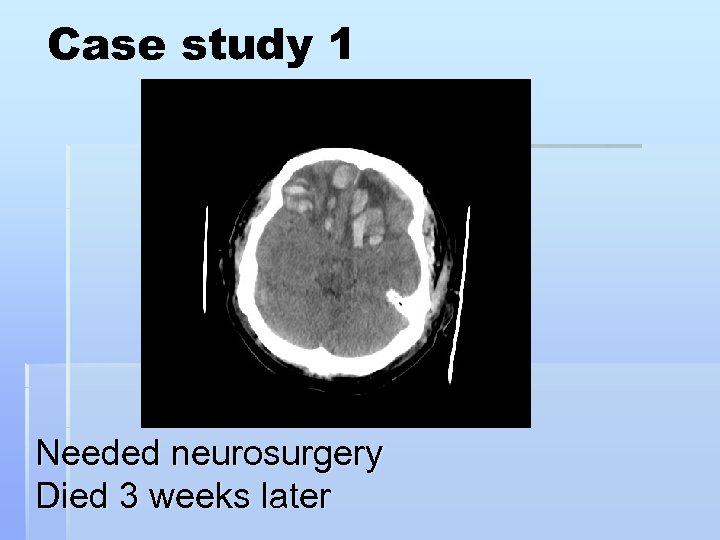
Case study 1 Needed neurosurgery Died 3 weeks later
Extra-Cranial Haemorrhage § What are the signs and symptoms? § Symptoms: abdominal pain or discomfort, nausea, obvious bleeding, malena § Signs: haematemesis, malena, haemodynamic compromise, pallor, increasing drowsiness, heavy blood loss, tachycardia
Extra-Cranial Haemorrhage § Common oozing from cannulation sites, gum bleeding § Post-angioplasty – careful management of sheath site, likely to require Fem-stop device to prevent haematoma development § GI bleed – management of blood pressure, blood volume, follow protocols for surgical reviews and administering blood products
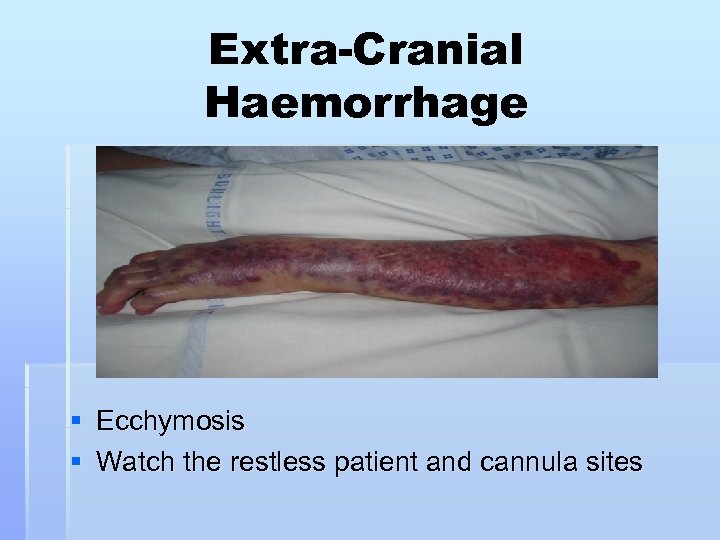
Extra-Cranial Haemorrhage § Ecchymosis § Watch the restless patient and cannula sites
Anaphylaxis § What are the signs and symptoms to observe for? § Symptoms: increased breathlessness, tightness in chest, itch, tingling lips or tongue, tightness in throat, dysphagia § Signs: oral oedema, facial oedema, audible wheeze, stridor, desaturation, increased respiratory rate and effort, respiratory arrest
Anaphylaxis § Stop infusion if still in progress § Administer adrenaline, chlorpheniramine and hydrocortisone as for anaphylaxis § Protect airway and maintain adequate oxygenation § May require intubation urgently via crash call
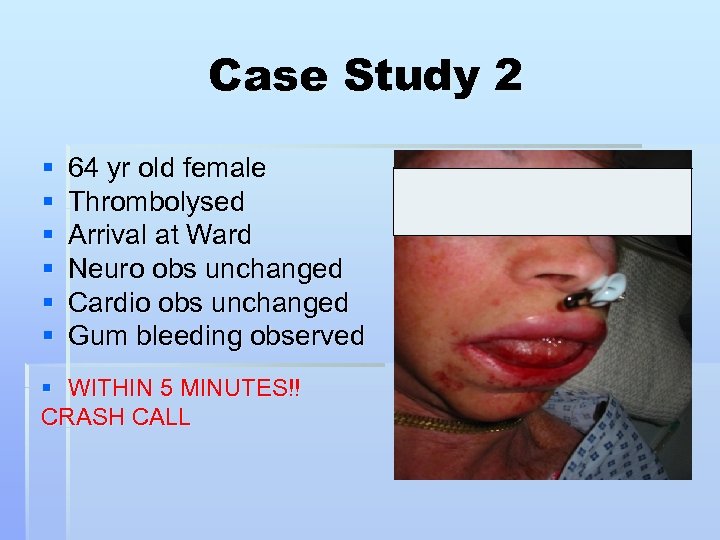
Case Study 2 § § § 64 yr old female Thrombolysed Arrival at Ward Neuro obs unchanged Cardio obs unchanged Gum bleeding observed § WITHIN 5 MINUTES!! CRASH CALL
Case study 2 § § Tongue, face, eyes swollen No BP fall or tachycardia Difficult Intubation Died in ITU due to secondary cerebral oedema Rate around 0. 5 -1% Some anecdotes that angio-oedema is more common in patients on ACE inhibitors on admission
Plan Ahead § § § Hand over to on-call teams/hospital at night Staff coverage – appropriate trained people. Have the ability to react quickly and appropriately when you notice a change no matter how little or subtle § Think of weekends and nights, drug charts, escalation § Never be worried to put out a Crash Call
Скачать презентацию Post Thrombolysis Care and Complications Gill Cluckie Clinical
b440cdf3d5cf8d00777fc421be717305.ppt