 Скачать презентацию POST-SECONDARY EDUCATION REFORM IN LOUISIANA Business Coalition on
be6c6d6da32cb4abfe2ef922fdcbae2e.ppt
- Количество слайдов: 23



POST-SECONDARY EDUCATION REFORM IN LOUISIANA Business Coalition on Higher Education, Initial Recommendations February 5, 2010
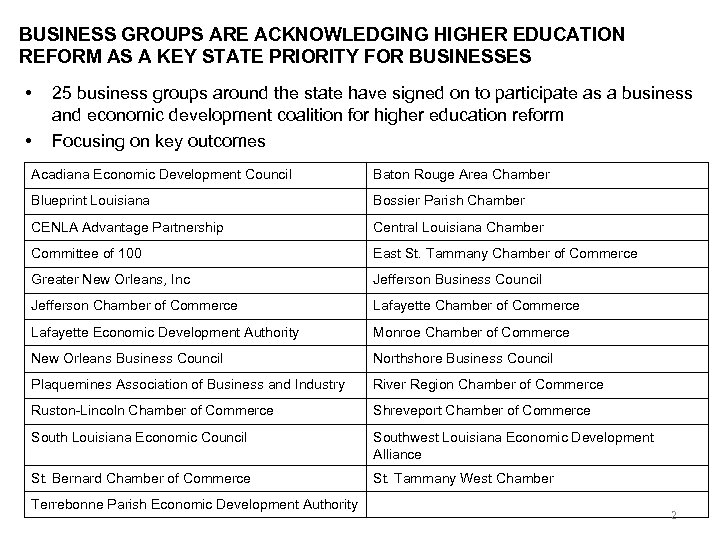
BUSINESS GROUPS ARE ACKNOWLEDGING HIGHER EDUCATION REFORM AS A KEY STATE PRIORITY FOR BUSINESSES • • 25 business groups around the state have signed on to participate as a business and economic development coalition for higher education reform Focusing on key outcomes Acadiana Economic Development Council Baton Rouge Area Chamber Blueprint Louisiana Bossier Parish Chamber CENLA Advantage Partnership Central Louisiana Chamber Committee of 100 East St. Tammany Chamber of Commerce Greater New Orleans, Inc Jefferson Business Council Jefferson Chamber of Commerce Lafayette Economic Development Authority Monroe Chamber of Commerce New Orleans Business Council Northshore Business Council Plaquemines Association of Business and Industry River Region Chamber of Commerce Ruston-Lincoln Chamber of Commerce Shreveport Chamber of Commerce South Louisiana Economic Council Southwest Louisiana Economic Development Alliance St. Bernard Chamber of Commerce St. Tammany West Chamber Terrebonne Parish Economic Development Authority 2
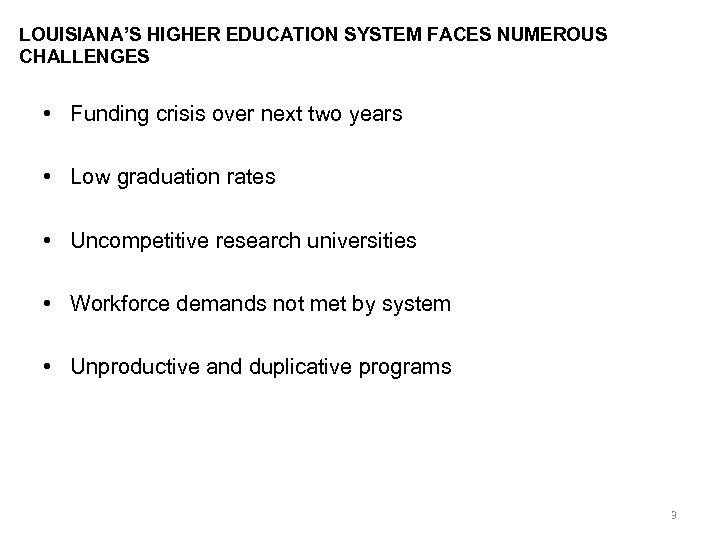
LOUISIANA’S HIGHER EDUCATION SYSTEM FACES NUMEROUS CHALLENGES • Funding crisis over next two years • Low graduation rates • Uncompetitive research universities • Workforce demands not met by system • Unproductive and duplicative programs 3
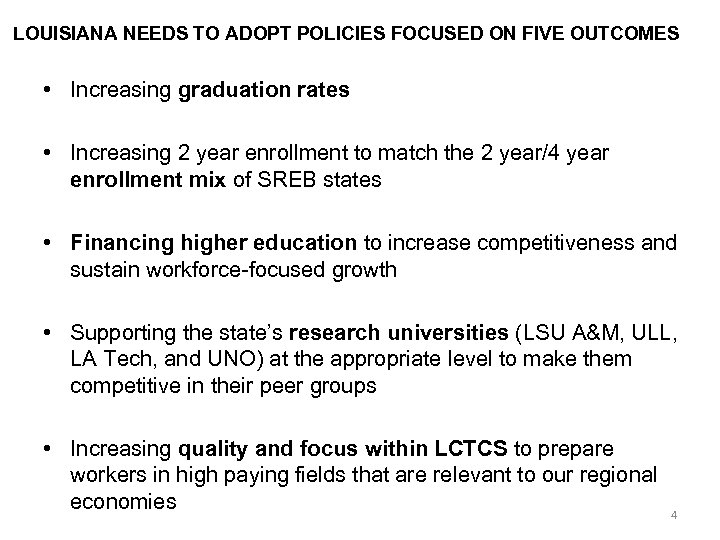
LOUISIANA NEEDS TO ADOPT POLICIES FOCUSED ON FIVE OUTCOMES • Increasing graduation rates • Increasing 2 year enrollment to match the 2 year/4 year enrollment mix of SREB states • Financing higher education to increase competitiveness and sustain workforce-focused growth • Supporting the state’s research universities (LSU A&M, ULL, LA Tech, and UNO) at the appropriate level to make them competitive in their peer groups • Increasing quality and focus within LCTCS to prepare workers in high paying fields that are relevant to our regional economies 4
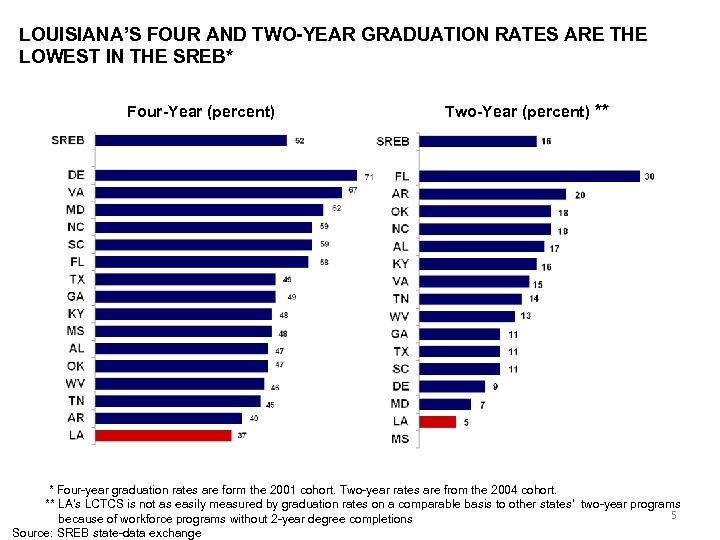
LOUISIANA’S FOUR AND TWO-YEAR GRADUATION RATES ARE THE LOWEST IN THE SREB* Four-Year (percent) Two-Year (percent) ** * Four-year graduation rates are form the 2001 cohort. Two-year rates are from the 2004 cohort. ** LA’s LCTCS is not as easily measured by graduation rates on a comparable basis to other states’ two-year programs 5 because of workforce programs without 2 -year degree completions Source: SREB state-data exchange
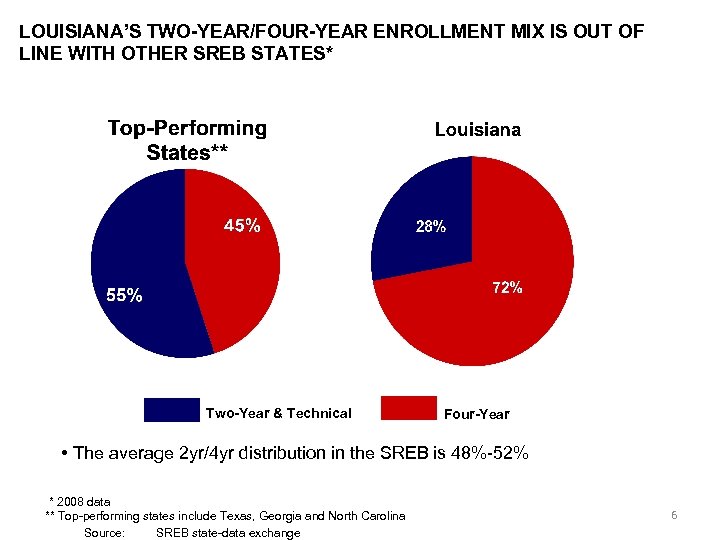
LOUISIANA’S TWO-YEAR/FOUR-YEAR ENROLLMENT MIX IS OUT OF LINE WITH OTHER SREB STATES* Two-Year & Technical Four-Year • The average 2 yr/4 yr distribution in the SREB is 48%-52% * 2008 data ** Top-performing states include Texas, Georgia and North Carolina Source: SREB state-data exchange 6
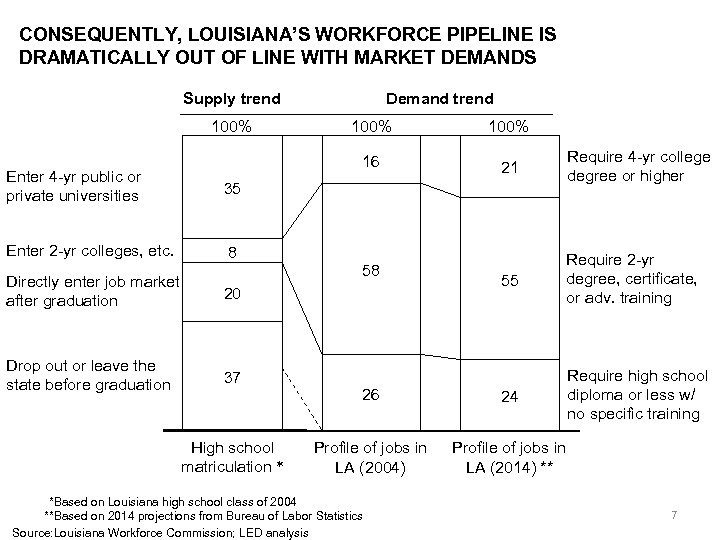
CONSEQUENTLY, LOUISIANA’S WORKFORCE PIPELINE IS DRAMATICALLY OUT OF LINE WITH MARKET DEMANDS Supply trend 100% Demand trend 21 Require 4 -yr college degree or higher 55 Require 2 -yr degree, certificate, or adv. training 26 24 Require high school diploma or less w/ no specific training Profile of jobs in LA (2004) Profile of jobs in LA (2014) ** 35 Enter 2 -yr colleges, etc. 100% 16 Enter 4 -yr public or private universities 100% 8 58 Directly enter job market after graduation 20 Drop out or leave the state before graduation 37 High school matriculation * *Based on Louisiana high school class of 2004 **Based on 2014 projections from Bureau of Labor Statistics Source: Louisiana Workforce Commission; LED analysis 7
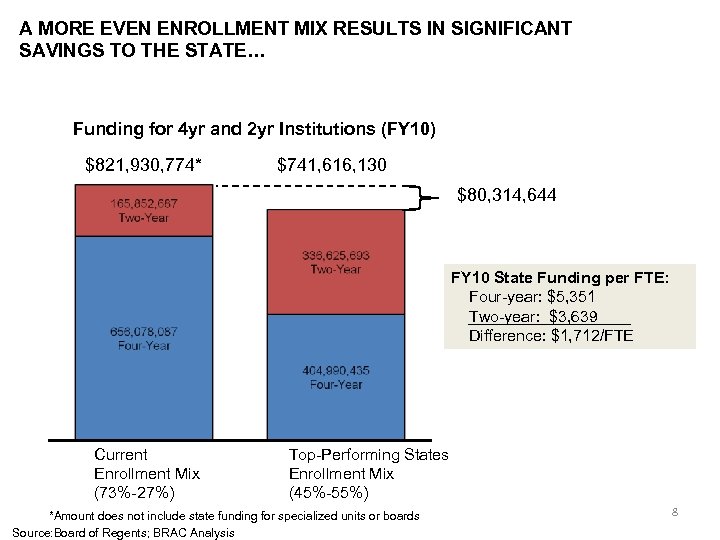
A MORE EVEN ENROLLMENT MIX RESULTS IN SIGNIFICANT SAVINGS TO THE STATE… Funding for 4 yr and 2 yr Institutions (FY 10) $821, 930, 774* $741, 616, 130 $80, 314, 644 FY 10 State Funding per FTE: Four-year: $5, 351 Two-year: $3, 639 Difference: $1, 712/FTE Current Enrollment Mix (73%-27%) Top-Performing States Enrollment Mix (45%-55%) *Amount does not include state funding for specialized units or boards Source: Board of Regents; BRAC Analysis 8
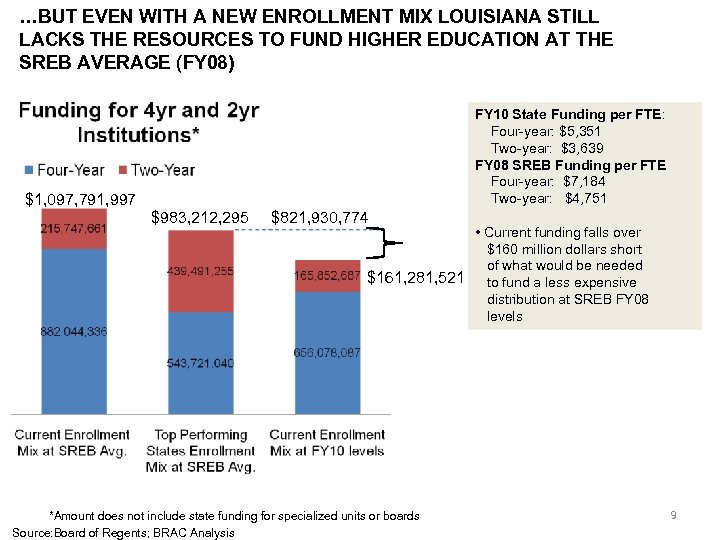
…BUT EVEN WITH A NEW ENROLLMENT MIX LOUISIANA STILL LACKS THE RESOURCES TO FUND HIGHER EDUCATION AT THE SREB AVERAGE (FY 08) FY 10 State Funding per FTE: Four-year: $5, 351 Two-year: $3, 639 FY 08 SREB Funding per FTE Four-year: $7, 184 Two-year: $4, 751 $1, 097, 791, 997 $983, 212, 295 $821, 930, 774 • Current funding falls over $160 million dollars short of what would be needed $161, 281, 521 to fund a less expensive distribution at SREB FY 08 levels *Amount does not include state funding for specialized units or boards Source: Board of Regents; BRAC Analysis 9
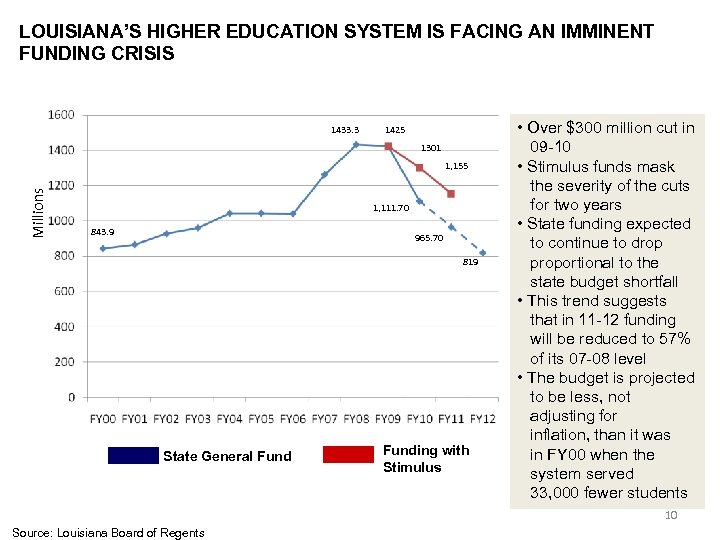
LOUISIANA’S HIGHER EDUCATION SYSTEM IS FACING AN IMMINENT FUNDING CRISIS 1433. 3 1425 1301 Millions 1, 155 1, 111. 70 843. 9 965. 70 819 State General Funding with Stimulus • Over $300 million cut in 09 -10 • Stimulus funds mask the severity of the cuts for two years • State funding expected to continue to drop proportional to the state budget shortfall • This trend suggests that in 11 -12 funding will be reduced to 57% of its 07 -08 level • The budget is projected to be less, not adjusting for inflation, than it was in FY 00 when the system served 33, 000 fewer students 10 Source: Louisiana Board of Regents
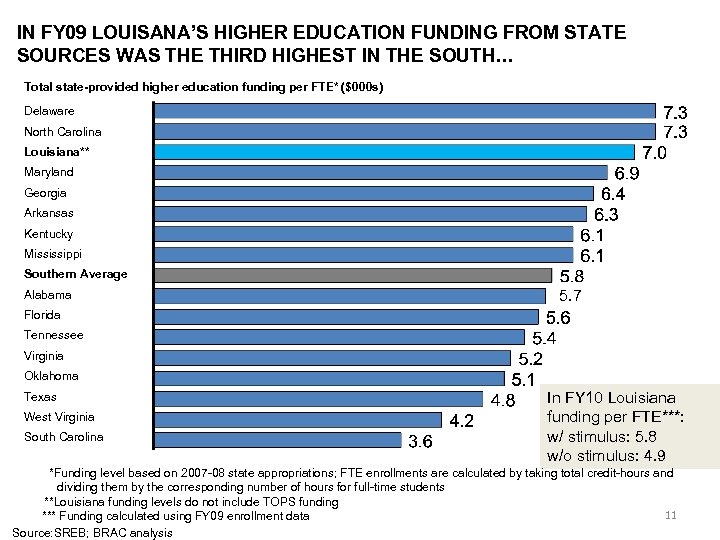
IN FY 09 LOUISANA’S HIGHER EDUCATION FUNDING FROM STATE SOURCES WAS THE THIRD HIGHEST IN THE SOUTH… Total state-provided higher education funding per FTE* ($000 s) Delaware North Carolina Louisiana** Maryland Georgia Arkansas Kentucky Mississippi Southern Average Alabama 5. 7 Florida Tennessee Virginia Oklahoma Texas West Virginia South Carolina In FY 10 Louisiana funding per FTE***: w/ stimulus: 5. 8 w/o stimulus: 4. 9 *Funding level based on 2007 -08 state appropriations; FTE enrollments are calculated by taking total credit-hours and dividing them by the corresponding number of hours for full-time students **Louisiana funding levels do not include TOPS funding 11 *** Funding calculated using FY 09 enrollment data Source: SREB; BRAC analysis
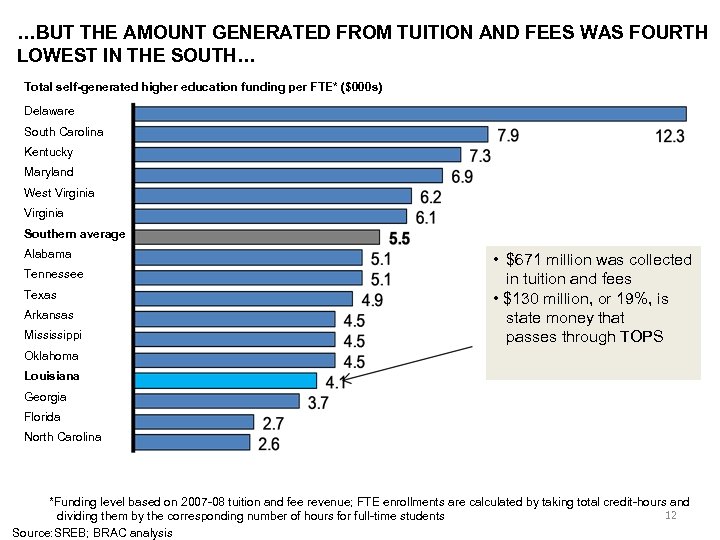
…BUT THE AMOUNT GENERATED FROM TUITION AND FEES WAS FOURTH LOWEST IN THE SOUTH… Total self-generated higher education funding per FTE* ($000 s) Delaware South Carolina Kentucky Maryland West Virginia Southern average Alabama Tennessee Texas Arkansas Mississippi • $671 million was collected in tuition and fees • $130 million, or 19%, is state money that passes through TOPS Oklahoma Louisiana Georgia Florida North Carolina *Funding level based on 2007 -08 tuition and fee revenue; FTE enrollments are calculated by taking total credit-hours and 12 dividing them by the corresponding number of hours for full-time students Source: SREB; BRAC analysis
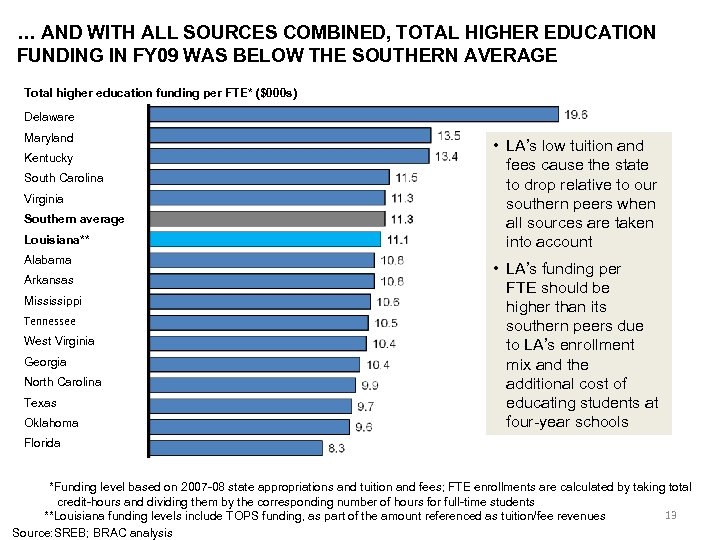
… AND WITH ALL SOURCES COMBINED, TOTAL HIGHER EDUCATION FUNDING IN FY 09 WAS BELOW THE SOUTHERN AVERAGE Total higher education funding per FTE* ($000 s) Delaware Maryland Kentucky South Carolina Virginia Southern average Louisiana** Alabama Arkansas Mississippi Tennessee West Virginia Georgia North Carolina Texas Oklahoma • LA’s low tuition and fees cause the state to drop relative to our southern peers when all sources are taken into account • LA’s funding per FTE should be higher than its southern peers due to LA’s enrollment mix and the additional cost of educating students at four-year schools Florida *Funding level based on 2007 -08 state appropriations and tuition and fees; FTE enrollments are calculated by taking total credit-hours and dividing them by the corresponding number of hours for full-time students 13 **Louisiana funding levels include TOPS funding, as part of the amount referenced as tuition/fee revenues Source: SREB; BRAC analysis
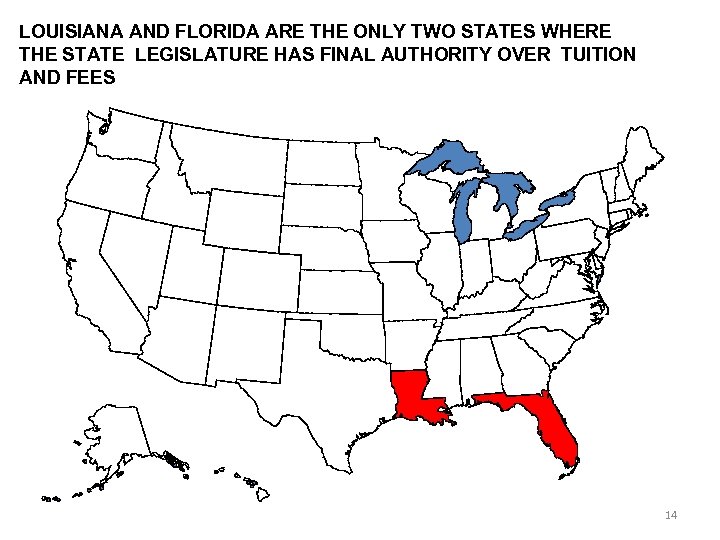
LOUISIANA AND FLORIDA ARE THE ONLY TWO STATES WHERE THE STATE LEGISLATURE HAS FINAL AUTHORITY OVER TUITION AND FEES 14
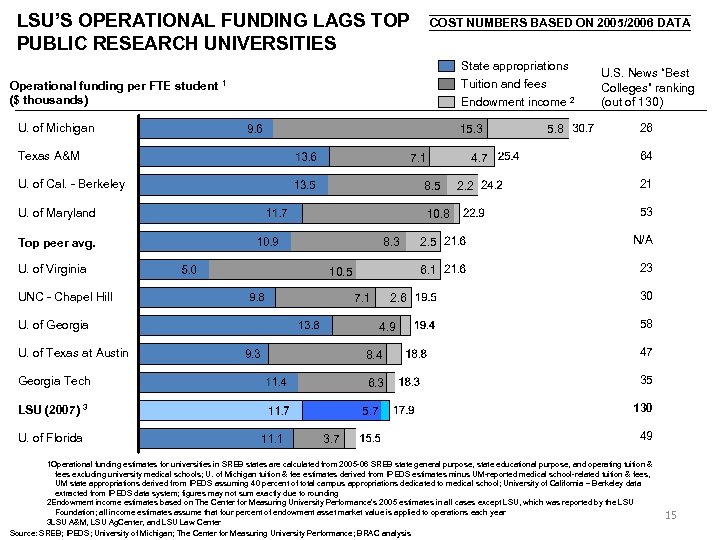
LSU’S OPERATIONAL FUNDING LAGS TOP PUBLIC RESEARCH UNIVERSITIES Operational funding per FTE student ($ thousands) COST NUMBERS BASED ON 2005/2006 DATA State appropriations Tuition and fees Endowment income 2 1 U. of Michigan 15. 3 Texas A&M 7. 1 U. of Cal. - Berkeley 8. 5 U. of Maryland 10. 8 10. 5 UNC - Chapel Hill 2. 2 26 64 21 53 7. 1 U. of Georgia 2. 6 4. 9 2. 5 N/A 6. 1 8. 3 Top peer avg. U. of Virginia 4. 7 5. 8 U. S. News “Best Colleges” ranking (out of 130) 23 30 58 U. of Texas at Austin 8. 4 47 Georgia Tech 6. 3 35 LSU (2007) 3 U. of Florida 5. 7 3. 7 130 49 1 Operational funding estimates for universities in SREB states are calculated from 2005 -06 SREB state general purpose, state educational purpose, and operating tuition & fees excluding university medical schools; U. of Michigan tuition & fee estimates derived from IPEDS estimates minus UM-reported medical school-related tuition & fees, UM state appropriations derived from IPEDS assuming 40 percent of total campus appropriations dedicated to medical school; University of California – Berkeley data extracted from IPEDS data system; figures may not sum exactly due to rounding 2 Endowment income estimates based on The Center for Measuring University Performance’s 2005 estimates in all cases except LSU, which was reported by the LSU Foundation; all income estimates assume that four percent of endowment asset market value is applied to operations each year 3 LSU A&M, LSU Ag. Center, and LSU Law Center Source: SREB; IPEDS; University of Michigan; The Center for Measuring University Performance; BRAC analysis 15
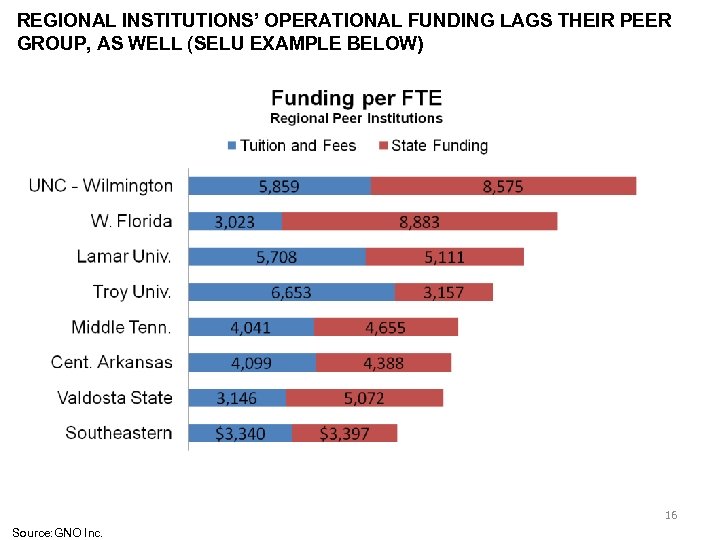
REGIONAL INSTITUTIONS’ OPERATIONAL FUNDING LAGS THEIR PEER GROUP, AS WELL (SELU EXAMPLE BELOW) 16 Source: GNO Inc.
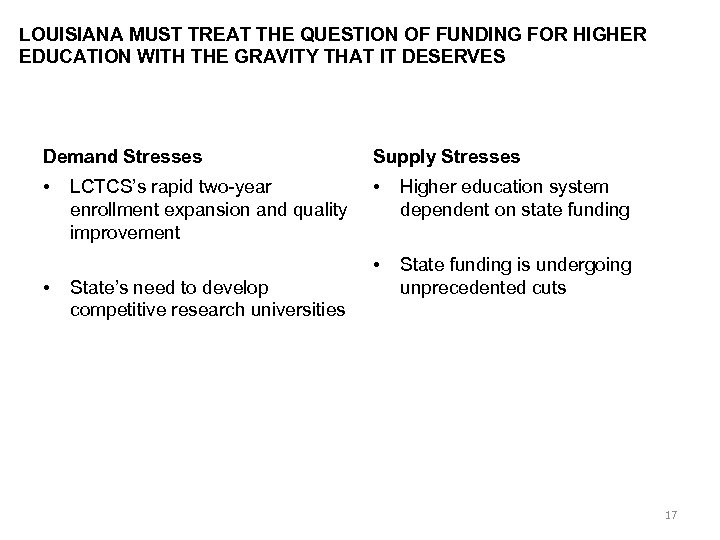
LOUISIANA MUST TREAT THE QUESTION OF FUNDING FOR HIGHER EDUCATION WITH THE GRAVITY THAT IT DESERVES Demand Stresses Supply Stresses • • Higher education system dependent on state funding • State funding is undergoing unprecedented cuts • LCTCS’s rapid two-year enrollment expansion and quality improvement State’s need to develop competitive research universities 17
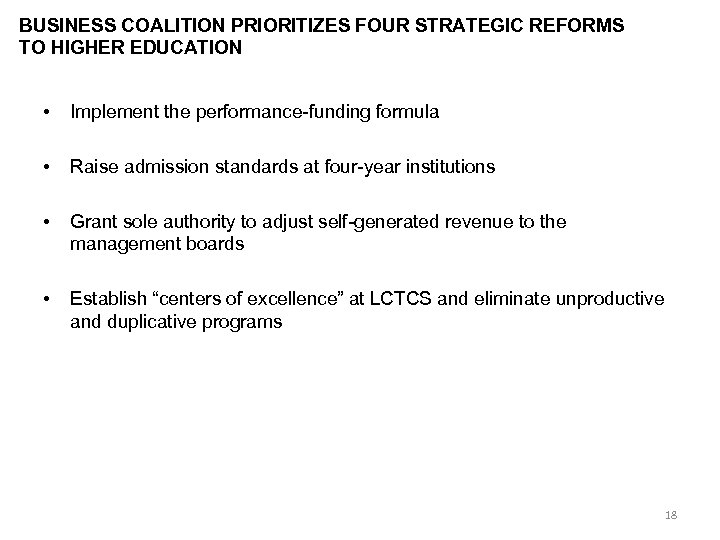
BUSINESS COALITION PRIORITIZES FOUR STRATEGIC REFORMS TO HIGHER EDUCATION • Implement the performance-funding formula • Raise admission standards at four-year institutions • Grant sole authority to adjust self-generated revenue to the management boards • Establish “centers of excellence” at LCTCS and eliminate unproductive and duplicative programs 18
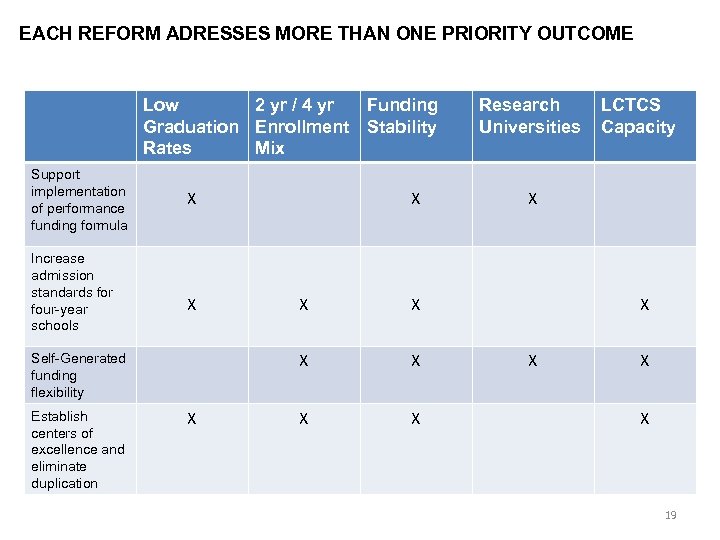
EACH REFORM ADRESSES MORE THAN ONE PRIORITY OUTCOME Low 2 yr / 4 yr Graduation Enrollment Rates Mix Support implementation of performance funding formula Increase admission standards for four-year schools X X X X Research Universities LCTCS Capacity X X X Self-Generated funding flexibility Establish centers of excellence and eliminate duplication Funding Stability X X 19
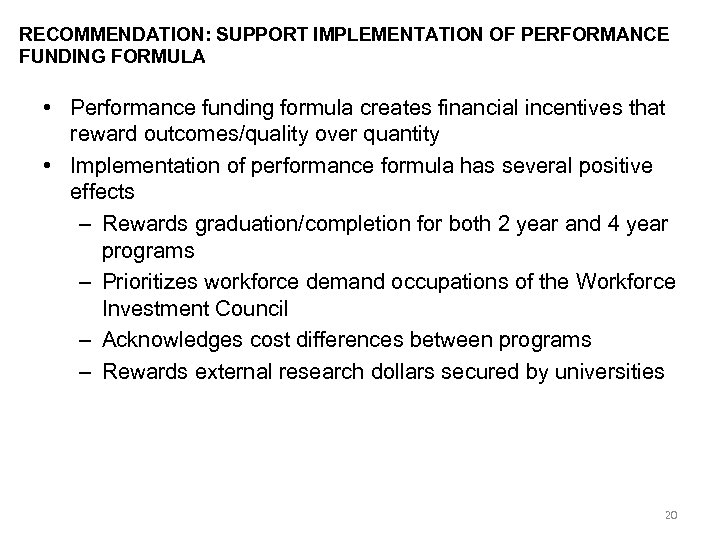
RECOMMENDATION: SUPPORT IMPLEMENTATION OF PERFORMANCE FUNDING FORMULA • Performance funding formula creates financial incentives that reward outcomes/quality over quantity • Implementation of performance formula has several positive effects – Rewards graduation/completion for both 2 year and 4 year programs – Prioritizes workforce demand occupations of the Workforce Investment Council – Acknowledges cost differences between programs – Rewards external research dollars secured by universities 20
RECOMMENDATION: RAISE ADMISSION STANDARDS AT FOURYEAR SCHOOLS FOR FALL 2011 • Higher admission standards across all four-year campuses is expected to increase graduation rates • Encourages students who may not be prepared to excel at a fouryear school to enroll in the LCTCS system. (Note: students taking this path will have the option to transfer to a four-year school after two years or enter the workforce with an associates degree after two years) • Increases the number of people who have access to programs for in -demand occupations • Ensures that students will be prepared for upper level courses when they transfer • Gives students more opportunities to choose a major that is right for them as opposed to opting for a general studies degree Note: Successful implementation of increased admission standards also requires finalizing reliable and straightforward articulation agreements between two-year and four-year institutions (RS, 2009; Act 356) 21
RECOMMENDATION: GRANT MANAGEMENT BOARDS FLEXIBILITY OVER SELF GENERATED REVENUES • Implement a solution for management boards to have full or partial autonomy over self-generated revenues, such as fees • Approval of self-generated revenues are typically managed by higher education boards, rather than Legislatures • Self generated revenues in Louisiana are among the lowest in the South and US • If fees increase, campuses should provide financial resources to students with greater financial challenges in order to address access to education for all families Note: Maintaining authority over self-generated revenues should be reliant on consistently meeting institutional performance goals. If an institution fails to meet performance goals after four years then authority over self-generated revenues should return to the legislature. Performance goals will be set relative to peer institutions in the South. 22
RECOMMENDATION: ESTABLISH LCTCS “CENTERS OF EXCELLENCE” AND ELIMINATE UNPRODUCTIVE AND DUPLICATIVE PROGRAMS • BOR and LCTCS should create specialized centers at select locations to build best-in-class programs in fields that are relevant to regional economies • LCTCS has plans for several of these centers but lacks the funding to implement the programs • Many community and technical college campuses offer a variety of programs that do not graduate many students and do not align with the needs of the community • Strategic elimination of unproductive or duplicative programs • Regions should continue to build relationships with business and industry to develop programs for high demand occupations Note: Establishment of Centers of Excellence should be coupled with a strengthening of the relationship between LCTCS and local high schools so that students can be fully informed about the opportunities offered in the LCTCS system 23
Скачать презентацию POST-SECONDARY EDUCATION REFORM IN LOUISIANA Business Coalition on
be6c6d6da32cb4abfe2ef922fdcbae2e.ppt