


 Скачать презентацию Post OPT Visa Options for Students and Scholars
74380e105720880be332f7b26e82e380.ppt
- Количество слайдов: 60
 Post OPT Visa Options for Students and Scholars, including Investment, Innovation and Entrepreneur Categories University of California, Davis April 13, 2016 BERNARD P. WOLFSDORF Attorney At Law Wolfsdorf Rosenthal LLP 1 -800 -VISA-LAW visalaw@wolfsdorf. com WWW. WOLFSDORF. COM © 2016 Wolfsdorf Rosenthal LLP (all rights reserved) • 1
 WOLFSDORF ROSENTHAL LLP • State Bar of California Certified Specialist in Immigration & Nationality Law • 20 lawyers offering full-service global immigration mobility services • Offices in Santa Monica, CA and New York, NY. • Bernard Wolfsdorf is the Who’s Who Legal “Immigration Lawyer of the Year for 2015, 2014, 2013, 2012, 2011 and 2010 (Official research partner of ABA). • Bernard Wolfsdorf is past President of the 14, 000 lawyer American Immigration Lawyers Association (AILA). • Member of ABIL, Global Alliance of Business Immigration Lawyers with 35 top immigration law firms, and over 1, 200 professionals providing highest standards of care and legal ability. • Operates in 40 gateway cities throughout the world, providing comprehensive personalized coverage available. • Allows us to offer full immigration services in over 100 countries. • 2
 Our Team
 B-1 Business Visitor Visa • B-1 facilitates business travel to the U. S. , which includes attending meetings, transacting business and even setting up a company. • Can be “in process” of investing useful for U. S. based entrepreneurs as a “prospective investor”. • Entrepreneur must be careful to not cross the line and engage in work rather than business. • Business activities must be in furtherance of facilitating international trade or commerce rather that being labor for hire. • B-1 in lieu of H-1 B visa permissible under narrow circumstances. • 4
 Investment & Entrepreneur Activities • Investing in the stock market or real estate (Permissible to single trades but not to be day trader; can only sell own condo/house) • Starting an on-line business (severely restricted) • Investing in an American friend’s business idea (generally okay) • Buying a business and running it (needs a work visa) • Selling a car (okay) versus selling cars (not permissible without employment authorization) • 5
 Students and Entrepreneur Activities • Is activity employment requiring work authorization? • Is work authorization available to the individual? • Will work authorization lead to long term status through the business or is person facing a “dead end”? • Important to make sure that even if self-employment is permissible on OPT, there is a path to another visa • such as H-1 B or E-2 • 6
 Restricted Employment vs. Permissible Passive Investment • Passive investment consists of: • Putting money into a business or enterprise but not working in same. • Includes investments in stocks and bonds, real property, active businesses. • Very easy to cross the line into employment: • for example, own a restaurant and manager is sick -- still not allowed to help. • If the investment becomes the primary or sole source of income, is it work? • For example, day trading in stocks not allowed. • Can paint but can’t sell painting within the U. S. • 7
 Optional Practical Training (OPT) • Optional Practical Training (OPT) – 1 year • Training must be in major field of study • Full-time employment after graduation and only 20 hours per week while still in school • Must wait for EAD card to start working • Make sure your I-20 is endorsed for employment • Don’t forget to apply! • 90 days prior to program end date; or • 60 days after program end date • Always check with your school for exact filing dates and program end dates as they vary greatly. • 8
 Optional Practical Training (OPT) • Unemployment periods • 90 days of unemployment = out of status (regular 12 month OPT) • 150 days of unemployment = out of status (STEM 36 month OPT) • How to avoid periods of “unemployment” • Volunteer – minimum 20 hours in your field of study • Tip: Stay in close contact with your ISO • 60 day grace period once OPT ends (or once your change of status petition is denied/revoked/withdrawn). • 9
 STEM OPT Extension • 24 -Month Extension of OPT (total 36 months!) STEM degree graduates only (Science, Technology, Engineering, Mathematics) • Make sure you check the list, your degree may qualify. You can check the list at: www. ice/gov/sevis. • Job must directly relate to degree major (most recent degree OR sometimes a prior STEM degree earned United States) • Employer must be registered with E-Verify • New wage requirements – salary commensurate with similarly situated workers • 10 • Employer REQUIRED to complete formal Training Plan with student
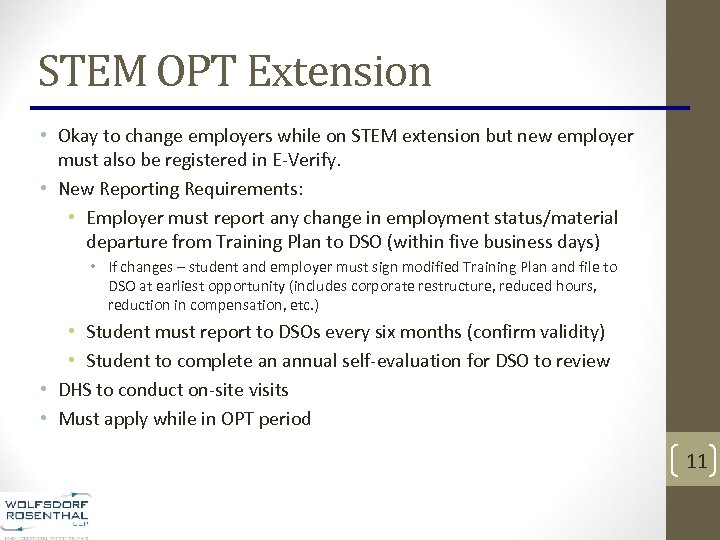 STEM OPT Extension • Okay to change employers while on STEM extension but new employer must also be registered in E-Verify. • New Reporting Requirements: • Employer must report any change in employment status/material departure from Training Plan to DSO (within five business days) • If changes – student and employer must sign modified Training Plan and file to DSO at earliest opportunity (includes corporate restructure, reduced hours, reduction in compensation, etc. ) • Student must report to DSOs every six months (confirm validity) • Student to complete an annual self-evaluation for DSO to review • DHS to conduct on-site visits • Must apply while in OPT period • 11
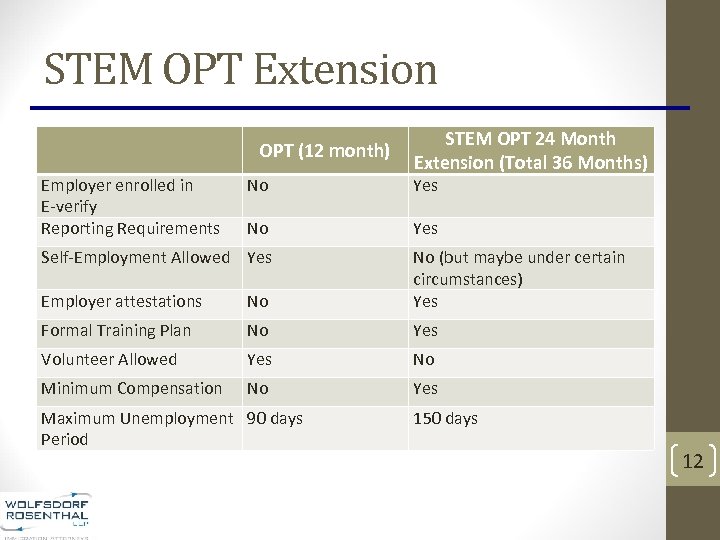 STEM OPT Extension Employer enrolled in E-verify Reporting Requirements OPT (12 month) STEM OPT 24 Month Extension (Total 36 Months) No Yes Self-Employment Allowed Yes Employer attestations No No (but maybe under certain circumstances) Yes Formal Training Plan No Yes Volunteer Allowed Yes No Minimum Compensation No Yes Maximum Unemployment 90 days Period 150 days 12
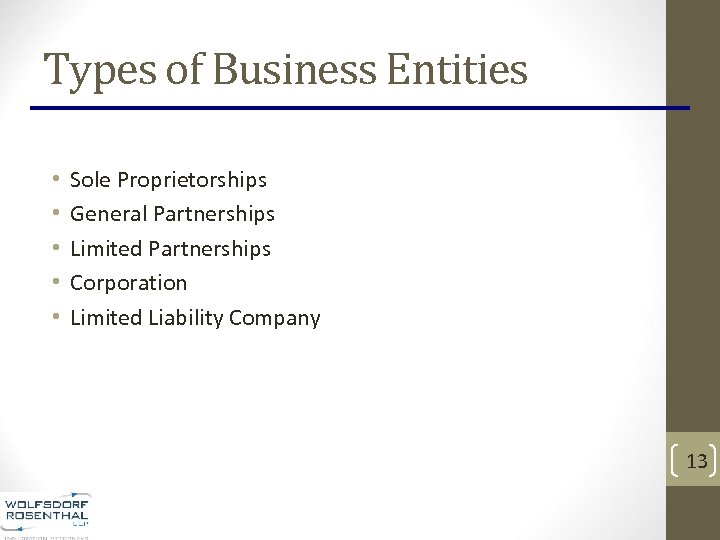 Types of Business Entities • • • Sole Proprietorships General Partnerships Limited Partnerships Corporation Limited Liability Company • 13
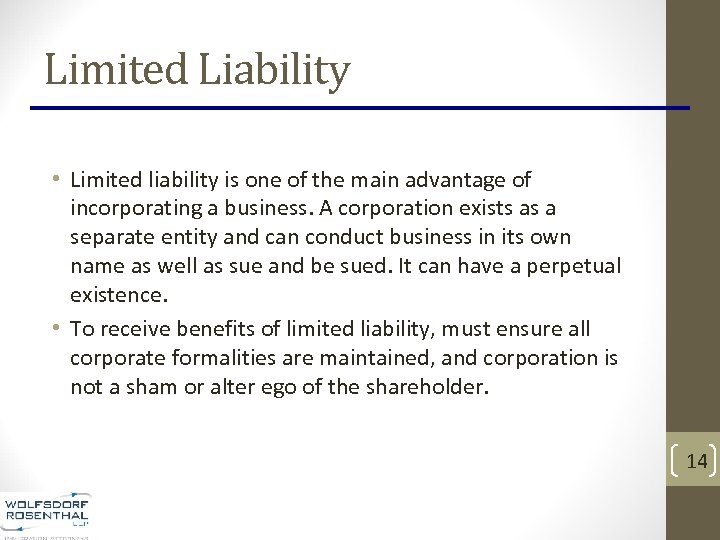 Limited Liability • Limited liability is one of the main advantage of incorporating a business. A corporation exists as a separate entity and can conduct business in its own name as well as sue and be sued. It can have a perpetual existence. • To receive benefits of limited liability, must ensure all corporate formalities are maintained, and corporation is not a sham or alter ego of the shareholder. • 14
 Incorporation • Advantageous for closely held corporation to incorporate in state where it is doing business rather than incorporate in Delaware. But where corporation may do business in more than one state, then may want to consider other state. • Delaware corporation has advantages such as: • Majority of shareholders is sufficient to authorize a merger, sale or dissolution; • May issue stock options upon approval of directors only, no need for shareholder vote; • Dividends may be paid out of net profit rather than surplus. • 15
 Incorporation • Organization tax rates are significantly lower in Delaware; • A natural person as well as corporate entity, partnership, or association can serve as an incorporator; • Permits shareholder action by written consent if signed by the requisite number of shareholders necessary to take such action. • 16
 H-1 B Issues for Start-Up Business • Must establish company with employer tax I. D. number • Company can be 100% owned by H-1 B employee: • Must be W-2 employee • Company separate entity from owner/employee • Independent Board of Directors or other mechanism • Employment contract • 17
 H-1 B Issues for Start-Up Business • Company must prove • Financial ability to pay salary • - Profits and/or capitalization • Real job to be done by H-1 B • Place of business • 18
 H-1 B Issues for Start-Up Business • Importance of business plan/financial projections • Other employees helpful – not required • Prevailing Wage • CEO vs. function-descriptive position • “Specialty Occupation” • Use of concepts learned in courses • 19
 Intracompany Transferee (L-1) Visas • National of any country • No quota • Length of visa • Start up 1 year • Established business 3 years • Maximum length 7 years • 20
 Intracompany Transferee (L-1) Visas • Start-up issues • Place of business • Employees • Capitalization • Need for “manager” • Business plan and financial projections • 21
 Treaty (E) Visas • E-1/E-2 Treaty Trade and Treaty Investor Visas for entrepreneurs/business. • Must have treaty between U. S. and Treaty country • Treaty Country list at: http: //travel. state. gov/content/visas/en/fees/ reciprocity-by-country. html. At least 50% of company must be owned by Treaty country • Can start-up company or buy a company as E-1 or E-2 • 22
 Treaty (E) Visas • Treaty trader (E-1) • At least 50% of trade must be between Treaty Country and U. S. • Import-export • Trade is substantial • 23
 Treaty (E) Visas • Treaty investors (E-2) • “Substantial” investment • No exact $ amount • Varies depending upon type of investment • Relevant issues • • Amount of investment Number of employees Needs of business Likely profitability and growth potential • Business plan and financial projections critical • 24
 O-1 Visas • O-1 Alien of Extraordinary Ability in Arts, Science, Education or Sports – a startup may also sponsor a founder on an O-1 visa provided the founder can establish extraordinary ability • For business, must be at the very top of the field – high standard that is not applied very rigidly. • Extensive documentation demonstrating the applicant’s accomplishments, such as major awards, high salary, press articles about the applicant, and/or holding a lead or critical position with high-profile or very successful companies, is required to meet this burden of proof. • 25
 Immigrant Visa (“Green Card”) Options • • • Green Card Lottery (www. travel. state. gov) 50, 000 green cards Diversity Immigrant Visa Program – aka DV lottery Over 9 million apply Over 125, 000 “winners” Registration period o October/early November o No application fee • Must be eligible to participate • 26
 Green Card Lottery • Based on country of birth (not citizenship) • Countries that have previously NOT been eligible include: • Bangladesh, Brazil, Canada, P. R. China, Colombia, Dominican Republic, Ecuador, El Salvador, Haiti, India, Jamaica, Mexico, Pakistan, Peru, Philippines, Poland, South Korea, United Kingdom (except Northern Ireland) and Vietnam • Persons born in Hong Kong SAR, Macau SAR and Taiwan are eligible! • “Cross-charge” to spouse’s country of birth. • 27
 Immigrant Visa (“Green Card”) Options • Family Based Immigrant Visas • Immediate Relative: spouse, parent, minor children of U. S. citizens • Immediate benefits – work permit and travel document within 2 -3 months • 4 -6 month processing • Conditional 2 year green card (marriage cases) • Adult child must be 21 years old • 28
 Family Based Immigrant Visas • Unmarried Adult Children of U. S. citizens (F 1) (6 – 8 year backlog) • Spouse/Children of Legal Permanent Resident (LPR) (F 2 A) (1+ year backlog) • Unmarried adult children of LPR (F 2 B) (8 -10 year backlog) • Married adult children of U. S. citizens (F 3) (10 -12 year backlog) • Brothers and sisters of U. S. citizens (F 4) (10 -15 year backlog) • 29
 Employment Based Immigrant Visas (EB-1 through EB-5) • EB-1 (First Preference) • Aliens of Extraordinary Ability • Outstanding Researchers/Professors • Multinational Executives and Managers (green card version of L-1 A) • 30
 Employment-Based, First Preference Immigrant Visa (EB-1) • Foreign Nationals of Extraordinary Ability • Reserved for recipients of a one-time achievement (major, international award) or at least 3 out of 10 criteria evidencing that the applicant has risen to the very top of the field. Important to define your field at the very outset of your case. • Self-petition or employer-sponsored. • If already granted an O-1, may qualify for an EB-1. Similar criteria, but EB-1 standard much higher in practice. • 31
 The First Step: EB-1 Criteria • Lesser nationally or internationally recognized prizes or awards for excellence in the field; • Membership in associations that require outstanding achievements as judged by recognized experts in the field; • Published material about the applicant in professional or major trade publications or other major media about his or her work in the field; • Participation as a judge of the work of others in the same or an allied field; • Original scientific contributions of major significance to the field; • 32
 EB-1 Criteria (cont. ) • Authorship of scholarly articles in the field, published in professional or major trade publications or other major media; • Display of the applicant’s work in the field at artistic exhibitions or showcases; • Performance in a leading or critical role for organizations or establishments with distinguished reputations; • Commanding a high salary or other significantly high remuneration for services in relation to others in the field; and • Evidence of commercial success in the performing arts. • 33
 Comparable Evidence • When the criteria do not readily apply to the applicant’s occupation, comparable evidence of extraordinary ability may be submitted to establish eligibility. • Several of the criteria, e. g. evidence of success in the performing arts, do not apply to the sciences, so ALWAYS argue comparable evidence. For example, scientists cannot argue display of work in artistic showcases, but comparable recognition for achievements would be presentation of work at prestigious national and international conferences in the field. Invited and oral presentations are particularly persuasive evidence. • 34
 The Second Step: The Final Merits Determination • Incredibly subjective – predicting outcomes in EB-11 adjudications is extremely difficult. An applicant may satisfy 3 or more criteria but still be denied at this stage. • Whatever the evidence submitted to satisfy at least 3 of the 10 criteria, it must be consistent with the claim that you have enjoyed sustained national or international acclaim and recognition for achievements. For example, reviewing 1 manuscript, authoring 1 article, and receiving 1 lesser known award over the course of an entire career may satisfy the minimum number of criteria without demonstrating eligibility for extraordinary ability classification. • 35
 Final Merits Determination Issues Specific to Researchers • The quality (rank and impact factor) of the journals in which you have published scholarly articles is important. • The number of articles and the period over which they were published is relevant – acclaim must be “sustained. ” • This is also true for review work – the more articles you have been asked to review, the more likely it is you will be seen as having distinguished yourself within the field. You can always volunteer to be a peer reviewer, but a handful of reviews will over a short period of time is likely not get you past the Final Merits Determination. • Student awards and scholarships are generally discounted completely. Similarly, grants are considered funding for future work rather than recognition for prior achievements. • 36
 Final Merits Determination Issues (cont. ) • How to establish critical or lead role: • The role must be critical or leading within the organization or establishment, not merely a single project. However, think of arguments to support the position that a project or projects are critical to the mission of the institution and thus how your role satisfies this criterion. • Choose your referees carefully! • Reference letters from top scientists in your field are important to both the critical/lead role and original contributions of major significance criteria. The more acclaimed and accomplished your referee, however, the less extraordinary you may appear to the adjudicating officer. • 37
 EB-2 National Interest Waiver (NIW) • Can self-petition (no employer required) • Three prong test: • Work has substantial intrinsic merit • Work is national in scope • The national interest would be adversely affected if the labor certification requirement were not waived. • 38
 NIW (continued) • How to satisfy the third prong: must demonstrate that you have had some impact on the field as a whole. • Arguing that the work is so important that any person performing it should receive an NIW will not be successful – you must establish that you have had “some degree of influence” on the field. • Lower standard than extraordinary ability but many of the same criteria considered in practice for researchers. • Unlike the EB-1, you do not have to show that you have risen to the top of the field not a rigorous comparative standard. However, must still establish that you have distinguished yourself and impacted the field. • 39
 Issues Specific to Researchers • Publications: • First author is a very strong factor. • The lower your name appears in the list of co-authors, the more difficult it becomes to attribute any impact on the field to you. • A limited publication record can be overcome by a high citation record. • Large Collaborations: • The larger the group in which you are working, the less willing USCIS is to credit you with the contribution to the field. • Reference letters are important evidence of your critical role in a project. • 40
 NIW Processing • Same as EB-1, but employment-based second preference has a backlog for those born in China and India. • No premium processing available for NIWs. • Chinese and Indian-born may elect to file an NIW to establish a priority date and then try to build up EB-1 case. • 41
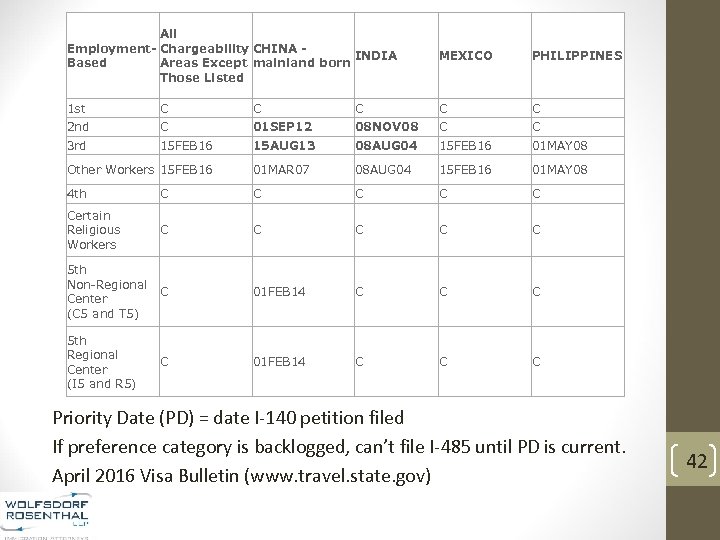 All Employment- Chargeability CHINA INDIA Based Areas Except mainland born Those Listed MEXICO PHILIPPINES 1 st C C C 2 nd C 01 SEP 12 08 NOV 08 C C 3 rd 15 FEB 16 15 AUG 13 08 AUG 04 15 FEB 16 01 MAY 08 Other Workers 15 FEB 16 01 MAR 07 08 AUG 04 15 FEB 16 01 MAY 08 4 th C C Certain Religious Workers C C C 5 th Non-Regional Center (C 5 and T 5) C 01 FEB 14 C C C 5 th Regional Center (I 5 and R 5) C 01 FEB 14 C C C Priority Date (PD) = date I-140 petition filed If preference category is backlogged, can’t file I-485 until PD is current. April 2016 Visa Bulletin (www. travel. state. gov) • 42
 Requests for Evidence • Requests for Evidence (RFEs) are not uncommon with E 11 s or NIWs. • RFEs must be read carefully – they often contain inaccurate statements of fact that should be corrected in the RFE response. • Don’t assume the officer did his job – if the RFE suggests the officer failed to consider some evidence, but sure to point this out. • A common complaint in RFEs is that the applicant is relying solely or primarily on reference letters to establish original contribution or influence on the field – make sure to point out how other evidence (publications in high impact journals, presentations in leading venues in the field, etc. ) corroborate the assertions made in the letters. • 43
 Employment Based Immigrant Visas (EB-1 through EB-5) • EB-2 (Second Preference) • Schedule A, Group II Alien of Exceptional Ability in Arts, Sciences or Performing Arts • Advanced Degree Holders • Masters or higher degree or foreign equivalent • BA plus five years progressive experience • National Interest Waiver • Special Handling for University/College Teachers • EB-3 (Third Preference) • Professionals with BA degree or foreign equivalent • Skilled Workers with 2 years experience • Other Workers • 44
 Immigrant Visa (“Green Card”) Options • EB-2 vs. EB-3 – why does it matter? • Retrogression • EB-2 vs. EB-3 processing times • Backlogged countries: China and India • 45
 PERM LC Process • Step 1: PERM Labor Certification process • USCIS and DOL • Employer must conduct “good faith” recruitment efforts and show there is no qualified U. S. worker to do the job • 2 Sunday newspaper ads • 3 additional forms of recruitment if professional position • Step 2: I-140 Immigrant Visa petition • Step 3: I-485 Adjustment of Status Application (AOS) • Employment Authorization Document (EAD) and Advance Parole travel document • Issued within 60 -90 days of filing AOS • 46
 PERM Issues • Deciding between EB-2 and EB-3 • NOT based on alien’s educational background • Based on actual minimum requirements for job • What doesn’t work: • Tailoring minimum job requirements to your experience or education • Foreign language requirements • Generally cannot use employment experience gained with sponsoring employer • 47
 Common Green Card Issues • When to Start Green Card Process • Latest: 4. 5 years into H-1 B • Why? • 2 ways to extend H-1 B beyond 6 years • Green card application pending for more than 1 year (one-year increments) • I-140 approved and cannot file I-485 (Step 3) application because of backlogs or “retrogression” (three-year increments) • 48
 Other Immigrant Visas • EB-4 Religious Worker • EB-5 “Million Dollar Investor Green Card” • $1 million investment/10 direct jobs/new commercial enterprise • $500, 000 in area of high unemployment • Must create 10 jobs • EB-5 Regional Center Programs: • • $500, 000 in pre-approved program Direct or indirect jobs Pooled investment Loan or equity model • 49
 EB-5 Requirements • Investment in a “new commercial enterprise” • Established after November 29, 1990; or • Restructured or reorganized (both very difficult); • 40% increase in net worth or number of employees • Equity or loan investment • Investment “at risk” • Amount of investment • $1, 000; or • $500, 000 if “targeted employment area” (TEA) or rural area • 50
 Stand-alone or Direct EB-5 • Engaged in management-not as popular as Regional Center • Less than 2% of cases filed because only direct job count • Money used for job creation • Proof of job creation: • 10 full time employees • Job descriptions • Job creation timeline • 51
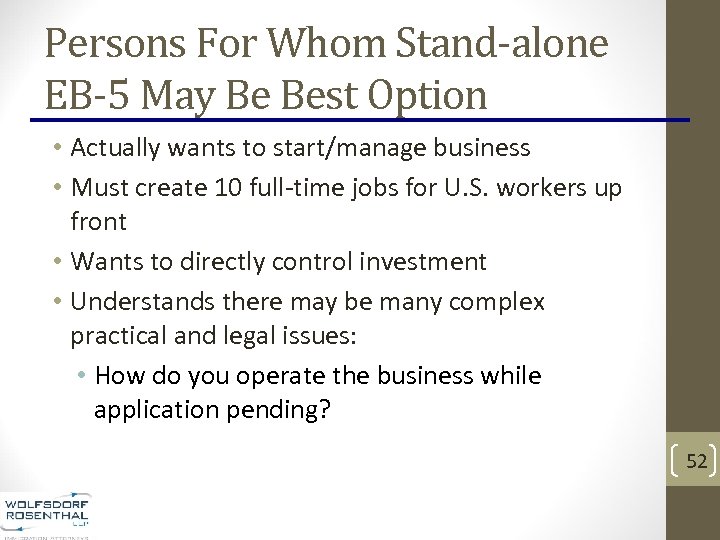 Persons For Whom Stand-alone EB-5 May Be Best Option • Actually wants to start/manage business • Must create 10 full-time jobs for U. S. workers up front • Wants to directly control investment • Understands there may be many complex practical and legal issues: • How do you operate the business while application pending? • 52
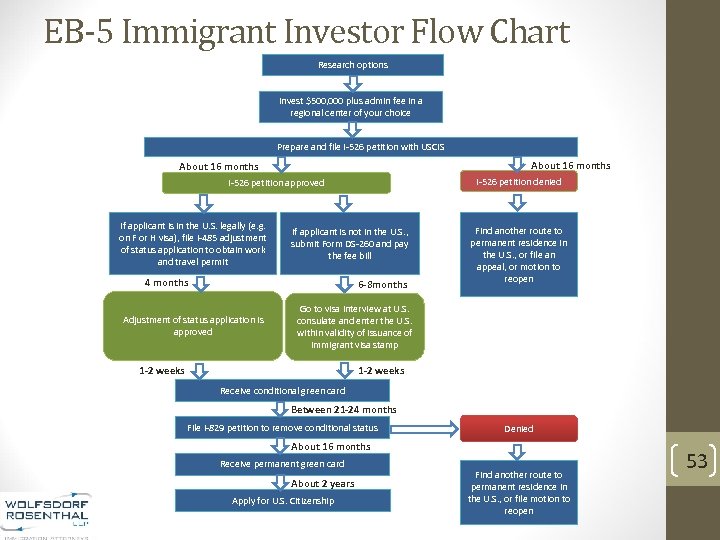 EB-5 Immigrant Investor Flow Chart Research options Invest $500, 000 plus admin fee in a regional center of your choice Prepare and file I-526 petition with USCIS About 16 months I-526 petition denied I-526 petition approved If applicant is in the U. S. legally (e. g. on F or H visa), file I-485 adjustment of status application to obtain work and travel permit If applicant is not in the U. S. , submit Form DS-260 and pay the fee bill 4 months 6 -8 months Adjustment of status application is approved Find another route to permanent residence in the U. S. , or file an appeal, or motion to reopen Go to visa interview at U. S. consulate and enter the U. S. within validity of issuance of immigrant visa stamp 1 -2 weeks Receive conditional green card Between 21 -24 months File I-829 petition to remove conditional status Denied About 16 months Receive permanent green card About 2 years Apply for U. S. Citizenship Find another route to permanent residence in the U. S. , or file motion to reopen • 53
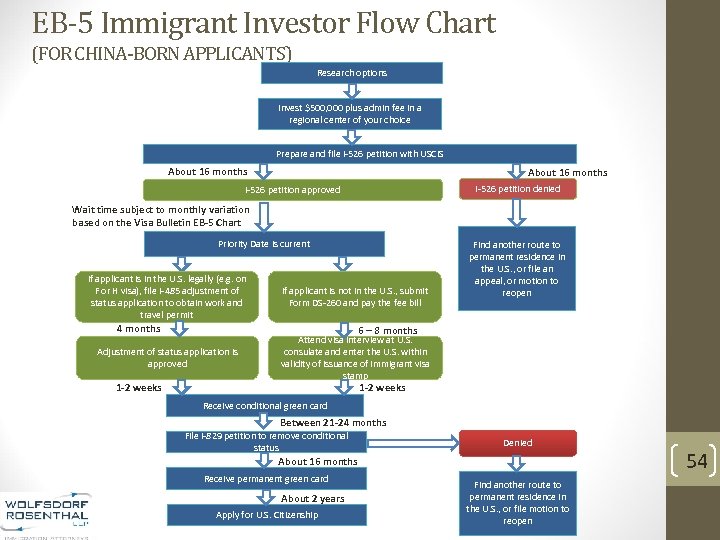 EB-5 Immigrant Investor Flow Chart (FOR CHINA-BORN APPLICANTS) Research options Invest $500, 000 plus admin fee in a regional center of your choice Prepare and file I-526 petition with USCIS About 16 months I-526 petition denied I-526 petition approved Wait time subject to monthly variation based on the Visa Bulletin EB-5 Chart Priority Date is current If applicant is in the U. S. legally (e. g. on F or H visa), file I-485 adjustment of status application to obtain work and travel permit 4 months 6 – 8 months Adjustment of status application is approved 1 -2 weeks If applicant is not in the U. S. , submit Form DS-260 and pay the fee bill Find another route to permanent residence in the U. S. , or file an appeal, or motion to reopen Attend visa interview at U. S. consulate and enter the U. S. within validity of issuance of immigrant visa stamp 1 -2 weeks Receive conditional green card Between 21 -24 months File I-829 petition to remove conditional status Denied About 16 months Receive permanent green card About 2 years Apply for U. S. Citizenship Find another route to permanent residence in the U. S. , or file motion to reopen • 54
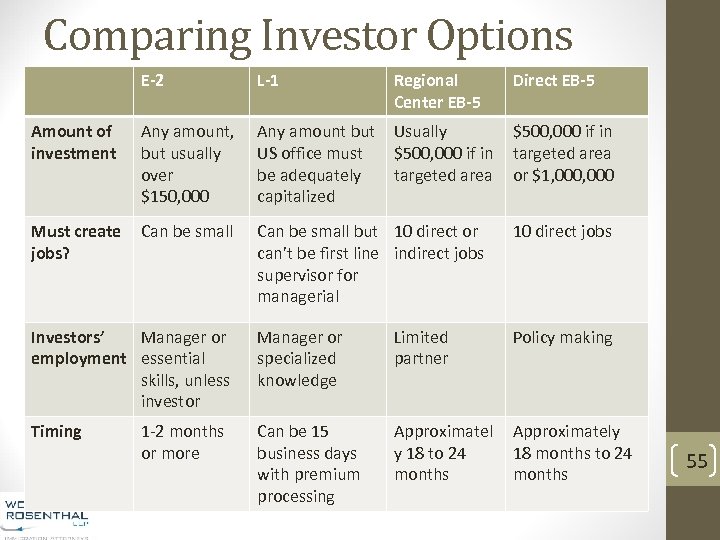 Comparing Investor Options E-2 Amount of investment L-1 Regional Center EB-5 Direct EB-5 Any amount, but usually over $150, 000 Any amount but Usually $500, 000 if in US office must $500, 000 if in targeted area be adequately targeted area or $1, 000 capitalized Must create Can be small jobs? Can be small but 10 direct or can’t be first line indirect jobs supervisor for managerial 10 direct jobs Investors’ Manager or employment essential skills, unless investor Manager or specialized knowledge Limited partner Policy making Timing Can be 15 business days with premium processing Approximatel y 18 to 24 months Approximately 18 months to 24 months 1 -2 months or more • 55
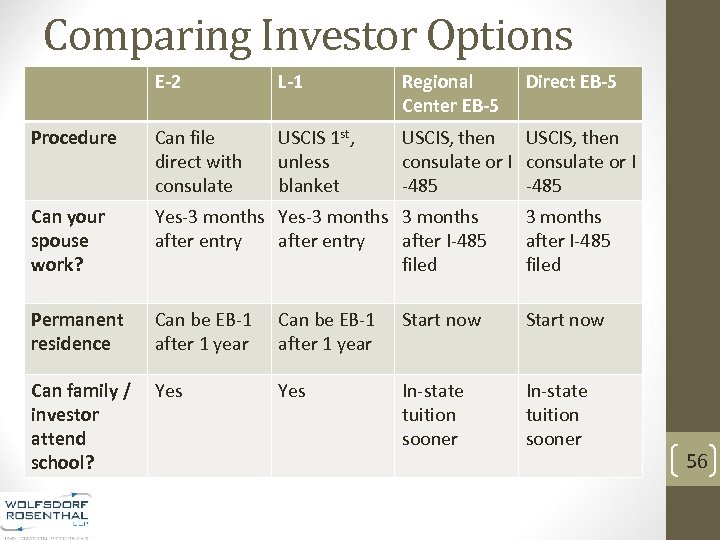 Comparing Investor Options E-2 L-1 Regional Center EB-5 Procedure Can file direct with consulate USCIS 1 st, unless blanket USCIS, then consulate or I -485 Can your spouse work? Yes-3 months after entry after I-485 filed 3 months after I-485 filed Permanent residence Can be EB-1 after 1 year Can family / Yes investor attend school? Direct EB-5 Can be EB-1 after 1 year Start now Yes In-state tuition sooner • 56
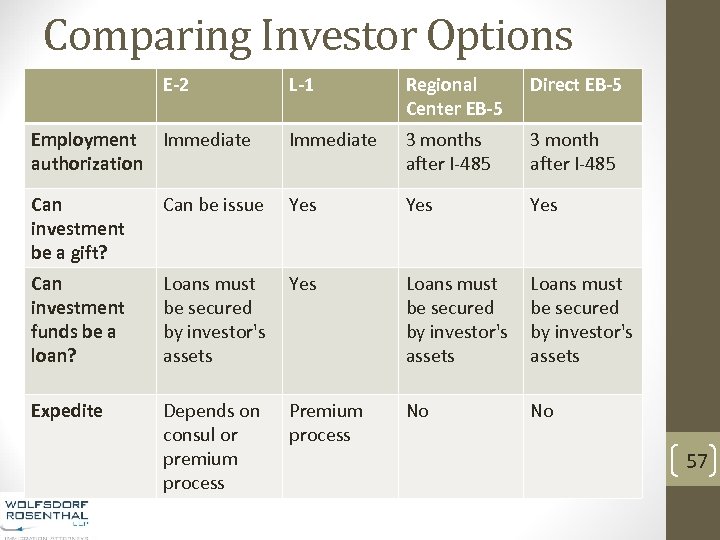 Comparing Investor Options E-2 L-1 Regional Center EB-5 Direct EB-5 Employment Immediate authorization Immediate 3 months after I-485 3 month after I-485 Can investment be a gift? Can be issue Yes Yes Can investment funds be a loan? Loans must Yes be secured by investor's assets Loans must be secured by investor's assets Expedite Depends on consul or premium process No No Premium process • 57
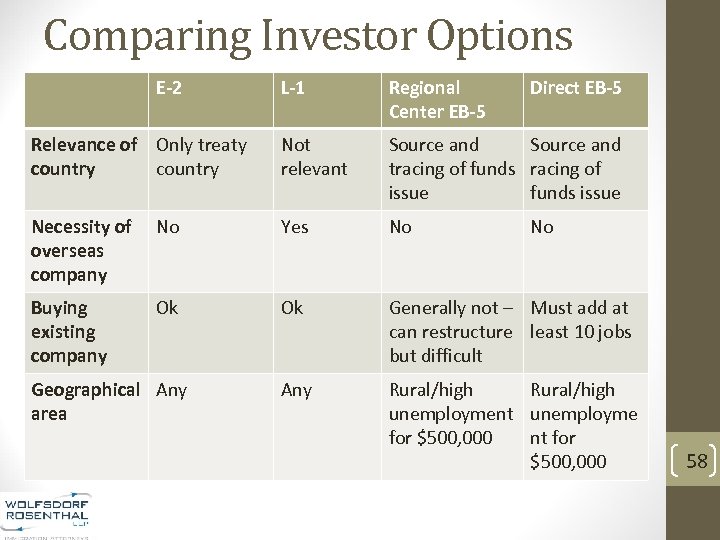 Comparing Investor Options E-2 L-1 Regional Center EB-5 Relevance of Only treaty country Not relevant Source and tracing of funds racing of issue funds issue Necessity of No overseas company Yes No Buying existing company Ok Generally not – Must add at can restructure least 10 jobs but difficult Any Rural/high unemployment unemployme for $500, 000 nt for $500, 000 Ok Geographical Any area Direct EB-5 No • 58
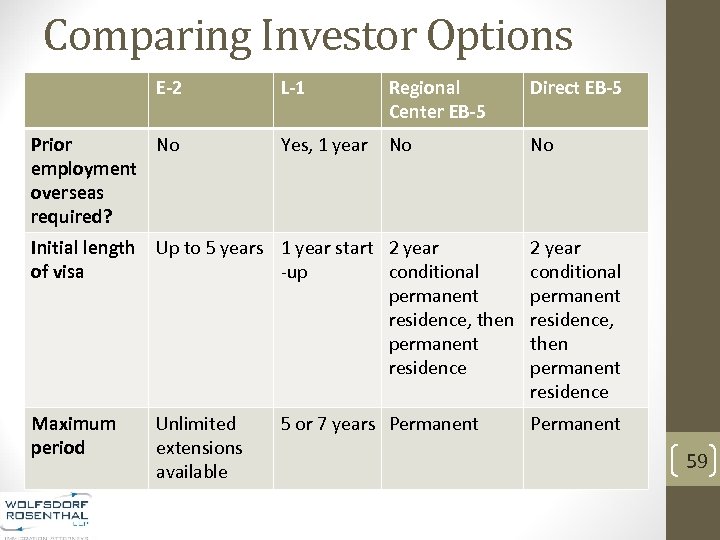 Comparing Investor Options E-2 Prior No employment overseas required? L-1 Regional Center EB-5 Direct EB-5 Yes, 1 year No No Initial length Up to 5 years 1 year start 2 year of visa -up conditional permanent residence, then permanent residence 2 year conditional permanent residence, then permanent residence Maximum period Permanent Unlimited extensions available 5 or 7 years Permanent • 59
 Q & A Wolfsdorf Rosenthal LLP For follow-up questions: Bernard Wolfsdorf Bernard@Wolfsdorf. com Robert Blanco Rblanco@Wolfsdorf. com Vivian Zhu VZhu@wolfsdorf. com 1 -800 -VISA-LAW www. wolfsdorf. com New York City Los Angeles 1 -212 -899 -5040 1 -310 -570 -4088 x 249 Like us on Facebook http: //www. facebook. com/800 visalaw Follow us on Twitter http: //www. twitter. com/wolfsdorf This presentation does not constitute direct legal advice and is for informational purposes only. The information provided should never replace informed counsel when specific immigrationrelated guidance is needed. • 60