


 Скачать презентацию Post-Corporate Integrity Program Compliance A User s Guide for
8330fbb9236e13169b599a395a635fab.ppt
- Количество слайдов: 42
 Post-Corporate Integrity Program Compliance A User’s Guide for Compliance Officers and Attorneys Lee J. Dobkin, Chief Counsel Robert Bacon MHA, Director of Compliance University of Pennsylvania Health System
 Background • Clinical Practices of the University of Pennsylvania (CPUP) 1995 OIG Settlement provided for Mandatory Five-year Professional Fee Program; • April, 2001 – CPUP formally released from Corp. Integrity Agreement, removed from OIG Web-site; • Challenge: Set Priorities, Maintain Protection 2 and Maximize Internal Support
 REGULATORY ENVIRONMENT FRAUD HOT LINE • “Who pays? You pay. Report ……. fraud by calling. . . …. . . An example of fraud would be claims for ……. . . items or services you did not receive. If you have any other questions about your claim, …. . ” 3
 HHS Fraud Line Who Pays; You Pay Program • Established by HHS in 1995 • HIPAA established incentive program for reporting fraud & abuse – 10% of recovered overpayment or a $1, 000 maximum • Medicare received over 1. 5 million calls over the past 4 years – Led to recoveries in excess of $38 million 4
 “It’s everybody’s responsibility now… HELP STOP Medicare/Medicaid Fraud” • Over $23 billion. . . lost to waste, fraud & abuse • . . Person who reports… paid up to 25%. . • If you work with a …health care provider who has committed health care fraud, please call our law firm…” 5
 FISCAL YEAR 2001 • $1. 6 billon in civil fraud recoveries; health care predominant • 75% of recoveries related to Whistleblower cases and settlements • $210 million paid to Whistle-blowers Department of Justice 11/14/01 6
 Fundamental Requirements I. System of Internal Auditing II. Program of Faculty/Staff Education III. Capacity to Respond to External or Internal Allegations 7
 Implement Monitoring, Auditing & Reporting Systems • Cost vs. Benefits – 80/20 rule • Select appropriate data to monitor – Organizational risk – Establishment of benchmarks – Ability to change based upon identified discrepancies 8
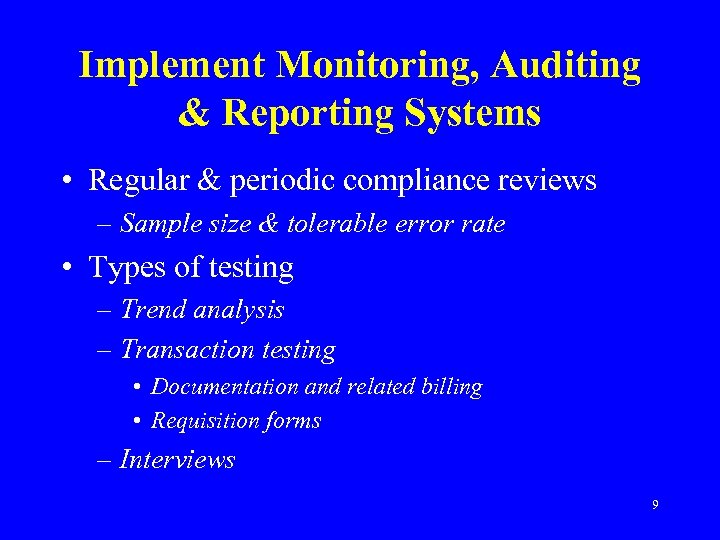 Implement Monitoring, Auditing & Reporting Systems • Regular & periodic compliance reviews – Sample size & tolerable error rate • Types of testing – Trend analysis – Transaction testing • Documentation and related billing • Requisition forms – Interviews 9
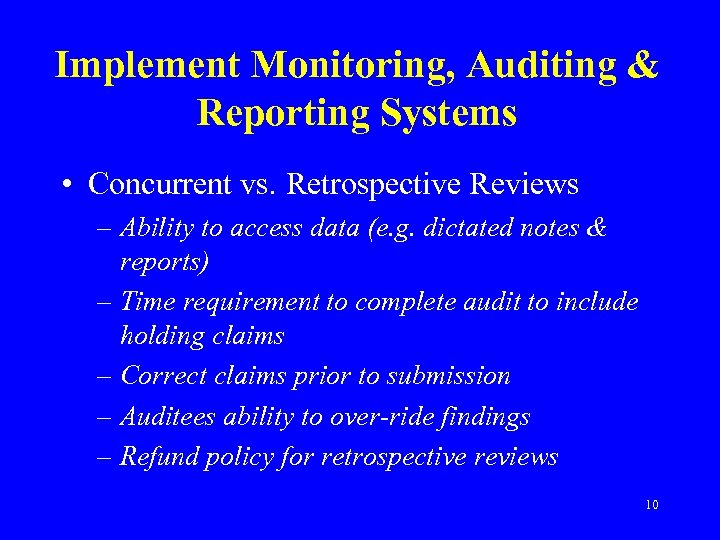 Implement Monitoring, Auditing & Reporting Systems • Concurrent vs. Retrospective Reviews – Ability to access data (e. g. dictated notes & reports) – Time requirement to complete audit to include holding claims – Correct claims prior to submission – Auditees ability to over-ride findings – Refund policy for retrospective reviews 10
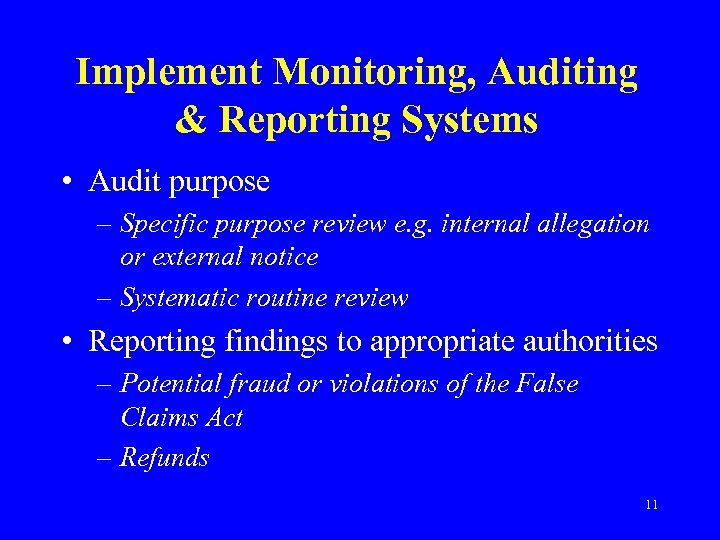 Implement Monitoring, Auditing & Reporting Systems • Audit purpose – Specific purpose review e. g. internal allegation or external notice – Systematic routine review • Reporting findings to appropriate authorities – Potential fraud or violations of the False Claims Act – Refunds 11
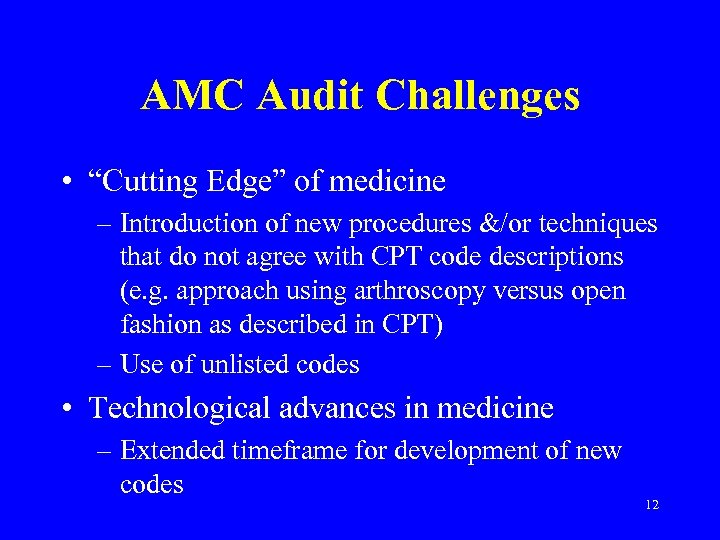 AMC Audit Challenges • “Cutting Edge” of medicine – Introduction of new procedures &/or techniques that do not agree with CPT code descriptions (e. g. approach using arthroscopy versus open fashion as described in CPT) – Use of unlisted codes • Technological advances in medicine – Extended timeframe for development of new codes 12
 AMC Audit Challenges • Tertiary/quaternary care institutes – Patient acuity • Teaching Physician New Rules (TPNR) – Required attestation & tethering language – Service fully documented by resident but insufficient documentation by teaching physician (e. g. attending documentation addresses PE and MDM but not history) 13
 UPHS Compliance Program • Extends to all areas of UPHS – Practice plans – Hospitals – Home health care • Goal: Ferret out potential issues, and rebut “reckless disregard” or “deliberate ignorance” standard if issues are missed 14
 DRG Audit Program • Quarterly reviews conducted at each hospital • Review of OIG targeted DRG’s/DRG Pairs • Focused review DRG 079 • Educational sessions conducted annually 15
 DRG Audit Program • The following attributes are required for the assignment of DRGs: – Principal diagnosis & all subsequent diagnoses; – Principal procedure & all subsequent procedures; – Complications and/or co-morbid conditions; – Signs and symptoms; & – Discharge status 16
 DRG Monitoring • Systematic Monitoring & Review Technique (SMART) – Software program from Pricewaterhouse. Coopers – Automated coding data quality review • 100% prospective screening of coded records prior to billing – 360 standard edits written in compliance with Coding Clinic guidelines 17
 Outpatient OT/PT • HCFA Form 700 & 701 – Start of care date – Diagnosis – Short & Long term goals – Specific modalities/procedures to be used (including amount, frequency & duration, etc) • Clinical documentation in support of services 18
 Medicare Coverage Requirements • Therapy must be ordered/prescribed by a physician • Therapy must be rendered by (or under the supervision of) a certified skilled therapist • Therapy must be reasonable & necessary for treatment of the patient’s condition 19
 Medicare Coverage Requirements • Amount, frequency & duration of services must be reasonable for patient’s condition and established treatment goals • Expectation that patient’s condition will improve significantly in a reasonable and generally predictable period of time 20
 Medicare Coverage Requirements • Therapy provided in accordance with physician-approved treatment plan • Services rendered under OT should not be duplicated by PT 21
 Home Health Care Audit Program • Review HCFA Form 485 – Start of care date – Signed physician certification – Plan of care (medications, functional limitations, goals, etc) • Review clinical documentation by all care givers 22
 Conditions Patient Must Meet to Qualify for Coverage • Confined to home • Plan of care established/approved by physician • Patient under care of qualified physician • Physician certification 23
 Conditions Patient Must Meet to Qualify for Coverage • Need for Skilled Nursing/Skilled Rehab Services on an Intermittent Basis – Physical therapy – Speech-language pathology – Intermittent skilled nursing – Occupational therapy 24
 Education Survival Tips • Avoid “off the shelf” educational programs with focus exclusively on legal ramifications – Focus on clinically relevant case studies with corresponding documentation requirements – Inform providers of coding changes (CPT-4 & ICD-9) – Share results of departmental auditing; compare to institution 25
 Education Survival Tips • Conduct documentation training at the departmental level – Use live progress notes for educational purposes with clinical significance – Identify “Physician Champion” in all educational sessions 26
 Education Survival Tips • Involve faculty in training • Include compliance training in new employee orientation programs 27
 Survival Tips • Providers should submit claims representing documented services that are medically necessary • If services are supported by medical necessity, bill accordingly – Avoid down-coding based on fear • The “R” word 28
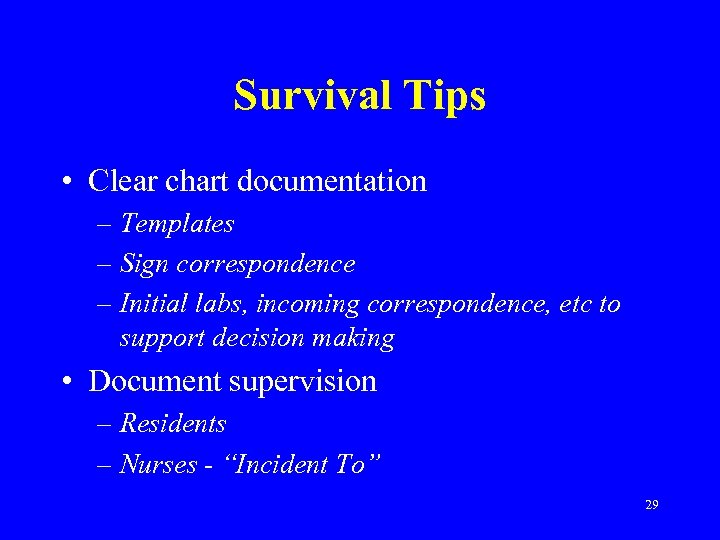 Survival Tips • Clear chart documentation – Templates – Sign correspondence – Initial labs, incoming correspondence, etc to support decision making • Document supervision – Residents – Nurses - “Incident To” 29
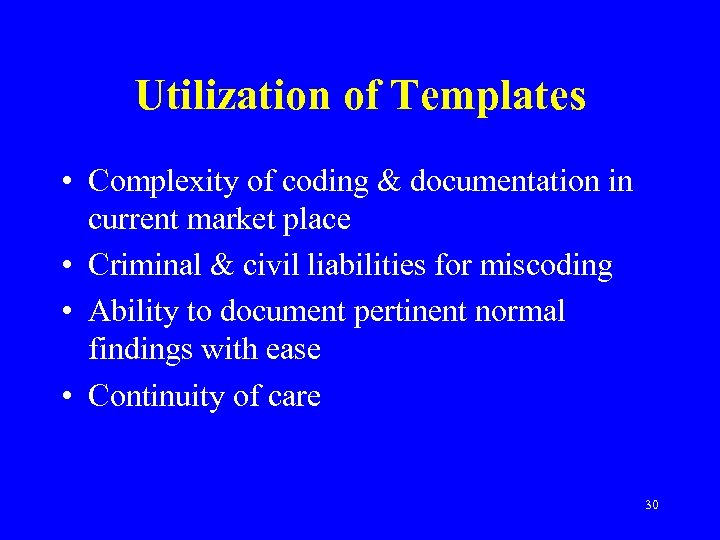 Utilization of Templates • Complexity of coding & documentation in current market place • Criminal & civil liabilities for miscoding • Ability to document pertinent normal findings with ease • Continuity of care 30
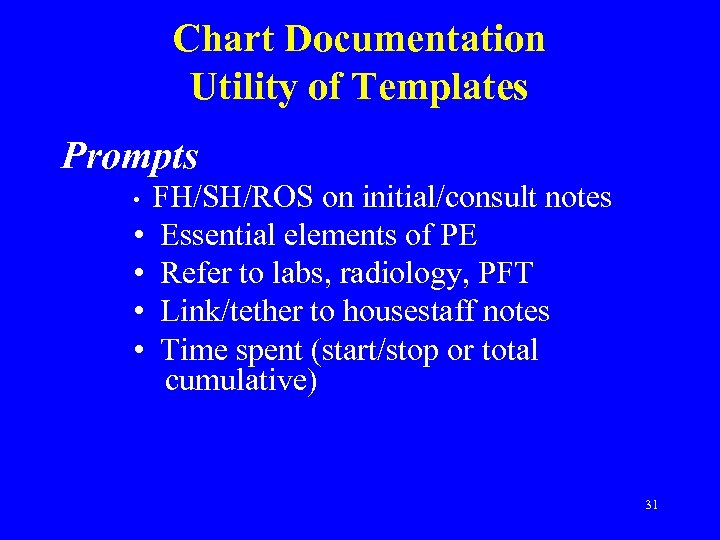 Chart Documentation Utility of Templates Prompts FH/SH/ROS on initial/consult notes • Essential elements of PE • Refer to labs, radiology, PFT • Link/tether to housestaff notes • Time spent (start/stop or total cumulative) • 31
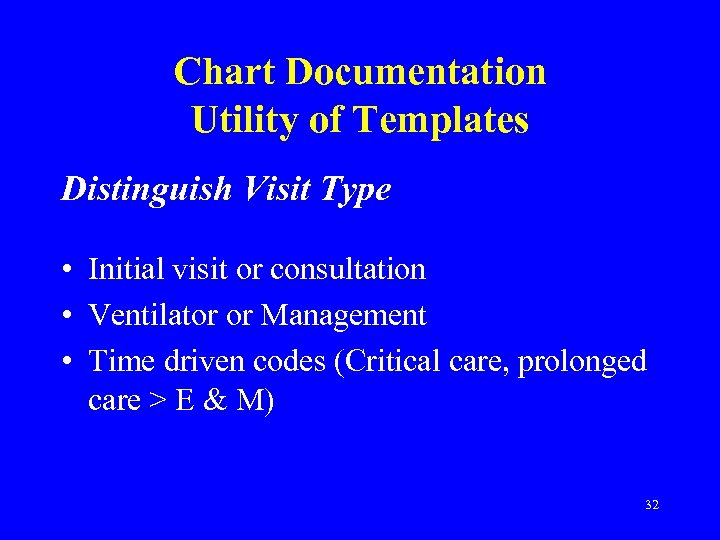 Chart Documentation Utility of Templates Distinguish Visit Type • Initial visit or consultation • Ventilator or Management • Time driven codes (Critical care, prolonged care > E & M) 32
 Chart Documentation Utility of Templates Efficiency • Reduce redundant writing • Facilitate abstraction, coding, billing Foundation for Electronic Medical Record 33
 Review of Templates • Ensure templates are not “leading” providers to select high levels of service – Explanations address all levels of service • Validate accuracy & completeness of forms • Ensure templates satisfy reporting requirements for Evaluation & Management services (E&M) 34
 Review of Templates • Ensure templates offer tethering language attending physician attestation • Documentation must equal performance and supported by medical necessity! 35
 Investigations: Operational Concerns • Organizations state of readiness – Critical need for operational policies to address organizational response to external notice(s) of investigation(s) • All members of organization must know what action is required upon receipt of notification 36
 Operational Concerns • Identify nature of allegations (if possible) – Physician based (e. g. upcoding, TPNR, etc. ) – Hospital based (e. g. DRG’s, 72 hour rule, transfers, cost report) • Identify entity that authored investigation notice – Insurance carrier/ FI – OIG 37
 Operational Concerns • What is the subject matter & time period under review? – Attention to date of service vs. applicable regulations & specific coding requirements • Complexity of coding – Over 1, 500 material changes in CPT CY’s 1999 2001 38
 Operational Concerns • Attorney - client privilege – Compliance initiated and managed investigations – Co-ordination • Tread carefully; “First, Do no harm” 39
 Shadow Audit • Ability to offer defense – Establish expected error rate & estimated potential liability – Identify errors that may result in over-payments – Identify & quantify favorable findings such as missed billings & under-coding 40
 Shadow Audit • Critical need for organization to identify potential deficiencies & liabilities • Potential interim measures, such as billing suspension • Organizational & managerial ability to make informed decisions – Influence to expedite settlement negotiations 41
 Treat Employee Allegations of Wrongdoing Extremely Carefully • Assume each complainant is current or potential Whistle-blower • Discount apparent bias or motive (government will) • Document responses and keep in communication • Confidentiality and privilege • Intercede to prevent Human Resource actions which could be misconstrued as retaliation 42