 Скачать презентацию Possibility to utilize solar heating system in Mongolia
88887a27a43fda4cfca68189e022120b.ppt
- Количество слайдов: 37



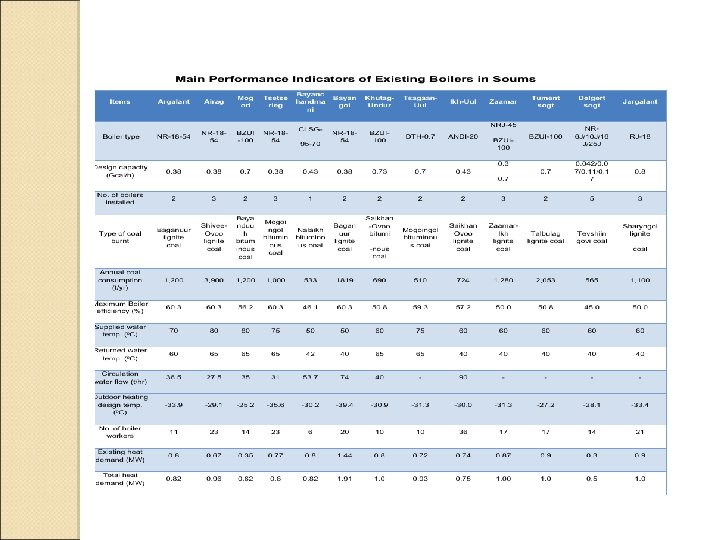
Possibility to utilize solar heating system in Mongolia D. CHIMEDDORJ Chief Engineer Energy Authority of Mongolia May 16, 2012
Contents Introduction Background The burning platform Solar Energy study in Mongolia Solar heating concepts Soum and Aimag heat demand Heat demand Generation in UB Solar heating technology Connecting to District heating network Economic overview Conclusion
Background information Mongolia has an extremely harsh winter climate Winter temperature range is -10 C to -30 C in the daytime Temperature drop is -40 C at night. Long heating season, with a total of eight months from the middle of September to the middle of May.
Background information Ulaanbaatar (UB) is the coldest capital city in the world. The air quality is dangerously bad - UB is becoming the world’s most polluted city. In UB, annual average particulate matter concentrations have been recorded at as high as 279. World Health Organization recommended PM 10 level is 20. UB’s PM 10 levels are 14 times higher than the WHO’s recommendation.
Background information The heating demand is continuously increasing. The heat supply in Mongolia is mainly provided from combined heat and power plants. The energy source is mainly coal which, despite co-generation, contributes to carbon emissions.
The burning platform From a global perspective the increasing global fuel prices, local environment (air pollution), limitation of fuel reserves and extensive amount of available solar resources, creates a burning platform for solar heating in district heating systems around the world.
The burning platform In northern Europe the solar heating systems are not only an environmental friendly solution, but also cost-efficient compared to other solutions. Furthermore, systems designed for solar heating has a tendency to be more efficient than traditional district heating systems, as temperature levels has been considered, heat storage tanks and other technical solutions has been utilized.
The burning platform Solar heating solutions have been used world wide for decades, not to say centuries, but have most often been relatively simple solutions with i. e. a tank on the roof with lack of controlling etc. However, the technology has been matured over the last decades where large scale solar heating plants have been constructed and connected to existing district heating systems. The technology is now days robust and can operate in both harsh winter climate and hot summer climate.
Solar Energy study in Mongolia The research started since 1961 Insolation of the direct radiation Insolation of the diffuse radiation Insolation of the total radiation Average irradiance in hours per day Solar Radiation Map of Mongolia Ministry of Education, Culture and Science - in 2010
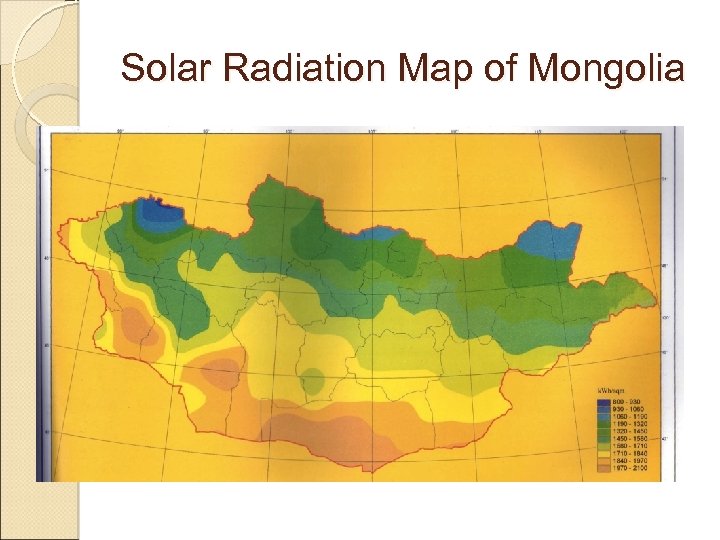
Solar Radiation Map of Mongolia
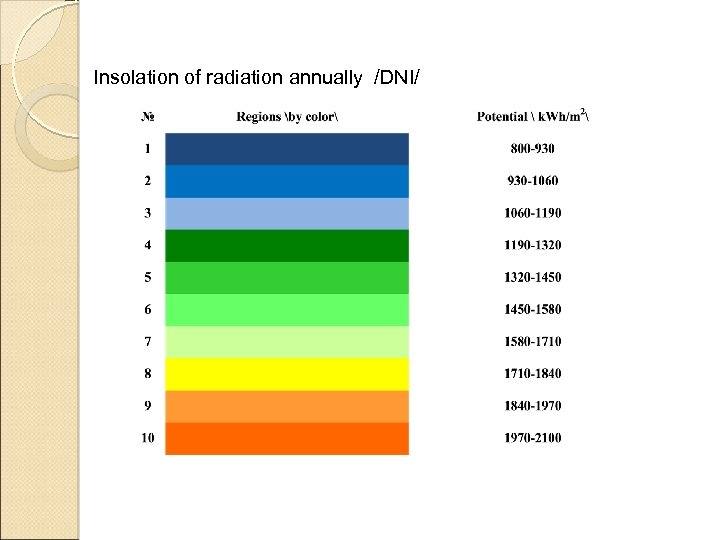
Insolation of radiation annually /DNI/
DNI In Mongolia the annual irradiation is 1350 -1850 k. Wh/m 2 and as illustrated in table the annual irradiation in Ulaanbaatar is above 1800 k. Wh/m 2.
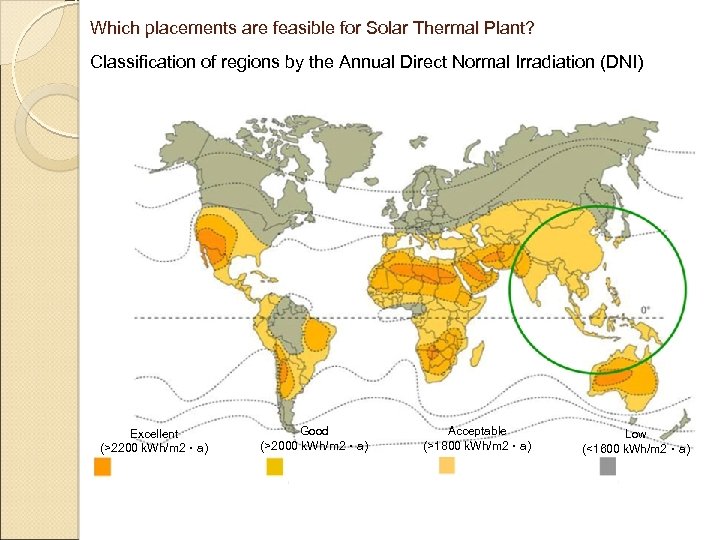
Which placements are feasible for Solar Thermal Plant? Classification of regions by the Annual Direct Normal Irradiation (DNI) Excellent (>2200 k. Wh/m 2・a) Good (>2000 k. Wh/m 2・a) Acceptable (>1800 k. Wh/m 2・a) Low (<1600 k. Wh/m 2・a)
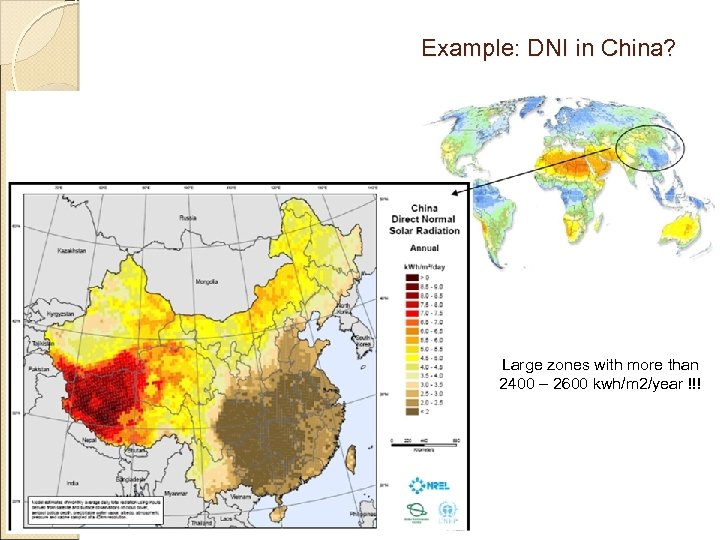
Example: DNI in China? Large zones with more than 2400 – 2600 kwh/m 2/year !!!
Solar heating concept Soum and Aimag heat demand Heat demand Generation in UB Solar heating technology Connecting to District heating network
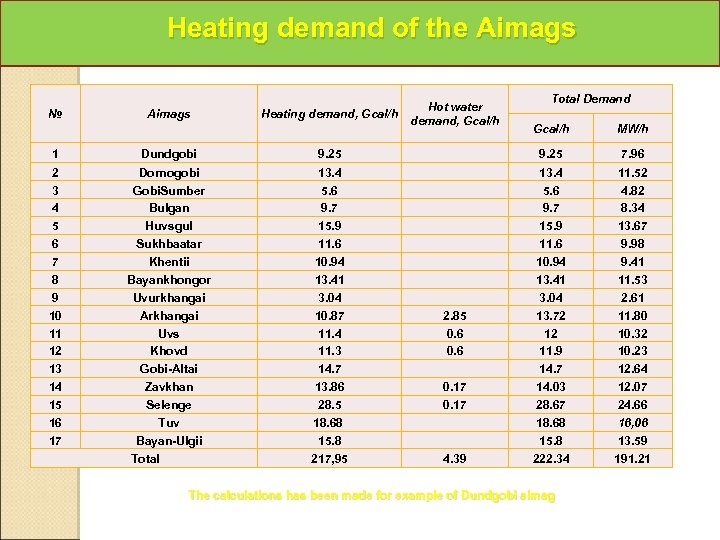
Heating demand of the Aimags № Aimags Heating demand, Gcal/h Hot water demand, Gcal/h Total Demand Gcal/h MW/h 1 Dundgobi 9. 25 7. 96 2 3 4 5 6 7 8 9 10 11 12 13 14 15 16 17 Dornogobi Gobi. Sumber Bulgan Huvsgul Sukhbaatar Khentii Bayankhongor Uvurkhangai Arkhangai Uvs Khovd Gobi-Altai Zavkhan Selenge Tuv Bayan-Ulgii 13. 4 5. 6 9. 7 15. 9 11. 6 10. 94 13. 41 3. 04 10. 87 11. 4 11. 3 14. 7 13. 86 28. 5 18. 68 15. 8 2. 85 0. 6 0. 17 13. 4 5. 6 9. 7 15. 9 11. 6 10. 94 13. 41 3. 04 13. 72 12 11. 9 14. 7 14. 03 28. 67 18. 68 15. 8 11. 52 4. 82 8. 34 13. 67 9. 98 9. 41 11. 53 2. 61 11. 80 10. 32 10. 23 12. 64 12. 07 24. 66 16, 06 13. 59 Total 217, 95 4. 39 222. 34 191. 21 The calculations has been made for example of Dundgobi aimag
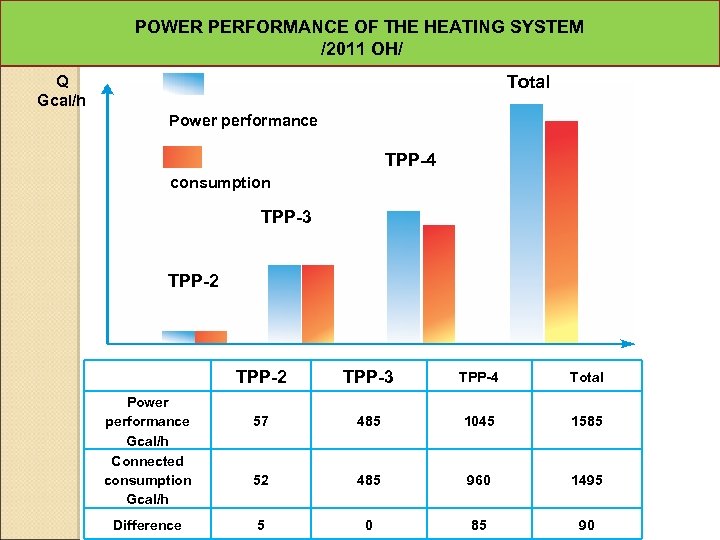
POWER PERFORMANCE OF THE HEATING SYSTEM /2011 ОН/ Total Q Gcal/h Power performance TPP-4 consumption TPP-3 TPP-2 Power performance Gcal/h Connected consumption Gcal/h Difference TPP-3 TPP-4 Total 57 485 1045 1585 52 485 960 1495 5 0 85 90
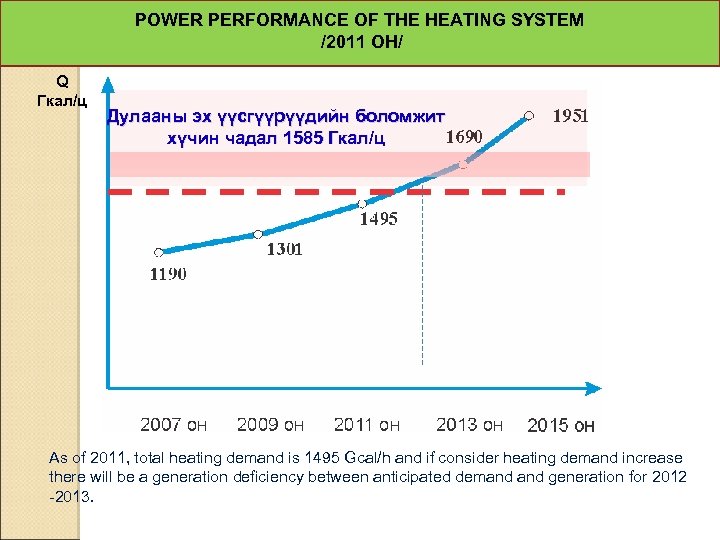
POWER PERFORMANCE OF THE HEATING SYSTEM /2011 ОН/ Q Гкал/ц Дулааны эх үүсгүүрүүдийн боломжит хүчин чадал 1585 Гкал/ц As of 2011, total heating demand is 1495 Gcal/h and if consider heating demand increase there will be a generation deficiency between anticipated demand generation for 2012 -2013.
Solar heating technologies There are four main technologies within solar thermal technologies: Central Receiver Tower Plant Parabolic solar unit Evacuated tubes Flat plate collectors
Central Receiver Tower Plant Concentrates solar radiation on a point receiver at the top of a tower Enables operation at high temperature level and provides heat storage capabilities Has high net solar to electrical efficiency and is a commercially proven technology
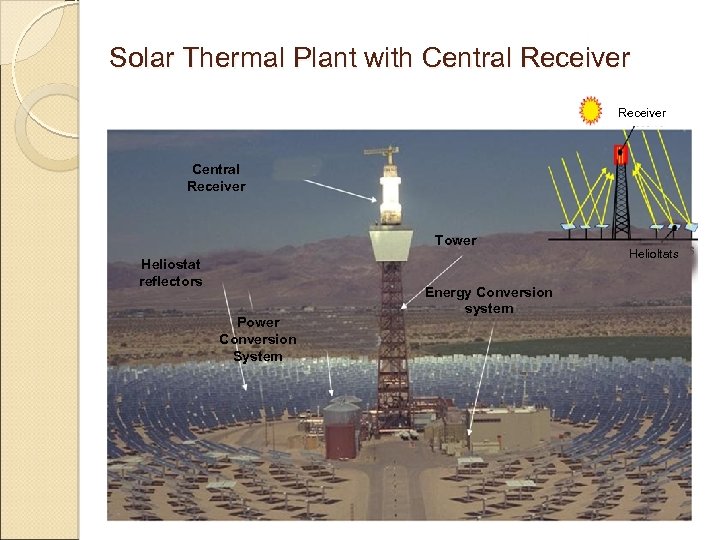
Solar Thermal Plant with Central Receiver Tower Heliostat reflectors Power Conversion System Energy Conversion system Helioltats
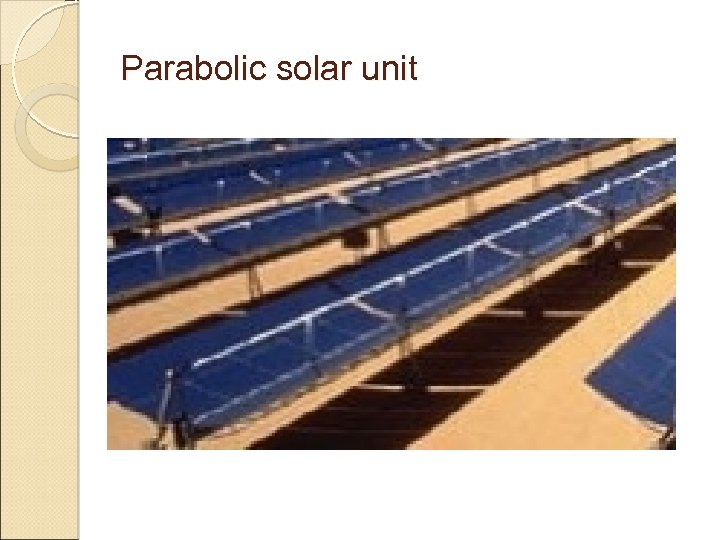
Parabolic solar unit A trough-shaped parabolic reflector is used to concentrate sunlight on an insulated tube (Dewar tube) or heat pipe, placed at the focal point, containing coolant which transfers heat from the collectors to the boilers in the power station. Temperature range: 0 -400°C
Parabolic solar unit
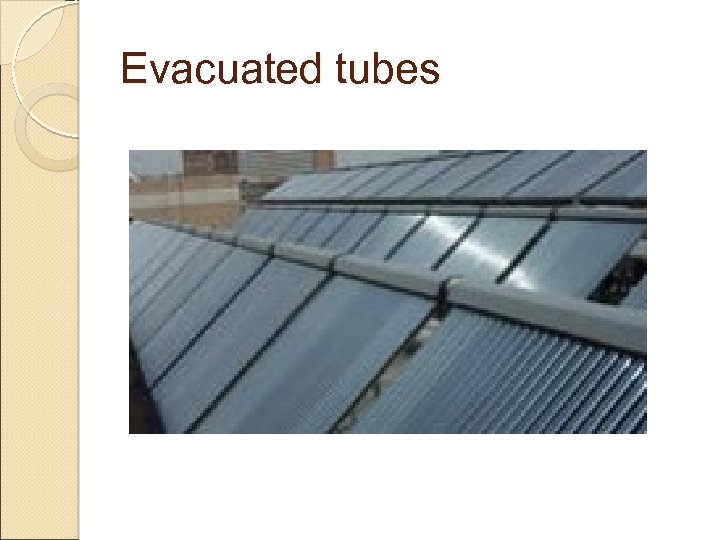
Evacuated tubes Evacuated heat pipe tubes are composed of multiple evacuated glass tubes each containing an absorber plate fused to a heat pipe. The heat from the hot end of the heat pipes is transferred to the transfer fluid of a domestic hot water or hydronic space heating system in a heat exchanger called a “manifold”. Temperature range: 0 -150°C
Evacuated tubes
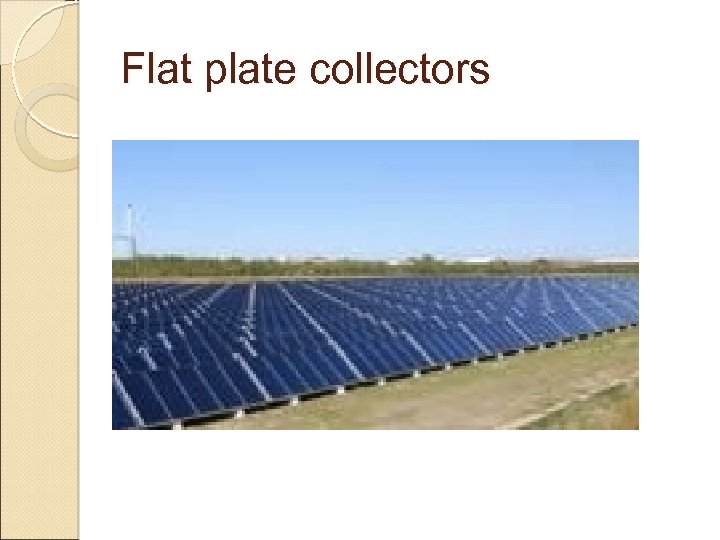
Flat plate collectors The solar energy is transformed into heat by the absorber which is located in the inside of the solar collector. It absorbs the solar heat and transmits it to a frost-resisting liquid which circulates in a system of pipes. The heated liquid is lead to a warm water tank, store tank or a separate heat exchanger. Temperature range: 0 -120°C
Flat plate collectors
Connection to District Heating networks in Mongolia, are most often divided into primary and secondary networks. The primary network can be seen as a transmission network where substations equipped with heat exchangers are separating the primary and the secondary network. The secondary networks are distributing heat to a number of dwellings.
Connection to District Heating network The temperature levels on the primary network are often 130/70, sometimes up to 150/80. The temperature levels on the secondary networks are typically in the range of 95/70.
Connection to District Heating network There are several ways to connect solar heating units to a district heating network. Most common way is solar heating units in combination with heat storage tank connected to the secondary network thru a heat exchanger. The hot water from the solar heating units is mixed with the supply water from the substation (when necessary). The storage tank can be used to level the variations in heat demand solar heat resources for optimal utilization of the resources.
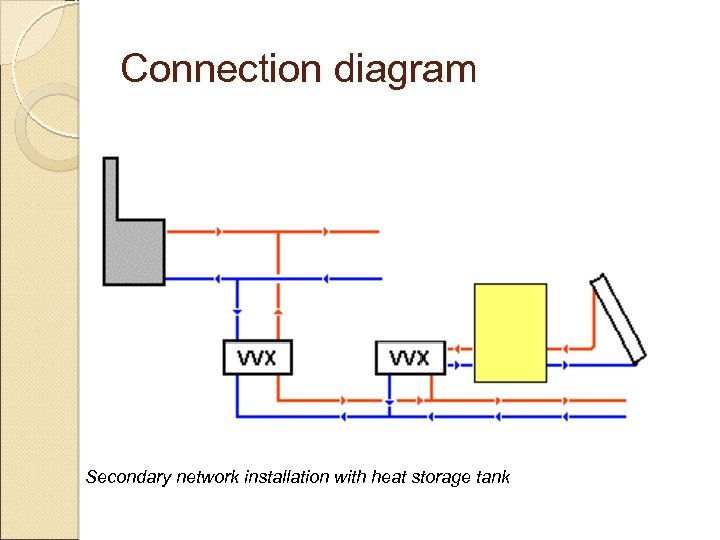
Connection diagram Secondary network installation with heat storage tank
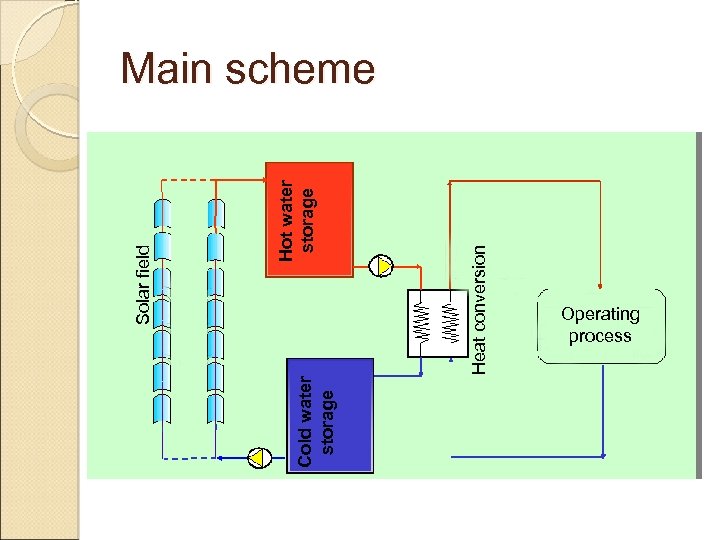
Heat conversion Cold water storage Hot water storage Solar field Main scheme Operating process
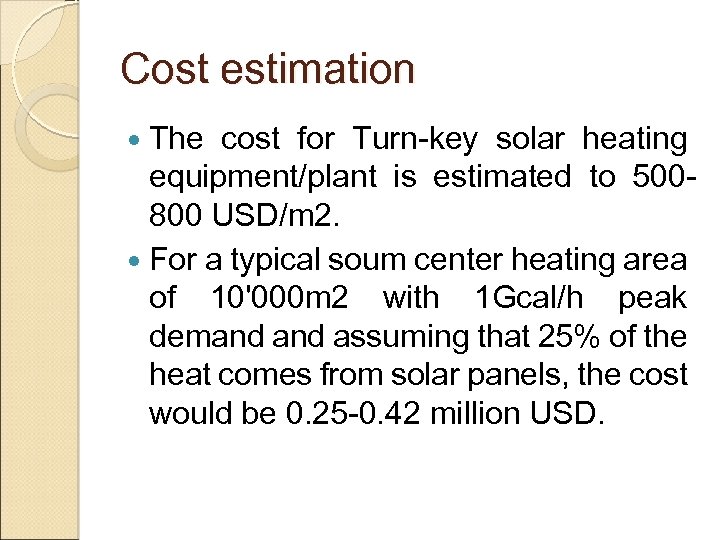
Cost estimation The cost for Turn-key solar heating equipment/plant is estimated to 500800 USD/m 2. For a typical soum center heating area of 10'000 m 2 with 1 Gcal/h peak demand assuming that 25% of the heat comes from solar panels, the cost would be 0. 25 -0. 42 million USD.
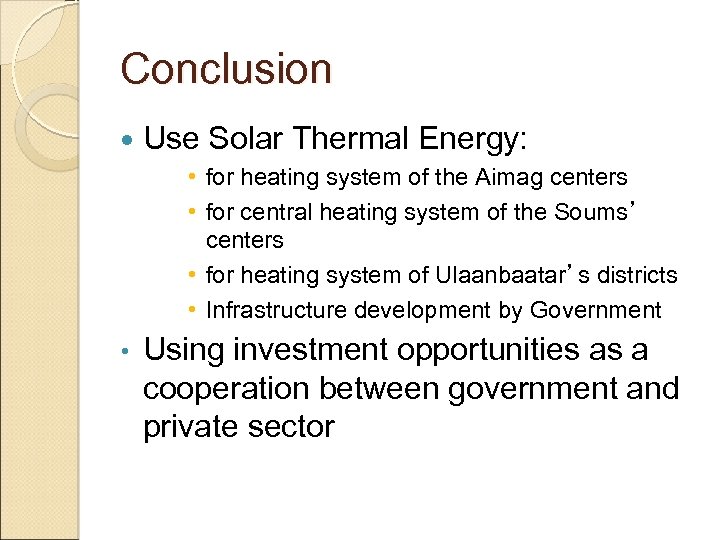
Conclusion Use Solar Thermal Energy: • for heating system of the Aimag centers • for central heating system of the Soums’ centers • for heating system of Ulaanbaatar’s districts • Infrastructure development by Government • Using investment opportunities as a cooperation between government and private sector
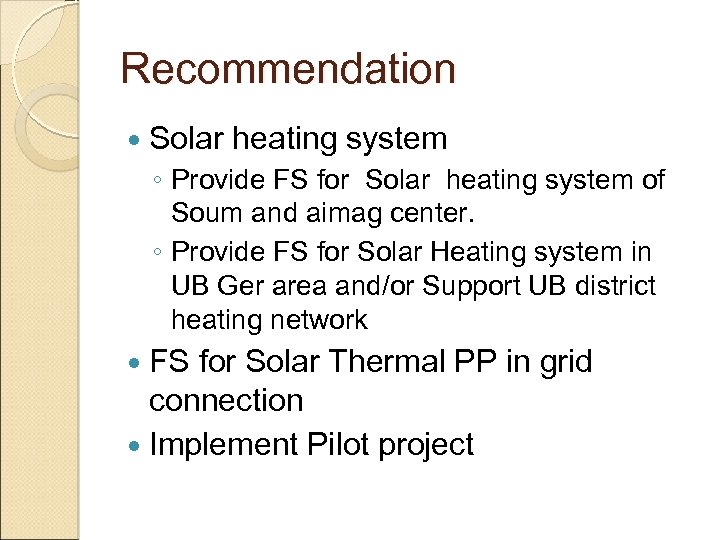
Recommendation Solar heating system ◦ Provide FS for Solar heating system of Soum and aimag center. ◦ Provide FS for Solar Heating system in UB Ger area and/or Support UB district heating network FS for Solar Thermal PP in grid connection Implement Pilot project
Скачать презентацию Possibility to utilize solar heating system in Mongolia
88887a27a43fda4cfca68189e022120b.ppt