


 Скачать презентацию POSC 2200 International Security War and Strife
60db113de0f074d37fc2daaa6c779ee0.ppt
- Количество слайдов: 24
 POSC 2200 – International Security, War and Strife Russell Alan Williams Department of Political Science
 Unit Six: International Security, War and Strife n n n n “Managing Insecurity” Required Reading: Mingst, Chapter 8. Mueller, The Essential Irrelevance of Nuclear Weapons: Stability in the Postwar World, Mingst and Snyder, pp. 341 -346. Outine: Arms Control Collective Security Balance of Power
 1) Arms Control: n “Arms Control”: Restrictions on the research, manufacture and deployment of certain kinds of weapons systems n n Reduce the spiral effect of arms races – limit growth Prevent proliferation of dangerous weapons Regulate the use of weapons “Disarmament”: The Policy of eliminating states’ offensive weaponry n n Reduce stockpiles of weapons - All, or some kinds Assumes that reductions in the number of weapons increases security. . . Both key aspects of liberal approach to “managing insecurity”
 Motivations? 1) Reduce tensions that lead to war. . . n General liberal belief that “security dilemma” can be reversed through cooperation n Fear that weapons generate their own “logic of use” 2) Save $$$$ n Periods of arms control correspond with financial problems 3) Reduce environmental and health hazards n E. g. Nuclear weapons testing
 Obstacles? 1. Shadow of the future. . . n What threats will emerge in the future? n 2. 3. 4. E. g. Post WWII US disarmament Verification n How do we know arms control agreements are being followed? n Technological improvements? “Flyovers” Doubts over the value of arms control n Arms control may not prevent war – the two are unrelated Domestic political obstacles n National pride and “Military-Industrial complex”
 History: n n Some ancient examples – Athens and Sparta Generally, arms control a 20 th Century phenomenon Why? n Changing technology – weapons became increasingly lethal from WWI onwards. . n Est. 40, 000 casualties
 n Washington Naval Conferences (1921 -1922) n US, UK, Japan, France and Italy n n Agreed to limit “tonnage” of battleships – response to “Naval Race” Tied to number of oceans to defend US and UK get large advantage but Japan cheats Geneva Protocol (1925 -1928): treaty prohibiting the use of chemical and biological weapons n n E. g. Chlorine Gas Effective? ? Chemical & Biological weapons are hard to use. . .
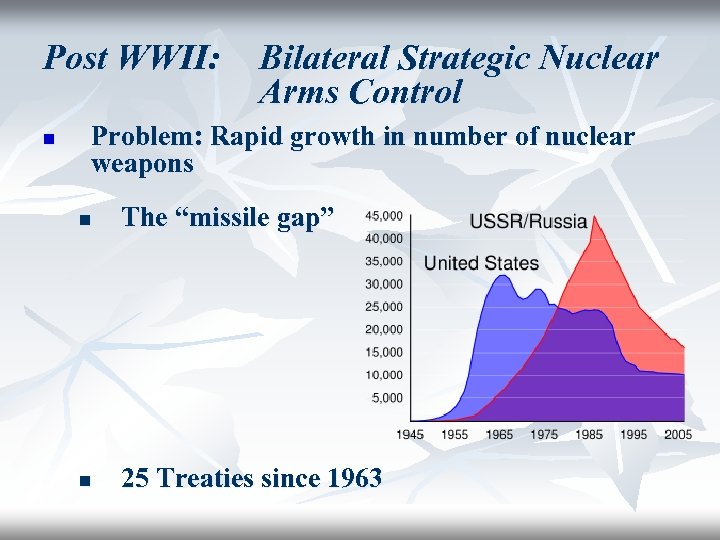 Post WWII: n Bilateral Strategic Nuclear Arms Control Problem: Rapid growth in number of nuclear weapons n The “missile gap” n 25 Treaties since 1963
 Treaties (US and USSR): “Strategic Arms Limitations Talks – SALT I & II” (1972 & 1979) n Tried to stop growth – stabilize arms race n Freeze in number of offensive weapons “Anti-ballistic Missile Treaty – ABM” (1973) n Agreed to stop developing missile defense systems n Systems would destroy incoming missiles n Thought to be destabilizing (e. g. Deterrence) n US withdrew in 2002. .
 End of Cold War – States intensify arms control efforts: “Strategic Arms Reduction Treaty – START I” (1991): n n Nuclear warheads reduced to 6, 000 each 1, 600 “delivery vehicles” “Strategic Arms Reduction Treaty – START II” (1993) n n n Nuclear warheads to be reduced to 3, 000 each (2007) “MIRV’s” banned Treaty never ratified – Russian response to US missile defense initiatives
 “Strategic Offensive Reduction Treaty – SORT” (2002): n Further 2/3 reduction in number of warheads n No limitations on MIRV’s
 Implications: n Success? n n Number of warheads cut by at least 80% Problems? n n n MAD doctrine remains in place “Tactical” weapons unregulated Many weapons “mothballed”
 Multilateral Arms Control: Focused on “proliferation” of dangerous weapons – WMD’s n Consistent with the security concerns of powerful states (!) n 1) “Nuclear Non-Proliferation Treaty - NPT” (1968, renewed 1995) n Bans sales, acquisition and production of nuclear weapons in all states that were not recognized as nuclear powers: n US, UK, Russia, France and China (note the coincidence? ) n “Non-nuclear states” subject to IAEA inspections
 2) “Partial Test Ban Treaty” (1963): n n Banned atmospheric and underwater testing of nuclear weapons Number of tests higher after the treaty (!) n Did not ban underground tests 3) “Comprehensive Test Ban Treaty” (1996 -? ): n n n Proposed complete ban on nuclear weapons tests – supported by UN General Assembly Legally binding if all 44 countries with atomic energy ratify treaty Status = ? Undermined by existing nuclear powers n France, Britain, Russia all ratified n China, Israel, India, Pakistan and the US have not – though some not testing
 Nuclear non-proliferation regime under strain? n New nuclear powers 1. Non-NPT members: n Indian and Pakistan NPT Members (Lies, lies and more lies!!) n Israel? n Iran? n Libya and Iraq? n North Korea? n Proliferation is easy and it is the “fast track” to international power However, most states have honored the treaty despite incentives to break it 1. n
 Chemical and Biological Weapons: n Building on Geneva Protocol – International law already prohibit use of chemical weapons “Biological Weapons Convention” (1972): States agreed not to develop more, and to get rid of all biological weapons n E. g. Anthrax “Chemical Weapons Convention” (1993): All chemical weapons were to be destroyed by 2005 n 184 signed treaty by 2002 n Problems? n n n Iraq, Libya, North Korea and Syria refused – some in response to Israel's nuclear weapons Hard to verify. . . Bush administration withdrew some US compliance
 New Areas – related to “human security”: n Antipersonnel landmines n Small arms
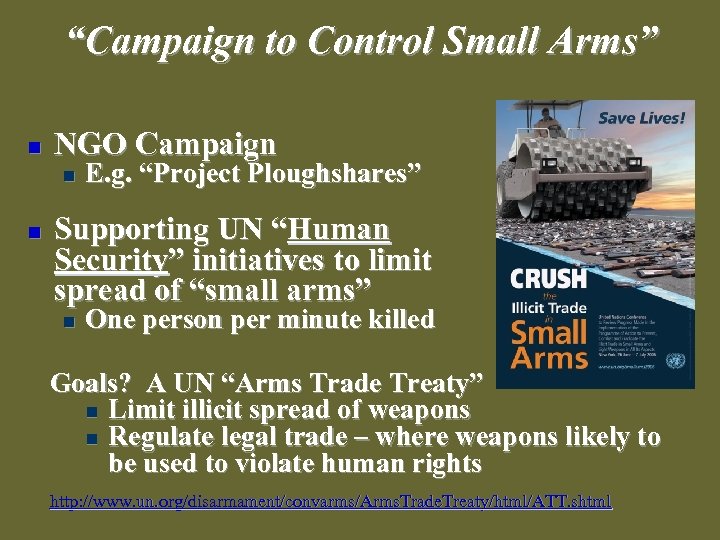 “Campaign to Control Small Arms” n NGO Campaign n n E. g. “Project Ploughshares” Supporting UN “Human Security” initiatives to limit spread of “small arms” n One person per minute killed Goals? A UN “Arms Trade Treaty” n Limit illicit spread of weapons n Regulate legal trade – where weapons likely to be used to violate human rights http: //www. un. org/disarmament/convarms/Arms. Trade. Treaty/html/ATT. shtml
 2) Collective Security: Key part of liberal strategy for managing insecurity “Collective Security”: Concept that aggression against a state should be defeated collectively – because aggression against one state is aggression against all. . n League of Nations and UN – less effective n Assumes it easy to identify the aggressor and that the aggressor is always outside of international norms n Military Alliances – more effective n Can only work if aggressors come to believe that states will act against them n n
 3) The Balance of Power: Realist approach to managing insecurity n =Ensure peace through the acquisition of military capabilities and alliances that make war with you undesirable Arms control and collective security are for lawyers - Probably do more harm then good n. E. g. Powers involved in the “Naval Race” were right! n Helped Britain win WWI n
 “Deterrence Theory”: Assumes that rational decision makers will avoid war where costs are going to be high n Seek peaceful resolutions n Key Claim: Effective military capabilities make the costs of war higher n Meaning. . . Arm your state and probably acquire WMD’s
 Risks of deterrence theory: n n Role of non-state actors in modern security environment n Problem of proliferation n Problem of “non-state armies” Modern “imbalance of power” n Logic of deterrence and offensive realism suggests US “primacy” should be used n E. g. China’s Nuclear weakness. .
 4) Conclusions – Security War & Strife: 1) Is conventional “general war” becoming obsolete? n Yes, but. . . mechanisms of preventing war focus only on these kind of conflicts – still a lot of wars 2) What is the impact of the advent of WMD’s on the nature of war? n Theoretical question – no consensus 3) Why is modern war a mainly “southern” phenomenon n Because southern states lack power to deter attack (Waltz) Because northern states have a normative consensus against war with each other (Mueller) Because southern states are “weak” and “artificial” – resolve internal political problems through violence
 5) For Next Time. . . Unit Seven: International Political Economy Required Reading: n n Mingst, Chapter 9. Scott, The Great Divide in the Global Village, Mingst and Snyder, pp. 421 -430.