


 Скачать презентацию POSC 1000 Introduction to Politics Parliamentary Systems Russell
da7bfdb2b03149c27509feee8df78cf9.ppt
- Количество слайдов: 21
 POSC 1000 Introduction to Politics Parliamentary Systems Russell Alan Williams
 Unit Five: Formal Political Institutions “Parliamentary Systems” Required Reading: Mac. Lean and Wood, Chapter 5 Outline: 1. 2. Introduction – Formal Institutions Parliamentary Systems 1. Legislative Institutions 2. Executive Institutions 3. Conclusions
 1) Introduction - Formal Institutions: Formal institutions include: “Unitary” vs. “Federal Systems” (Unit Six) “Presidential” vs. “Parliamentary” Systems • More important distinction Basis of major differences between Canada and the U. S.
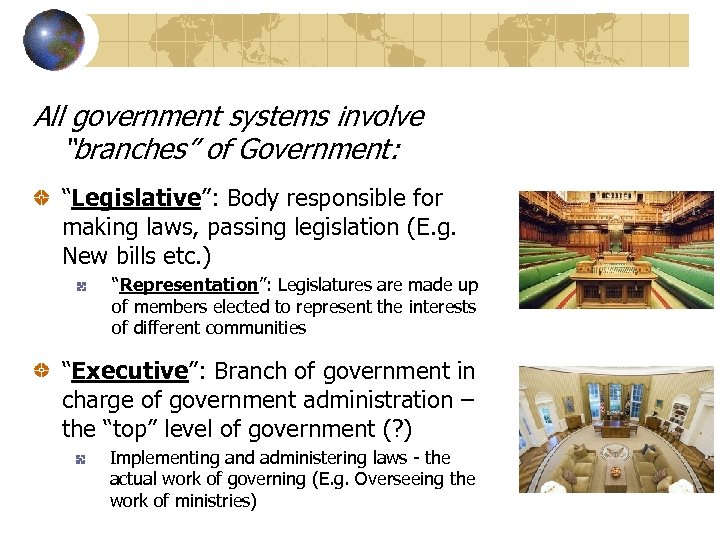 All government systems involve “branches” of Government: “Legislative”: Body responsible for making laws, passing legislation (E. g. New bills etc. ) “Representation”: Legislatures are made up of members elected to represent the interests of different communities “Executive”: Branch of government in charge of government administration – the “top” level of government (? ) Implementing and administering laws - the actual work of governing (E. g. Overseeing the work of ministries)
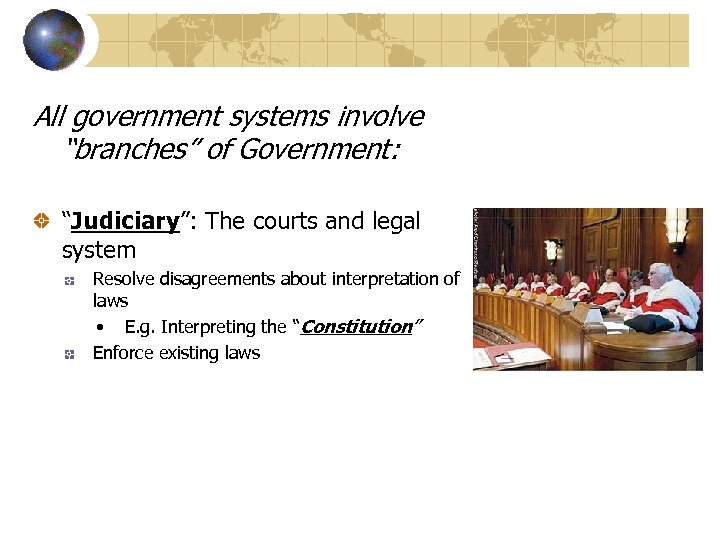 All government systems involve “branches” of Government: “Judiciary”: The courts and legal system Resolve disagreements about interpretation of laws • E. g. Interpreting the “Constitution” Enforce existing laws
 In “Parliamentary Systems”: “Fusion of Powers” - Close relationship between executive and legislative activities Government must have support of legislature • Government selected from legislature, not elected by people! In “Presidential Systems”: “Separation of powers” between different activities President and bureaucracy = executive Congress = legislative • Neither is dependent on the other as both have been elected Results in more “checks and balances”? ? ?
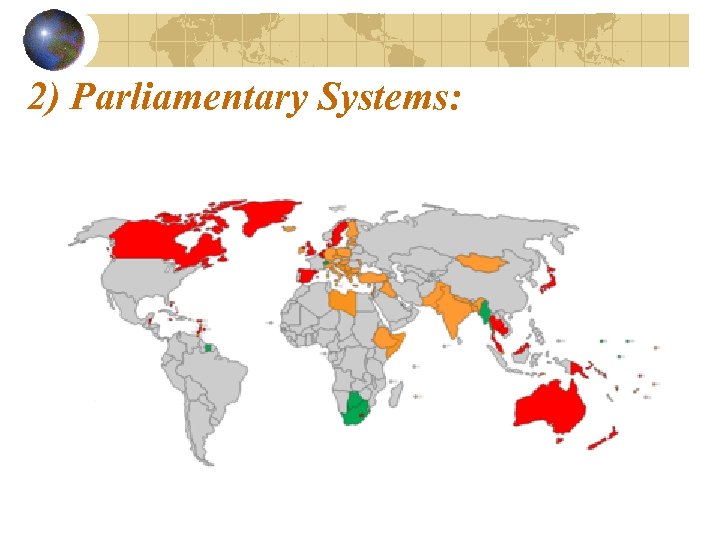 2) Parliamentary Systems:
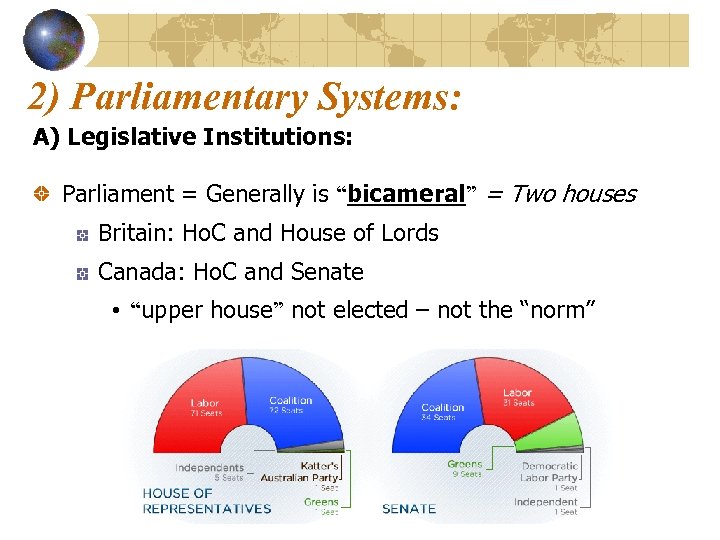 2) Parliamentary Systems: A) Legislative Institutions: Parliament = Generally is “bicameral” = Two houses Britain: Ho. C and House of Lords Canada: Ho. C and Senate • “upper house” not elected – not the “norm”
 i) “House of Commons”: Elected chamber in Canada Each “Member of Parliament” (MP) is elected from a geographical constituency The government: “Head of Government”: Person who runs government In parliamentary system this is normally the leader of the party with the most MP’s in the House of Commons = the prime minister “Cabinet”: Members of the political executive In parliamentary system these are normally MP’s selected by prime minister from their own party Cabinet proposes all major legislation and controls the budget Principles: “Cabinet Secrecy” & “Cabinet Solidarity”
 “Majority Government”: When one party has more than 50% of MP’s • Easy for PM and cabinet to pass legislation E. g. Dunderdale government (2011 -? ? ) Harper Government (2011 – until the end of time. . . ) “Minority Government”: When party with most MPs (but not majority) forms a government but cannot pass legislation without support of other parties E. g. Paul Martin Government (2004 -2006) E. g. Harper Government (2006 -2009) Traditionally = requires formal arrangement In Canada = ? ? ?
 “House of Commons”. . The “opposition”: One or more parties that are not part of government, but form a check on the ruling power of the governing party “Official Opposition”: Party with 2 nd most MP’s Always leads “question period” and criticisms of government policy “Loyal Opposition”: Other parties – loyal to the state, not to the government Other key concepts: “Private Members”: All MPs not in Cabinet Can propose own legislation, but hard to get on the “order paper” for debate Normally vote “party lines” on all legislation = “Party Discipline” “Non Confidence Motion”: Vote on whether the Gov’t has the support of the House of Commons Government defeat = election or new government
 House of Commons Committees: Divided by policy area – do the work of the Ho. C Investigate issues, hold hearings, debate early legislation Important in parliamentary system? Not so much. . “Filibuster”: The use of delaying tactics to prevent government legislations from passing. E. g. An MP gives a never-ending speech “Closure”: A procedure that allows government to end debate on legislation with a majority vote E. g. Ends a filibuster “Prorogation”: The suspension or end of a Parliamentary session by the Governor General. . . At the request of the PM E. g. Ends all the fun and games. .
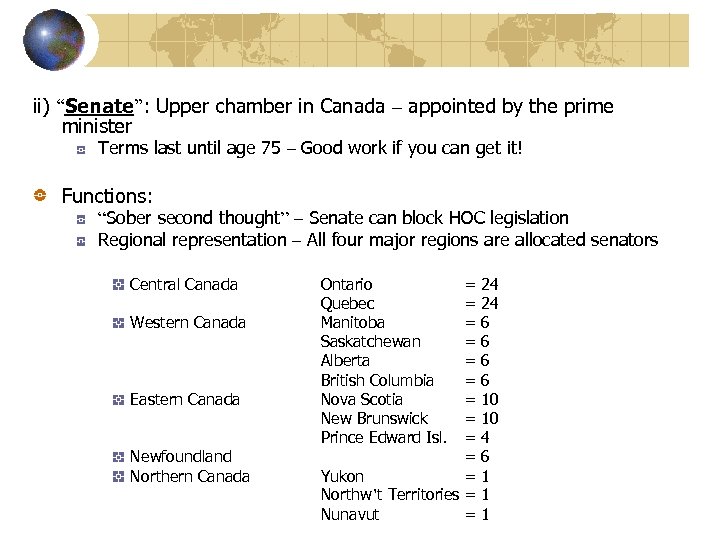 ii) “Senate”: Upper chamber in Canada – appointed by the prime minister Terms last until age 75 – Good work if you can get it! Functions: “Sober second thought” – Senate can block HOC legislation Regional representation – All four major regions are allocated senators Central Canada Western Canada Eastern Canada Newfoundland Northern Canada Ontario Quebec Manitoba Saskatchewan Alberta British Columbia Nova Scotia New Brunswick Prince Edward Isl. = = = = = Yukon = Northw’t Territories = Nunavut = 24 24 6 6 10 10 4 6 1 1 1
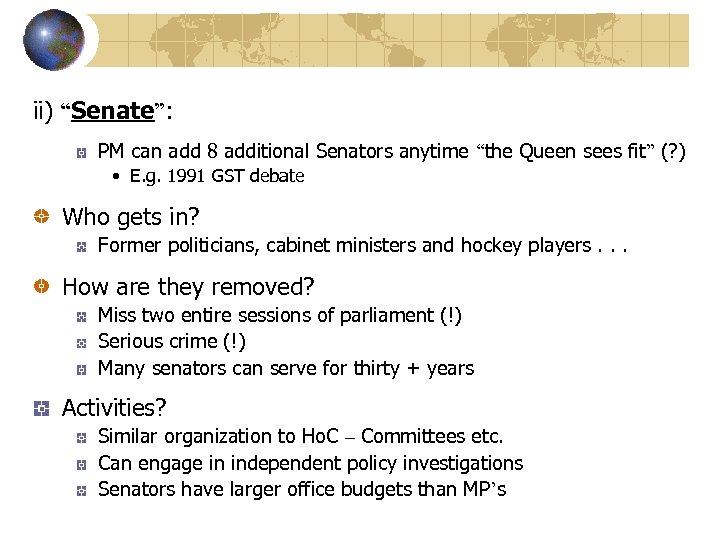 ii) “Senate”: PM can add 8 additional Senators anytime “the Queen sees fit” (? ) • E. g. 1991 GST debate Who gets in? Former politicians, cabinet ministers and hockey players. . . How are they removed? Miss two entire sessions of parliament (!) Serious crime (!) Many senators can serve for thirty + years Activities? Similar organization to Ho. C – Committees etc. Can engage in independent policy investigations Senators have larger office budgets than MP’s
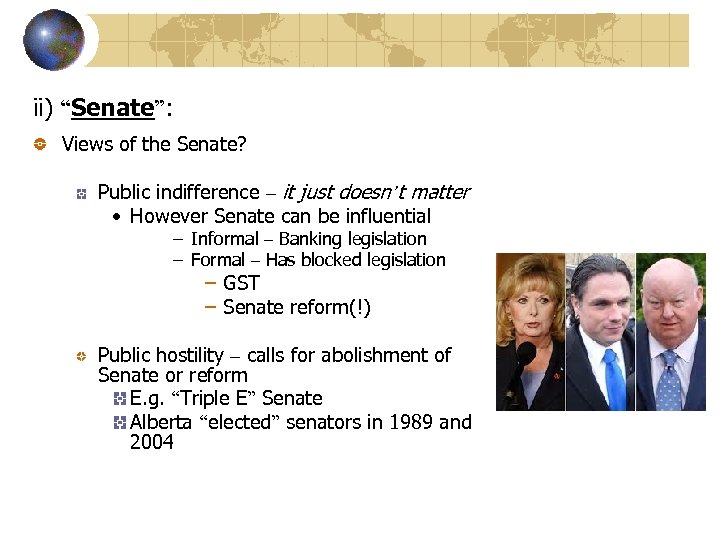 ii) “Senate”: Views of the Senate? Public indifference – it just doesn’t matter • However Senate can be influential – Informal – Banking legislation – Formal – Has blocked legislation – GST – Senate reform(!) Public hostility – calls for abolishment of Senate or reform E. g. “Triple E” Senate Alberta “elected” senators in 1989 and 2004
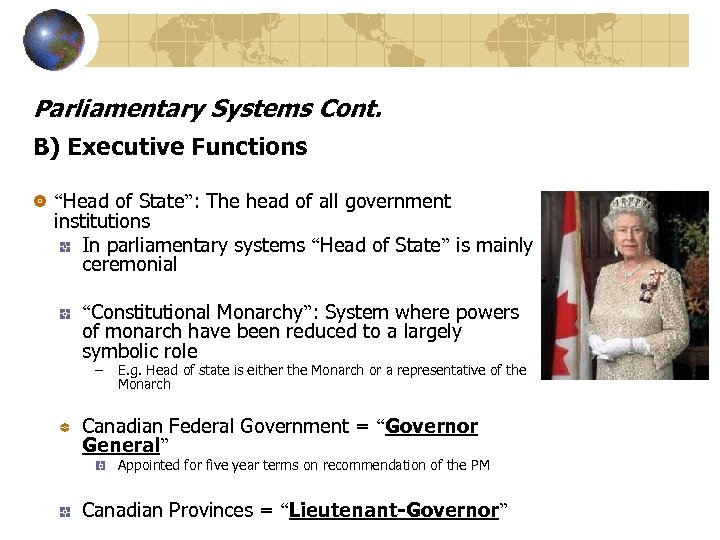 Parliamentary Systems Cont. B) Executive Functions “Head of State”: The head of all government institutions In parliamentary systems “Head of State” is mainly ceremonial “Constitutional Monarchy”: System where powers of monarch have been reduced to a largely symbolic role – E. g. Head of state is either the Monarch or a representative of the Monarch Canadian Federal Government = “Governor General” Appointed for five year terms on recommendation of the PM Canadian Provinces = “Lieutenant-Governor”
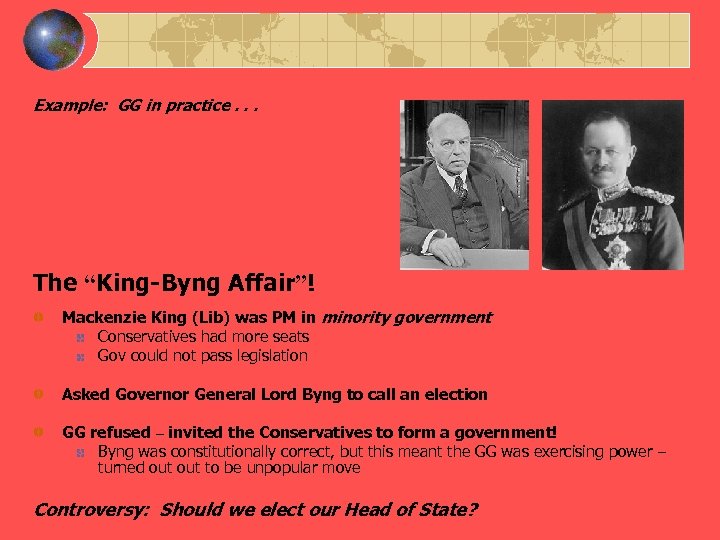 Example: GG in practice. . . The “King-Byng Affair”! Mackenzie King (Lib) was PM in minority government Conservatives had more seats Gov could not pass legislation Asked Governor General Lord Byng to call an election GG refused – invited the Conservatives to form a government! Byng was constitutionally correct, but this meant the GG was exercising power – turned out to be unpopular move Controversy: Should we elect our Head of State?
 “Head of Government”: Prime minister Premiers (in Provinces) Chooses cabinet ministers Oversees “Central Agencies”: Organizations that coordinate government activity • • Privy Council Office Prime Ministers Office Treasury Board Department of Finance Drafts legislation and Budgets Oversees the “Bureaucracy”: Civil servants and unelected officials responsible for carrying out public policy of governments Canadian PM is particularly powerful: Appoints: Judges, Senators, Cabinet ministers Dominates own party caucus =“Executive Dominance”: Little role for legislature in day to day operations of government
 3)Conclusions on Parliamentary System: Key points: a) Government “executive” is formed from parliamentary “caucus” • All ministers are either an MP or a Senator - Ensures close link between executive and legislature • Virtue: Government can always be questioned – E. g. “Question Period”: time allotted in Parliament for private members to question members of cabinet and prime minister b) Conflicting Principles:
 “Responsible Government”: Cabinet is responsible to the Ho. C • Not the public! Ho. C can “throw out” a government “Ministerial Responsibility” Principle that individual members of the executive (cabinet) remain accountable to the legislature. • E. g. Constitutional convention - Mistakes by the Cabinet ministers’ staff require that the Minister should resign!
 “Party Discipline”: Ensures all MP’s vote along party lines Particularly strong in Canada - Gov’t members rarely vote against gov’t bills =Little role for parliament in designing legislation =Little role for parliament in holding majority gov’ts accountable Just who is cabinet “responsible” too? “Fusion of Powers”: Executive and legislative branches of government are combined. Reduces access points to influence government – little “pluralism”