


 Скачать презентацию Portion Distortion Size Up Your Servings Helping you
436d027d7033f57d3879fe03bbb7a12b.ppt
- Количество слайдов: 19
 Portion Distortion Size Up Your Servings Helping you achieve a healthy community within your worksite 1
 Creeping portion distortion Portion sizes have increased dramatically within the last 20 years. Slides marked by are adapted from “Portion Distortion” by the National Heart, Lung and Blood Institute at http: //hin. nhlbi. nih. gov/portion 2
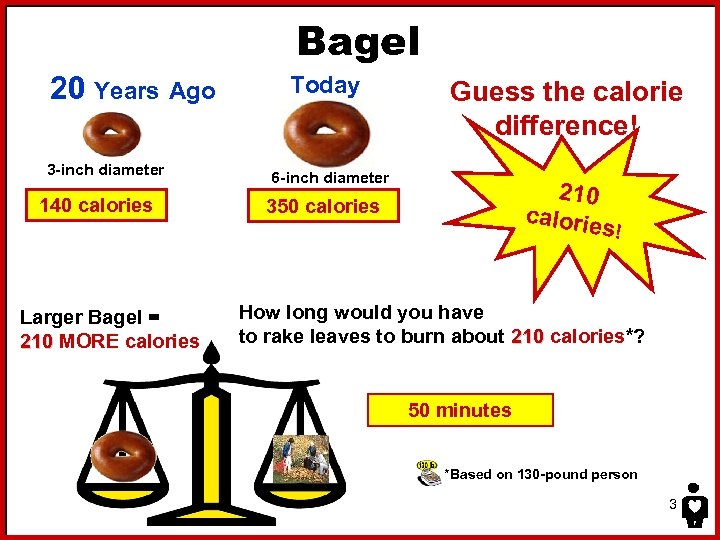 Bagel 20 Years Ago 3 -inch diameter 140 calories Larger Bagel = 210 MORE calories Today Guess the calorie difference! 6 -inch diameter 210 calorie s! 350 calories How long would you have to rake leaves to burn about 210 calories*? 50 minutes *Based on 130 -pound person 3
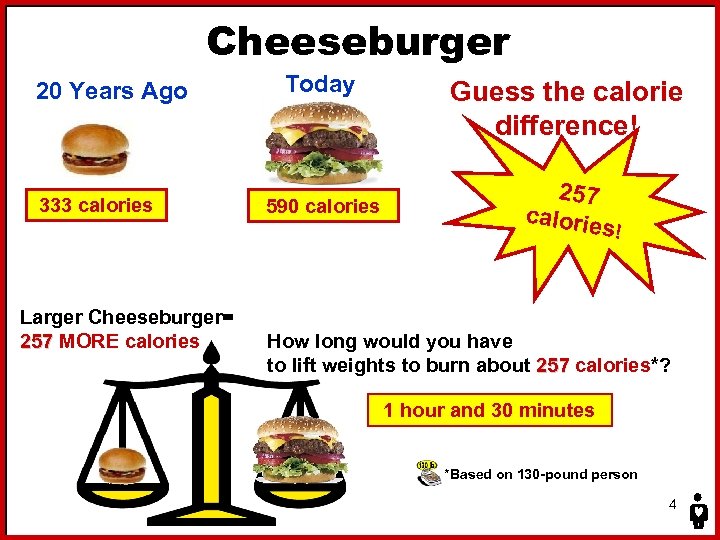 Cheeseburger 20 Years Ago 333 calories Larger Cheeseburger= 257 MORE calories Today 590 calories Guess the calorie difference! 257 calorie s! How long would you have to lift weights to burn about 257 calories*? 1 hour and 30 minutes *Based on 130 -pound person 4
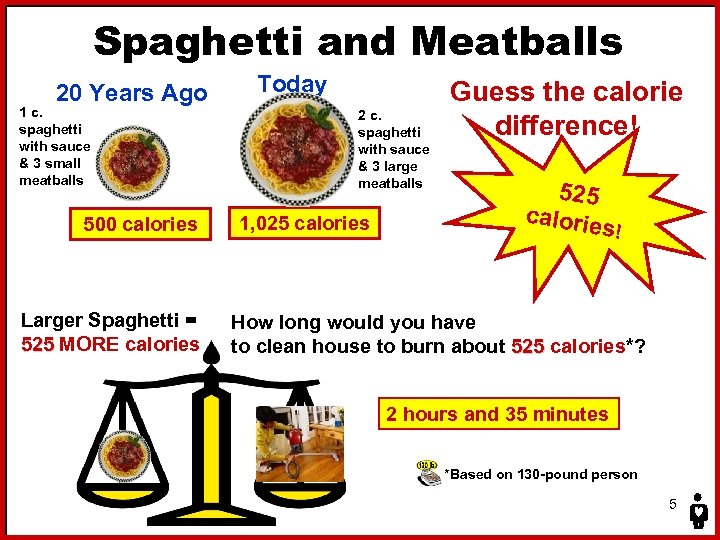 Spaghetti and Meatballs 20 Years Ago 1 c. spaghetti with sauce & 3 small meatballs 500 calories Larger Spaghetti = 525 MORE calories Today 2 c. spaghetti with sauce & 3 large meatballs 1, 025 calories Guess the calorie difference! 525 calorie s! How long would you have to clean house to burn about 525 calories*? 2 hours and 35 minutes *Based on 130 -pound person 5
 What is Portion Distortion? When we are accustomed to seeing a certain portion of food, we begin to think that is a normal portion. Note: A portion includes the total amount of food you eat at one time. For example, you may choose to eat a small amount but you go back for seconds and thirds. If this is more food than your body needs, it becomes an example of portion distortion. 6
 Why does portion distortion exist? Many reasons related to marketing & media images ü“More is better” belief üLarger restaurant portions üLarger portions at home 7
 What happens when we have a larger portion? Research shows most people will eat more than they need when served larger portions! 8
 Examples: Reasons why we eat more than we need. n Habit. n Feel like we need to get our money’s worth. n Reluctance to waste food. n It tastes good. n We may not be listening to our body’s signals of hunger and satisfaction. 9
 Potential Implications of Portion Distortion. 1. Nutritional a) More calories than a body needs – excess weight. b) Too much of certain nutrients (example: saturated fat) – increased risk for certain chronic diseases. 2. Financial a) Eating more than we need costs more. 3. Environmental a) Food production, transportation and packaging use earth’s resources. b) Eating more food than we need wastes resources. 10
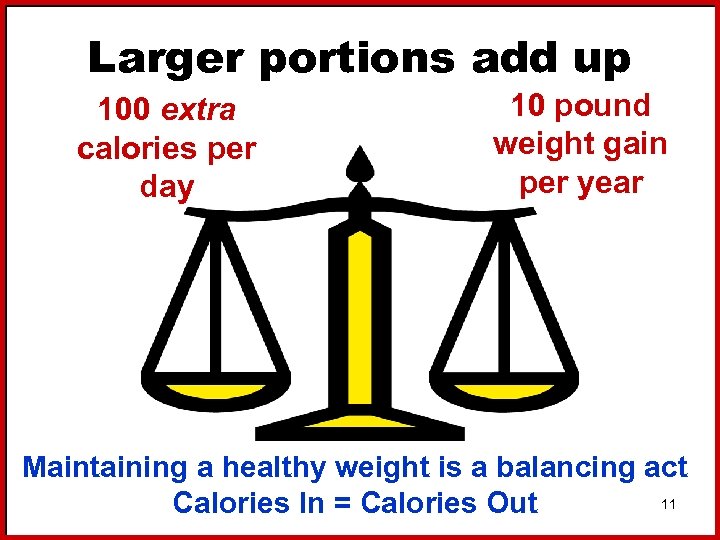 Larger portions add up 100 extra calories per day 10 pound weight gain per year Maintaining a healthy weight is a balancing act 11 Calories In = Calories Out
 Combating Portion Distortion n Learn to recognize a reasonable portion. n Take action steps to avoid eating more than your body needs. Example: Learn to listen to hunger. Stop eating when you are no longer hungry. n If a portion is large (example: large cookie), share it with a friend. n 12
 tion por oid ion! Av tort dis Keep an “eye” on your food portion sizes 13
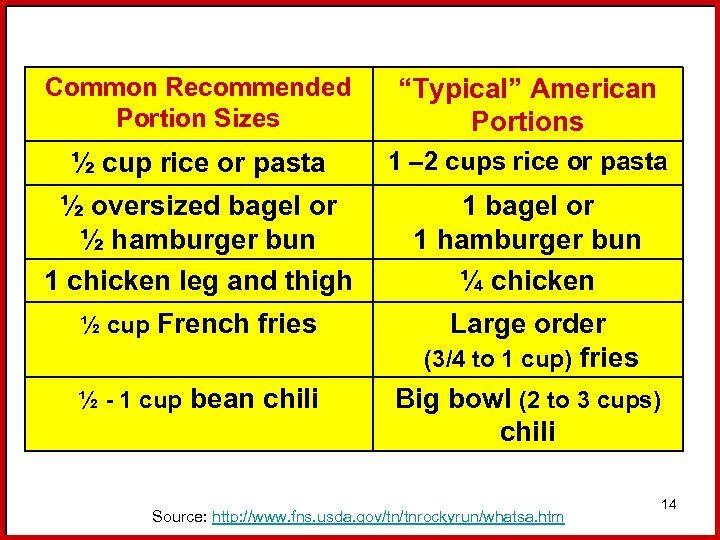 Common Recommended Portion Sizes “Typical” American Portions ½ cup rice or pasta 1 – 2 cups rice or pasta ½ oversized bagel or ½ hamburger bun 1 chicken leg and thigh 1 bagel or 1 hamburger bun ¼ chicken ½ cup French fries Large order (3/4 to 1 cup) fries Big bowl (2 to 3 cups) chili ½ - 1 cup bean chili Source: http: //www. fns. usda. gov/tn/tnrockyrun/whatsa. htm 14
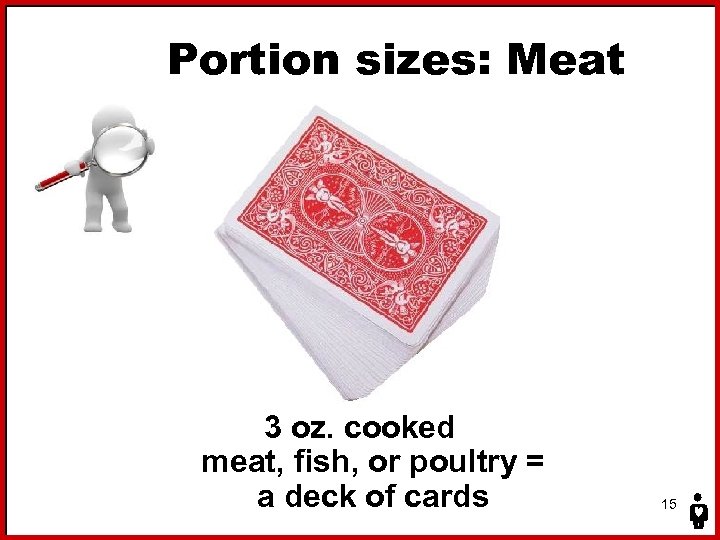 Portion sizes: Meat 3 oz. cooked meat, fish, or poultry = a deck of cards 15
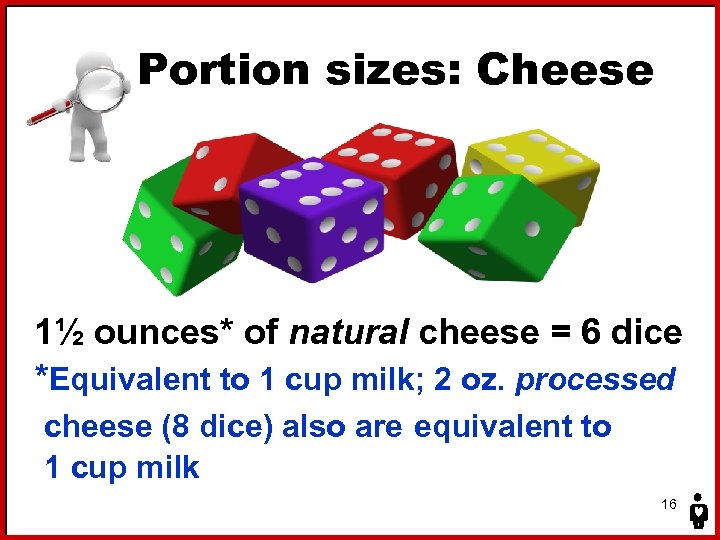 Portion sizes: Cheese 1½ ounces* of natural cheese = 6 dice *Equivalent to 1 cup milk; 2 oz. processed cheese (8 dice) also are equivalent to 1 cup milk 16
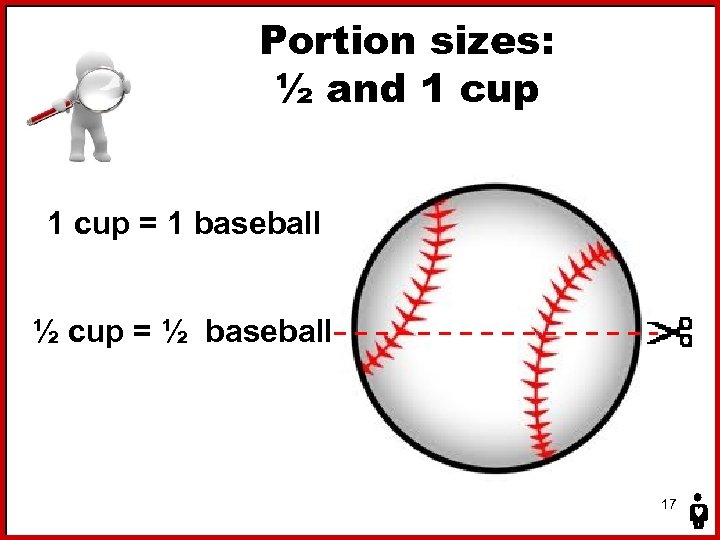 Portion sizes: ½ and 1 cup = 1 baseball ½ cup = ½ baseball 17
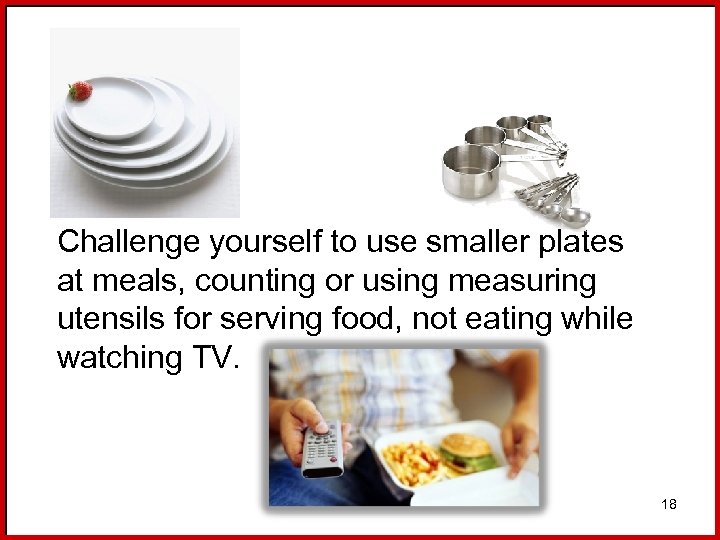 Challenge yourself to use smaller plates at meals, counting or using measuring utensils for serving food, not eating while watching TV. 18
 • Portion sizes can impact how much we eat or don’t eat. • Be portion wise and mindful of what you are eating. 19