 Скачать презентацию PORTFOLIO INSURANCE Done by Botbayeva Zhibek Mugalim Aida
Portfolio Insurance.pptx
- Количество слайдов: 24



PORTFOLIO INSURANCE Done by: Botbayeva Zhibek Mugalim Aida Serik Akbota

INTRODUCTION v We are all very much familiar with insurance concept and most of us entered and entering into the insurance agreement like Life insurance, Health Insurance, Vehicle Insurance and Wealth Insurance but our investments (Portfolio &Mutual Fund) are not covered by insurance because most of us do not aware of Portfolio Insurance.
OUTLINE v What is it? v Evolution of portfolio insurance v Insurance strategies v How they work

WHAT IS IT? v Portfolio insurance is an investment strategy where various financial instruments like equities and debts and derivatives are combined in such a way that degradation of portfolio value is protected. v Portfolio insurance is a method of hedging a portfolio of stocks against the market risk by short selling stock index futures.
EVOLUTION OF PORTFOLIO INSURANCE v Hayne E. Leland Mark Rubinstein (11 th September 1976). v Hayne E. Leland suggested put option as tool (Option Based Portfolio Insurance ).
v In 1987 Black and Jones proposed the new Portfolio Insurance strategy using the risky (equity) and riskless (bonds) assets in portfolio. this strategy is known as Constant Proportionate Portfolio insurance(CPPI).

INSURANCE STRATEGIES v 1) Option Based Portfolio Insurance(OBPI) v 2)Constant Proportionate Portfolio Insurance (CPPI)
OBPI v OBPI is achieved by using financial derivatives like put option. In this strategy when market is seems to decrease the investor hedge his portfolio of stocks against the market risk using put option on stock index futures. Advantages: 1) faster execution 2) greatly reduced transaction costs
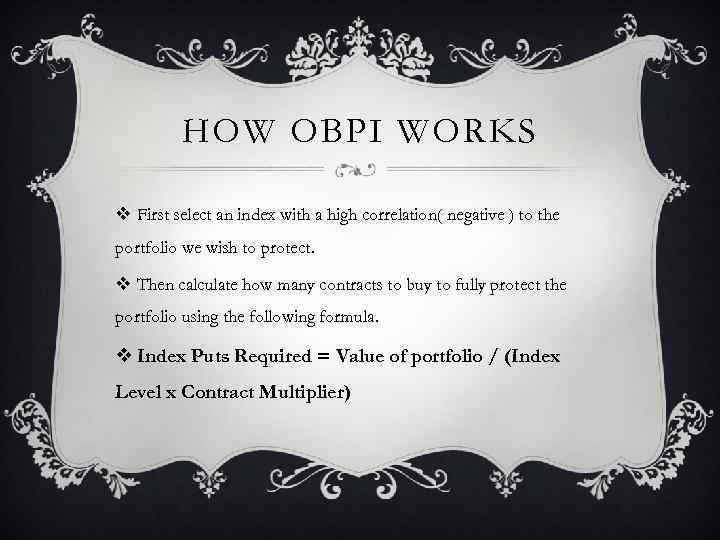
HOW OBPI WORKS v First select an index with a high correlation( negative ) to the portfolio we wish to protect. v Then calculate how many contracts to buy to fully protect the portfolio using the following formula. v Index Puts Required = Value of portfolio / (Index Level x Contract Multiplier)
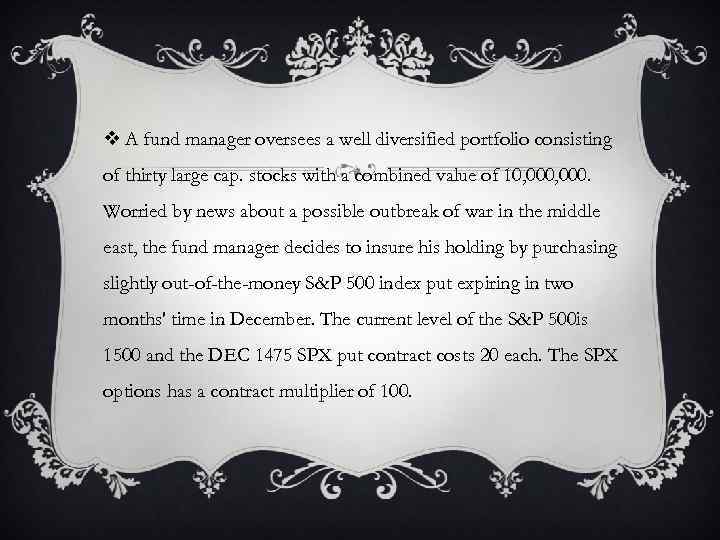
v A fund manager oversees a well diversified portfolio consisting of thirty large cap. stocks with a combined value of 10, 000. Worried by news about a possible outbreak of war in the middle east, the fund manager decides to insure his holding by purchasing slightly out-of-the-money S&P 500 index put expiring in two months' time in December. The current level of the S&P 500 is 1500 and the DEC 1475 SPX put contract costs 20 each. The SPX options has a contract multiplier of 100.
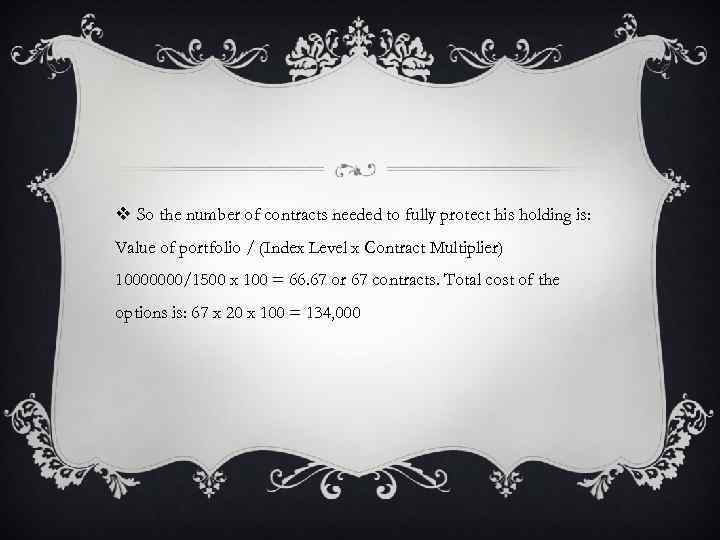
v So the number of contracts needed to fully protect his holding is: Value of portfolio / (Index Level x Contract Multiplier) 10000000/1500 x 100 = 66. 67 or 67 contracts. Total cost of the options is: 67 x 20 x 100 = 134, 000
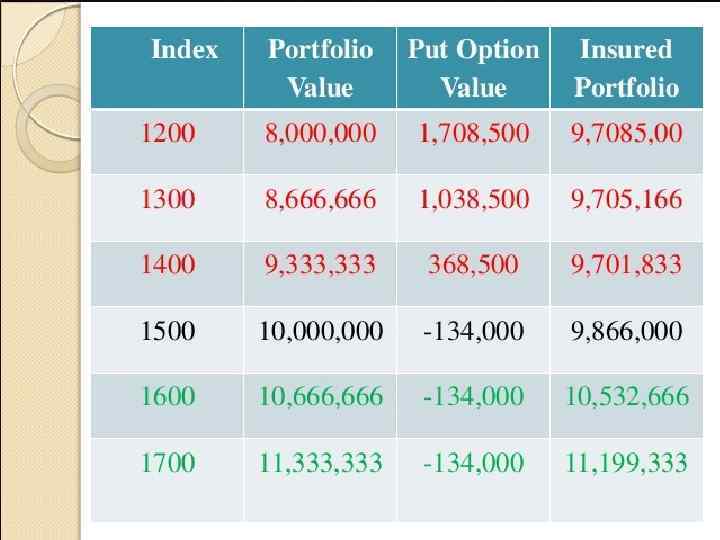

v. Effects of portfolio insurance: v When market falls v When market rises v When market is flat
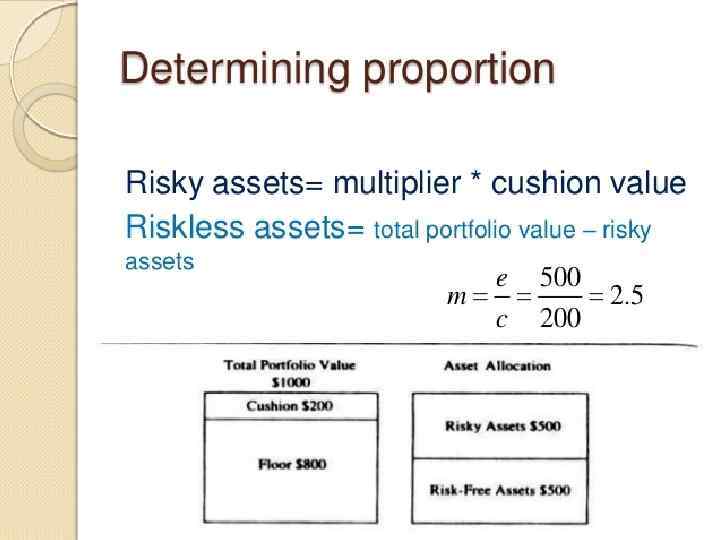
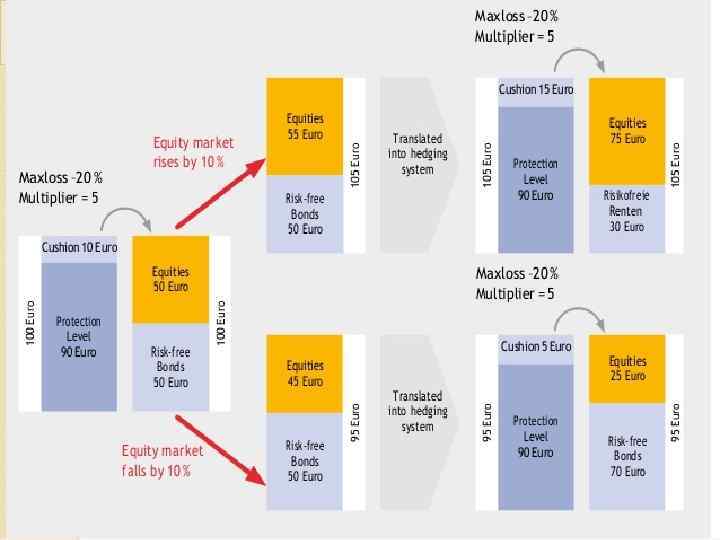
CPPI v CPPI (Constant proportion portfolio insurance) CPPI strategy is about proportionate of risky (equity) and riskless (bonds) assets in a portfolio to avoid the risk protect the value of portfolio. CPPI is a method of portfolio insurance in which the investor sets a floor value of his or her portfolio and then structures asset allocation around that decision. The two asset classes used in CPPI are a risky asset (equities or mutual funds), and a riskless asset of cash, equivalents or Treasury bonds. The percentage allocated to each depends on the "cushion" value.
v Advantages of CPPI : v Does not require derivatives v Fewer management expenses v Adjustable risk and reward

ATTRIBUTES v Generally, portfolio insurance can be thought of as holding two portfolios. Risky and riskless assets v The floor level, the lowest value the portfolio can have, is viewed as the safe or riskless portfolio with value equal to the level of protection desired. v The second portfolio is portfolio cushion which consists of the difference between the total value of the portfolio and the floor. v These assets consist of a leveraged position in risky assets. v To insure the portfolio, the cushion should be managed so as to never fall below zero in value because of the limited-liability property of common stock.

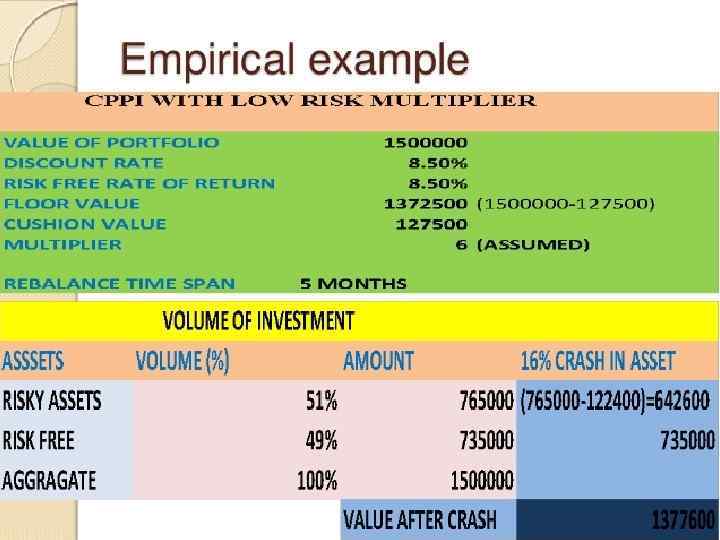
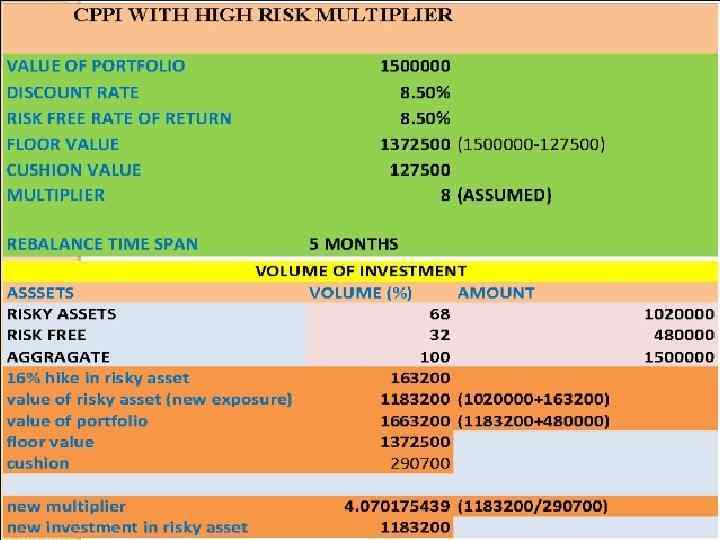
v Portfolio value It is the total financial value of the portfolio as on the day. v Floor value It is the minimum value can be realized by the portfolio as on that day. It’s normally calculated using time value. In this case riskless assets return will be the discount factor. Value of portfolio should not go Below the floor value. v Cushion value It is a difference between portfolio value and Floor value. (portfolio value- Floor value). Its also called as Gap value. It will help to determine the investment value of Risky assets. v. Cushion = portfolio value – floor value
Multiplier It is the risk leverage of portfolio, the high value of multiplier means high risk and vice versa. Multiplier= exposure /cushion Exposure = value of risk free assets
CONCLUSION v The OBPI will helpful in case of aggressive portfolio when market volatile affect it. This can be useful for blue chip portfolio and mutual funds. v The CPPI is good for all the situation and for all type of investment because it will reduce the risk by investing in riskless assets.

Thank you!
Скачать презентацию PORTFOLIO INSURANCE Done by Botbayeva Zhibek Mugalim Aida
Portfolio Insurance.pptx