 Скачать презентацию Portfolio Committee Water Environmental Affairs Briefing on
443a4828cba17869212a7eda93524f3b.ppt
- Количество слайдов: 26



Portfolio Committee: Water & Environmental Affairs Briefing on the Audited Financial Statements 2011/12 Department: Water Affairs Main Account 10 to 11 October 2012 1
Contents of presentation Section Part A Title Expenditure analysis for the year ending 31 st March 2012 Slide no 4 - 14 Part B Successes and challenges experienced 15 - 19 Part C Under spending on Acid Mine Drainage 20 - 23 Part D Remedial action plan 24 – 25 2
PART A – EXPENDITURE ANALYSIS FOR THE YEAR ENDING 31 ST MARCH 2012 3
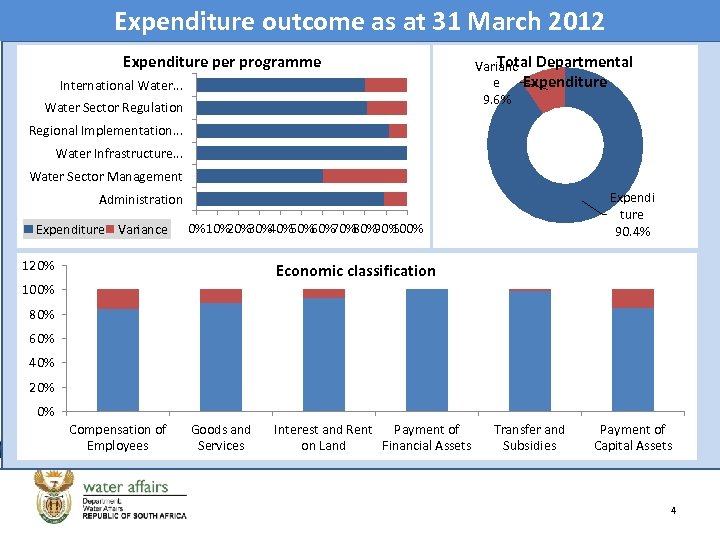
Expenditure outcome as at 31 March 2012 Expenditure per programme International Water. . . Water Sector Regulation Total Departmental Varianc Expenditure e 9. 6% Regional Implementation. . . Water Infrastructure. . . Water Sector Management Expendi ture 90. 4% Administration Expenditure Variance 0%10% 30% 50% 70% 90% 20% 40% 60% 80% 100% 120% Economic classification 100% 80% 60% 40% 20% 0% Compensation of Employees Goods and Services Interest and Rent Payment of on Land Financial Assets Transfer and Subsidies Payment of Capital Assets 4
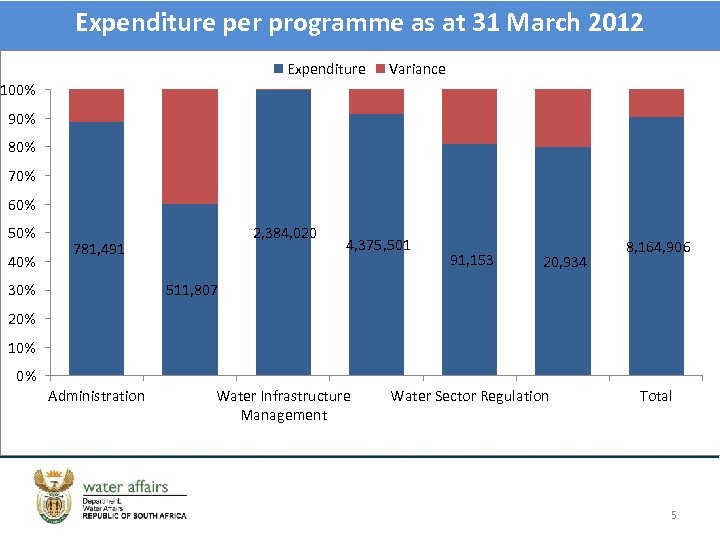
Expenditure per programme as at 31 March 2012 Expenditure Variance 100% 90% 80% 70% 60% 50% 40% 2, 384, 020 781, 491 4, 375, 501 91, 153 20, 934 8, 164, 906 511, 807 30% 20% 10% 0% Administration Water Infrastructure Management Water Sector Regulation Total 5
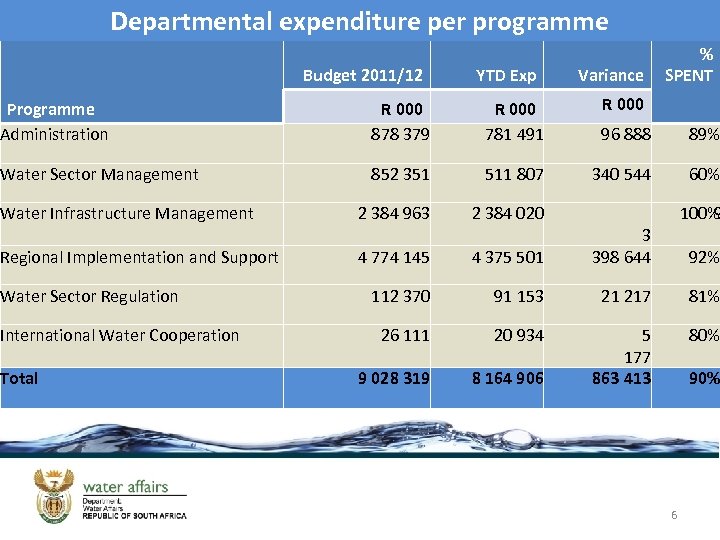
Departmental expenditure per programme Budget 2011/12 YTD Exp Variance % SPENT R 000 Programme Administration R 000 878 379 R 000 781 491 96 888 89% Water Sector Management 852 351 511 807 340 544 60% Water Infrastructure Management 2 384 963 2 384 020 Regional Implementation and Support 4 774 145 4 375 501 3 398 644 112 370 91 153 21 217 81% 26 111 20 934 5 177 8 164 906 863 413 80% Water Sector Regulation International Water Cooperation Total 9 028 319 100% 9 92% 90% 6
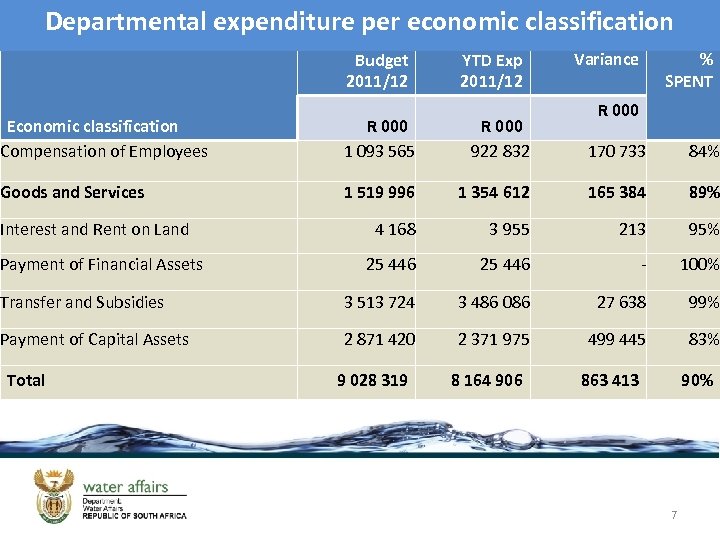
Departmental expenditure per economic classification Budget 2011/12 Economic classification Compensation of Employees Goods and Services Interest and Rent on Land R 000 1 093 565 1 519 996 YTD Exp 2011/12 R 000 922 832 Variance % SPENT R 000 170 733 84% 1 354 612 165 384 89% 4 168 3 955 213 95% 25 446 - 100% Transfer and Subsidies 3 513 724 3 486 086 27 638 99% Payment of Capital Assets 2 871 420 2 371 975 499 445 83% Payment of Financial Assets Total 9 028 319 8 164 906 863 413 90% 7
Reasons for under-spending • The Department spent R 8 164 906 000 of the total allocation of R 9 028 319 000 which represents 90. 4% total spending of the Department. • The remaining 9. 6% of the under expenditure is mainly due to the following: 8
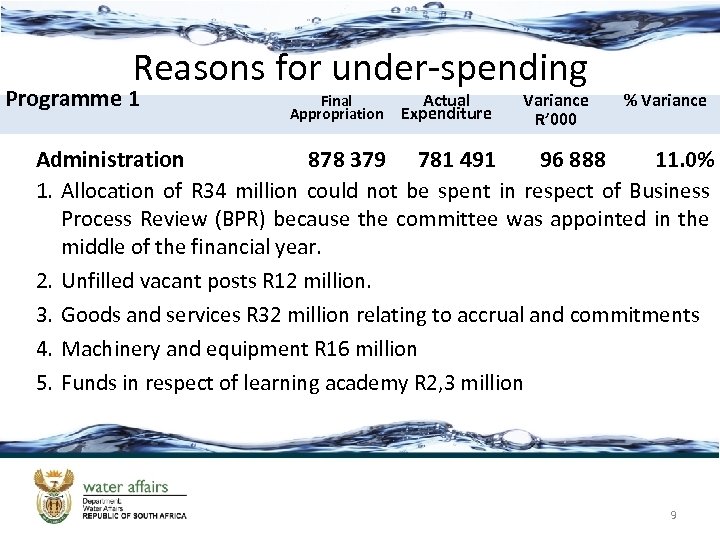
Reasons for under-spending Programme 1 Final Appropriation Actual Expenditure Variance R’ 000 % Variance Administration 878 379 781 491 96 888 11. 0% 1. Allocation of R 34 million could not be spent in respect of Business Process Review (BPR) because the committee was appointed in the middle of the financial year. 2. Unfilled vacant posts R 12 million. 3. Goods and services R 32 million relating to accrual and commitments 4. Machinery and equipment R 16 million 5. Funds in respect of learning academy R 2, 3 million 9
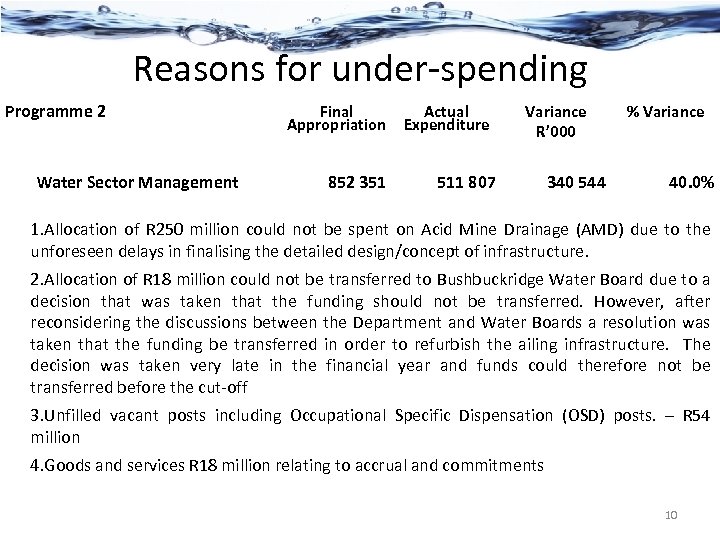
Reasons for under-spending Programme 2 Water Sector Management Final Appropriation 852 351 Actual Expenditure Variance R’ 000 511 807 340 544 % Variance 40. 0% 1. Allocation of R 250 million could not be spent on Acid Mine Drainage (AMD) due to the unforeseen delays in finalising the detailed design/concept of infrastructure. 2. Allocation of R 18 million could not be transferred to Bushbuckridge Water Board due to a decision that was taken that the funding should not be transferred. However, after reconsidering the discussions between the Department and Water Boards a resolution was taken that the funding be transferred in order to refurbish the ailing infrastructure. The decision was taken very late in the financial year and funds could therefore not be transferred before the cut-off 3. Unfilled vacant posts including Occupational Specific Dispensation (OSD) posts. – R 54 million 4. Goods and services R 18 million relating to accrual and commitments 10
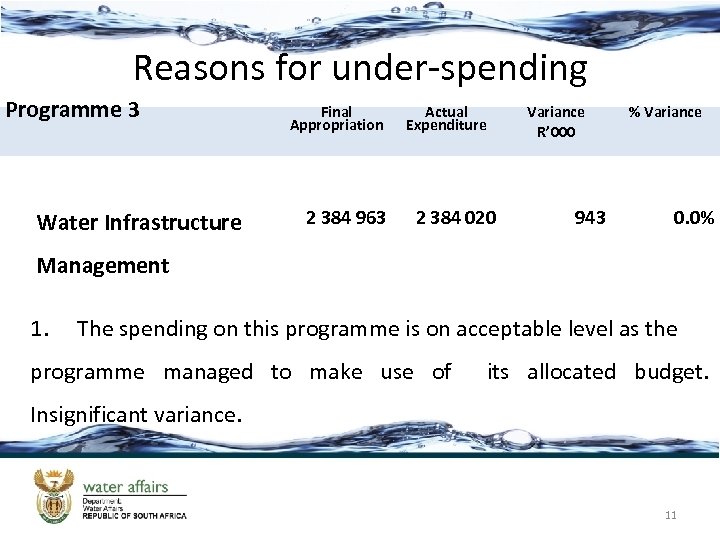
Reasons for under-spending Programme 3 Water Infrastructure Final Appropriation 2 384 963 Actual Expenditure 2 384 020 Variance R’ 000 943 % Variance 0. 0% Management 1. The spending on this programme is on acceptable level as the programme managed to make use of its allocated budget. Insignificant variance. 11
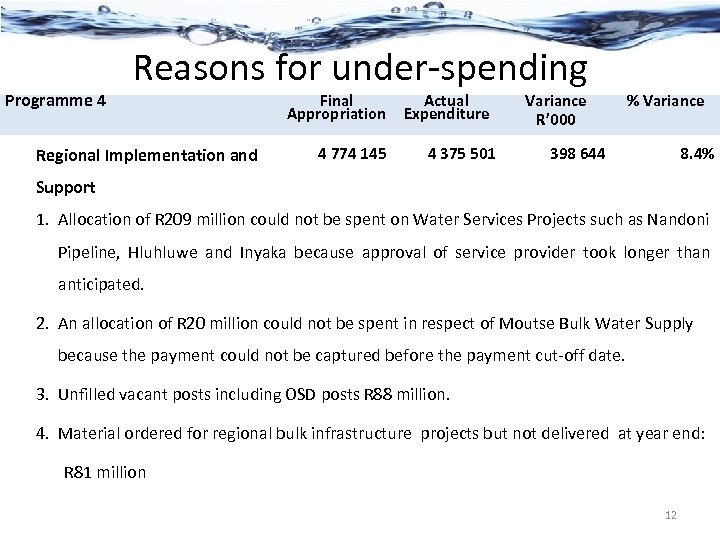
Programme 4 Reasons for under-spending Regional Implementation and Final Appropriation 4 774 145 Actual Expenditure 4 375 501 Variance R’ 000 % Variance 398 644 8. 4% Support 1. Allocation of R 209 million could not be spent on Water Services Projects such as Nandoni Pipeline, Hluhluwe and Inyaka because approval of service provider took longer than anticipated. 2. An allocation of R 20 million could not be spent in respect of Moutse Bulk Water Supply because the payment could not be captured before the payment cut-off date. 3. Unfilled vacant posts including OSD posts R 88 million. 4. Material ordered for regional bulk infrastructure projects but not delivered at year end: R 81 million 12
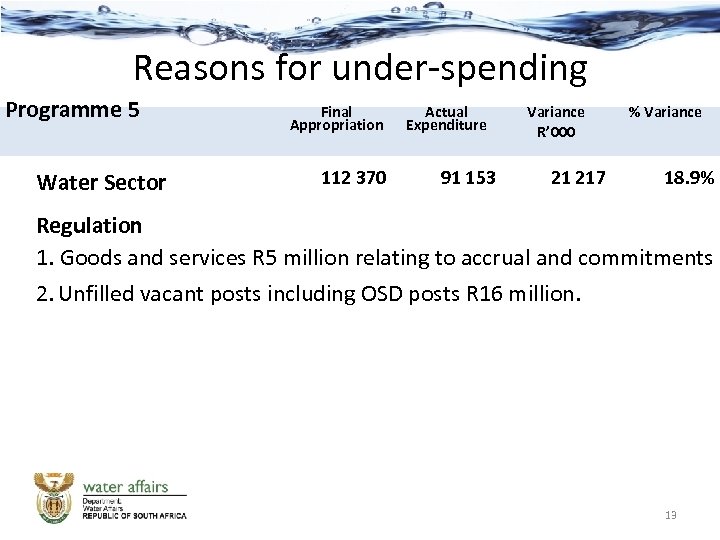
Reasons for under-spending Programme 5 Water Sector Final Appropriation 112 370 Actual Expenditure 91 153 Variance R’ 000 21 217 % Variance 18. 9% Regulation 1. Goods and services R 5 million relating to accrual and commitments 2. Unfilled vacant posts including OSD posts R 16 million. 13
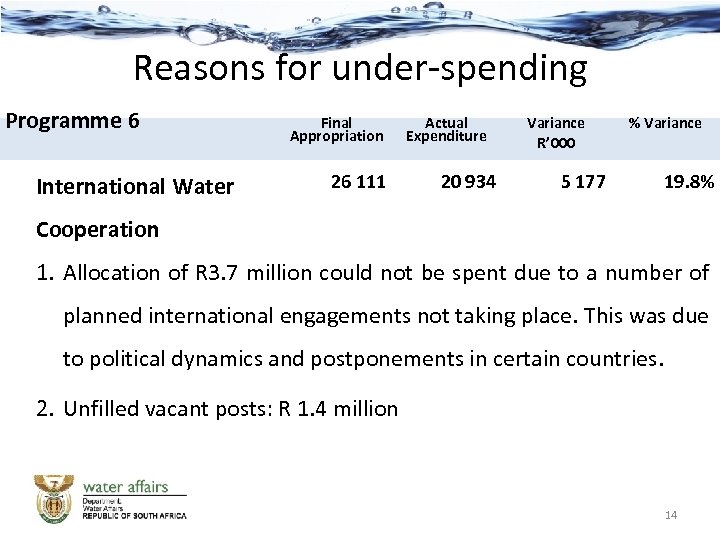
Reasons for under-spending Programme 6 International Water Final Appropriation 26 111 Actual Expenditure 20 934 Variance R’ 000 % Variance 5 177 19. 8% Cooperation 1. Allocation of R 3. 7 million could not be spent due to a number of planned international engagements not taking place. This was due to political dynamics and postponements in certain countries. 2. Unfilled vacant posts: R 1. 4 million 14
PART B – SUCCESSES AND CHALLENGES EXPERIENCED 15
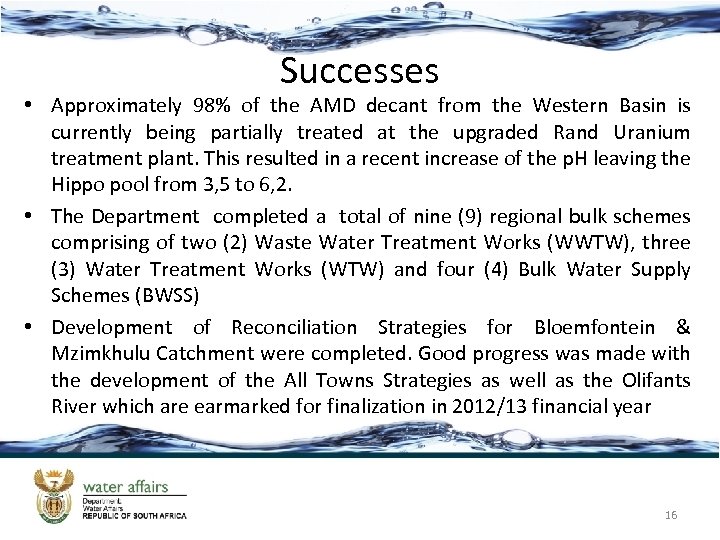
Successes • Approximately 98% of the AMD decant from the Western Basin is currently being partially treated at the upgraded Rand Uranium treatment plant. This resulted in a recent increase of the p. H leaving the Hippo pool from 3, 5 to 6, 2. • The Department completed a total of nine (9) regional bulk schemes comprising of two (2) Waste Water Treatment Works (WWTW), three (3) Water Treatment Works (WTW) and four (4) Bulk Water Supply Schemes (BWSS) • Development of Reconciliation Strategies for Bloemfontein & Mzimkhulu Catchment were completed. Good progress was made with the development of the All Towns Strategies as well as the Olifants River which are earmarked for finalization in 2012/13 financial year 16
Successes • Good progress has been made in ensuring that various systems and stand alone dams have robust operating rules which are annually updated and implemented. As such, annual system operation runs were done for all systems with the Algoa System, the only one with restrictions on both urban (PE area) and irrigation water use. • 5 Catchments were optimally monitored (Berg, Breede, Gouritz, Olifants, Mhlathuze and Levhuvu/Letaba) • The incentive based regulatory approach has succeeded in raising awareness and providing a positive stimulus for gradual and sustainable improvement in both water and waste water treatment works. This is evident in the both 2011 Blue Drop and Green Drop reports. This is shown by the 21% improvement on the Blue Drop scores attained (72. 9% in 2011 compared to 51. 4% in 2009). The Green Drop scores improved by 8%. 17
Successes • In preparation for the 2012 reports, 831 wastewater and 931 water supply systems were assessed. • The Councillors Induction Programme gained momentum as 1224 Councillors were inducted far exceeding the 166 that was planned for. • Water infrastructure status and intervention plans for 22 priority District Municipalities were completed 18
Challenges • Data discrepancies delayed the finalisation of the comprehensive reserves • The high water levels in the Vaal River delayed the completion of the Klipplaatdrift monitoring station • The implementation of OSD is impacting the availability of the technical skills required to ensure service delivery within the Branch as critical posts could not be filled 19
PART- C UNDEREXPENDITURE ON ACID MINE DRAINAGE 20
Reasons for underspending on AMD • Since the Trans Caledon Tunnel Authority (TCTA) has been appointed by the Minister, a decision was made that prior to implementation of any solution, a due diligence review had to be done first. • Collaborative efforts between the Department and the TCTA have resulted in interrogation of existing mine water treatment infrastructure in the Western and Central Basin mining areas, as well as potential arrangements with the mining companies still operational in these Basins. Long consultation processes to compile transfer agreements were fruitful but time consuming 21
Reasons for under-spending on AMD • Delay in the implementation of the Immediate Intervention for the Western Basin. The upgrade of the Rand Uranium Treatment plant at a cost of R 25 million was only completed in June 2012 compared to originally planned completion date of March 2012. The delay was mainly due to longer than anticipated manufacturing times for the electrical & mechanical equipment. 22
Reasons for under-spending on AMD • Delay in the award of the contract for the construction of the shortterm intervention for the three basins. The delay was caused by a longer than expected tender evaluation period. The original planned date of award was February 2012 compared to a date now of August 2012 which date is subject slightly to lower rise of water levels in the Central and Eastern Basins allowed more time. It is extremely important that critical decisions can only be made on good and reliable data. Due to a lack of consistent information, more time was spent in obtaining as much as possible data from various sources subject to sufficient funding being secured to allow TCTA to enter into contractual commitments. 23
PART D – REMEDIAL ACTIONS PLAN 24
Actions taken or planned to avoid recurrence • To strengthen the project management and contract management capacity within the department including overseeing • Improve on the governance structures that will assist with the monitoring of the expenditure on a continuous basis; the department has established Budget Committee that will quarterly review the expenditure against the performance and the service delivery. • Quarterly review sessions with the National Treasury • The department has also established the CAPEX committee that will oversee and monitor all projects under work in progress. . 25
END 26
Скачать презентацию Portfolio Committee Water Environmental Affairs Briefing on
443a4828cba17869212a7eda93524f3b.ppt