 Скачать презентацию Porous Silicon Porous Si is produced by room
2- Material Aspects of Micro- and Nanoelectromechanical Systems.ppt
- Количество слайдов: 80



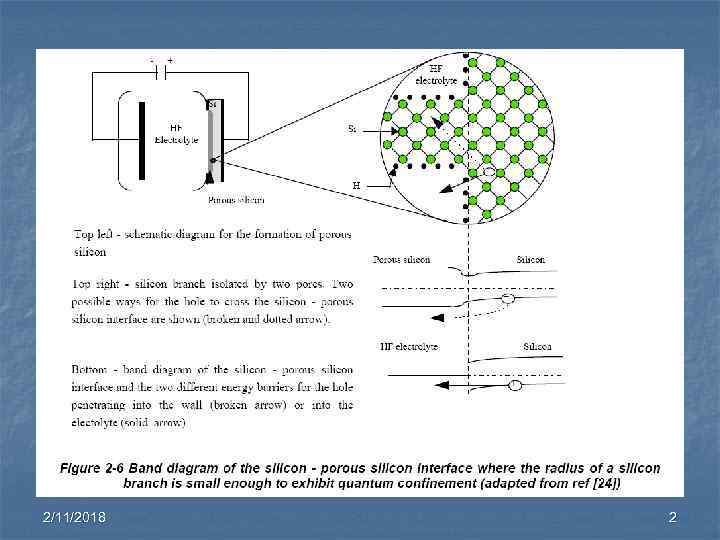
Porous Silicon Porous Si is produced by room temperature electrochemical etching of Si in HF. n If configured as an electrode in an HF-based electrochemical circuit, positive charge carriers (holes) at the Si surface facilitate the exchange of F atoms with H atoms, that terminate the Si surface. n n The exchange continues in the subsurface region, leading to the eventual removal of the fluorinated Si. n. The quality of the etched surface is related to the density of holes at the surface, which is controlled by the applied current density. 2/11/2018 1
2/11/2018 2
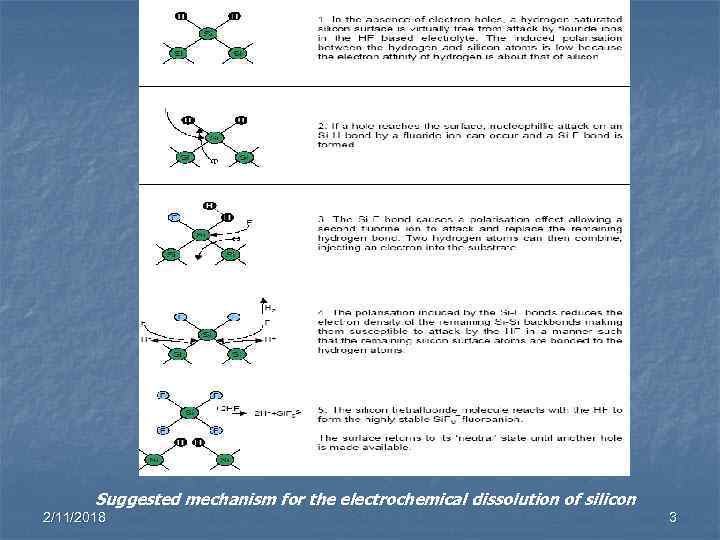
Suggested mechanism for the electrochemical dissolution of silicon 2/11/2018 3
2/11/2018 4
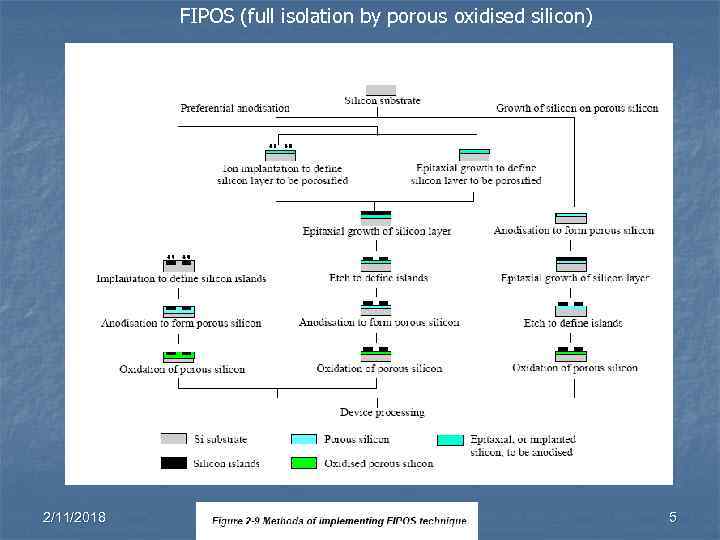
FIPOS (full isolation by porous oxidised silicon) 2/11/2018 5
2/11/2018 6
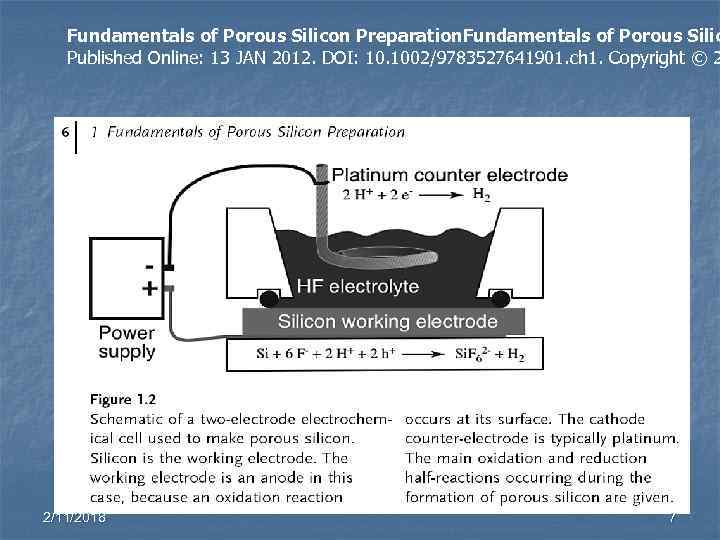
Fundamentals of Porous Silicon Preparation. Fundamentals of Porous Silic Published Online: 13 JAN 2012. DOI: 10. 1002/9783527641901. ch 1. Copyright © 2 2/11/2018 7
n n The techniques employed for dielectric isolation using porous silicon can also be used for micromachining applications. Micromachining is used to fabricate small-scale mechanical devices that are integrated with conventional microelectronics. Examples of micromachined devices include motors, cantilevers and a wide variety of sensors that are designed to sense temperature, IR and UV radiation, fluid flow or gas flow. Many of these structures are fabricated on free-standing membranes, structures that can be easily fabricated using porous silicon. 2/11/2018 8
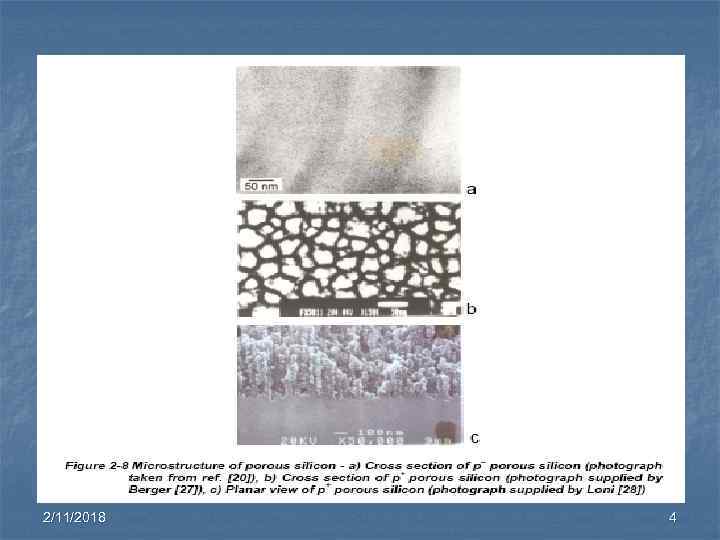
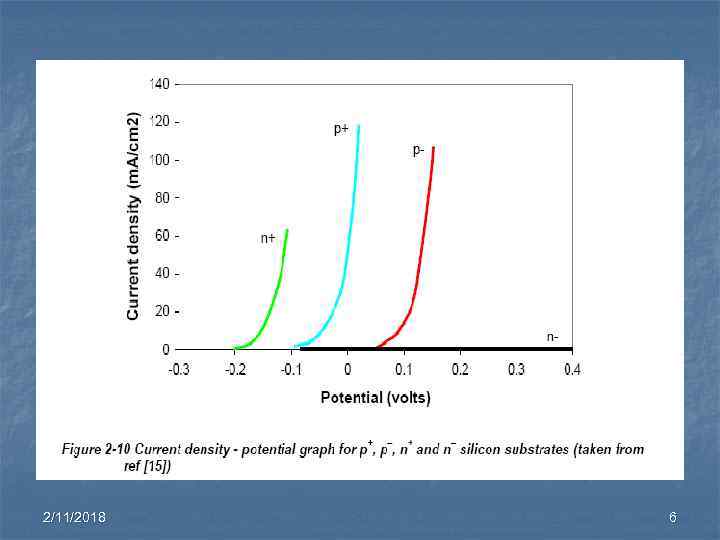
n n For high current densities, the density of holes is high and the etched surface is smooth. For low current densities, the hole density is low and clustered in highly localized regions associated with surface defects. n Surface defects become enlarged by etching, which leads to the formation of pores. n Pore size and density are related to the type of Si used and the conditions of the electrochemical cell. n Both single crystal and polycrystalline Si can be converted to porous Si. 2/11/2018 9
n n The large surface-to-volume ratios make porous Si attractive for gaseous and liquid applications, including filter membranes and absorbing layers for chemical and mass sensing. When single crystal substrates are used, the unetched porous layer remains single crystalline and is suitable for epitaxial Si growth. CVD coatings do not generally penetrate the porous regions, but rather overcoat the pores at the surface of the substrate. The formation of localized Si-on-insulator structures is possible by combining pore formation with epitaxial growth, followed by dry etching to create access (доступ) holes to the porous region, and thermal oxidation of the underlying porous region. 2/11/2018 10
n n A third application uses porous Si as a sacrificial layer for polysilicon and single crystalline Si surface micromachining. As shown by Lang et al. , the process involves the electrical isolation of the solid structural Si layer by either p-n-junction formation through selective doping, or use of electrically insulating thin films, since the formation of pores only occurs on electrically charged surfaces. n A weak Si etchant will aggressively attack the porous regions with little damage to the structural Si layers and can be used to release the devices. 2/11/2018 11
Silicon Dioxide n n Silicon dioxide (Si. O 2) is one of the most widely used materials in the fabrication of MEMS. In polysilicon surface micromachining, Si. O 2 is used as a sacrificial material, since it can be easily dissolved using etchants that do not attack polysilicon. Si. O 2 is widely used as etch mask for dry etching of thick polysilicon films, since it is chemically resistant to dry etching processes for polysilicon. Si. O 2 films are also used as passivation layers on the surfaces of environmentally sensitive devices. 2/11/2018 12
n n n n The most common processes used to produce Si. O 2 films for polysilicon surface micromachining are thermal oxidation and LPCVD. Thermal oxidation of Si is performed at temperatures of 900 ◦C to 1, 200 ◦C in the presence of oxygen or steam. Since thermal oxidation is a self-limiting process, the maximum practical film thickness that can be obtained is about 2µm, which is sufficient for many sacrificial applications. Thermal oxidation of Si can only be performed on Si surfaces. 2/11/2018 13
n n n Si. O 2 films can be deposited on a wide variety of substrate materials by LPCVD provides a means for depositing thick (> 2µm) Si. O 2 films at temperatures much lower than thermal oxidation. Known as low-temperature oxides (LTO), these films have a higher etch rate in HF than thermal oxides, which translates to significantly faster release times when LTO films are used as sacrificial layers. 2/11/2018 14
n n Phosphosilicate glass (PSG) can be formed using nearly the same deposition process as LTO by adding a phosphorus-containing gas to the precursor flows. PSG films are useful as sacrificial layers, since they generally have higher etching rates in HF than LTO films 2/11/2018 15
n n n PSG and LTO films are deposited in hot-wall, low pressure, fused silica furnaces in systems similar to those described previously for polysilicon. Precursor gases include Si. H 4 as a Si source, O 2 as an oxygen source, and, in the case of PSG, PH 3 as a source of phosphorus. LTO and PSG films are typically deposited at temperatures of 425 ◦C to 450 ◦C and pressures ranging from 200 mtorr to 400 mtorr. 2/11/2018 16
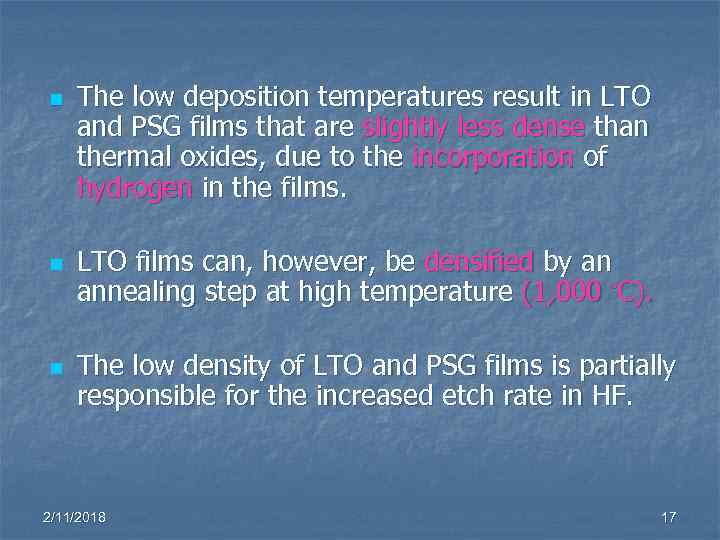
n n n The low deposition temperatures result in LTO and PSG films that are slightly less dense than thermal oxides, due to the incorporation of hydrogen in the films. LTO films can, however, be densified by an annealing step at high temperature (1, 000 ◦C). The low density of LTO and PSG films is partially responsible for the increased etch rate in HF. 2/11/2018 17
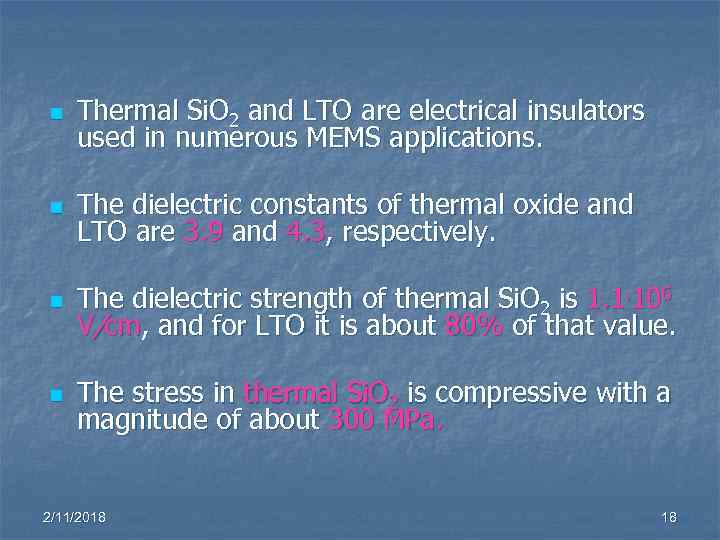
n Thermal Si. O 2 and LTO are electrical insulators used in numerous MEMS applications. n The dielectric constants of thermal oxide and LTO are 3. 9 and 4. 3, respectively. n The dielectric strength of thermal Si. O 2 is 1. 1. 106 V/cm, and for LTO it is about 80% of that value. n The stress in thermal Si. O 2 is compressive with a magnitude of about 300 MPa. 2/11/2018 18
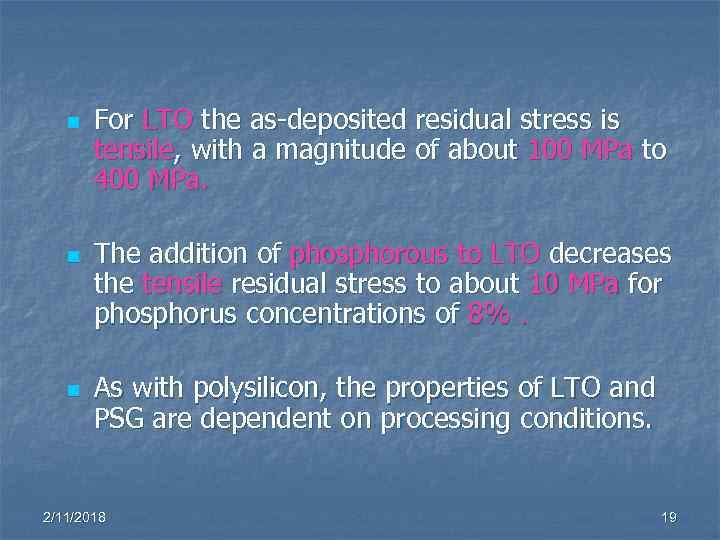
n n n For LTO the as-deposited residual stress is tensile, with a magnitude of about 100 MPa to 400 MPa. The addition of phosphorous to LTO decreases the tensile residual stress to about 10 MPa for phosphorus concentrations of 8%. As with polysilicon, the properties of LTO and PSG are dependent on processing conditions. 2/11/2018 19
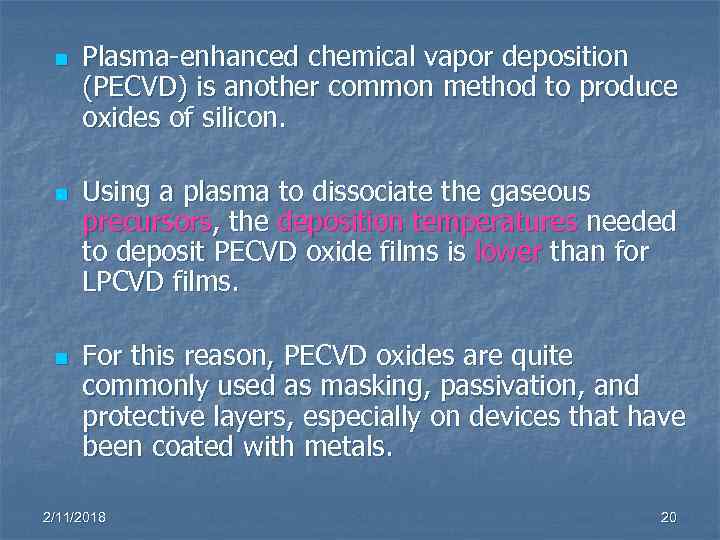
n n n Plasma-enhanced chemical vapor deposition (PECVD) is another common method to produce oxides of silicon. Using a plasma to dissociate the gaseous precursors, the deposition temperatures needed to deposit PECVD oxide films is lower than for LPCVD films. For this reason, PECVD oxides are quite commonly used as masking, passivation, and protective layers, especially on devices that have been coated with metals. 2/11/2018 20
n n Quartz is the crystalline form of Si. O 2 and has interesting properties for MEMS. Quartz is optically transparent, piezoelectric, and electrically insulating. Like single crystal Si, quartz substrates are available as high quality, large area wafers that can be bulk micromachined using anisotropic etchants. Quartz has recently become a popular substrate material for microfluidic devices due to its optical, electronic, and chemical properties. 2/11/2018 21
n n n Another Si. O 2 -related material that has recently found uses in MEMS is spin-on-glass (SOG). SOG is a polymeric material with a viscosity suitable for spin coating. Two recent publications illustrate the potential for SOG in MEMS fabrication. In the first example, Yasseen et al. detailed the development of SOG as a thick-film sacrificial molding material for thick polysilicon films. The authors reported a process to deposit, polish, and etch SOG films that were 20 microns thick. 2/11/2018 22
n n The thick SOG films were patterned into molds and filled with 10 micron-thick LPCVD polysilicon films, planarized by selective CMP, and subsequently dissolved in a wet etchant containing HCl, HF, and H 2 O to reveal (обнажить) the patterned polysilicon structures. The cured (отвержденная) SOG films were completely compatible with the polysilicon deposition process. 2/11/2018 23
n n In the second example, Liu et al. fabricated high -aspect ratio channel plate microstructures from SOG. Electroplated nickel (Ni) was used as a molding material, with Ni channel plate molds fabricated using a conventional LIGA process. The Ni molds were then filled with SOG, and the sacrificial Ni molds were removed in a reverse electroplating process. In this case, the fabricated SOG structures (over 100 microns tall) were micromachined glass structures fabricated using a molding material more commonly used for structural components. 2/11/2018 24
n n Thick (5– 100 µm) spin-on glass (SOG) has the ability to uniformly coat surfaces and smooth out underlying topographical variations, effectively planarizing surface features. Thin (0. 1– 0. 5 µm) SOG was heavily investigated in the integrated circuit industry as an interlayer dielectric between metals for high-speed electrical interconnects; however, its electrical properties are considered poor compared to thermal or CVD silicon oxides. 2/11/2018 25
n n n Spin-on glass is commercially available in different forms, commonly siloxane- or silicate-based. The latter type allows water absorption into the film, resulting in a higher relative dielectric constant and a tendency to crack. After deposition, the layer is typically densified at a temperature between 300º and 500ºC. Measured film stress is approximately 200 MPa in tension but decreases substantially with increasing anneal temperatures. There are two basic types of SOG: siloxane-based organic SOG and silicate-based inorganic SOG. 2/11/2018 26
n n Spin on glass (SOG) is a mixture of Si. O 2 and dopants (either boron or phosphorous) that is suspended in a solvent solution. The SOG is applied to a clean silicon wafer by spin-coating just like photoresist. 2/11/2018 27
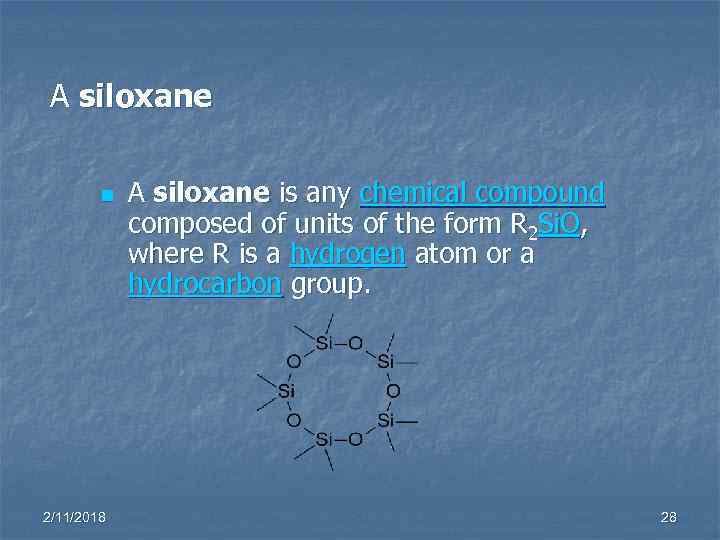
A siloxane n 2/11/2018 A siloxane is any chemical compound composed of units of the form R 2 Si. O, where R is a hydrogen atom or a hydrocarbon group. 28
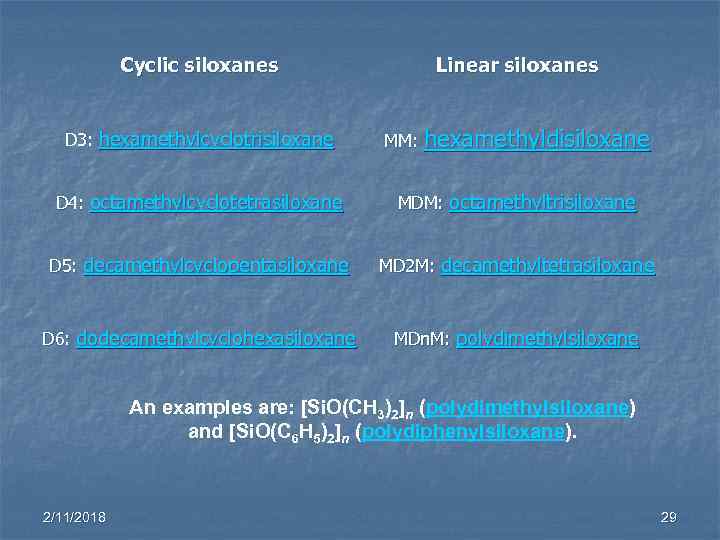
Cyclic siloxanes Linear siloxanes D 3: hexamethylcyclotrisiloxane MM: hexamethyldisiloxane D 4: octamethylcyclotetrasiloxane MDM: octamethyltrisiloxane D 5: decamethylcyclopentasiloxane MD 2 M: decamethyltetrasiloxane D 6: dodecamethylcyclohexasiloxane MDn. M: polydimethylsiloxane An examples are: [Si. O(CH 3)2]n (polydimethylsiloxane) and [Si. O(C 6 H 5)2]n (polydiphenylsiloxane). 2/11/2018 29
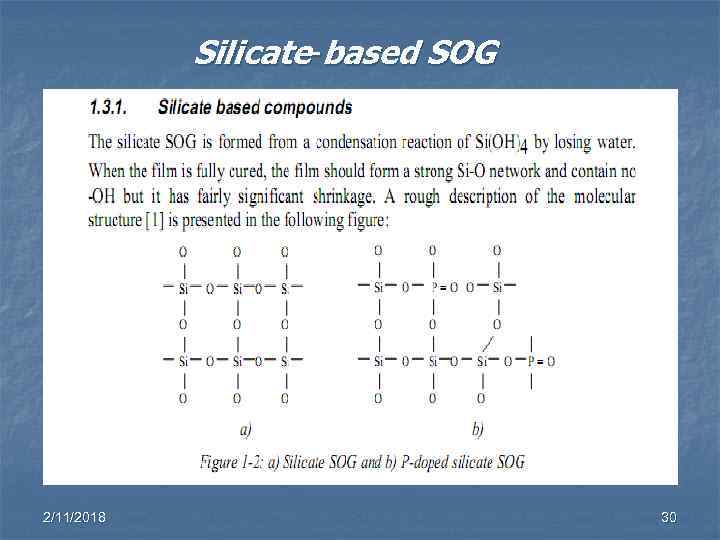
Silicate-based SOG 2/11/2018 30
Silicon Nitride n n n Silicon nitride (Si 3 N 4) is widely used in MEMS for electrical isolation, surface passivation, etch masking, and as a mechanical material. Two deposition methods are commonly used to deposit Si 3 N 4 thin films: LPCVD and PECVD. . 2/11/2018 31
n n n PECVD silicon nitride is generally nonstoichiometric (sometimes denoted as Six. Ny : H) and may contain significant concentrations of hydrogen. Use of PECVD silicon nitride in micromachining applications is somewhat limited because it has a high etch rate in HF (e. g. , often higher than that of thermally grown Si. O 2). However, PECVD offers the ability to deposit nearly stress-free silicon nitride films, an attractive property for encapsulation and packaging. 2/11/2018 32
n n n Unlike its PECVD counterpart, LPCVD Si 3 N 4 is extremely resistant to chemical attack, making it the material of choice for many Si bulk and surface micromachining applications. LPCVD Si 3 N 4 is commonly used as an insulating layer because it has a resistivity of 1016 Ω cm and field breakdown limit of 107 V/cm. LPCVD Si 3 N 4 films are deposited in horizontal furnaces similar to those used for polysilicon deposition. 2/11/2018 33
n n n Typical deposition temperatures and pressures range between 700 ◦C to 900 ◦C and 200 mtorr to 500 mtorr, respectively. The standard source gases are dichlorosilane (Si. H 2 Cl 2) and ammonia (NH 3), to produce stoichiometric Si 3 N 4, a NH 3 to Si. H 2 Cl 2 ratio of 10: 1 is commonly used. The microstructure of films deposited under these conditions is amorphous. 2/11/2018 34
n n n The residual stress in stoichiometric Si 3 N 4 is large and tensile, with a magnitude of about 1 GPa. Such a large residual stress causes films thicker than a few thousand angstroms to crack. Nonetheless, thin stoichiometric Si 3 N 4 films have been used as mechanical support structures and electrical insulating layers in piezoresistive pressure sensors 2/11/2018 35
n n n Стехиометрия (от др. -греч. στοιχεῖον «элемент» + μετρέω «измерять» ) — раздел химии о соотношениях реагентов в химических реакциях. Позволяет теоретически вычислять необходимые массы и объёмы реагентов. Отношения количеств реагентов, равные отношениям коэффицентов в стехиометрическом уравнении реакции, называются стехиометрическими. Если вещества реагируют в соотношении 1: 1, то их соответственные количества называют эквимолярными. 2/11/2018 36
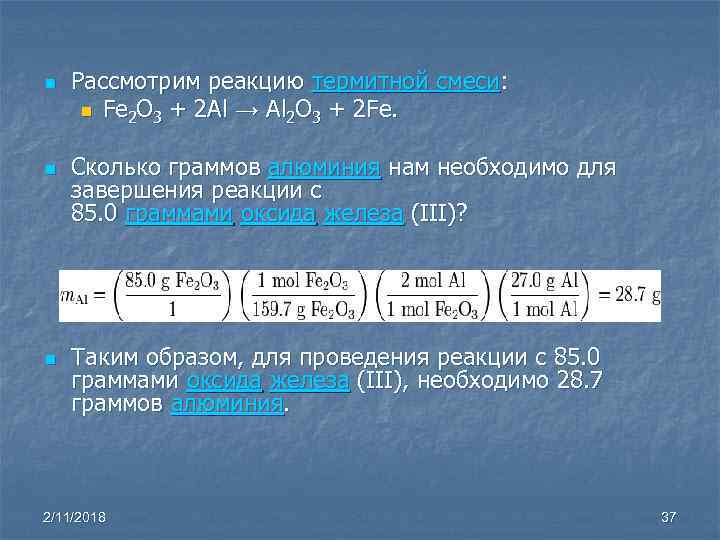
n n n Рассмотрим реакцию термитной смеси: n Fe 2 O 3 + 2 Al → Al 2 O 3 + 2 Fe. Сколько граммов алюминия нам необходимо для завершения реакции с 85. 0 граммами оксида железа (III)? Таким образом, для проведения реакции с 85. 0 граммами оксида железа (III), необходимо 28. 7 граммов алюминия. 2/11/2018 37
n n To enable the use of Si 3 N 4 films for applications that require micron thick, durable (прочные), and chemically resistant membranes, Six. Ny films can be deposited by LPCVD. These films, often referred to as Si-rich or lowstress nitride, are intentionally deposited with an excess of Si by simply decreasing the ratio of NH 3 to Si. H 2 Cl 2 during deposition. 2/11/2018 38
n n n Nearly stress-free films can be deposited using a NH 3 to Si. H 2 Cl 2 ratio of 1 : 6, a deposition temperature of 850 ◦C, and a pressure of 500 mtorr. The increase in Si content not only leads to a reduction in tensile stress, but also a decrease in the etch rate in HF. Such properties have enabled the development of fabrication techniques that would otherwise not be feasible with stoichiometric Si 3 N 4. 2/11/2018 39
Germanium-Based Materials n n Like Si, Ge has a long history as a semiconductor device material, dating back to the development of the earliest transistors and semiconductor strain gauges. Issues related to the water solubility of germanium oxide, however, stymied the development of Ge for microelectronic devices. n Nonetheless, there is a renewed interest in using Ge in micromachined devices due to the relatively low processing temperatures required to deposit the material. 2/11/2018 40
n n n Polycrystalline Ge Thin polycrystalline Ge (poly-Ge) films can be deposited by LPCVD at temperatures as low as 325 ◦C on Si, Ge, and Si. Ge substrates. Ge does not nucleate on Si. O 2 surfaces, which prohibits the use of thermal oxides and LTO films as sacrificial layers, but enables the use of these films as sacrificial molds. Residual stress in poly-Ge films deposited on Si substrates can be reduced to nearly zero after short anneals at modest temperatures (30 s at 600 ◦C). 2/11/2018 41
n n Poly-Ge is essentially impervious (невосприимчивый) to KOH, TMAH, and BOE, enabling the fabrication of Ge membranes on Si substrates. The mechanical properties of poly-Ge are comparable to polysilicon, having a Young’s modulus of 132 GPa and a fracture stress between 1. 5 GPa and 3. 0 GPa. 2/11/2018 42
n n n Mixtures of HNO 3, H 2 O, and HCl and H 2 O, H 2 O 2, and HCl, as well as the RCA SC-1 cleaning solution isotropically etch Ge. Since these mixtures do not etch Si, Si. O 2, Si 3 N 4, and Si. N, poly-Ge can be used as a sacrificial substrate layer in polysilicon surface micromachining. RCA, the Radio Corporation of America 2/11/2018 43
n Werner Kern developed the basic procedure in 1965 while working for RCA, the Radio Corporation of America. It involves the following : n 1. Removal of the organic contaminants (Organic Clean) n 2. Removal of thin oxide layer (Oxide Strip) n 3. Removal of ionic contamination (Ionic Clean) 2/11/2018 44
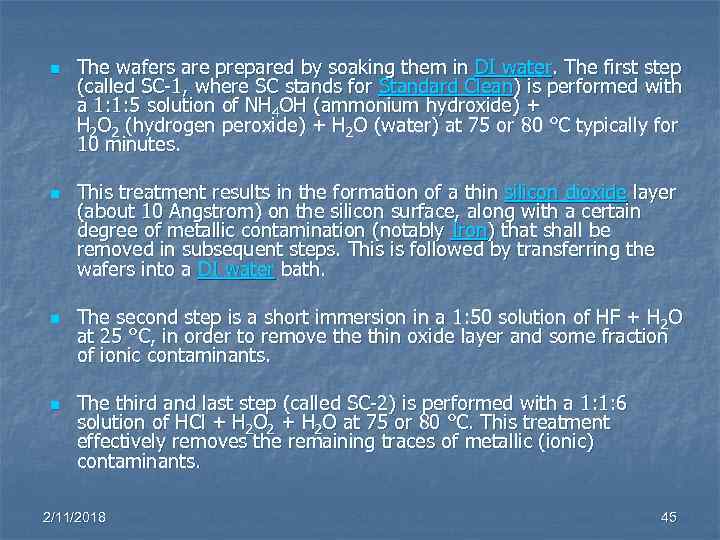
n n The wafers are prepared by soaking them in DI water. The first step (called SC-1, where SC stands for Standard Clean) is performed with a 1: 1: 5 solution of NH 4 OH (ammonium hydroxide) + H 2 O 2 (hydrogen peroxide) + H 2 O (water) at 75 or 80 °C typically for 10 minutes. This treatment results in the formation of a thin silicon dioxide layer (about 10 Angstrom) on the silicon surface, along with a certain degree of metallic contamination (notably Iron) that shall be removed in subsequent steps. This is followed by transferring the wafers into a DI water bath. The second step is a short immersion in a 1: 50 solution of HF + H 2 O at 25 °C, in order to remove thin oxide layer and some fraction of ionic contaminants. The third and last step (called SC-2) is performed with a 1: 1: 6 solution of HCl + H 2 O 2 + H 2 O at 75 or 80 °C. This treatment effectively removes the remaining traces of metallic (ionic) contaminants. 2/11/2018 45
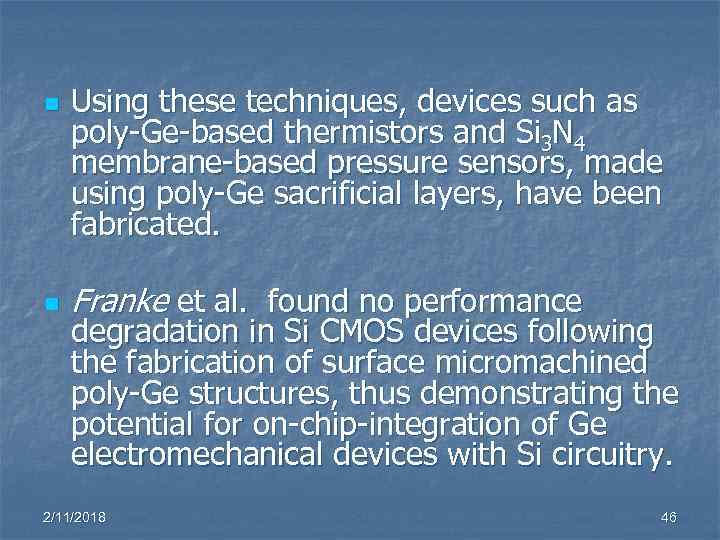
n n Using these techniques, devices such as poly-Ge-based thermistors and Si 3 N 4 membrane-based pressure sensors, made using poly-Ge sacrificial layers, have been fabricated. Franke et al. found no performance degradation in Si CMOS devices following the fabrication of surface micromachined poly-Ge structures, thus demonstrating the potential for on-chip-integration of Ge electromechanical devices with Si circuitry. 2/11/2018 46
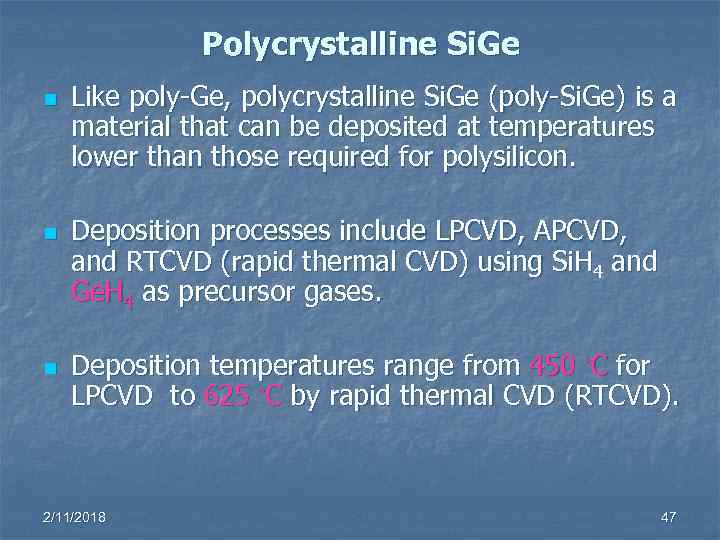
Polycrystalline Si. Ge n n n Like poly-Ge, polycrystalline Si. Ge (poly-Si. Ge) is a material that can be deposited at temperatures lower than those required for polysilicon. Deposition processes include LPCVD, APCVD, and RTCVD (rapid thermal CVD) using Si. H 4 and Ge. H 4 as precursor gases. Deposition temperatures range from 450 ◦C for LPCVD to 625 ◦C by rapid thermal CVD (RTCVD). 2/11/2018 47
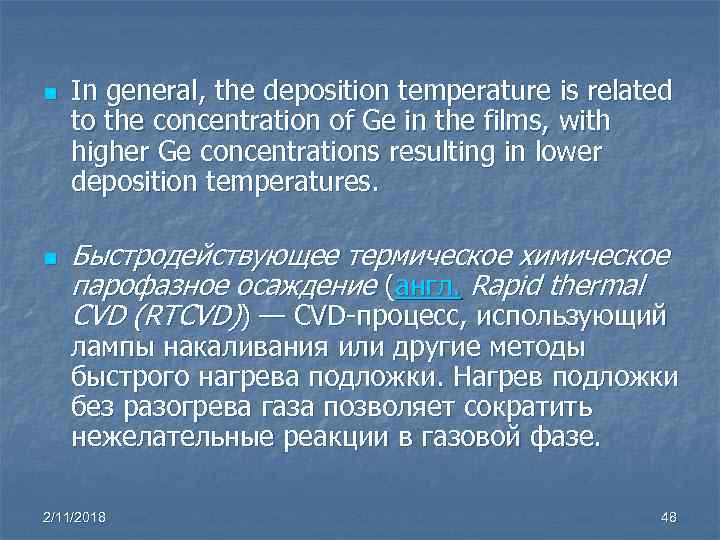
n n In general, the deposition temperature is related to the concentration of Ge in the films, with higher Ge concentrations resulting in lower deposition temperatures. Быстродействующее термическое химическое парофазное осаждение (англ. Rapid thermal CVD (RTCVD)) — CVD-процесс, использующий лампы накаливания или другие методы быстрого нагрева подложки. Нагрев подложки без разогрева газа позволяет сократить нежелательные реакции в газовой фазе. 2/11/2018 48
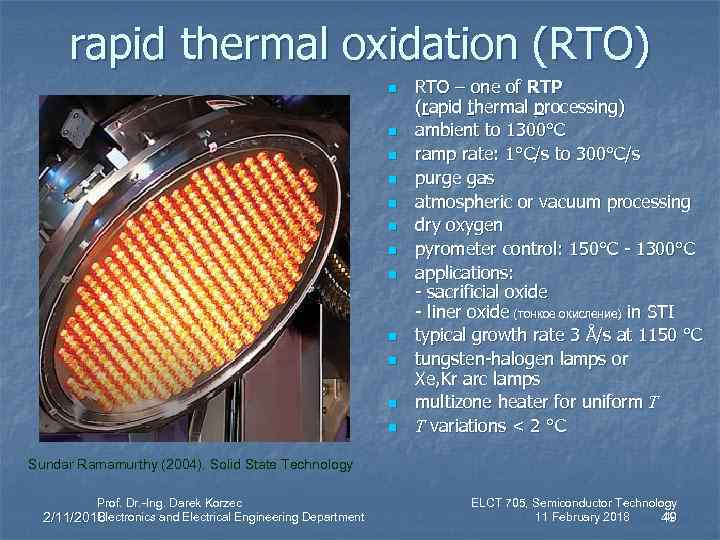
rapid thermal oxidation (RTO) n n n RTO – one of RTP (rapid thermal processing) ambient to 1300°C ramp rate: 1°C/s to 300°C/s purge gas atmospheric or vacuum processing dry oxygen pyrometer control: 150°C - 1300°C applications: - sacrificial oxide - liner oxide (тонкое окисление) in STI typical growth rate 3 Å/s at 1150 °C tungsten-halogen lamps or Xe, Kr arc lamps multizone heater for uniform T T variations < 2 °C Sundar Ramamurthy (2004). Solid State Technology Prof. Dr. -Ing. Darek Korzec Electronics and Electrical Engineering Department 2/11/2018 ELCT 705, Semiconductor Technology 11 February 2018 49 49
n Like polysilicon, poly-Si. Ge can be doped with boron and phosphorus to modify its conductivity. n In situ boron doping can be performed at temperatures as low as 450 ◦C. n Sedky et al. showed that the deposition temperature of conductive films doped with boron could be further reduced to 400 ◦C if the Ge content was kept at or above 70%. 2/11/2018 50
n n n Unlike poly-Ge, poly-Si. Ge can be deposited on a number of sacrificial substrates, including Si. O 2, PSG, and poly-Ge. For Ge rich films, a thin polysilicon seed layer is sometimes used on Si. O 2 surfaces since Ge does not readily nucleate on oxide surfaces. Like many compound materials, variations in film composition can change the physical properties of the material. 2/11/2018 51
n For instance, etching of poly-Si. Ge by H 2 O 2 becomes significant for Ge concentrations over 70%. n n Sedky et al. have shown that the microstructure, film conductivity, residual-stress, and residual stress gradient are related to the concentration of Ge in the material. With respect to residual stress, Franke et al. produced in situ boron doped films with residual compressive stresses as low as 10 MPa. 2/11/2018 52
n n n The poly-Si. Ge, poly-Ge material system is particularly attractive for surface micromachining since H 2 O 2 can be used as a release agent. It has been reported that poly-Ge etches at a rate of 0. 4 microns/min in H 2 O 2, while poly-Si. Ge with Ge concentrations below 80% have no observable etch rate after 40 hrs. The ability to use H 2 O 2 as a sacrificial etchant makes the combination of poly-Si. Ge and poly-Ge extremely attractive for surface micromachining from the processing, safety, and materials compatibility points of view. 2/11/2018 53
n n Due to the conformal nature of LPCVD processing, poly-Si. Ge structural elements, such as gimbal-based microactuator (микроактюатор с кардановым подвесом) structures, have been made by high-aspect ratio micromolding. (Интеграция с Si-ИС) Capitalizing on the low deposition temperatures, an integrated MEMS fabrication process with Si ICs has been demonstrated. 2/11/2018 54
n n In this process, CMOS structures are first fabricated on Si wafers. Poly-Si. Ge mechanical structures are then surface micromachined using a poly-Ge sacrificial layer. (Вертикальное расположение Si/Si. Ge/Poly-Ge technology) n A significant advantage of this design is that the MEMS structure is positioned directly above the CMOS structure, thus reducing the parasitic capacitance and contact resistance characteristic of interconnects associated with side-by-side integration schemes. 2/11/2018 55
n n Use of H 2 O 2 as the sacrificial etchant means that no special protective layers are required to protect the underlying CMOS layer during release. In addition to its utility as a material for integrated MEMS devices, poly-Si. Ge has been identified as a material well suited for micromachined thermopiles (термоэлементы) due to its lower thermal conductivity relative to Si. 2/11/2018 56
Metals n n Metallic thin films are used in many different capacities ranging from etch masks used in device fabrication to interconnects and structural elements in microsensors and microactuators. Metallic thin films can be deposited using a wide range of techniques, including evaporation, sputtering, CVD, and electroplating. 2/11/2018 57
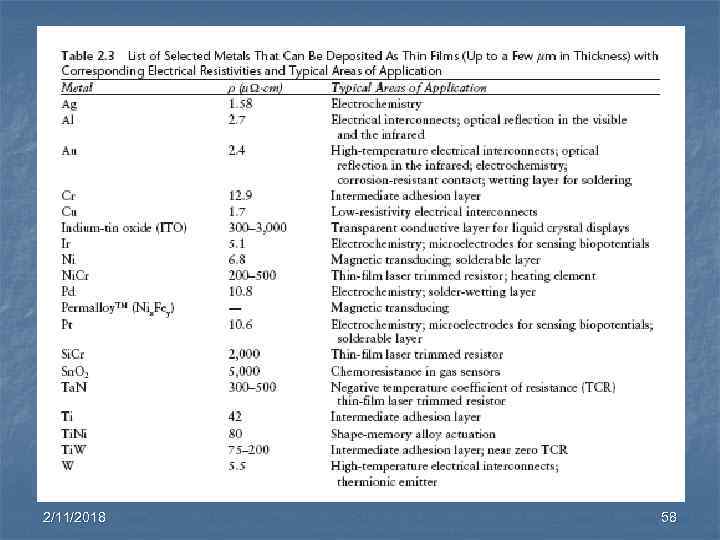
2/11/2018 58
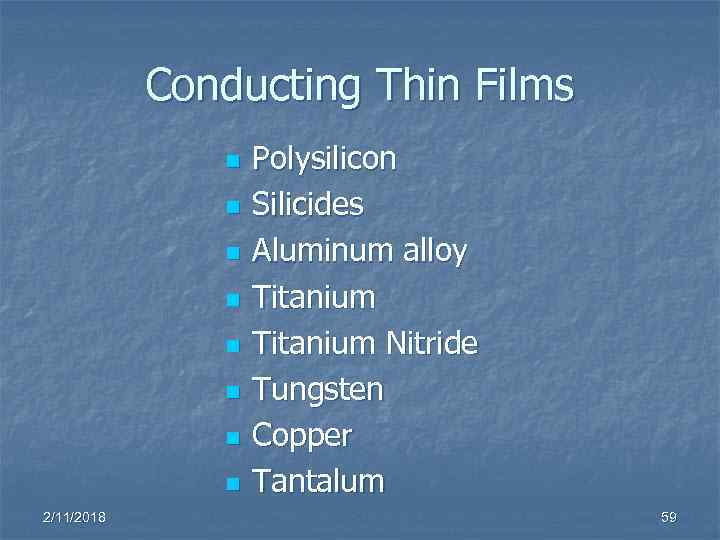
Conducting Thin Films n n n n 2/11/2018 Polysilicon Silicides Aluminum alloy Titanium Nitride Tungsten Copper Tantalum 59
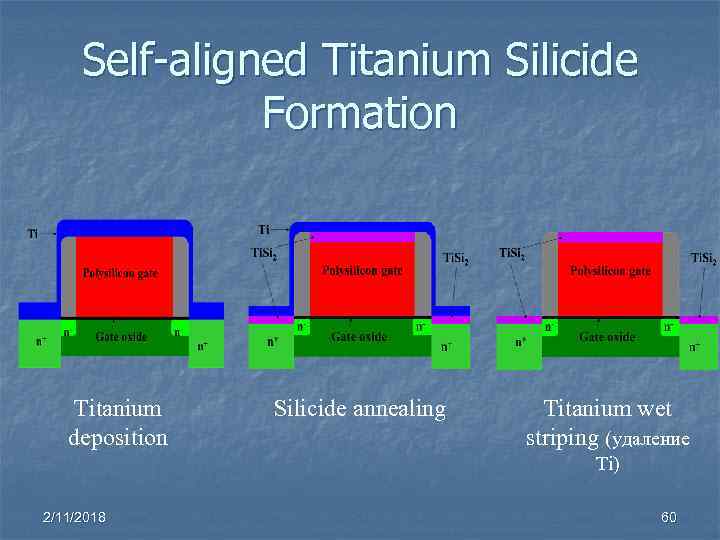
Self-aligned Titanium Silicide Formation Titanium deposition Silicide annealing Titanium wet striping (удаление Ti) 2/11/2018 60
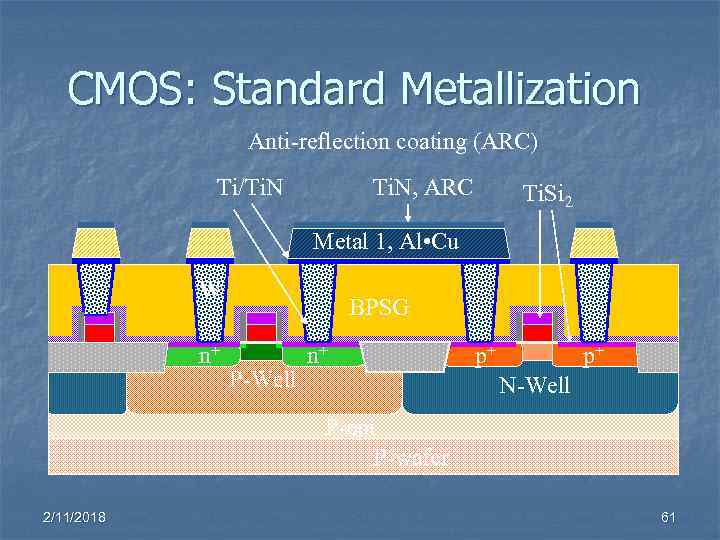
CMOS: Standard Metallization Anti-reflection coating (ARC) Ti/Ti. N, ARC Ti. Si 2 Metal 1, Al • Cu W STI n+ BPSG P-Well n+ USG p+ p+ N-Well P-epi P-wafer 2/11/2018 61
n n Fluorosilicate glass (FSG) is a low-k dielectric used in between copper metal layers during silicon integrated circuit fabrication process. It has a low dielectric constant (k) and is now widely adopted by semiconductor foundries on geometries sub 0. 25μ. Fluorosilicate glass is effectively a fluorine -containing silicon dioxide (k=3. 5, while k of undoped silicon dioxide is 3. 9). Fluorosilicate glass is used by IBM. Intel started using Cu metal layers and FSG on its 1. 2 GHz Pentium processor at 130 nm CMOS. 2/11/2018 62
n n Shallow trench isolation (STI), also known as Box Isolation Technique, is an integrated circuit feature which prevents electrical current leakage between adjacent semiconductor device components. STI is generally used on CMOS process technology nodes of 250 nanometers and smaller. Older CMOS technologies and non-MOS technologies commonly use isolation based on LOCOS. USG – Undoped Silicate Glass USG stands for Undoped Silicate Glass. This definition appears very rarely. 2/11/2018 63
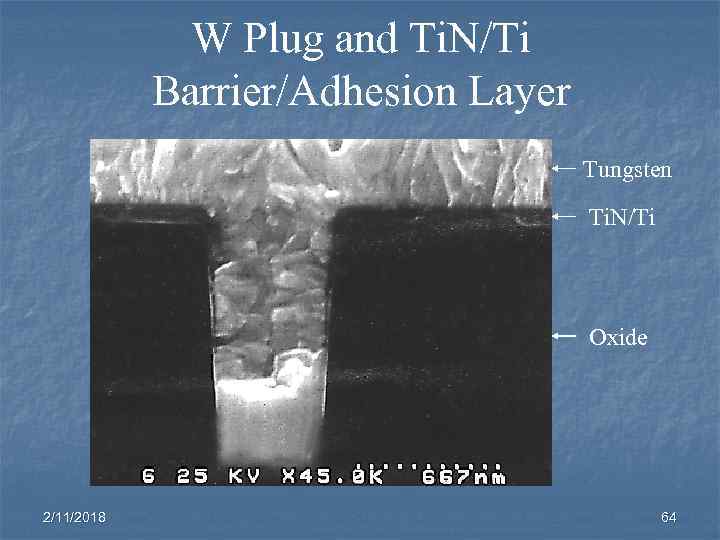
W Plug and Ti. N/Ti Barrier/Adhesion Layer Tungsten Ti. N/Ti Oxide 2/11/2018 64
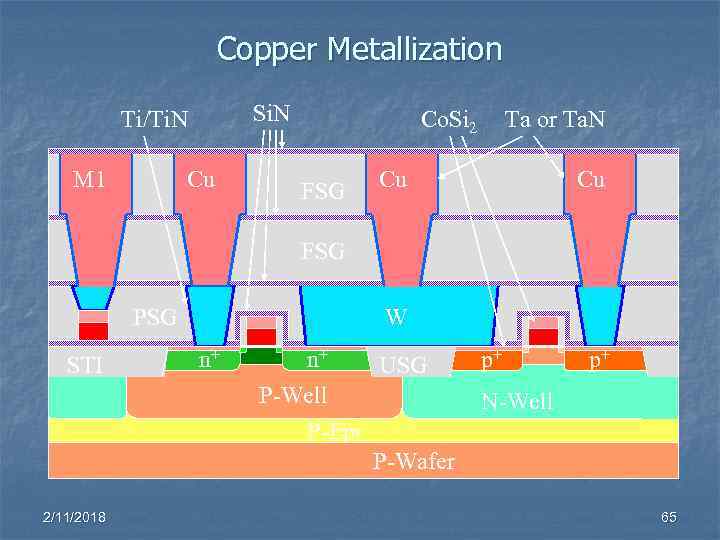
Copper Metallization Si. N Ti/Ti. N M 1 Cu Co. Si 2 FSG PSG STI Ta or Ta. N Cu Cu W W n+ n+ P-Well USG p+ p+ N-Well P-Epi P-Wafer 2/11/2018 65
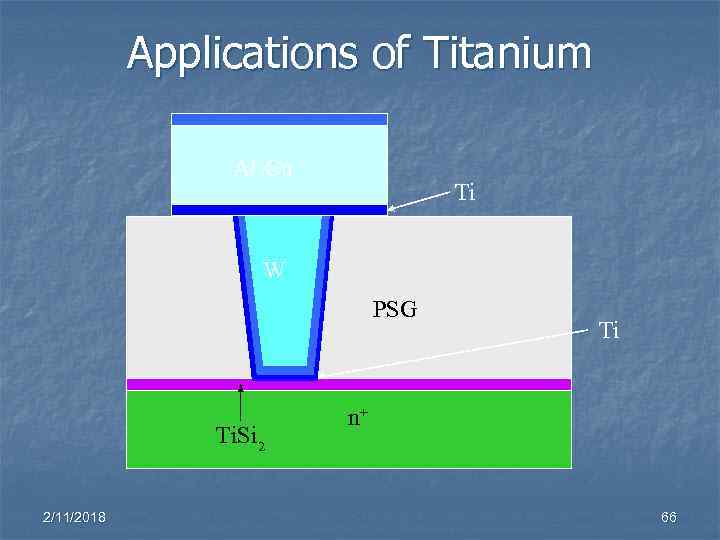
Applications of Titanium Al-Cu Ti W PSG Ti. Si 2 2/11/2018 Ti n+ 66
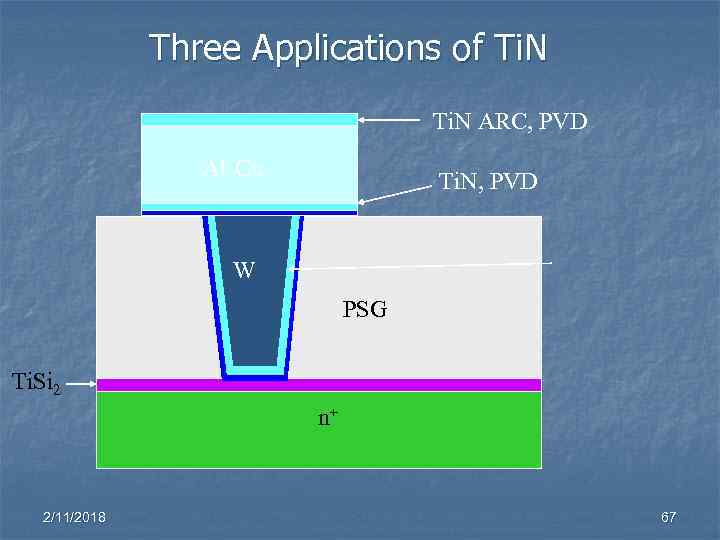
Three Applications of Ti. N ARC, PVD Al-Cu Ti. N, PVD W PSG Ti. Si 2 n+ 2/11/2018 67
n n Aluminum (Al) and gold (Au) are among the most widely employed metals in most microfabricated electronic and MEM devices, as a result of their useas innerconnect and packaging materials. In addition to these critical electrical functions, Al and Au are also desirable as electromechanical materials. 2/11/2018 68
n n One such example is the use of Au example micromechanical switches for RF MEMS. For conventional RF applications, chip level switching is currently performed using FET (полевой транзистор)- and PIN diode-based solid PIN state devices fabricated from gallium arsenide (Ga. As) substrates. 2/11/2018 69
http: //airccse. com/eeij/papers/1114 eeij 03. pdf n n n Electrical Engineering: An International Journal (EEIJ), Vol. 1, No. 1, June 2014 A NOVEL SEESAW-TYPE RF MEMS SWITCH WITH MINIMUM STRESS IN MEMBRANE FOR RF FRONTEND APPLICATIONS Dr. G. Velmathi and Jones Theodore Department of ECE, Velammal College of Engineering and Technology, ABSTRACT In this paper a novel RF MEMS switch design with a seesaw-type movable part to implement a metallic connection across a broken CPW transmission (Coplanar waveguide) line has been proposed and tested. The switching action is done through two separate pull-up electrodes. For this design with a 5 -10 µm gap between the suspended membrane and the pull-down electrodes, applying an actuation voltage of 5 -10 V, dynamic analysis shows a switching time of less than 10 µs. Unlike in other MEMS switches designed earlier for RF devices the proposed work in this report works with two supply lines switched seamlessly. The bending of the membrane is considerably reduced in this type of switch as the actuation electrodes are in the outer end and the signal lines between the pivot arrangement and electrode. The existing switches implement a single signal line and it is switched on and off but in the proposed switch two supply lines on both sides of the substrate are kept and are switched from one to the other by the see-saw operation of the membrane. 2/11/2018 70
n n Unfortunately, these devices suffer (страдают) from insertion losses and poor electrical solation. In an effort to develop replacements for Ga. Asbased solid state switches, Hyman et al. reported the development of an electrostatically actuated, cantilever-based micromechanical switch fabricated on Ga. As substrates. 2/11/2018 71
n The trilayer cantilever structure was chosen to minimize the deleterious effects minimize of thermal and process-related stress gradients in order to produce unbent (не разогнутые балки) and thermally stable beams. thermally n After deposition and pattering, the cantilevers were released in HF. 2/11/2018 72
n n The processing steps proved to be steps completely compatible with Ga. As substrates. The released cantilevers demonstrated switching speeds better than 50µs at 25 V with contact lifetimes exceeding 109 cycles. 2/11/2018 73
n n In a second example from RF MEMS, Chang et al. reported the fabrication of an Al-based micromachined switch as an micromachined alternative to Ga. As FETs and PIN diodes. In contrast to the work by Hyman et al. , this switch utilizes the differences in the residual stresses in Al and Cr thin films to create bent (изгибать) cantilever switches that capitalize on the stress differences in the materials. 2/11/2018 74
n n n Each switch is comprised of a series of linked bimorph cantilevers designed in such a way that the resulting structure bends significantly out of the plane of the wafer due to the stress differences in the bimorph. The switch is drawn closed by electrostatic attraction. The bimorph consists of metals that can easily be processed with Ga. As wafers, thus making integration with Ga. As devices possible. 2/11/2018 75
n n n The released switches were relatively slow, at 10 ms, but an actuation voltage of only 26 V was needed to close the switch. Thin-film metallic alloys that exhibit the shapememory effect are of particular interest to the MEMS community for their potential in microactuators. The shape-memory effect relies on the reversible transformation from a ductile (эластичный) martensite phase to a stiff (жесткий) austenite phase in the material with the application of heat. 2/11/2018 76
n n The reversible phase change allows the shapememory effect to be used as an actuation mechanism, since the material changes shape during the transition. It has been found that high forces and strains can be generated from shape-memory thin films at reasonable power inputs, thus enabling shape -memory actuation to be used in MEMS-based microfluidic devices, such as microvalves and micropumps. 2/11/2018 77
n n Titanium-nickel (Ti. Ni) is among the most popular of the shape-memory alloys, owing to its high actuation work density (50 MJ/m 3) and large bandwidth (up to 0. 1 k. Hz). Ti. Ni is also attractive because conventional sputtering techniques can be employed to deposit thin films, as detailed in a recent report by Shih et al. 2/11/2018 78
n n In this study, Ti. Ni films were deposited by cosputtering elemental Ti and Ni targets, and a cosputtering Ti. Ni alloy and elemental Ti targets. It was reported that co-sputtering from Ti. Ni and Ti targets produced better films due to process variations related to the roughening of the Ni target in the case of Ti and Ni co-sputtering. The Ti. Ni/Ti co-sputtering process has been used to produce shape-memory material for a silicon spring-based microvalve. 2/11/2018 79
n n n Use of thin-film metal alloys in magnetic actuator systems is another example of the versatility of metallic materials in MEMS. Magnetic actuation in microdevices generally requires the magnetic layers to be relatively thick (tens to hundreds of microns) to generate magnetic fields of sufficient strength to generate the desired actuation. To this end, magnetic materials are often deposited by thick film methods, such as electroplating. 2/11/2018 80
Скачать презентацию Porous Silicon Porous Si is produced by room
2- Material Aspects of Micro- and Nanoelectromechanical Systems.ppt