


 Скачать презентацию Population in Switzerland year total male female Swiss
Population in Switzerland.pptx
- Количество слайдов: 2
 Population in Switzerland year total male female Swiss foreign 2009 7, 785, 800 3, 830, 600 (49. 2% ) 3, 955, 200 (50. 8% ) 6, 071, 800 (78. 0% ) 1, 714, 000 (22. 0% ) 2008 7, 701, 900 3, 786, 700 (49. 2% ) 3, 915, 200 (50. 8% ) 6, 032, 100 (78. 3% ) 1, 669, 700 (21. 7% ) 2007 7, 593, 500 3, 727, 000 (49. 1% ) 3, 866, 500 (50. 9% ) 5, 991, 400 (78. 9% ) 1, 602, 100 (21. 1% ) 3, 679, 400 (49. 0% ) 3, 829, 400 (51. 0% ) 5, 954, 200 (79. 3% ) 1, 554, 500 (20. 7% ) 2006 7, 508, 700 2005 7, 459, 100 3, 652, 500 (49. 0% ) 3, 806, 600 (51. 0% ) 5, 917, 200 (79. 3% ) 1, 541, 900 (20. 7% ) 2004 7, 415, 100 3, 628, 700 (48. 9% ) 3, 786, 400 (51. 1% ) 5, 890, 400 (79. 4% ) 1, 524, 700 (20. 6% ) 2003 7, 364, 100 3, 601, 500 (48. 9% ) 3, 762, 600 (51. 1% ) 5, 863, 200 (79. 6% ) 1, 500, 900 (20. 4% ) 2002 7, 313, 900 3, 575, 000 (48. 9% ) 3, 738, 800 (51. 1% ) 5, 836, 900 (79. 8% ) 1, 477, 000 (20. 2% )
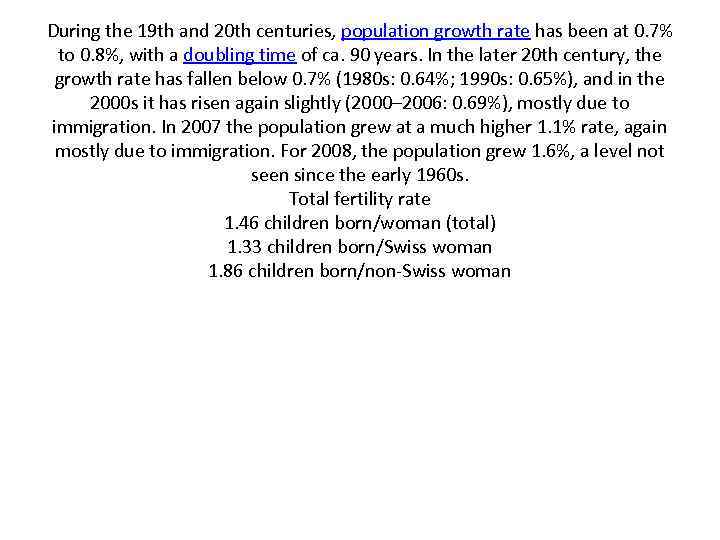 During the 19 th and 20 th centuries, population growth rate has been at 0. 7% to 0. 8%, with a doubling time of ca. 90 years. In the later 20 th century, the growth rate has fallen below 0. 7% (1980 s: 0. 64%; 1990 s: 0. 65%), and in the 2000 s it has risen again slightly (2000– 2006: 0. 69%), mostly due to immigration. In 2007 the population grew at a much higher 1. 1% rate, again mostly due to immigration. For 2008, the population grew 1. 6%, a level not seen since the early 1960 s. Total fertility rate 1. 46 children born/woman (total) 1. 33 children born/Swiss woman 1. 86 children born/non-Swiss woman