


 Скачать презентацию Population Ecology ES 100 10 23 06 Announcements
ddf557ca5347ba57f4d6ba2fe5726d4f.ppt
- Количество слайдов: 22
 Population Ecology ES 100 10/23/06
 Announcements: • Problem Set will be posted on course website today. • • • Start early! Due Friday, November 3 rd Midterm: 1 week from today • • Last year’s midterm is posted on website This year: will require a bit more thinking
 Mathematical Models Uses: • • • synthesize information look at a system quantitatively test your understanding predict system dynamics make management decisions
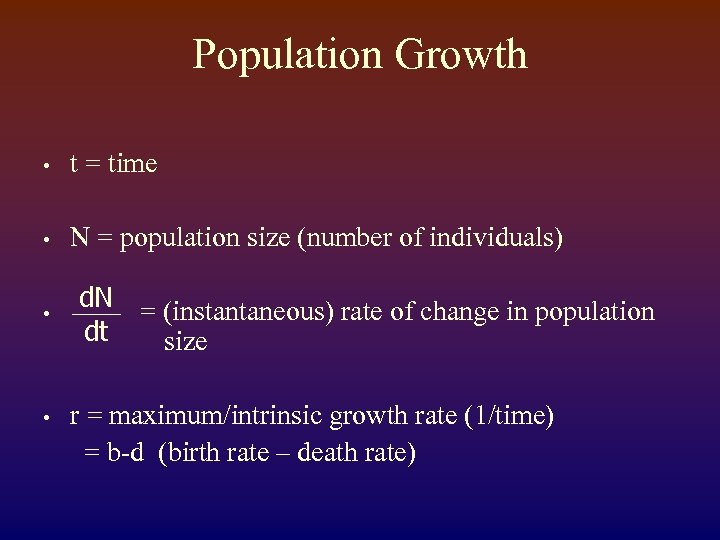 Population Growth • t = time • N = population size (number of individuals) • • d. N = (instantaneous) rate of change in population dt size r = maximum/intrinsic growth rate (1/time) = b-d (birth rate – death rate)
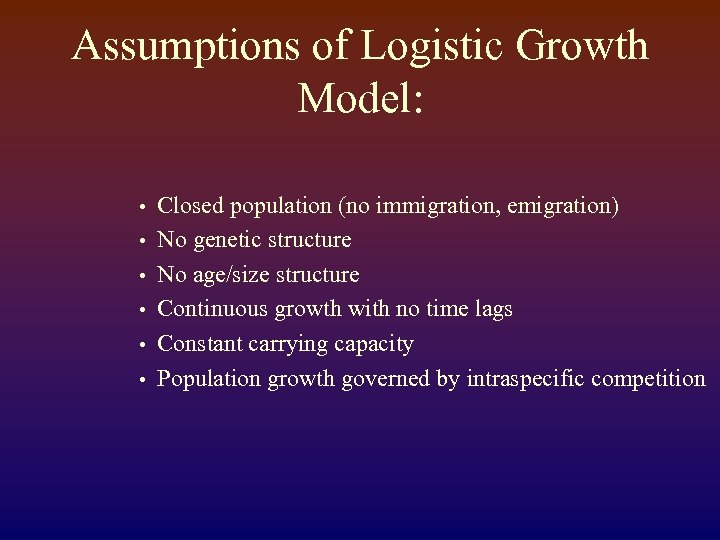
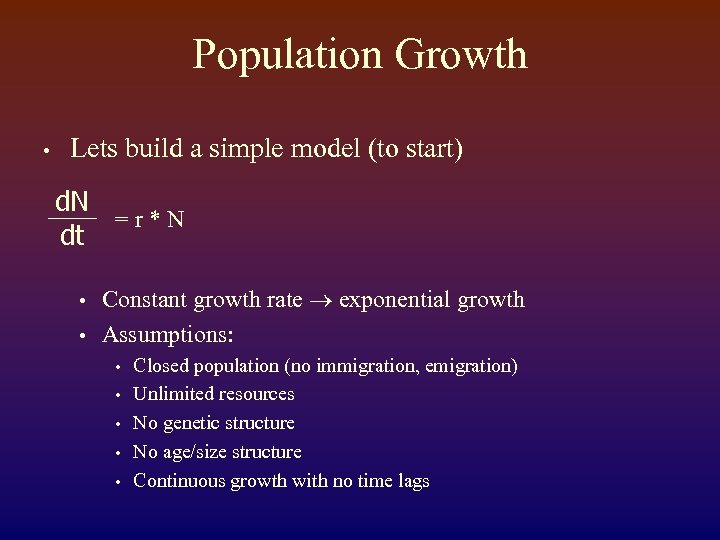 Population Growth • Lets build a simple model (to start) d. N =r*N dt • • Constant growth rate exponential growth Assumptions: • • • Closed population (no immigration, emigration) Unlimited resources No genetic structure No age/size structure Continuous growth with no time lags
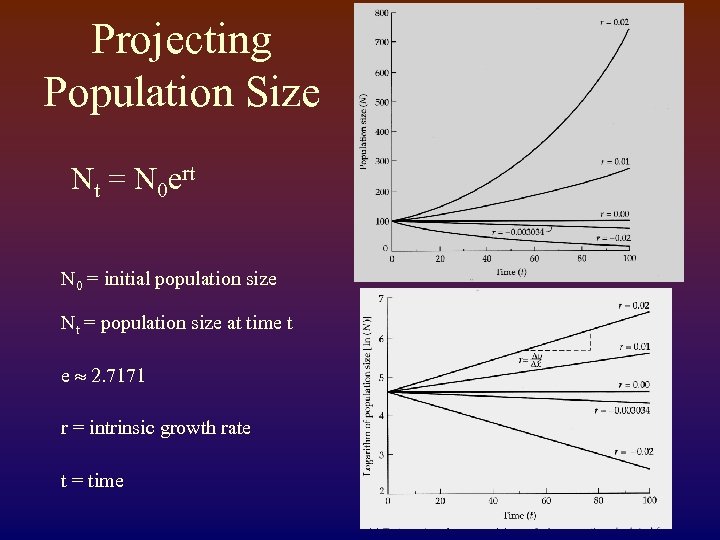 Projecting Population Size Nt = N 0 ert N 0 = initial population size Nt = population size at time t e 2. 7171 r = intrinsic growth rate t = time
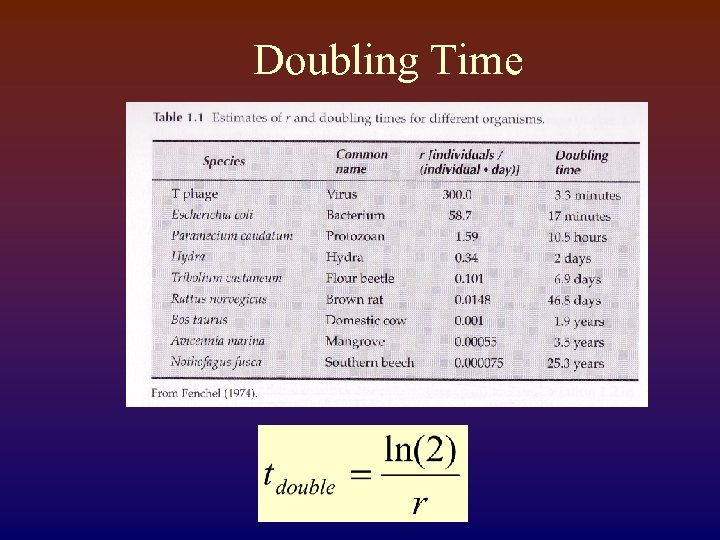 Doubling Time
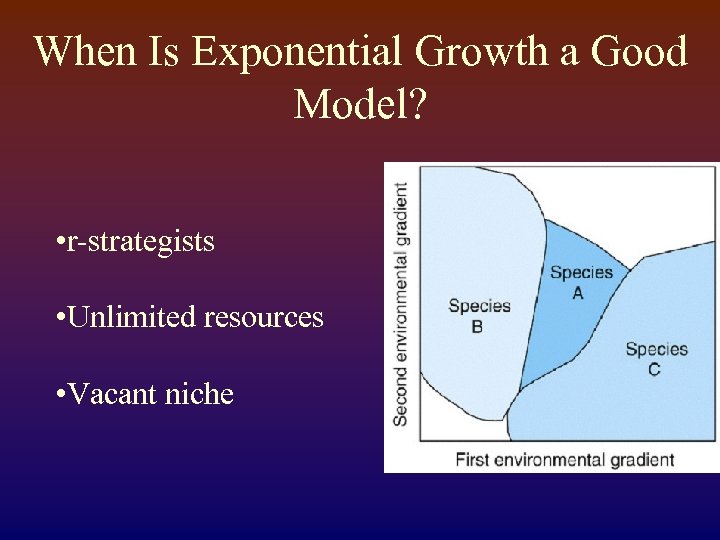 When Is Exponential Growth a Good Model? • r-strategists • Unlimited resources • Vacant niche
 Let’s Try It! The brown rat (Rattus norvegicus) is known to have an intrinsic growth rate of: 0. 015 individual/individual*day Suppose your house is infested with 20 rats. v How long will it be before the population doubles? v How many rats would you expect to have after 2 months? Is the model more sensitive to N 0 or r?
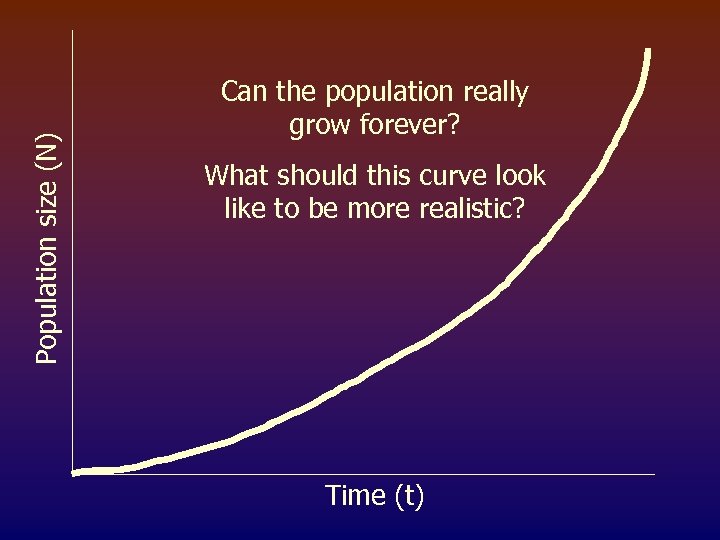 Population size (N) Can the population really grow forever? What should this curve look like to be more realistic? Time (t)
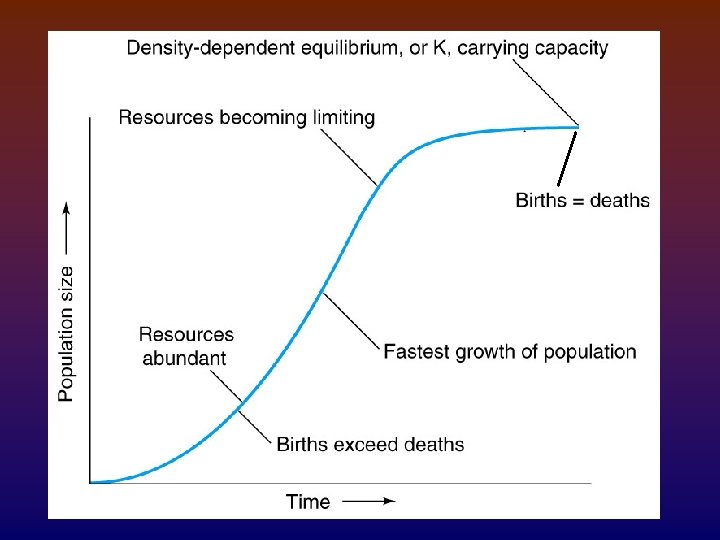
 Population Growth • Logistic growth • • • Population Density: # of individuals of a certain species in a given area Assumes that density-dependent factors affect population Growth rate should decline when the population size gets large Symmetrical S-shaped curve with an upper asymptote
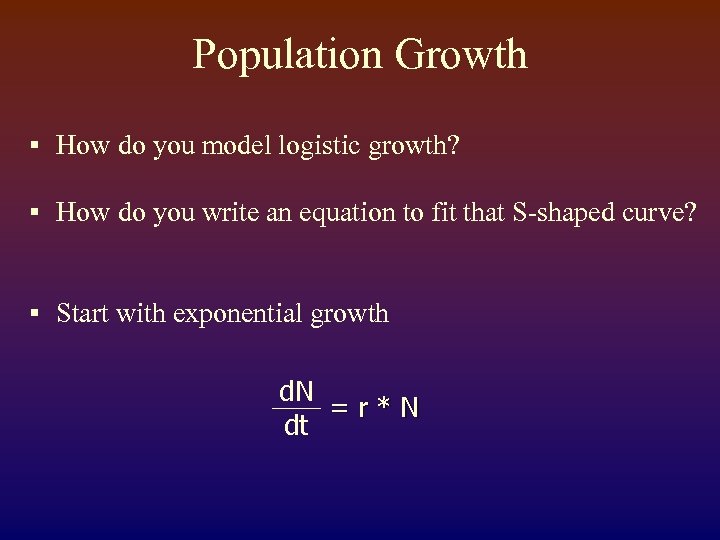 Population Growth § How do you model logistic growth? § How do you write an equation to fit that S-shaped curve? § Start with exponential growth d. N =r*N dt
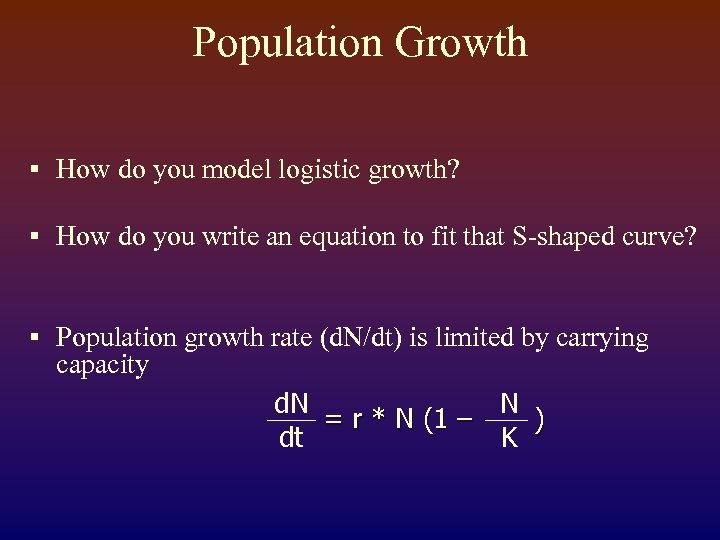 Population Growth § How do you model logistic growth? § How do you write an equation to fit that S-shaped curve? § Population growth rate (d. N/dt) is limited by carrying capacity d. N N = r * N (1 – ) dt K
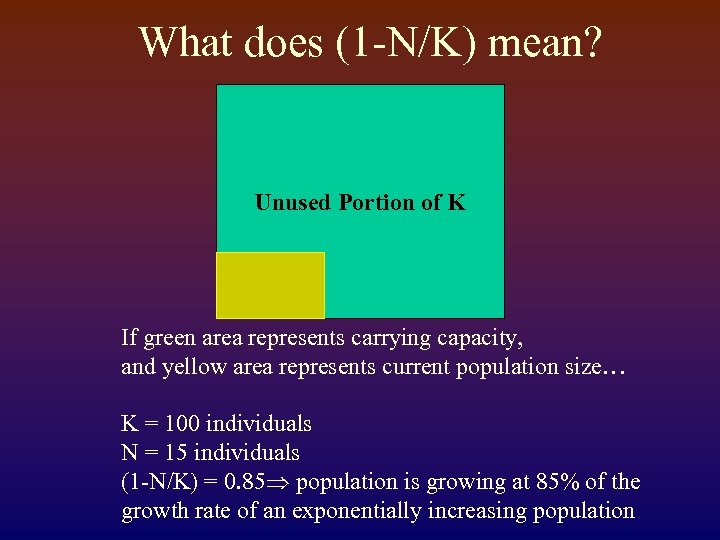 What does (1 -N/K) mean? Unused Portion of K If green area represents carrying capacity, and yellow area represents current population size… K = 100 individuals N = 15 individuals (1 -N/K) = 0. 85 population is growing at 85% of the growth rate of an exponentially increasing population
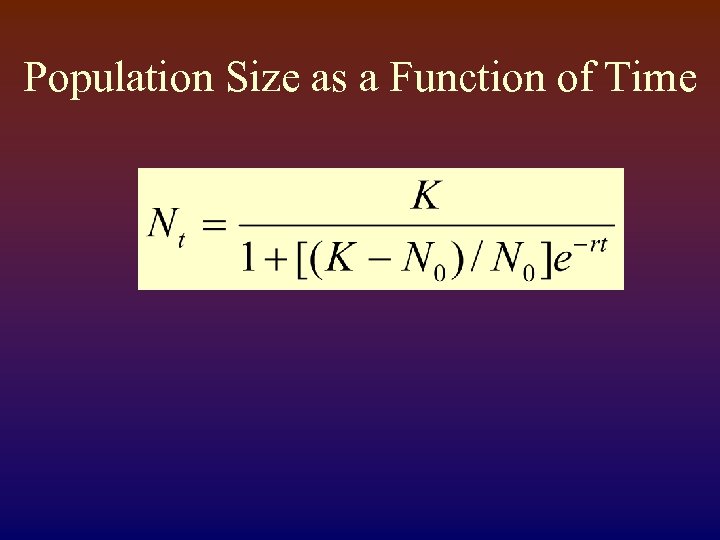
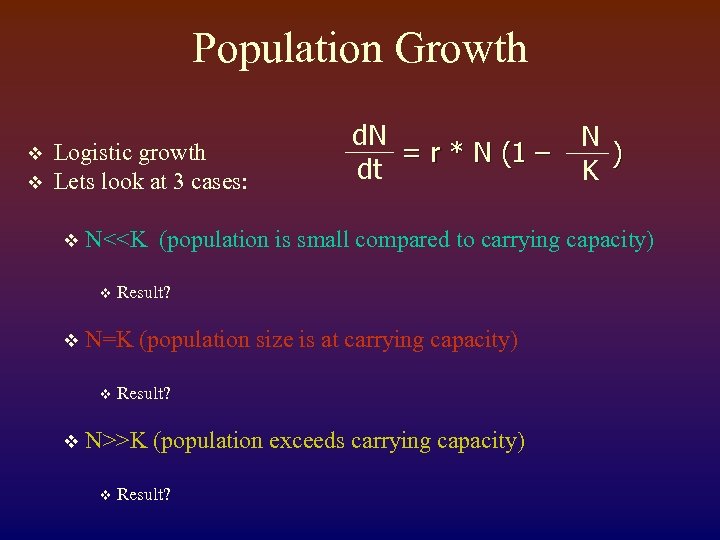 Population Growth v v Logistic growth Lets look at 3 cases: v Result? N=K (population size is at carrying capacity) v v N ) K N<
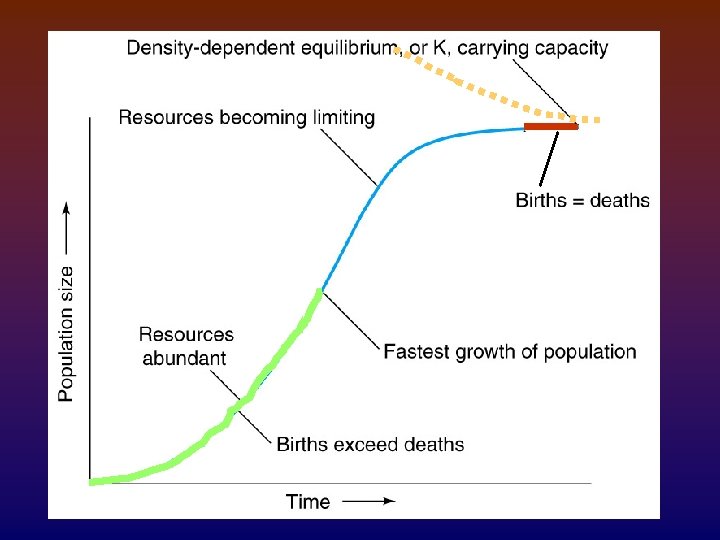
 Population Size as a Function of Time
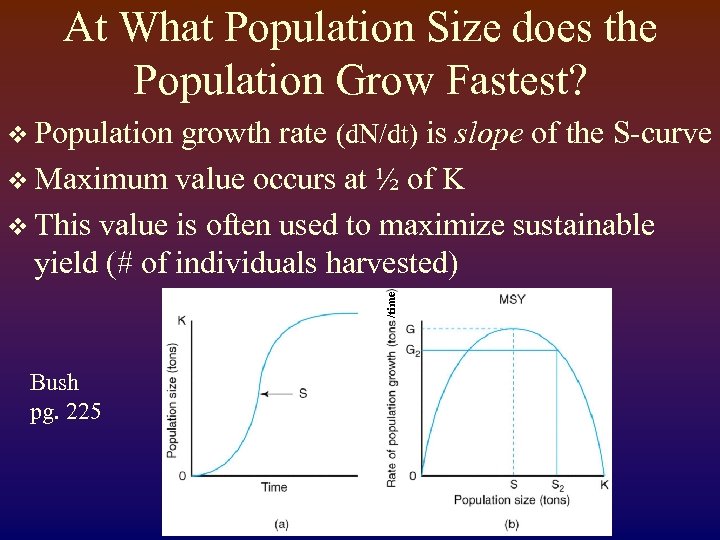 At What Population Size does the Population Grow Fastest? growth rate (d. N/dt) is slope of the S-curve v Maximum value occurs at ½ of K v This value is often used to maximize sustainable yield (# of individuals harvested) /time v Population Bush pg. 225
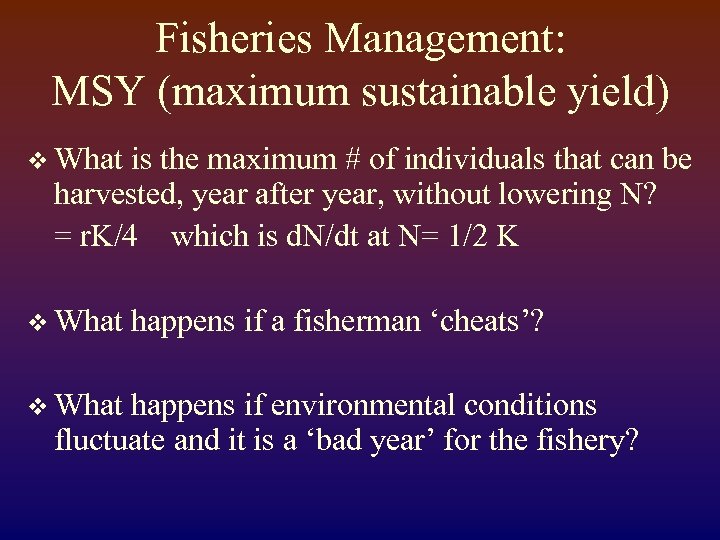 Fisheries Management: MSY (maximum sustainable yield) v What is the maximum # of individuals that can be harvested, year after year, without lowering N? = r. K/4 which is d. N/dt at N= 1/2 K v What happens if a fisherman ‘cheats’? happens if environmental conditions fluctuate and it is a ‘bad year’ for the fishery?
 Assumptions of Logistic Growth Model: • • • Closed population (no immigration, emigration) No genetic structure No age/size structure Continuous growth with no time lags Constant carrying capacity Population growth governed by intraspecific competition
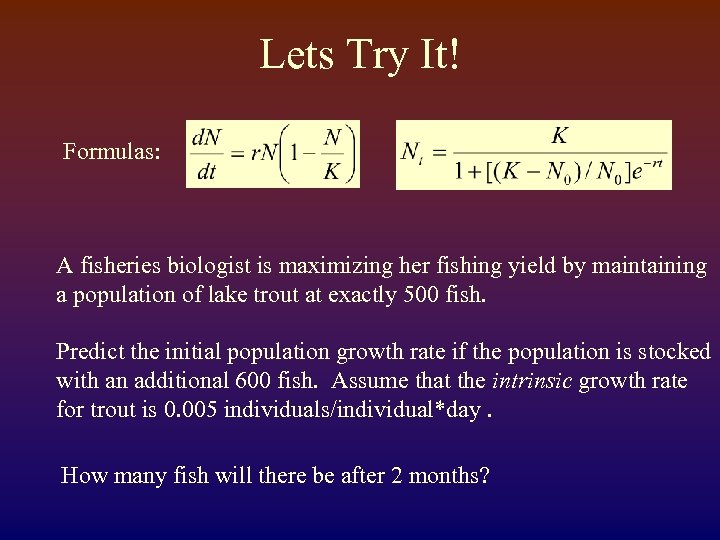 Lets Try It! Formulas: A fisheries biologist is maximizing her fishing yield by maintaining a population of lake trout at exactly 500 fish. Predict the initial population growth rate if the population is stocked with an additional 600 fish. Assume that the intrinsic growth rate for trout is 0. 005 individuals/individual*day. How many fish will there be after 2 months?