


 Скачать презентацию Population aging and intergenerational transfers a macroperspective Ronald
93d3942eb20519cd9b162c64820927a6.ppt
- Количество слайдов: 62
 Population aging and intergenerational transfers: a macroperspective Ronald Lee UC Berkeley August 31, 2006 University of Southern California
 Colaborative work • Andy Mason and I are co-Directors for this project, with NIA funding through parallel grants. • Many collaborators on research teams in other countries.
 Conceptual roots • Samuelson’s classic article on consumption loan economy with overlapping generations • Arthur and Mc. Nicoll • Willis • Lee and Bommier-Lee
 References – downloadable from http: //www. schemearts. com/proj/nta/ web/nta/show/Working%20 Papers • Ronald Lee and Andrew Mason, “A Research Plan for the Macroeconomic Demography of Intergenerational Transfers”, January 2004. • Antoine Bommier, Ronald Lee, Timothy Miller, and Stephane Zuber, “Who wins and who loses? Public transfer accounts for US generations born 1850 to 2090”, NBER working paper, December 2004. • Andrew Mason, Ronald Lee, An-Chi Tung, Mun-Sim Lai, and Tim Miller, forthcoming. “Population Aging and Intergenerational Transfers: Introducing Age into National Accounts”, Economics of Aging Series, David Wise, ed. NBER and University of Chicago Press. NBER working paper. • Ronald Lee, Sang-Hyop Lee, and Andrew Mason. “Charting the Economic Life-Cycle”, (forthcoming) NBER working paper
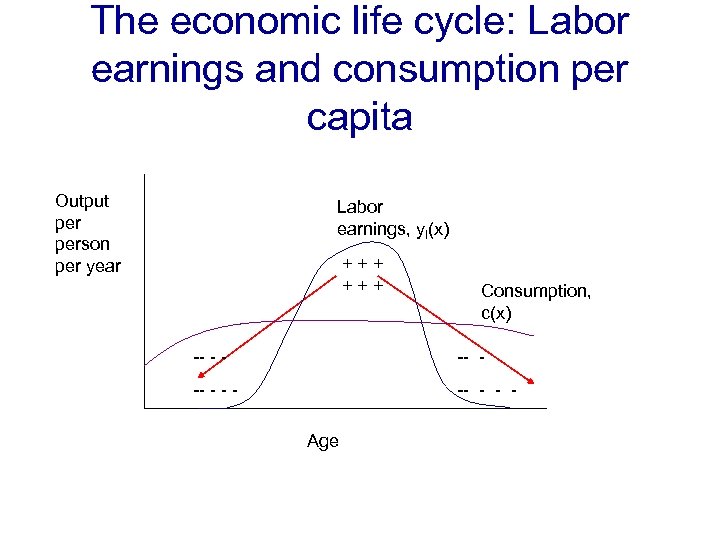 The economic life cycle: Labor earnings and consumption per capita Output person per year Labor earnings, yl(x) +++ Consumption, c(x) -- - -- - - Age
 The NTA project estimates • Average consumption and labor earnings by age for a number of countries • The institutional arrangements and mechanisms by which surplus earnings in the middle years are reallocated to children and the elderly. • Comparisons across countries and over time, and projections. • Will analyze – – Descriptive patterns by culture and insitutions interaction with population aging consequences for economic growth, intergenerational equity.
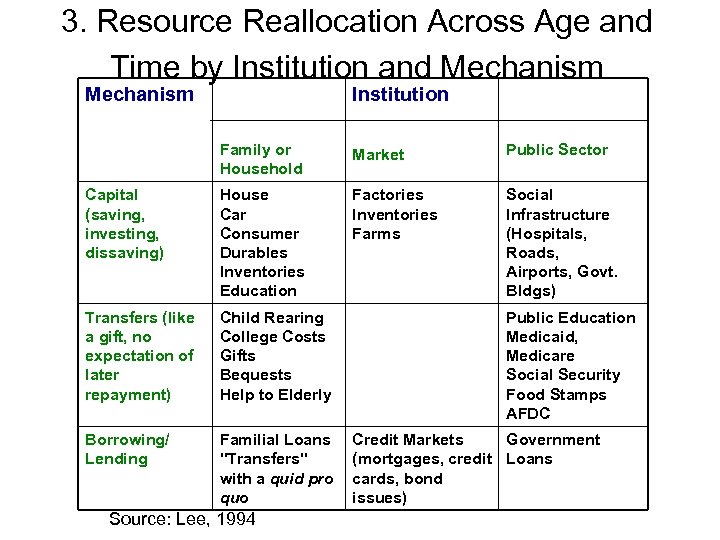 3. Resource Reallocation Across Age and Time by Institution and Mechanism Institution Family or Household Market Public Sector Capital (saving, investing, dissaving) House Car Consumer Durables Inventories Education Factories Inventories Farms Social Infrastructure (Hospitals, Roads, Airports, Govt. Bldgs) Transfers (like a gift, no expectation of later repayment) Child Rearing College Costs Gifts Bequests Help to Elderly Borrowing/ Lending Familial Loans "Transfers" with a quid pro quo Source: Lee, 1994 Public Education Medicaid, Medicare Social Security Food Stamps AFDC Credit Markets Government (mortgages, credit Loans cards, bond issues)
 A little theoretical background to motivate empirical accounts • How are earning and consumption at the individual level related to the aggregate economy? • In what direction is income reallocated, up or down the age distribution? • How do these reallocations generate a demand for wealth to achieve desired consumption path? • In what ways can the demand for wealth be satisfied? • I will discuss briefly for a simple case (golden rule).
 Is income redistributed upwards or downward across age, on average? • Caldwell has argued that “wealth flows” are upwards in traditional societies, from children to adults. • Others have argued that wealth (income) flows downwards on net, from adults to children. • Assess by calculating the average at which a dollar (or calorie) is consumed in the population, and similarly at which one is produced, Ac and Ay. – Weight these age profiles by the share of the population at each age. – If Ac < Ay, then consumption precedes production on average, so income is redistributed downwards across ages, from old to young. – If Ay < Ac then the reverse: the young are transferring to older individuals on average.
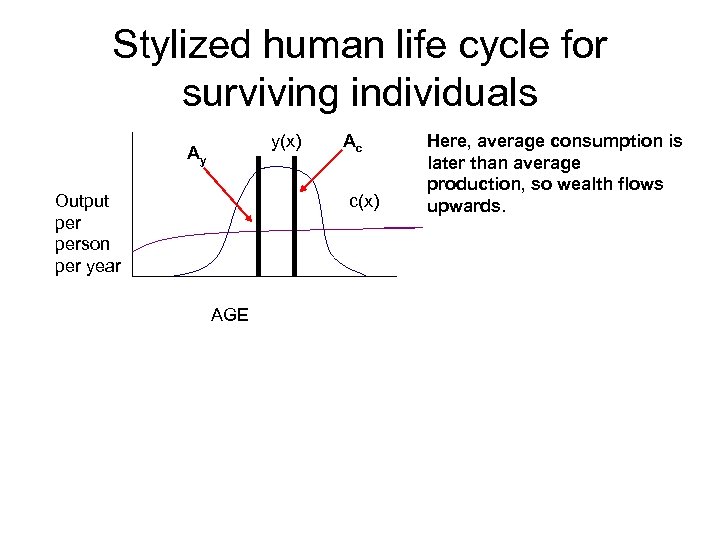 Stylized human life cycle for surviving individuals y(x) Ay Output person per year Ac c(x) AGE Here, average consumption is later than average production, so wealth flows upwards.
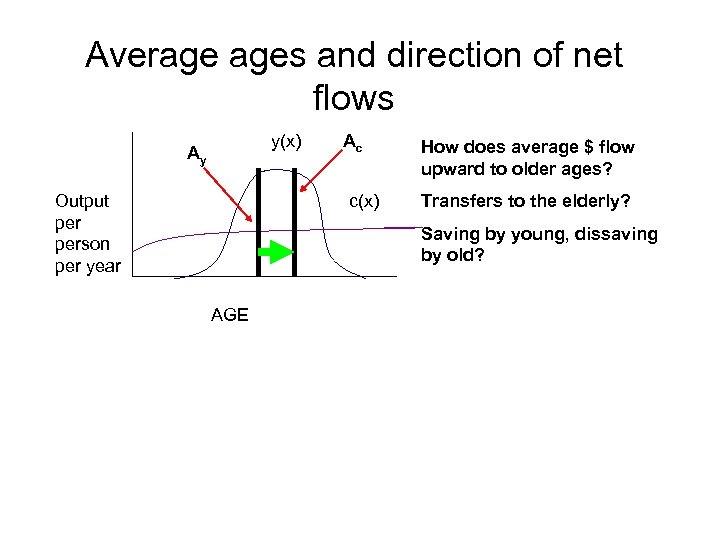 Average ages and direction of net flows y(x) Ay Output person per year Ac c(x) How does average $ flow upward to older ages? Transfers to the elderly? Saving by young, dissaving by old? AGE
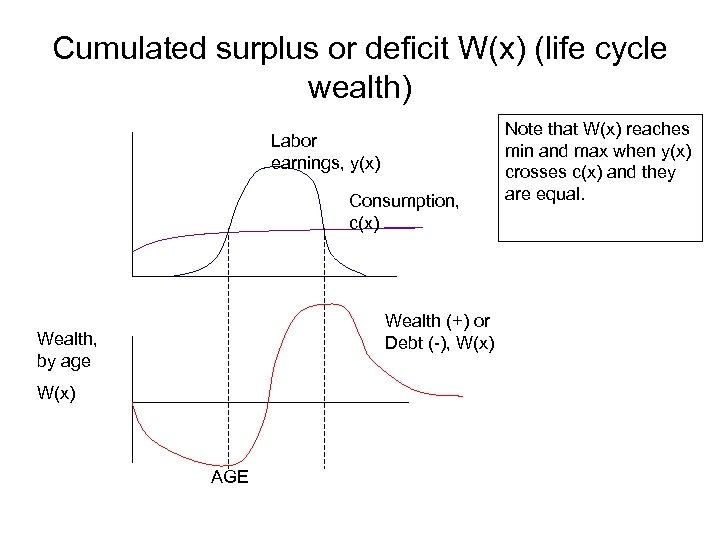 Cumulated surplus or deficit W(x) (life cycle wealth) Labor earnings, y(x) Consumption, c(x) Wealth (+) or Debt (-), W(x) Wealth, by age W(x) AGE Note that W(x) reaches min and max when y(x) crosses c(x) and they are equal.
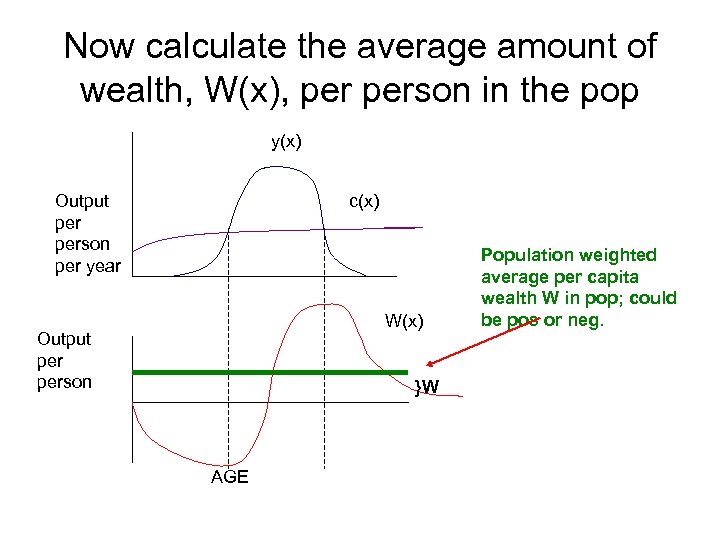 Now calculate the average amount of wealth, W(x), person in the pop y(x) Output person per year c(x) W(x) Output person }W AGE Population weighted average per capita wealth W in pop; could be pos or neg.
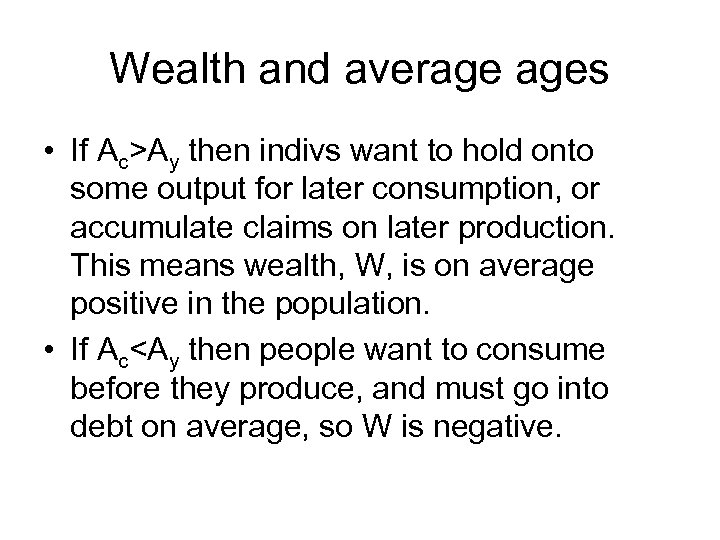 Wealth and average ages • If Ac>Ay then indivs want to hold onto some output for later consumption, or accumulate claims on later production. This means wealth, W, is on average positive in the population. • If Ac
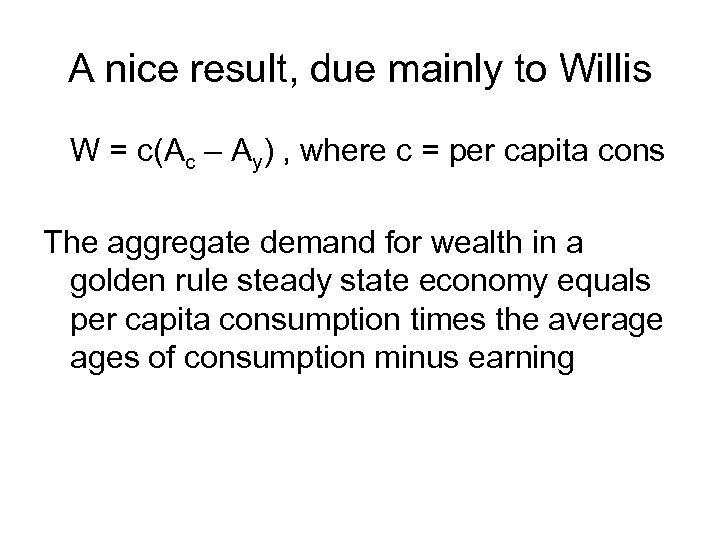 A nice result, due mainly to Willis W = c(Ac – Ay) , where c = per capita cons The aggregate demand for wealth in a golden rule steady state economy equals per capita consumption times the average ages of consumption minus earning
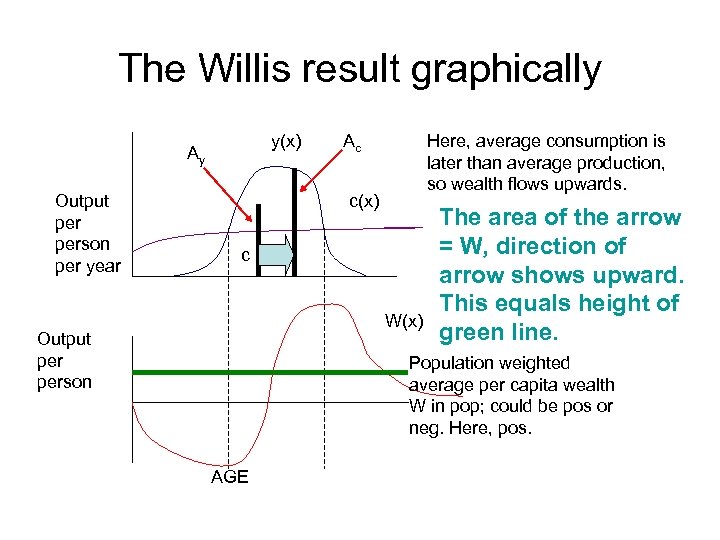 The Willis result graphically y(x) Ay Output person per year Ac Here, average consumption is later than average production, so wealth flows upwards. c(x) c W(x) Output person The area of the arrow = W, direction of arrow shows upward. This equals height of green line. Population weighted average per capita wealth W in pop; could be pos or neg. Here, pos. AGE
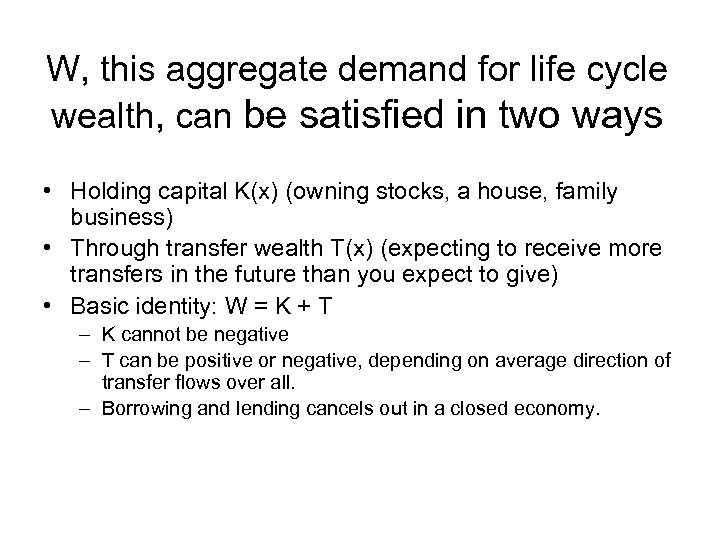 W, this aggregate demand for life cycle wealth, can be satisfied in two ways • Holding capital K(x) (owning stocks, a house, family business) • Through transfer wealth T(x) (expecting to receive more transfers in the future than you expect to give) • Basic identity: W = K + T – K cannot be negative – T can be positive or negative, depending on average direction of transfer flows over all. – Borrowing and lending cancels out in a closed economy.
 A link to growth theory in case of “golden rule” or optimal aggregate saving and consumption • Population aging is due both to low fertility and to low mortality. • Here focus on role of low fertility, causing low population growth rate, n. – How would lower n affect life cycle consumption across steady state paths?
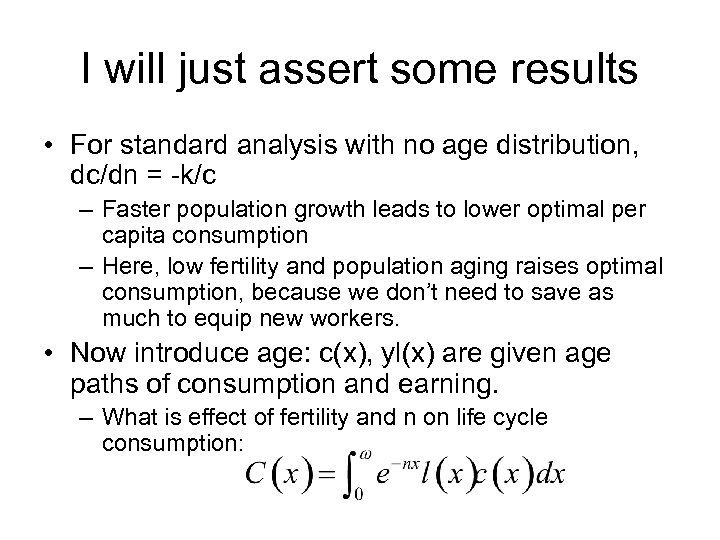 I will just assert some results • For standard analysis with no age distribution, dc/dn = -k/c – Faster population growth leads to lower optimal per capita consumption – Here, low fertility and population aging raises optimal consumption, because we don’t need to save as much to equip new workers. • Now introduce age: c(x), yl(x) are given age paths of consumption and earning. – What is effect of fertility and n on life cycle consumption:
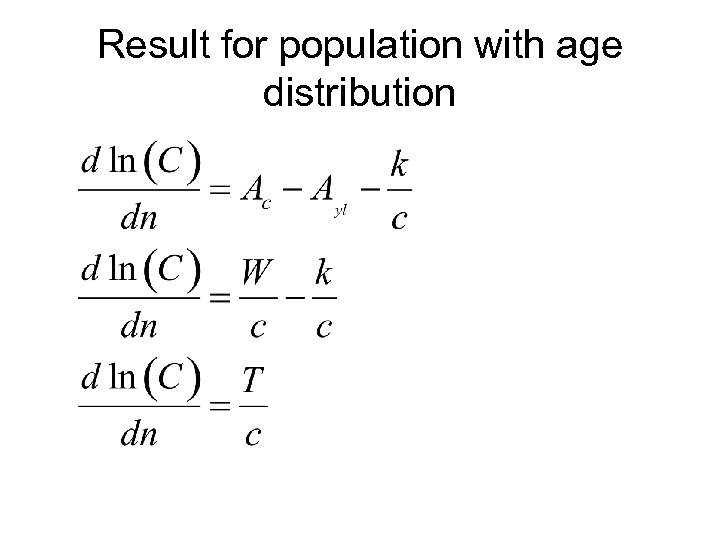 Result for population with age distribution
 In words: The effect of low fertility on life cycle consumption can be positive, negative, or nill depending on sign and size of transfer wealth. With upward transfers (Soc Sec? ), slow growth and aging reduces life cycle consumption (even though per capita cons rises) Caution: assumes we stay on path of optimal saving, and does not consider how pop aging will affect savings etc.
 More complicated and realistic analyses involve additional factors • Basic points carry over – Age patterns of consumption and earnings, and direction of reallocations, matter to outcome. – Whether reallocations are achieved through transfers or through individual saving and investment is also key. – Reliance on upward transfers for support of elderly makes population very costly (familial support, unfunded public pensions).
 An important conclusion about aging • Population aging will lead to a substantial increase in the demand for wealth, due to increased share of the population at older wealth -holding ages • In addition, longer life and lower fertility will raise the demand for wealth per elderly person. • Combined, these mean that aggregate demand for wealth per capita and per worker should double or triple over the demographic transition. • If this increased wealth takes form of capital rather than transfer wealth, population aging will boost productivity and consumption.
 Now look at estimated average ages for some very different economic/cultural regimes • Estimated from different kinds of data • Tell a consistent story
![+3 -2 2050 United States [Lee & Miller] Lee, 2000, 2003 (see cv)](https://present5.com/presentation/93d3942eb20519cd9b162c64820927a6/image-25.jpg "+3 -2 2050 United States [Lee & Miller] Lee, 2000, 2003 (see cv)") +3 -2 2050 United States [Lee & Miller] Lee, 2000, 2003 (see cv)
+3 -2 2050 United States [Lee & Miller] Lee, 2000, 2003 (see cv)
 5. Estimated age profiles of production and consumption • These come from NTA project • Research by teams working in each country. • Looks simple; actually a great deal of analysis lies behind them.
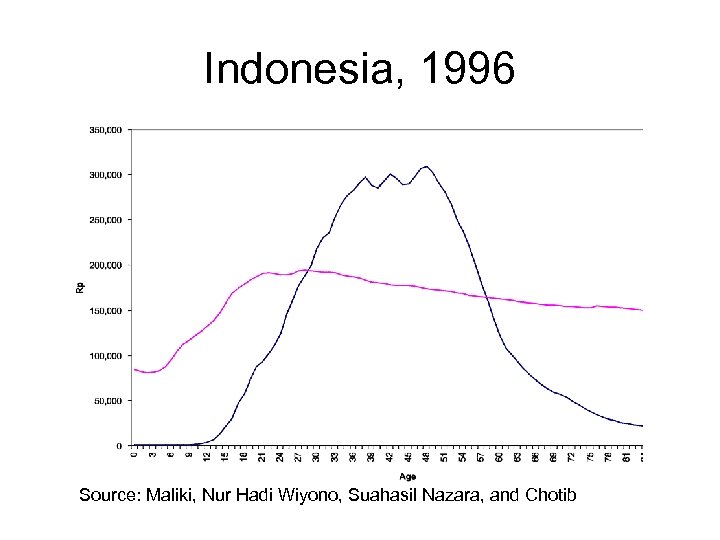 Indonesia, 1996 Source: Maliki, Nur Hadi Wiyono, Suahasil Nazara, and Chotib
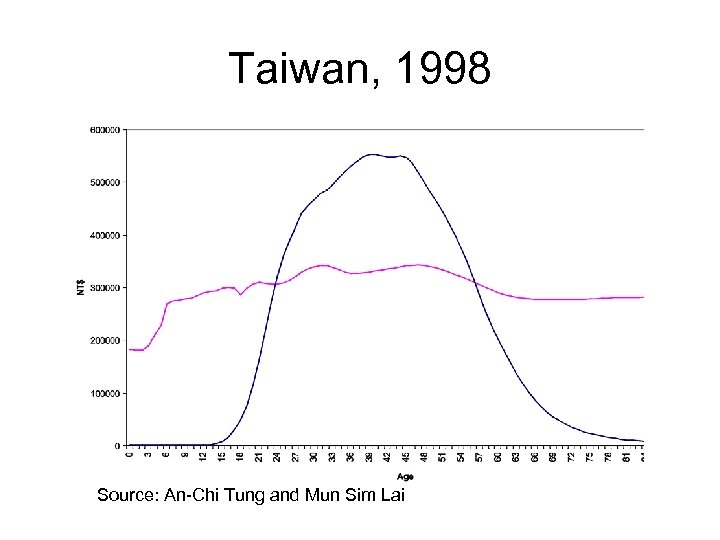 Taiwan, 1998 Source: An-Chi Tung and Mun Sim Lai
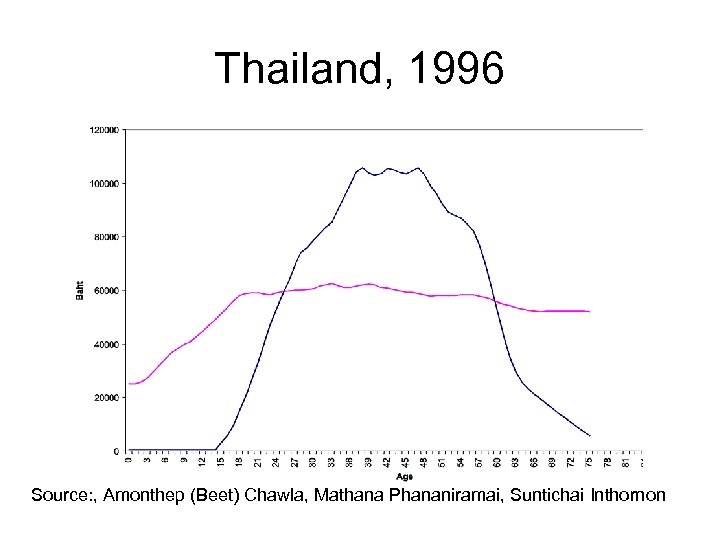 Thailand, 1996 Source: , Amonthep (Beet) Chawla, Mathana Phananiramai, Suntichai Inthornon
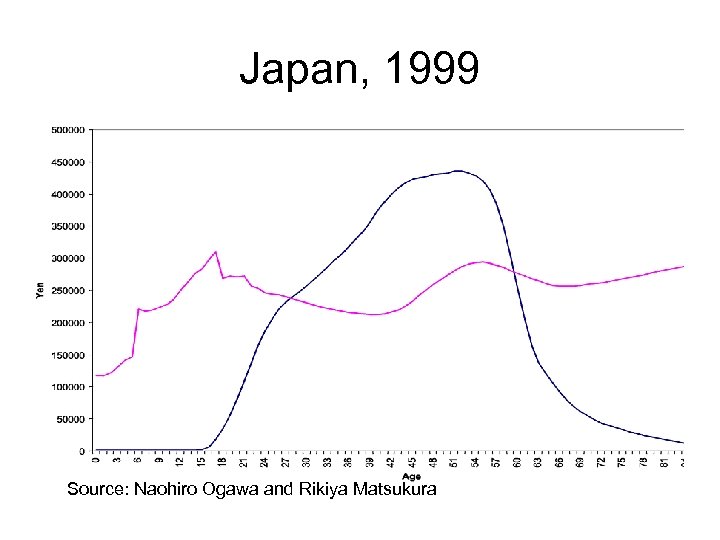 Japan, 1999 Source: Naohiro Ogawa and Rikiya Matsukura
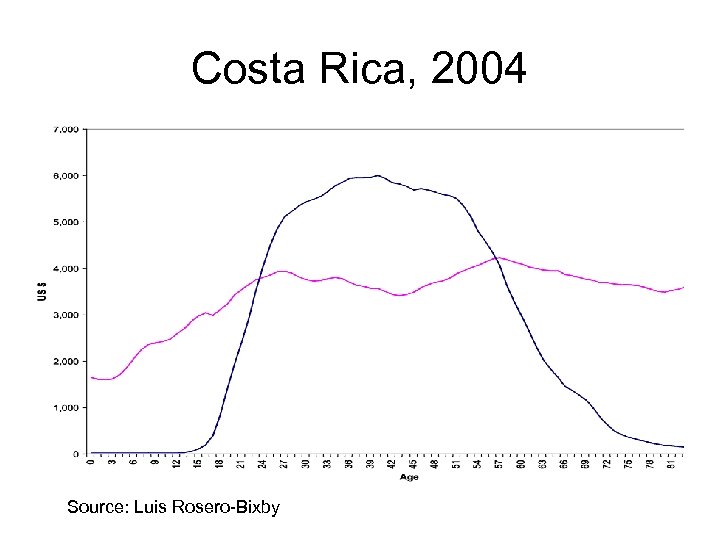 Costa Rica, 2004 Source: Luis Rosero-Bixby
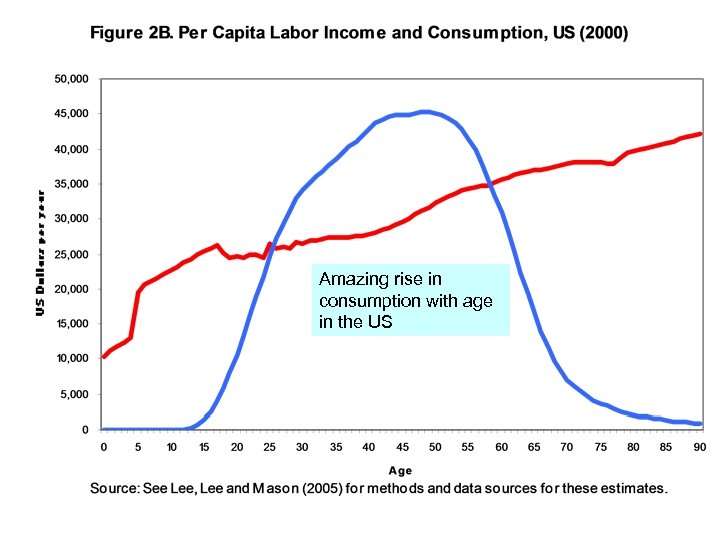 Amazing rise in consumption with age in the US
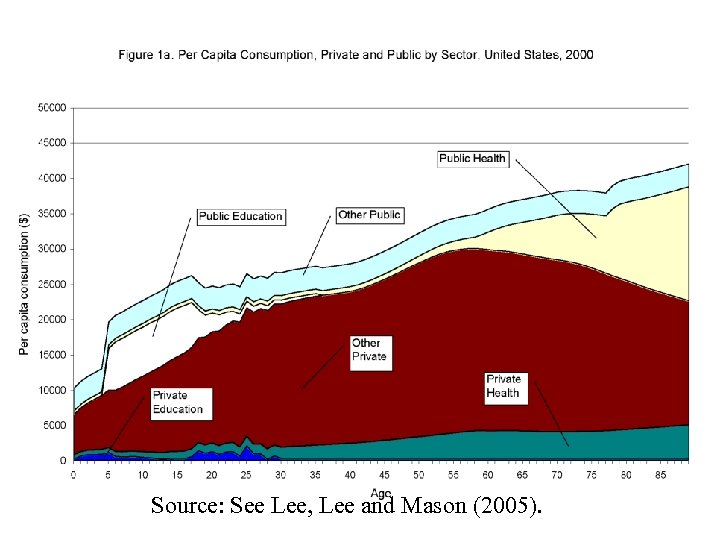 Source: See Lee, Lee and Mason (2005).
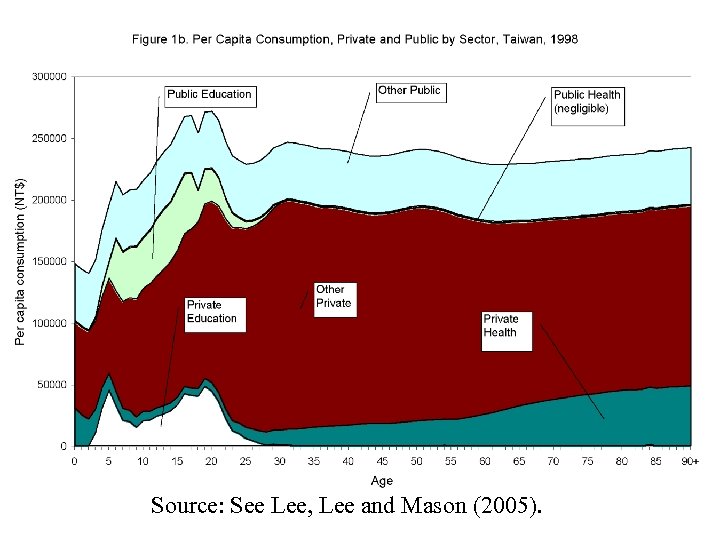 Source: See Lee, Lee and Mason (2005).
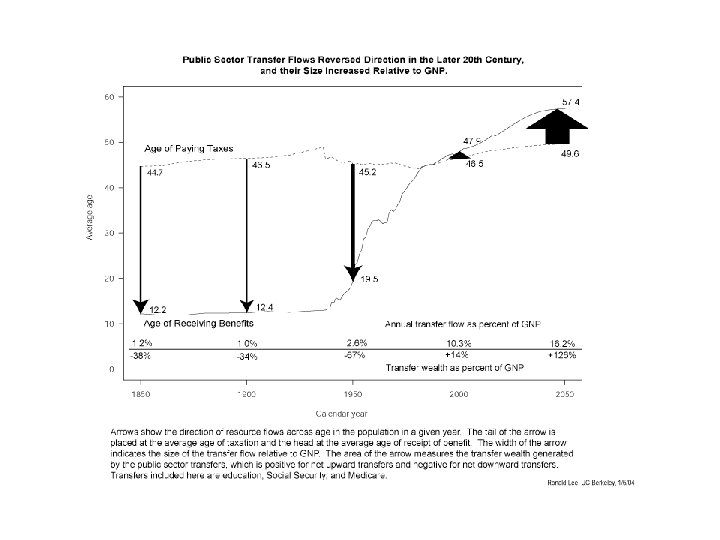
 What causes the reversal of the direction of income shifting from down to up? • To what extent is it simply due to population aging? • To what extent is it due to increased consumption by the elderly? • To what extent is it due to reduced labor supply by the elderly (falling age at retirement)?
 The role of population aging: Japan
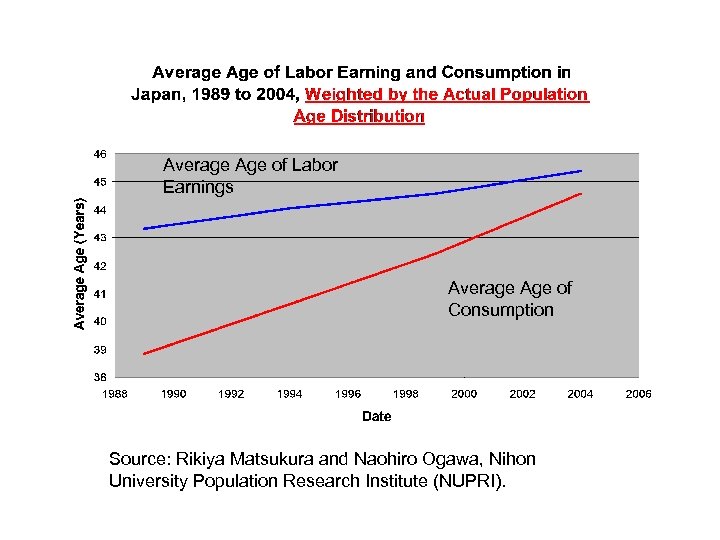 Average Age of Labor Earnings Average Age of Consumption Source: Rikiya Matsukura and Naohiro Ogawa, Nihon University Population Research Institute (NUPRI).
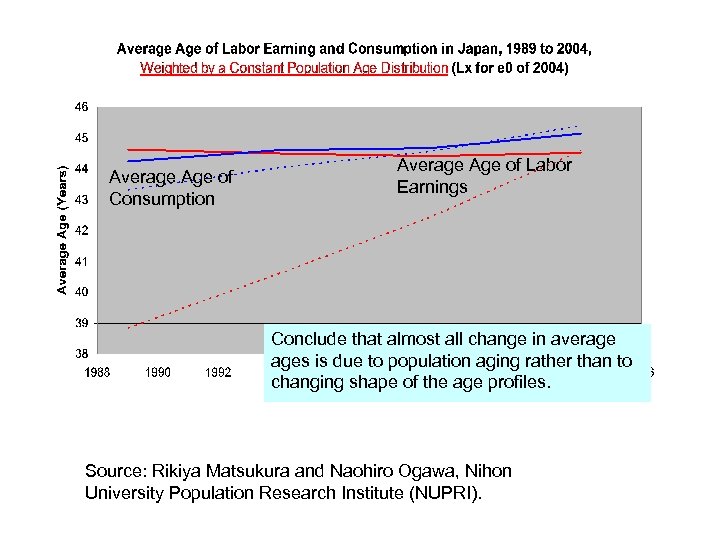 Average Age of Consumption Average Age of Labor Earnings Conclude that almost all change in average ages is due to population aging rather than to changing shape of the age profiles. Source: Rikiya Matsukura and Naohiro Ogawa, Nihon University Population Research Institute (NUPRI).
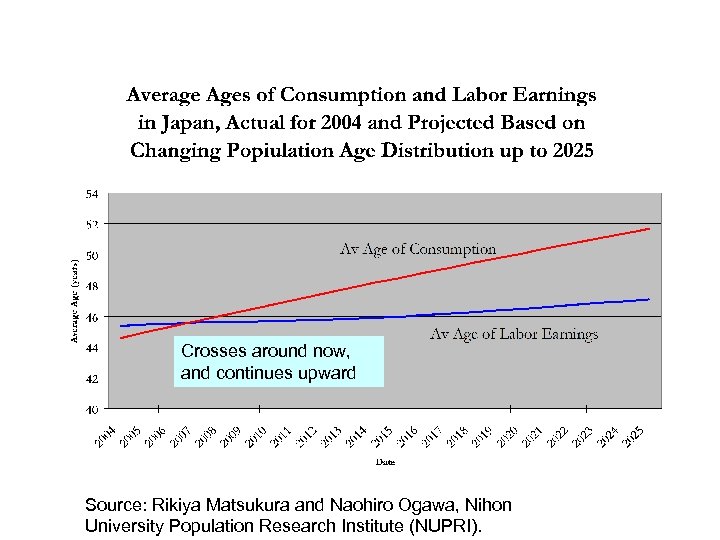 Crosses around now, and continues upward Source: Rikiya Matsukura and Naohiro Ogawa, Nihon University Population Research Institute (NUPRI).
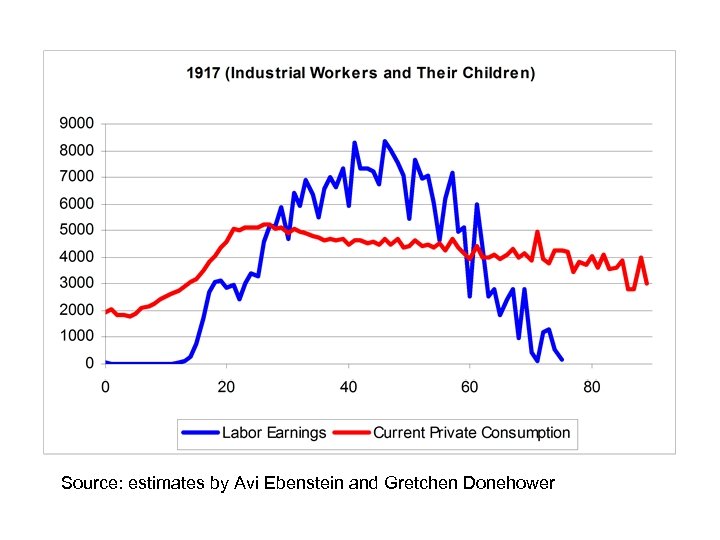
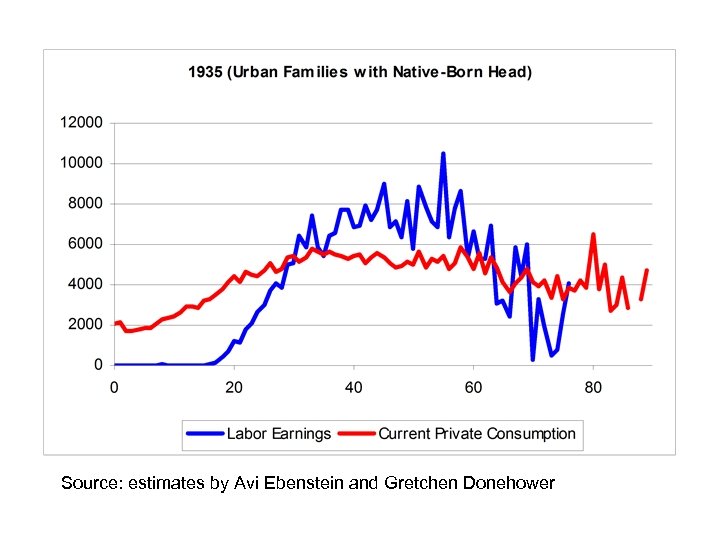
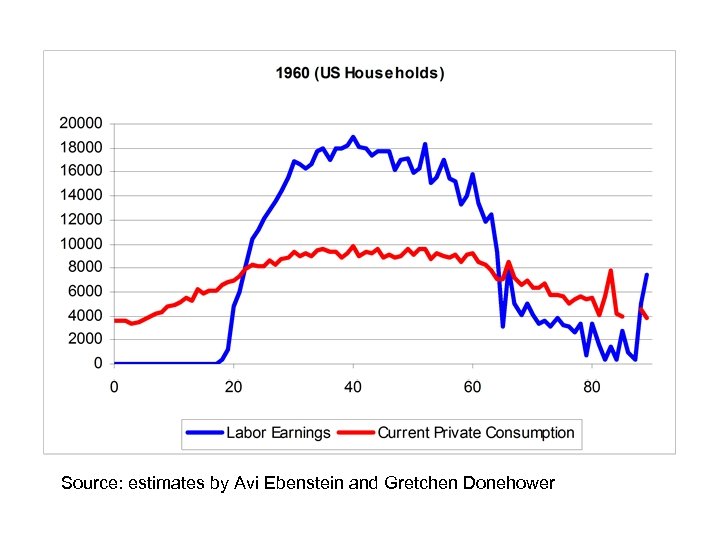
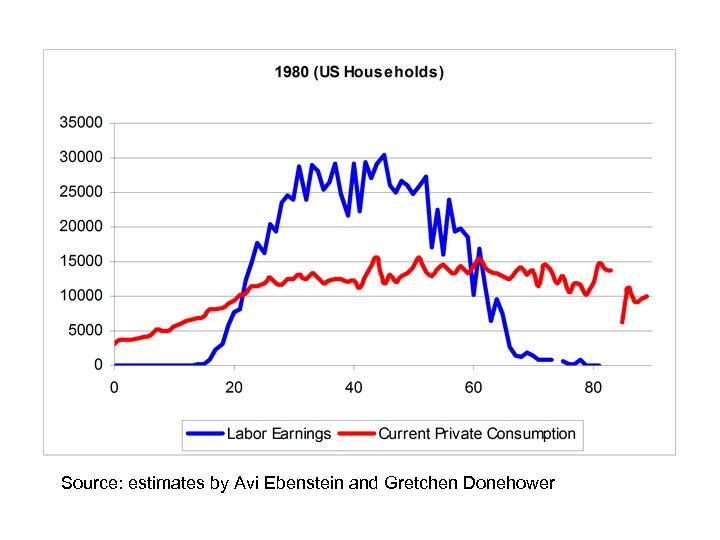
 The role of changing shape of consumption and earning: US • For the US, we have some CEX type surveys of special subpopulations at a few dates – – 1888: Industrial workers and their children 1917: Industrial workers and their children 1935: Urban Families with Native-Born Head 1960, 1980, 1990, 2002: US Households • Analyzed (with great care and ingenuity) by Avi Ebenstein and Gretchen Donehower
 More on the historical data • Profiles have been adjusted to national control totals • Limitations – These do not include public in-kind transfers, only private. – Because of varying sample limitations, not strictly comparable before 1980. But let’s take a look anyway…
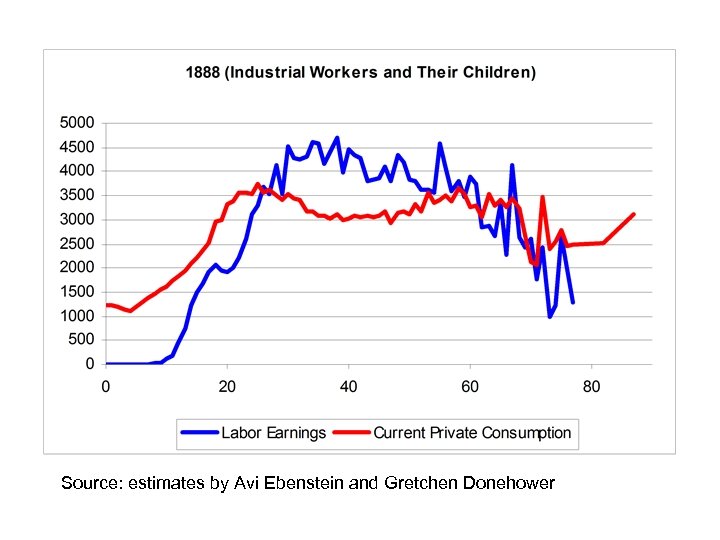 Source: estimates by Avi Ebenstein and Gretchen Donehower
 Source: estimates by Avi Ebenstein and Gretchen Donehower
 Source: estimates by Avi Ebenstein and Gretchen Donehower
 Source: estimates by Avi Ebenstein and Gretchen Donehower
 Source: estimates by Avi Ebenstein and Gretchen Donehower
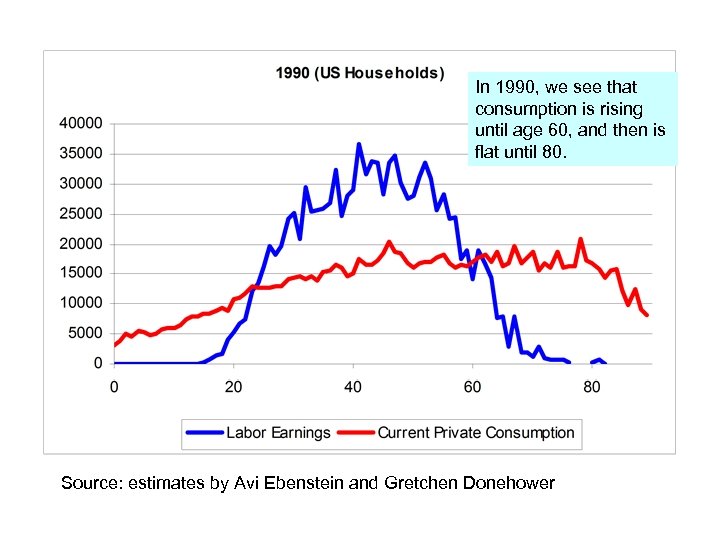 In 1990, we see that consumption is rising until age 60, and then is flat until 80. Source: estimates by Avi Ebenstein and Gretchen Donehower
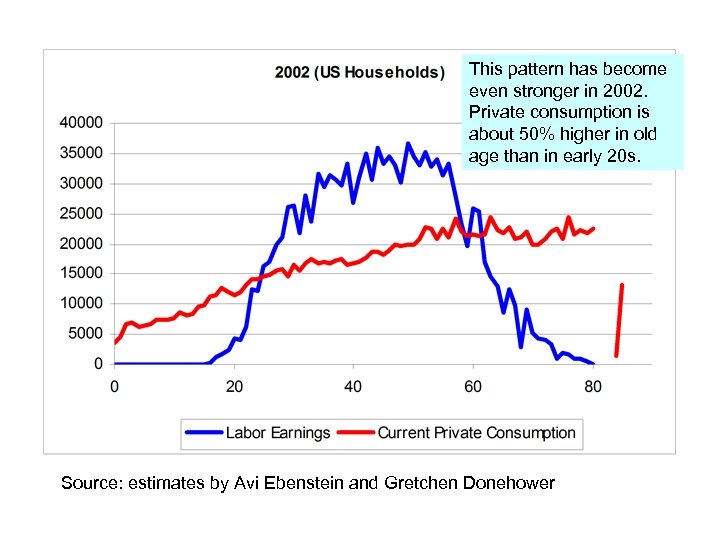 This pattern has become even stronger in 2002. Private consumption is about 50% higher in old age than in early 20 s. Source: estimates by Avi Ebenstein and Gretchen Donehower
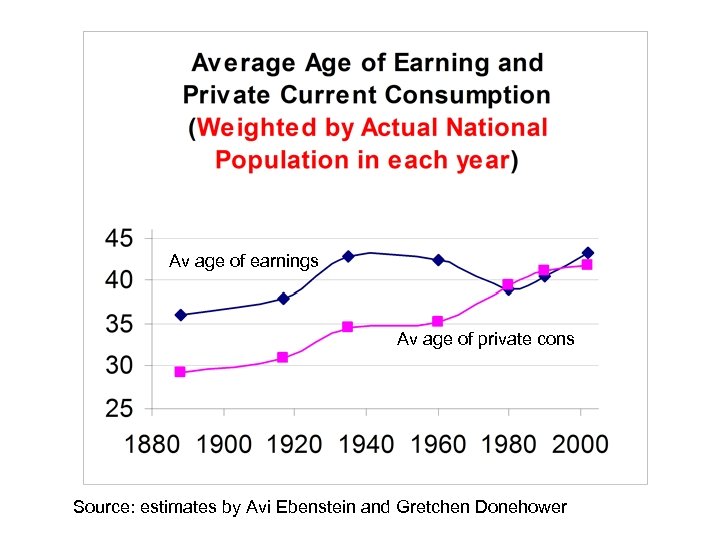 Av age of earnings Av age of private cons Source: estimates by Avi Ebenstein and Gretchen Donehower
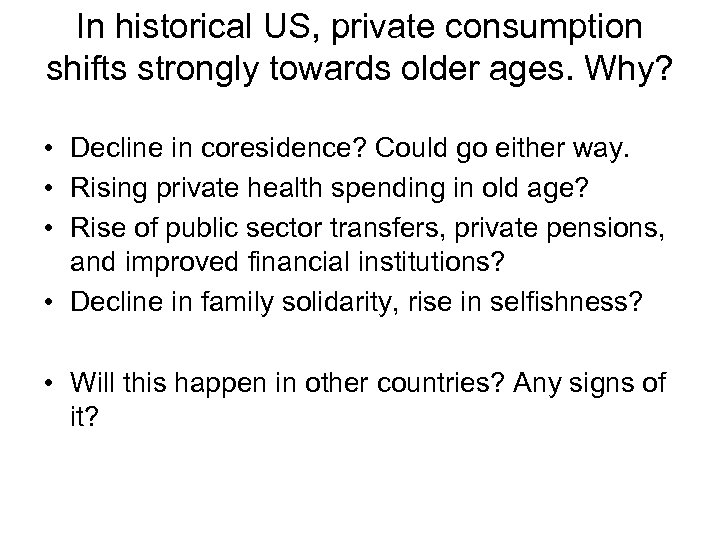 In historical US, private consumption shifts strongly towards older ages. Why? • Decline in coresidence? Could go either way. • Rising private health spending in old age? • Rise of public sector transfers, private pensions, and improved financial institutions? • Decline in family solidarity, rise in selfishness? • Will this happen in other countries? Any signs of it?
 What institutions and mechanisms provide the flows that support these consumption patterns? • Source by age – Inter vivos familial transfers – Bequests – Public transfers – Assets (credit and capital)
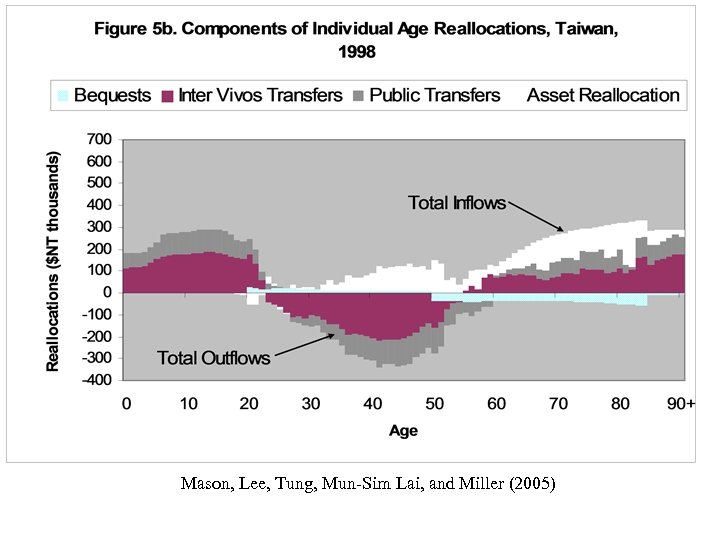 Mason, Lee, Tung, Mun-Sim Lai, and Miller (2005)
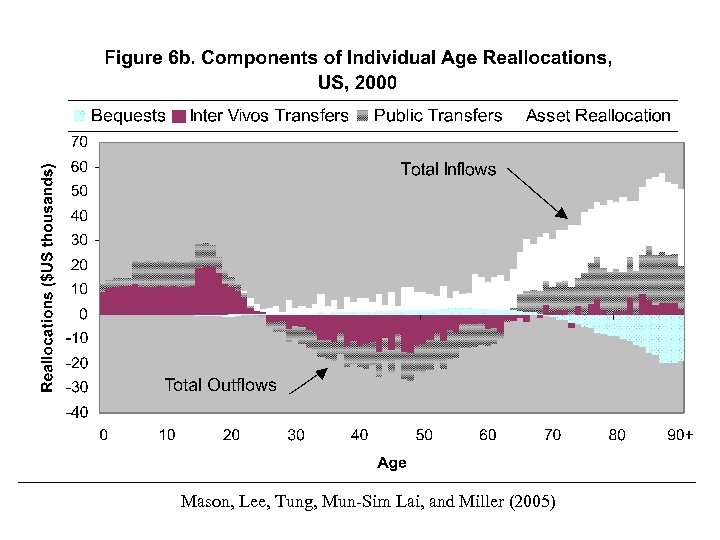 Mason, Lee, Tung, Mun-Sim Lai, and Miller (2005)
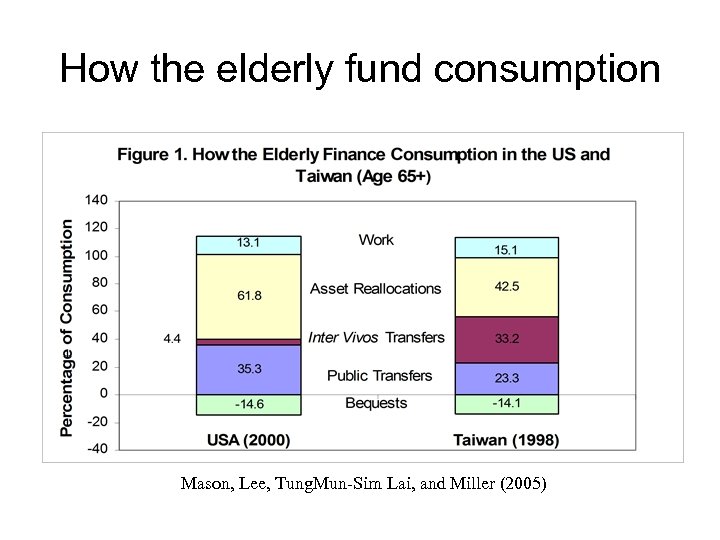 How the elderly fund consumption Mason, Lee, Tung. Mun-Sim Lai, and Miller (2005)
 An illustration of what can be done with historical depth and projections
 Net Present Values of Benefits minus Taxes for Generations • Includes only Public Educ, Social Sec, and Medicare • NPVs calculated based on – estimates and projections of age specific taxes paid and benefits received, 1850 -2200 – Current program structure for benefits – Budgets balanced 50 -50 by cutting benefits and raising taxes – Discounted at 3% real – actual or projected survival
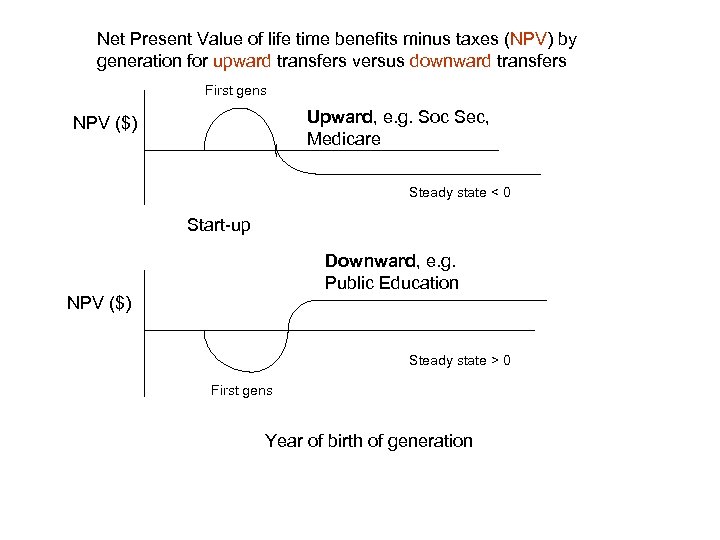 Net Present Value of life time benefits minus taxes (NPV) by generation for upward transfers versus downward transfers First gens Upward, e. g. Soc Sec, Medicare NPV ($) Steady state < 0 Start-up Downward, e. g. Public Education NPV ($) Steady state > 0 First gens Year of birth of generation
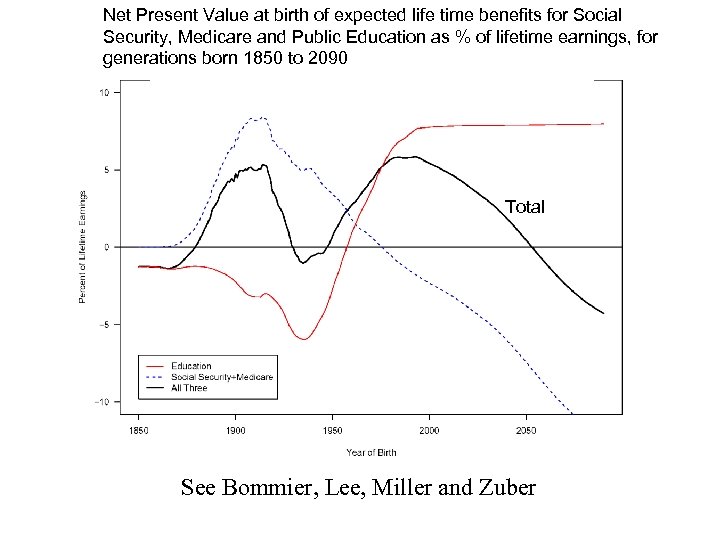 Net Present Value at birth of expected life time benefits for Social Security, Medicare and Public Education as % of lifetime earnings, for generations born 1850 to 2090 Total See Bommier, Lee, Miller and Zuber
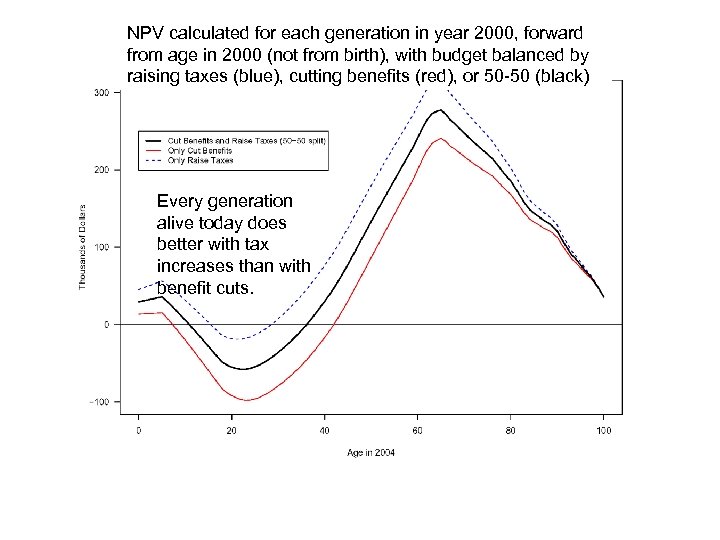 NPV calculated for each generation in year 2000, forward from age in 2000 (not from birth), with budget balanced by raising taxes (blue), cutting benefits (red), or 50 -50 (black) Every generation alive today does better with tax increases than with benefit cuts.
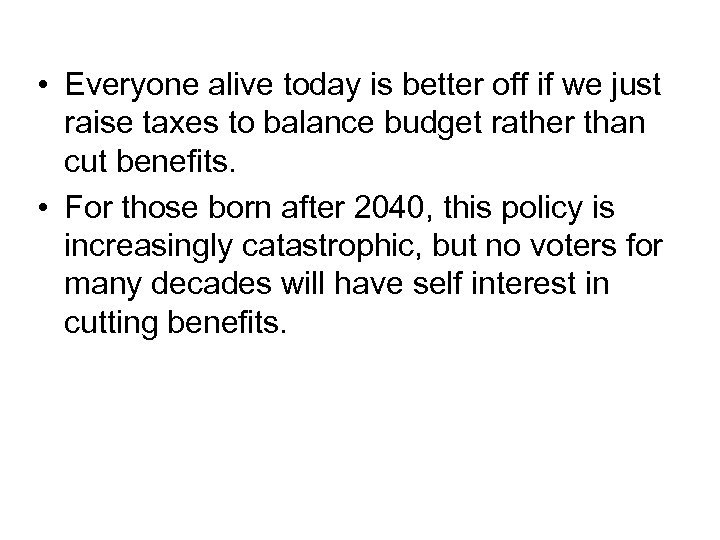 • Everyone alive today is better off if we just raise taxes to balance budget rather than cut benefits. • For those born after 2040, this policy is increasingly catastrophic, but no voters for many decades will have self interest in cutting benefits.
 END
END