



 Пономарева Елена Юрьевна к. ф. н, ст. пр. кафедры английского языка Каб. 213
 Stylistics of the English Language RECOMMENDED LITERATURE: 1. 2. 3. 4. 5. 6. 7. Galperin I. R. Stylistics. - M. , 1987. Screbnev Y. N. Fundamentals of Stylistics, M. 1985. Арнольд И. В. Стилистика современного английского языка (стилистика декодирования). – M. , 2001. Ивашкин М. П. Стилистика английского языка. - M. , 2003. Кухаренко В. А. A Book of Practice in Stylistics– 2009. Гуревич В. В. English Stylistics. М. : Изд-во «Наука» , 2005. Кухаренко В. А. Seminars in Style (exercise book)
 Course Outline 1. Stylistics as a branch of linguistics 2. Phonetic EM and SD 3. Graphic EM 4. Morphemic level of stylistic analysis 5. Stylistic differentiation of the English vocabulary 6. Stylistic semasiology: lexical, syntactical and lexico-syntactical SD 7. Types of narration 8. Functional styles.
 Lecture 1. STYLISTICS AS A BRANCH OF LINGUISTICS Outline 1. Stylistics as a branch of linguistics, 2. 3. 4. 5. its aims and tasks. Different branches of stylistics. The system of the language and the problem of the norm in stylistics. The stylistic function. Functional styles, classifications and controversial moments.
 Stylistics from Greek “stylos” (a pen). n Style is a way of using a language (average dictionary definition) n “Language expresses and style stresses” /M. Riffattere/. n “Style is the mystery of having been moved by words” /D. Thomas/ n Stylus virum arguit : “The style proclaims the man” /R. Burton/ n Style is the dress of thoughts; if your style is homely, coarse, and vulgar, they will appear to as much disadvantage” /Lord Chesterfield/
 Style n “Style is a product of individual choices and patterns of choices among linguistic possibilities” /S. Chatman/ n “A style of language is a system of interrelated language means which serves a definite aim in communication” /I. R. Galperin/.
 Summing up: n Style can be understood as ‘literary style’ – it focuses on the way language is used for artistic purposes. n Style can be viewed as a system of language means used for a certain communicative purpose. n Style can be seen as a product of individual choices or as an idiostyle having its own idiosyncrasies.
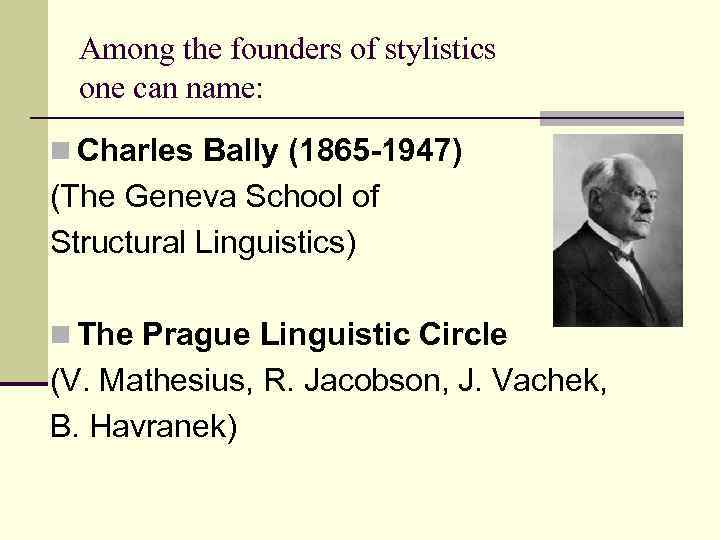 Among the founders of stylistics one can name: n Charles Bally (1865 -1947) (The Geneva School of Structural Linguistics) n The Prague Linguistic Circle (V. Mathesius, R. Jacobson, J. Vachek, B. Havranek)
 Stylistics is a branch of linguistics which studies the principles of choice and the effect of choice of different language elements in rendering thought and emotion under different conditions of communication.
 n The ultimate aim of stylistics is to establish the objective laws and practical rules of using proper linguistic forms in proper situations – to find out which form among the multitude of synonymous linguistic means conforms to the given extralinguistic circumstances.
 Stylistics is applied to: 1. A system of stylistic devices (SD) 2. 3. 4. 5. 6. and expressive means in the language (EM); Emotional colouring; Synonymous ways of rendering one and the same idea (Ch. Bally); Aesthetic function of the language; Functional styles (the Prague School); The individual style of the writer.
 n. Retire, please! n. Leave the room! n. Clear out! n. Beat it, lady! n. I have got nothing! n. I ain’t got nothing!
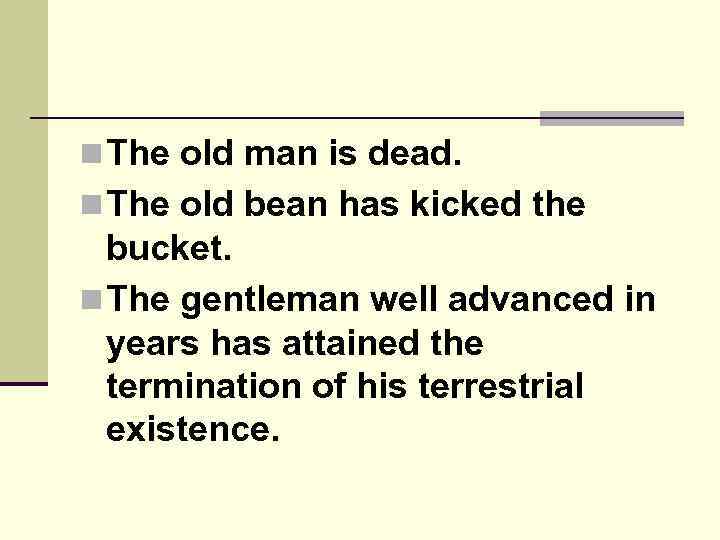 n The old man is dead. n The old bean has kicked the bucket. n The gentleman well advanced in years has attained the termination of his terrestrial existence.
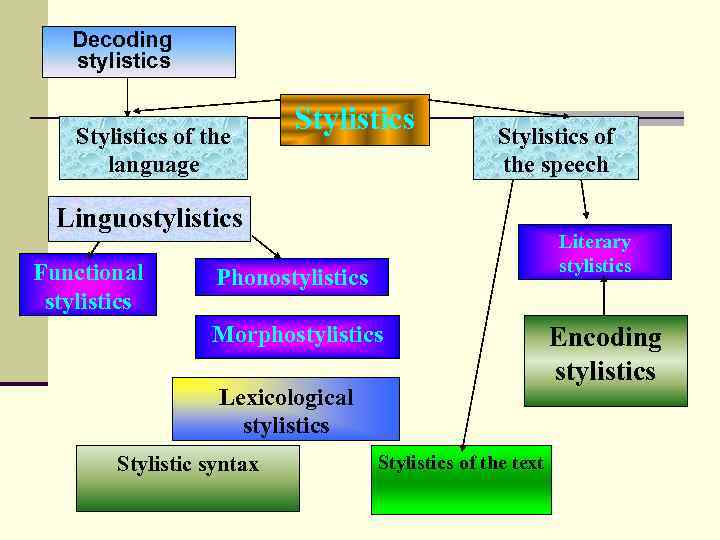 Decoding stylistics Stylistics of the language Stylistics of the speech Linguostylistics Functional stylistics Literary stylistics Phonostylistics Morphostylistics Lexicological stylistics Stylistic syntax Stylistics of the text Encoding stylistics
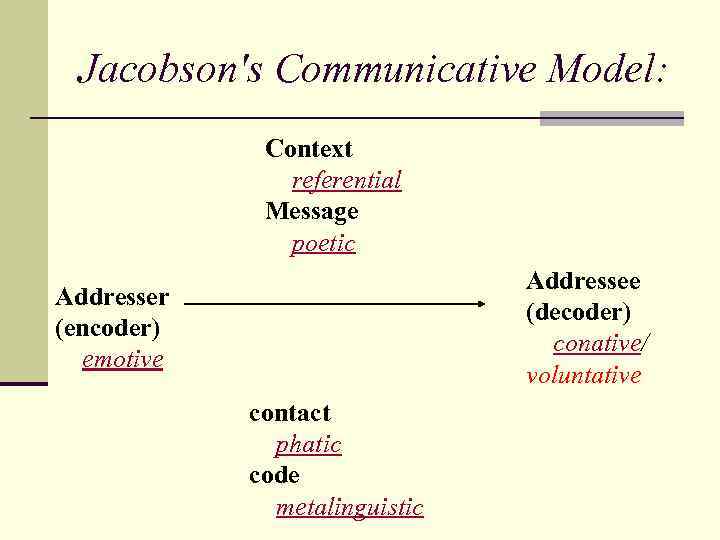 Jacobson's Communicative Model: Context referential Message poetic Addressee (decoder) conative/ voluntative Addresser (encoder) emotive contact phatic code metalinguistic
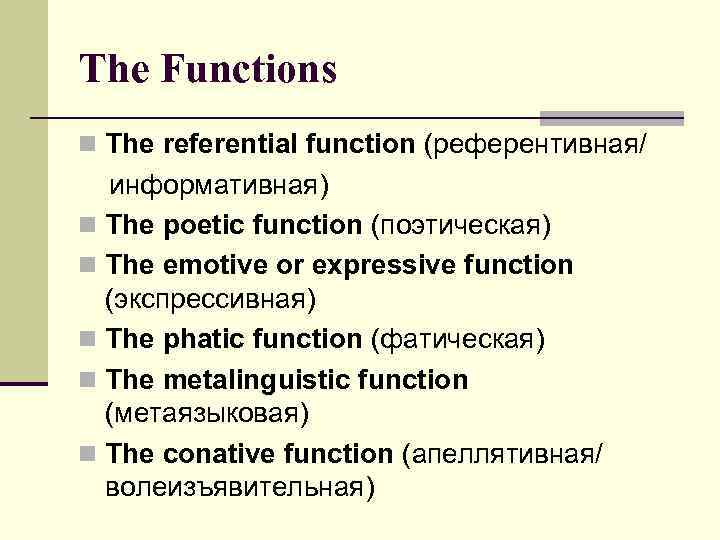 The Functions n The referential function (референтивная/ информативная) n The poetic function (поэтическая) n The emotive or expressive function (экспрессивная) n The phatic function (фатическая) n The metalinguistic function (метаязыковая) n The conative function (апеллятивная/ волеизъявительная)
 n The referential function is what is being spoken of, what is n n n being referred to. The poetic function is the focus on the message (beauty of the message) The emotive or expressive functions refer to the attitude of the addresser towards that of which (or to whom) he speaks: through emphasis, intonation, loudness, pace, etc. The phatic function is the use of language to keep people in contact with each other. The metalinguistic function is that use of language, by which people check out with each other whether they are 'on the same page', using the same codes in the same contexts. The conative function refers to those aspects of language that aim to create a certain response in the addressee.
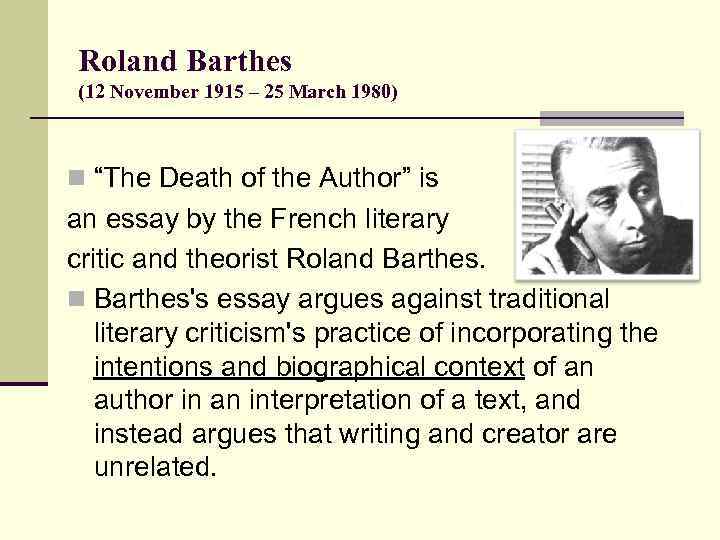 Roland Barthes (12 November 1915 – 25 March 1980) n “The Death of the Author” is an essay by the French literary critic and theorist Roland Barthes. n Barthes's essay argues against traditional literary criticism's practice of incorporating the intentions and biographical context of an author in an interpretation of a text, and instead argues that writing and creator are unrelated.
 DIFFERENT BRANCHES OF STYLISTICS n DECODING STYLISTICS vs ENCODING STYLISTICS n STYLISTICS OF LANGUAGE vs STYLISTICS OF SPEECH n LINGUOSTYLISTICS vs LITERARY STYLISTICS n FUNCTIONAL STYLISTICS.
 THE NORM In literary lg the NORM is the invariant of the n phonetic, n morphological, n lexical and n syntactic patterns in circulation during a given period in the language development.
 n The theory of NORM is based on theory of OPPOSITION. n STYLISTICALLY NEUTRAL words are opposed to STYLICTICALLY CHARGED (COLOURED) words. n Stylistics studies not only the norm but also the VIOLATION of the norm.
 n The norm constitutes the background of any text. Professor I. V. Arnold calls it automatization. n The Prague School introduced the term “foregrounding” or “actualization”. n Foregrounding is the ability of a verbal element to obtain extra significance, to say more in a definite context.
 Come, we burn daylight, ho! (Romeo and Juliet, I, 4) n Foreground vs background: in art criticism, the items in the foreground will usually appear larger than those in the background n Foreground vs background: in stylistics, the background is what is linguistically normal, the foreground is the portions of text which do not conform to expectations n We burn paper, wood, coal, oil, fuel: normal paradigm, vs n We burn daylight: abnormal paradigm
 Foregrounding n Semantic deviation (figurative meaning) n Lexical deviation (occasionalisms) n Grammatical deviation (deviant word order) n Morphological deviation (highlighting single morphemes) n Graphological deviation: the written equivalent of phonological deviation 24
 Example In the room So loud to my own. A grief ago; Once below a time; All the sun long; Happy as the heart was long. /Dylan. Thomas/.
 Expressive Means EM of the language are presented by a choice of words, clauses, sentences, combination of sounds, which signal additional information (emotive, expressive, evaluative, stylistic).
 EM at different levels of the language n Phonetic EM (pitch, melody, stress, pausation etc. ) n Morphological EM (the historic present, emphatic “shall”, emphatic demonstrative pronouns) n Lexical EM (interjections, words with connotations (love, hate etc), slang, poetic, archaic words) n Syntactical EM (emphatic structures)
 Stylistic Device A STYLISTIC DEVICE is a generative model based on intensification of some typical structure and/or semantic property of a language unit. (Galperin I. R. ).
 Examples of SDs n“Sara was a menace and a tonic, my best enemy”. (чистое наказание) n. Rozzie was a disease, my worst friend”.
 The stylistic function is an expressive realization of interrelated lg means in the text to convey not only logical (denotative), but expressive, emotive, evaluative and aesthetic information.
 Stylistic Function The stylistic function is characterized by accumulation of the mood (tonality) expressed by different EM and SD, constituting convergence on the whole, it is based on implication and irradiation.
 n Accumulation (передача настроения) is the transition of the mood, feelings by means of several EM and SD whose aim is to attract the reader's attention. n Convergence (единство) (Michael Riffaterre) is the combination of different SD fulfilling the same stylistic function. n Implication (подразумевание) is the ability of a text to contain additional implicit information. n Irradiation (распространение) is the ability of EM and SD to influence the whole text.
 Example “And heaved and heaved, still unrestingly heaved the Black sea, as if its vast tides were a conscience”. /H. Melville/.
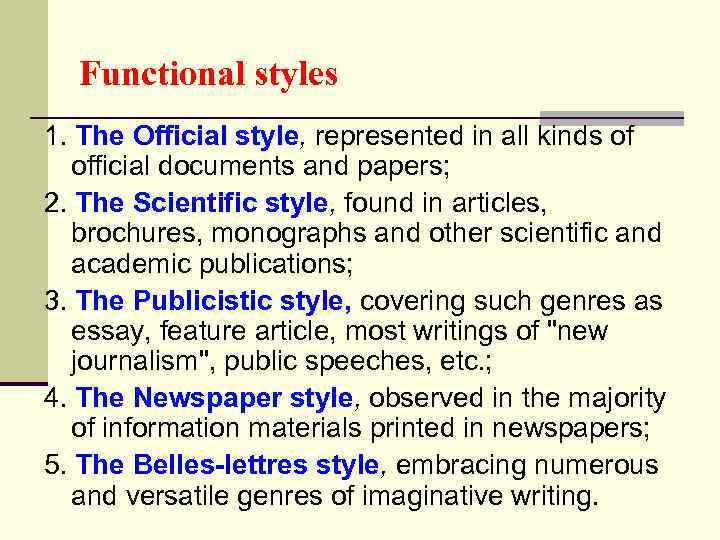 Functional styles 1. The Official style, represented in all kinds of official documents and papers; 2. The Scientific style, found in articles, brochures, monographs and other scientific and academic publications; 3. The Publicistic style, covering such genres as essay, feature article, most writings of "new journalism", public speeches, etc. ; 4. The Newspaper style, observed in the majority of information materials printed in newspapers; 5. The Belles-lettres style, embracing numerous and versatile genres of imaginative writing.
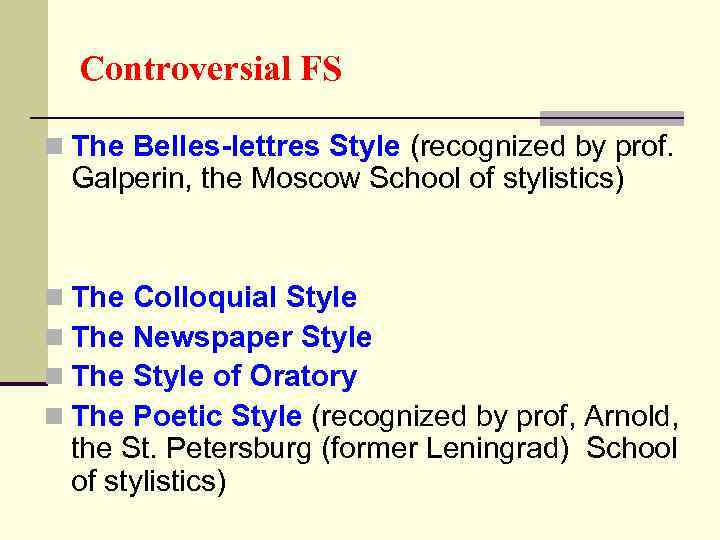 Controversial FS n The Belles-lettres Style (recognized by prof. Galperin, the Moscow School of stylistics) n The Colloquial Style Newspaper Style of Oratory Poetic Style (recognized by prof, Arnold, the St. Petersburg (former Leningrad) School of stylistics)
 Questions Give definitions to the following notions: n Style (the extended definition+3 approaches) n Stylistics n Norm n Foregrounding+types of foregrounding n Stylistic function n EM and SD