 Скачать презентацию Polymerization and complex Autocatalytic feedback assembly Taxis and
3368683f1ca02982b42bf25925c9d2f9.ppt
- Количество слайдов: 160



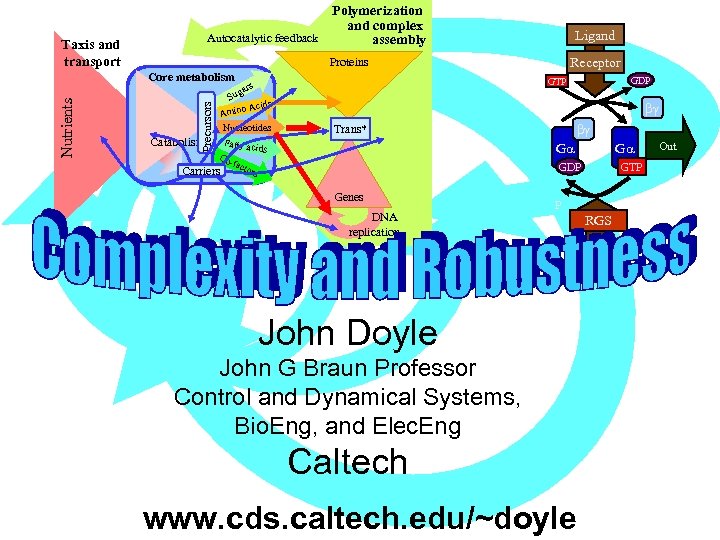
Polymerization and complex Autocatalytic feedback assembly Taxis and transport In Receptor Proteins Core metabolism Catabolism GDP GTP rs uga Precursors Nutrients Ligand S cids mino A A Nucleotides Trans* Fatty acid s Cofact ors Carriers G G GDP Genes DNA replication GTP P John Doyle John G Braun Professor Control and Dynamical Systems, Bio. Eng, and Elec. Eng Caltech www. cds. caltech. edu/~doyle RGS In Out
Collaborators and contributors (partial list) Biology: Csete, Yi, Tanaka, Arkin, Savageau, Simon, Af. CS, Kurata, Khammash, El-Samad, Gross, Kitano, Hucka, Sauro, Finney, Bolouri, Gillespie, Petzold, F Doyle, Stelling, … Theory: Parrilo, Carlson, Paganini, Papachristodoulou, Prajna, Goncalves, Fazel, Liu, Lall, D’Andrea, Jadbabaie, Dahleh, Martins, Recht, many more current and former students, … Web/Internet: Li, Alderson, Chen, Low, Willinger, Vinnicombe, Kelly, Zhu, Yu, Wang, Chandy, … Turbulence: Bamieh, Bobba, Gharib, Marsden, … Physics: Mabuchi, Doherty, Barahona, Reynolds, Disturbance ecology: Moritz, Carlson, … Finance: Martinez, Primbs, Yamada, Giannelli, … Engineering CAD: Ortiz, Murray, Schroder, Burdick, … Current Caltech Former Caltech Longterm Visitor Other
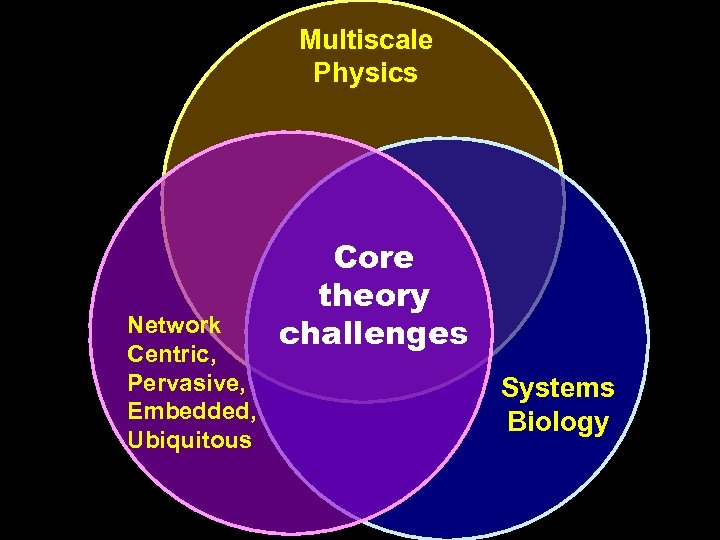
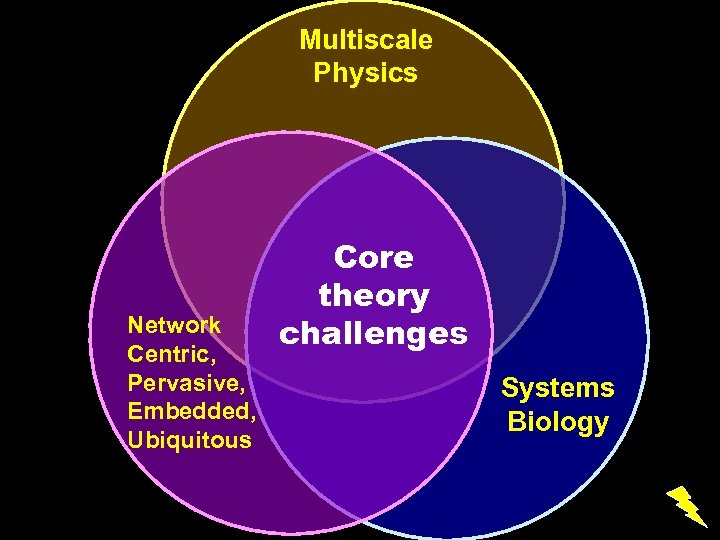
Multiscale Physics Network Centric, Pervasive, Embedded, Ubiquitous Core theory challenges Systems Biology
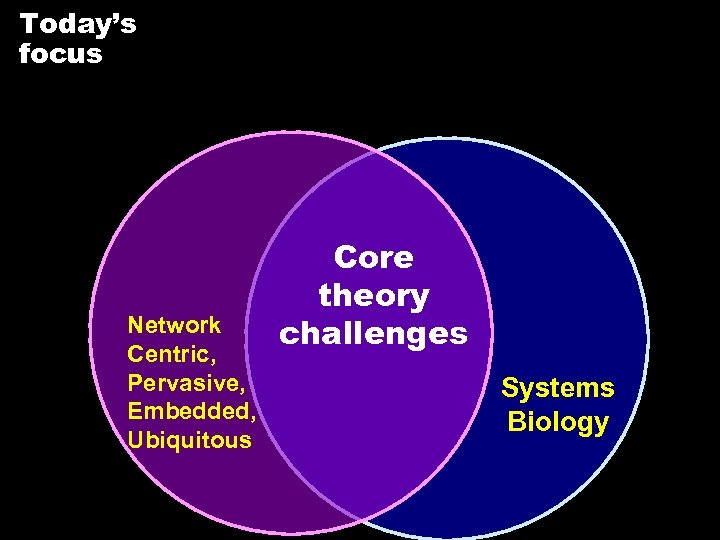
Today’s focus Network Centric, Pervasive, Embedded, Ubiquitous Core theory challenges Systems Biology
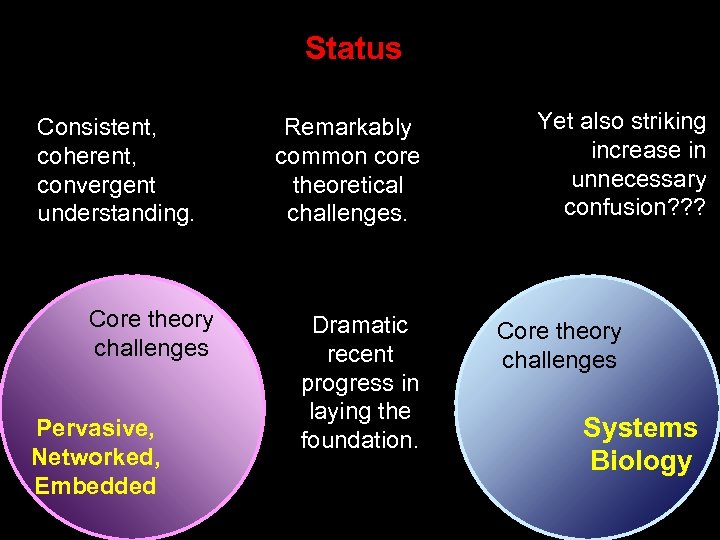
Status Consistent, coherent, convergent understanding. Core theory challenges Pervasive, Networked, Embedded Remarkably common core theoretical Core theory challenges Dramatic recent progress in laying the foundation. Yet also striking increase in unnecessary confusion? ? ? Core theory challenges Systems Biology
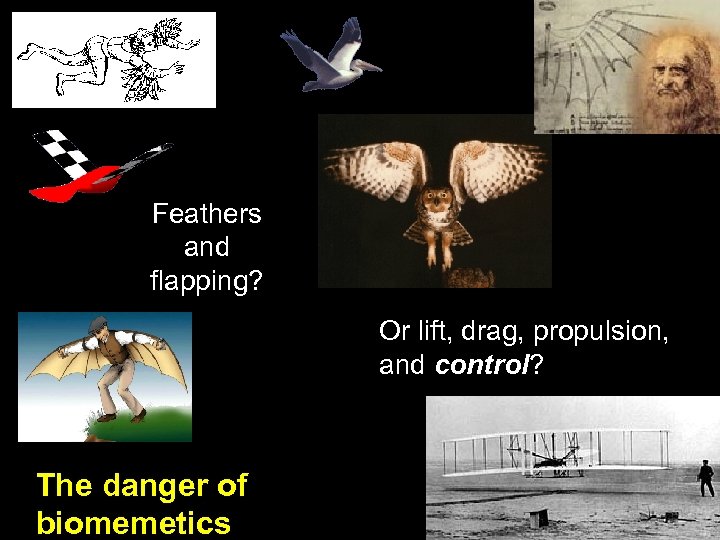
Feathers and flapping? Or lift, drag, propulsion, and control? The danger of biomemetics
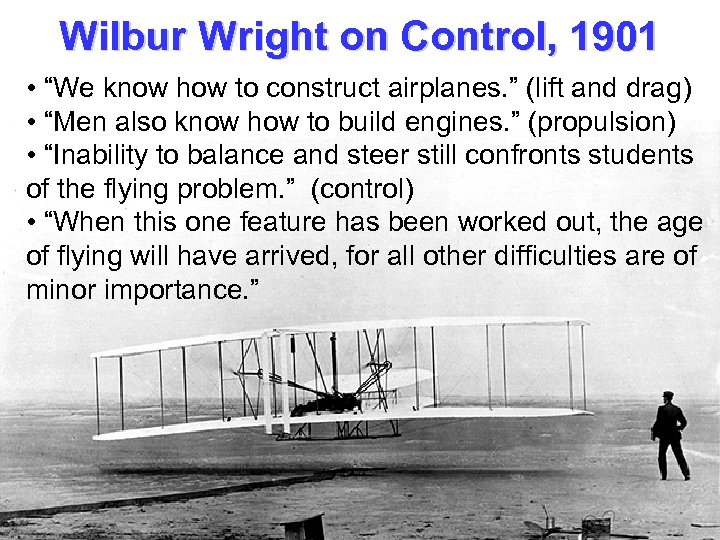
Wilbur Wright on Control, 1901 • “We know how to construct airplanes. ” (lift and drag) • “Men also know how to build engines. ” (propulsion) • “Inability to balance and steer still confronts students of the flying problem. ” (control) • “When this one feature has been worked out, the age of flying will have arrived, for all other difficulties are of minor importance. ”
Core theory challenges • Hard constraints • Simple models • Short proofs • Architecture
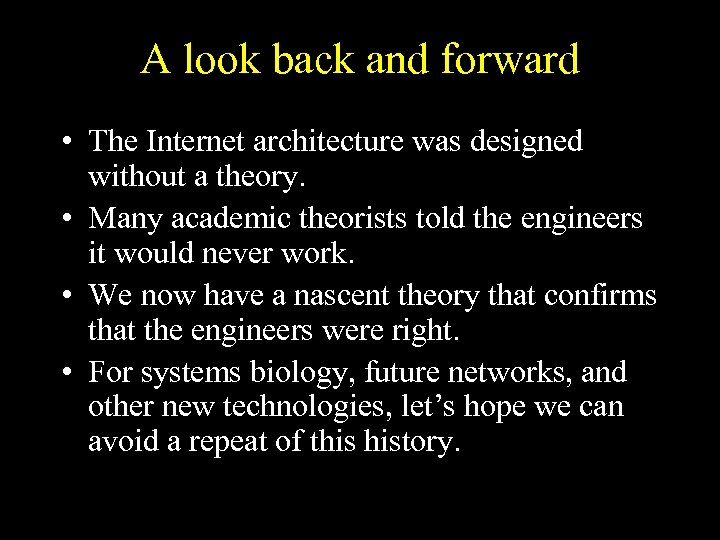
A look back and forward • The Internet architecture was designed without a theory. • Many academic theorists told the engineers it would never work. • We now have a nascent theory that confirms that the engineers were right. • For systems biology, future networks, and other new technologies, let’s hope we can avoid a repeat of this history.
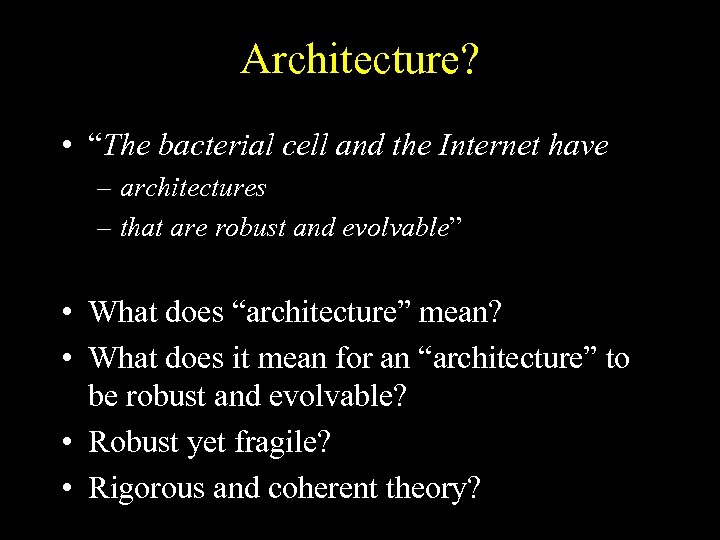
Architecture? • “The bacterial cell and the Internet have – architectures – that are robust and evolvable” • What does “architecture” mean? • What does it mean for an “architecture” to be robust and evolvable? • Robust yet fragile? • Rigorous and coherent theory?
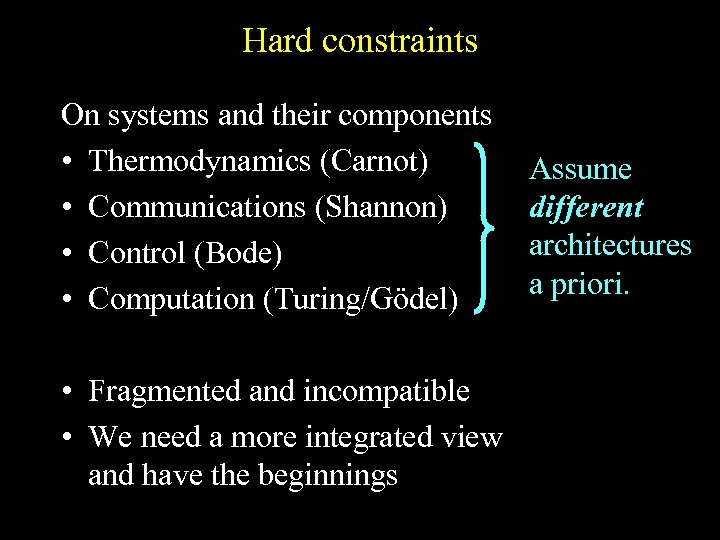
Hard constraints On systems and their components • Thermodynamics (Carnot) • Communications (Shannon) • Control (Bode) • Computation (Turing/Gödel) • Fragmented and incompatible • We need a more integrated view and have the beginnings Assume different architectures a priori.
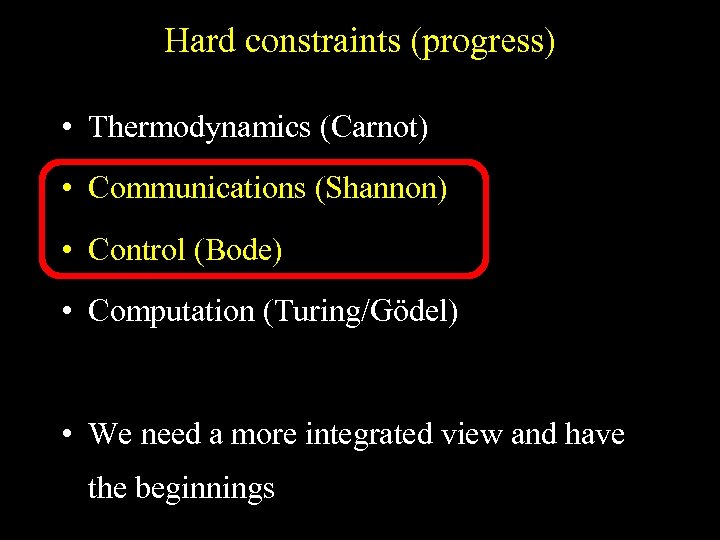
Hard constraints (progress) • Thermodynamics (Carnot) • Communications (Shannon) • Control (Bode) • Computation (Turing/Gödel) • We need a more integrated view and have the beginnings
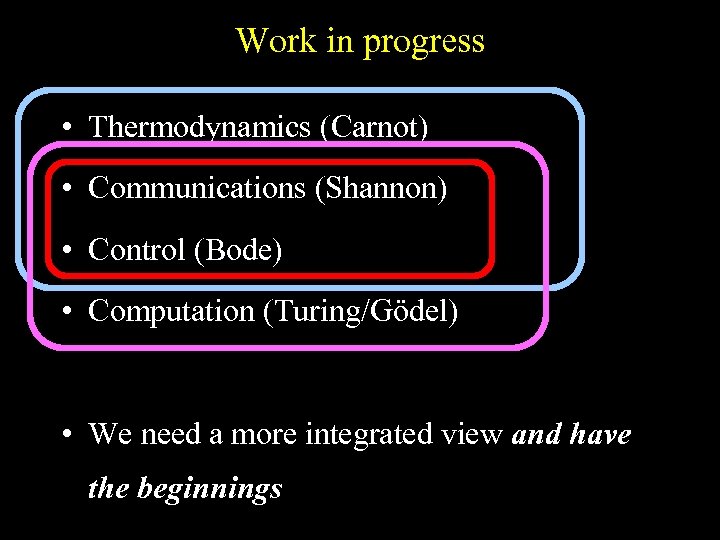
Work in progress • Thermodynamics (Carnot) • Communications (Shannon) • Control (Bode) • Computation (Turing/Gödel) • We need a more integrated view and have the beginnings
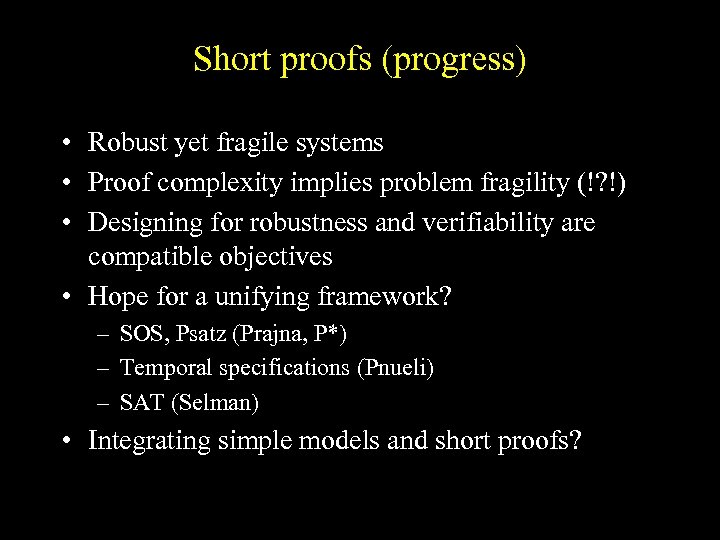
Short proofs (progress) • Robust yet fragile systems • Proof complexity implies problem fragility (!? !) • Designing for robustness and verifiability are compatible objectives • Hope for a unifying framework? – SOS, Psatz (Prajna, P*) – Temporal specifications (Pnueli) – SAT (Selman) • Integrating simple models and short proofs?
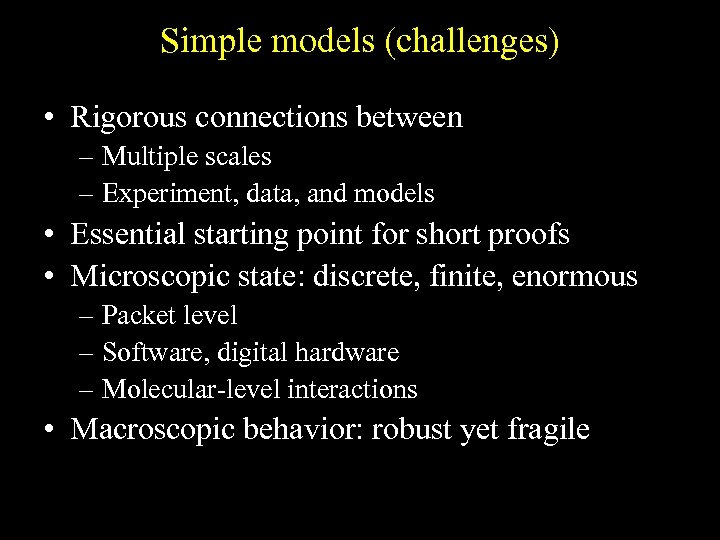
Simple models (challenges) • Rigorous connections between – Multiple scales – Experiment, data, and models • Essential starting point for short proofs • Microscopic state: discrete, finite, enormous – Packet level – Software, digital hardware – Molecular-level interactions • Macroscopic behavior: robust yet fragile
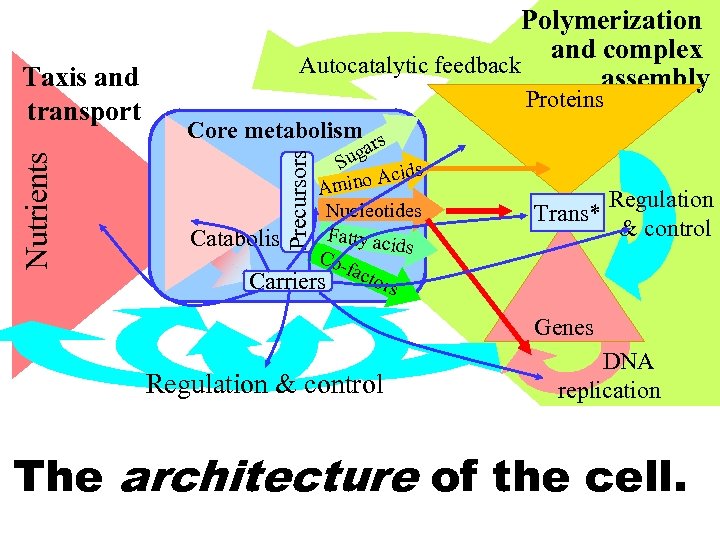
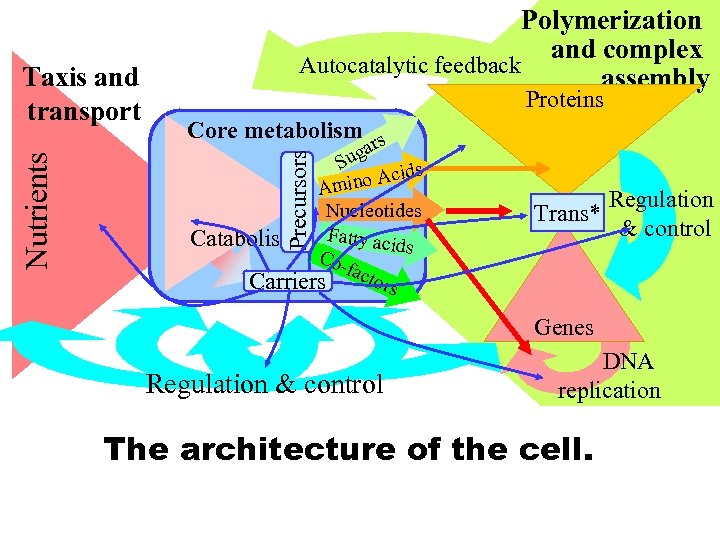
Proteins Core metabolism s ar g Su ids ino Ac Am Nucleotides Catabolism Fatty acids Cofact ors Carriers Precursors Nutrients Taxis and transport Polymerization and complex Autocatalytic feedback assembly Regulation Trans* & control Genes Regulation & control DNA replication The architecture of the cell.
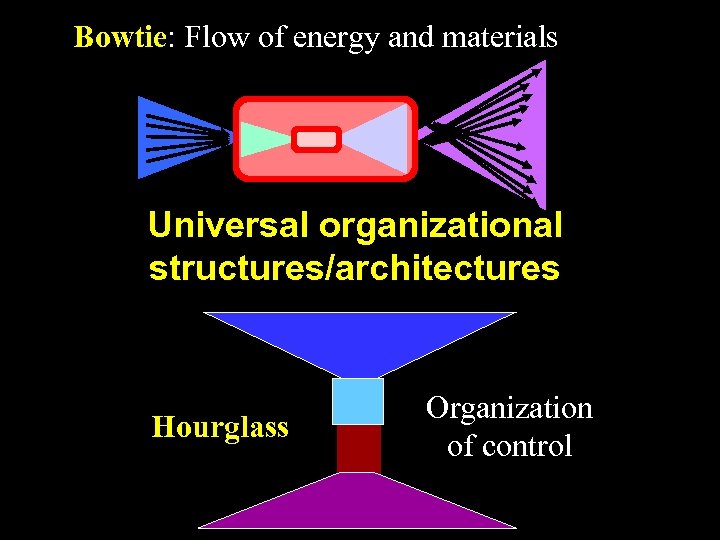
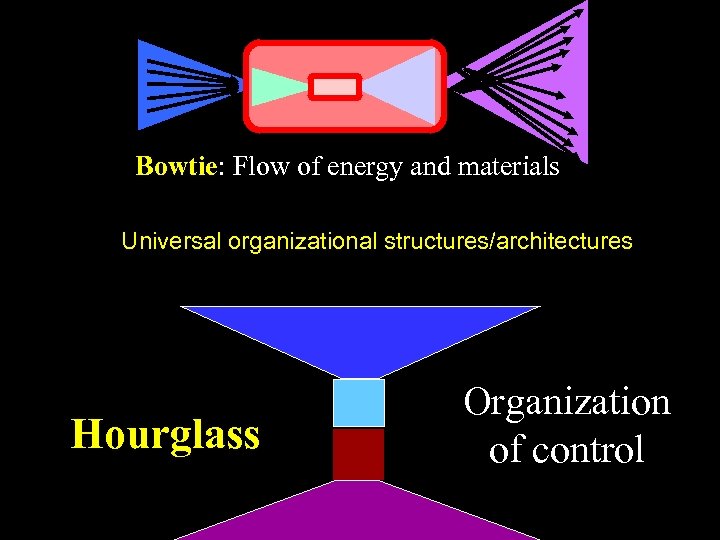
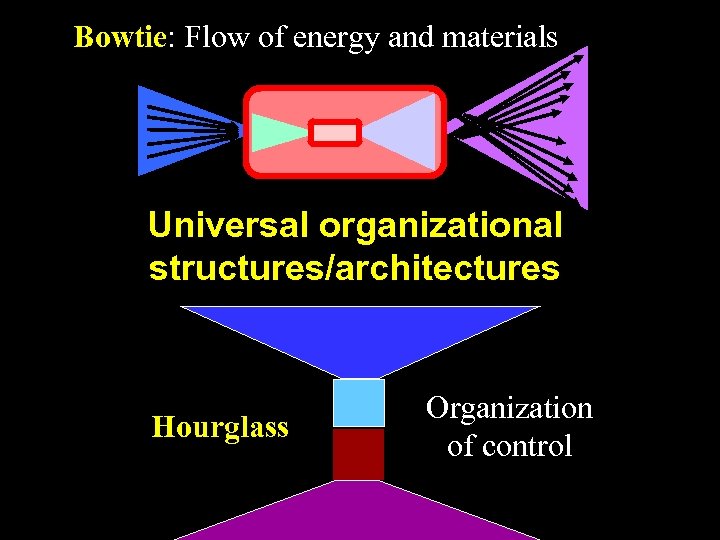
Bowtie: Flow of energy and materials Universal organizational structures/architectures Hourglass Organization of control
Proteins Core metabolism s ar g Su ids ino Ac Am Nucleotides Catabolism Fatty acids Cofact ors Carriers Precursors Nutrients Taxis and transport Polymerization and complex Autocatalytic feedback assembly Regulation Trans* & control Genes Regulation & control DNA replication The architecture of the cell.
Taxis and transport Regulation Trans* & control Nucleotides Catabolism Fatty aci ds Cofact ors Carriers Genes Polymerization and complex Autocatalytic feedback assembly Proteins Precursors Core metabolism Nutrients Regulation & control Taxis and transport g Su Acids Amino Nucleotides Catabolism Fatty aci ds Cofa Carriers ctors Regulation Trans* & control Proteins Regulation & control Fatty aci ds Cofact ors Carriers Regulation & control Taxis and transport g Su Acids Amino Nucleotides Catabolism Fatty aci ds Cofa Carriers ctors DNA replication Polymerization and complex Autocatalytic feedback assembly Proteins Regulation Trans* & control rs uga S Acids Amino Nucleotides Catabolism Fatty aci ds Cofa Carriers ctors Genes Regulation & control Regulation Trans* & control Core metabolism ars Genes DNA replication Nucleotides Catabolism Genes DNA replication Polymerization and complex Autocatalytic feedback assembly Core metabolism ars Nutrients Taxis and transport s gar Su s o Acid Amin Genes DNA replication Precursors Regulation & control Regulation Trans* & control Precursors Fatty aci ds Cofact ors Carriers Nutrients Nucleotides Catabolism s gar Su s o Acid Amin Proteins Core metabolism Nutrients s gar Su s o Acid Amin Taxis and transport Core metabolism Nutrients Precursors Nutrients Core metabolism Proteins Polymerization and complex Autocatalytic feedback assembly Precursors Taxis and transport Polymerization and complex Autocatalytic feedback assembly DNA replication Regulation & control Multicellularity Regulation Trans* & control Genes Regulation & control DNA replication
Robustness: Efficient and flexible metabolism Fragility: Obesity and diabetes Cell Glucose and Oxygen Transport Cell Cell Autocatalytic and regulatory feedback
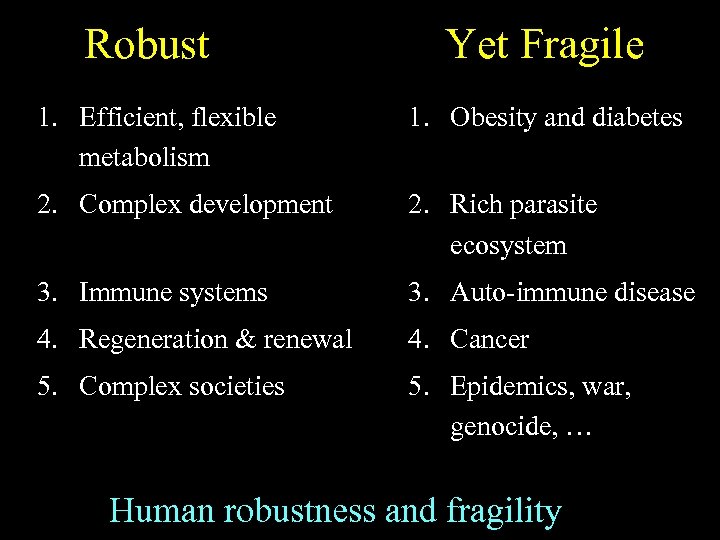
Robust Yet Fragile 1. Efficient, flexible metabolism 1. Obesity and diabetes and 2. Complex development and 2. Rich parasite ecosystem 3. Immune systems 3. Auto-immune disease 4. Regeneration & renewal 4. Cancer 5. Complex societies 5. Epidemics, war, genocide, … Human robustness and fragility
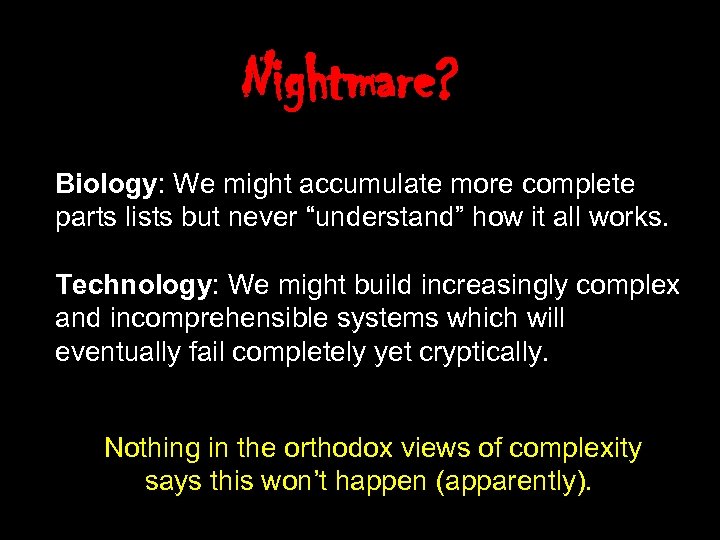
Nightmare? Biology: We might accumulate more complete parts lists but never “understand” how it all works. Technology: We might build increasingly complex and incomprehensible systems which will eventually fail completely yet cryptically. Nothing in the orthodox views of complexity says this won’t happen (apparently).
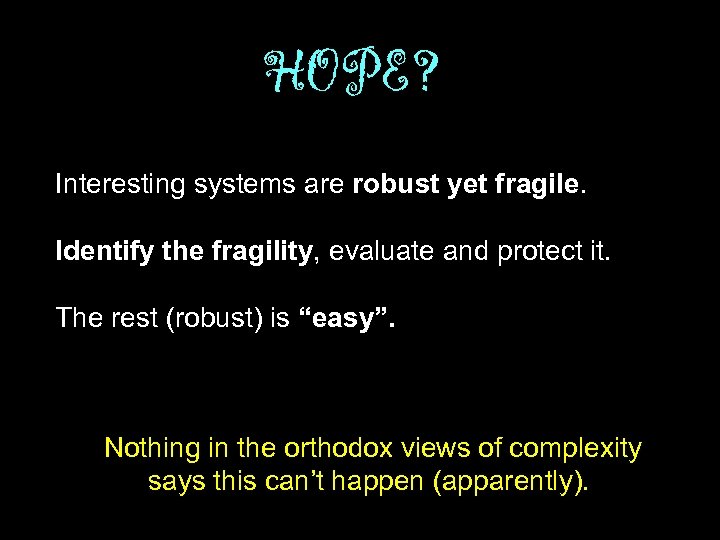
HOPE? Interesting systems are robust yet fragile. Identify the fragility, evaluate and protect it. The rest (robust) is “easy”. Nothing in the orthodox views of complexity says this can’t happen (apparently).
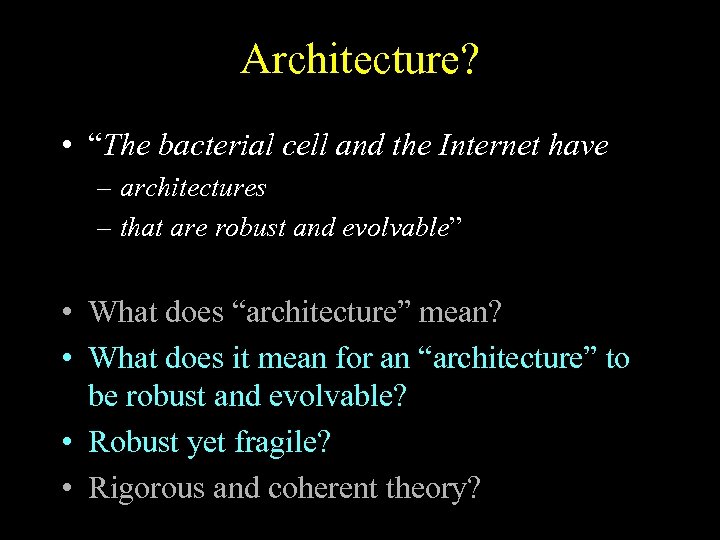
Architecture? • “The bacterial cell and the Internet have – architectures – that are robust and evolvable” • What does “architecture” mean? • What does it mean for an “architecture” to be robust and evolvable? • Robust yet fragile? • Rigorous and coherent theory?
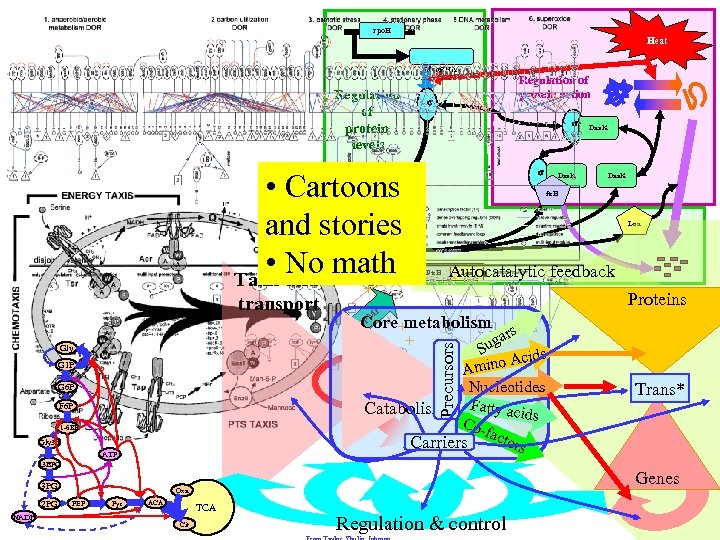
rpo. H Heat m. RNA Regulation of protein levels Regulation of protein action • Cartoons and stories • No math + Taxis and RNAP + fts. H Lon Fts. H Autocatalytic feedback Lon Proteins F PM Core+ metabolism G 1 P G 6 P F 1 -6 BP Gly 3 p ATP Precursors rs uga S ids ino Ac Am Nucleotides Catabolism Fatty acids Cofact ors Carriers + Gly 13 BPG 3 PG 2 PG NADH Pyr ACA TCA Cit Trans* Genes Oxa PEP Dna. K RNAP Dna. K transport Dna. K Regulation & control
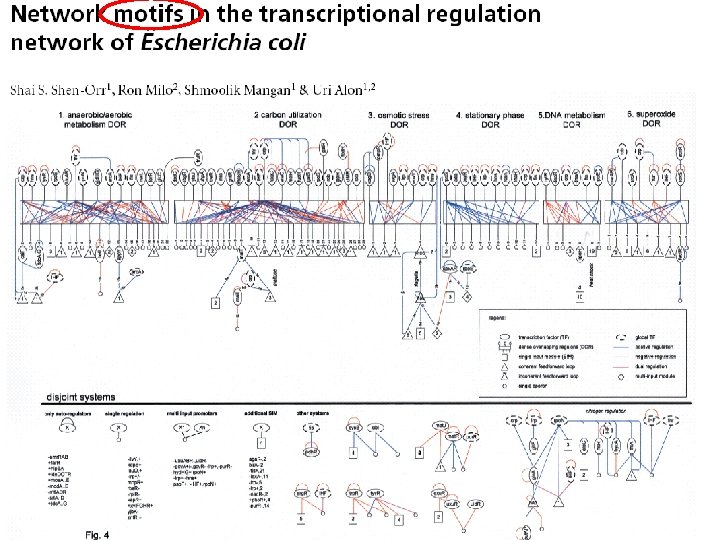
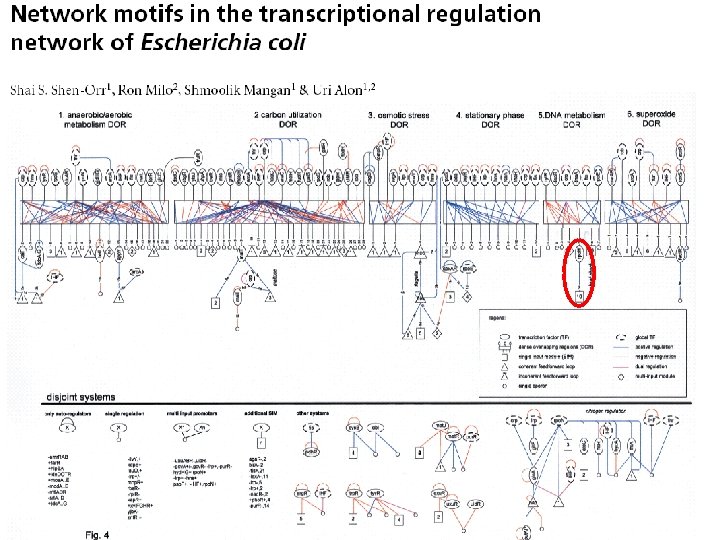
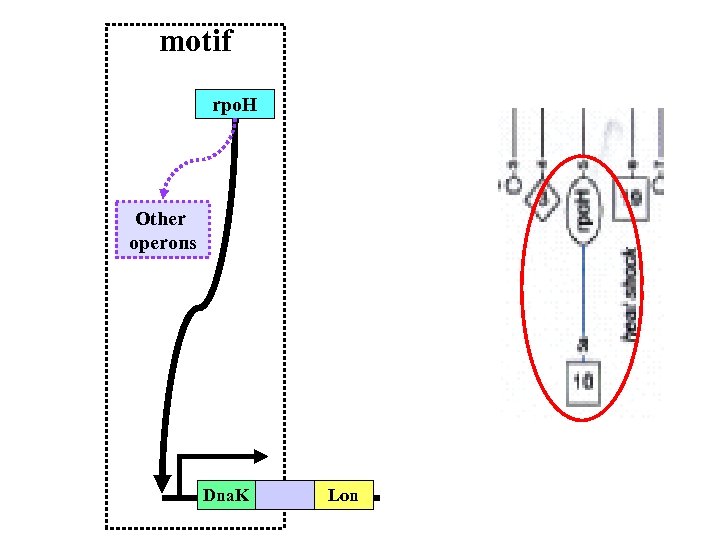
motif rpo. H Other operons Dna. K Lon
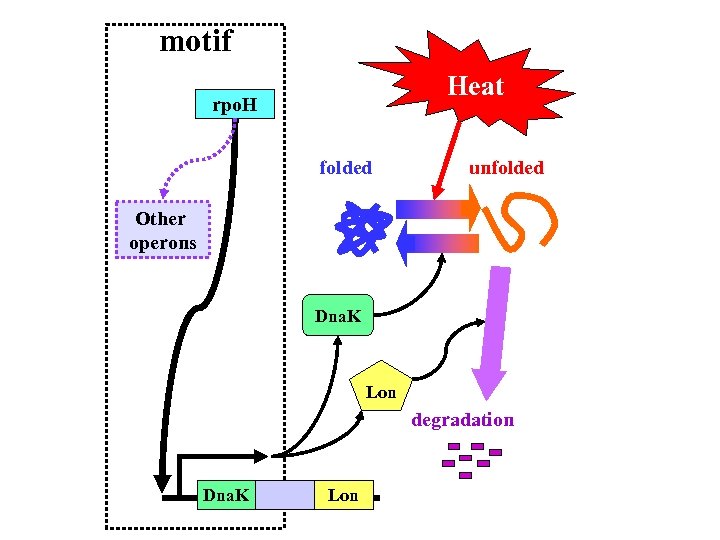
motif Heat rpo. H folded unfolded Other operons Dna. K Lon degradation Dna. K Lon
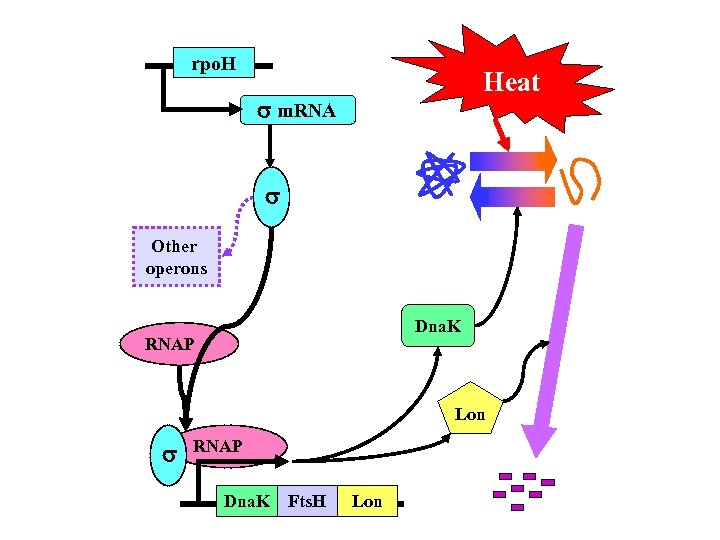
rpo. H Heat m. RNA Other operons Dna. K RNAP Lon RNAP Dna. K Fts. H Lon
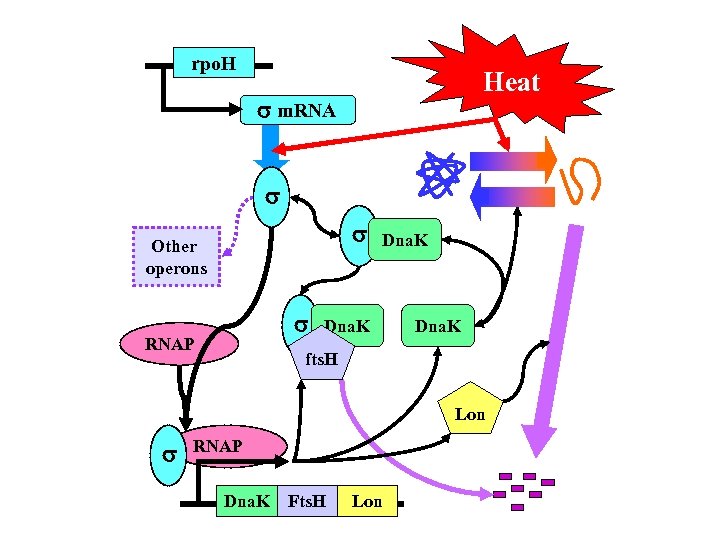
rpo. H Heat m. RNA Other operons RNAP Dna. K fts. H Lon RNAP Dna. K Fts. H Lon
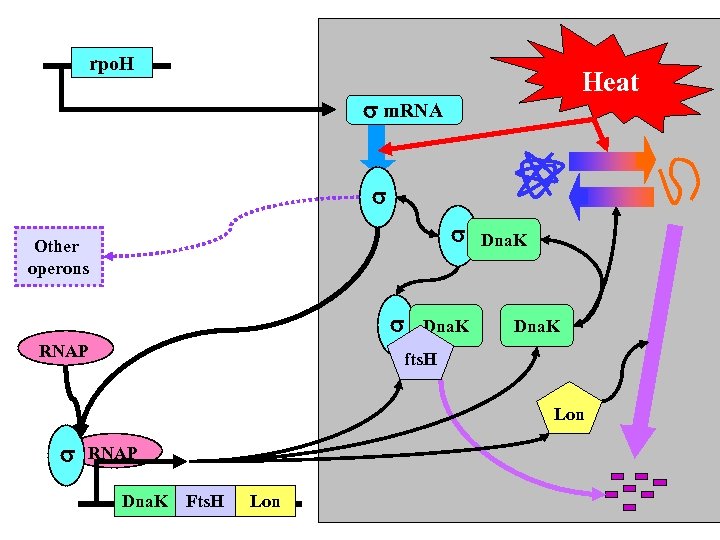
rpo. H Heat m. RNA Other operons RNAP Dna. K fts. H Lon RNAP Dna. K Fts. H Lon
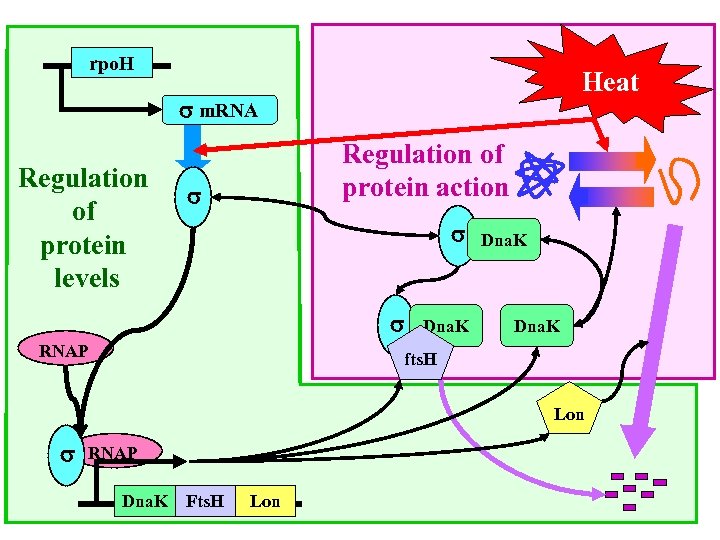
rpo. H Heat m. RNA Regulation of protein levels Regulation of protein action RNAP Dna. K fts. H Lon RNAP Dna. K Fts. H Lon
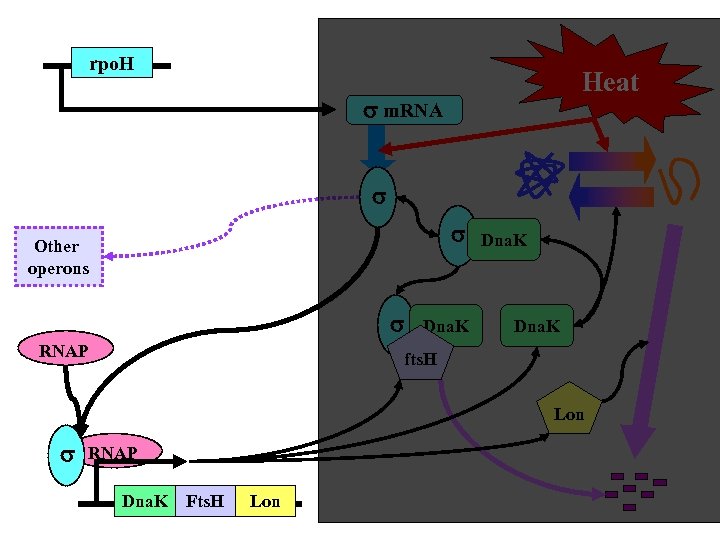
rpo. H Heat m. RNA Other operons RNAP Dna. K fts. H Lon RNAP Dna. K Fts. H Lon
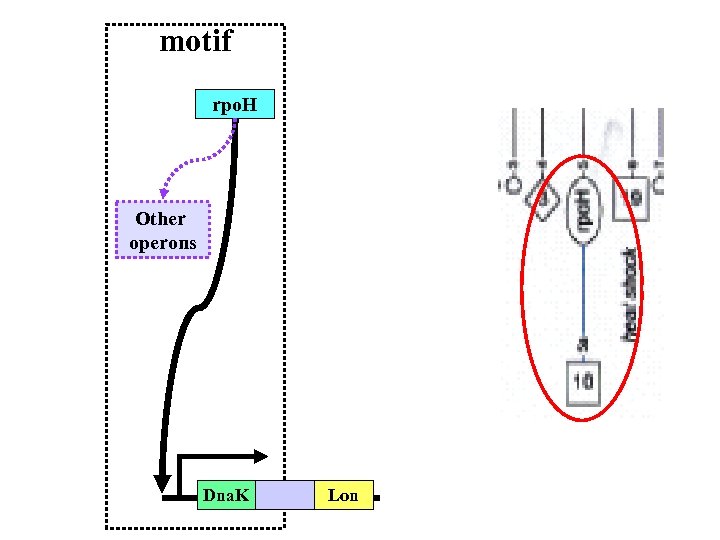
motif rpo. H Other operons Dna. K Lon
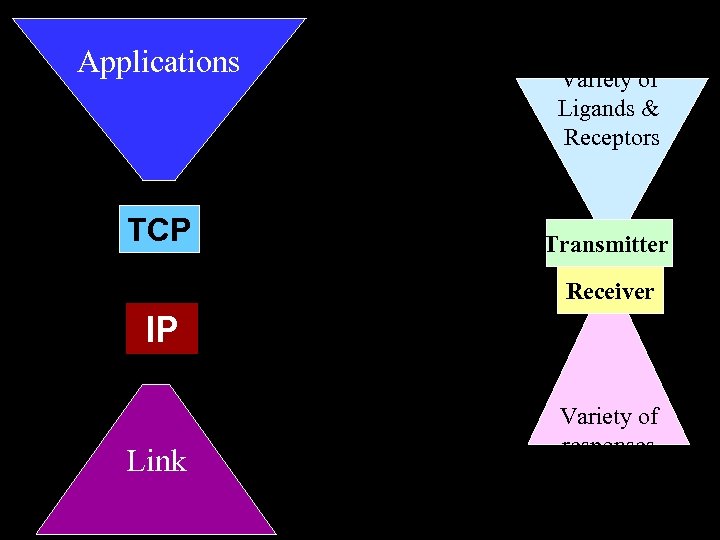
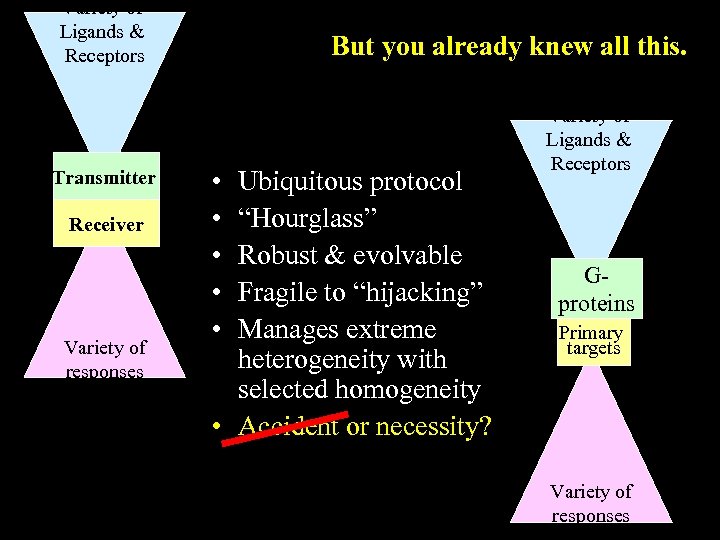
Variety of Ligands & Receptors Transmitter Receiver • • • Ubiquitous protocol “Hourglass” “Robust yet fragile” Robust & evolvable Fragile to “hijacking” Manages extreme heterogeneity with selected homogeneity • Accident or necessity? Variety of responses Signal transduction Variety of Ligands & Receptors Gproteins Primary targets Variety of responses
Bio: Huge variety of environments, metabolisms Universal control architecture Allosteric regulation Regulation of enzyme levels Huge variety of genomes Huge variety of components
The Internet hourglass Applications Web FTP Mail Ethernet 802. 11 News Video Power lines ATM Audio Optical Link technologies ping napster Satellite Bluetooth
The Internet hourglass Applications Web FTP Mail News Video Audio ping napster TCP IP Ethernet 802. 11 Power lines ATM Optical Link technologies Satellite Bluetooth
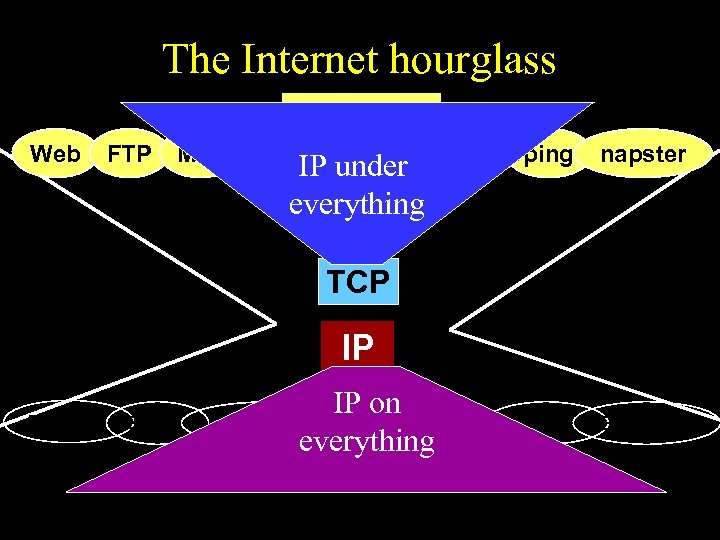
The Internet hourglass Applications Web FTP Mail News Video IP under Audio everything ping napster TCP IP Ethernet 802. 11 IP on Power lines ATM Optical everything Link technologies Satellite Bluetooth
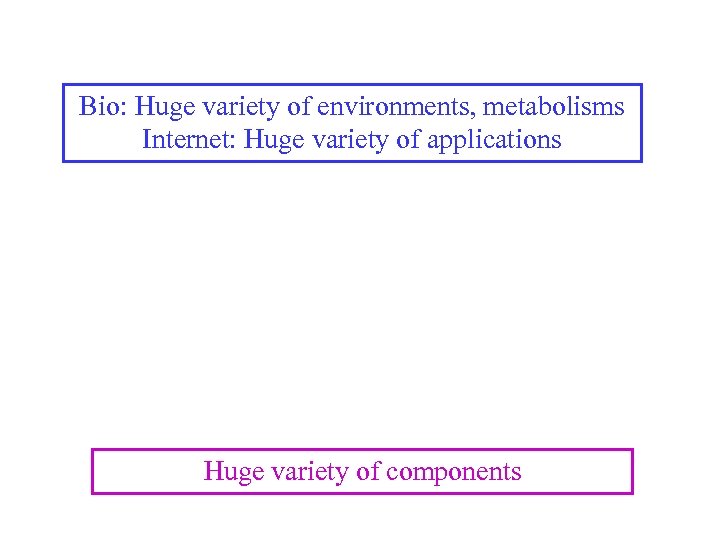
Bio: Huge variety of environments, metabolisms Internet: Huge variety of applications Huge variety of components
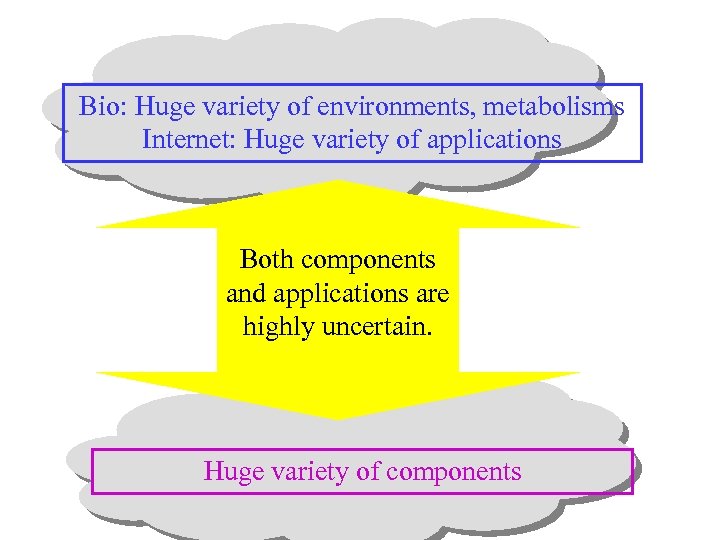
Bio: Huge variety of environments, metabolisms Internet: Huge variety of applications Both components and applications are highly uncertain. Huge variety of components
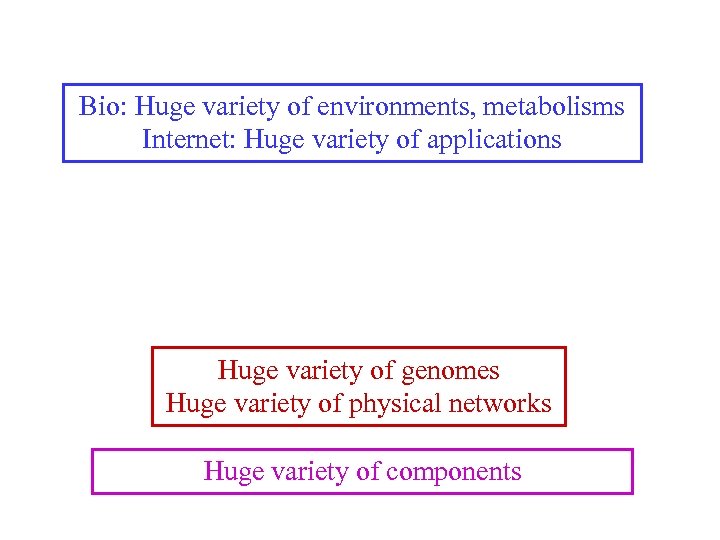
Bio: Huge variety of environments, metabolisms Internet: Huge variety of applications Huge variety of genomes Huge variety of physical networks Huge variety of components
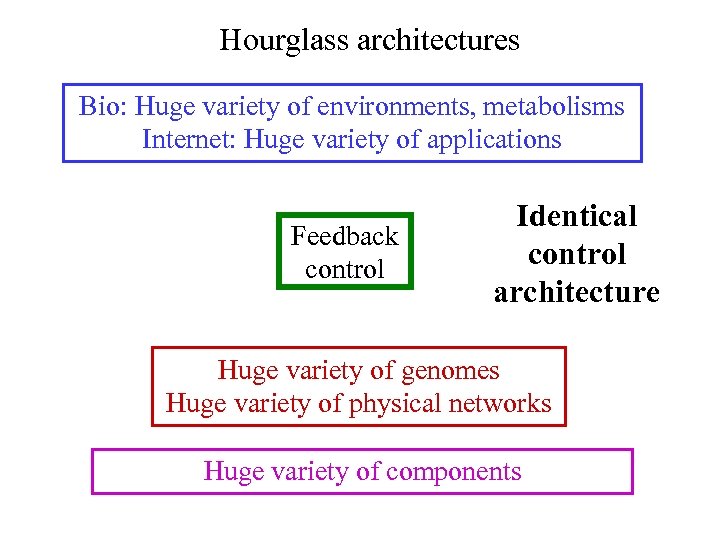
Hourglass architectures Bio: Huge variety of environments, metabolisms Internet: Huge variety of applications Feedback control Identical control architecture Huge variety of genomes Huge variety of physical networks Huge variety of components
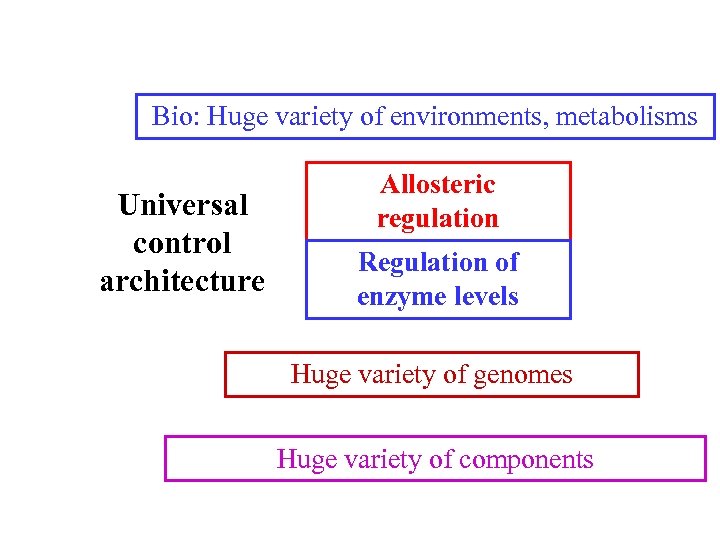
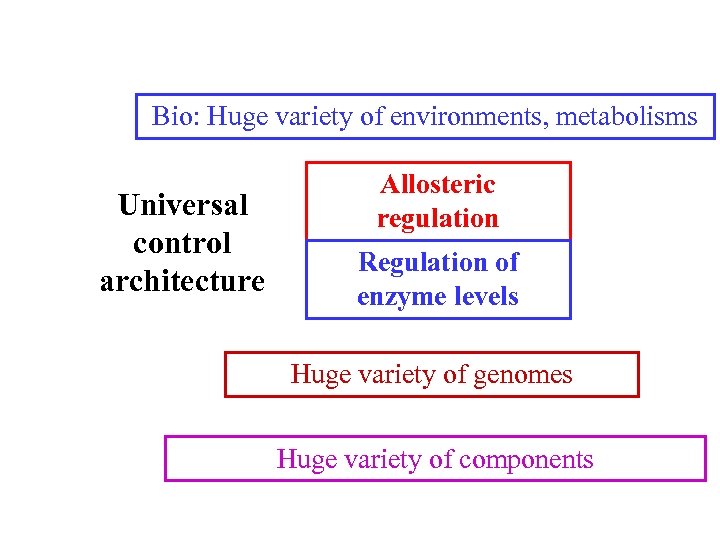
Bio: Huge variety of environments, metabolisms Universal control architecture Allosteric regulation Regulation of enzyme levels Huge variety of genomes Huge variety of components
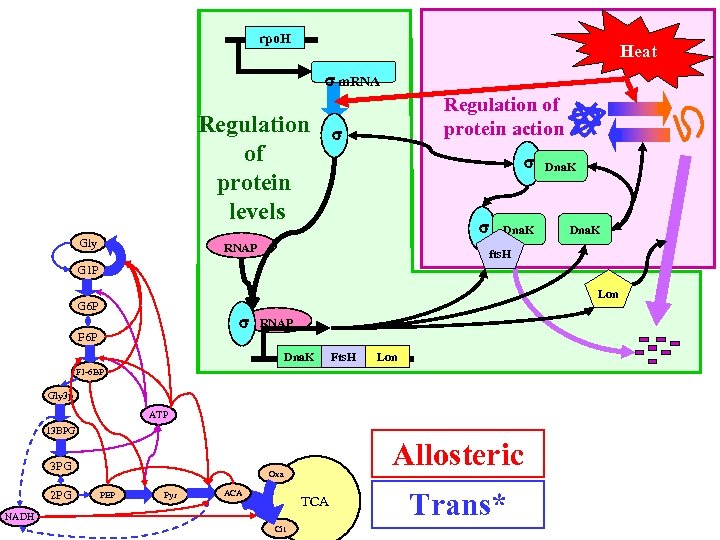
rpo. H Heat m. RNA Regulation of protein levels Gly Regulation of protein action RNAP Dna. K fts. H G 1 P Lon G 6 P F 6 P RNAP Dna. K Fts. H Lon F 1 -6 BP Gly 3 p ATP 13 BPG 3 PG 2 PG Allosteric Oxa PEP Pyr ACA TCA NADH Cit Trans*
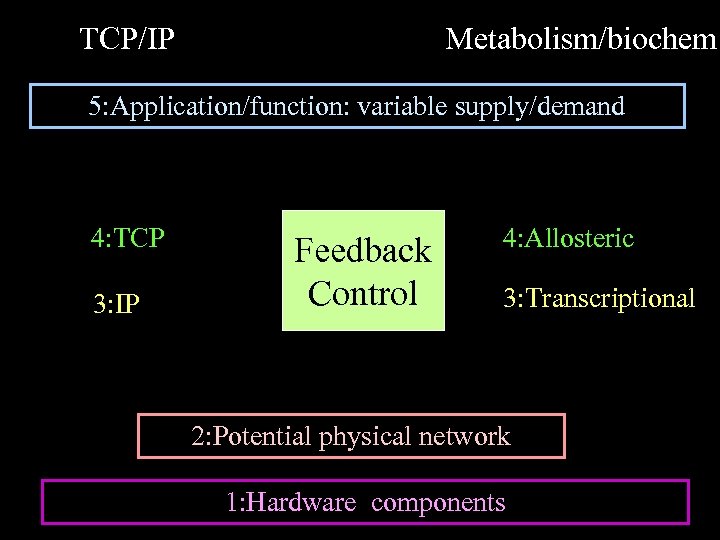
TCP/IP Metabolism/biochem 5: Application/function: variable supply/demand 4: TCP 3: IP Feedback Control 4: Allosteric 3: Transcriptional 2: Potential physical network 1: Hardware components
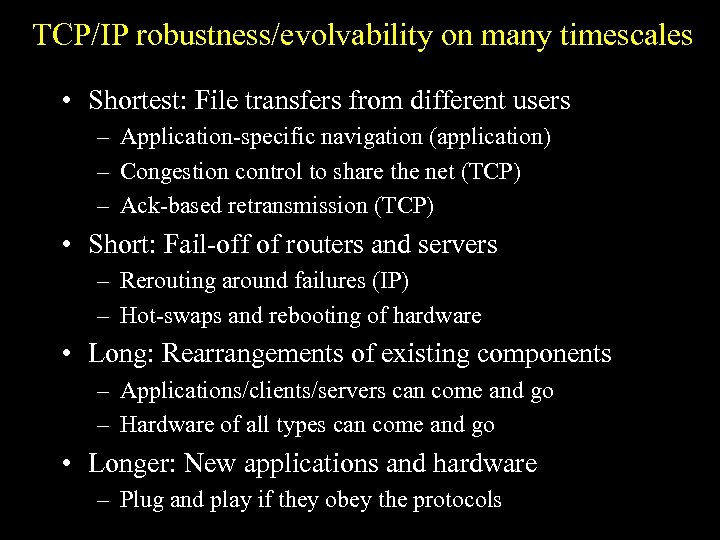
TCP/IP robustness/evolvability on many timescales • Shortest: File transfers from different users – Application-specific navigation (application) – Congestion control to share the net (TCP) – Ack-based retransmission (TCP) • Short: Fail-off of routers and servers – Rerouting around failures (IP) – Hot-swaps and rebooting of hardware • Long: Rearrangements of existing components – Applications/clients/servers can come and go – Hardware of all types can come and go • Longer: New applications and hardware – Plug and play if they obey the protocols
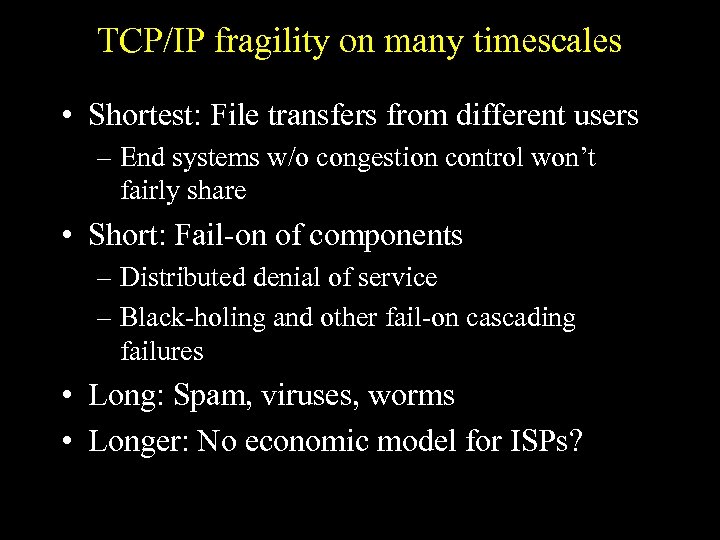
TCP/IP fragility on many timescales • Shortest: File transfers from different users – End systems w/o congestion control won’t fairly share • Short: Fail-on of components – Distributed denial of service – Black-holing and other fail-on cascading failures • Long: Spam, viruses, worms • Longer: No economic model for ISPs?
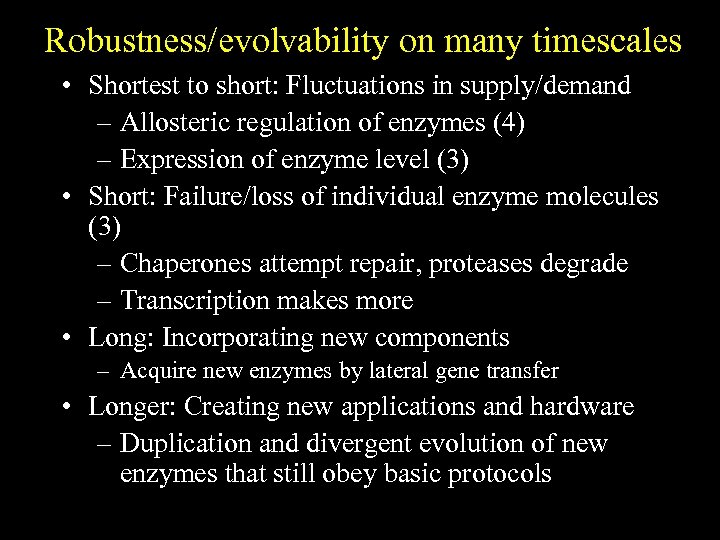
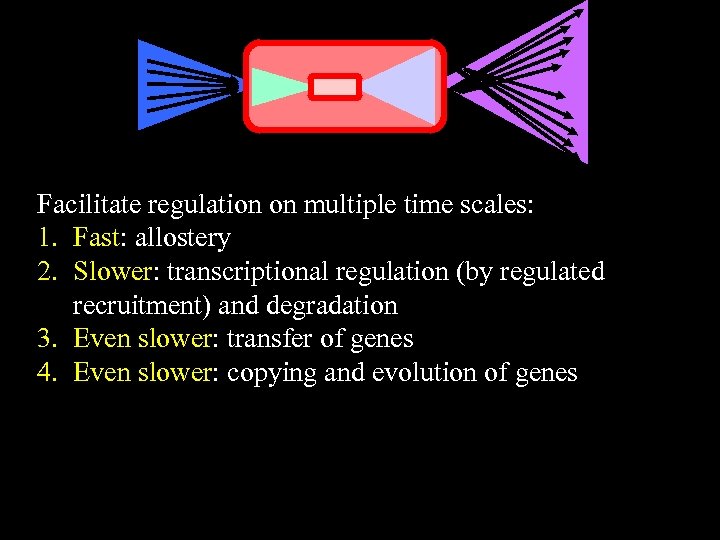
Robustness/evolvability on many timescales • Shortest to short: Fluctuations in supply/demand – Allosteric regulation of enzymes (4) – Expression of enzyme level (3) • Short: Failure/loss of individual enzyme molecules (3) – Chaperones attempt repair, proteases degrade – Transcription makes more • Long: Incorporating new components – Acquire new enzymes by lateral gene transfer • Longer: Creating new applications and hardware – Duplication and divergent evolution of new enzymes that still obey basic protocols
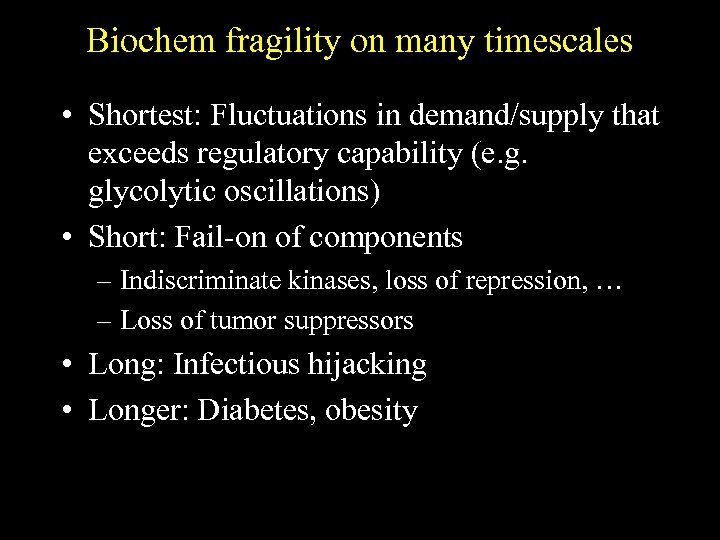
Biochem fragility on many timescales • Shortest: Fluctuations in demand/supply that exceeds regulatory capability (e. g. glycolytic oscillations) • Short: Fail-on of components – Indiscriminate kinases, loss of repression, … – Loss of tumor suppressors • Long: Infectious hijacking • Longer: Diabetes, obesity
Robust yet fragile (RYF) • The same mechanisms responsible for robustness to most perturbations • Allows possible extreme fragilities to others • Usually involving hijacking the robustness mechanism in some way • High variability (and thus power laws)
Experimental (and network) biology • Laws: Conservation of energy and matter • Modules: Pipettes, Petri dishes, PCR machines, microscopes, … • Protocols: Rules and recipes by which modules interact to create function • All 3 must be understood. • Laws are immutable • Protocols are more important than modules
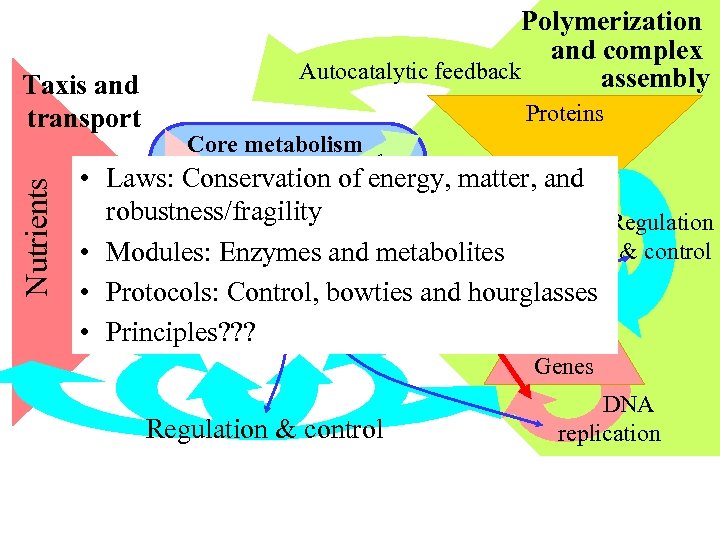
• Proteins Core metabolism s gar Laws: Conservation of energy, matter, and Su ids ino Ac robustness/fragility. Am Regulation Nucleotides Trans* & control Modules: Enzymes and metabolites Catabolism Fatty acid s Co. Protocols: Control, bowties and hourglasses fact ors Carriers • • • Principles? ? ? Precursors Nutrients Taxis and transport Polymerization and complex Autocatalytic feedback assembly Genes Regulation & control DNA replication
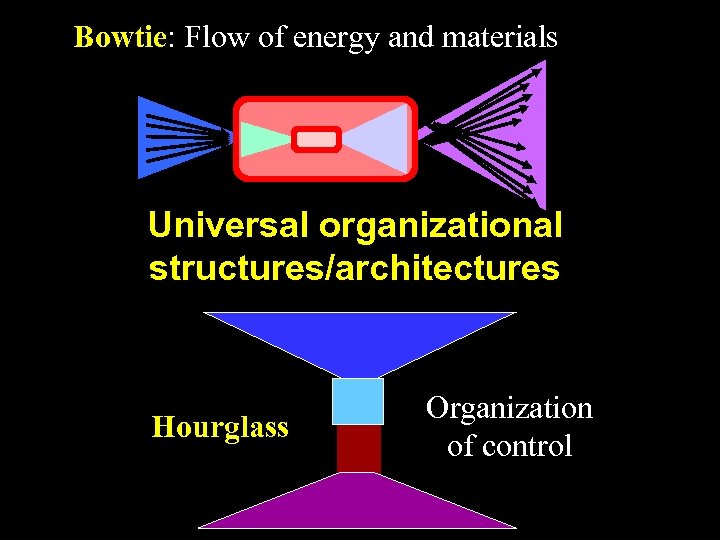
Bowtie: Flow of energy and materials Universal organizational structures/architectures Hourglass Organization of control
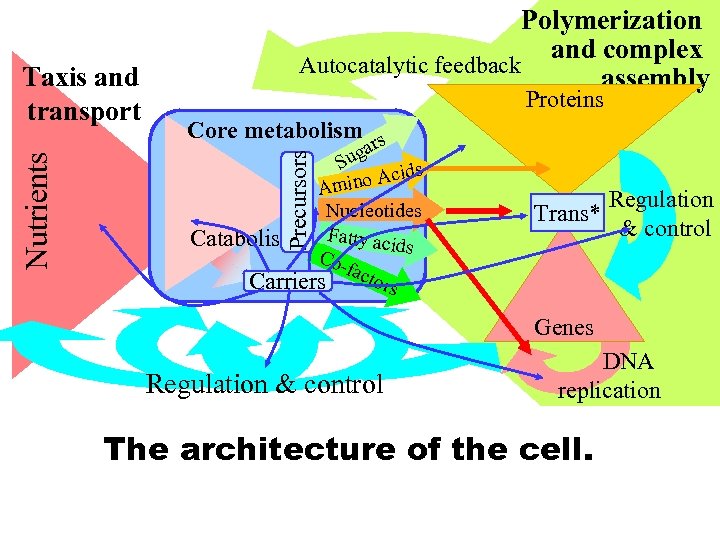
Proteins Core metabolism s ar g Su ids ino Ac Am Nucleotides Catabolism Fatty acids Cofact ors Carriers Precursors Nutrients Taxis and transport Polymerization and complex Autocatalytic feedback assembly Regulation Trans* & control Genes Regulation & control DNA replication The architecture of the cell.
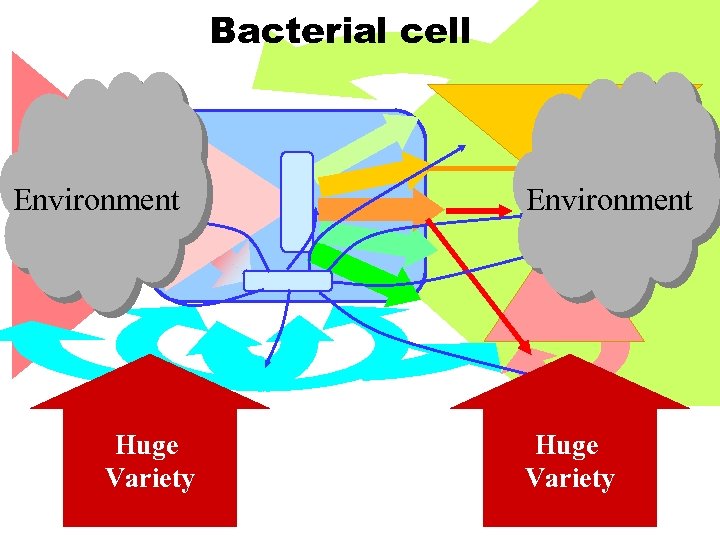
Bacterial cell Environment Huge Variety
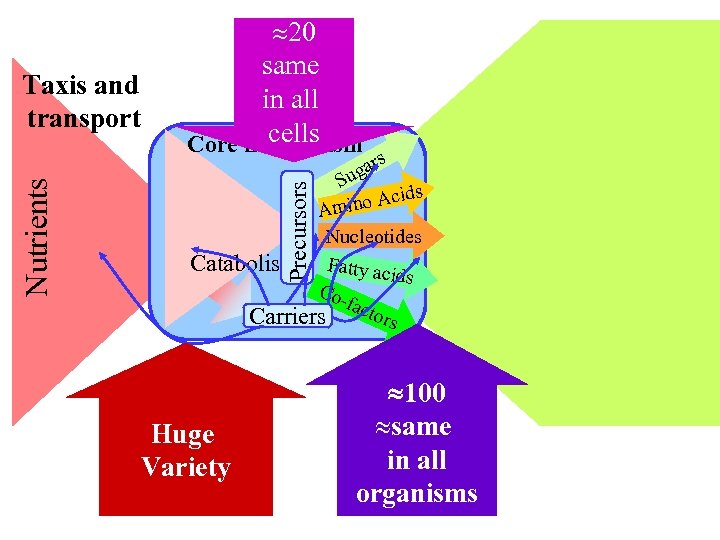
Precursors Nutrients Taxis and transport 20 same in all cells Core metabolism s gar Su ids ino Ac m A Nucleotides Catabolism Fatty acid s Cofact ors Carriers Huge Variety 100 same in all organisms
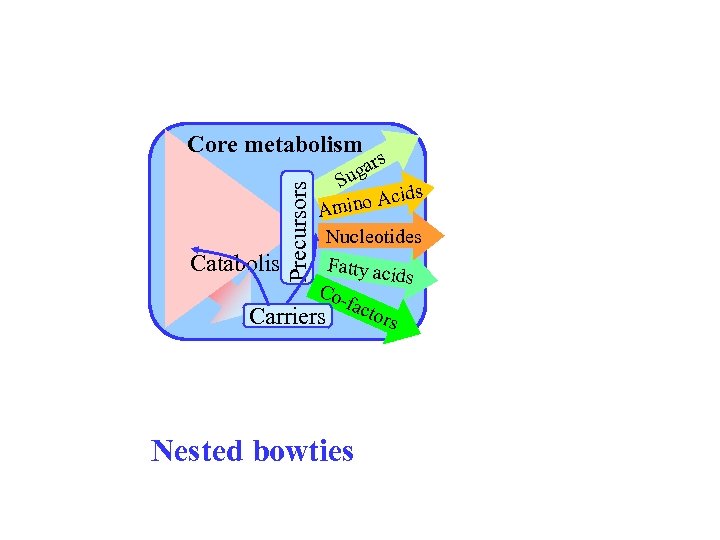
Precursors Core metabolism s gar Su ids ino Ac m A Nucleotides Catabolism Fatty acid s Cofact ors Carriers Nested bowties
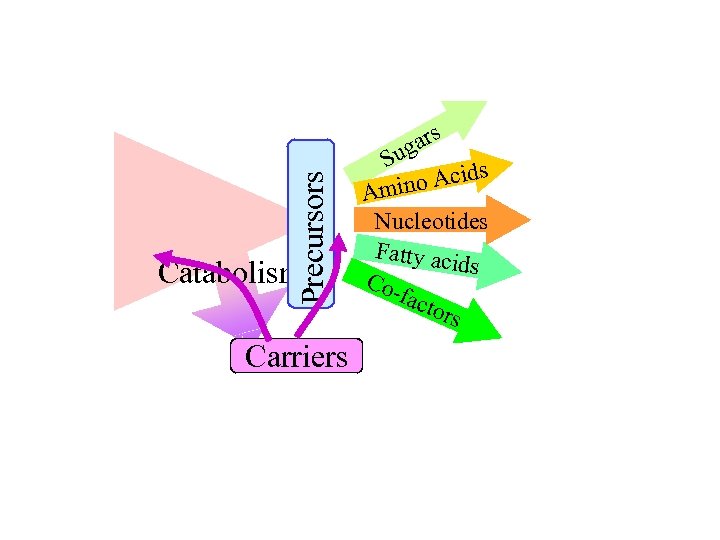
Precursors Catabolism Carriers s gar Su s o Acid Amin Nucleotides Fatty aci ds Cofact ors
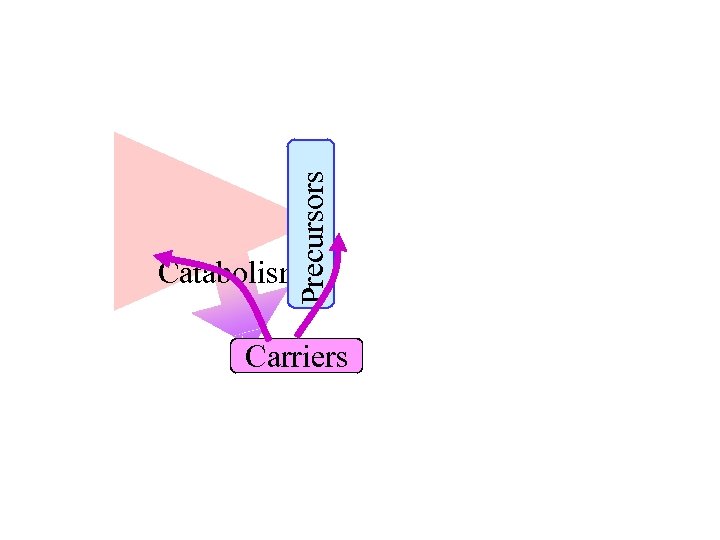
Precursors Catabolism Carriers
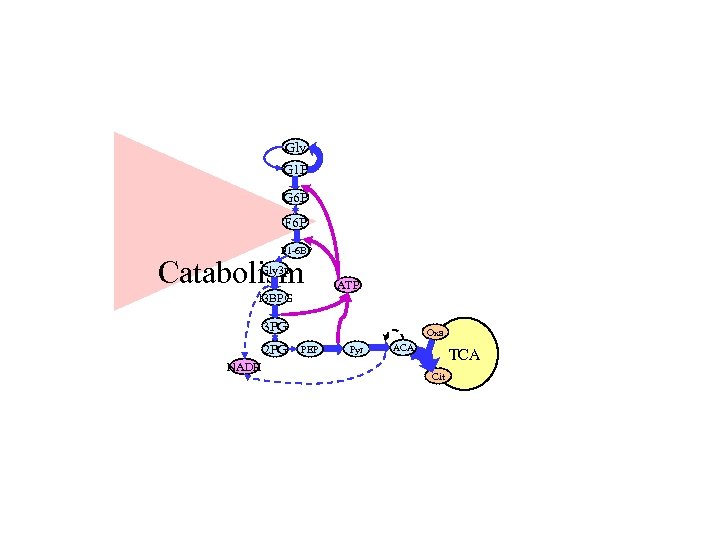
Gly G 1 P G 6 P F 1 -6 BP Catabolism Gly 3 p 13 BPG ATP 3 PG 2 PG NADH Oxa PEP Pyr ACA TCA Cit
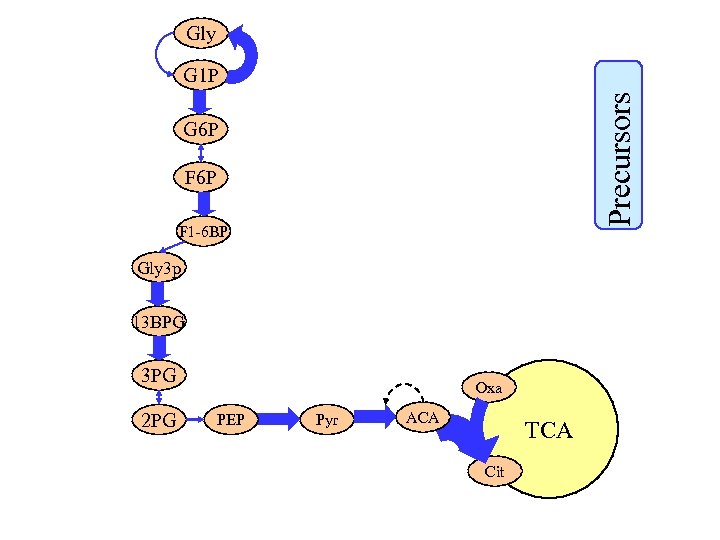
Gly Precursors G 1 P G 6 P F 1 -6 BP Gly 3 p 13 BPG 3 PG 2 PG Oxa PEP Pyr ACA TCA Cit
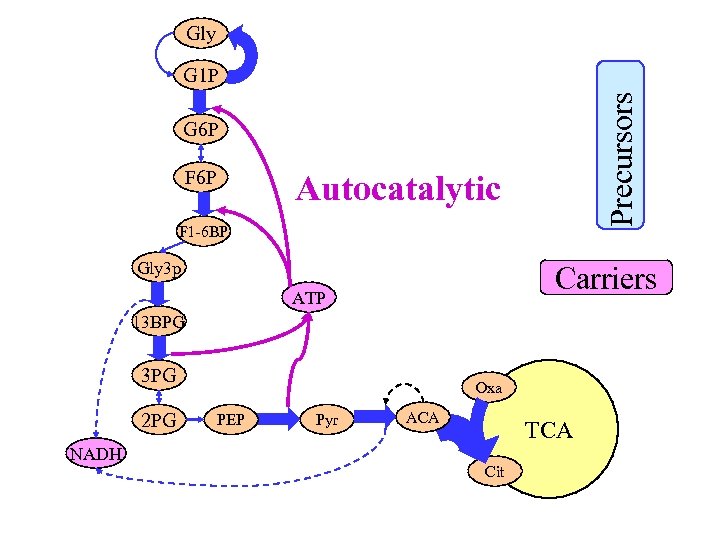
Gly Precursors G 1 P G 6 P F 6 P Autocatalytic F 1 -6 BP Gly 3 p Carriers ATP 13 BPG 3 PG 2 PG NADH Oxa PEP Pyr ACA TCA Cit
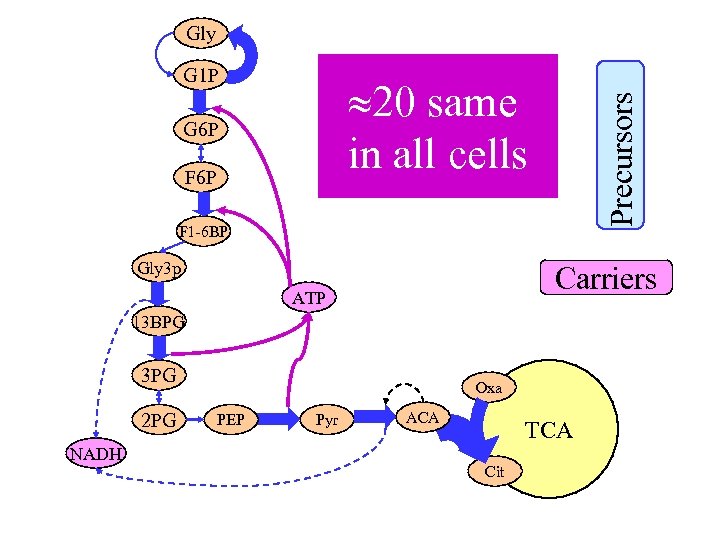
Gly G 1 P G 6 P F 6 P Precursors 20 same in all cells F 1 -6 BP Gly 3 p Carriers ATP 13 BPG 3 PG 2 PG NADH Oxa PEP Pyr ACA TCA Cit
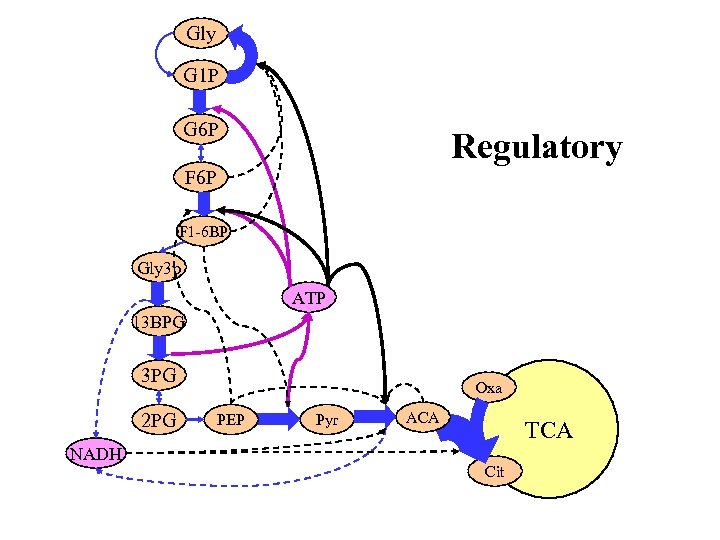
Gly G 1 P G 6 P Regulatory F 6 P F 1 -6 BP Gly 3 p ATP 13 BPG 3 PG 2 PG NADH Oxa PEP Pyr ACA TCA Cit
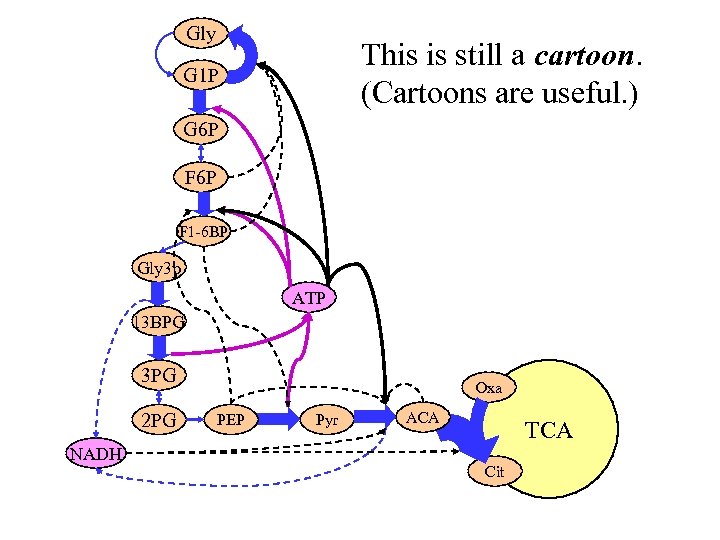
Gly This is still a cartoon. (Cartoons are useful. ) G 1 P G 6 P F 1 -6 BP Gly 3 p ATP 13 BPG 3 PG 2 PG NADH Oxa PEP Pyr ACA TCA Cit
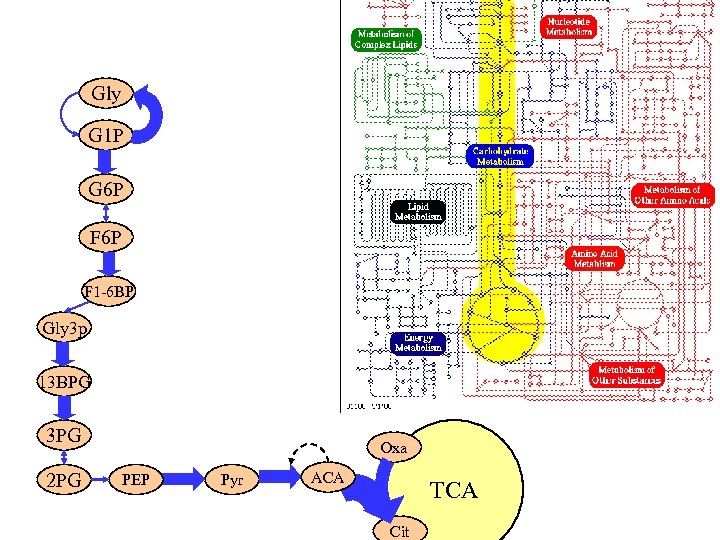
Gly G 1 P G 6 P F 1 -6 BP Gly 3 p 13 BPG 3 PG 2 PG Oxa PEP Pyr ACA TCA Cit
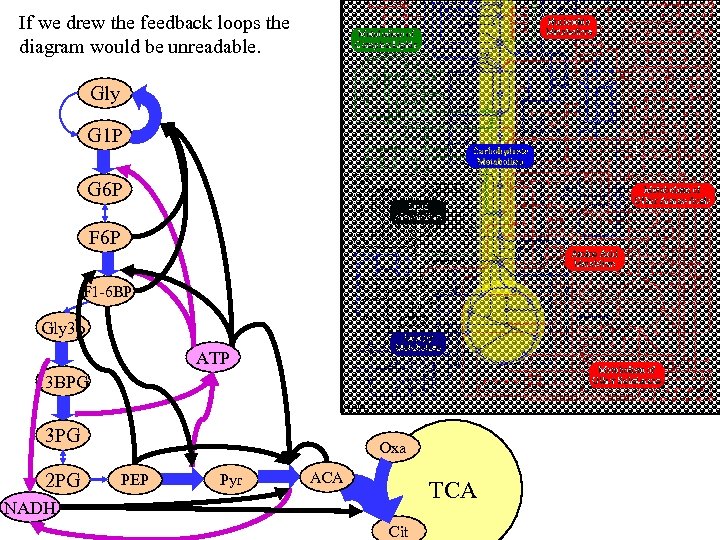
If we drew the feedback loops the diagram would be unreadable. Gly G 1 P G 6 P F 1 -6 BP Gly 3 p ATP 13 BPG 3 PG 2 PG Oxa PEP Pyr ACA TCA NADH Cit
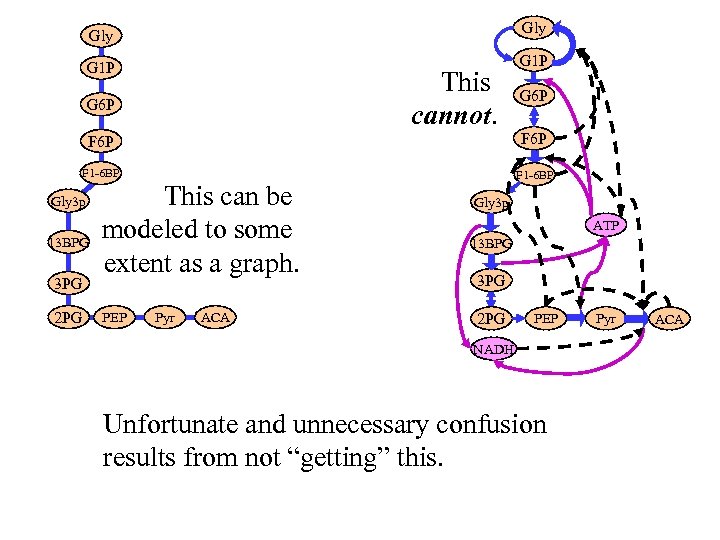
Gly G 1 P This cannot. G 6 P F 1 -6 BP Gly 3 p 13 BPG 3 PG 2 PG This can be modeled to some extent as a graph. PEP Pyr ACA Gly 3 p ATP 13 BPG 3 PG 2 PG PEP NADH Unfortunate and unnecessary confusion results from not “getting” this. Pyr ACA
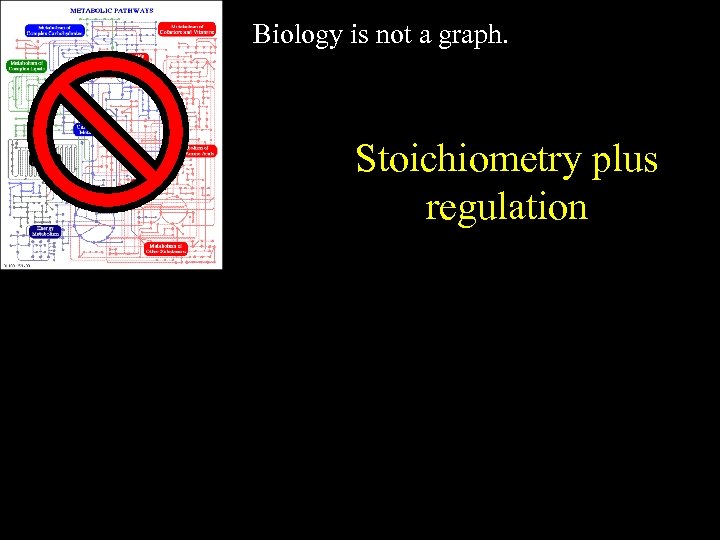
Biology is not a graph. Stoichiometry plus regulation
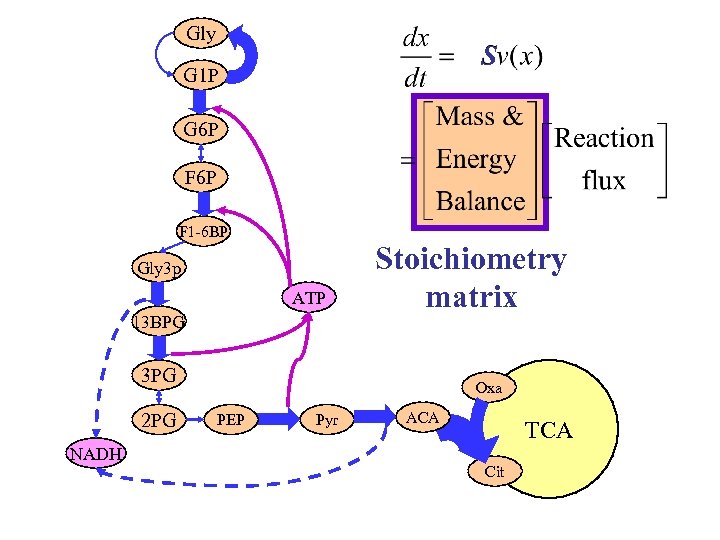
Gly S G 1 P G 6 P F 1 -6 BP Gly 3 p ATP 13 BPG Stoichiometry matrix 3 PG 2 PG NADH Oxa PEP Pyr ACA TCA Cit
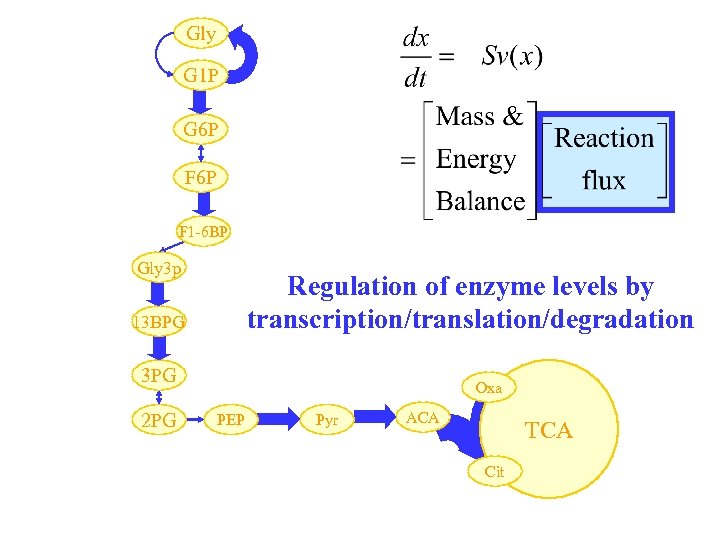
Gly G 1 P G 6 P F 1 -6 BP Gly 3 p Regulation of enzyme levels by transcription/translation/degradation 13 BPG 3 PG 2 PG Oxa PEP Pyr ACA TCA Cit
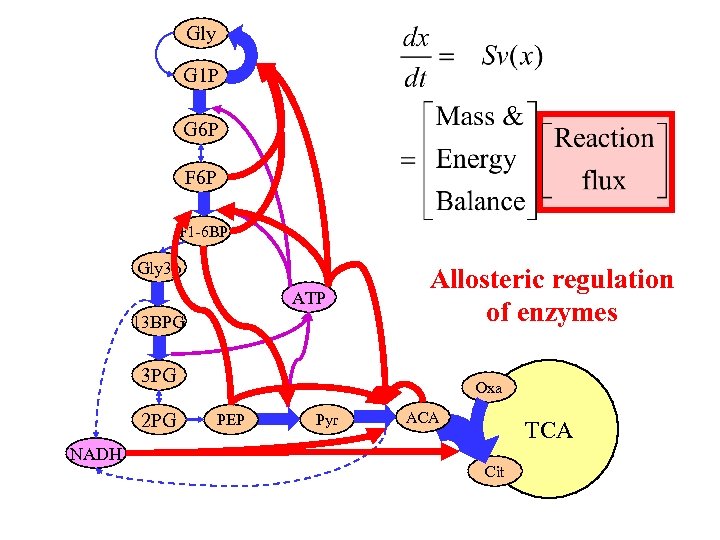
Gly G 1 P G 6 P F 1 -6 BP Gly 3 p ATP 13 BPG Allosteric regulation of enzymes 3 PG 2 PG NADH Oxa PEP Pyr ACA TCA Cit
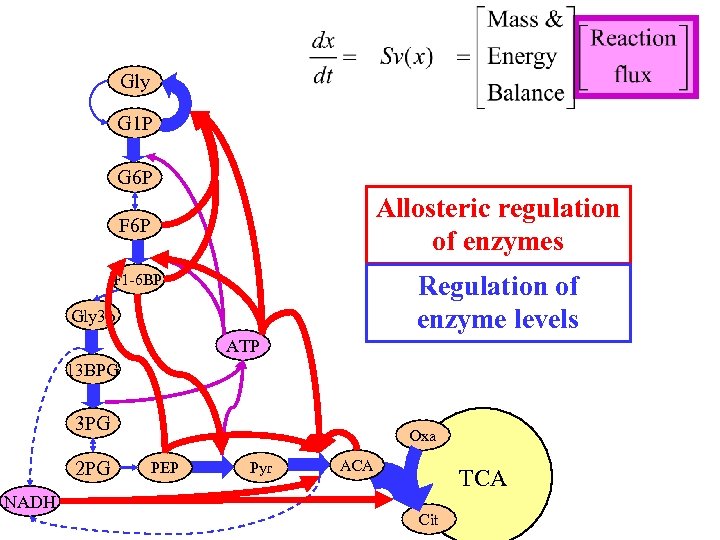
Gly G 1 P G 6 P Allosteric regulation of enzymes F 6 P Regulation of enzyme levels F 1 -6 BP Gly 3 p ATP 13 BPG 3 PG 2 PG NADH Oxa PEP Pyr ACA TCA Cit
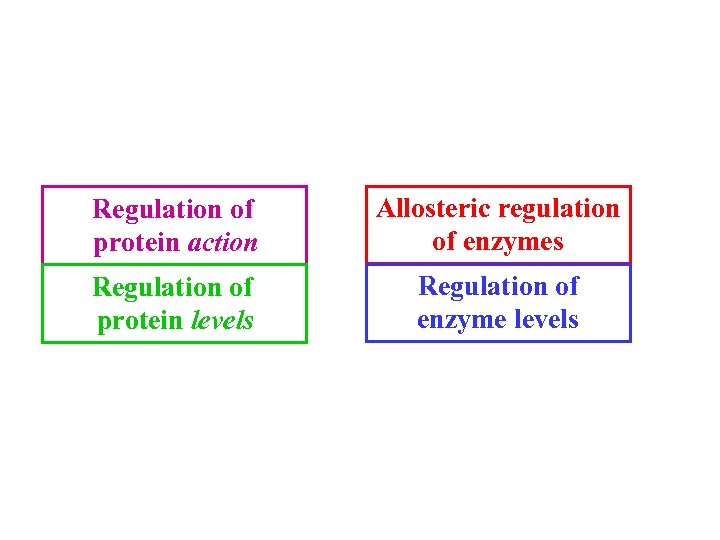
Regulation of protein action Allosteric regulation of enzymes Regulation of protein levels Regulation of enzyme levels
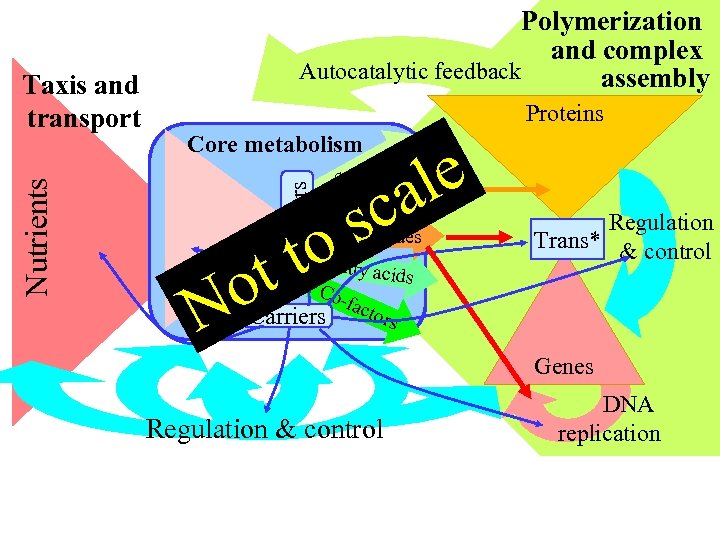
Proteins Core metabolism Precursors Nutrients Taxis and transport Polymerization and complex Autocatalytic feedback assembly le ca s gar Su ids ino Ac m s to A Nucleotides Catabolism Fatty acid s Cofact ors Carriers t o N Regulation Trans* & control Genes Regulation & control DNA replication
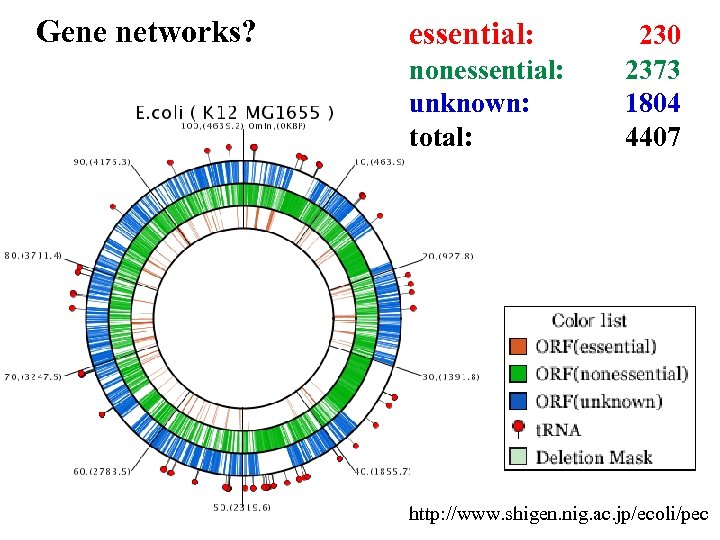
Gene networks? essential: nonessential: unknown: total: 230 2373 1804 4407 http: //www. shigen. nig. ac. jp/ecoli/pec
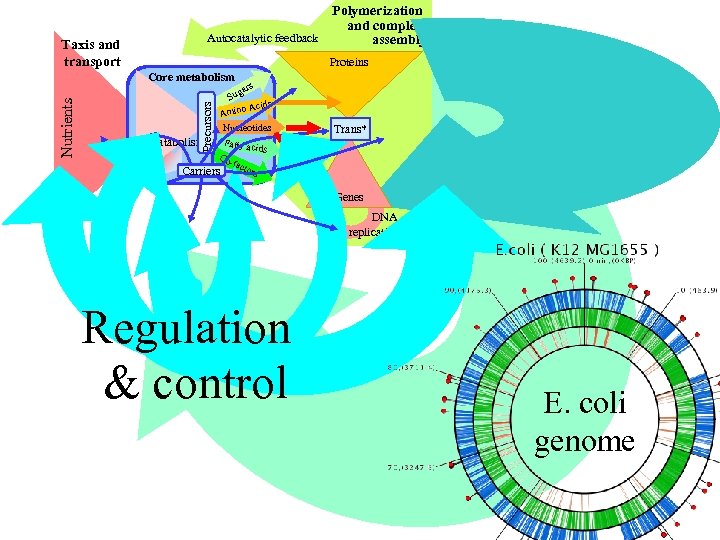
Polymerization and complex Autocatalytic feedback assembly Taxis and transport Proteins Precursors Nutrients Core metabolism s gar Su Acids Amino Nucleotides Catabolism Trans* Fatty acid s Cofact ors Carriers Genes DNA replication Regulation & control E. coli genome
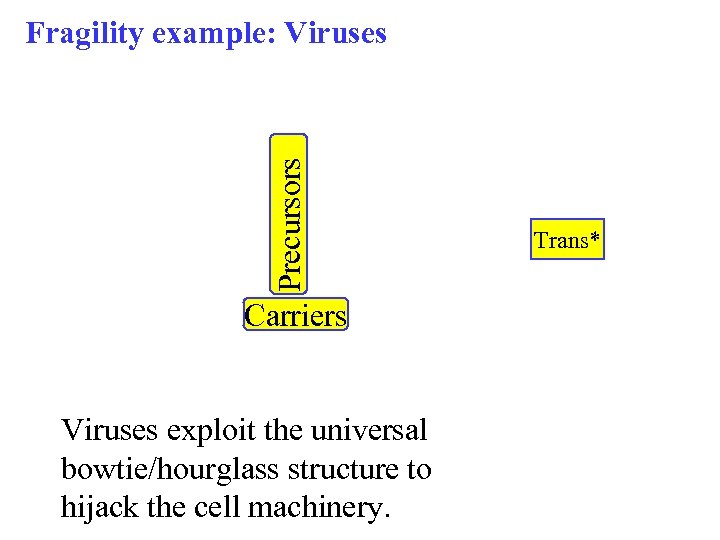
Precursors Fragility example: Viruses Carriers Viruses exploit the universal bowtie/hourglass structure to hijack the cell machinery. Trans*
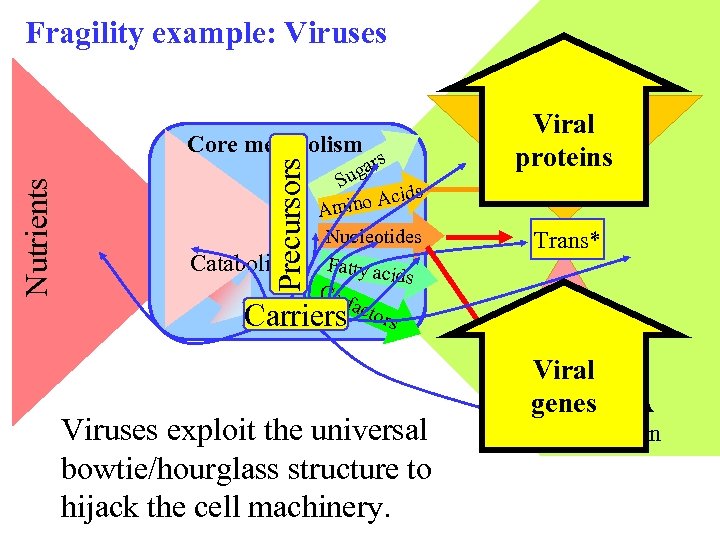
Fragility example: Viruses Precursors Nutrients Core metabolism Catabolism s gar Su ids ino Ac m A Nucleotides Fatty aci ds Cofact ors Proteins Viral proteins Trans* Carriers Viruses exploit the universal bowtie/hourglass structure to hijack the cell machinery. Genes Viral genes DNA replication
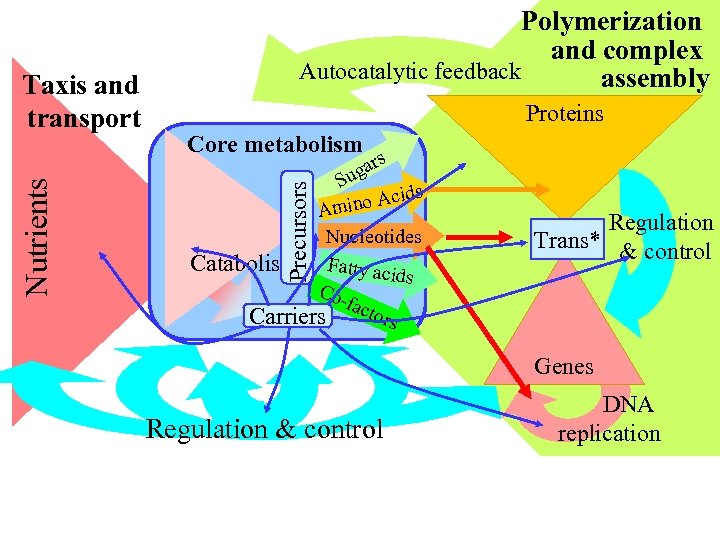
Proteins Core metabolism Precursors Nutrients Taxis and transport Polymerization and complex Autocatalytic feedback assembly s gar Su ids ino Ac m A Nucleotides Catabolism Fatty acid s Cofact ors Carriers Regulation Trans* & control Genes Regulation & control DNA replication
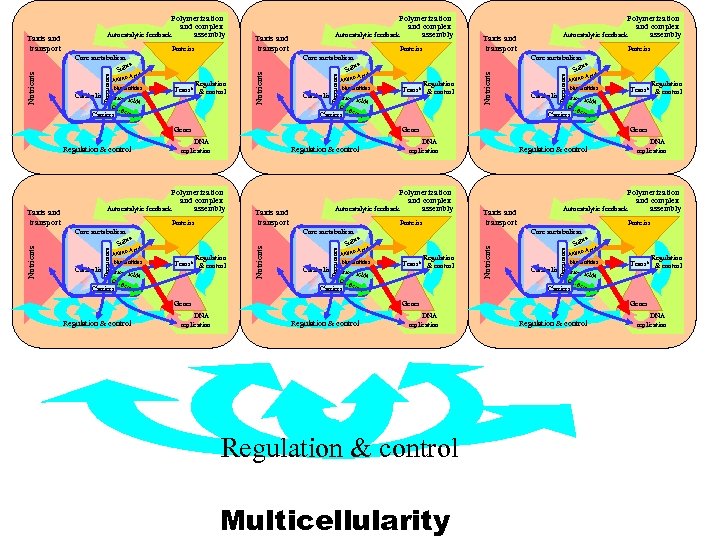
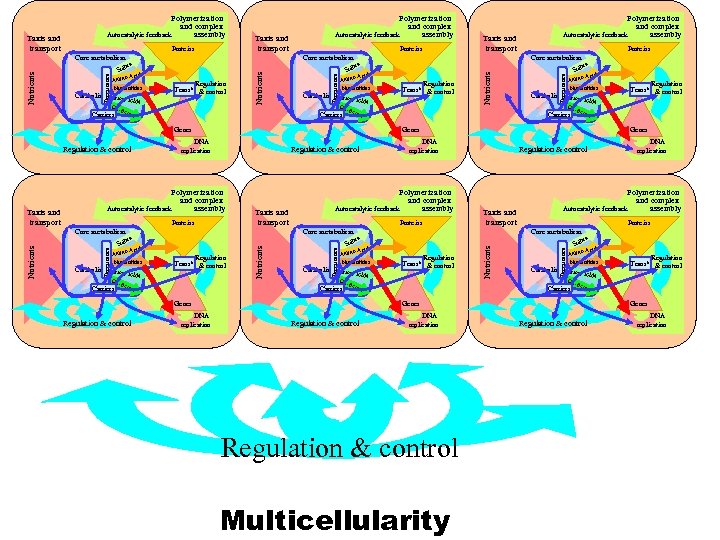
Taxis and transport Regulation Trans* & control Nucleotides Catabolism Fatty aci ds Cofact ors Carriers Genes Polymerization and complex Autocatalytic feedback assembly Proteins Precursors Core metabolism Nutrients Regulation & control Taxis and transport g Su Acids Amino Nucleotides Catabolism Fatty aci ds Cofa Carriers ctors Regulation Trans* & control Proteins Regulation & control Fatty aci ds Cofact ors Carriers Regulation & control Taxis and transport g Su Acids Amino Nucleotides Catabolism Fatty aci ds Cofa Carriers ctors DNA replication Polymerization and complex Autocatalytic feedback assembly Proteins Regulation Trans* & control rs uga S Acids Amino Nucleotides Catabolism Fatty aci ds Cofa Carriers ctors Genes Regulation & control Regulation Trans* & control Core metabolism ars Genes DNA replication Nucleotides Catabolism Genes DNA replication Polymerization and complex Autocatalytic feedback assembly Core metabolism ars Nutrients Taxis and transport s gar Su s o Acid Amin Genes DNA replication Precursors Regulation & control Regulation Trans* & control Precursors Fatty aci ds Cofact ors Carriers Nutrients Nucleotides Catabolism s gar Su s o Acid Amin Proteins Core metabolism Nutrients s gar Su s o Acid Amin Taxis and transport Core metabolism Nutrients Precursors Nutrients Core metabolism Proteins Polymerization and complex Autocatalytic feedback assembly Precursors Taxis and transport Polymerization and complex Autocatalytic feedback assembly DNA replication Regulation & control Multicellularity Regulation Trans* & control Genes Regulation & control DNA replication
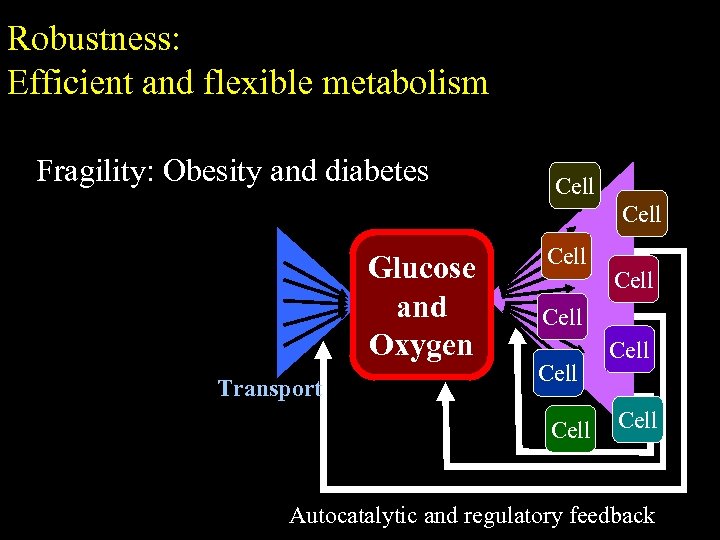
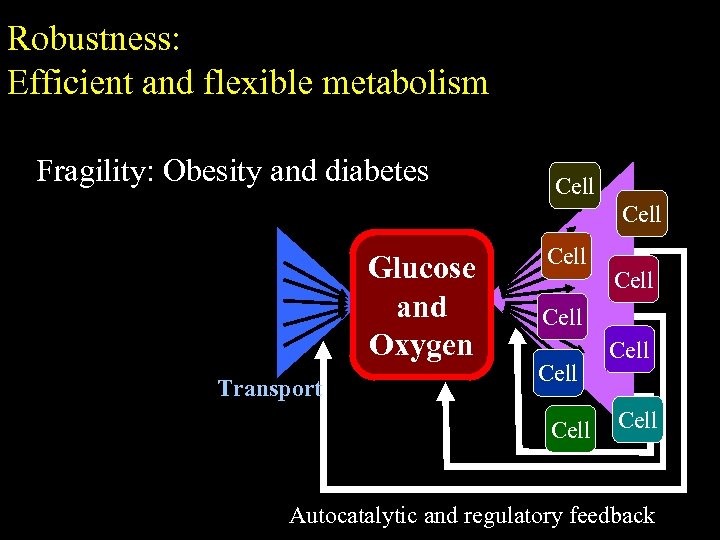
Robustness: Efficient and flexible metabolism Fragility: Obesity and diabetes Cell Glucose and Oxygen Transport Cell Cell Autocatalytic and regulatory feedback
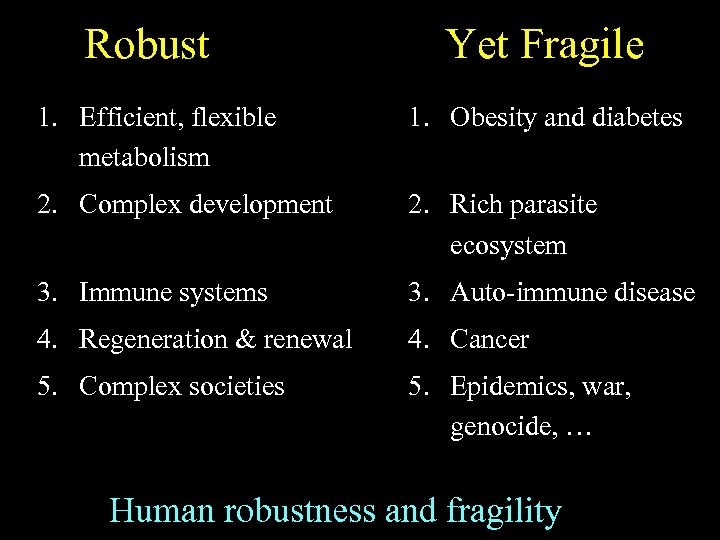
Robust Yet Fragile 1. Efficient, flexible metabolism 1. Obesity and diabetes and 2. Complex development and 2. Rich parasite ecosystem 3. Immune systems 3. Auto-immune disease 4. Regeneration & renewal 4. Cancer 5. Complex societies 5. Epidemics, war, genocide, … Human robustness and fragility
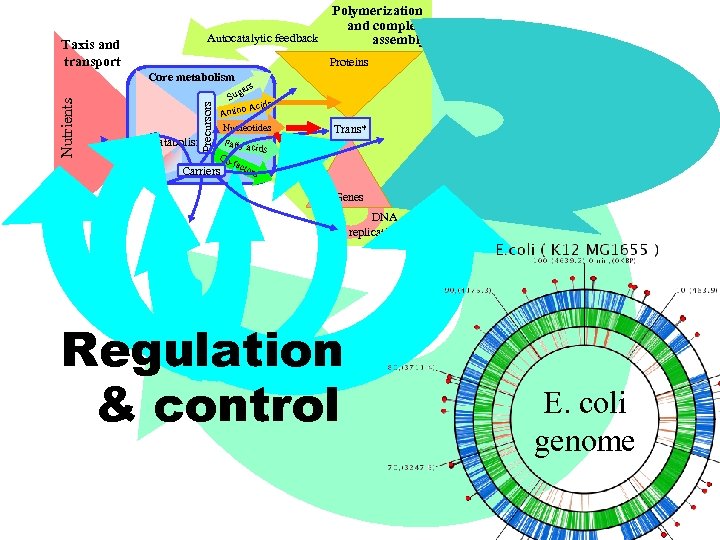
Polymerization and complex Autocatalytic feedback assembly Taxis and transport Proteins Precursors Nutrients Core metabolism Catabolism s gar Su Acids Amino Nucleotides Trans* Fatty acid s Cofact ors Carriers Genes DNA replication Regulation & control E. coli genome
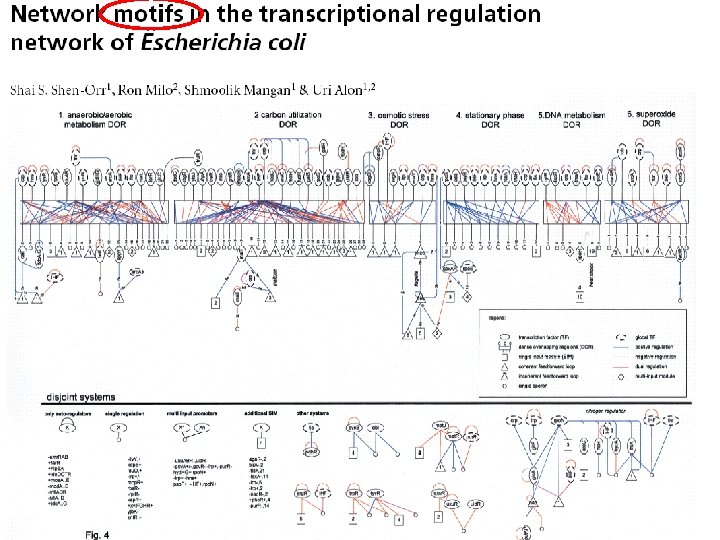
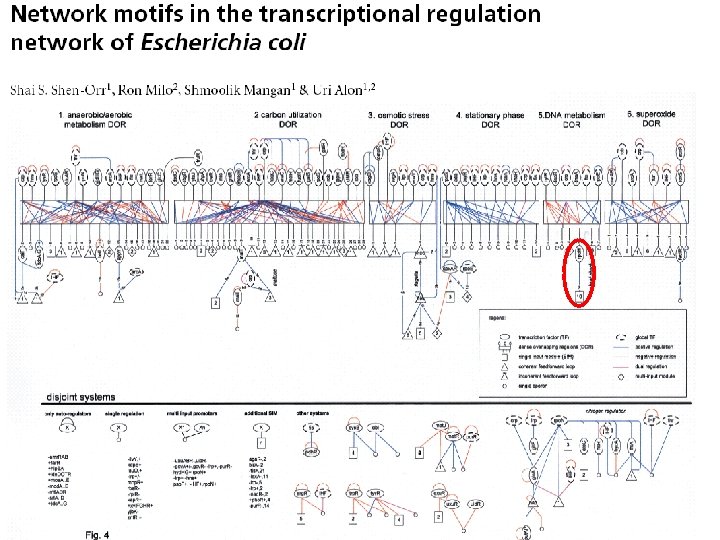
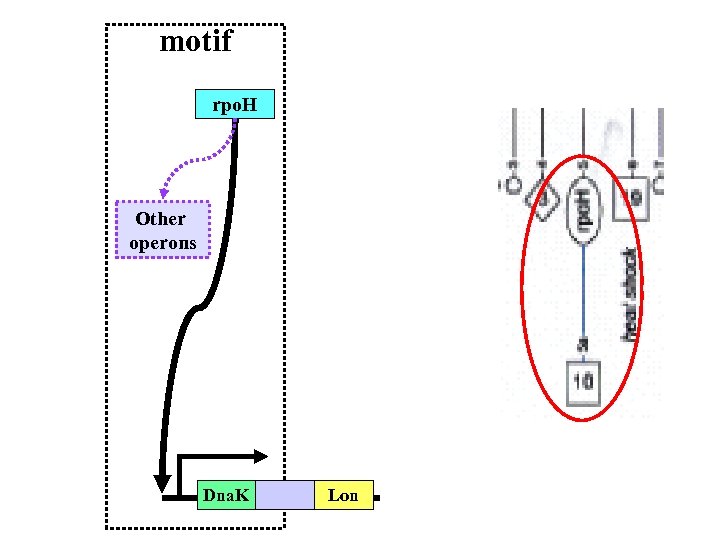
motif rpo. H Other operons Dna. K Lon
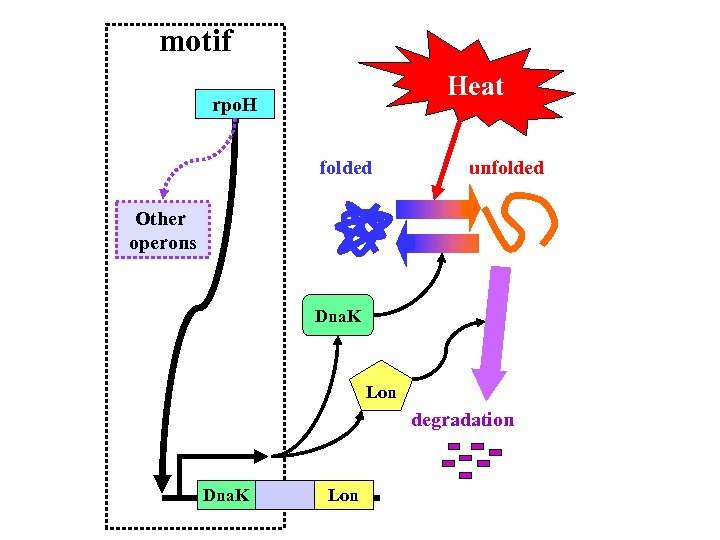
motif Heat rpo. H folded unfolded Other operons Dna. K Lon degradation Dna. K Lon
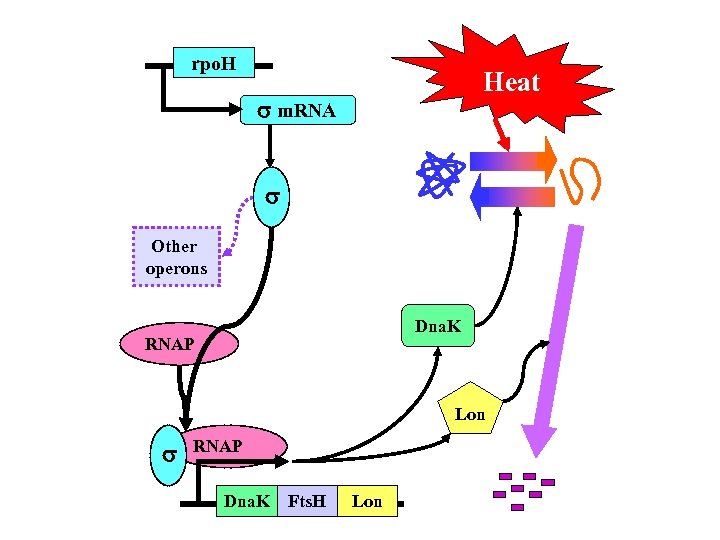
rpo. H Heat m. RNA Other operons Dna. K RNAP Lon RNAP Dna. K Fts. H Lon
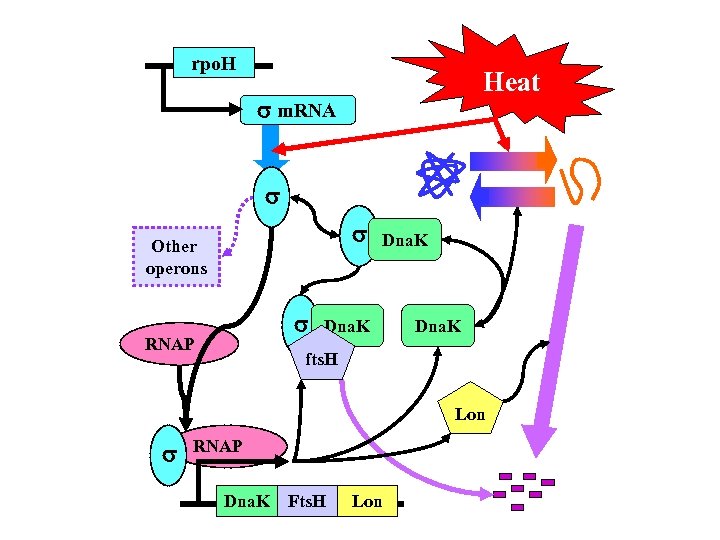
rpo. H Heat m. RNA Other operons RNAP Dna. K fts. H Lon RNAP Dna. K Fts. H Lon
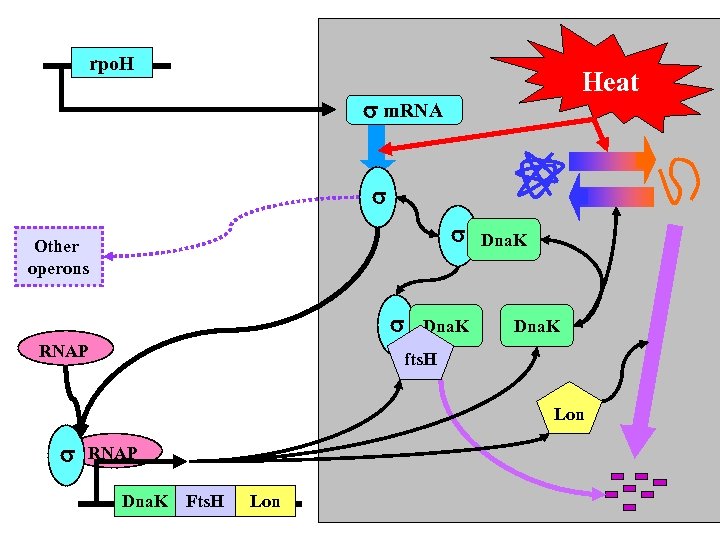
rpo. H Heat m. RNA Other operons RNAP Dna. K fts. H Lon RNAP Dna. K Fts. H Lon
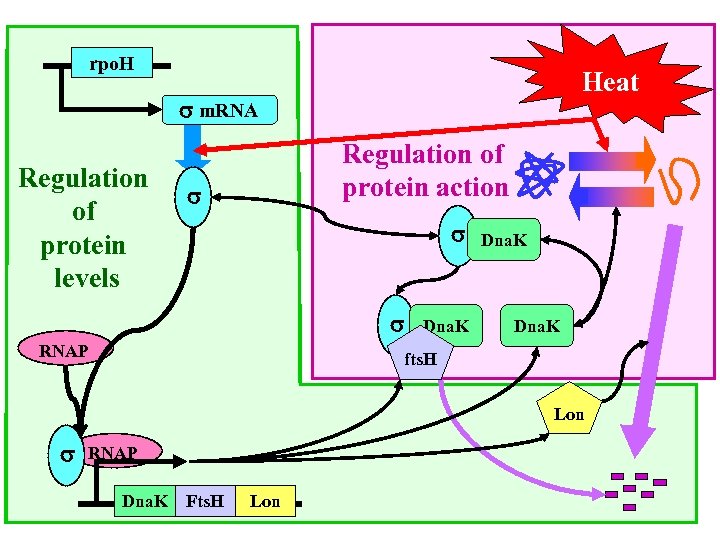
rpo. H Heat m. RNA Regulation of protein levels Regulation of protein action RNAP Dna. K fts. H Lon RNAP Dna. K Fts. H Lon
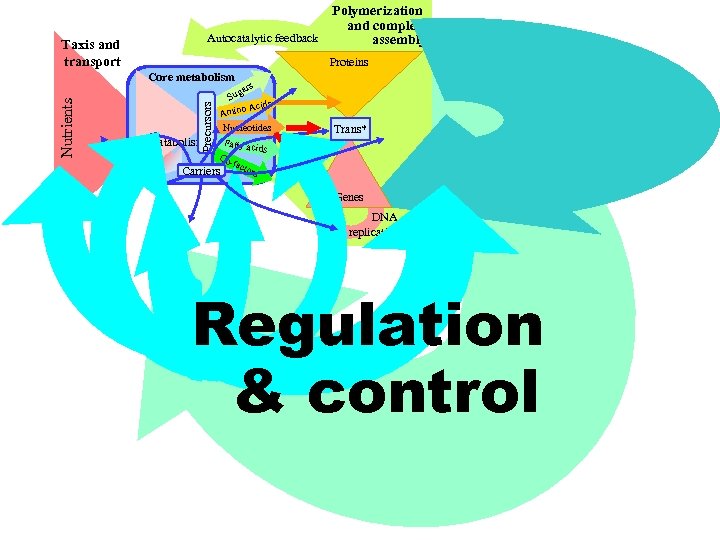
Polymerization and complex Autocatalytic feedback assembly Taxis and transport Proteins Precursors Nutrients Core metabolism Catabolism s gar Su Acids Amino Nucleotides Trans* Fatty acid s Cofact ors Carriers Genes DNA replication Regulation & control
Bowtie: Flow of energy and materials Universal organizational structures/architectures Hourglass Organization of control
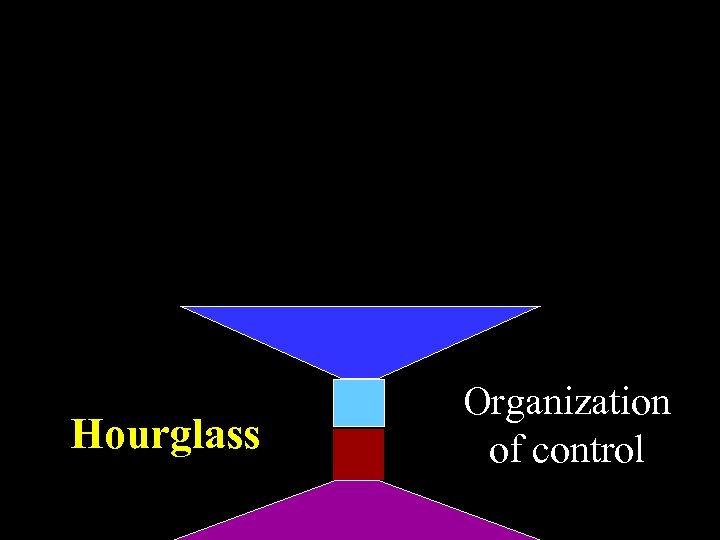
Hourglass Organization of control
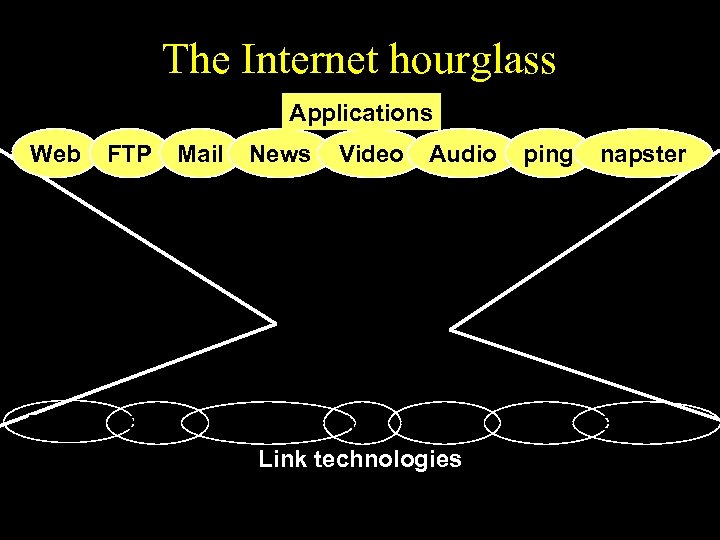
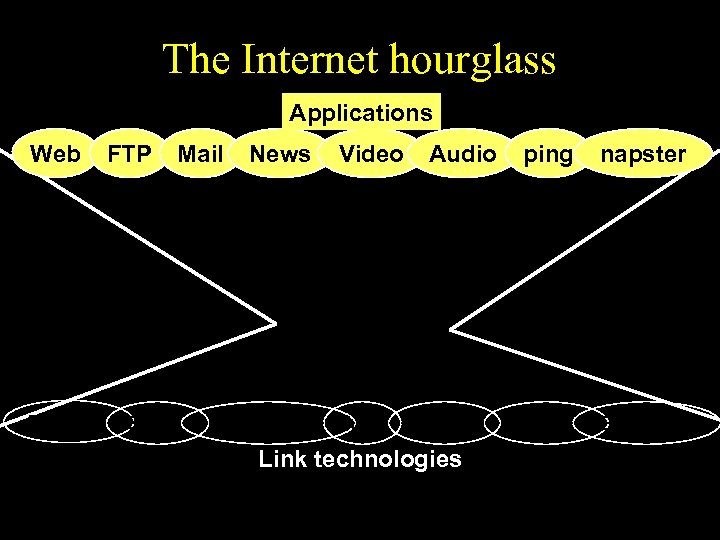
The Internet hourglass Applications Web FTP Mail Ethernet 802. 11 News Video Power lines ATM Audio Optical Link technologies ping napster Satellite Bluetooth
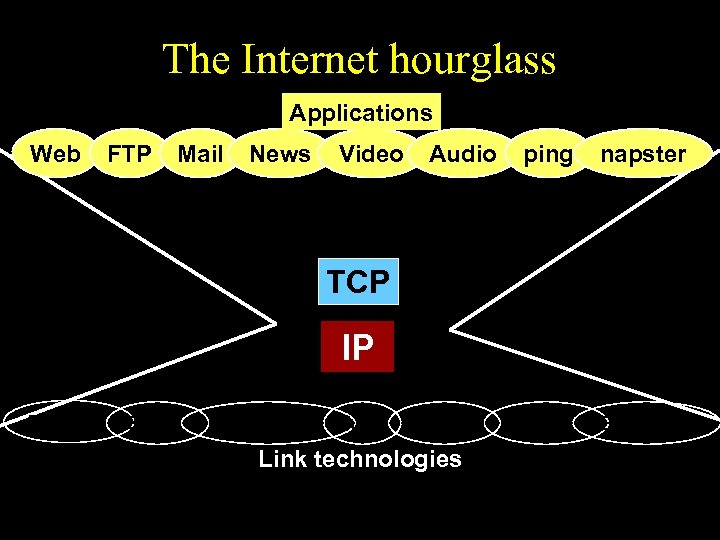
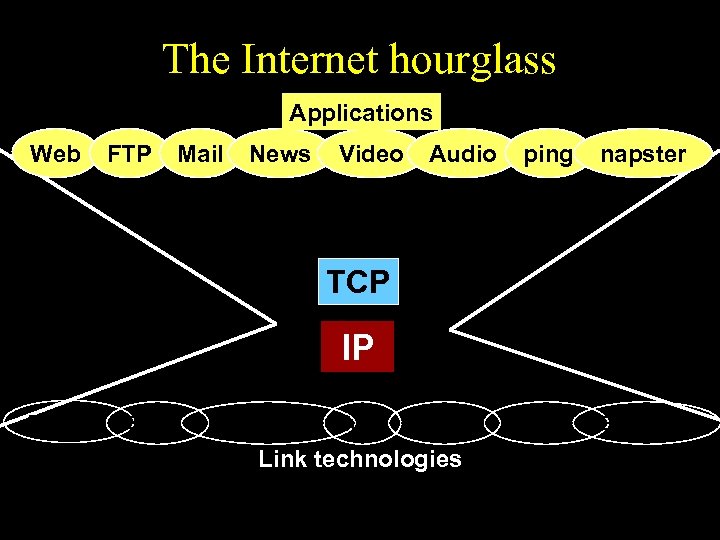
The Internet hourglass Applications Web FTP Mail News Video Audio ping napster TCP IP Ethernet 802. 11 Power lines ATM Optical Link technologies Satellite Bluetooth
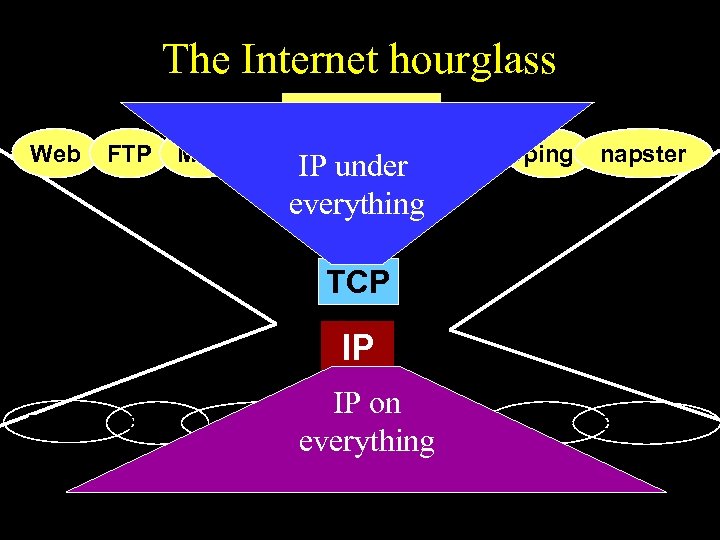
The Internet hourglass Applications Web FTP Mail News Video IP under Audio everything ping napster TCP IP Ethernet 802. 11 IP on Power lines ATM Optical everything Link technologies Satellite Bluetooth
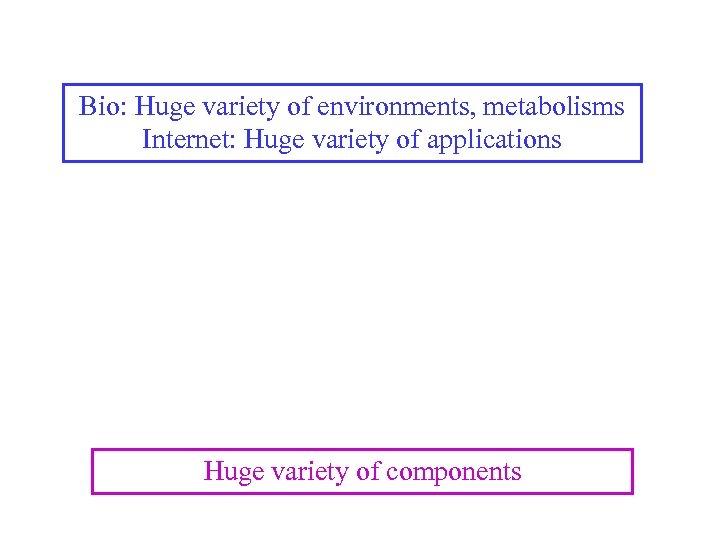
Bio: Huge variety of environments, metabolisms Internet: Huge variety of applications Huge variety of components
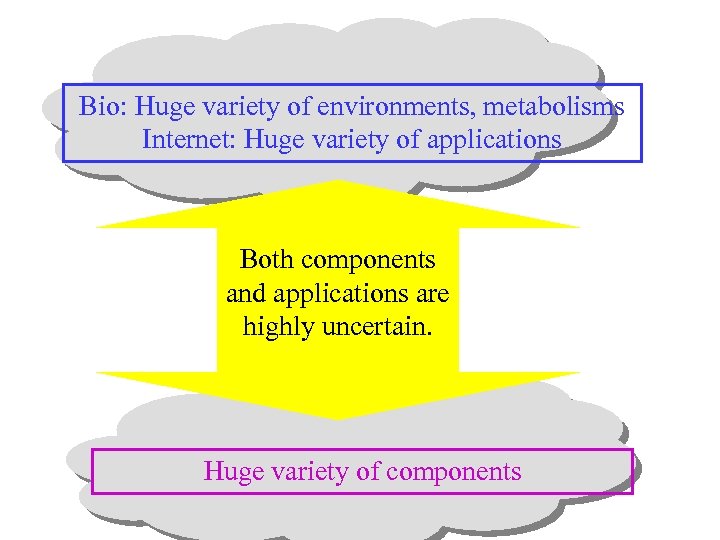
Bio: Huge variety of environments, metabolisms Internet: Huge variety of applications Both components and applications are highly uncertain. Huge variety of components
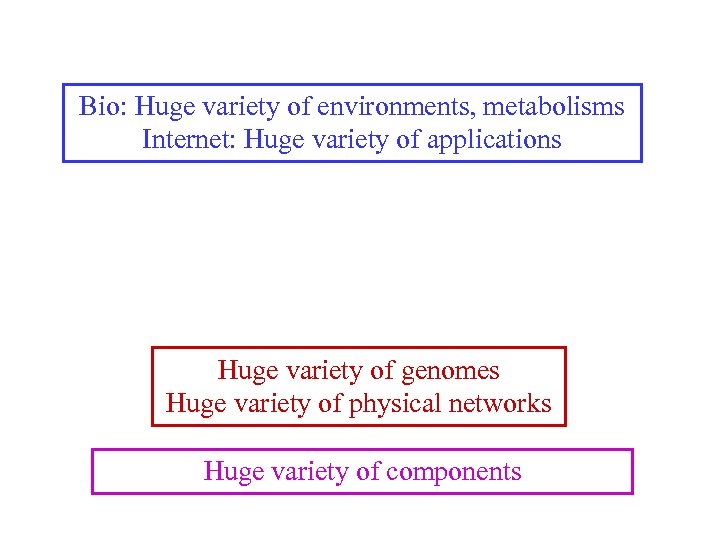
Bio: Huge variety of environments, metabolisms Internet: Huge variety of applications Huge variety of genomes Huge variety of physical networks Huge variety of components
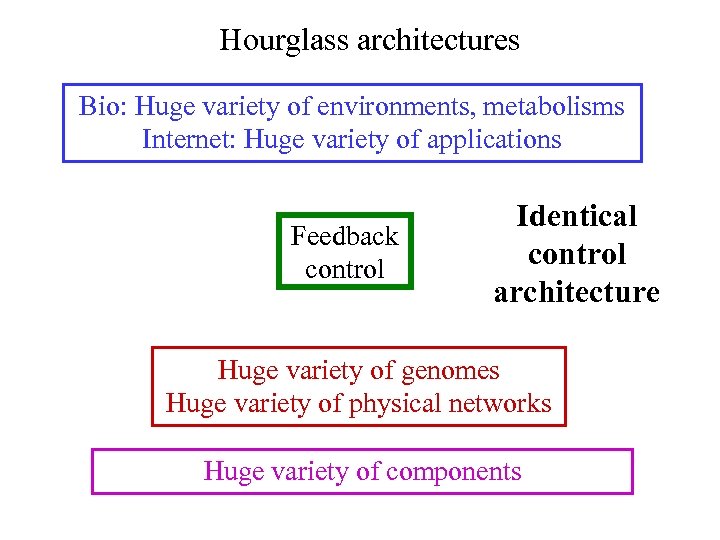
Hourglass architectures Bio: Huge variety of environments, metabolisms Internet: Huge variety of applications Feedback control Identical control architecture Huge variety of genomes Huge variety of physical networks Huge variety of components
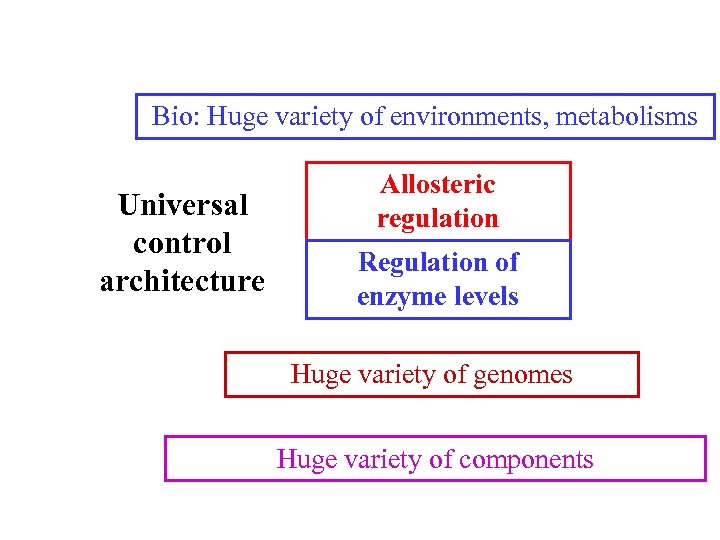
Bio: Huge variety of environments, metabolisms Universal control architecture Allosteric regulation Regulation of enzyme levels Huge variety of genomes Huge variety of components
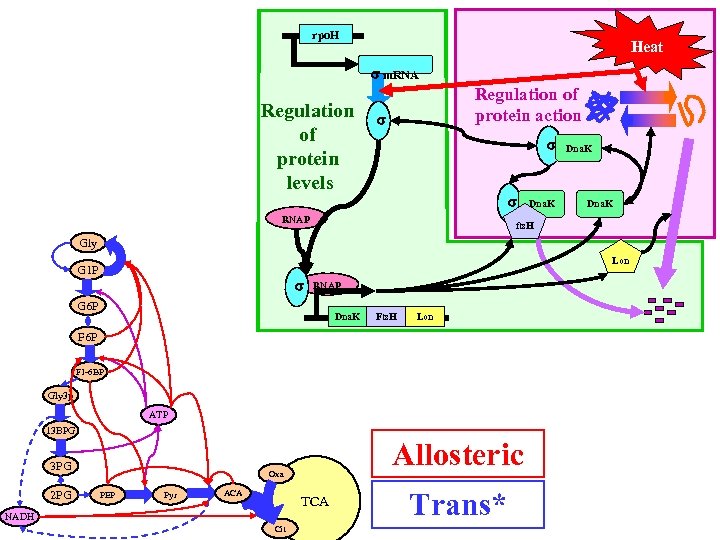
rpo. H Heat m. RNA Regulation of protein levels Regulation of protein action RNAP Dna. K fts. H Gly Lon G 1 P RNAP G 6 P Dna. K Fts. H Lon F 6 P F 1 -6 BP Gly 3 p ATP 13 BPG 3 PG 2 PG Allosteric Oxa PEP Pyr ACA TCA NADH Cit Trans*
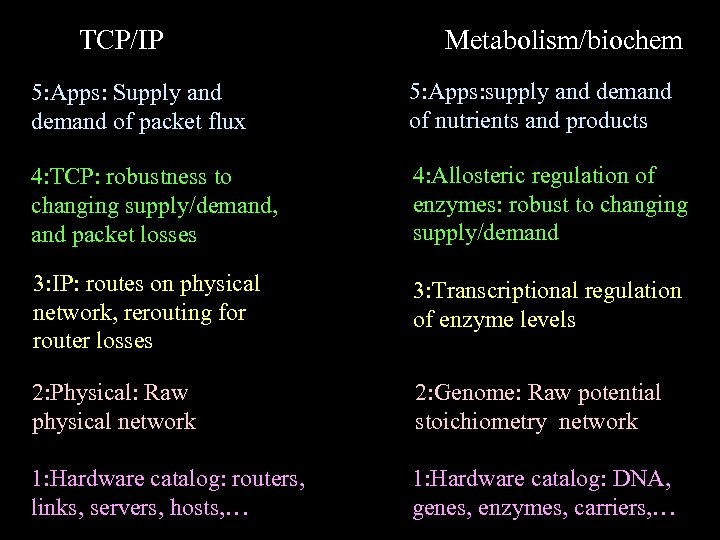
TCP/IP Metabolism/biochem 5: Apps: Supply and demand of packet flux 5: Apps: supply and demand of nutrients and products 4: TCP: robustness to changing supply/demand, and packet losses 4: Allosteric regulation of enzymes: robust to changing supply/demand 3: IP: routes on physical network, rerouting for router losses 3: Transcriptional regulation of enzyme levels 2: Physical: Raw physical network 2: Genome: Raw potential stoichiometry network 1: Hardware catalog: routers, links, servers, hosts, … 1: Hardware catalog: DNA, genes, enzymes, carriers, …
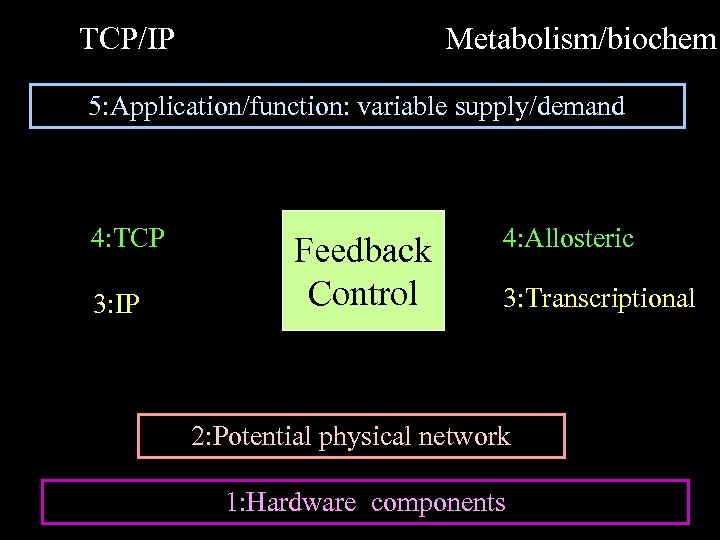
TCP/IP Metabolism/biochem 5: Application/function: variable supply/demand 4: TCP 3: IP Feedback Control 4: Allosteric 3: Transcriptional 2: Potential physical network 1: Hardware components
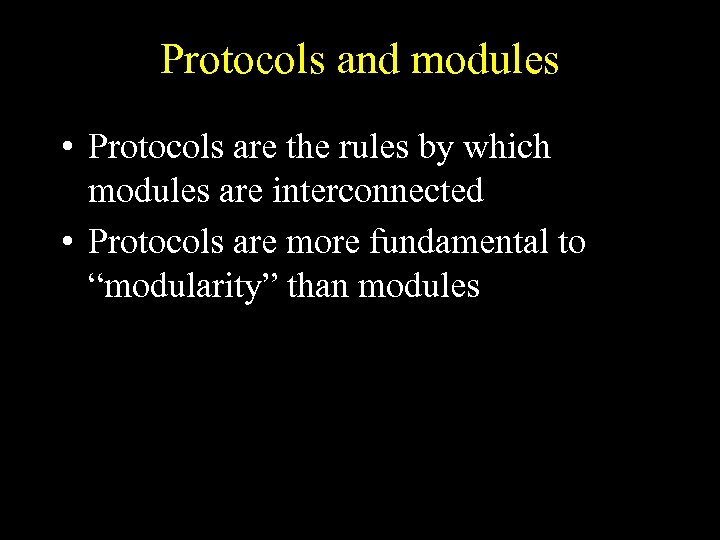
Protocols and modules • Protocols are the rules by which modules are interconnected • Protocols are more fundamental to “modularity” than modules
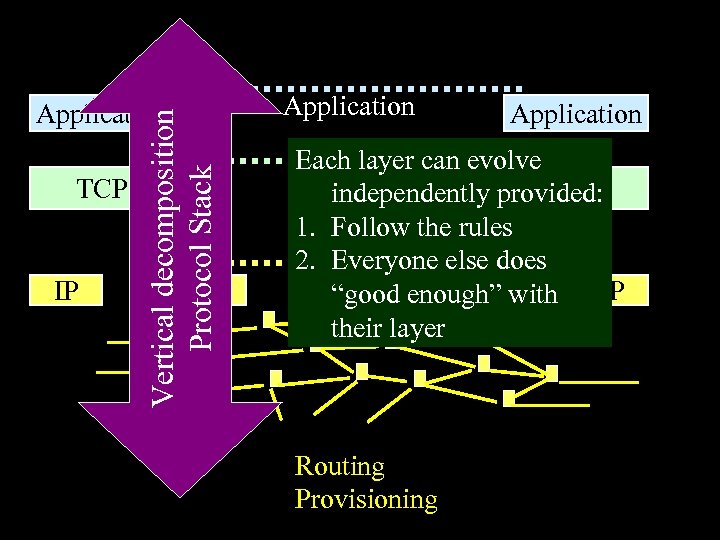
TCP IP Vertical decomposition Protocol Stack Application IP Application Each layer can evolve TCP independently provided: 1. Follow the rules 2. Everyone else does IP IP “good enough” with IP their layer Routing Provisioning
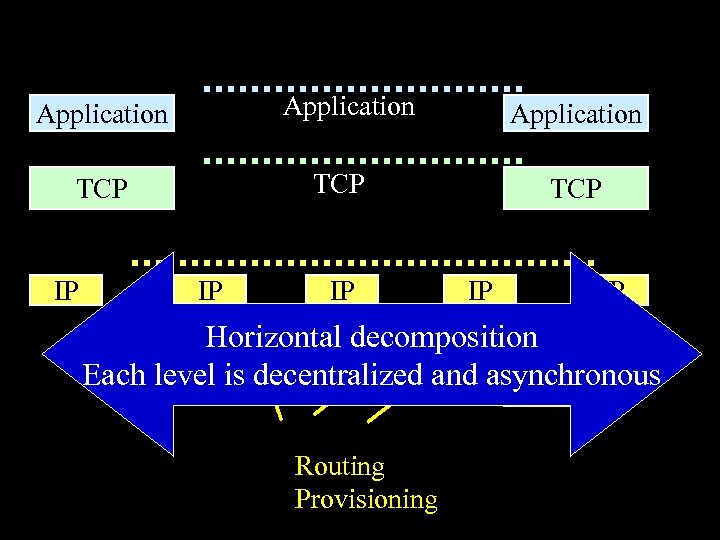
Application TCP IP Application IP IP TCP IP IP Horizontal decomposition Each level is decentralized and asynchronous Routing Provisioning
Bowtie: Flow of energy and materials Universal organizational structures/architectures Hourglass Organization of control
Robust yet fragile (RYF) • The same mechanisms responsible for robustness to most perturbations • Allows possible extreme fragilities to others • Usually involving hijacking the robustness mechanism in some way • High variability (and thus power laws)
Facilitate regulation on multiple time scales: 1. Fast: allostery 2. Slower: transcriptional regulation (by regulated recruitment) and degradation 3. Even slower: transfer of genes 4. Even slower: copying and evolution of genes
TCP/IP robustness/evolvability on many timescales • Shortest: File transfers from different users – Application-specific navigation (application) – Congestion control to share the net (TCP) – Ack-based retransmission (TCP) • Short: Fail-off of routers and servers – Rerouting around failures (IP) – Hot-swaps and rebooting of hardware • Long: Rearrangements of existing components – Applications/clients/servers can come and go – Hardware of all types can come and go • Longer: New applications and hardware – Plug and play if they obey the protocols
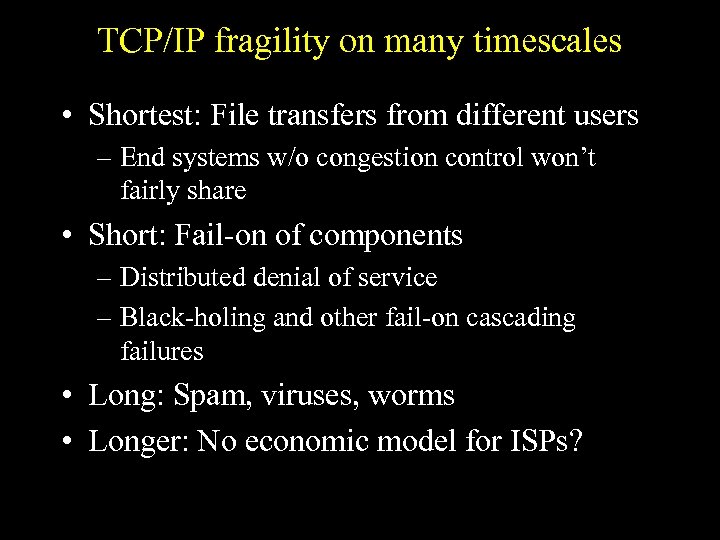
TCP/IP fragility on many timescales • Shortest: File transfers from different users – End systems w/o congestion control won’t fairly share • Short: Fail-on of components – Distributed denial of service – Black-holing and other fail-on cascading failures • Long: Spam, viruses, worms • Longer: No economic model for ISPs?
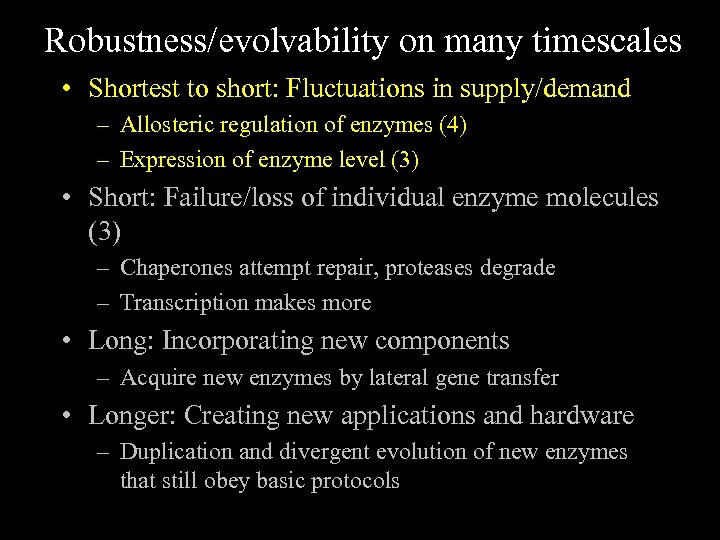
Robustness/evolvability on many timescales • Shortest to short: Fluctuations in supply/demand – Allosteric regulation of enzymes (4) – Expression of enzyme level (3) • Short: Failure/loss of individual enzyme molecules (3) – Chaperones attempt repair, proteases degrade – Transcription makes more • Long: Incorporating new components – Acquire new enzymes by lateral gene transfer • Longer: Creating new applications and hardware – Duplication and divergent evolution of new enzymes that still obey basic protocols
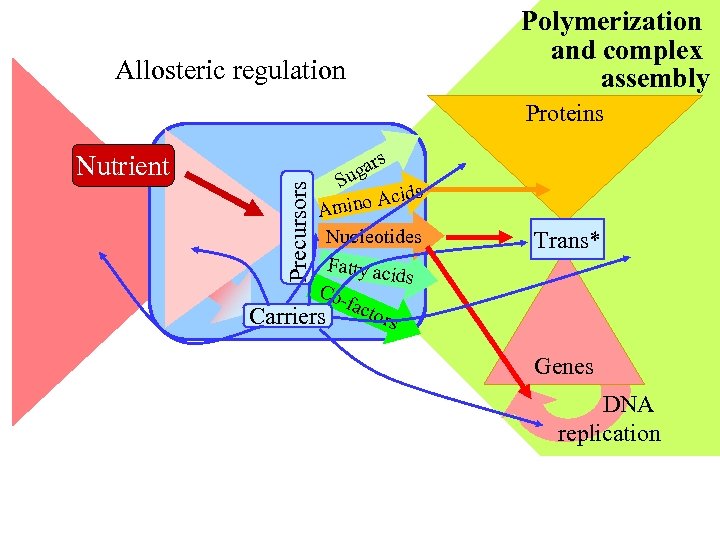
Allosteric regulation Polymerization and complex assembly Nutrient Precursors Proteins s gar Su ids ino Ac m A Nucleotides Fatty aci ds Cofact ors Carriers Trans* Genes DNA replication
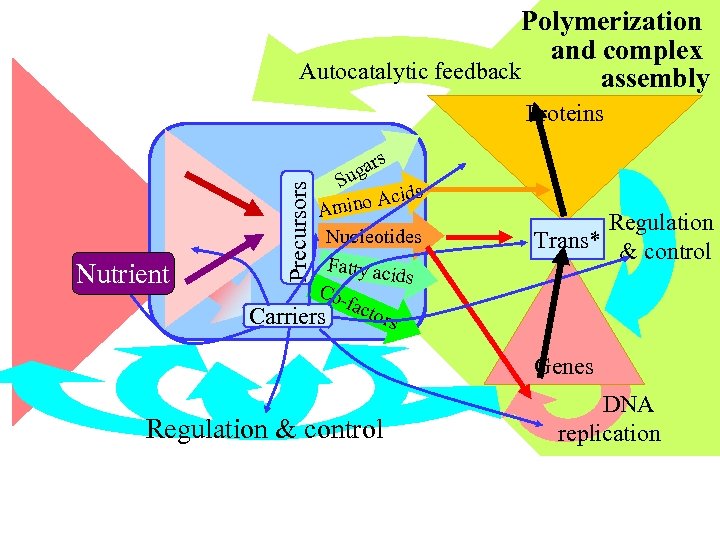
Polymerization and complex Autocatalytic feedback assembly Nutrient Precursors Proteins s gar Su ids ino Ac m A Nucleotides Fatty aci ds Cofact ors Carriers Regulation Trans* & control Genes Regulation & control DNA replication
Robustness/evolvability on many timescales • Shortest to short: Fluctuations in supply/demand – Allosteric regulation of enzymes (4) – Expression of enzyme level (3) • Short: Failure/loss of individual enzyme molecules (3) – Chaperones attempt repair, proteases degrade – Transcription makes more • Long: Incorporating new components – Acquire new enzymes by lateral gene transfer • Longer: Creating new applications and hardware – Duplication and divergent evolution of new enzymes that still obey basic protocols
Robustness/evolvability on many timescales • Shortest to short: Fluctuations in supply/demand – Allosteric regulation of enzymes (4) – Expression of enzyme level (3) • Short: Failure/loss of individual enzyme molecules (3) – Chaperones attempt repair, proteases degrade – Transcription makes more • Long: Incorporating new components – Acquire new enzymes by lateral gene transfer • Longer: Creating new applications and hardware – Duplication and divergent evolution of new enzymes that still obey basic protocols
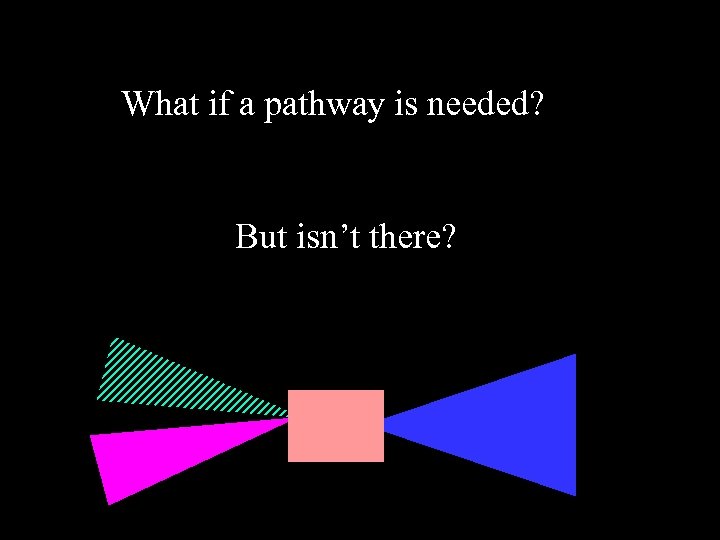
What if a pathway is needed? But isn’t there?
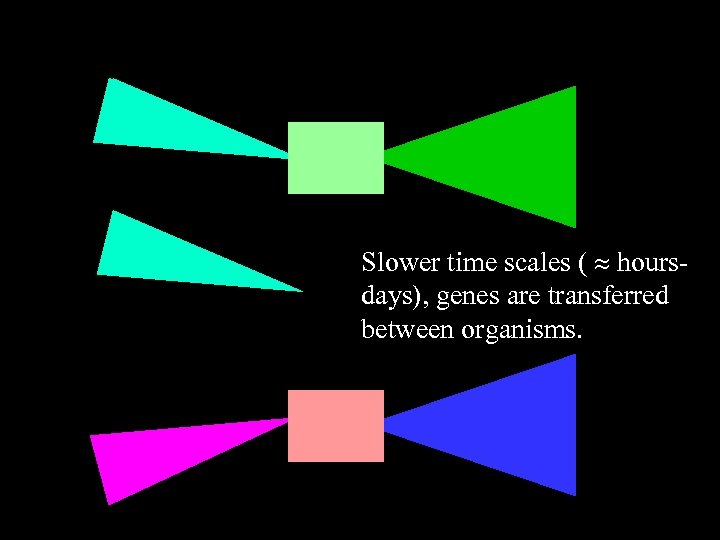
Slower time scales ( hoursdays), genes are transferred between organisms.
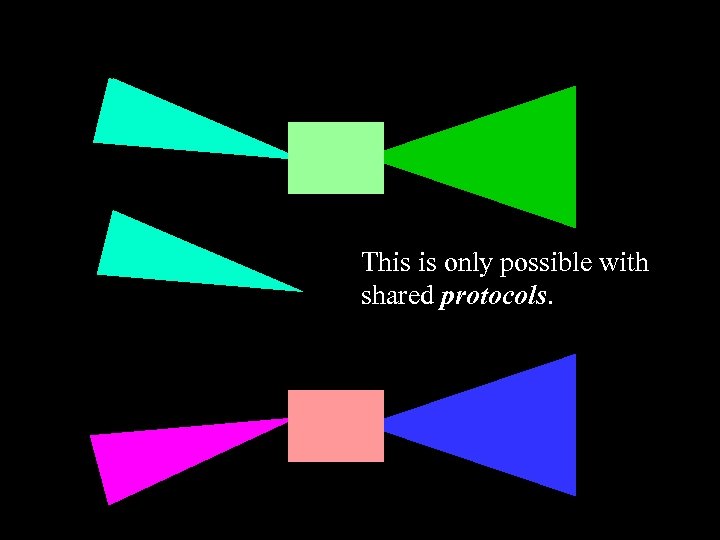
This is only possible with shared protocols.
Robustness/evolvability on many timescales • Shortest to short: Fluctuations in supply/demand – Allosteric regulation of enzymes (4) – Expression of enzyme level (3) • Short: Failure/loss of individual enzyme molecules (3) – Chaperones attempt repair, proteases degrade – Transcription makes more • Long: Incorporating new components – Acquire new enzymes by lateral gene transfer • Longer: Creating new applications and hardware – Duplication and divergent evolution of new enzymes that still obey basic protocols
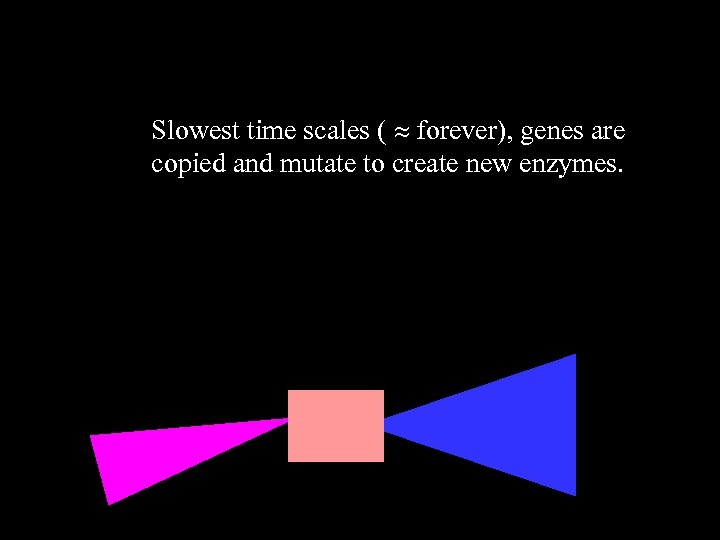
Slowest time scales ( forever), genes are copied and mutate to create new enzymes.
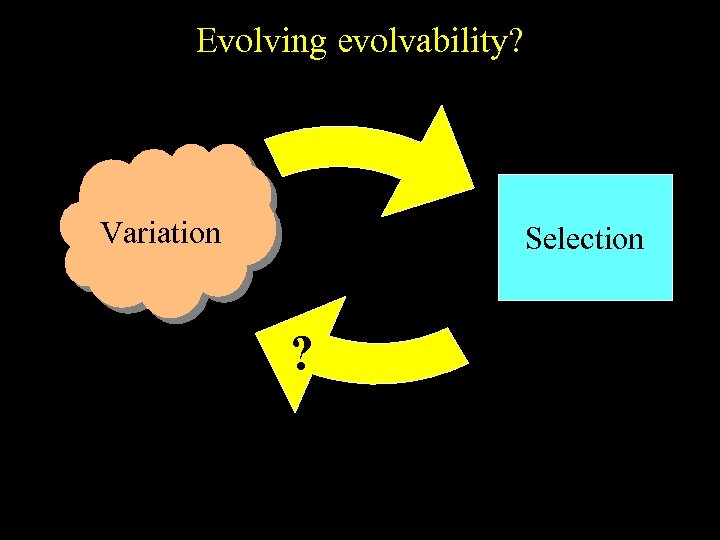
Evolving evolvability? Variation Selection ?
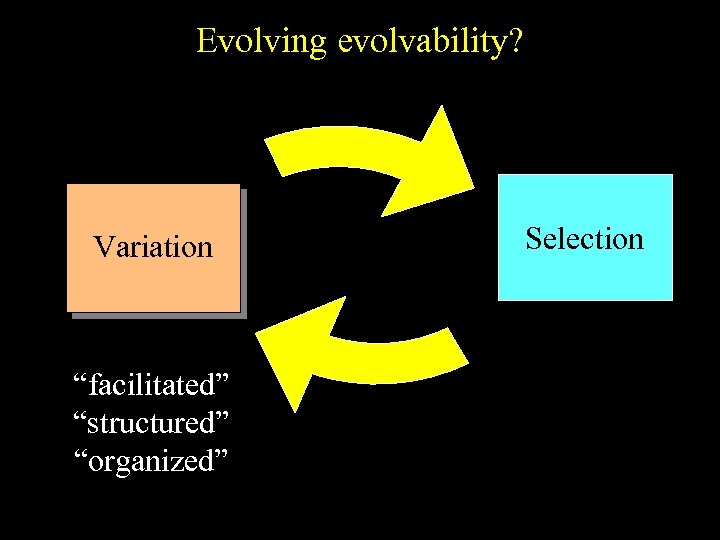
Evolving evolvability? Variation “facilitated” “structured” “organized” Selection
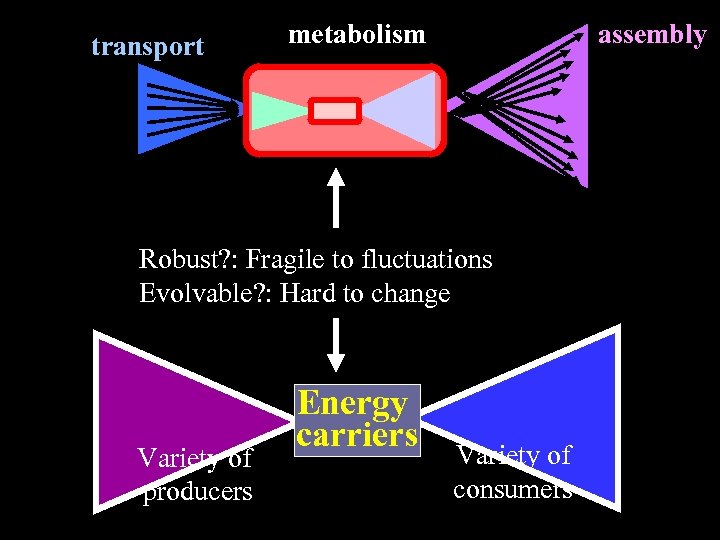
transport metabolism assembly Robust? : Fragile to fluctuations Evolvable? : Hard to change Variety of producers Energy carriers Variety of consumers
Biochem fragility on many timescales • Shortest: Fluctuations in demand/supply that exceeds regulatory capability (e. g. glycolytic oscillations) • Short: Fail-on of components – Indiscriminate kinases, loss of repression, … – Loss of tumor suppressors • Long: Infectious hijacking • Longer: Diabetes, obesity
Robust yet fragile (RYF) • The same mechanisms responsible for robustness to most perturbations • Allows possible extreme fragilities to others • Usually involving hijacking the robustness mechanism in some way • High variability (and thus power laws)
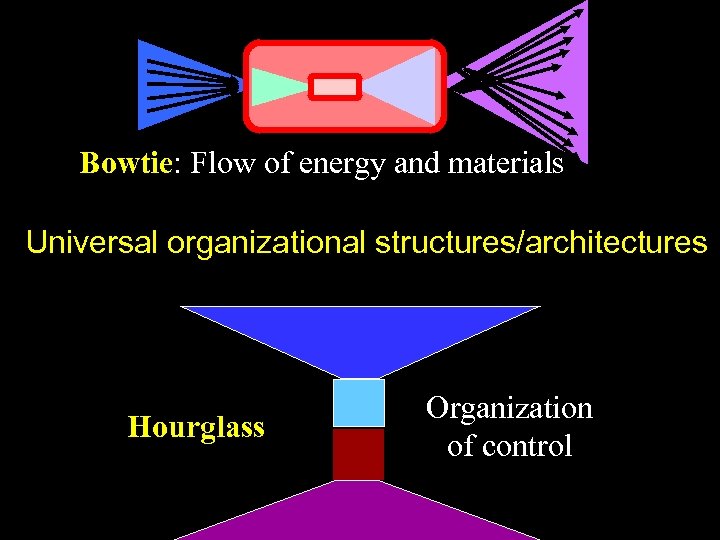
Bowtie: Flow of energy and materials Universal organizational structures/architectures Hourglass Organization of control
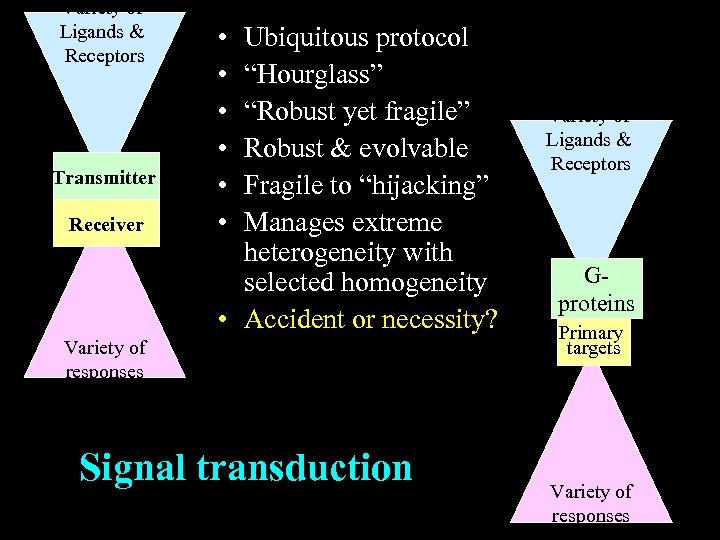
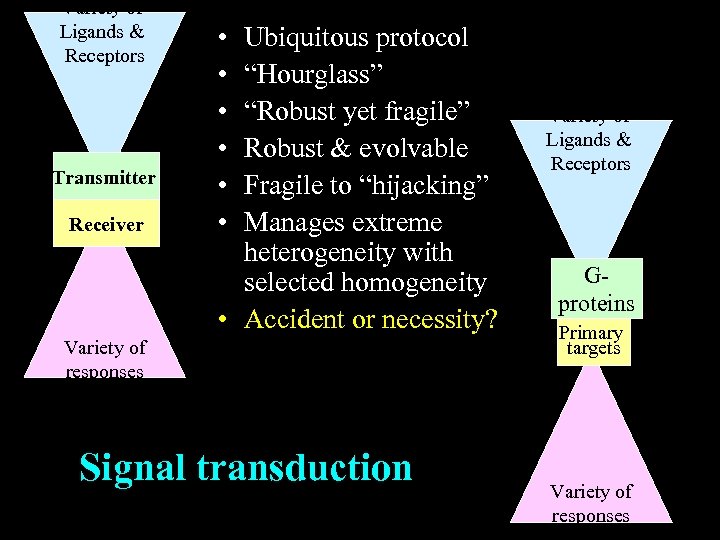
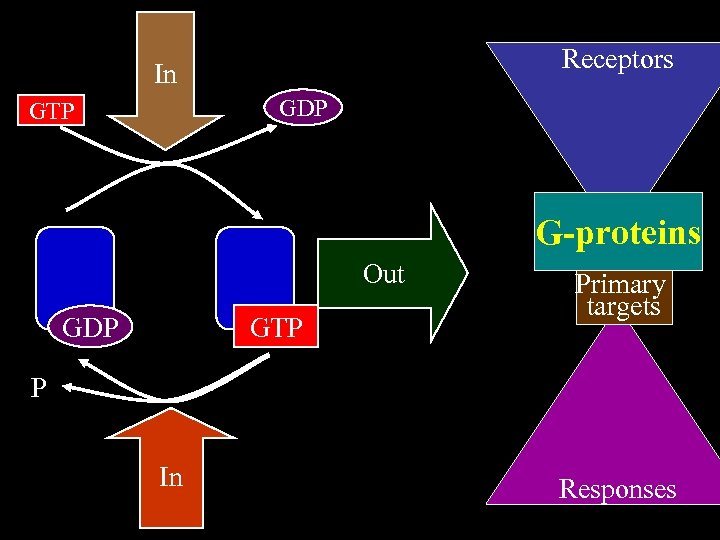
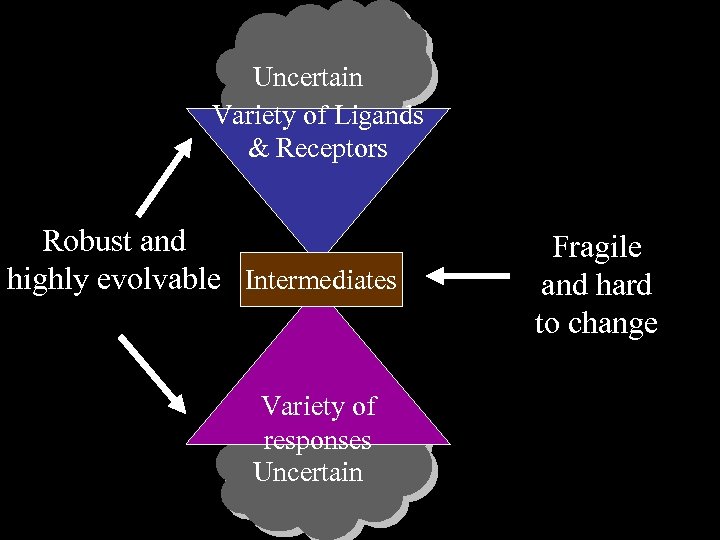
Variety of Ligands & Receptors Transmitter Receiver • • • Ubiquitous protocol “Hourglass” “Robust yet fragile” Robust & evolvable Fragile to “hijacking” Manages extreme heterogeneity with selected homogeneity • Accident or necessity? Variety of responses Signal transduction Variety of Ligands & Receptors Gproteins Primary targets Variety of responses
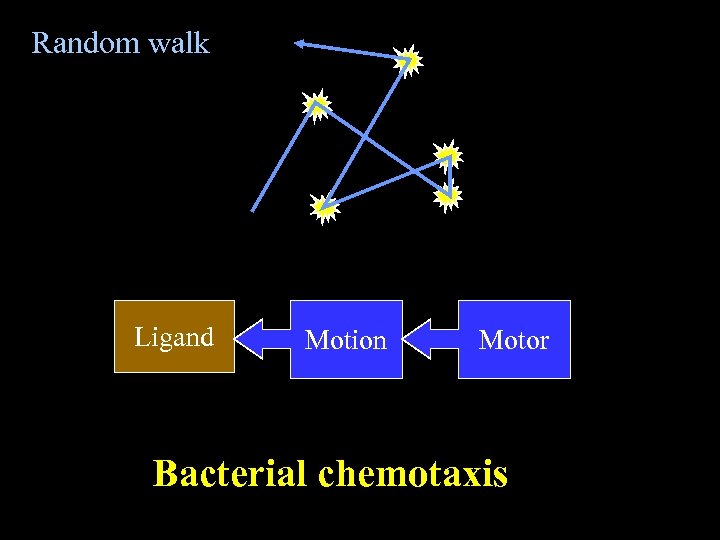
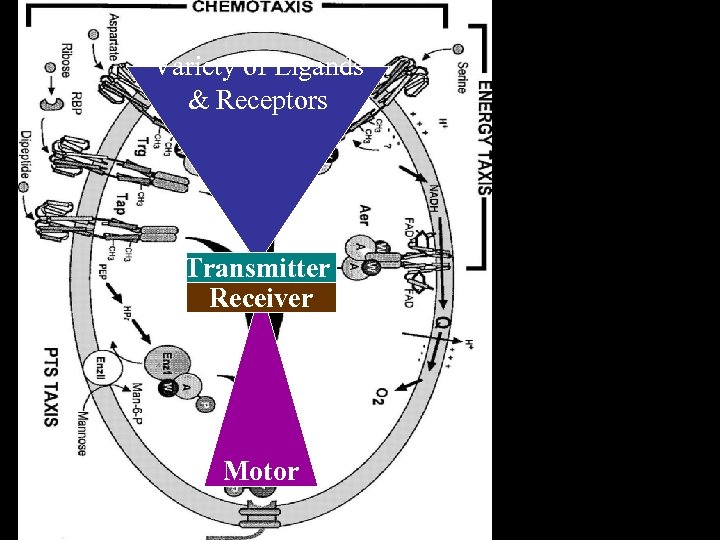
Random walk Ligand Motion Motor Bacterial chemotaxis
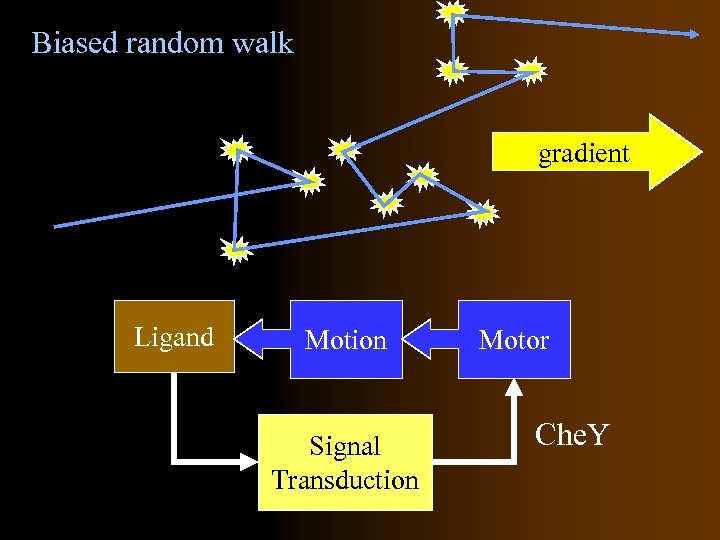
Biased random walk gradient Ligand Motion Signal Transduction Motor Che. Y
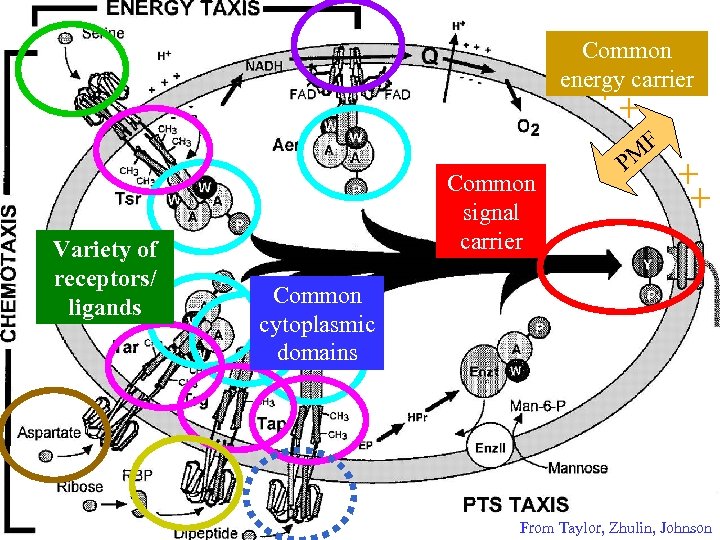
Common energy carrier + + F Variety of receptors/ ligands Common signal carrier PM + + Common cytoplasmic domains From Taylor, Zhulin, Johnson
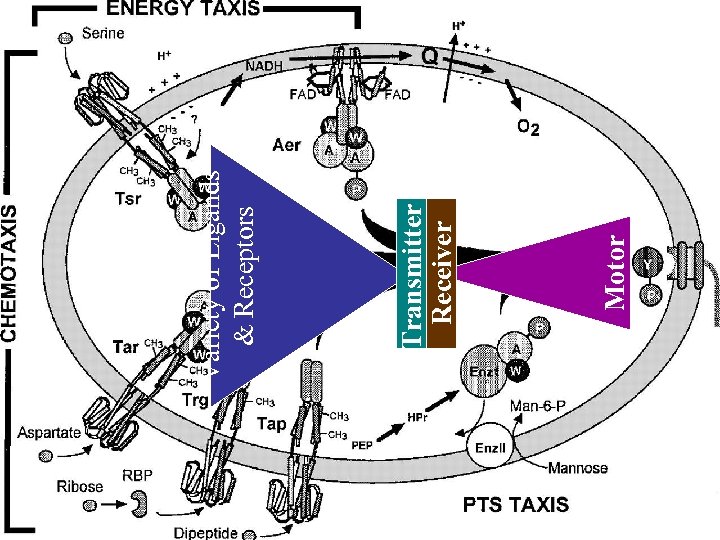
Motor Transmitter Receiver Variety of Ligands & Receptors
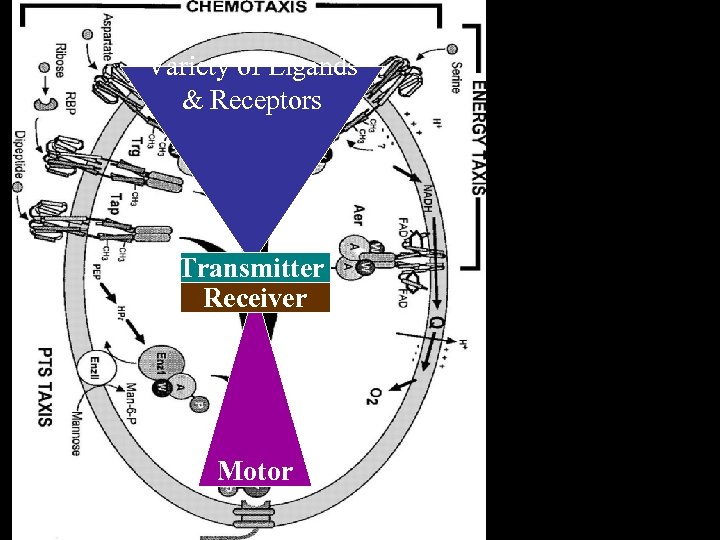
Variety of Ligands & Receptors Transmitter Receiver Motor
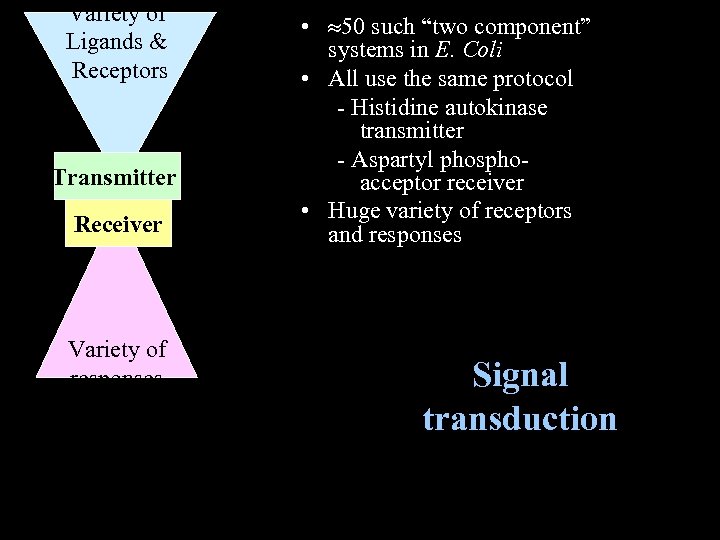
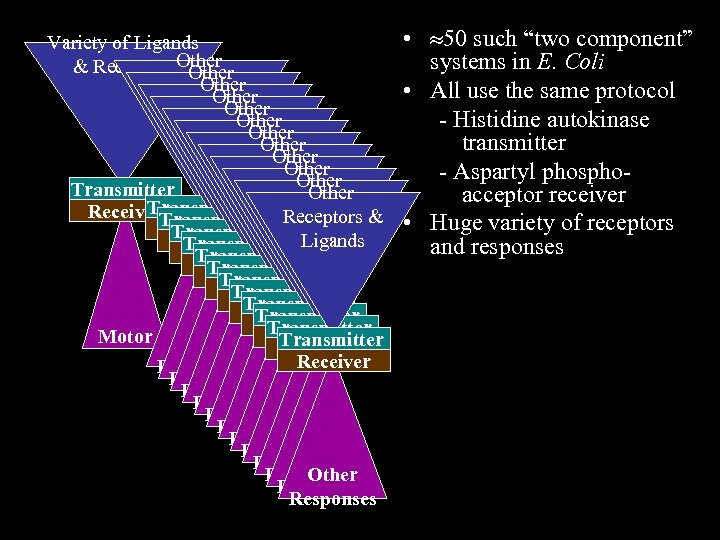
Variety of Ligands & Receptors Transmitter Receiver Variety of responses • 50 such “two component” systems in E. Coli • All use the same protocol - Histidine autokinase transmitter - Aspartyl phosphoacceptor receiver • Huge variety of receptors and responses Signal transduction
Applications TCP Variety of Ligands & Receptors Transmitter Receiver IP Link Variety of responses
Variety of Ligands & Receptors Transmitter Receiver Motor
Variety of Ligands & Receptors Other Receptors & Other Ligands Receptors & Other Ligands Receptors & Other Transmitter Ligands Receptors & Other Ligands Receptors & Transmitter Receiver. Transmitter Ligands Receptors & Receiver Transmitter Ligands Receiver Transmitter Receiver Transmitter Motor Other Receiver Transmitter Receiver Other Responses Other Responses Other Responses Responses • 50 such “two component” systems in E. Coli • All use the same protocol - Histidine autokinase transmitter - Aspartyl phosphoacceptor receiver • Huge variety of receptors and responses
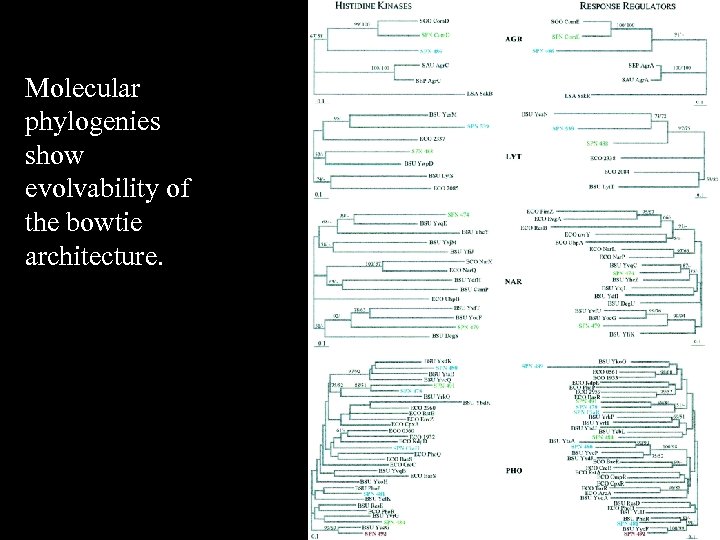
Molecular phylogenies show evolvability of the bowtie architecture.
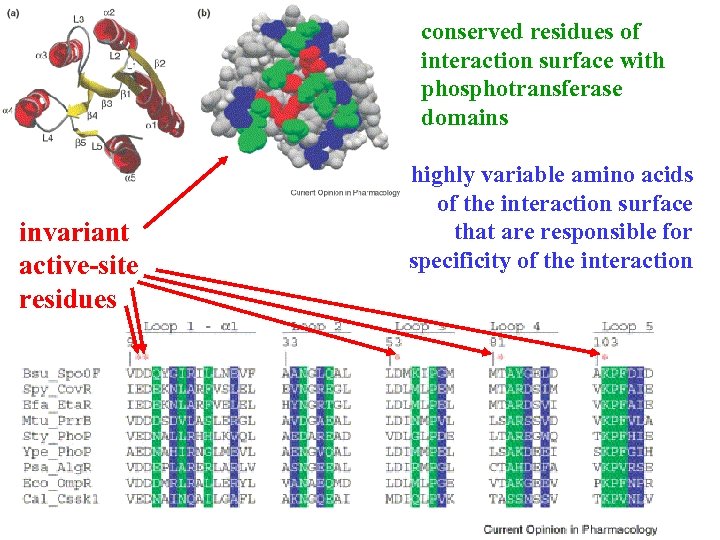
conserved residues of interaction surface with phosphotransferase domains invariant active-site residues highly variable amino acids of the interaction surface that are responsible for specificity of the interaction
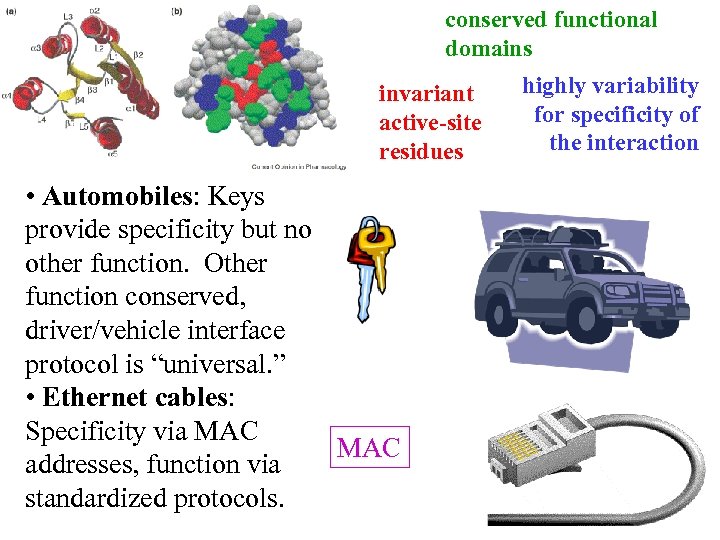
conserved functional domains invariant active-site residues • Automobiles: Keys provide specificity but no other function. Other function conserved, driver/vehicle interface protocol is “universal. ” • Ethernet cables: Specificity via MAC addresses, function via standardized protocols. highly variability for specificity of the interaction
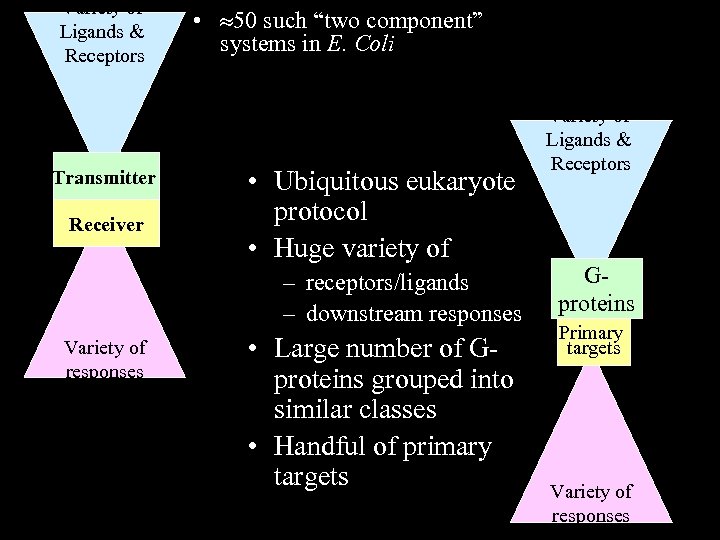
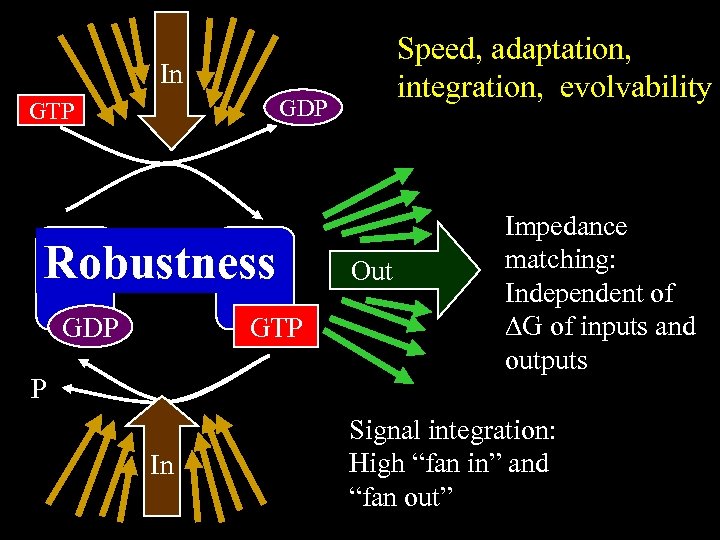
Variety of Ligands & Receptors Transmitter Receiver • 50 such “two component” systems in E. Coli • Ubiquitous eukaryote protocol • Huge variety of – receptors/ligands – downstream responses Variety of responses • Large number of Gproteins grouped into similar classes • Handful of primary targets Variety of Ligands & Receptors Gproteins Primary targets Variety of responses
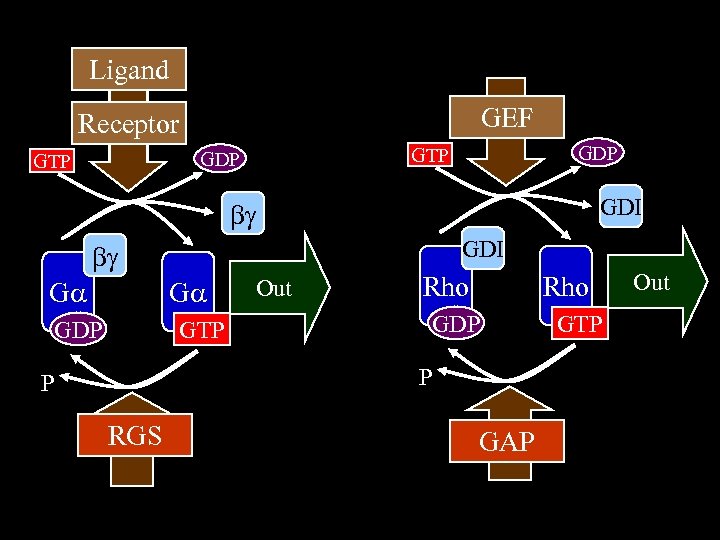
Ligand GEF In In Receptor GDP GTP GDI G G GTP GDP Out Rho GDP P P RGS In In GAP GTP Out
Receptors In GDP GTP G-proteins Out GDP GTP Primary targets P In Responses
In GDP GTP Robustness GDP GTP P In Speed, adaptation, integration, evolvability Out Impedance matching: Independent of G of inputs and outputs Signal integration: High “fan in” and “fan out”
Uncertain Variety of Ligands & Receptors Robust and highly evolvable Intermediates Variety of responses Uncertain Fragile and hard to change
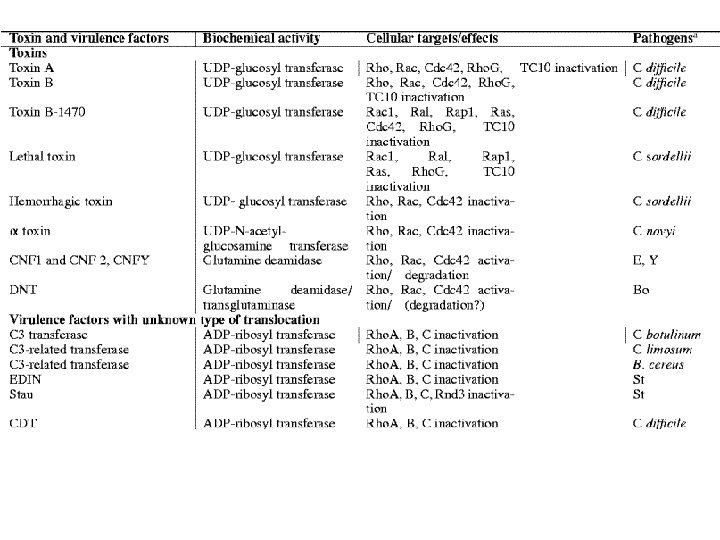
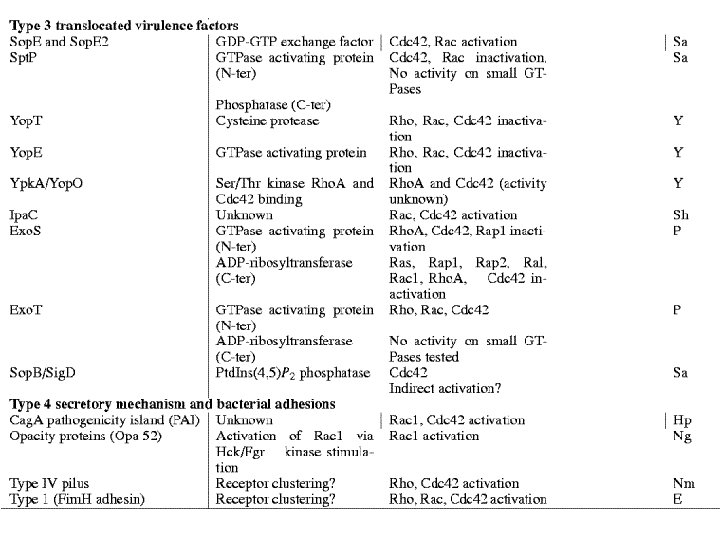
Fragility? • A huge variety of pathogens attack and hijack GTPases. • A huge variety of cancers are associated with altered (hijacked) GTPase pathways. • The GTPases may be the least evolvable elements in signaling pathways, in part because they facilitate evolvability elsewhere GEF In GDP GTP GDI Rho GTP GDP P In GAP Out
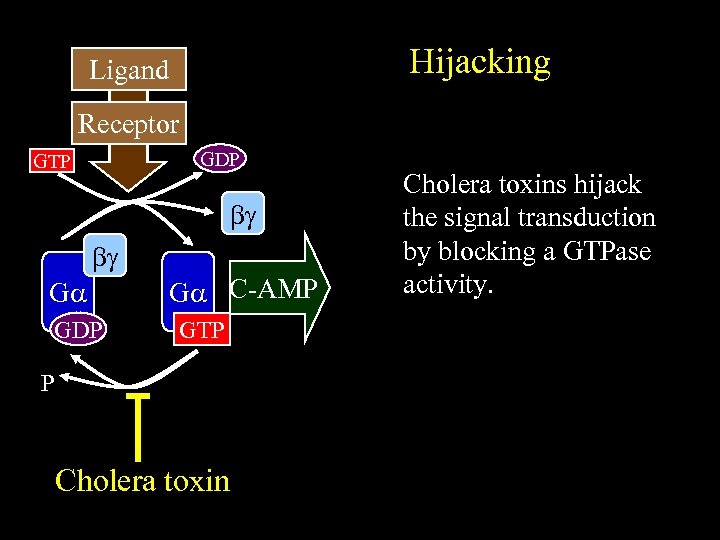
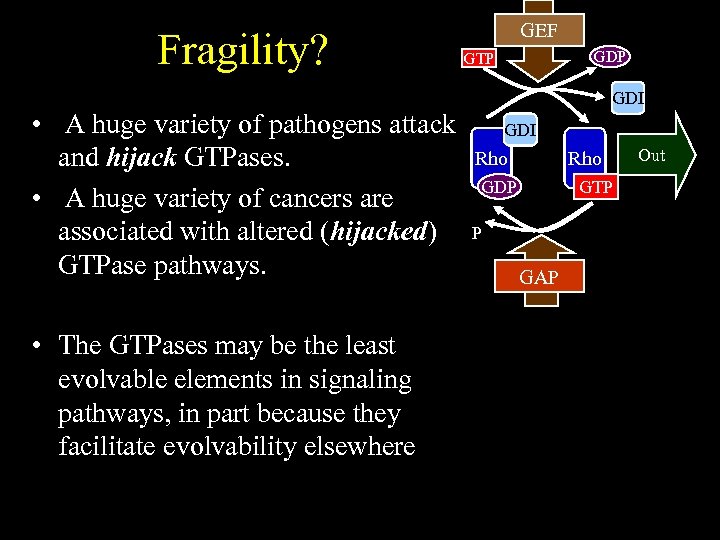
Hijacking Ligand In Receptor GDP GTP G GDP G C-AMP GTP P Cholera toxins hijack the signal transduction by blocking a GTPase activity.
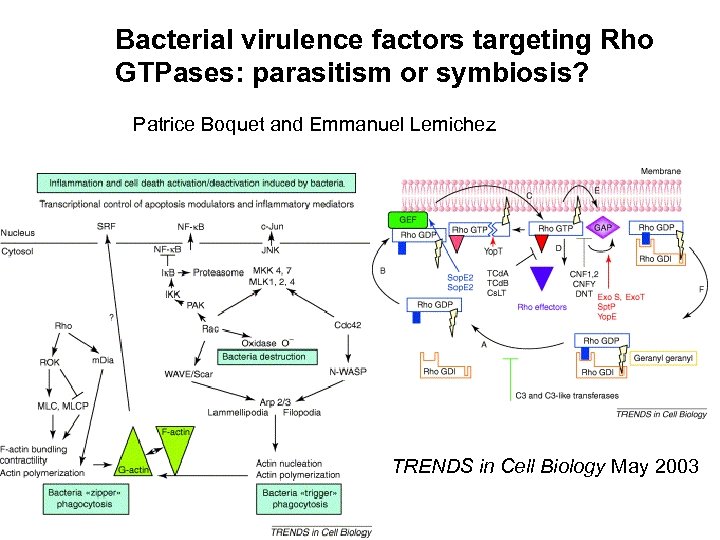
Bacterial virulence factors targeting Rho GTPases: parasitism or symbiosis? Patrice Boquet and Emmanuel Lemichez TRENDS in Cell Biology May 2003
Variety of Ligands & Receptors Transmitter Receiver Variety of responses But you already knew all this. • • • Ubiquitous protocol “Hourglass” Robust & evolvable Fragile to “hijacking” Manages extreme heterogeneity with selected homogeneity • Accident or necessity? Variety of Ligands & Receptors Gproteins Primary targets Variety of responses
Theoretical foundations for networks • The most rigorous, sophisticated, and applicable of existing theories – Computation – Control – Communications • • Have become fragmented and isolated Failed attempts at unified “new sciences” Need new mathematics Recent progress has been spectacular, both in rigor and relevance
A look back and forward • The Internet architecture was designed without a theory. • Many academic theorists told the engineers it would never work. • We now have a nascent theory that confirms that the engineers were right. • For MANETs and other new technologies, let’s hope we can avoid a repeat of this history.
Multiscale Physics Network Centric, Pervasive, Embedded, Ubiquitous Core theory challenges Systems Biology
Скачать презентацию Polymerization and complex Autocatalytic feedback assembly Taxis and
3368683f1ca02982b42bf25925c9d2f9.ppt