


 Скачать презентацию Polymer Synthesis Manufacturing Systems Frank Crossman and
e9e5cc75030dd1474e001e984090d2d4.ppt
- Количество слайдов: 21
 Polymer Synthesis & Manufacturing Systems Frank Crossman and Robert Milligan Overview From our current knowledge of the chemical makeup of the Mars regolith and atmosphere, we develop a sequence of chemical processes that produce sufficient quantities of chemical precursor and reagent stocks to (1)allow the synthesis of some important polymers for construction of a small permanent settlement in a two- Earth year time period and (2) provide the chemical industry infrastructure necessary to replicate that settlement in subsequent two-year cycles in arithmetic increments of settlers every two years. Aug-6 -05 F. Crossman and R. Milligan 1
 Scope We describe the synthesis & manufacture of three polymers which represent three uses of structural polymers on Mars: • polyethylene for piping and a variety of general storage containers. A pellet extruder and die system will be used to produce piping and joints, blown bottles, and other structural shapes from extruded sheet and assembled by thermal welding. • polyester to provide a matrix for glass fiber reinforced composites used for habitat module construction. Glass reinforced polyester matrix composites will be used where structural strength is critical such as in the habitat pressure vessels. The cylindrical pressure vessel structures will be fabricated in a wet filament winding machine and the polyester matrix will be cross-link cured at room temperature. • epoxy for use as a structural adhesive for metal, glass, and composite joints. Aug-6 -05 F. Crossman and R. Milligan 2
 Challenges in Polymer Manufacture on Mars … Imagine awaking in your bed one morning to discover that all man-made polymers in your daily life had disappeared. You have no sheets, no toothbrush, no computer, no microwave, no phone. You might have some cotton undergarments remaining… … Now imagine that you awakened in a world where oil is non-existent as well. Now you have no oil power, no gas heat, and no petroleum chemical stocks from which most chemicals and polymers are derived. … The challenge is to synthesize and manufacture polymers from scratch using available in-situ minerals and gases on Mars with chemical processing equipment that is sized to the Mars Homestead needs. Aug-6 -05 F. Crossman and R. Milligan 3
 Sizing the Chemical Plant Phase 2 Design studies have estimated the quantity materials needed to build a habitat sufficient to house 12 settlers. • 115 tonnes of fiber glass polyester composite, • 46 tonnes of polyethylene • 5 tonnes of epoxy adhesive These materials are produced during a 400 day period at average daily production rates of • 70 kg/day - Unsaturated polyester resin and styrene for crosslinked polyester • 116 kg/day - Polyethylene • 12 kg/day - Epoxy Pdc Machines, Inc. The size of the chemical reactor to produce 45 kg of unsaturated polyester resin (a viscous liquid) in a one batch a day process is Volume = mass/density = 45/1. 2 = 0. 038 cubic meters or 9. 4 gallons Conclusion: The chemical plant needed to produce these quantities is more than laboratory scale but less than that of many pilot plants on Earth. Aug-6 -05 F. Crossman and R. Milligan 4
 To Polymers working forward from known Mars resources The known in-situ Mars resources that we start with are small in number and rely on the existence of a chemical processing capability already established on Mars to produce the bare necessities of life including methane for fuel and oxygen to breathe. The 12 chemical building blocks are: • CO 2 (carbon dioxide) and N 2 (nitrogen) from the atmosphere of Mars • H 2 O (water), Na. Cl (salt), and hydrated Ca. SO 4 (gypsum), silica, alumina, magnesia from the regolith of Mars • CO (carbon monoxide), CH 4 (methane) from the making* of methane fuel • H 2 (hydrogen) and O 2 (oxygen) from the electrolysis* of water to obtain oxygen * (see R. Zubrin, The Case for Mars, 1996) All the rest of the required chemicals and polymers are derived from this short list of pre-existing chemicals. Aug-6 -05 F. Crossman and R. Milligan 5
 The end products Case 1: Polyethylene flake + remelted/formed = Polyethylene thermoplastic Case 2: Bisphenol A + Epichlorohydrin + Diamine accelerator = Crosslinked Epoxy Adhesive Case 3: Glass fiber + Unsaturated Polyester Resin + Styrene + Peroxide initiator = Glass Fiber Reinforced, Crosslinked Polyester Composite For this presentation we’ll detail the materials needed for the third case- glass fiber reinforced composites for pressure vessels. Aug-6 -05 F. Crossman and R. Milligan 6
 Working backward from crosslinked polyester • Unsaturated Polyester Resin (1) which is derived from Maleic anhydride (2) which is derived from butane (3) (& O 2 & VPO catalyst) which is derived from butene (4) (& H 2 & Raney Ni catalyst) which is derived from methanol (5) (& Zeolite catalyst) which is derived from CO, H 2, CO 2 and Ethylene glycol (6) is which derived from oxirane (7) (& steam) is which derived from ethylene (8) (& Ag and Al 2 O 3 catalysts) which is derived from methanol • Styrene (9) which is derived from ethylbenzene (10) (& Fe catalyst) which is derived from benzene (11) (& Zeolite catalyst) which is derived from CO 2, H 2 O and Aug-6 -05 ethylene (12) which is derived from methanol F. Crossman and R. Milligan 7
 Working backward to the basic 12 chemicals And as the reaction initiator • Methyl ketone peroxide (13) which is derived from 2 -butanone (14) which is derived from 2 -butanol (15) which is derived from butene and hydrogen peroxide(16) which is derived from sulfuric acid (17) which is derived from SO 2 (18) (& O 2, H 2 O & Vanadium dioxide catalyst) which is derived from Gypsum thermal decomposition and HCl (19) which is derived from sulfuric acid and Na. Cl . So…a total of 19 chemicals derived from the 12 basic chemicals have been identified for the production of crosslinked polyester on Mars. Aug-6 -05 F. Crossman and R. Milligan 8
 Summary: all polymer precursor chemicals 8 inorganic chemicals Proceeding in a similar fashion with the backward derivation of polyethylene and epoxy to the 12 basic chemicals, we discover that we need a total of • 8 inorganic chemicals produced on Mars • 30 organic polymer precursor chemicals produced on Mars • 15 recoverable catalysts imported initially from Earth in small quantity 30 Organic polymer precursor chemicals Aug-6 -05 F. Crossman and R. Milligan 15 Imported Catalysts 9
 The analysis of each chemical reaction and the sequencing of these reactions has been carried to the level of detail shown on this slide and the next. CH 3 COCH 3 1 -10 atm. , O 2 [Cumene Hydro Cumene (2 -Phenylpropane) 82 - 90 o. C, -peroxide CHP] radical initiator Ca. 30% To 8. 60 -70 o. C H+, H 20 Phenol Vacuum distill unreacted cumene Weak caustic scrub to remove phenol, acids Aug-6 -05 F. Crossman and R. Milligan 10
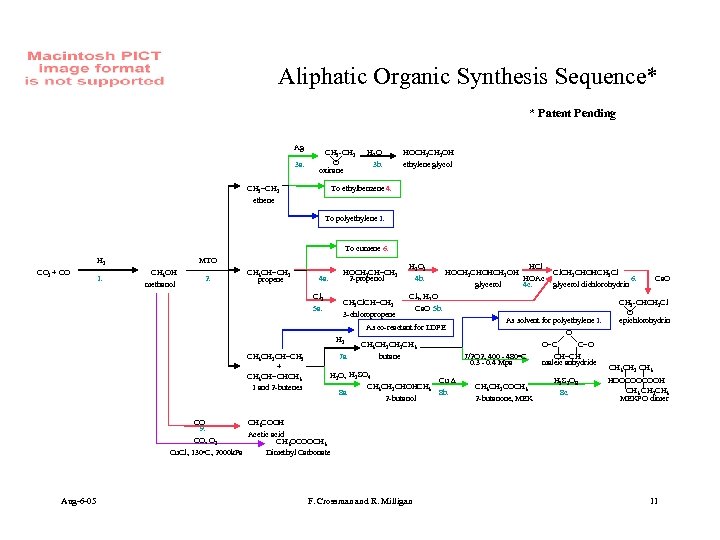 Aliphatic Organic Synthesis Sequence* * Patent Pending Ag 3 a. CH 2 -CH 2 O oxirane H 2 O 3 b. HOCH 2 OH ethylene glycol To ethylbenzene 4. CH 2=CH 2 ethene To polyethylene 1. To cumene 6. H 2 CO 2 + CO 1. MTO CH 3 OH methanol 2. CH 3 CH=CH 2 propene HOCH 2 CH=CH 2 2 -propenol 4 a. Cl 2 5 a. CH 2 Cl. CH=CH 2 3 -chloropropene H 2 O 2 4 b. HCl HOCH 2 CHOHCH 2 OH HOAc glycerol 4 c. Cl 2, H 2 O Ca. O 5 b. As co-reactant for LDPE H 2 CH 3 CH 2 CH=CH 2 + CH 3 CH=CHCH 3 1 and 2 -butenes 7 a. Cl. CH 2 CHOHCH 2 Cl 6. glycerol dichlorohydrin CH 3 CH 2 CH 3 butane H 2 O, H 2 SO 4 CH 3 CH 2 CHOHCH 3 8 a. 2 -butanol As solvent for polyethylene 1. 7/2 O 2, 400 - 480 o. C 0. 3 - 0. 4 Mpa Cu D 8 b. CH 3 CH 2 COCH 3 2 -butanone, MEK O O=C C=O CH=CH maleic anhydride H 2 S 2 O 8 8 c. Ca. O CH 2 -CHCH 2 Cl O epichlorohydrin CH 3 CH 2 CH 3 HOOCOOCOOH CH 3 CH 2 CH 3 MEKPO dimer CO CH 3 COOH 9. Acetic acid CO, O 2 CH 3 OCOOCH 3 Cu. Cl, 130 o. C, 2000 k. Pa Dimethyl Carbonate Aug-6 -05 F. Crossman and R. Milligan 11
 Manufacturing the glass fiber Glass fiber is the least energy intensive fiber to produce on Mars. Three main types of fiber glass 1. C glass (uncommon) used in corrosive environments. It is a soda-lime-borosilicate composition 2. E glass used in printed circuit boards. Has the greatest number of components. 3. S glass used in aerospace for its high strength and resistance to moisture. It has the highest strength and modulus of all these fibers and it is the simplest composition of only silica, alumina, and magnesia or simply magnesium aluminosilicate Since we want the strongest fiber, and it is the simplest composition using compounds that we know exist on Mars, we will make S glass fiber. Aug-6 -05 F. Crossman and R. Milligan 12
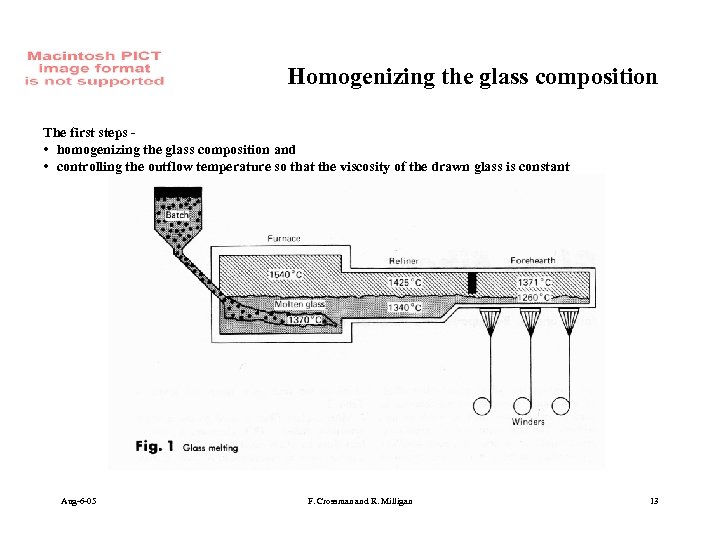 Homogenizing the glass composition The first steps - • homogenizing the glass composition and • controlling the outflow temperature so that the viscosity of the drawn glass is constant Aug-6 -05 F. Crossman and R. Milligan 13
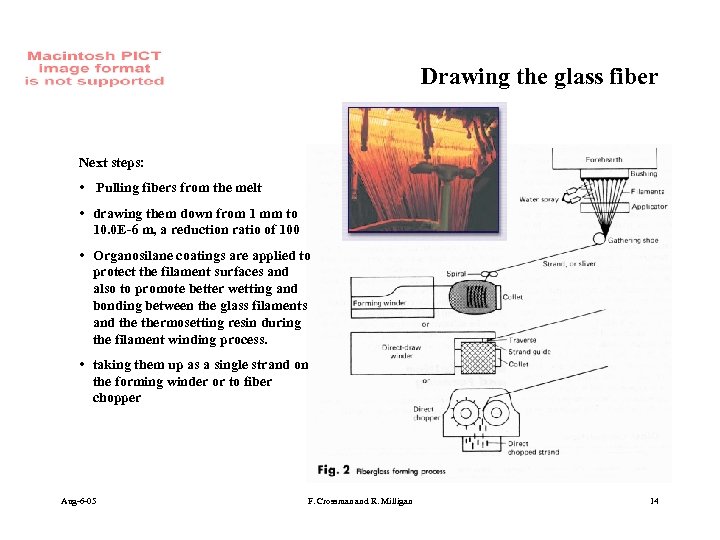 Drawing the glass fiber Next steps: • Pulling fibers from the melt • drawing them down from 1 mm to 10. 0 E-6 m, a reduction ratio of 100 • Organosilane coatings are applied to protect the filament surfaces and also to promote better wetting and bonding between the glass filaments and thermosetting resin during the filament winding process. • taking them up as a single strand on the forming winder or to fiber chopper Aug-6 -05 F. Crossman and R. Milligan 14
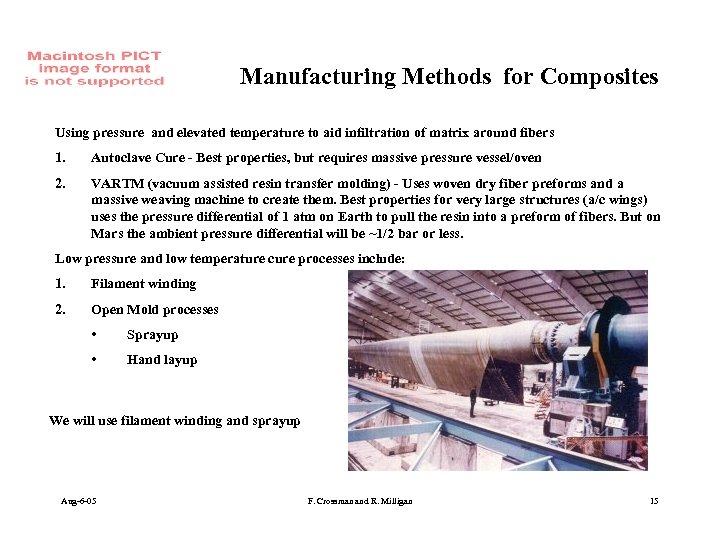 Manufacturing Methods for Composites Using pressure and elevated temperature to aid infiltration of matrix around fibers 1. Autoclave Cure - Best properties, but requires massive pressure vessel/oven 2. VARTM (vacuum assisted resin transfer molding) - Uses woven dry fiber preforms and a massive weaving machine to create them. Best properties for very large structures (a/c wings) uses the pressure differential of 1 atm on Earth to pull the resin into a preform of fibers. But on Mars the ambient pressure differential will be ~1/2 bar or less. Low pressure and low temperature cure processes include: 1. Filament winding 2. Open Mold processes • Sprayup • Hand layup We will use filament winding and sprayup Aug-6 -05 F. Crossman and R. Milligan 15
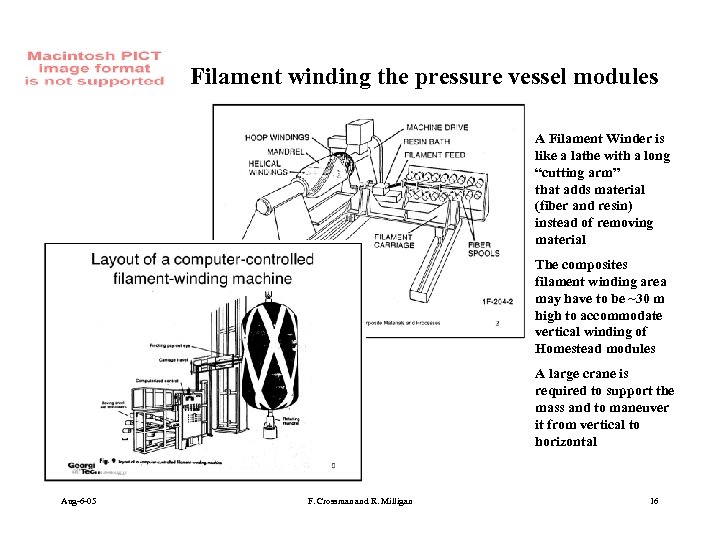 Filament winding the pressure vessel modules A Filament Winder is like a lathe with a long “cutting arm” that adds material (fiber and resin) instead of removing material The composites filament winding area may have to be ~30 m high to accommodate vertical winding of Homestead modules A large crane is required to support the mass and to maneuver it from vertical to horizontal Aug-6 -05 F. Crossman and R. Milligan 16
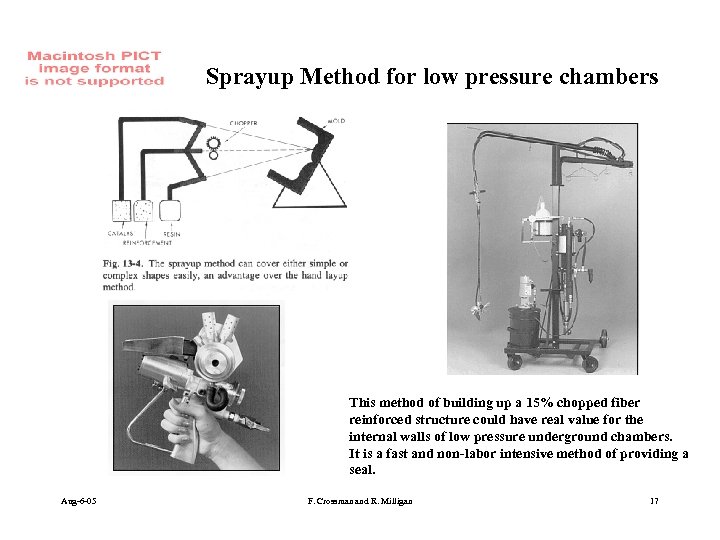 Sprayup Method for low pressure chambers This method of building up a 15% chopped fiber reinforced structure could have real value for the internal walls of low pressure underground chambers. It is a fast and non-labor intensive method of providing a seal. Aug-6 -05 F. Crossman and R. Milligan 17
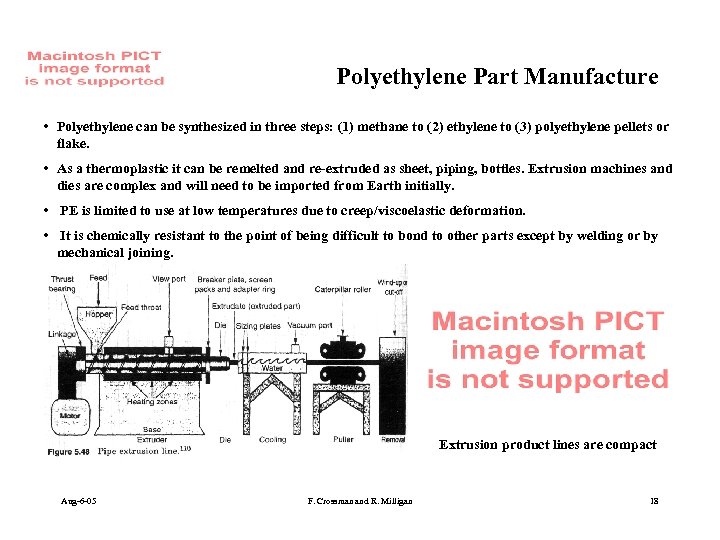 Polyethylene Part Manufacture • Polyethylene can be synthesized in three steps: (1) methane to (2) ethylene to (3) polyethylene pellets or flake. • As a thermoplastic it can be remelted and re-extruded as sheet, piping, bottles. Extrusion machines and dies are complex and will need to be imported from Earth initially. • PE is limited to use at low temperatures due to creep/viscoelastic deformation. • It is chemically resistant to the point of being difficult to bond to other parts except by welding or by mechanical joining. Extrusion product lines are compact Aug-6 -05 F. Crossman and R. Milligan 18
 Conclusions • We have analyzed the requirements to establish a chemical processing and polymer manufacturing plant on Mars capable of producing, over a period of 400 days, 166 tonnes of glass reinforced polyester composites for pressurized habitats, polyethylene piping and sheet, and a quantity of epoxy adhesive for general structural bonding use. • The route to polymer precursor formulation uses syntheses that do not rely on a petroleum precursor, the basis for much of today’s chemical industry. • Based on literature and patent searches, we have established the reaction sequence and conditions (temperature, pressure, catalyst, reactants, products) to produce the polymer end products. • In the process we have also established the production of a range of organic and inorganic chemicals and reagents that have other uses such as in the extraction and refining of metals and ceramics from the Mars regolith. The authors want to express their gratitude to Mark Homnick, Bruce Mac. Kenzie, and Joseph Palaia the founders of the Mars Foundation, without whose support and encouragement this project would not have been undertaken. Aug-6 -05 F. Crossman and R. Milligan 19
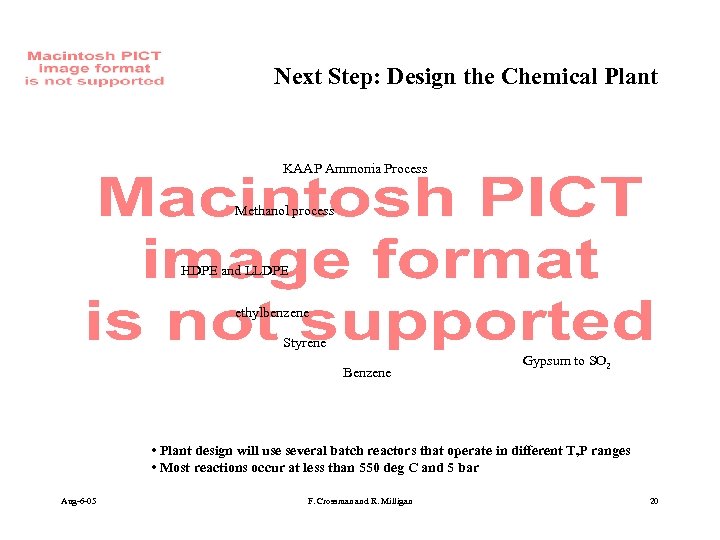 Next Step: Design the Chemical Plant KAAP Ammonia Process Methanol process HDPE and LLDPE ethylbenzene Styrene Benzene Gypsum to SO 2 • Plant design will use several batch reactors that operate in different T, P ranges • Most reactions occur at less than 550 deg C and 5 bar Aug-6 -05 F. Crossman and R. Milligan 20
 The Next Step The next step requires a chemical engineering plant design that is unique to Mars. • The reaction products must be stored and/or fed as reactants to the next reaction sequence. • Reaction chambers should be designed for production of several different chemical products that share similar reaction temperature and pressure conditions. • The reaction sequences must be prototyped to establish the reaction kinetics - optimum temperature & pressure conditions, catalyst type, and the yield of each reaction. While many individual chemical processes on Earth are licensable, they are designed for very large automated, continuous production in facilities that occupy hundred of acres. It is not evident that the Mars facility can take advantage of this prior art. • The Mars Homestead chemical processing plant will involve a total plant size that is on the order of a small pilot plant on Earth. • Like most pilot plants The Mars Homestead chemical processing plant will likely use batch rather than automated, continuous processing of chemicals, and this must be accomplished in a way that will not be human labor intensive. It will of necessity require robotic support and automated sensing and control equipment. The Mars Foundation is soliciting the help of a Chemical Engineering group at a university or research institute. Aug-6 -05 F. Crossman and R. Milligan 21