



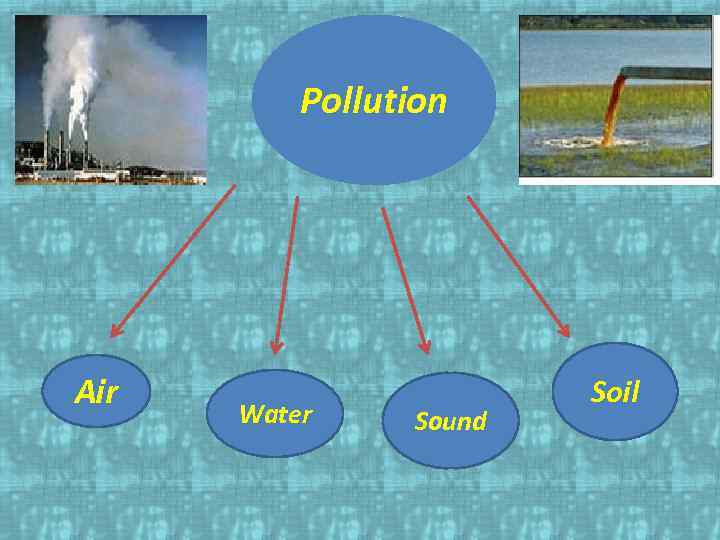
 Pollution Air Water Sound Soil
 What is Air pollution. Air is the ocean we breathe. Air supplies us with oxygen which is essential for our bodies to live. Air is 99. 9% nitrogen, oxygen, water vapor and inert gases. Human activities can release substances into the air, some of which can cause problems for humans, plants, and animals.
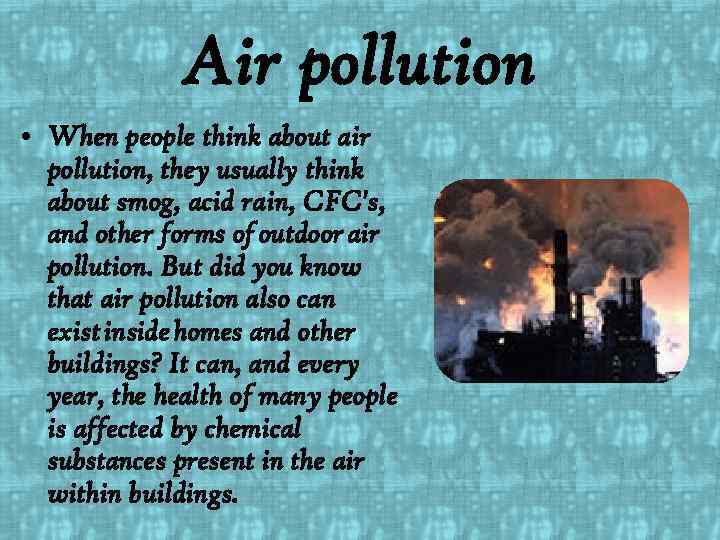 Air pollution • When people think about air pollution, they usually think about smog, acid rain, CFC's, and other forms of outdoor air pollution. But did you know that air pollution also can exist inside homes and other buildings? It can, and every year, the health of many people is affected by chemical substances present in the air within buildings.
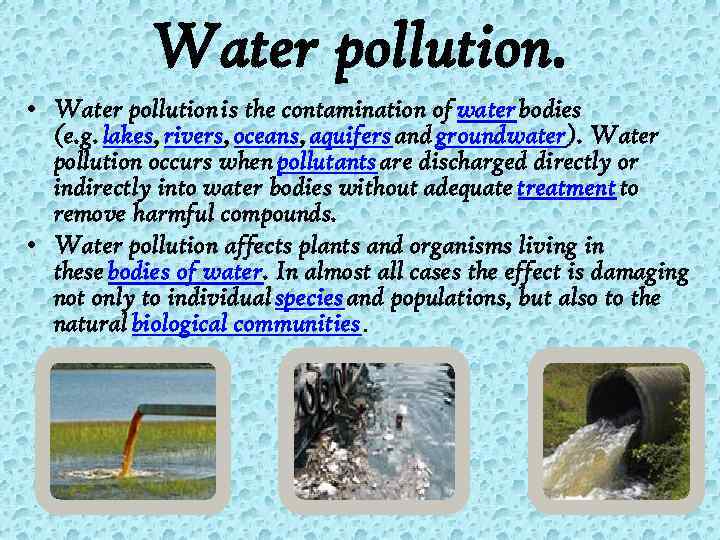 Water pollution. • Water pollution is the contamination of water bodies (e. g. lakes, rivers, oceans, aquifers and groundwater). Water pollution occurs when pollutants are discharged directly or indirectly into water bodies without adequate treatment to remove harmful compounds. • Water pollution affects plants and organisms living in these bodies of water. In almost all cases the effect is damaging not only to individual species and populations, but also to the natural biological communities.
 Sound pollution. • Noise pollution is excessive, displeasing human, animal, or machine-created environmental noise that disrupts the activity or balance of human or animal life. The word noise may be from the Latin word nauseas, metaphorically meaning disgust or discomfort. [1] The source of most outdoor noise worldwide is mainly construction and transportation systems, including motor vehicle noise, aircraft noise, and rail noise. [2][3] Poor urban planning may give rise to noise pollution, since side-by-side industrial and residential buildings can result in noise pollution in the residential area.
 What is soil pollution. • Soil pollution results from the build up of contaminants, toxic compounds, radioactive materials, salts, chemicals and cancer-causing agents. The most common soil pollutants are hydrocarbons, heavy metals (cadmium, lead, chromium, copper, zinc, mercury and arsenic), herbicides, pesticides, oils, tars, PCBs and dioxins. Until the 1970 s, there was little talk of soil pollution and its devastating effects. In the 1980 s, the U. S. Superfund was created to set guidelines for the handling of hazardous material and soil contamination cleanup. Today there are more than 200, 000 sites awaiting EPA soil cleanup, which is very expensive and labor-intensive work. Even a small cleanup project can cost $10, 000, while larger areas require millions of dollars to clean it up for future use. Does this Spark an idea?
 Soil pollution.