


 Скачать презентацию Politics Politics is a social
cf29962d3e002559ecba12cfb23f1787.ppt
- Количество слайдов: 18
 Politics • • • Politics is a social process through which people and groups acquire, exercise, maintain, or lose power over others. (Sociology) Politics is the art or science of government or governing, especially the governing of a political entity, such as a nation, and the administration and control of its internal and external affairs. Politics is the activities or affairs engaged in by a government, politician, or political party. “All politics is local”--Thomas P. O'Neill, Jr. “Politics have appealed to me since I was at Oxford because they are exciting morning, noon, and night”-Jeffrey Archer
 Political Systems • Authoritarian—power is monopolized by a small elite (or a single leader) who govern without constitutional limits and who recognize responsibility only to themselves rather than the general public • Democratic—power is based on popular participation in decision making, where ultimate authority is vested in people
 Authority and Power • Authority is legitimate power that has widespread social approval and is obeyed because people believe that those who exercise it have a right to do so--or because people see no need or way to change it – Traditional—based on custom or habit – Legal-rational—based on rules, regulations, and procedures – Charismatic—based on a leader’s personal qualities – Expertise—derived from the possession of specialized knowledge
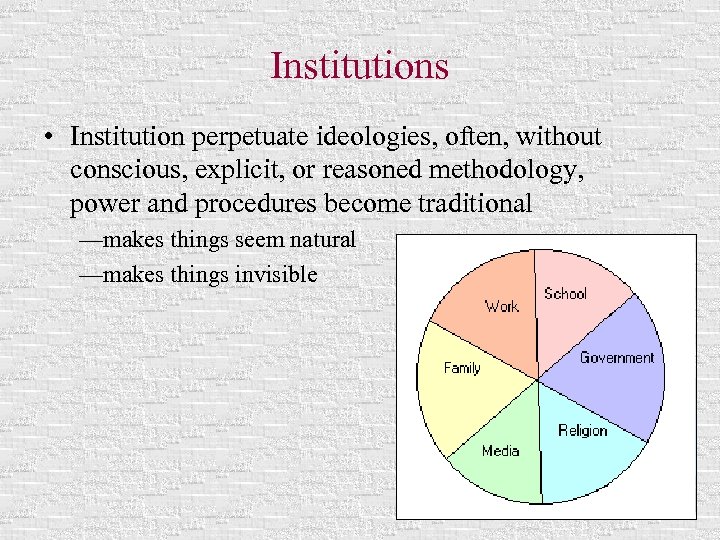 Institutions • Institution perpetuate ideologies, often, without conscious, explicit, or reasoned methodology, power and procedures become traditional —makes things seem natural —makes things invisible
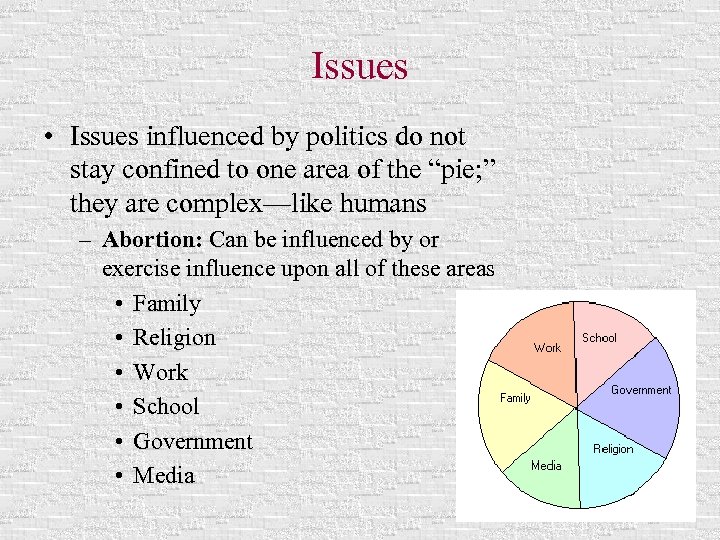 Issues • Issues influenced by politics do not stay confined to one area of the “pie; ” they are complex—like humans – Abortion: Can be influenced by or exercise influence upon all of these areas • Family • Religion • Work • School • Government • Media
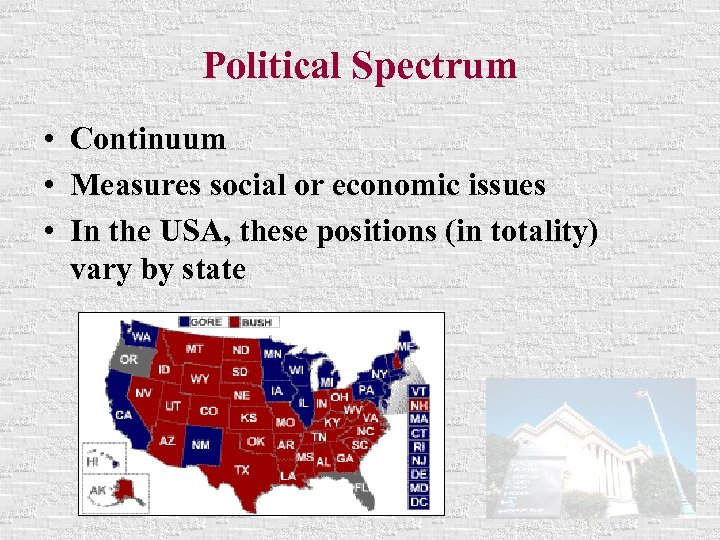 Political Spectrum • Continuum • Measures social or economic issues • In the USA, these positions (in totality) vary by state
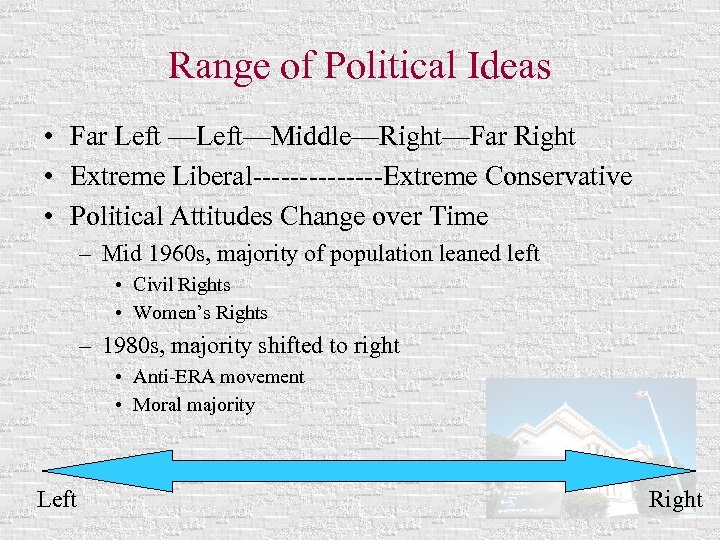 Range of Political Ideas • Far Left —Left—Middle—Right—Far Right • Extreme Liberal-------Extreme Conservative • Political Attitudes Change over Time – Mid 1960 s, majority of population leaned left • Civil Rights • Women’s Rights – 1980 s, majority shifted to right • Anti-ERA movement • Moral majority Left Right
 Variations in Political Ideas • By Time • By Region – Massachusetts and Minnesota • Liberal – Indiana and Texas • Conservative • By Ethnicity and Religion – Jewish – Asians Liberal Conservative • By Gender – Women are more liberal than men, especially female feminists, and become more liberal as they age; men become more conservative as they age.
 Social Liberals • • • Lean to the left (side of the continuum) Shape their own lifestyles Want freedom to decide on moral questions Favor expanding opportunities for women Pro-Choice Propose [equal] rights for gay men and lesbians
 Social Conservatives • On the right (side of the continuum) • Respect the traditional family – Marriage forever – Children are valued but subordinate – Men at work, women at home • Criticize too much individualism • Favor Pro-Life • Look to the past, to tradition, for answers
 Economic • Decisions about how a society should distribute its material resources – How much control government should have – How much social inequality there should be • Liberals favor government regulation of the economy to reduce inequality – Free-market, laissez-faire is BAD – Higher minimum wage and high taxes on rich to pay for social services for the poor • Conservatives want limited government role – Market sets wage levels – Want lower tax rates so people keep more of their earnings and take responsibility for themselves
 Existing Political System • Both Liberal and Conservatives want changes to occur within the current system • Radicals, those “off the spectrum, ” want change of the system, itself – Extremely liberal or extremely conservative
 Demographics of Representation • Blacks in the 108 th Congress – 39 in House: 39 Democrats; 0 in Senate • Hispanics in the 108 th Congress – 25 in House: 5 Republicans, 20 Democrats; 0 in Senate • Asians and Pacific Islanders in the 108 th Congress – 5 in House: 5 Democrats; 2 in Senate: 2 Democrats • American Indians in the 108 th Congress – 2 in House: 1 Democrat, 1 Republican; 1 in Senate: 1 Republican • Women in the 108 th Congress – 62 in House: 21 Republicans, 41 Democrats; 14 in Senate: 5 Republicans, 9 Democrats – Of these 62, approximately 12 are also Black and 7 are also Hispanic
 Abortion Controversy • Liberals: Legal access to abortion is the key to women having control over their bodies (economy, career, etc. ) during childbearing years and for their entire life. – Establishes independence from men when they (women) have more income earning opportunities.
 Abortion Controversy • Conservatives: Killing of unborn children; the issue is a matter of life and death – Nothing to do with economics or independence
 Mild Statistics • A typical woman receiving an abortion: – – Is in her 20 s Has already had one Is probably white (58%) Is unmarried (81%)
 Social – Political debates about moral judgments about how people should live Feminism Abortion Homosexual Marriages Death Penalty –Liberals –Favor expanding opportunities for women –Pro-choice –Greater rights for homosexuals –Conservatives –Want women to stick to , embrace, and enjoy traditional roles –Pro-Life –Homosexuals should choose traditional roles –Endorse Death Penalty
 Politics by Demographics • High Education, Good Wealth lead to “good” social position – Tend to be Liberal, more tolerant of difference in lifestyles • Little Education, Little Wealth tend to have “lower” social position – Tend to be conservative on social issues – Tend to be liberal on economic issues • • Very little difference in the way men and women vote or make decisions. Social position determines political ideology.