


 Скачать презентацию Politics Mathematics Education A Call for Action
9194202de2f54a0614e347b91bf492a0.ppt
- Количество слайдов: 49
 Politics & Mathematics Education: A Call for Action Dr. Eric Milou Rowan University Department of Mathematics milou@rowan. edu 856 -256 -4500 x 3876 1
 Outline Math Wars History Lesson NJ Standards & Politics State Standards, NAEP & the Fordham Foundation NSF, NMP, Singapore Calculators Common Core Standards Assessments 2
 HOW WE GOT HERE • A defining moment occurred when the National Council of Teachers of Mathematics (NCTM) released Curriculum and Evaluation Standards for School Mathematics in 1989. This document sparked the contentious debate known as the “math wars” and firmly established two distinct “camps”: reformists or standards-based advocates and traditionalists or basic skill advocates. • Throughout the 1990 s, the Standards movement gained momentum as the National Science Foundation (NSF) funded many standards-based curricula. Moreover, motivated by NCTM’s example in mathematics, the NRC undertook the creation of the National Science Education Standards (1995) and fields as diverse as English and social studies wrote standards. • In October 1999, the U. S. Department of Education recommended a list of math books, including several reform NSF-supported texts. Within a month of that release, an open letter was sent to Secretary Riley calling upon his department to withdraw those recommendations.
 And More… • The debate raged on the Internet with many groups displaying a thesaurus of derogatory terms for reform curricula and texts. Reformists and NCTM were slow to respond to the verbal sparring. The revision of the Standards in 2000, Principles and Standards for School Mathematics, made little difference as both camps were dug in to their positions. • Thus for 20 years, we continue to have various agreements and disagreements. But almost all agree that the status quo is unacceptable and mathematics instruction must improve. 4
 NEW JERSEY Standards created in 1990 s based on NCTM Standards. Revisions made on a 5 year cycle. 2008 revision made on time and submitted to the state. State rejects them and in February 2009 issues its own set of standards copied from other states (200 standards directly copied from Indiana). Heavy political pressure from small vocal minority group. State convenes task force. 5
 Political Pressure NJ coalition for world class math Rhetoric is simple: Constructivism is evil No Calculators; Standard algorithm ONLY America is so far behind the rest of the world California is great We love Singapore; we hate Everyday Math and Connected Mathematicians not Math Educators 6
 Letter I find it abhorrent that mathematics educators are hoping to continue to dictate the content of math standards that will drive curricula throughout the state of NJ. It is becoming increasingly evident that there is a clear divide between those who teach mathematics (or teach mathematics teachers), and those who actually use mathematics in their daily life as scientists, engineers, or in other professions. The failures in this educator‐driven approach to curriculum are reflected in the continued decline of the United States’ dominant position in science, engineering and mathematics. Since the NCTM recommendations of ~20 years ago were developed into various curricula, the level of mathematics competency within the US has been abysmal. Now, with the State of NJ poised to draft new core curriculum content standards for math that eschew many of the components of the NCTM recommendations, your group hopes to continue to hold NJ's students back by holding fast to the status quo. 7
 The Latest Seattle Public Schools sued for selecting inquiry math HS textbook Judge sides with plaintiffs. http: //www. seattlepi. com/local/4150 49_math 04. html Key. Press response: http: //www. keypress. com/seattle 8
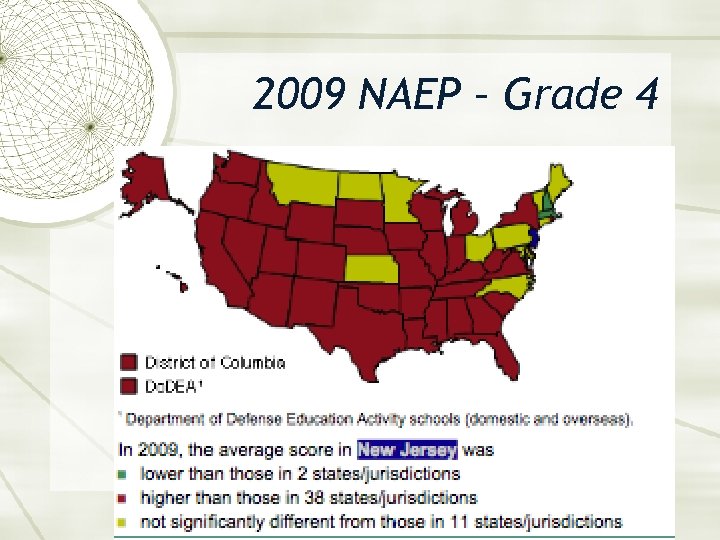 2009 NAEP – Grade 4 9
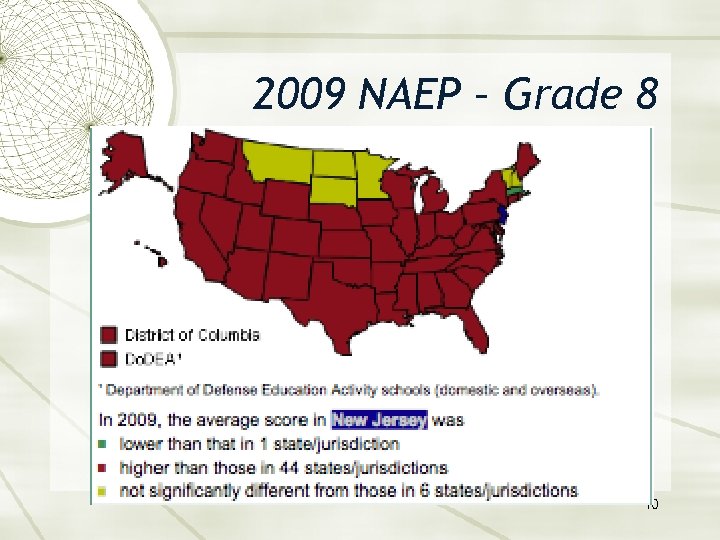 2009 NAEP – Grade 8 10
 Fordham Foundation Right Wing Think Tank New Jersey's Math Standards graded "D”. Three states, California, Indiana, and Massachusetts - earned an "A” NJ has: widespread use of calculators, the lack of memorization of basic facts, the rejection of teaching standard algorithms, insufficient instruction on fractions, obsession with patterns and manipulatives, the over-emphasis of estimation, probability and statistics 11
 EDUCATION POLICY STUDIES LABORATORY (ASU) This review found no evidence supporting the validity of the grades and also found no evidence of a relationship to student academic performance, contrary to the report’s conclusions. The report’s claims in support of its grading practice were selectively data-mined and were seriously lacking in methodological rigor. Policymakers and educators would be ill-advised to base any decisions about policy or practice on the grades assigned by this report. http: //epsl. asu. edu/epru/ttreviews/EPSL-0609 -209 -EPRU. pdf 12
 NSF supported Curricula Everyday Math, Investigations and Connected Math All three programs have been extensively studied and all have shown to have a positive impact on student achievement – particularly in the domains of conceptual understanding and problem solving; and None of the four major brother-sister traditional programs (Houghton-Mifflin/Mc. Dougal-Littell, Harcourt/Holt, Scott Foresman/Prentice Hall, and Mc. Graw Hill/Glencoe) have been subject to any kind of similar evaluation.
 Reformed vs. Traditional Programs • If we seek to honestly explain the dismal NAEP and TIMSS performance, it is far more likely the result of the fact that 80% of the classrooms in the U. S. use traditional materials than the minimal intrusion of reform programs.
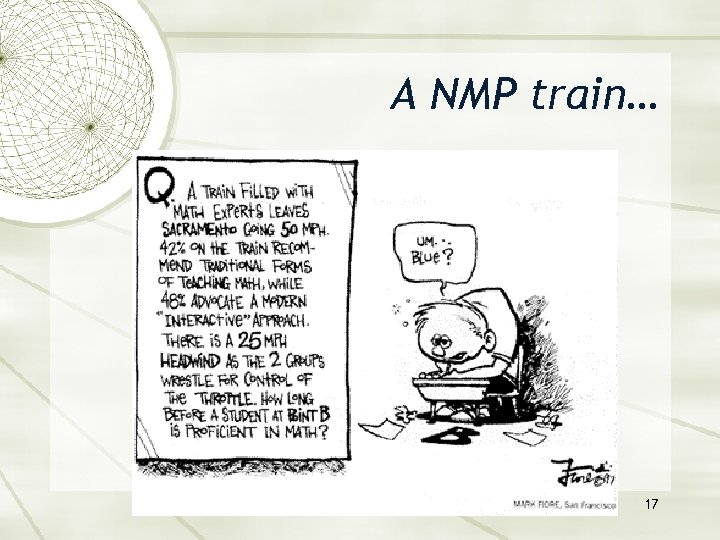
 National Math Panel (NMP) Any approach that continually revisits topics year after year without closure is to be avoided. High-quality research does not support the contention that instruction should be either entirely “student centered” or “teacher directed. ” A major goal for K– 8 mathematics education should be proficiency with fractions (including decimals, percents, and negative fractions). 15
 NMP Critique Panel had 19 members, only 5 (4 mathematics educators and the one mathematics teacher) regularly had sustained interactions with mathematics instruction at the K– 12 level; fewer than half the Panel members had documented academic preparation in mathematics. Of the 466 journal articles referenced in the task group’s report, mathematics education articles constituted only slightly more than 10%, whereas psychological accounts constituted approximately 70% of the references. Only one leading research journal in mathematics education had more than 10 citations. 16
 A NMP train… 17
 Teaching Gap, Stigler and Hiebert, 1999 Stated vs Developed
 CALCULATORS • A review of 11 studies that met the National Math Panel’s rigorous criteria (only one study less than 20 years old) found limited or no impact of calculators on calculation skills, problem solving, or conceptual development over periods of up to one year. 19
 Calculator Memo No calculator on SCRs items in all grades In grades 3 and 4, calculators will be permitted on one of the five remaining parts. In grades 5 through 8, calculators will be permitted on three of the five remaining parts. The overall test design does take into account the additional time (15 seconds more for each non calculator item); however, the overall test time has not significantly increased in any of the grade levels. The calculator use policy for the High School Proficiency Assessment (HSPA) remains unchanged. 20
 Common Core Standards http: //www. Core. Standards. org/Standards/index. htm The Council of Chief State School Officers and The National Governors Association Center for Best Practices Fewer, clearer, and higher, to best drive effective policy and practice; Aligned with college and work expectations, so that all students are prepared for success upon graduating from high school; Inclusive of rigorous content and application of knowledge through high-order skills, so that all students are prepared for the 21 st century; Internationally benchmarked, so that all students are prepared for succeeding in our global economy and society; and Research and evidence-based. 21
 The Process End-of-High-School Expectations K-12 Standards in Language Arts and Math (early February 2010? ) Adoption Each state adopting the common core either directly or by fully aligning its state standards may do so in accordance with current state timelines for standards adoption not to exceed three (3) years. States that choose to align their standards to the common core standards accept 100% of the core in English language arts and mathematics. States may additional standards. 22
 Race to the Top Fund The Obama administration has proposed giving states that adopt common standards a competitive advantage in seeking federal aid, as part of the $4 billion Race to the Top Fund, a pool of economicstimulus money. Obama Wants to Link Title I Aid to College-Career Standards 23
 Why national standards? The current argument used by today’s proponents of nationalizing education is American children need to score at or near the top on international tests of academic achievement in order for the U. S. to remain economically competitive, and; a national curriculum will cause that to happen. 24
 Alfie Kohn’s Response Debunking the Case for National Standards If you read the FAQs page on the common-core- standards Web site, don’t bother looking for words like “exploration, ” “intrinsic motivation, ” “developmentally appropriate, ” or “democracy. ” Instead, the very first sentence contains the phrase “success in the global economy, ” followed immediately by “America’s competitive edge. ” http: //tinyurl. com/yarqj 9 z 25
 K-12 Grade Level Standards The document provides grade level standards for mathematics in grades K– 8, and high school standards organized under the headings of the College and Career Readiness Standards in Mathematics. In other words, in grades 9 -12, there are not grade level standards but standards by content area. 26
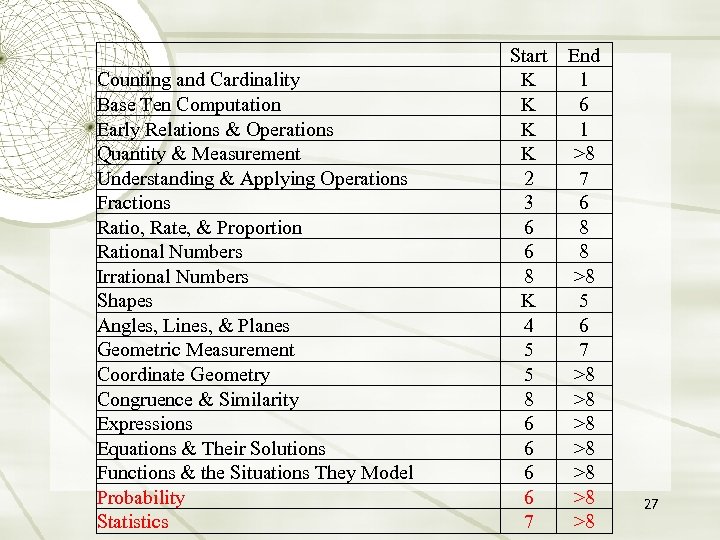 Counting and Cardinality Base Ten Computation Early Relations & Operations Quantity & Measurement Understanding & Applying Operations Fractions Ratio, Rate, & Proportion Rational Numbers Irrational Numbers Shapes Angles, Lines, & Planes Geometric Measurement Coordinate Geometry Congruence & Similarity Expressions Equations & Their Solutions Functions & the Situations They Model Probability Statistics Start K K 2 3 6 6 8 K 4 5 5 8 6 6 7 End 1 6 1 >8 7 6 8 8 >8 5 6 7 >8 >8 27
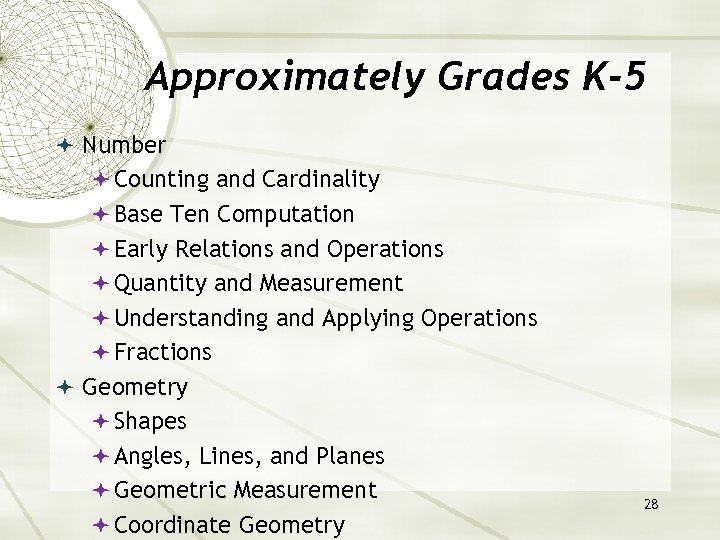 Approximately Grades K‐ 5 Number Counting and Cardinality Base Ten Computation Early Relations and Operations Quantity and Measurement Understanding and Applying Operations Fractions Geometry Shapes Angles, Lines, and Planes Geometric Measurement Coordinate Geometry 28
 Approximately Grades 6‐ 8 Number Ratios, Rates, and Proportional Relationships Rational Numbers Irrational Numbers Algebra Expressions Equations and Their Solutions Functions and the Situations They Model Geometry Angles, Lines, and Planes Geometric Measurement Coordinate Geometry Congruence and Similarity Data & Probability 29
 Fanatical Fraction Focus There is an obsession with fractions that is ridiculous and crowds out other mathematics. This unbalanced approach will result in more disinterest in mathematics from students (and teachers). Mathematics in these grades can and should be—a study of data and space, geometry and measurement, as well as 30 number.
 Obsession with Singapore The repeated references to Singapore and other Asian countries misinterprets why they have high performance. These reasons are basically the following (Usiskin). (1) At grade 6 there are exams that determine which secondary schools students will attend are felt by parents to determine their children's future earning power - a view of restricted opportunity that is not what we espouse in the U. S. (2) The vast majority of students - some reports are over 95% - in Singapore and Korea and a significantly high proportion of students in Japan attend after-school tutoring schools that often match or exceed the amount of time spent in school on mathematics. (3) In the case of Singapore, few tested are lower class students (menial work is done by non-Singaporeans whose children are not in the country). These repeated references are also an insult to the many places in the United States where, under our current system, public school students perform as high as students in 31 those Asian countries.
 Readiness Level Students reaching the readiness level described in College Readiness & Career document will be prepared for non-remedial college mathematics courses and for training programs for career-level jobs. Recognizing that most students and parents have higher aspirations, and that ready for college is not the same as ready for mathematics-intensive majors and careers, we have included in the K-12 standards going beyond the readiness level. Most students will cover these additional standards. (ADV) 32
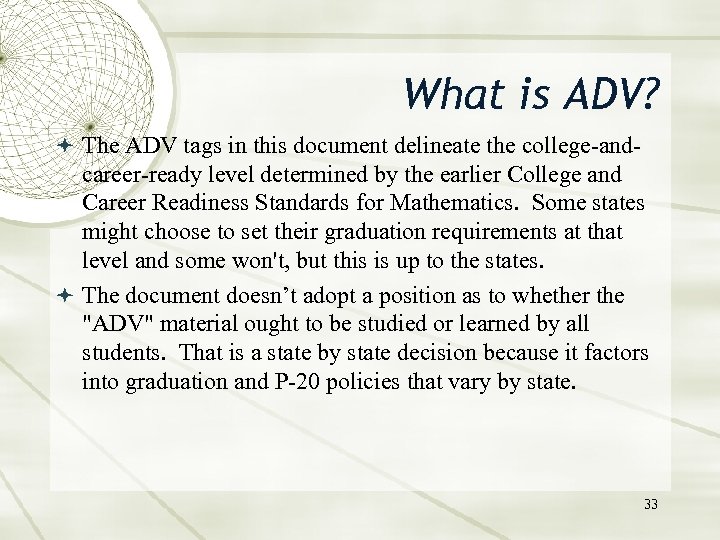 What is ADV? The ADV tags in this document delineate the college-and- career-ready level determined by the earlier College and Career Readiness Standards for Mathematics. Some states might choose to set their graduation requirements at that level and some won't, but this is up to the states. The document doesn’t adopt a position as to whether the "ADV" material ought to be studied or learned by all students. That is a state by state decision because it factors into graduation and P-20 policies that vary by state. 33
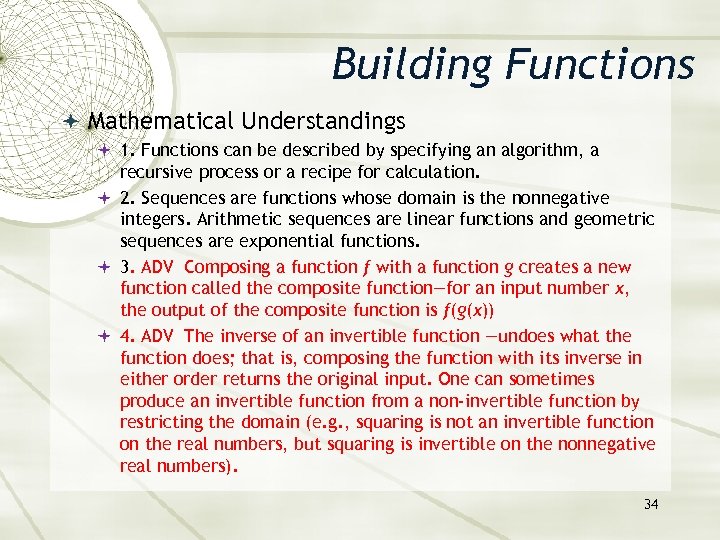 Building Functions Mathematical Understandings 1. Functions can be described by specifying an algorithm, a recursive process or a recipe for calculation. 2. Sequences are functions whose domain is the nonnegative integers. Arithmetic sequences are linear functions and geometric sequences are exponential functions. 3. ADV Composing a function f with a function g creates a new function called the composite function—for an input number x, the output of the composite function is f(g(x)) 4. ADV The inverse of an invertible function ―undoes what the function does; that is, composing the function with its inverse in either order returns the original input. One can sometimes produce an invertible function from a non-invertible function by restricting the domain (e. g. , squaring is not an invertible function on the real numbers, but squaring is invertible on the nonnegative real numbers). 34
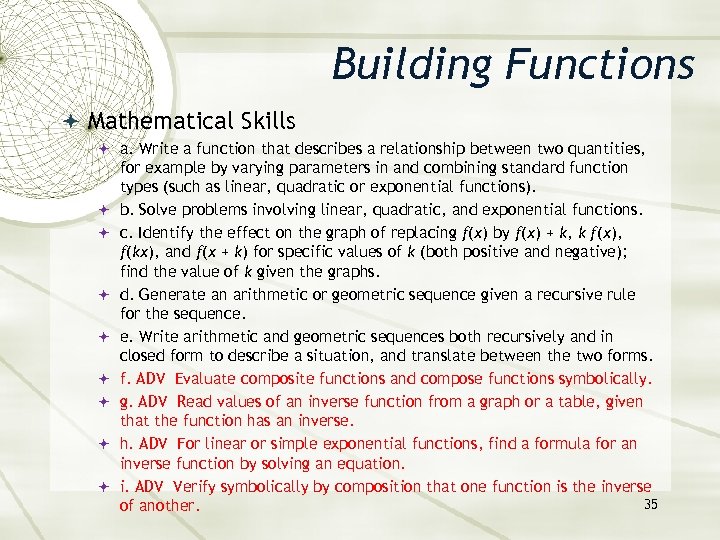 Building Functions Mathematical Skills a. Write a function that describes a relationship between two quantities, for example by varying parameters in and combining standard function types (such as linear, quadratic or exponential functions). b. Solve problems involving linear, quadratic, and exponential functions. c. Identify the effect on the graph of replacing f(x) by f(x) + k, k f(x), f(kx), and f(x + k) for specific values of k (both positive and negative); find the value of k given the graphs. d. Generate an arithmetic or geometric sequence given a recursive rule for the sequence. e. Write arithmetic and geometric sequences both recursively and in closed form to describe a situation, and translate between the two forms. f. ADV Evaluate composite functions and compose functions symbolically. g. ADV Read values of an inverse function from a graph or a table, given that the function has an inverse. h. ADV For linear or simple exponential functions, find a formula for an inverse function by solving an equation. i. ADV Verify symbolically by composition that one function is the inverse 35 of another.
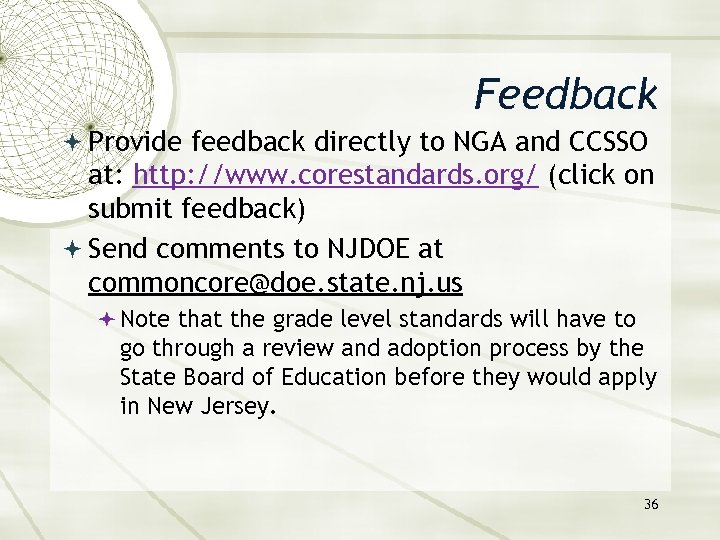 Feedback Provide feedback directly to NGA and CCSSO at: http: //www. corestandards. org/ (click on submit feedback) Send comments to NJDOE at commoncore@doe. state. nj. us Note that the grade level standards will have to go through a review and adoption process by the State Board of Education before they would apply in New Jersey. 36
 Common Core Assessments? What will they assess? Readiness Level only? ADV? K-12 grade level standards? States have already join consortiums to write common assessments. 37
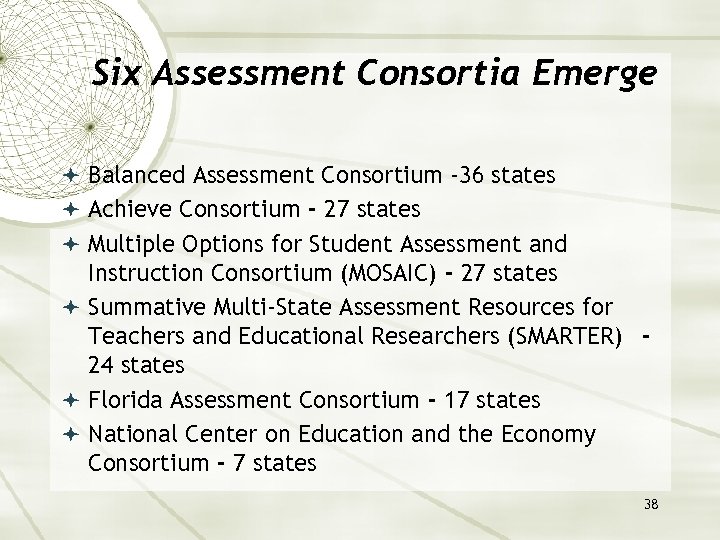 Six Assessment Consortia Emerge Balanced Assessment Consortium -36 states Achieve Consortium - 27 states Multiple Options for Student Assessment and Instruction Consortium (MOSAIC) - 27 states Summative Multi-State Assessment Resources for Teachers and Educational Researchers (SMARTER)
24 states Florida Assessment Consortium - 17 states National Center on Education and the Economy Consortium - 7 states 38
Six Assessment Consortia Emerge Balanced Assessment Consortium -36 states Achieve Consortium - 27 states Multiple Options for Student Assessment and Instruction Consortium (MOSAIC) - 27 states Summative Multi-State Assessment Resources for Teachers and Educational Researchers (SMARTER)
24 states Florida Assessment Consortium - 17 states National Center on Education and the Economy Consortium - 7 states 38
 NJ Assessments Which horse are you betting on? HSPA Achieve Algebra I EOC exam This costly assessment should be abandoned by NJ Common Core Assessments 39
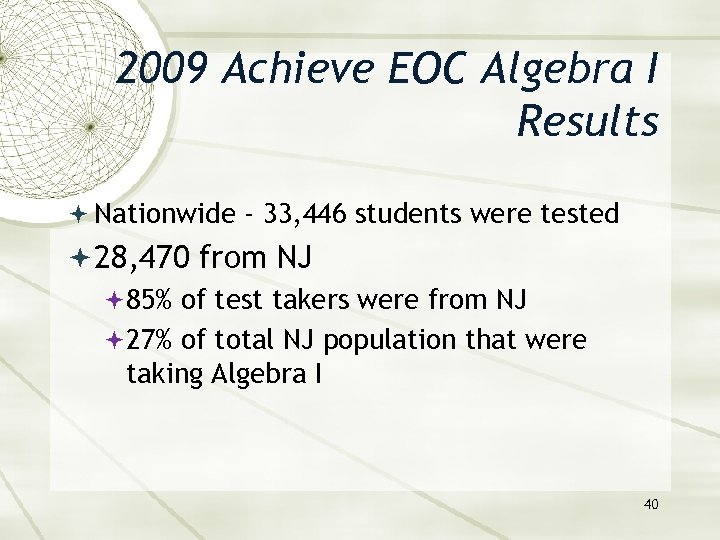 2009 Achieve EOC Algebra I Results Nationwide - 33, 446 students were tested 28, 470 from NJ 85% of test takers were from NJ 27% of total NJ population that were taking Algebra I 40
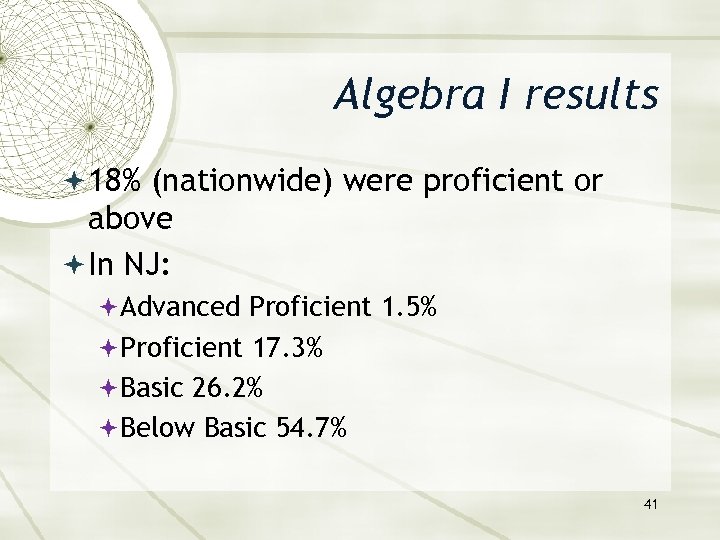 Algebra I results 18% (nationwide) were proficient or above In NJ: Advanced Proficient 1. 5% Proficient 17. 3% Basic 26. 2% Below Basic 54. 7% 41
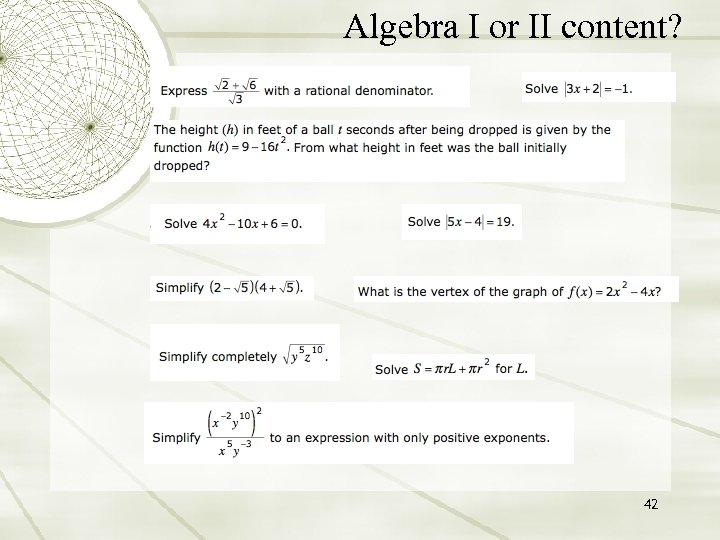 Algebra I or II content? 42
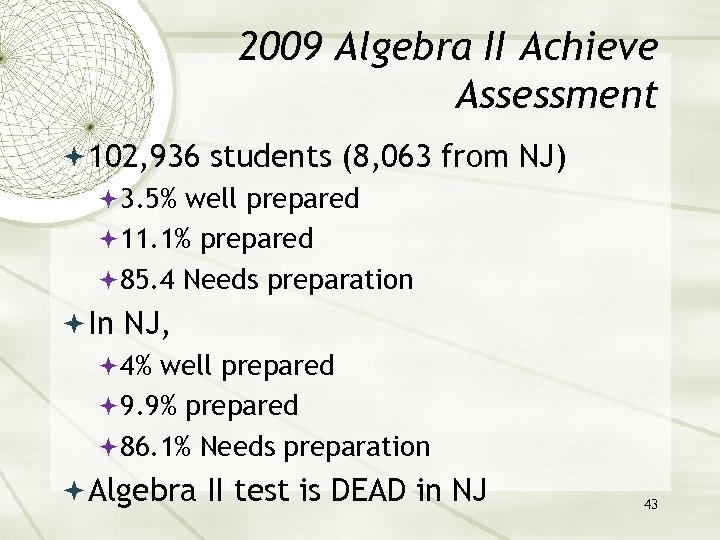 2009 Algebra II Achieve Assessment 102, 936 students (8, 063 from NJ) 3. 5% well prepared 11. 1% prepared 85. 4 Needs preparation In NJ, 4% well prepared 9. 9% prepared 86. 1% Needs preparation Algebra II test is DEAD in NJ 43
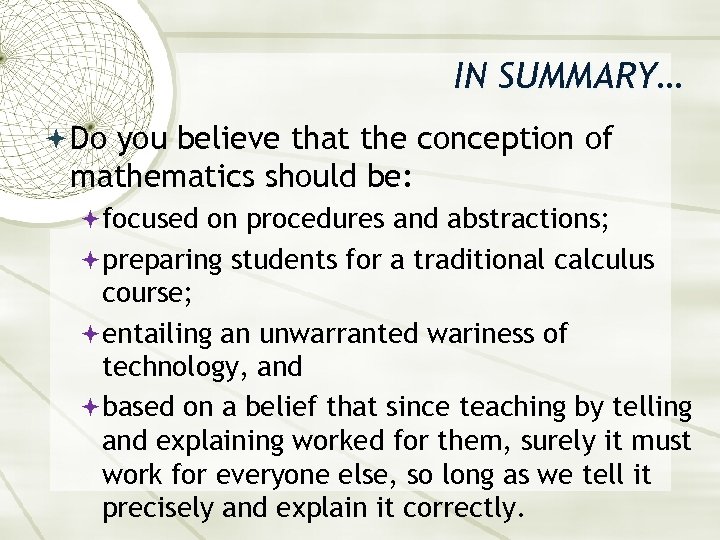 IN SUMMARY… Do you believe that the conception of mathematics should be: focused on procedures and abstractions; preparing students for a traditional calculus course; entailing an unwarranted wariness of technology, and based on a belief that since teaching by telling and explaining worked for them, surely it must work for everyone else, so long as we tell it precisely and explain it correctly.
 Or SHOULD Mathematics programs give all students a chance to succeed and be based on a conception of mathematics that: balances the development of skills and concepts that empower students to solve practical and real-world problems; makes judicious use of technology, like every other productive segment of our society, to enhance learning and preclude the waste of precious time devoted to pencil and paper skills that are no longer used in the workplace; builds coherently over time when students are confronted with interesting and complex problems and expected to struggle as part of the learning process.
 Get Active State Board JOSEPHINE E. HERNANDEZ, President jhernandez@pccc. edu Acting Commissioner Bret Schundler Common Core Standards http: //www. corestandards. org/ (click on submit feedback) 46
 State Board Email Addresses ARCELIO APONTE, Vice President, apontea@ci. newark. nj. us RON BUTCHER butcher@rowan. edu KATHLEEN A. DIETZ kdietz 1@crdus. jnj. com ERNEST P. LEPORE lepore@ruccs. rutgers. edu ROBERT P. HANEY rhaney@cov. com DOROTHY STRICKLAND strickla@rci. rutgers. edu FLORENCE MCGINN fmcginn@insynthesis. com EDIE FULTON ediefulton@comcast. net ILAN PLAWKER iplawker@nj. rr. com 47
 On the CD This Powerpoint Research on the Shortage on Scientists & Engineers (Bracey) NJ RTTP Application ‘Restoring Value’ To The High School Diploma: The Rhetoric And Practice Of Higher Standards (ASU) NAEP 2009 NJ Results in grade 4 & 8 The Misplaced Math Student: Lost in Eighth Grade Algebra (Brown Center Report) The 18 th Annual Bracey Report Digital Natives, Digital Immigrants (Marc Prensky) Review of Fordham Report on State of Math Standards End of Course Exams: 2009 Annual Report by Achieve The ‘Psychological Prisons’ from which they never escaped: The role of ability grouping in reproducing social class inequalities (Jo Boaler) When Politics Took the Place of Inquiry: A Response to the National Mathematics Advisory Panel’s Review of Instructional Practices (Jo 48 Boaler)
 Thank YOU ERIC MILOU milou@rowan. edu 856. 256. 4500 x 3876