 Скачать презентацию Politics-Business Interaction Paths Marianna Belloc and Ugo Pagano
83d3dff7b48d08ab3a4daa3a88a10aeb.ppt
- Количество слайдов: 31



Politics-Business Interaction Paths Marianna Belloc* and Ugo Pagano** * Sapienza University of Rome **University of Siena and CEU ISNIE CONFERENCE 2009 Berkeley
The end of the end of history The recent crisis has marked a new end of the ends of histories. Similarly to and, indeed more of, the earlier success of the Japanese model the pre-crisis success of the American economy and the revival of the British were taken to signal that one “natural” form of capitalism should prevail. The last history-end-fashion relied to a final convergence of all the varieties of capitalism to “free” financial markets and to a world of maximization of share-holder value. The main issue was to explain what impeded the convergence of other model of capitalism to this free, efficient and natural model. The analysis concentrated on the legal and political obstacles which in other countries impeded the separation between ownership and control. Legal origins and electoral systems became the object of intensive investigations. 2
Obstacles to the end of history Legal origin approach: The Anglo-American model had old roots in the common law traditions. Only in common law countries private owners, including the minority shareholders of large firms, could be properly protected, making it possible the separation between ownership and control. Civil law countries should remove obstacles stemming from their legal and political institutions. Electoral systems explanation: Non-proportional electoral systems, prevailing in the Anglo. American world, favors political coalitions which are more friendly to shareholders. Proportional systems, which allow a more active role for the lobbies should be removed. 3
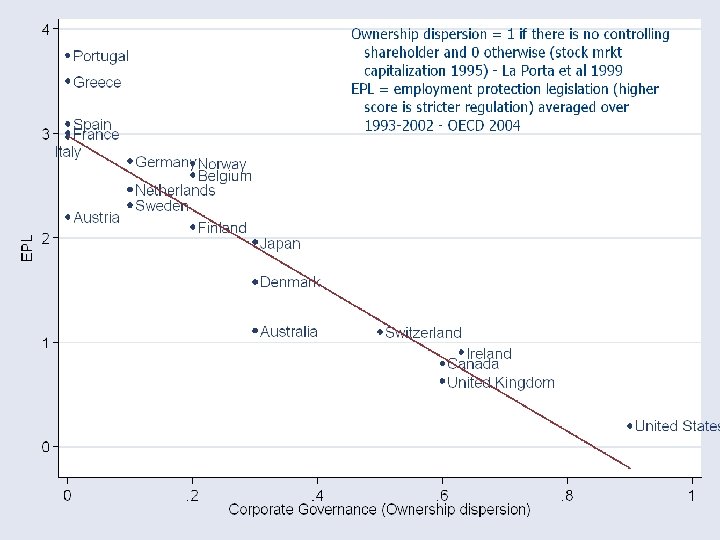
The No-Social-Democracy Explanation n n In modern capitalist economies, there is a causal relation running from social democracy to corporate governance. According to Roe (2003), the higher the degree of social democracy (and, in particular, the strength of employees’ rights) the stronger the employers' tendency to organize in concentrated forms of corporate ownership with one or few major block holders The separation of ownership and control is not due to “better” corporate laws. It is proportional to the degree of “social democratic” political pressure and, in particular, to forms of job protection. When this pressure is present, strong and active owners are necessary to limit managers' tendency to collude with employees. In this case, by resisting this pressure, big block holders would provide a public service also for the small share holders. 4
5
Multiplicity of Histories: the Business-Politics Co-evolution Approach In Belloc, M. , Pagano, U. (2005 and IRLE 2009) we extended Roe’s approach. We argued that if social-democracy can inhibit dispersed ownership, the opposite is also true: the presence of block holders, linked by strong family and social ties, can be the very reason to seek some social-democratic protection. The concentration of the interests of one group makes it more convenient the concentration of the interests of the other group. Like in an arms race, different levels of (dis)armament co-evolve. A multiplicity of histories is bound to exist. 6
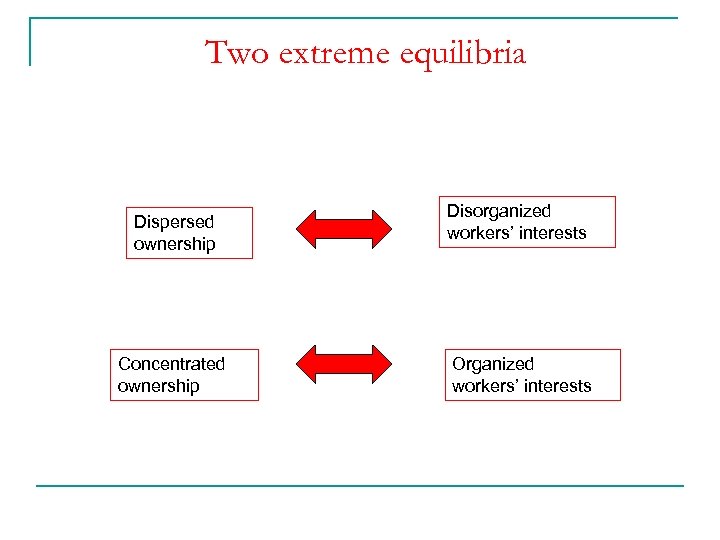
Two extreme equilibria Dispersed ownership Concentrated ownership Disorganized workers’ interests Organized workers’ interests
The aim of this paper We compare the co-evolution hypothesis (our inversion-extension of the Roe explanation) with the legal origins approach and the electoral systems explanation. The present crisis has shaken the idea that there is a natural and efficient model of capitalism. However, independently of it and on the basis of the pre-crisis evidence, we wish to argue that are both quantitative and qualitative arguments supporting our thesis. At the end of the paper we will also shortly consider some implications of our approach for the present crisis. 8
The extreme dispersed equilibrium: the American exception n At the time of the second industrial revolution, thanks to two major conflicts (independence war and secession war), the US had already fought successfully against the old European aristocracy and the slave-owning American farmers of the South. The development of large firms happened in the framework of a strong democracy. Large block holdings, present in more than one firm, were seen with suspicion by early antitrust authorities, (Sherman and Clayton acts). Pyramids were dismantled by F. D. Roosevelt by the means of appropriate fiscal policies. This “exceptional” early dispersion of capitalist interests made it less important to concentrate workers’ interests in strong unions and in social democratic parties. A dispersed equilibrium emerged. 9
The European rule of concentrated equilibria n n n The European countries (with possible exception of Switzerland) followed a different path: at the time of the second industrial revolution, their societies were hierarchical and still permeated by aristocratic privileges. No democratic authority could limit the concentration of the power of the capitalist dynasties occurring with the second industrial revolution. A social-democratic reaction concentrated also workers’ interest and a concentrated equilibrium emerged in all these countries. 10
The British Metamorphosis (I): from concentrated equilibrium to disequilibrium n At the time of the second industrial revolution, aristocratic influence, early unionization and a deep sense of class division made Britain a typical case of concentrated equilibrium. n However, transmission and division of inheritance, coupled with the international role of the city produced a dispersion of property. n In seventies the UK was characterized by a situation of "institutional disequilibrium" where the traditionally well-organized British unions were not matched by a countervailing centralization of firms' ownership. 11
The British Metamorphosis (II): from disequilibrium to dispersed equilibrium. n n n This institutional disequilibrium coincided with a crisis of the British economy which, for some times, seemed to lead to "continental solutions" such as pyramids and cross-share holding on one side and some "responsible" centralization of union's activity on the other (Franks, Mayer, Rossi 2005). These "continental solutions" were, however, opposed by the city. Eventually the Thatcher government made a sharp move towards a dispersed type of institutional equilibrium, characterised by strong limitations of unions' activities and by a (much advertised) shareholder popular capitalism. These arrangements have not been substantially reversed by the subsequent Labour Party governments. 12
Switzerland: an Alpine America? n n n There are remarkable similarities between U. S. and Switzerland historical backgrounds. Both countries came to an early tolerance of religious and ethnic diversity and the "cement of society" relied more on shared values and ways of life than on ethnic or religious homogeneity. Also Switzerland achieved an early definitive exit from aristocratic privileges (in 1847). Swiss feudal ties were traditionally weak. The peasants were difficult to dominate because they were often far away on the Alpine pastures and because they were well trained in military activities (serving, often, as the most valuable mercenaries all around Europe). Like the U. S. , at the time of the second industrial revolution, Switzerland had a robust democracy and satisfied the conditions to realize a “dispersed equilibrium”. 13
Rules and exceptions: the co-evolution approach n n n Like the other theories our approach explains the current divide between Anglo-American and European Continental models and it is a matter of quantitative analysis which one of them is more likely to fit the evidence. In qualitative terms our analysis can explain both the singularity of the American case and the European rule as well as the two exceptions to this latter rule: the “British metamorphosis” (as a difficult transition from a concentrated to a dispersed equilibrium) and the Swiss case (as analogous to the U. S. experience). By contrast, we believe that competing theories cannot give a satisfactory explanations of these two cases. 14
Rules and exceptions: competing theories The legal origins theories cannot easily explain: Why, in spite of her ancient common law origins, England was moving from one equilibrium to another Why Switzerland in spite of his civil law legal origins has such developed and dispersed share holding. n The electoral systems explanations face similar problems: With the same electoral system England moved from concentrated ownership an strong unions to dispersed ownership and weak unions. The “over-proportional” Swiss electoral system seems to be compatible with dispersed share holding. n 15
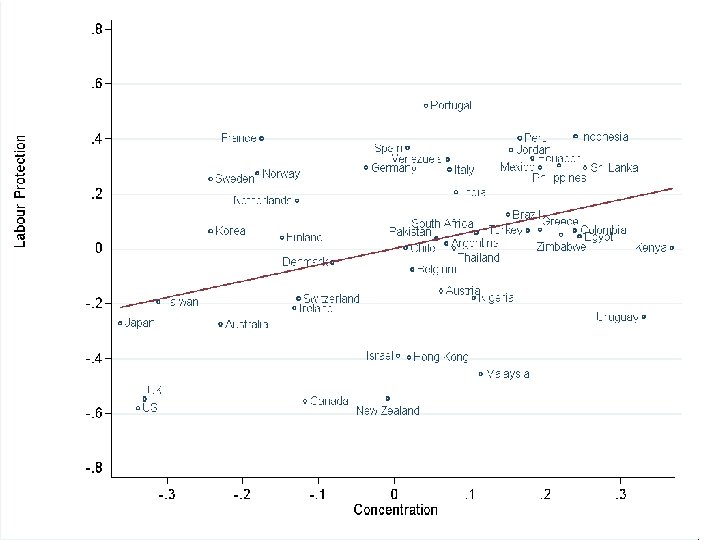
Empirical Analysis: Aim and Strategy n n We carry out an econometric analysis to gauge the two-way relationship between corporate governance forms (business) and degree of workers’ rights protection (politics), using a crosssection of 47 economies* We adopt a Bayesian perspective in estimation and model comparison *Argentina, Australia, Austria, Belgium, Brazil, Canada, Chile, Colombia, Denmark, Ecuador, Egypt, Finland, France, Germany, Greece, India, Indonesia, Ireland, Israel, Italy, Japan, Jordan, Kenya, Korea, Malaysia, Mexico, Netherlands, New Zealand, Nigeria, Norway, Pakistan, Peru, Philippines, Portugal, South Africa, Spain, Sri Lanka, Sweden, Switzerland, Taiwan, Thailand, Turkey, United Kingdom, United States, Uruguay, Venezuela, Zimbabwe 16
Bayesian Econometrics: Motivation (1) n n There is previous data evidence on alternative explanations for employment protection and ownership structure determination Thus, to study the co-determination of employment protection and ownership concentration without an arbitrary variable selection procedure, we need to control for a long list of regressors (model uncertainty) We need to investigate the relative importance of one model relatively to another considering all the models that cannot be rejected by the data. The Bayesian methodology allows explicit account to be taken of model uncertainty when implementing model comparisons If prior information on the parameters of interest is available, it can be used to select the list of regressors to include into the model and to assign prior distributions to the corresponding parameters that represent basis for inference 17
Bayesian Econometrics: Motivation (2) The second reason is suggested by small sample limitations n As it is frequent in cross-country analyses, our sample is small (47 data points). n When the number of parameters is large with respect to the number of observations, Bayesian approaches are superior in terms of parameter estimates to frequentist approaches (Gelman & Rubin 1995) 18
Bayesian Estimation: Methodology We consider a simultaneous two-equation model for labour protection-and-ownership concentration determination taking into account the various theories proposed by the previous literature (legal, political, and efficiency theories) as well as our own co-evolution approach. Two steps: 1. The full model is estimated by Bayesian econometrics 2. The various theories are compared by Bayesian nested and non-nested model comparison 19
20
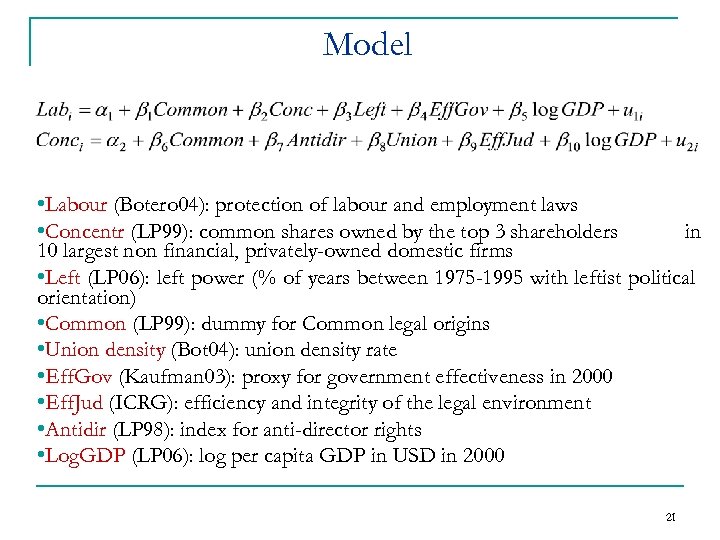
Model • Labour (Botero 04): protection of labour and employment laws • Concentr (LP 99): common shares owned by the top 3 shareholders in 10 largest non financial, privately-owned domestic firms • Left (LP 06): left power (% of years between 1975 -1995 with leftist political orientation) • Common (LP 99): dummy for Common legal origins • Union density (Bot 04): union density rate • Eff. Gov (Kaufman 03): proxy for government effectiveness in 2000 • Eff. Jud (ICRG): efficiency and integrity of the legal environment • Antidir (LP 98): index for anti-director rights • Log. GDP (LP 06): log per capita GDP in USD in 2000 21
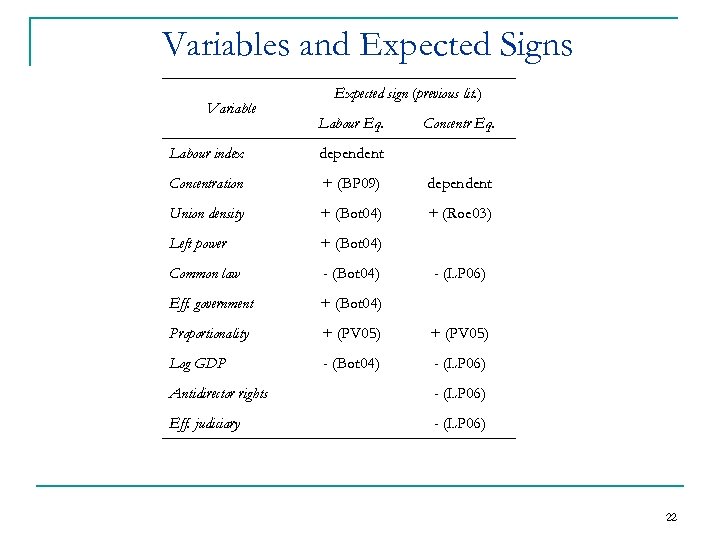
Variables and Expected Signs Variable Expected sign (previous lit. ) Labour Eq. Concentr Eq. Labour index dependent Concentration + (BP 09) dependent Union density + (Bot 04) + (Roe 03) Left power + (Bot 04) Common law - (Bot 04) Eff. government + (Bot 04) Proportionality + (PV 05) Log GDP - (Bot 04) - (LP 06) Antidirector rights - (LP 06) Eff. judiciary - (LP 06) 22
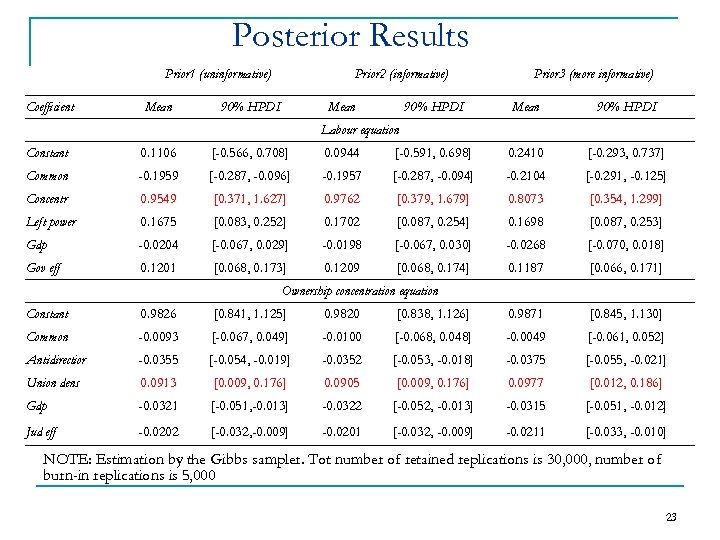
Posterior Results Prior 1 (uninformative) Coefficient Mean Prior 2 (informative) 90% HPDI Mean Prior 3 (more informative) 90% HPDI Mean 90% HPDI Labour equation Constant 0. 1106 [-0. 566, 0. 708] 0. 0944 [-0. 591, 0. 698] 0. 2410 [-0. 293, 0. 737] Common -0. 1959 [-0. 287, -0. 096] -0. 1957 [-0. 287, -0. 094] -0. 2104 [-0. 291, -0. 125] Concentr 0. 9549 [0. 371, 1. 627] 0. 9762 [0. 379, 1. 679] 0. 8073 [0. 354, 1. 299] Left power 0. 1675 [0. 083, 0. 252] 0. 1702 [0. 087, 0. 254] 0. 1698 [0. 087, 0. 253] Gdp -0. 0204 [-0. 067, 0. 029] -0. 0198 [-0. 067, 0. 030] -0. 0268 [-0. 070, 0. 018] Gov eff 0. 1201 [0. 068, 0. 173] 0. 1209 [0. 068, 0. 174] 0. 1187 [0. 066, 0. 171] Ownership concentration equation Constant 0. 9826 [0. 841, 1. 125] 0. 9820 [0. 838, 1. 126] 0. 9871 [0. 845, 1. 130] Common -0. 0093 [-0. 067, 0. 049] -0. 0100 [-0. 068, 0. 048] -0. 0049 [-0. 061, 0. 052] Antidirectior -0. 0355 [-0. 054, -0. 019] -0. 0352 [-0. 053, -0. 018] -0. 0375 [-0. 055, -0. 021] Union dens 0. 0913 [0. 009, 0. 176] 0. 0905 [0. 009, 0. 176] 0. 0977 [0. 012, 0. 186] Gdp -0. 0321 [-0. 051, -0. 013] -0. 0322 [-0. 052, -0. 013] -0. 0315 [-0. 051, -0. 012] Jud eff -0. 0202 [-0. 032, -0. 009] -0. 0201 [-0. 032, -0. 009] -0. 0211 [-0. 033, -0. 010] NOTE: Estimation by the Gibbs sampler. Tot number of retained replications is 30, 000, number of burn-in replications is 5, 000 23
Posterior Results n n n Results from PRIOR 1, PRIOR 2 and PRIOR 3 are very similar suggesting that data information is predominant All signs are as expected The posterior means of the regression coefficients (almost) always fall at least within the 10% confidence level 24
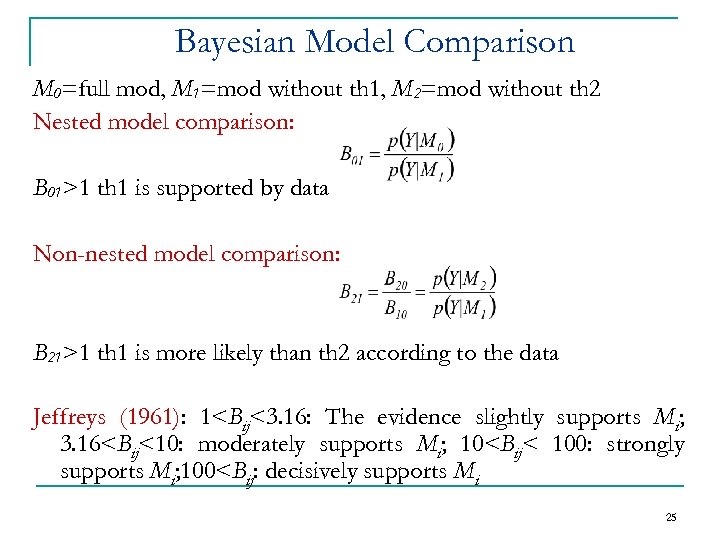
Bayesian Model Comparison M 0=full mod, M 1=mod without th 1, M 2=mod without th 2 Nested model comparison: B 01>1 th 1 is supported by data Non-nested model comparison: B 21>1 th 1 is more likely than th 2 according to the data Jeffreys (1961): 1<Bij<3. 16: The evidence slightly supports Mi; 3. 16<Bij<10: moderately supports Mi; 10<Bij< 100: strongly supports Mi; 100<Bij: decisively supports Mi 25
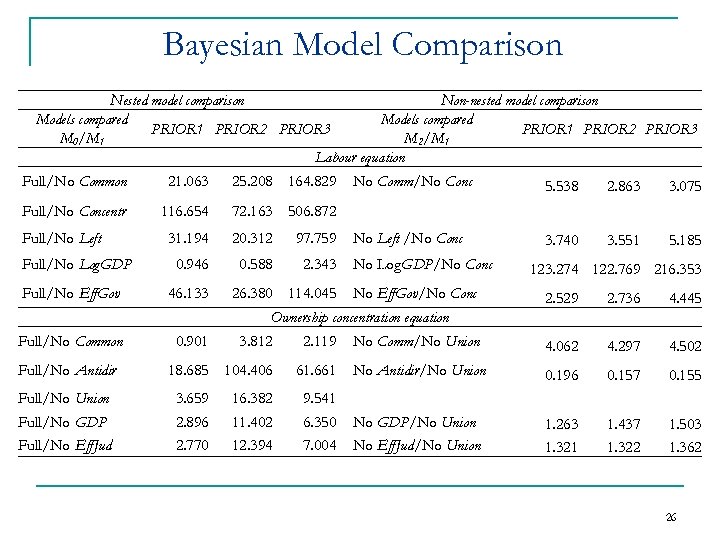
Bayesian Model Comparison Nested model comparison Non-nested model comparison Models compared PRIOR 1 PRIOR 2 PRIOR 3 M 0/M 1 M 2/M 1 Labour equation Full/No Common 21. 063 25. 208 164. 829 Full/No Concentr 116. 654 72. 163 506. 872 Full/No Left Full/No Log. GDP Full/No Eff. Gov 31. 194 20. 312 97. 759 0. 946 0. 588 2. 343 46. 133 26. 380 114. 045 No Comm/No Conc 5. 538 2. 863 3. 075 No Left /No Conc 3. 740 3. 551 5. 185 No Log. GDP/No Conc No Eff. Gov/No Conc 123. 274 122. 769 216. 353 2. 529 2. 736 4. 445 Ownership concentration equation Full/No Common Full/No Antidir 0. 901 3. 812 2. 119 No Comm/No Union 4. 062 4. 297 4. 502 18. 685 104. 406 61. 661 No Antidir/No Union 0. 196 0. 157 0. 155 No GDP/No Union No Eff. Jud/No Union 1. 263 1. 321 1. 437 1. 322 1. 503 1. 362 Full/No Union 3. 659 16. 382 9. 541 Full/No GDP Full/No Eff. Jud 2. 896 2. 770 11. 402 12. 394 6. 350 7. 004 26
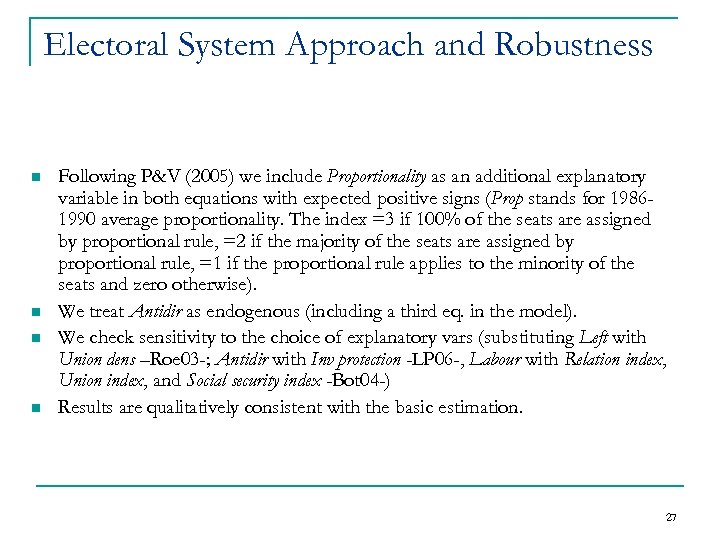
Electoral System Approach and Robustness n n Following P&V (2005) we include Proportionality as an additional explanatory variable in both equations with expected positive signs (Prop stands for 19861990 average proportionality. The index =3 if 100% of the seats are assigned by proportional rule, =2 if the majority of the seats are assigned by proportional rule, =1 if the proportional rule applies to the minority of the seats and zero otherwise). We treat Antidir as endogenous (including a third eq. in the model). We check sensitivity to the choice of explanatory vars (substituting Left with Union dens –Roe 03 -; Antidir with Inv protection -LP 06 -, Labour with Relation index, Union index, and Social security index -Bot 04 -) Results are qualitatively consistent with the basic estimation. 27
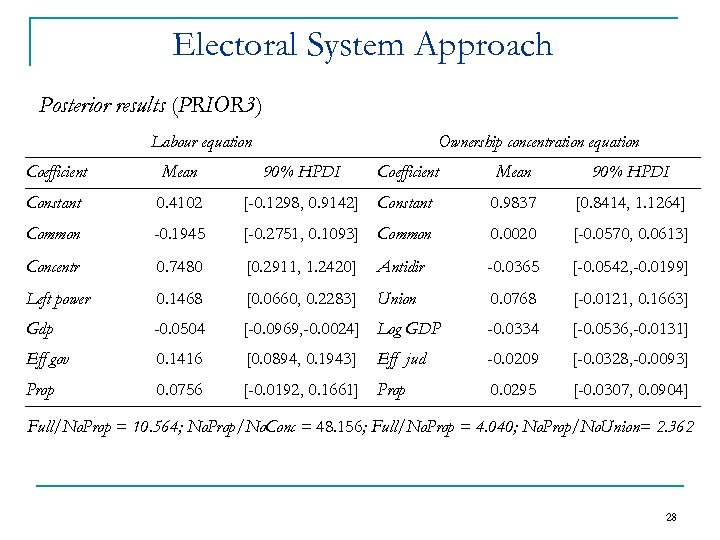
Electoral System Approach Posterior results (PRIOR 3) Labour equation Coefficient Mean Constant 0. 4102 Common Ownership concentration equation 90% HPDI Coefficient Mean 90% HPDI [-0. 1298, 0. 9142] Constant 0. 9837 [0. 8414, 1. 1264] -0. 1945 [-0. 2751, 0. 1093] Common 0. 0020 [-0. 0570, 0. 0613] Concentr 0. 7480 [0. 2911, 1. 2420] Antidir -0. 0365 [-0. 0542, -0. 0199] Left power 0. 1468 [0. 0660, 0. 2283] Union 0. 0768 [-0. 0121, 0. 1663] Gdp -0. 0504 [-0. 0969, -0. 0024] Log GDP -0. 0334 [-0. 0536, -0. 0131] Eff gov 0. 1416 [0. 0894, 0. 1943] -0. 0209 [-0. 0328, -0. 0093] Prop 0. 0756 [-0. 0192, 0. 1661] Prop 0. 0295 [-0. 0307, 0. 0904] Eff jud Full/No. Prop = 10. 564; No. Prop/No. Conc = 48. 156; Full/No. Prop = 4. 040; No. Prop/No. Union= 2. 362 28
Conclusion 1: different post-crisis attractors? n The legal origins approach and the political economy of corporate governance suggested that the introduction of American corporate legislation should anticipate an inevitable global prevalence of its economic model. Electoral and Legal reforms were suggested to accelerate the convergence. n Both qualitative and quantitative analysis suggest that the co-evolution approach is more convincing: labour market and financial markets institutions co-evolve along different institutional paths. Their disequilibrium can be politically and economically painful. n The crisis may imply that each system tries to re-tighten its own peculiar set of institutional complementarities, even if in some cases, like the U. K, the recent metamorphosis make this set of relations particularly unstable. 29
Conclusion 2: the dangers of unique models and of hybridization Part of the crisis can indeed be blamed on the hybridization of different systems: German banks invested in risky securities of foreign and severed their symbiotic relations with local firms and their employees. The Glass Steagall act (differentiating the U. S. from German Universal Banking) was repealed. Most regulations, which guaranteed the workings and the competitiveness of American financial markets, were dismantled. Institutions, such as the German codetermination system, (which balanced concentrated employers power) were weakened. 30
Conclusion 3: adjusting policy to institutional diversity n In the co-evolution approach, American populism (keep capitalistic dynasties under control!) and European social democracy (create workers' counter-power to powerful capitalist families!) are two very different political strategies sharing a common purpose: both make concentration of power associated with large-scale production compatible with democracy and safeguarded the human capital investment of non-owners. n Only if the potential complementarities are taken into account, some combination of coherent policies may be beneficial. Otherwise, they may decrease economic efficiency, and even upset the balance between economic power and political democracy. 31
Скачать презентацию Politics-Business Interaction Paths Marianna Belloc and Ugo Pagano
83d3dff7b48d08ab3a4daa3a88a10aeb.ppt