 Скачать презентацию Political Social and Economic Factors BRINGING IT ALL
bb40f877012c9b74ce68dc735b256db6.ppt
- Количество слайдов: 32



Political, Social and Economic Factors BRINGING IT ALL TOGETHER! Mario Blanco & Luz Marina Delgado Caltech, November, 2006
Introduction: Engineering and socialcultural realities; a fair balance Cooperation between different fields of knowledge provides better chances to: l – – See the problem as a whole Understand the impact of variables Understand the need for research Promote interaction between grass roots experience with “higher level” professionals
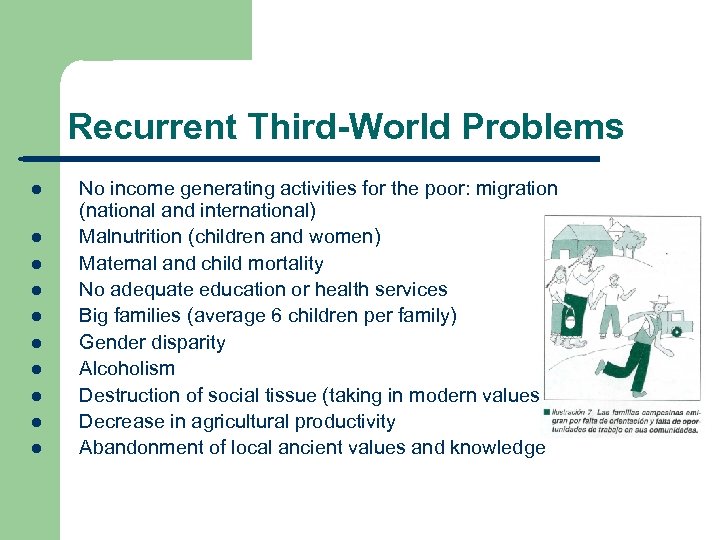
Recurrent Third-World Problems l l l l l No income generating activities for the poor: migration (national and international) Malnutrition (children and women) Maternal and child mortality No adequate education or health services Big families (average 6 children per family) Gender disparity Alcoholism Destruction of social tissue (taking in modern values) Decrease in agricultural productivity Abandonment of local ancient values and knowledge
Have these problems been solved over the past 30 years? No! We’ll see the development index later in this lecture.
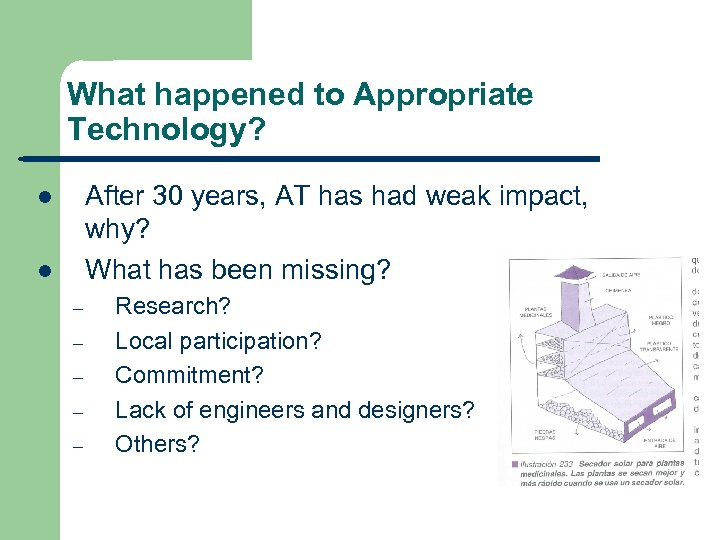
What happened to Appropriate Technology? After 30 years, AT has had weak impact, why? What has been missing? l l – – – Research? Local participation? Commitment? Lack of engineers and designers? Others?
What happened to Appropriate Technology? Our Experience says: l Barriers to adoption of new Technologies: – – Dissemination l – Type of Media and Costs Competing with commercial interests of large trans -nationals l – l Technical Cultural Petrochemical and Agricultural Companies Example: The Case of San Pablo Toaca
The Case of San Pablo Toaca Peasants of San Pablo Toacá continue to use their traditional seeds, use only organic methods and the following technologies (some native some introduced by a Belgian missionary in the 50 -60 s): l – – – – ground and soil conservation by extensive use of terraces live barriers (fast growing lemon grass, shrubs) to erosion organic composting natural biocides (wood distillates) enclosed herding of small animals (sheep) recovery and use of native seeds minimum farming (tillage) techniques Trees in plot boundaries for foliage and wind-thermal barrier
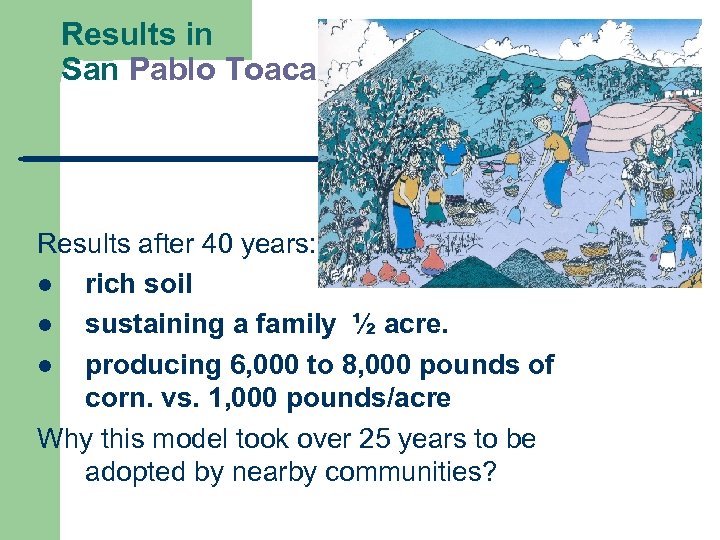
Results in San Pablo Toaca Results after 40 years: l rich soil l sustaining a family ½ acre. l producing 6, 000 to 8, 000 pounds of corn. vs. 1, 000 pounds/acre Why this model took over 25 years to be adopted by nearby communities?
Why this model took over 25 years to be adopted by nearby communities? Barriers to Dissemination of New Technologies (even if appropriate) : l Mayan, an ancient culture, has large inertia or resistance to change l Economic losses during transition • The power of modern marketing to push ‘modern’ but ineffective solutions petrochemicals, hybrid seeds, the ‘green’ revolution
Seeds and Petrochemicals l l l Credibility: Seeds and other technologies may have "credence qualities" that only become apparent over time or under special circumstances (Tripp 2001). Transparency: A technology's effects may also change through time as a result of factors that are difficult or impossible for the farmer to monitor (Sillitoe, 1998) Insecticides: effects vary sharply from year to year – – Direct on target and indirect impacts on predator species the less the farmer knows about insect ecology, the more insecticide is used (Thrupp 1990; Vandeman 1995). insecticide resistance chaotic fluctuations in insect populations (Brogdon and Mc. Allister 1998), Tripp, Robert, 2001 Can Biotechnology Reach the Poor? The Adequacy of Information and Seed Delivery. Food Policy 26: 249 -264. Sillitoe, Paul, 1998 The Development of Indigenous Knowledge: A New Applied Anthropology. Current Anthropology 39: 223 -252. Thrupp, 1990 Inappropriate Incentives for Pesticide Use: Credit Requirements for Agrochemicals in Developing Countries. Agriculture and Human Values 7: 62 -69. Brogdon, William G. , and Janet C. Mc. Allister, 1998 Insecticide Resistance and Vector Control. Emerging Infectious Diseases 4: 605 -613.
Solutions? Dissemination through modern media technologies: Documentary? Billboards, radio, TV? Sustainability: create income generating activities for transition periods Access to markets l l l – – Niche, fragmented markets Organic markets Fair, Direct Trade, Ethnic Markets Eco and Ethnic-Tourism
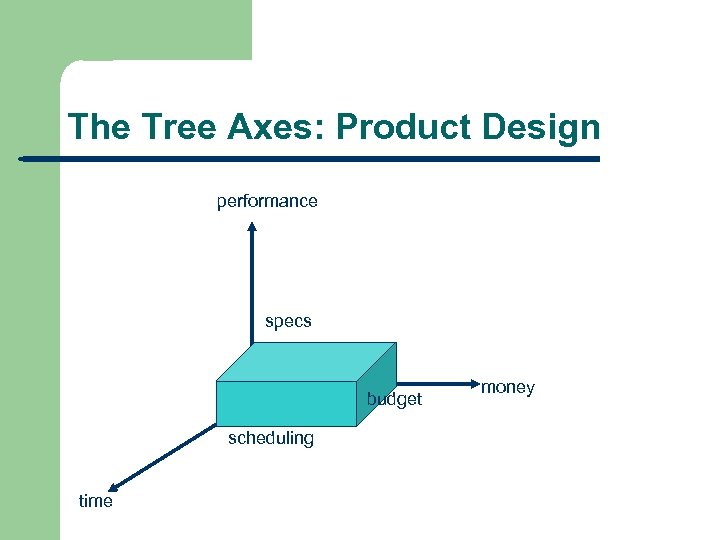
The Tree Axes: Product Design performance specs budget scheduling time money
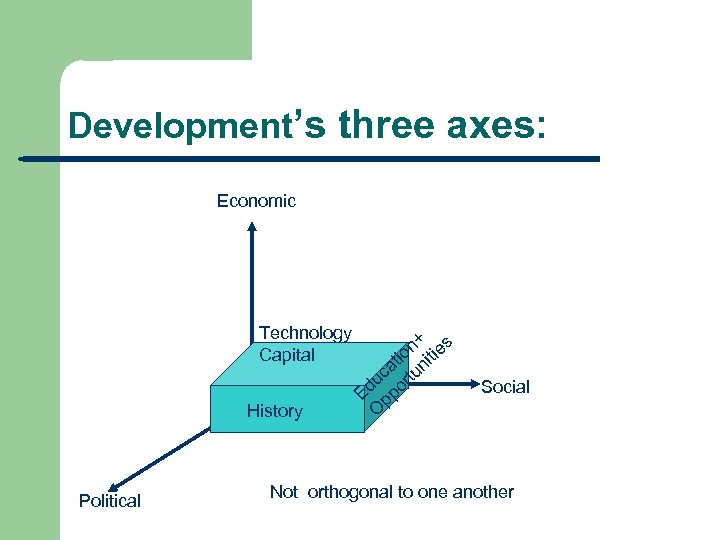
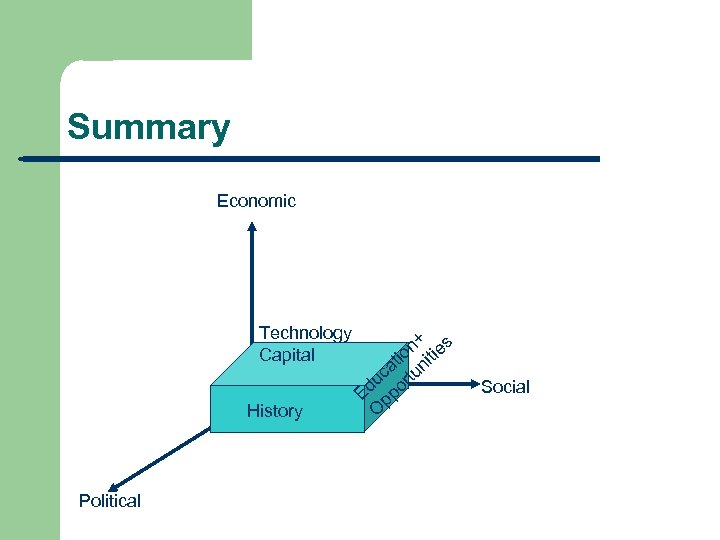
Development’s three axes: Economic Technology Capital History Political + s on itie i at un uc ort Ed pp O Social Not orthogonal to one another
Political Axis l l l International Relations Symmetrical vs. Controlling Relations What type prevails? Why?
History of U. S. Promoted Development “Development Project” concept: l – – originated for the reconstruction of Europe after WW-II Marshall Plan: Full participation to European People DP concept for the Americas l – – – “Top-Down” “Carrot and Stick” Policies Non-Participatory: promote political inequality Alliance for Progress, Peace Corps. Also the product of Cold War policy: l – – Direct Political intervention to change or influence Latin American governments to the expansion needs of the US Military Aid Watch first 10 seconds of this video: http: //video. google. com/videoplay? docid=-3650053512224622409
United Nations’ Deep Questioning 1980: billions of dollars invested in the developing world did not accomplish much change, why? 1990: ‘Five Success Variables’ l l – Full participation, ethnicity, gender, environment, cooperation 2000: Empowerment of the poor l – Civil organizations and local NGO’s on the rise
Development Projects: 2 Visions Old Paradigm: Top-down l – – Charitable, Infrastructure Schools, bridges, hospitals, community centers New Paradigm: Bottom-up l – – – Propitiate change at the local level: Advancement of People as opposed to Building Infrastructure Emphasis on Opportunity Building Social organizations: Cooperatives, local NGO’s Full participation: local values, “know-how” and raw materials: seeds, medicinal plants, etc Appropriate technology (solar, biogas, alternative building materials, fuel saving stoves, composting, latrines) Take a look at ‘Manos de Mujer’
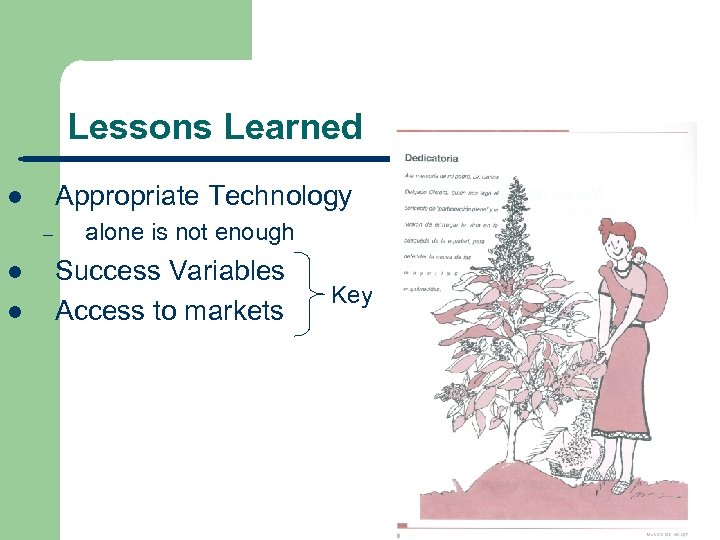
Lessons Learned Appropriate Technology l – l l alone is not enough Success Variables Access to markets Key
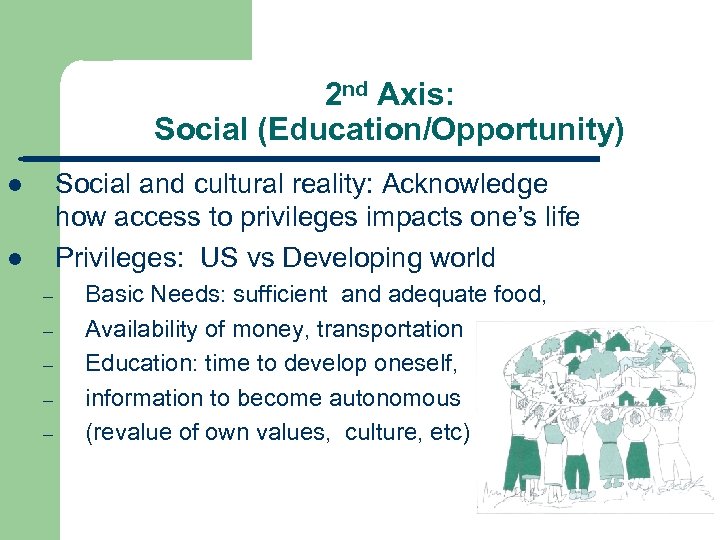
Social Axis How people relate to one another? l – – Each person has a contribution to give l – – – In human relations there is always an issue of “power” Controlling or Sharing Power? every idea has value knowledge is a communal effort its benefits are to be shared information is a tool lets share it!
Social issues… Ethnocentrism is an impediment: l – To empower we need full participation at every level: l – – l l “We” don’t have all the right answers or ideas… Project definition: brainstorming, ideas Identification of all party’s motives and goals, Project management, Resources, Information. Market vs. Stadium, Communal Store vs. Community Bank Up to what level are we ready to share? What are we willing to share? Ideas, decision making, management, budget, evaluation, follow up activities?
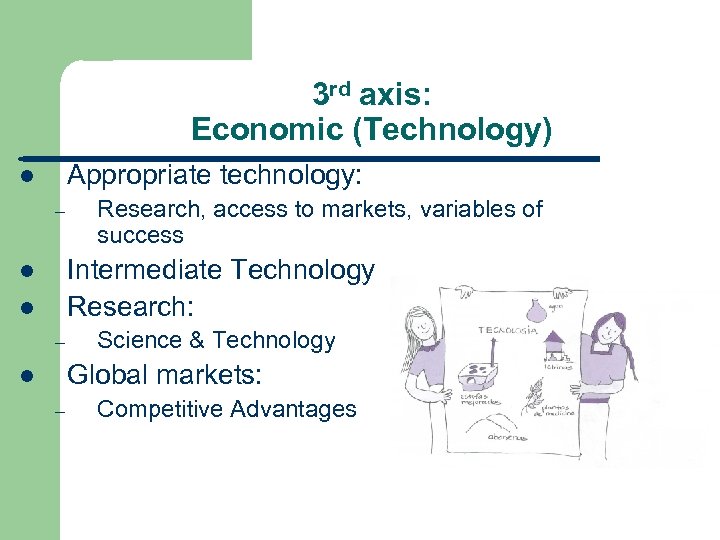
Economic Axis l l l Demographics Human Development Index Definition of Development Cost of Development Technology: Why don’t we create it? Technological Pathway to Development
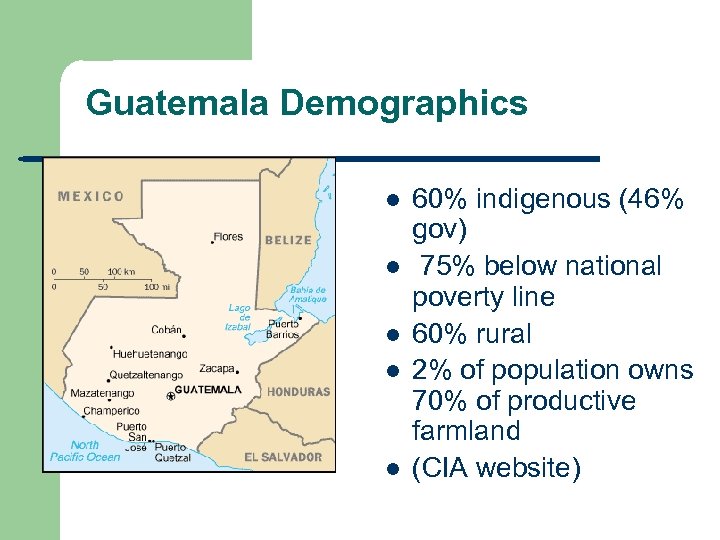
Guatemala Demographics l l l 60% indigenous (46% gov) 75% below national poverty line 60% rural 2% of population owns 70% of productive farmland (CIA website)
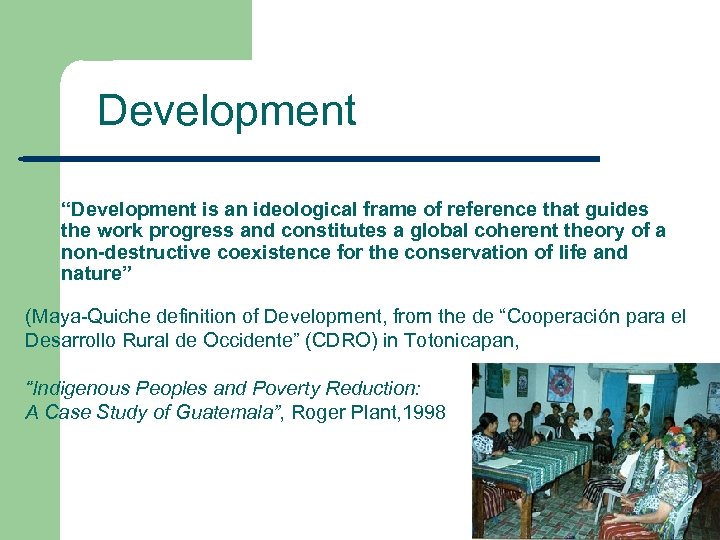
Development “Development is an ideological frame of reference that guides the work progress and constitutes a global coherent theory of a non-destructive coexistence for the conservation of life and nature” (Maya-Quiche definition of Development, from the de “Cooperación para el Desarrollo Rural de Occidente” (CDRO) in Totonicapan, “Indigenous Peoples and Poverty Reduction: A Case Study of Guatemala”, Roger Plant, 1998
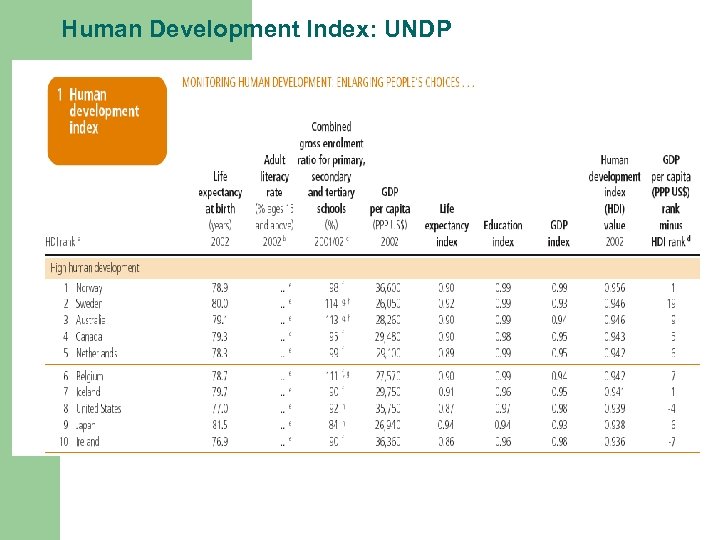
Human Development Index: UNDP
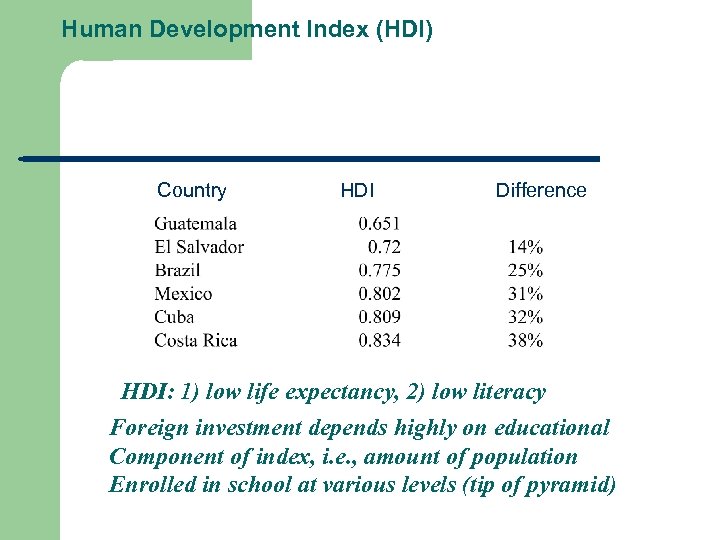
Human Development Index (HDI) Country HDI Difference HDI: 1) low life expectancy, 2) low literacy Foreign investment depends highly on educational Component of index, i. e. , amount of population Enrolled in school at various levels (tip of pyramid)
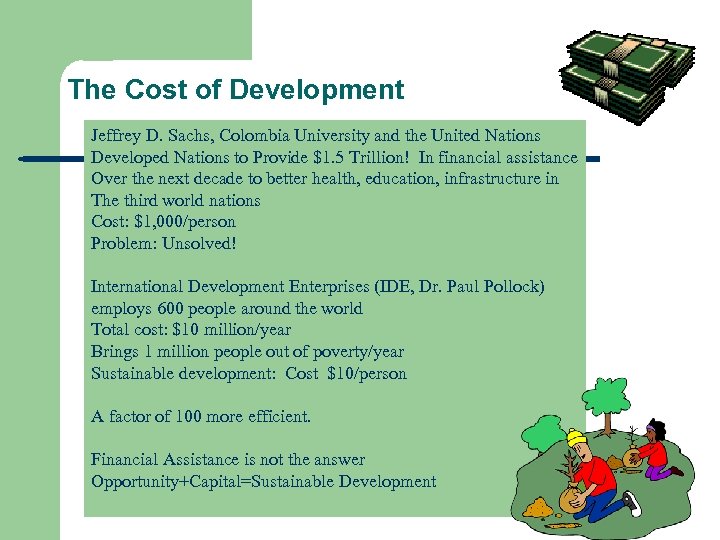
The Cost of Development Jeffrey D. Sachs, Colombia University and the United Nations Developed Nations to Provide $1. 5 Trillion! In financial assistance Over the next decade to better health, education, infrastructure in The third world nations Cost: $1, 000/person Problem: Unsolved! International Development Enterprises (IDE, Dr. Paul Pollock) employs 600 people around the world Total cost: $10 million/year Brings 1 million people out of poverty/year Sustainable development: Cost $10/person A factor of 100 more efficient. Financial Assistance is not the answer Opportunity+Capital=Sustainable Development
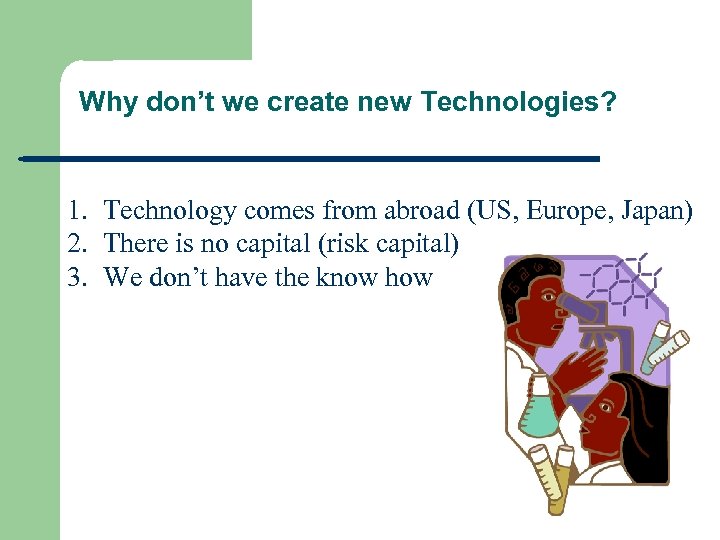
Why don’t we create new Technologies? 1. Technology comes from abroad (US, Europe, Japan) 2. There is no capital (risk capital) 3. We don’t have the know how
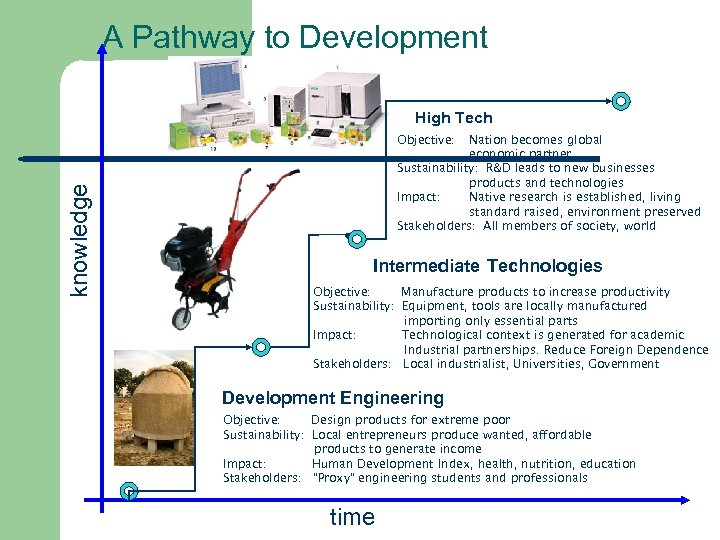
A Pathway to Development High Tech knowledge Objective: Nation becomes global economic partner Sustainability: R&D leads to new businesses products and technologies Impact: Native research is established, living standard raised, environment preserved Stakeholders: All members of society, world Intermediate Technologies Objective: Manufacture products to increase productivity Sustainability: Equipment, tools are locally manufactured importing only essential parts Impact: Technological context is generated for academic Industrial partnerships. Reduce Foreign Dependence Stakeholders: Local industrialist, Universities, Government Development Engineering Objective: Design products for extreme poor Sustainability: Local entrepreneurs produce wanted, affordable products to generate income Impact: Human Development Index, health, nutrition, education Stakeholders: “Proxy” engineering students and professionals time
Summary Economic Technology Capital History Political + s on itie i at un uc ort Ed pp O Social
1 st Axis: Political (History) l l International politics and the expansion of capitalism, what does that mean to me, at a personal level? What prevents us and others to participate in the political process? Do my actions influence others lives? Is that influence perceived globally? Do misery and poverty affect me? How?
2 nd Axis: Social (Education/Opportunity) Social and cultural reality: Acknowledge how access to privileges impacts one’s life Privileges: US vs Developing world l l – – – Basic Needs: sufficient and adequate food, Availability of money, transportation Education: time to develop oneself, information to become autonomous (revalue of own values, culture, etc)
3 rd axis: Economic (Technology) Appropriate technology: l – Research, access to markets, variables of success Intermediate Technology Research: l l – Science & Technology Global markets: l – Competitive Advantages
Скачать презентацию Political Social and Economic Factors BRINGING IT ALL
bb40f877012c9b74ce68dc735b256db6.ppt