


 Скачать презентацию Political Science Semester Review Lots and lots of
aa990e927839dc19f64750b324ab486c.ppt
- Количество слайдов: 61
 Political Science Semester Review Lots and lots of Good old Multiple Guess Questions
 1. ____ is the study of the rights and duties of citizens. • A. Economics • B. Patriotism • C. Citizenship • D. Civics
 2. A government controlled by one person or a small group of people is called • A. a Representative Democracy • B. a Dictatorship • C. an anarchist commune • D. a Direct Democracy
 3. A budget is a plan for • A. helping needy people • B. protecting citizens • C. paying politicians • D. collecting and spending money
 4. ____ is the first step to gaining American citizenship. • A. The Oath of Allegiance • B. Living in the United States for five years • C. Filing an application for citizenship • D. The Declaration of Intention
 5. Between 1830 and 1930, the population of the United States increased from 12 million people to • A. 20 million people. • B. 40 million people. • C. 120 million people. • D. 12 billion people.
 6. Unlike citizens, aliens may not • A. hold jobs. • B. attend public schools. • C. own property. • D. vote in elections.
 7. E pluribus unum is Latin for • A. “One nation, under God. ” • B. “One nation to rule them all. ” • C. “In God we trust. ” • D. “Out of many, one. ”
 8. As Americans, we show our ____, or love for our country, by flying the flag. • A. majority rule • B. patriotism • C. citizenship • D. jingoism
 9. The ____ guaranteed that not even the king or queen was above the law. • A. Constitution • B. Magna Carta • C. House of Burgesses • D. Mayflower Compact
 10. What was the legislative body that drew up the English Bill of Rights in 1689? • A. Parliament • B. First Continental Congress • C. House of Burgesses • D. Second Continental Congress
 11. What marked the beginning of self -government in colonial America? • A. Mayflower Compact • B. House of Burgesses • C. Boston Tea Party • D. First Continental Congress
 12. The Mayflower Compact was an example of • A. representative democracy. • B. constitutional law. • C. direct democracy. • D. charter government.
 13. The Boston Tea Party caused Parliament to pass the Coercive Acts, which Americans called the • A. Tea Acts. • B. Townshend Acts. • C. Intolerable Acts. • D. Declaratory Acts.
 14. Who wrote Common Sense? • A. Thomas Jefferson • B. John Locke • C. Thomas Paine • D. George Washington
 15. The Declaration of Independence states that among our inalienable rights are “Life, Liberty, and ____. ” • A. independence from Tyranny • B. the pursuit of Happiness • C. freedom of Religion • D. the search for Prosperity
 16. Like the English Parliament, the new state legislatures were • A. bicameral. • B. unbalanced. • C. wealthy. • D. powerless.
 17. The ____ was the first constitution of the United States of America. • A. Articles of Confederation • B. United States Constitution • C. Mayflower Compact • D. Declaration of Independence
 18. Who led an armed uprising of about 1, 200 Massachusetts farmers on a federal arsenal? • A. John Locke • B. Thomas Paine • C. Daniel Shays • D. George Washington
 19. What plan proposed that every five enslaved persons would count as three free persons? • A. the Three-Fifths Compromise • B. the Cotton Compromise • C. the New Jersey Plan • D. the Five-Thirds Plan
 20. Because its leaders opposed a stronger central government, ____ was not represented at the Constitutional Convention. • A. Pennsylvania • B. North Carolina • C. Rhode Island • D. Indiana
 21. The ____ called for Congress to have a Senate and a House of Representatives. • A. Virginia Plan • B. Three-Fifths Compromise • C. Great Compromise • D. New Jersey Plan
 22. The necessary and proper clause allows Congress to exercise • A. wartime powers. • B. implied powers. • C. unconstitutional powers. • D. judicial powers.
 23. What part of the Constitution deals with how the legislative branch will work? • A. Preamble • B. the First Amendment • C. Article I • D. Bill of Rights
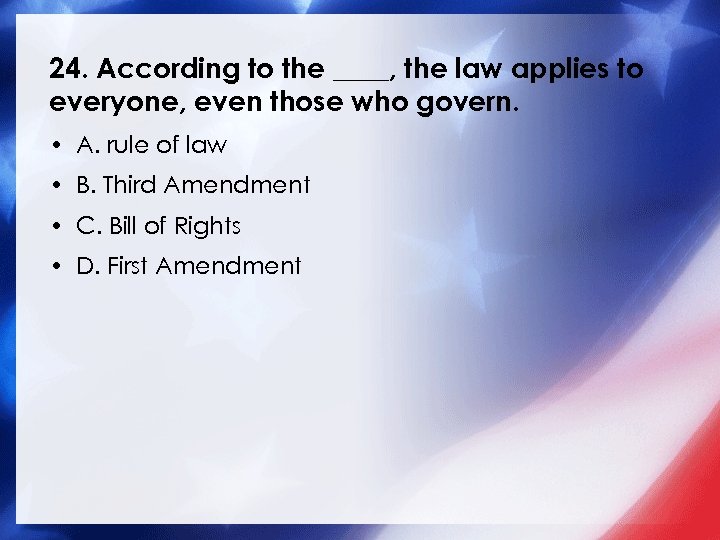 24. According to the ____, the law applies to everyone, even those who govern. • A. rule of law • B. Third Amendment • C. Bill of Rights • D. First Amendment
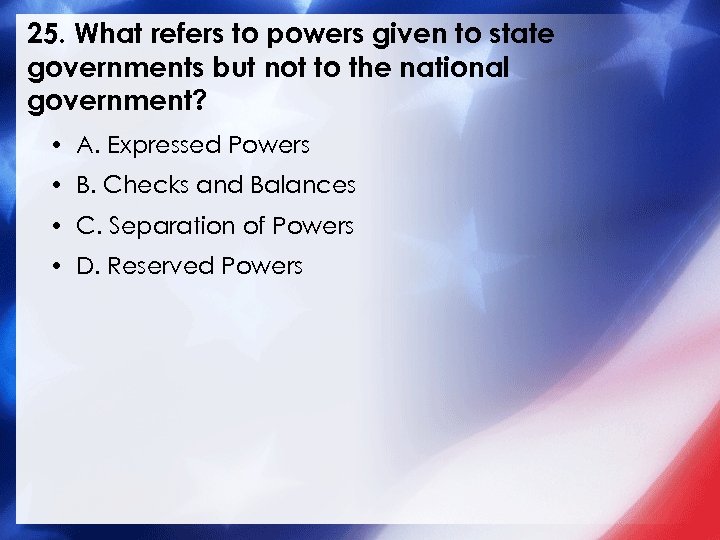 25. What refers to powers given to state governments but not to the national government? • A. Expressed Powers • B. Checks and Balances • C. Separation of Powers • D. Reserved Powers
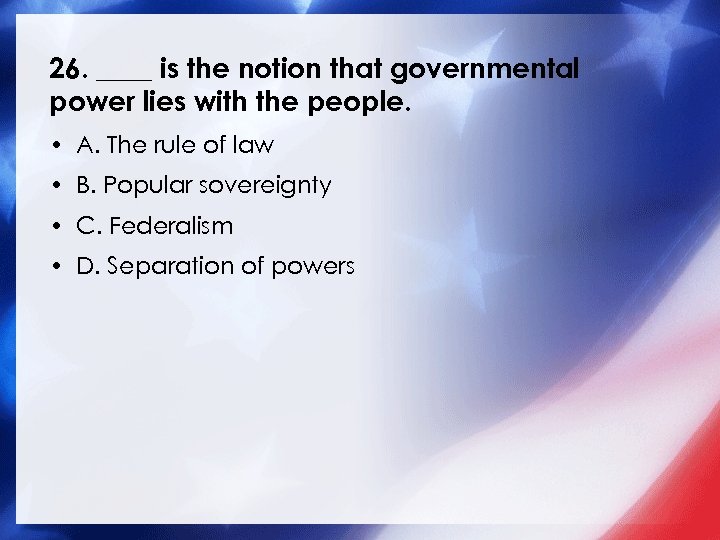 26. ____ is the notion that governmental power lies with the people. • A. The rule of law • B. Popular sovereignty • C. Federalism • D. Separation of powers
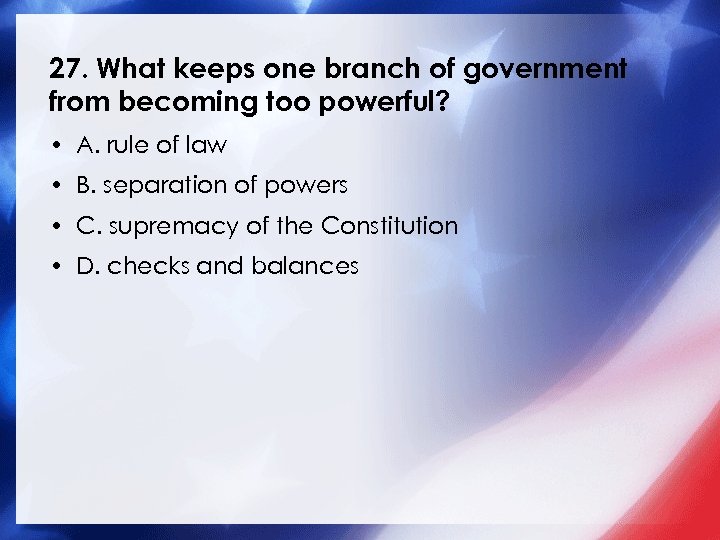 27. What keeps one branch of government from becoming too powerful? • A. rule of law • B. separation of powers • C. supremacy of the Constitution • D. checks and balances
 28. ____ means that a person judged not guilty cannot be put on trial again for the same crime. • A. Due Process • B. Suffrage • C. Double Jeopardy • D. Censorship
 29. Which amendment protects Americans “against unreasonable searches and seizures”? • A. Fourth • B. Fifth • C. Sixth • D. Eighth
 30. The Nineteenth Amendment extended ____ to women. • A. civil liberties • B. suffrage • C. equal pay • D. civil rights
 31. ____ are things we are required to do as citizens. • A. Options • B. Exemptions • C. Responsibilities • D. Duties
 32. A citizen’s most important duty is to obey the • A. law. • B. president. • C. church. • D. principal.
 33. ____ are things people should do; they are obligations that should be fulfilled voluntarily. • A. Duties • B. Exemptions • C. Responsibilities • D. Options
 34. How do Americans give their consent to the government? • A. obeying laws • B. jury duty • C. volunteerism • D. voting
 35. Good citizens are concerned about the ____ of all members of the community. • A. status • B. opinion • C. welfare • D. wealth
 36. The most powerful member of the House of Representatives is the • A. majority leader. • B. President of the House. • C. majority whip. • D. Speaker of the House.
 37. A ____ committee is created to do a special job for a limited period. • A. joint • B. select • C. standing • D. conference
 38. A ____ is an oddly shaped district designed to increase the voting strength of a particular group • A. cloture • B. filbuster • C. gerrymander • D. rider
 39. Who is the person who usually acts as chairperson of the Senate? • A. majority whip • B. president pro tempore • C. majority leader • D. vice president
 40. What is another name for Clause 18, the “necessary and proper” clause? • A. Santa Clause • B. Implied Clause • C. Elastic Clause • D. Supremacy Clause
 41. A ____ requires police to explain to a court why they are holding a prisoner. • A. writ of habeas corpus • B. bill of attainder • C. ex post facto law • D. rider
 42. What term refers to government projects and grants that primarily benefit a Congress member’s home state? • A. Cloture Grants • B. Re. Election Projects • C. Fat Money • D. Pork Barrel Projects
 43. What is the tactic of delaying a vote until a bill’s sponsor withdraws the measure? • A. cloture • B. gabling • C. filibuster • D. pigeonholing
 44. If the president ignores a bill for 10 days and Congress is not in session, it is a • A. pocket veto • B. filibuster • C. line item veto • D. slate bill
 45. Who follows the vice president in succession to the presidency? • A. Speaker of the House • B. Secretary of State • C. Attorney General • D. President Pro Tempore
 46. A state has as many ____ as the total of its U. S. senators and representatives. • A. Pork Barrel Projects • B. Electoral Votes • C. Congressional Staff • D. Interns
 47. The president has the power to issue an ____, which is a rule or command that has the force of law. • A. execution order • B. economic sanction • C. amnesty order • D. executive order
 48. What is the basic goal of American foreign policy? • A. National Security • B. Treaty Negotiation • C. Trade Sanctions • D. Embargo Resolution
 49. ____ is a formal agreement between two or more countries. • A. An executive agreement • B. A treaty • C. An embargo • D. An accord
 50. What is the term for efforts to punish another nation by imposing trade barriers? • A. blockades • B. trade sanctions • C. tariffs • D. spoils
 51. The civil service system is a ____ system. • A. spoils • B. congressional • C. merit • D. regulatory
 52. What is the Federal Communications Commission? • A. Executive Agency • B. Government Corporation • C. Regulatory Board • D. Civil Service Corporation
 53. ____ parties rarely win major elections, and have never won a presidential election. • A. Ideological • B. Third • C. Single Issue • D. Radical
 54. Representatives from every state make up a political party’s ____ committee. • A. Electoral • B. Precinct • C. Ward • D. National
 55. All voters in a ____ cast their ballots at the same voting place. • A. ward • B. caucus • C. county • D. precinct
 56. In ____ primaries, only declared members of a party are allowed to vote for that party’s nominees. • A. open • B. closed • C. public • D. limited
 57. People who cannot go to the polls can request an ____ ballot in advance. • A. absentee • B. electorate • C. apathy • D. exit
 58. What term refers to all of the people who are eligible to vote? • A. electorate • B. constituents • C. morons • D. masses
 59. Political action committees give most of their money to • A. Democrats • B. Republicans • C. Incumbents • D. Communists
 60. If neither presidential candidate wins a majority of electoral votes, who elects the president? • A. House of Representatives • B. Senate • C. Supreme Court • D. Governors of the 50 states