


 Скачать презентацию Political regimes and economic performance Sergei Guriev New
991975e1837ead0246587e740682314e.ppt
- Количество слайдов: 37
 Political regimes and economic performance Sergei Guriev, New Economic School, Moscow ESNIE, May 22, 2008 ESNIE May 22, 2008 Sergei Guriev
 Economic case for democracy? We all like democracy per se … … but can we also make an economic case for democracy? How about “Democracy is good for economy”? l There are no rich non-democratic countries … (except for Singapore and Gulf countries) … but which way is causality? May be “democracy is only sustainable in a rich country”? What about “Democracy causes faster economic growth”? l l This result does not emerge clearly from the standard growth regressions But cross-country growth regressions are themselves methodologically vulnerable New methods? Panel, difference-in-difference, matching Heterogeneity: go beyond democracy/dictatorship dichotomy ESNIE May 22, 2008 Sergei Guriev 2
 Outline l l Arguments for and against democracy Basic facts on democracy and development Cross-country regressions New methodological approaches: l l Fixed effects: Rodrik and Wacziarg Difference-in-difference, matching (Persson and Tabellini 2007) Microeconomic difference-in-difference (Durnev and Guriev) Go beyond democracy-autocracy dichotomy: l l Heterogeneity within democracies: effect of political institutions within democracies on growth Heterogeneity within autocracies: effect of political institutions within autocracies (Besley and Kudamatsu), role of leaders in autocracies ESNIE May 22, 2008 Sergei Guriev 3
 Democracy and growth l The main dilemma (North, North-Weingast, New Comparative Economics): which regime can best protect the property rights? l l l Democracy rent-seeking by private agents (e. g. interest groups) Democracy redistribution by the poor (Alesina-Rodrik, Acemoglu-Robinson) Non-democracy expropriation by the ruler ESNIE May 22, 2008 Sergei Guriev 4
 Data l Economic variables – same as in the growth regressions (Penn World Tables, World Development Indicators etc. ) l Data start from 1960, higher quality from 1975 l Democracy: Polity IV (Democ, Autoc, Polity=Democ. Autoc) l Freedom House: voting rights, civil liberties l ESNIE May 22, 2008 Sergei Guriev 5
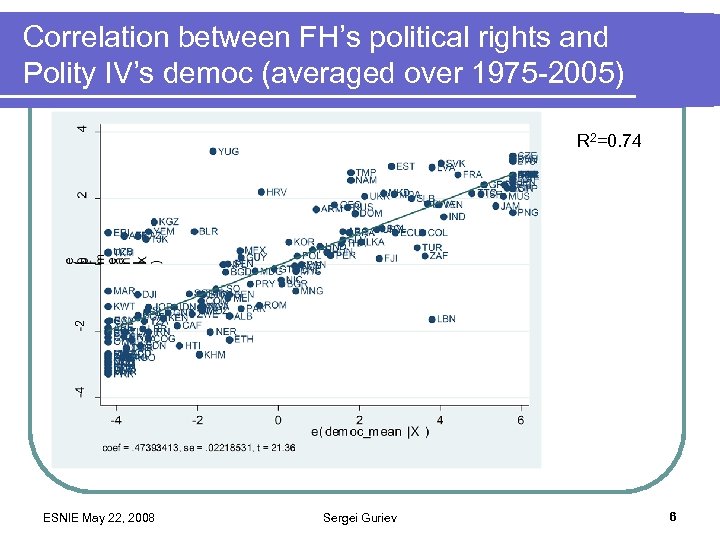 Correlation between FH’s political rights and Polity IV’s democ (averaged over 1975 -2005) R 2=0. 74 ESNIE May 22, 2008 Sergei Guriev 6
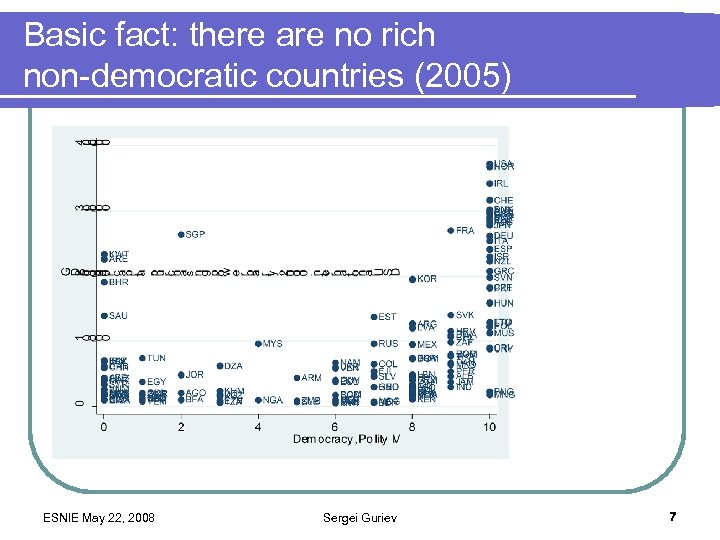 Basic fact: there are no rich non-democratic countries (2005) ESNIE May 22, 2008 Sergei Guriev 7
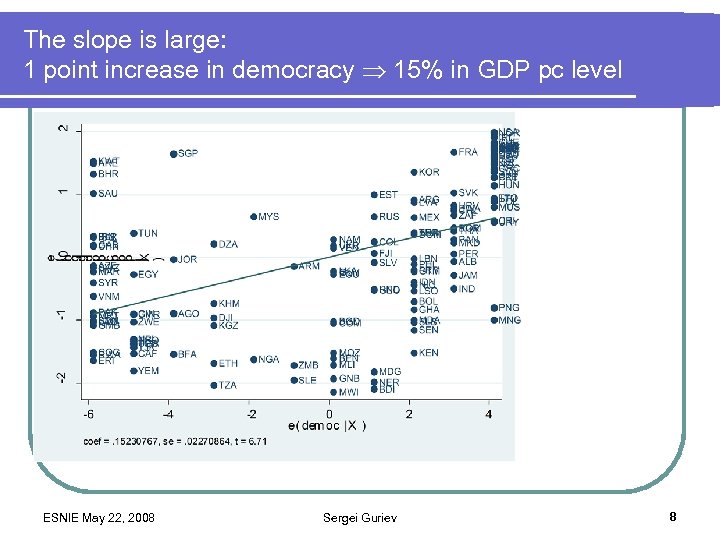 The slope is large: 1 point increase in democracy 15% in GDP pc level ESNIE May 22, 2008 Sergei Guriev 8
 Which way is causality? Lipset 1959 “Some Social Requisites for Democracy”(plus Lipset 1994) l Democracy is not limited to Judeo-Christianic countries – there are social prerequisites l l l GDP per capita and education Political legitimacy Lipset credis Aristotle for the argument: l l Poor cannot responsibly participate in politics, populism prevails The argument is modeled in Acemoglu-Robinson 2006 ESNIE May 22, 2008 Sergei Guriev 9
 Is it important? l Understanding democracy-growth relationship: crucial policy implications l “Democracy growth”: l l l start with democratization delaying democratization would eventually slow down growth If all the correlation is explained by “High income democracy”: l l delay democratization, do other things first: establish rule of law, fight corruption, invest in education etc. resulting growth will bring democracy anyway Let’s check the democracy-growth correlations … ESNIE May 22, 2008 Sergei Guriev 10
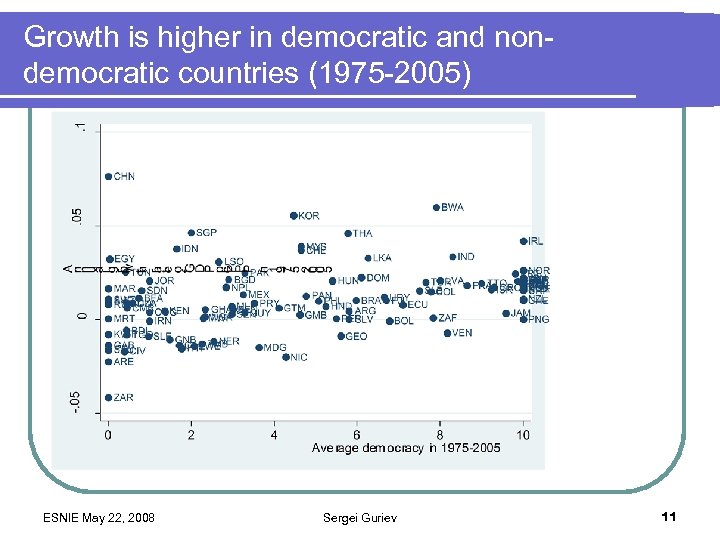 Growth is higher in democratic and nondemocratic countries (1975 -2005) ESNIE May 22, 2008 Sergei Guriev 11
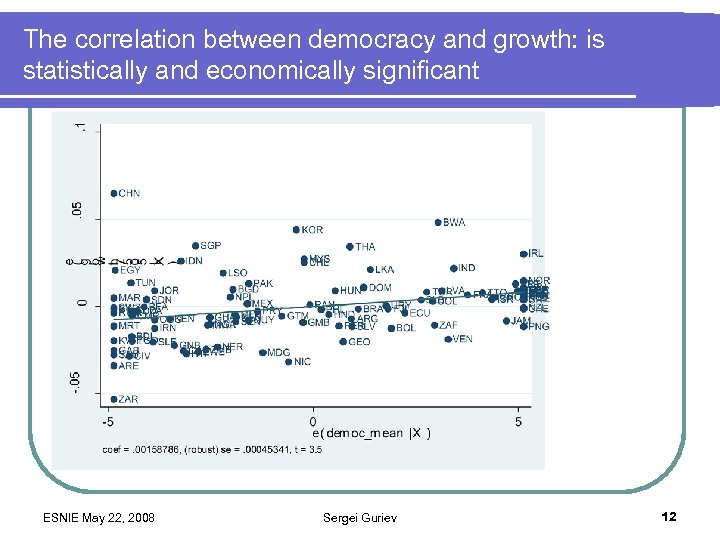 The correlation between democracy and growth: is statistically and economically significant ESNIE May 22, 2008 Sergei Guriev 12
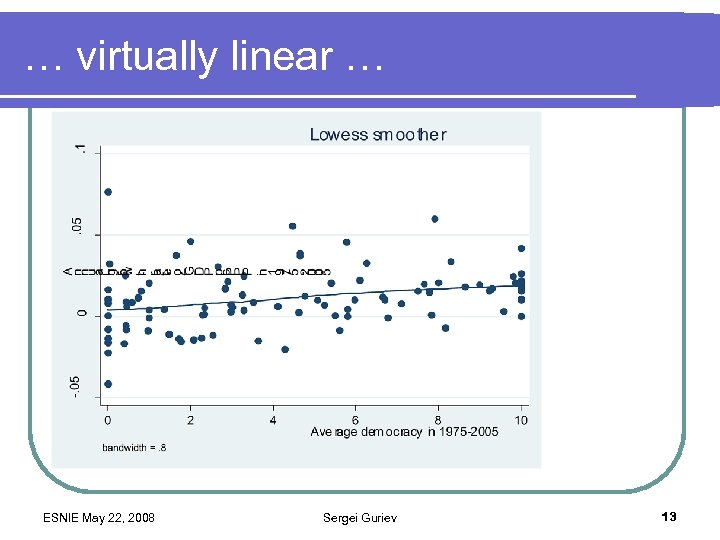 … virtually linear … ESNIE May 22, 2008 Sergei Guriev 13
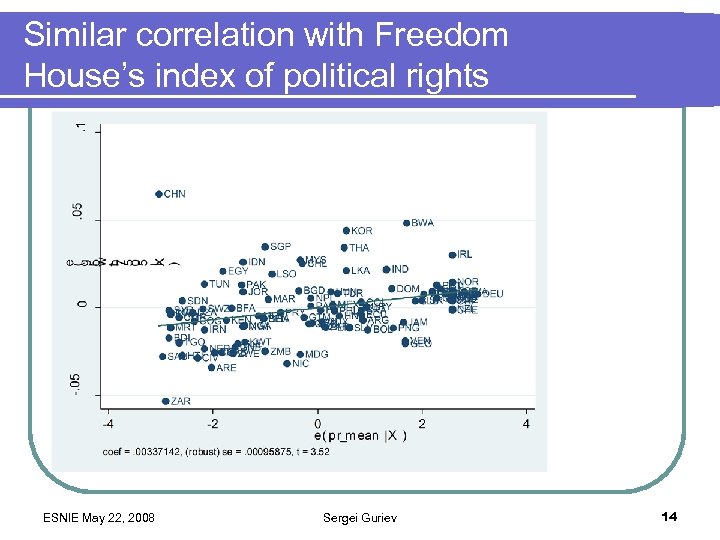 Similar correlation with Freedom House’s index of political rights ESNIE May 22, 2008 Sergei Guriev 14
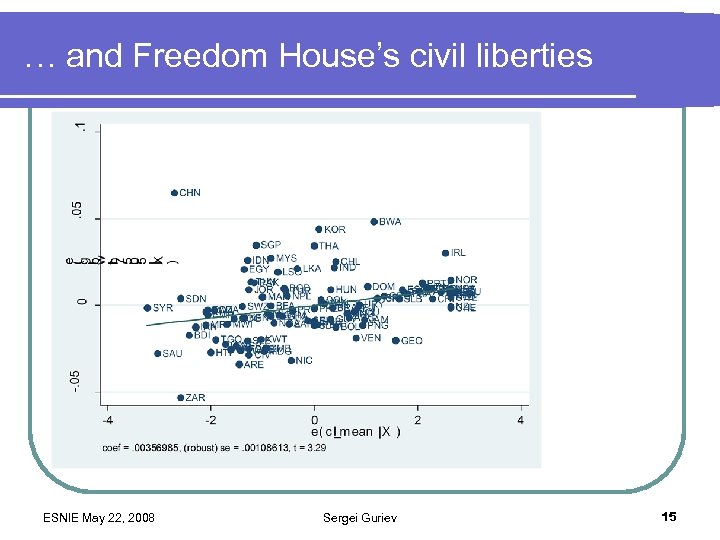 … and Freedom House’s civil liberties ESNIE May 22, 2008 Sergei Guriev 15
 Beyond pairwise correlations: cross-country regressions l Need to control for initial GDP per capita … l The result remains the same … and all other standard determinants of growth in growth regressions l Since early 1990 s economists have included democracy scores in cross-country growth regressions. l The results have been inconclusive: l l Different results for different samples and time periods There is no significant difference in economic performance between democratic and non-democratic regimes In some specifications, democracy has a non-linear effect on growth One robust finding: democracy lower volatility of growth l l Both across and within countries All greatest successes and greatest disasters have been observed in non-democracies ESNIE May 22, 2008 Sergei Guriev 16
 Many dictatorships that start well then end up growth failures l Many dictatorships are overrated: Castro (despite huge achievements in healthcare): zero growth in 50 years l Mao: economic disaster l “Uzbek growth puzzle”: no puzzle l Pinochet: bad performance overall l Gulf countries: almost no growth of GDP per capita in 30 years l ESNIE May 22, 2008 Sergei Guriev 17
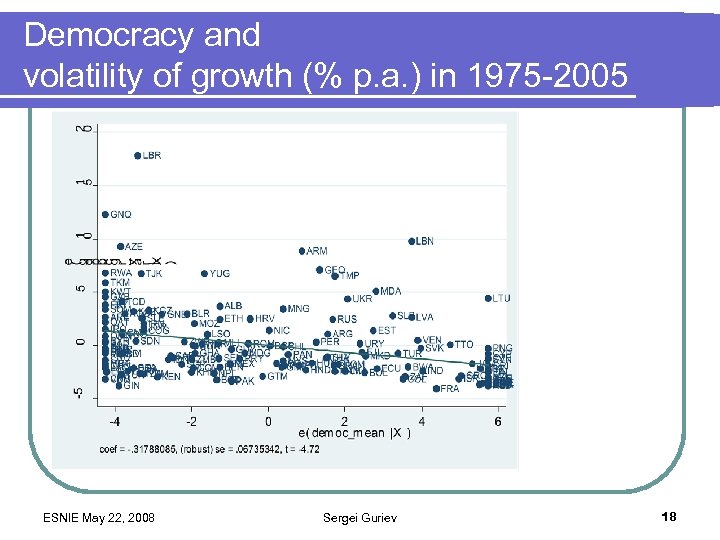 Democracy and volatility of growth (% p. a. ) in 1975 -2005 ESNIE May 22, 2008 Sergei Guriev 18
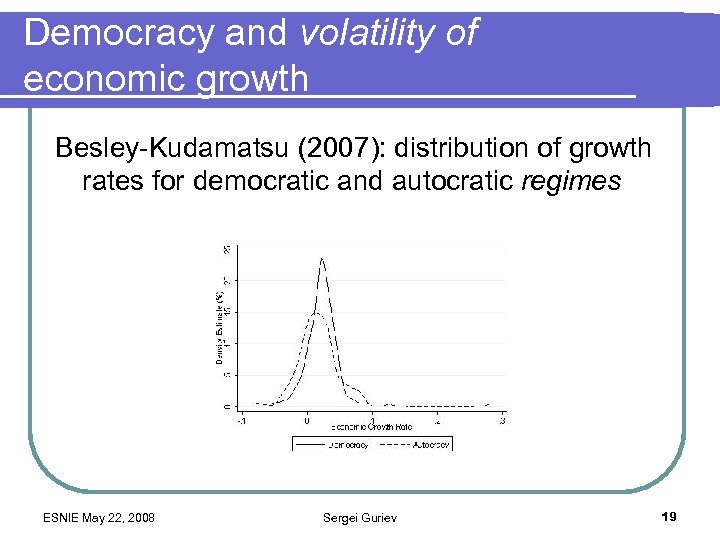 Democracy and volatility of economic growth Besley-Kudamatsu (2007): distribution of growth rates for democratic and autocratic regimes ESNIE May 22, 2008 Sergei Guriev 19
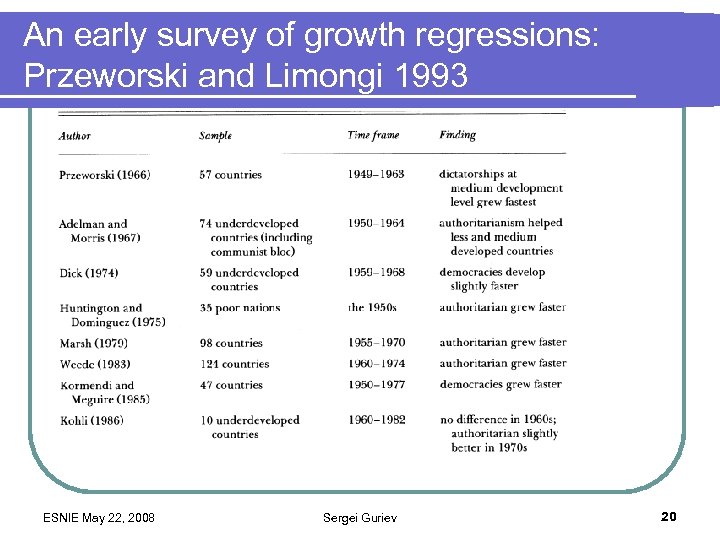 An early survey of growth regressions: Przeworski and Limongi 1993 ESNIE May 22, 2008 Sergei Guriev 20
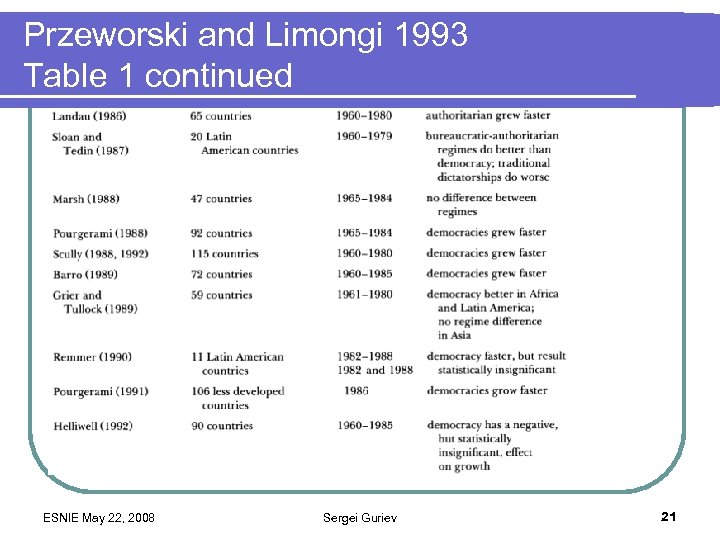 Przeworski and Limongi 1993 Table 1 continued ESNIE May 22, 2008 Sergei Guriev 21
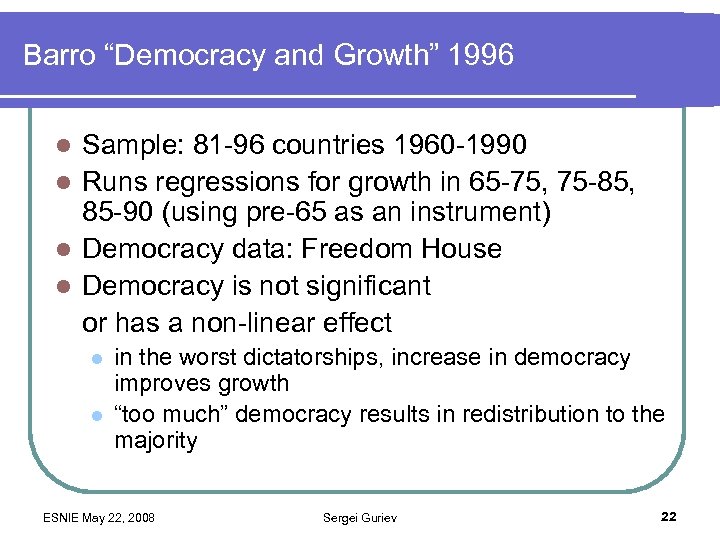 Barro “Democracy and Growth” 1996 Sample: 81 -96 countries 1960 -1990 l Runs regressions for growth in 65 -75, 75 -85, 85 -90 (using pre-65 as an instrument) l Democracy data: Freedom House l Democracy is not significant or has a non-linear effect l l l in the worst dictatorships, increase in democracy improves growth “too much” democracy results in redistribution to the majority ESNIE May 22, 2008 Sergei Guriev 22
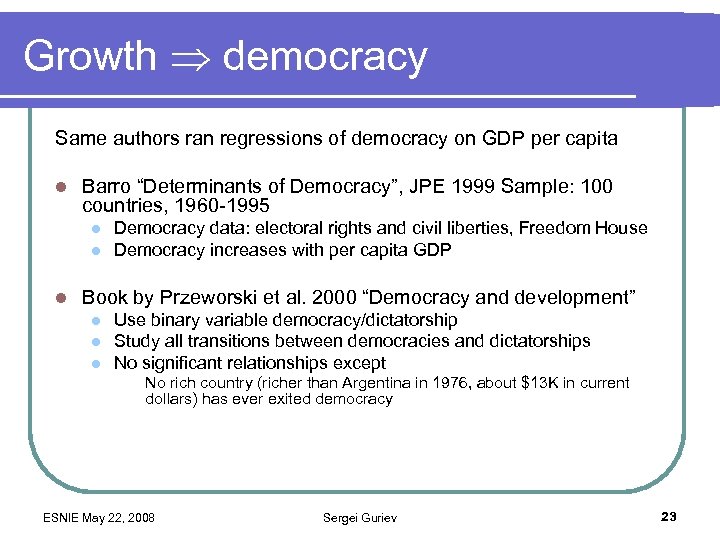 Growth democracy Same authors ran regressions of democracy on GDP per capita l Barro “Determinants of Democracy”, JPE 1999 Sample: 100 countries, 1960 -1995 l l l Democracy data: electoral rights and civil liberties, Freedom House Democracy increases with per capita GDP Book by Przeworski et al. 2000 “Democracy and development” l l l Use binary variable democracy/dictatorship Study all transitions between democracies and dictatorships No significant relationships except No rich country (richer than Argentina in 1976, about $13 K in current dollars) has ever exited democracy ESNIE May 22, 2008 Sergei Guriev 23
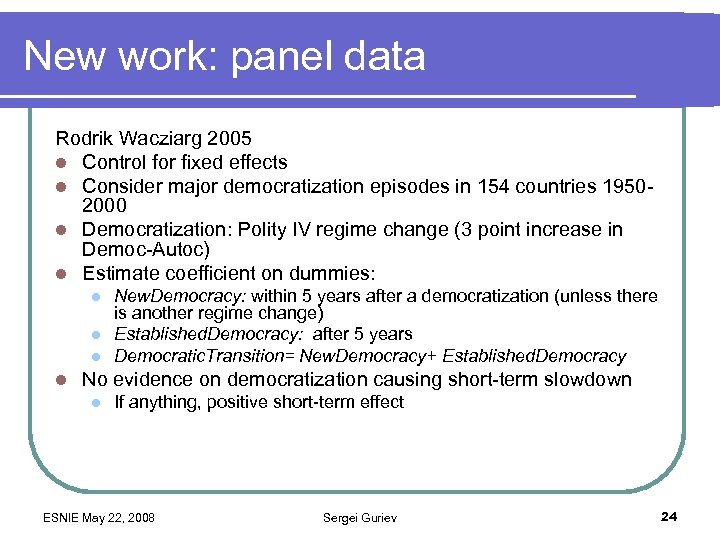 New work: panel data Rodrik Wacziarg 2005 l Control for fixed effects l Consider major democratization episodes in 154 countries 19502000 l Democratization: Polity IV regime change (3 point increase in Democ-Autoc) l Estimate coefficient on dummies: l l New. Democracy: within 5 years after a democratization (unless there is another regime change) Established. Democracy: after 5 years Democratic. Transition= New. Democracy+ Established. Democracy No evidence on democratization causing short-term slowdown l If anything, positive short-term effect ESNIE May 22, 2008 Sergei Guriev 24
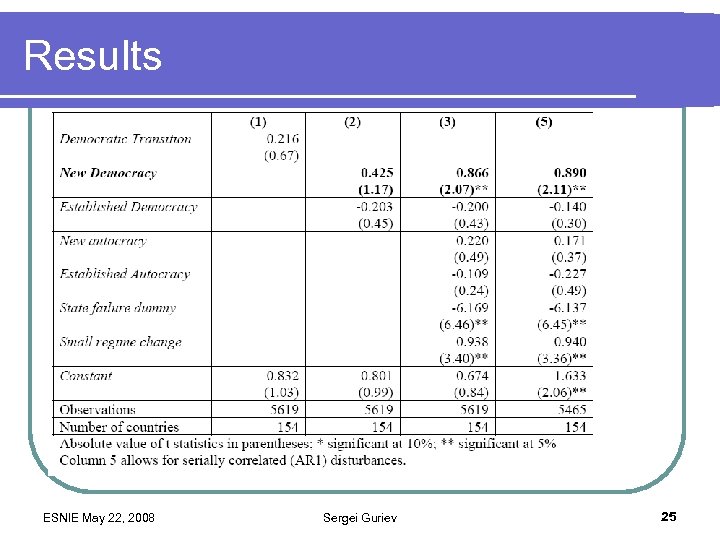 Results ESNIE May 22, 2008 Sergei Guriev 25
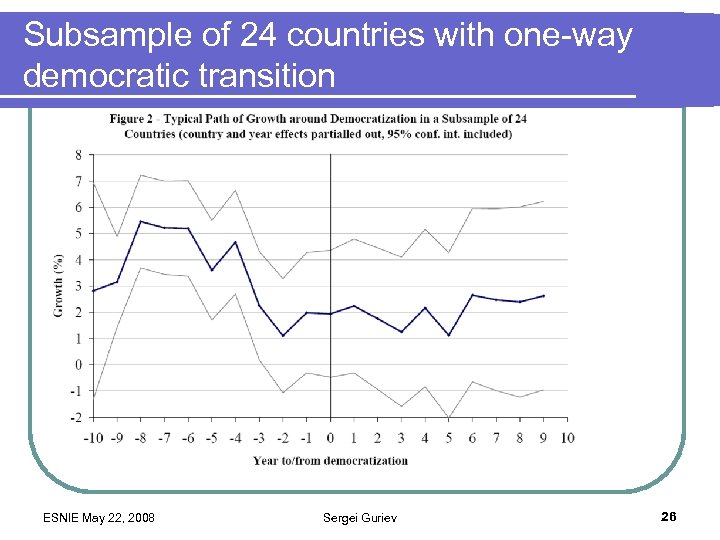 Subsample of 24 countries with one-way democratic transition ESNIE May 22, 2008 Sergei Guriev 26
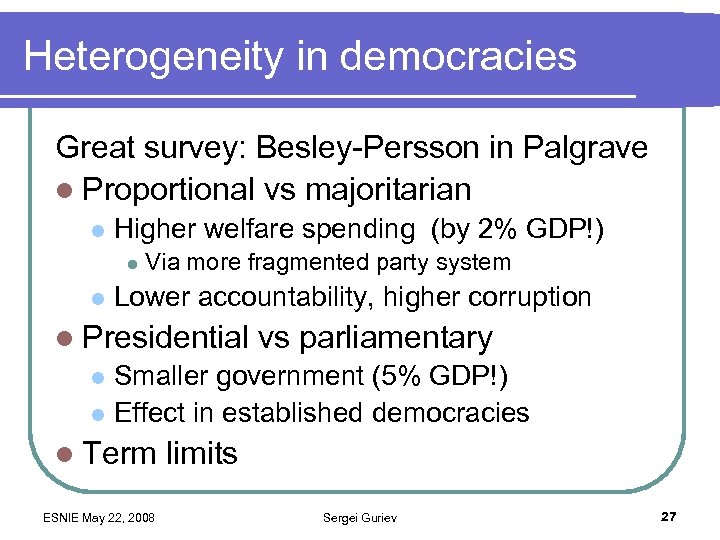 Heterogeneity in democracies Great survey: Besley-Persson in Palgrave l Proportional vs majoritarian l Higher welfare spending (by 2% GDP!) l l Via more fragmented party system Lower accountability, higher corruption l Presidential vs parliamentary Smaller government (5% GDP!) l Effect in established democracies l l Term ESNIE May 22, 2008 limits Sergei Guriev 27
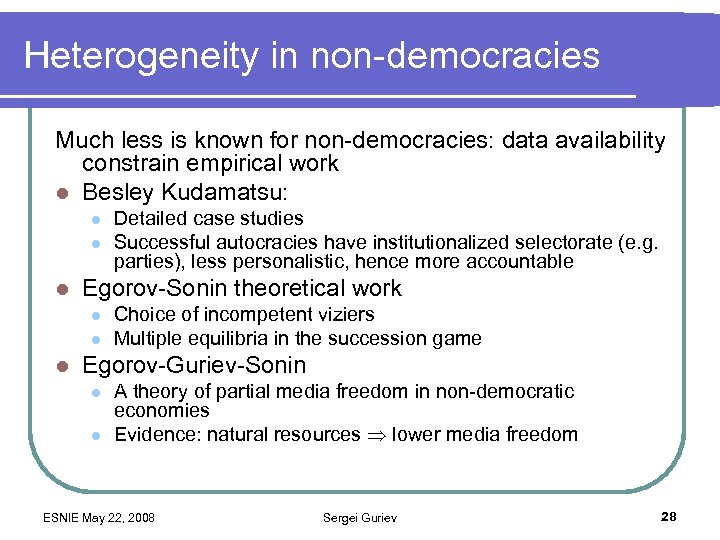 Heterogeneity in non-democracies Much less is known for non-democracies: data availability constrain empirical work l Besley Kudamatsu: l l l Egorov-Sonin theoretical work l l l Detailed case studies Successful autocracies have institutionalized selectorate (e. g. parties), less personalistic, hence more accountable Choice of incompetent viziers Multiple equilibria in the succession game Egorov-Guriev-Sonin l l A theory of partial media freedom in non-democratic economies Evidence: natural resources lower media freedom ESNIE May 22, 2008 Sergei Guriev 28
 Leadership change in autocracies vs. democracies Effect of leadership change on the economy is hard to study because of reverse causality l Only recently, innovative empirical work l l Following corporate finance literature l l Fisman et al. : l l l Suharto’s health problems market downgrades stock of Suhartoconnected firms No such effect for Cheney Jones, Olken: l l l Effect of an unexpected death of CEO on the stock price Unexpected death of leader in dictatorial regimes causes positive growth (1. 5%!) But no such effect in the democracies Besley-Kudamatsu: l l Leadership turnover is higher in successful autocracies Unexpected death exposes the degree of institutionalization of selectorate ESNIE May 22, 2008 Sergei Guriev 29
 Persson-Tabellini 2007 l l Basic idea: correct counterfactual! Apply diff-in-diff+matching (widely used in applied microeconomics) l l Estimate the regime change propensity score (probability of leaving democracy as a function of observable variables) Compare growth experiences of countries with similar propensity scores Data: 1960 -2000, democracy from Polity IV Why has it not been done before? l Unlike labor economics, small dataset, hence loss of efficiency is important! ESNIE May 22, 2008 Sergei Guriev 30
![Results [first stage: consistent with Przeworski, autocratic transitions less likely in rich countries] l](https://present5.com/presentation/991975e1837ead0246587e740682314e/image-31.jpg "Results [first stage: consistent with Przeworski, autocratic transitions less likely in rich countries] l") Results [first stage: consistent with Przeworski, autocratic transitions less likely in rich countries] l Democratic transitions raise growth by 1 percentage point per year l Autocratic transitions decrease growth by 2 percentage points per year l Taking into account the length of transition period, democracy should be richer than autocracy by 45%! l ESNIE May 22, 2008 Sergei Guriev 31
Results [first stage: consistent with Przeworski, autocratic transitions less likely in rich countries] l Democratic transitions raise growth by 1 percentage point per year l Autocratic transitions decrease growth by 2 percentage points per year l Taking into account the length of transition period, democracy should be richer than autocracy by 45%! l ESNIE May 22, 2008 Sergei Guriev 31
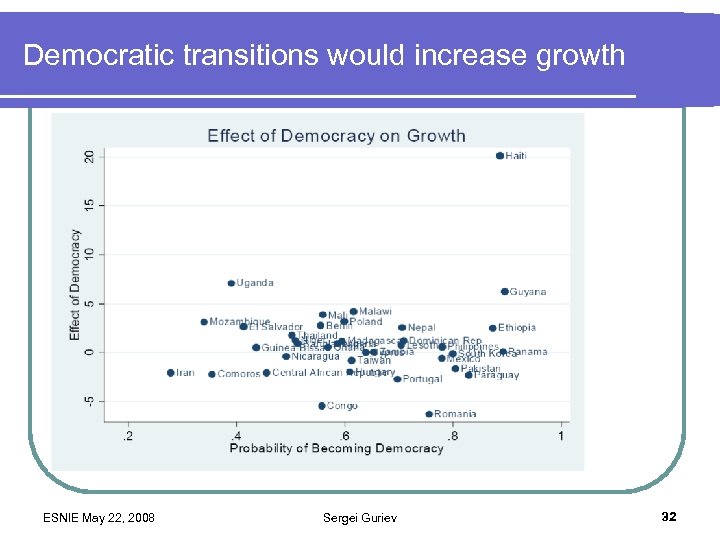 Democratic transitions would increase growth ESNIE May 22, 2008 Sergei Guriev 32
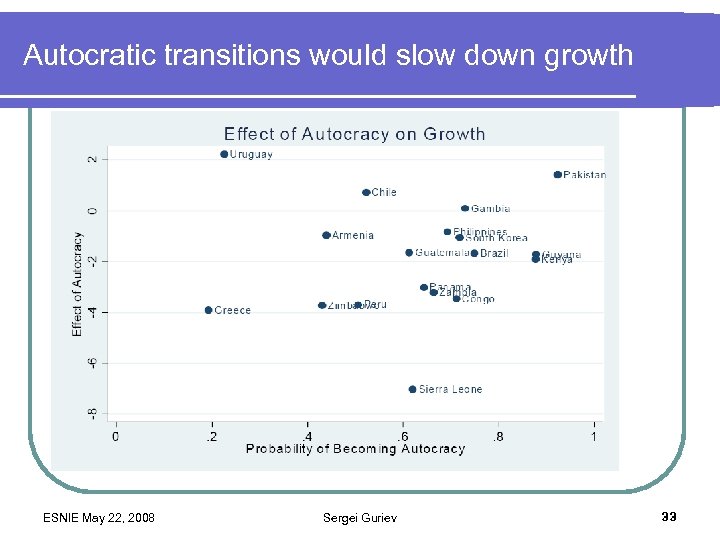 Autocratic transitions would slow down growth ESNIE May 22, 2008 Sergei Guriev 33
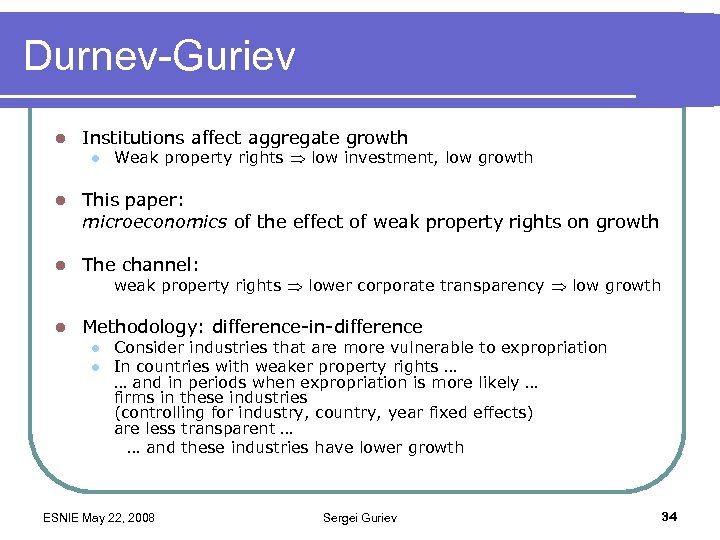 Durnev-Guriev l Institutions affect aggregate growth l Weak property rights low investment, low growth l This paper: microeconomics of the effect of weak property rights on growth l The channel: weak property rights lower corporate transparency low growth l Methodology: difference-in-difference l l Consider industries that are more vulnerable to expropriation In countries with weaker property rights … … and in periods when expropriation is more likely … firms in these industries (controlling for industry, country, year fixed effects) are less transparent … … and these industries have lower growth ESNIE May 22, 2008 Sergei Guriev 34
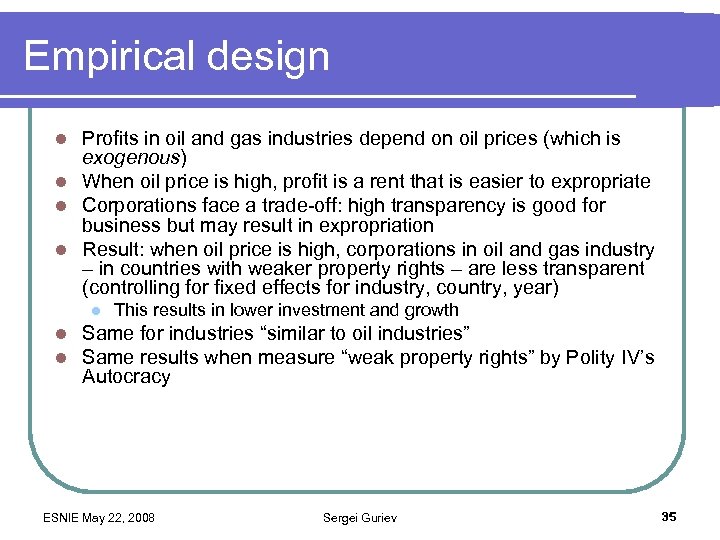 Empirical design Profits in oil and gas industries depend on oil prices (which is exogenous) l When oil price is high, profit is a rent that is easier to expropriate l Corporations face a trade-off: high transparency is good for business but may result in expropriation l Result: when oil price is high, corporations in oil and gas industry – in countries with weaker property rights – are less transparent (controlling for fixed effects for industry, country, year) l l This results in lower investment and growth Same for industries “similar to oil industries” Same results when measure “weak property rights” by Polity IV’s Autocracy ESNIE May 22, 2008 Sergei Guriev 35
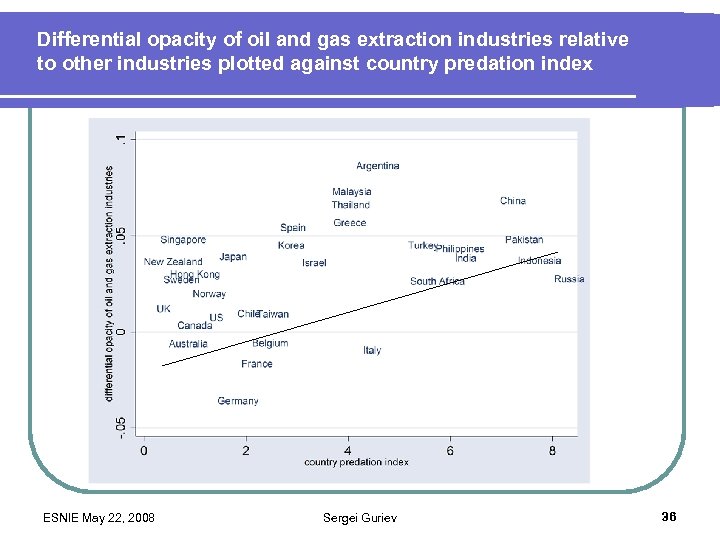 Differential opacity of oil and gas extraction industries relative to other industries plotted against country predation index ESNIE May 22, 2008 Sergei Guriev 36
 Conclusions l The “democracy-growth” debate is far from over l In particular, no clear results emerge from cross-country regressions l Recent l research is using new methods Results are more consistent with “democracy is good for growth” ESNIE May 22, 2008 Sergei Guriev 37