


 Скачать презентацию Political Parties Interest Groups the Media American
0bde724300d466c93f27453cad7a23c4.ppt
- Количество слайдов: 45
 Political Parties, Interest Groups, & the Media American Government Content Statement #2: Political parties, interest groups and the media provide opportunities for civic involvement through various means.
 What is a political party? Organization whose members hold similar views on public issues Seek to determine public policy through winning of elections & having members hold public office
 What do political parties do? Nominate candidates Rally supporters Participate in government Make sure officeholders/members are successful Watchdog over “the other party”
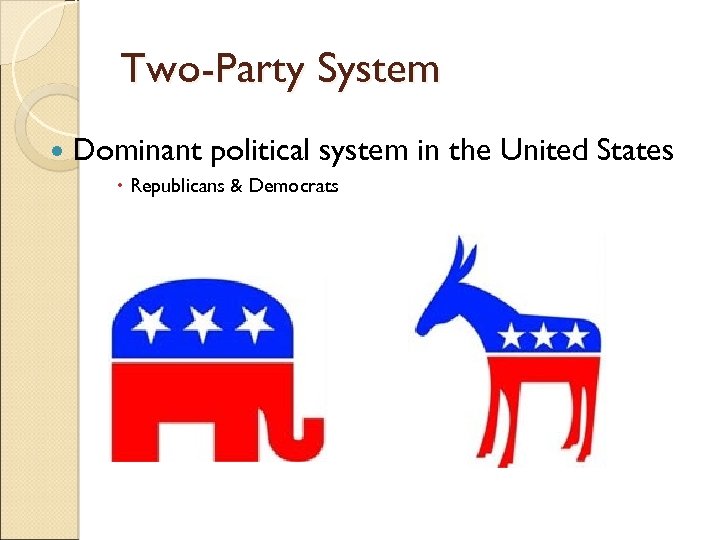 Two-Party System Dominant political system in the United States Republicans & Democrats
 Characteristics of the Republican Party (GOP) Favor private market forces in the economy (laissez faire) Believe Federal Government should be less involved in social welfare programs Small government Conservative social views
![Grand Old Party [They define] themselves as the party of first principles, that is,](https://present5.com/presentation/0bde724300d466c93f27453cad7a23c4/image-6.jpg "Grand Old Party [They define] themselves as the party of first principles, that is,") Grand Old Party [They define] themselves as the party of first principles, that is, the original American values and models — individualism, pioneering spirit, free enterprise, anti-centralism and antibureaucracy, family values and neighborly spirit etc. Model their views after Abraham Lincoln
Grand Old Party [They define] themselves as the party of first principles, that is, the original American values and models — individualism, pioneering spirit, free enterprise, anti-centralism and antibureaucracy, family values and neighborly spirit etc. Model their views after Abraham Lincoln
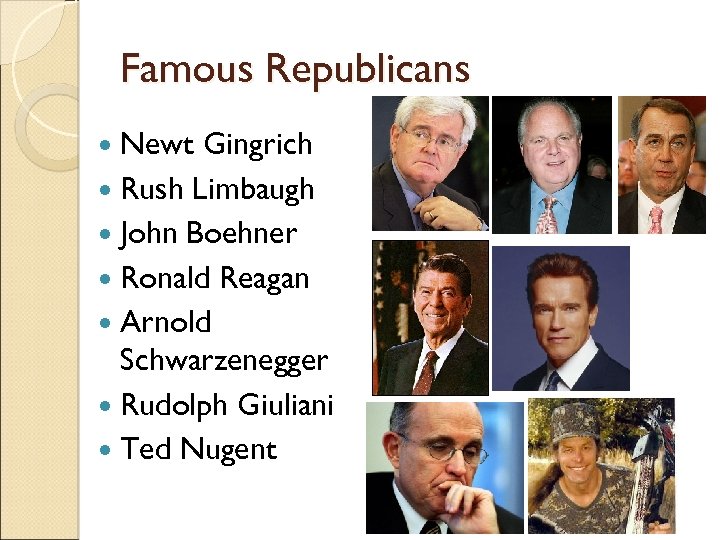 Famous Republicans Newt Gingrich Rush Limbaugh John Boehner Ronald Reagan Arnold Schwarzenegger Rudolph Giuliani Ted Nugent
 Characteristics of the Democratic Party Support social welfare programs Favor government regulation of business practices Support efforts to improve status of minorities Big government Liberal social & political views
 Democratic Party They define themselves: ◦ For over 200 years, Democrats have stood for the idea that wealth and status should not be an entitlement to rule. Democrats recognize that our country and our economy are strongest when they provide opportunity for all Americans— when we grow our country from the bottom up. ◦ Democrats stand for an abiding faith in the judgment of hardworking American families, and a commitment to helping the excluded, the disenfranchised and the poor strengthen our nation by earning themselves a piece of the American Dream. We remember that our country was sculpted by immigrants and slaves, their children and grandchildren. Even today, it is our diversity above all else that provides us with our enduring strength. Model their views after Andrew Jackson
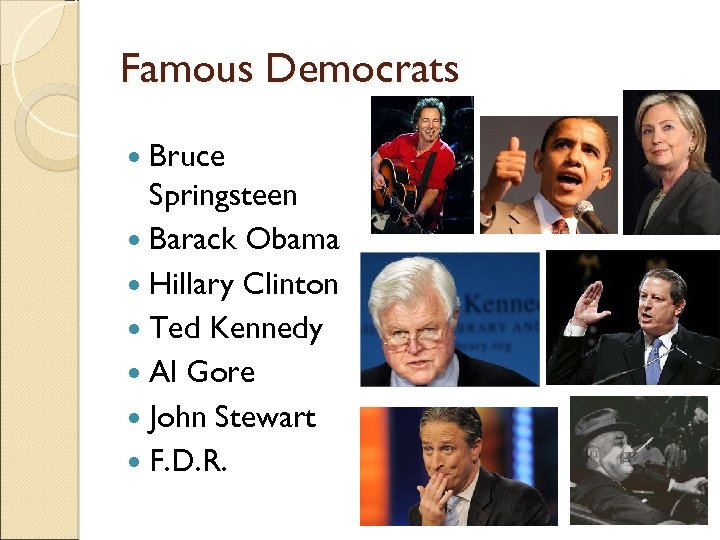 Famous Democrats Bruce Springsteen Barack Obama Hillary Clinton Ted Kennedy Al Gore John Stewart F. D. R.
 Differences between the Parties The following video clips are intended as a comical view on both political parties and should not, in any way be taken seriously or literally. Additionally, these clips do not in any way represent the beliefs of any Mayfield High School staff member or Mayfield High School as a whole. http: //www. huffingtonpost. com/2011/08/27/thedaily-show-explains-republicansdemocrats_n_939020. html
 What is a Radical? Seen as being on the far left of the political spectrum, radicals call for widesweeping rapid change in the basic structure of the political, social, or economic system. They may be willing to resort to extreme methods to bring about change, including the use of violence and revolution.
 What is a Liberal? Liberals believe that the government should be actively involved in the promotion of social welfare of a nation’s citizens. They usually call for peaceful, gradual change within the existing political system. They reject violent revolution as a way of changing the way things are, often called the status quo.
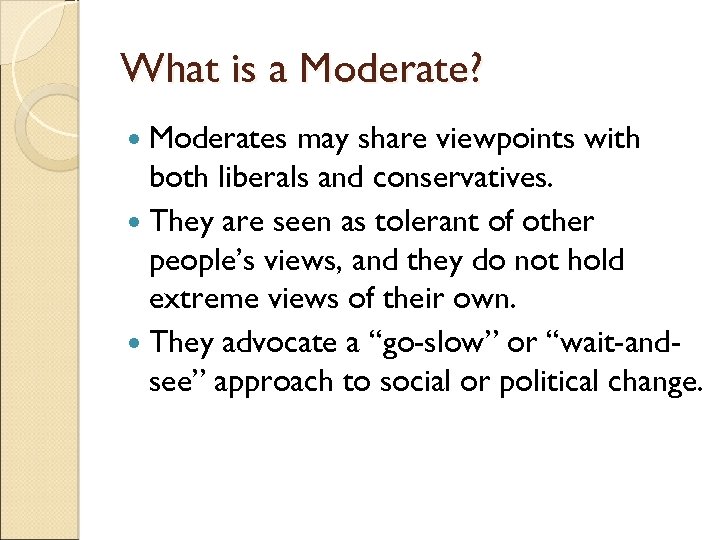 What is a Moderate? Moderates may share viewpoints with both liberals and conservatives. They are seen as tolerant of other people’s views, and they do not hold extreme views of their own. They advocate a “go-slow” or “wait-andsee” approach to social or political change.
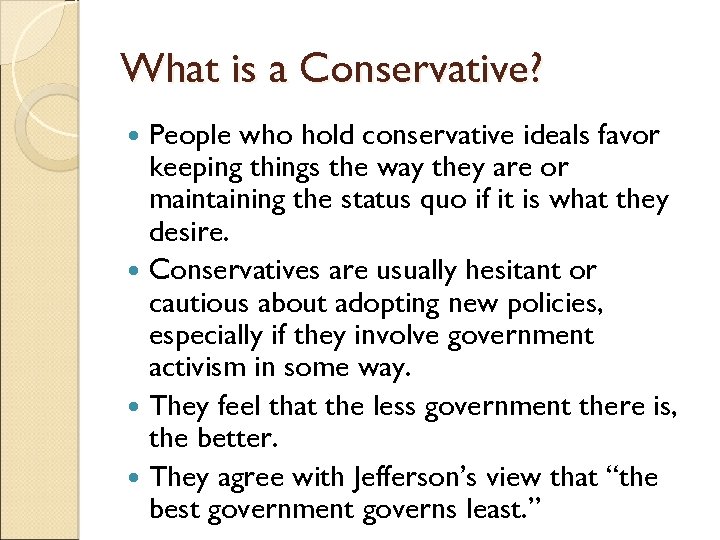 What is a Conservative? People who hold conservative ideals favor keeping things the way they are or maintaining the status quo if it is what they desire. Conservatives are usually hesitant or cautious about adopting new policies, especially if they involve government activism in some way. They feel that the less government there is, the better. They agree with Jefferson’s view that “the best government governs least. ”
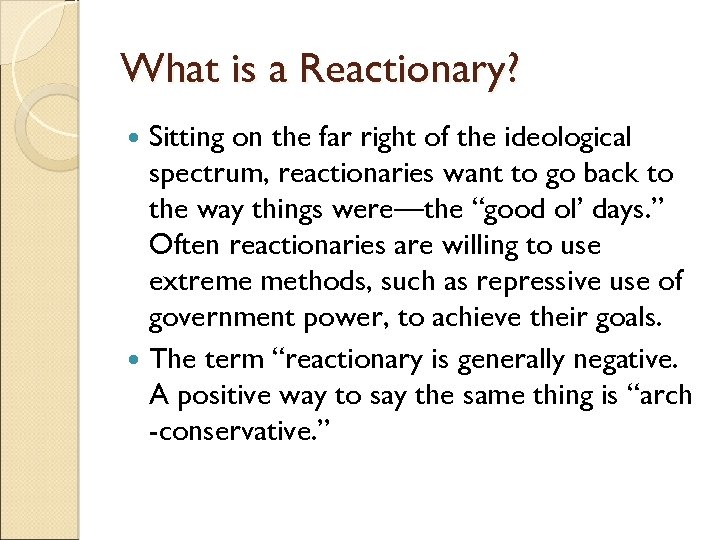 What is a Reactionary? Sitting on the far right of the ideological spectrum, reactionaries want to go back to the way things were—the “good ol’ days. ” Often reactionaries are willing to use extreme methods, such as repressive use of government power, to achieve their goals. The term “reactionary is generally negative. A positive way to say the same thing is “arch -conservative. ”
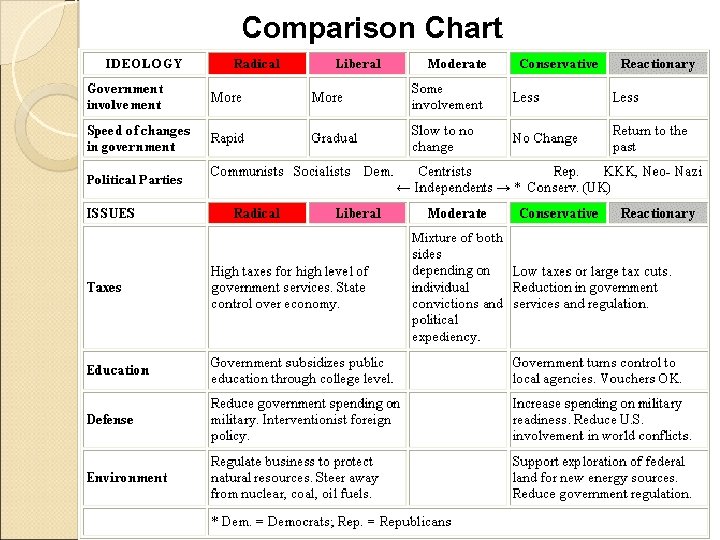 Comparison Chart
 Roles of Third Parties Keep major parties in check Call attention to controversial issues that major parties may not May also rally around a specific issue Acts as a ‘spoiler’ during elections
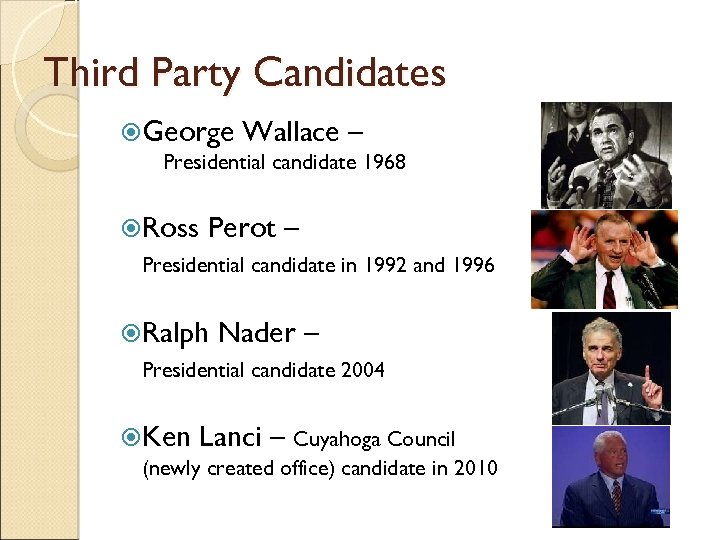 Third Party Candidates George Wallace – Presidential candidate 1968 Ross Perot – Presidential candidate in 1992 and 1996 Ralph Nader – Presidential candidate 2004 Ken Lanci – Cuyahoga Council (newly created office) candidate in 2010
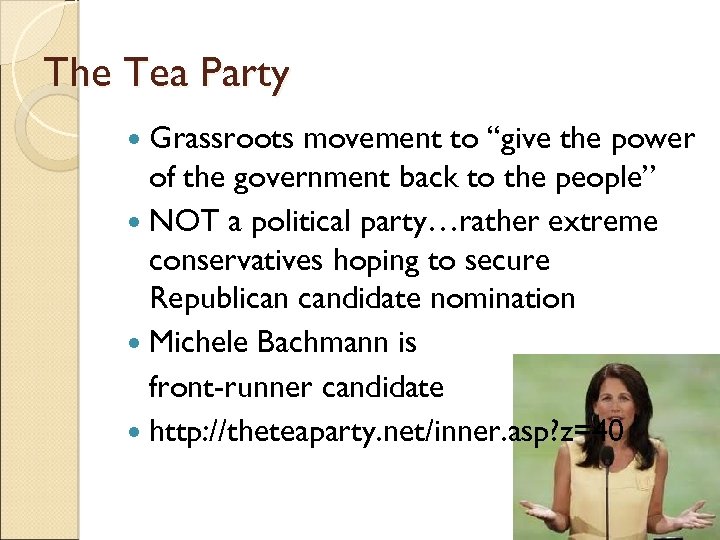 The Tea Party Grassroots movement to “give the power of the government back to the people” NOT a political party…rather extreme conservatives hoping to secure Republican candidate nomination Michele Bachmann is front-runner candidate http: //theteaparty. net/inner. asp? z=40
 Third Parties Libertarian Party - total individual liberty (pro-drug legalization, pro-choice, pro-gay marriage, pro-home schooling, pro-gun rights, etc. ) and total economic freedom (anti-welfare, anti-government regulation of business, antiminimum wage, anti-income tax, pro-free trade) Green Party of the United States - Committed to environmentalism, non-violence, social justice and grassroots organizing Constitution Party - strongly pro-life, anti-gun control, anti-tax, anti-immigration, trade protectionist, "anti. New World Order, " anti-United Nations, anti-gay rights, antiwelfare, and pro-school prayer. http: //politics 1. com/parties. htm
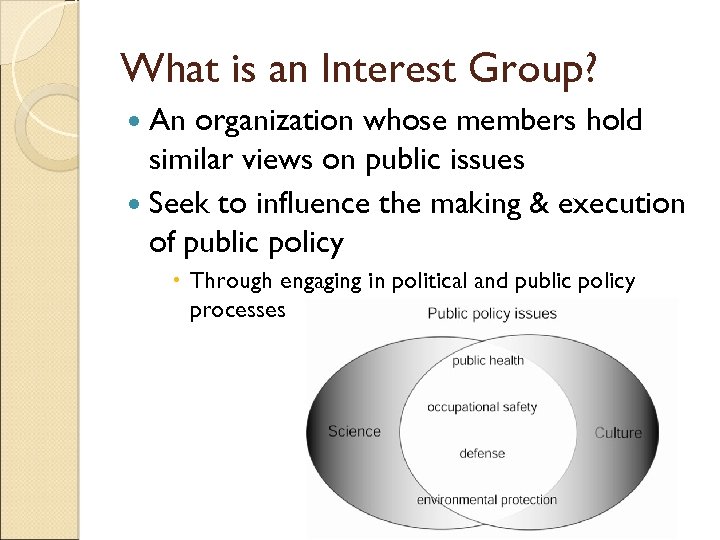 What is an Interest Group? An organization whose members hold similar views on public issues Seek to influence the making & execution of public policy Through engaging in political and public policy processes
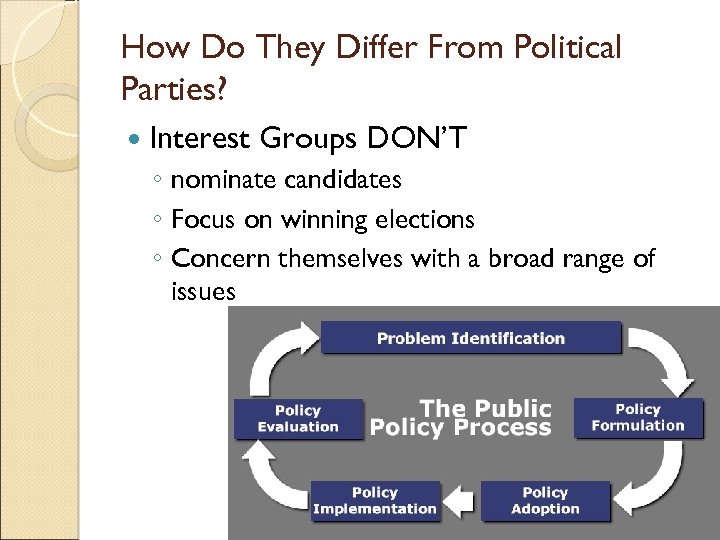 How Do They Differ From Political Parties? Interest Groups DON’T ◦ nominate candidates ◦ Focus on winning elections ◦ Concern themselves with a broad range of issues
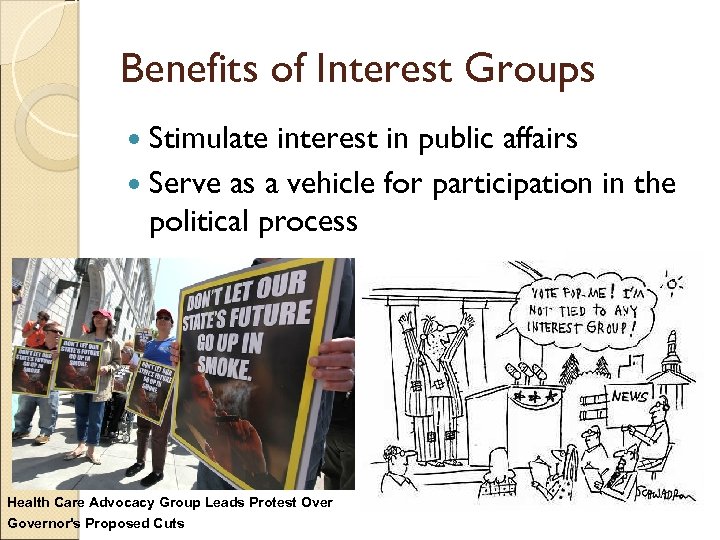 Benefits of Interest Groups Stimulate interest in public affairs Serve as a vehicle for participation in the political process Health Care Advocacy Group Leads Protest Over Governor's Proposed Cuts
 Criticisms of Interest Groups Having influence disproportionate to their size Occasionally use unethical tactics
 Types of Interest Groups Most people belong to several organizations defined as an interest group Most represent economic interests Business, labor, agriculture, certain professions Some are devoted to social and political causes, religious interests, or the welfare of a certain segment of the population Public-interest groups work for some aspect of the public good List of interest groups by type: http: //faculty. ucc. edu/egh-damerow/interest_groups 1. htm
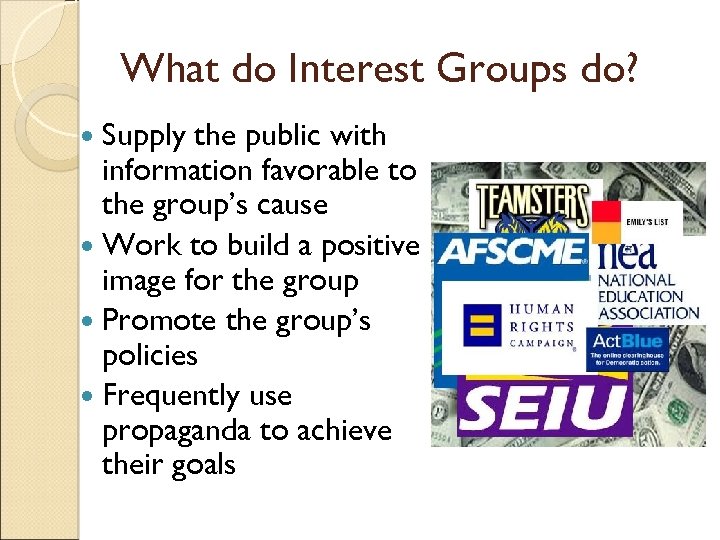 What do Interest Groups do? Supply the public with information favorable to the group’s cause Work to build a positive image for the group Promote the group’s policies Frequently use propaganda to achieve their goals
 Citizens United v. FEC (2010) Political spending is a form of protected speech under the First Amendment The government may not keep corporations or unions from spending money to support or denounce individual candidates in elections.
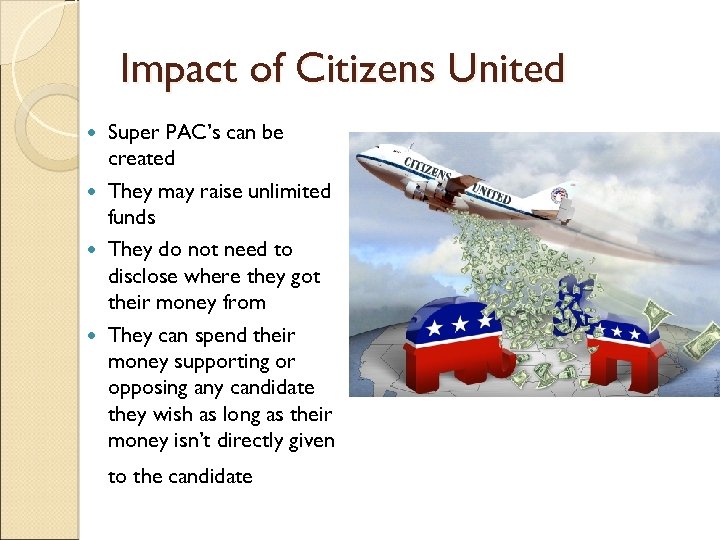 Impact of Citizens United Super PAC’s can be created They may raise unlimited funds They do not need to disclose where they got their money from They can spend their money supporting or opposing any candidate they wish as long as their money isn’t directly given to the candidate
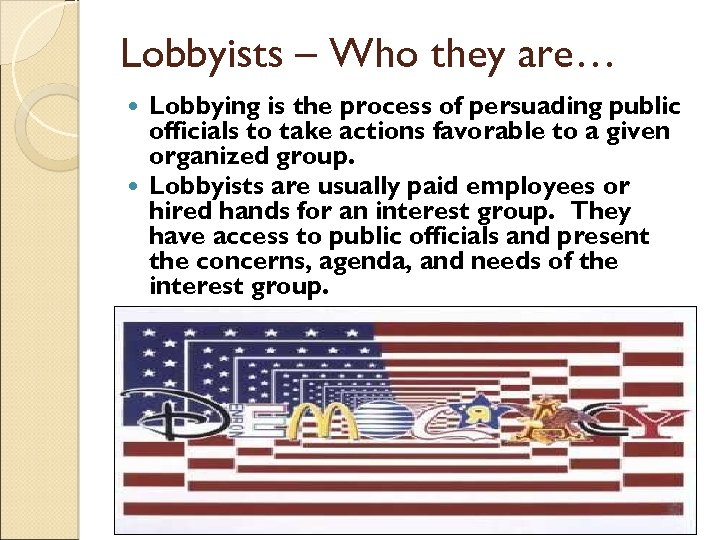 Lobbyists – Who they are… Lobbying is the process of persuading public officials to take actions favorable to a given organized group. Lobbyists are usually paid employees or hired hands for an interest group. They have access to public officials and present the concerns, agenda, and needs of the interest group.
 Lobbyists – What they do… Access is the most important advantage which lobbyists have over ordinary people. Lobbyists build up rapport with public officials over years, often decades. Having the elected official as a college buddy, former business associate, or family member certainly helps.
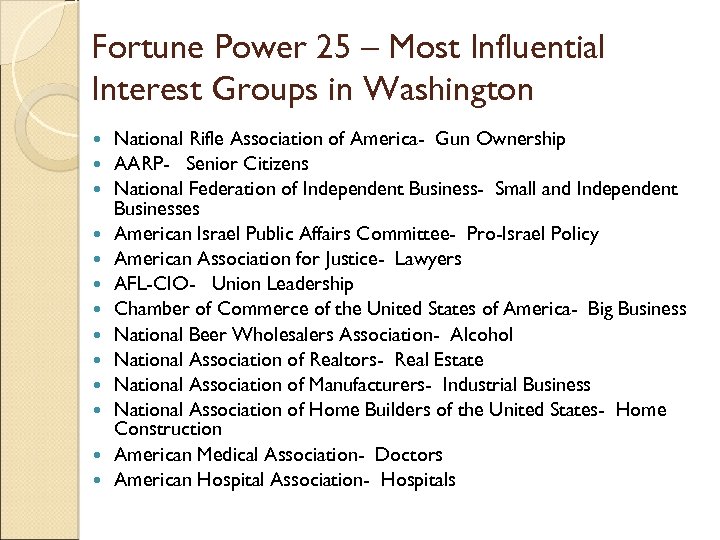 Fortune Power 25 – Most Influential Interest Groups in Washington National Rifle Association of America- Gun Ownership AARP- Senior Citizens National Federation of Independent Business- Small and Independent Businesses American Israel Public Affairs Committee- Pro-Israel Policy American Association for Justice- Lawyers AFL-CIO- Union Leadership Chamber of Commerce of the United States of America- Big Business National Beer Wholesalers Association- Alcohol National Association of Realtors- Real Estate National Association of Manufacturers- Industrial Business National Association of Home Builders of the United States- Home Construction American Medical Association- Doctors American Hospital Association- Hospitals
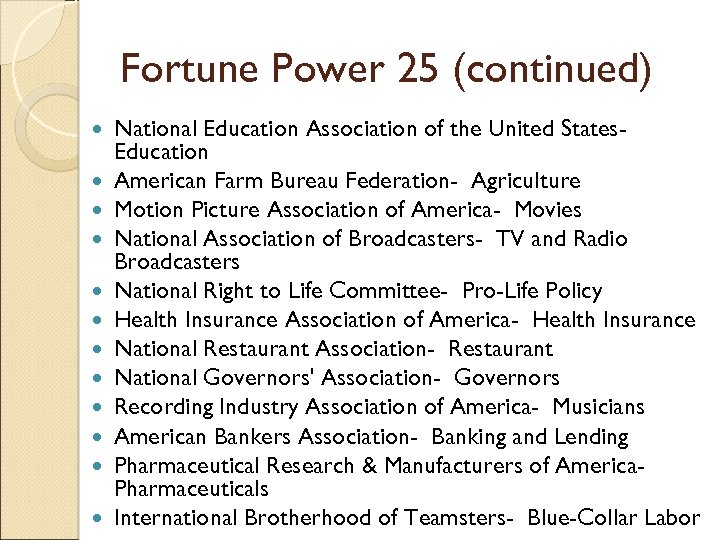 Fortune Power 25 (continued) National Education Association of the United States. Education American Farm Bureau Federation- Agriculture Motion Picture Association of America- Movies National Association of Broadcasters- TV and Radio Broadcasters National Right to Life Committee- Pro-Life Policy Health Insurance Association of America- Health Insurance National Restaurant Association- Restaurant National Governors' Association- Governors Recording Industry Association of America- Musicians American Bankers Association- Banking and Lending Pharmaceutical Research & Manufacturers of America. Pharmaceuticals International Brotherhood of Teamsters- Blue-Collar Labor
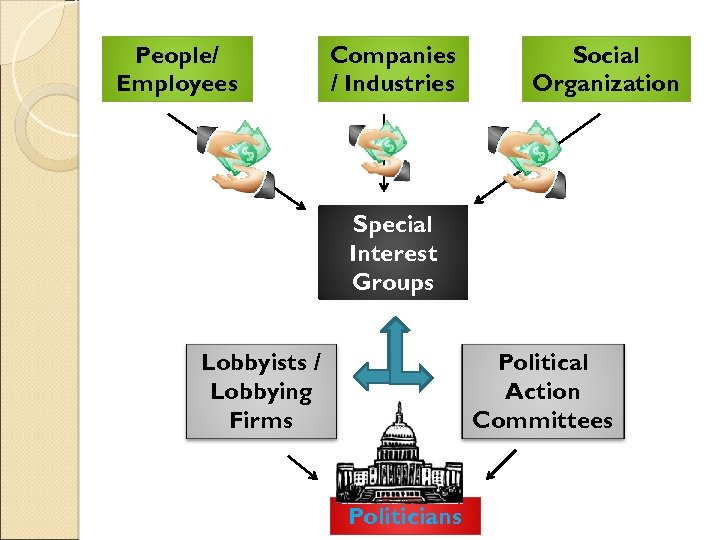 People/ Employees Companies / Industries Social Organization Special Interest Groups Lobbyists / Lobbying Firms Political Action Committees Politicians
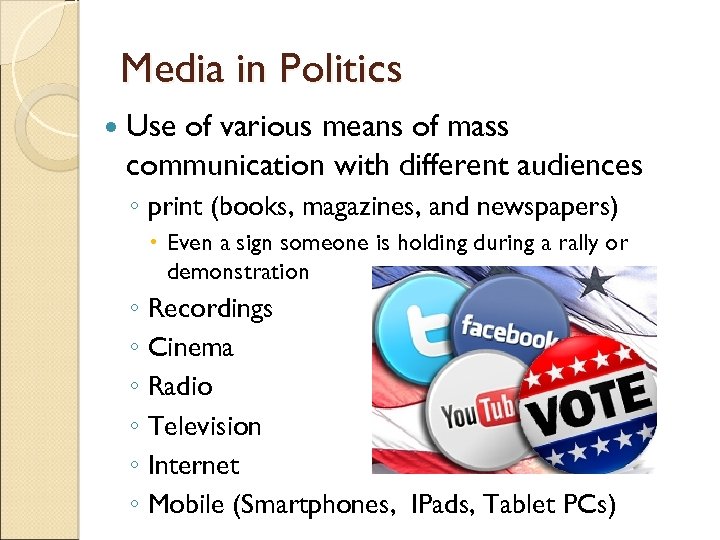 Media in Politics Use of various means of mass communication with different audiences ◦ print (books, magazines, and newspapers) Even a sign someone is holding during a rally or demonstration ◦ Recordings ◦ Cinema ◦ Radio ◦ Television ◦ Internet ◦ Mobile (Smartphones, IPads, Tablet PCs)
 Media in Politics (cont. ) Used heavily by political parties & interest groups ◦ influence the political and public policy process ◦ Help to set public agenda Societal problems political leaders & citizens agree need government attention ◦ Plays a central role in electoral politics
 Media Influence Limited Many people use mass media for entertainment & not information Few people follow international, or local politics closely Those who do are selective Pay attention to sources that generally agree with their viewpoints (liberal vs. conservative)
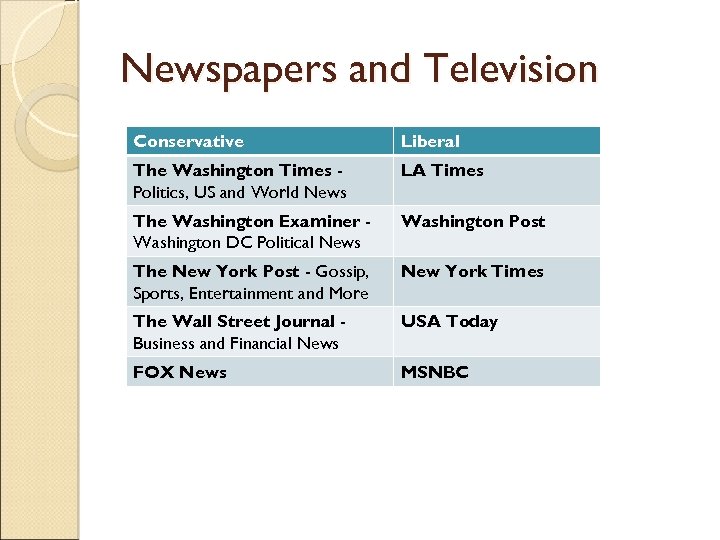 Newspapers and Television Conservative Liberal The Washington Times Politics, US and World News LA Times The Washington Examiner Washington DC Political News Washington Post The New York Post - Gossip, Sports, Entertainment and More New York Times The Wall Street Journal Business and Financial News USA Today FOX News MSNBC
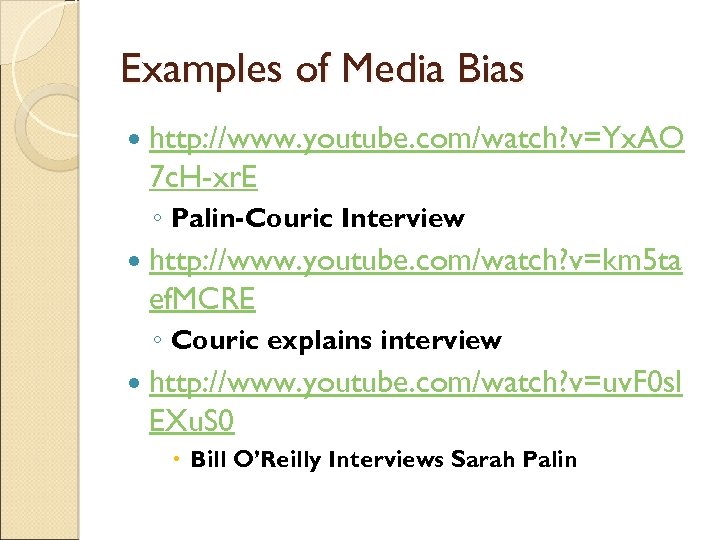 Examples of Media Bias http: //www. youtube. com/watch? v=Yx. AO 7 c. H-xr. E ◦ Palin-Couric Interview http: //www. youtube. com/watch? v=km 5 ta ef. MCRE ◦ Couric explains interview http: //www. youtube. com/watch? v=uv. F 0 sl EXu. S 0 Bill O’Reilly Interviews Sarah Palin
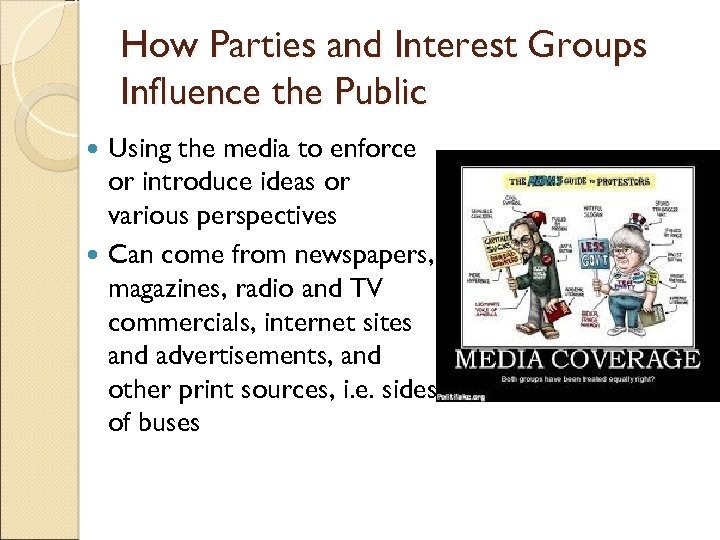 How Parties and Interest Groups Influence the Public Using the media to enforce or introduce ideas or various perspectives Can come from newspapers, magazines, radio and TV commercials, internet sites and advertisements, and other print sources, i. e. sides of buses
 Card Stacking Deliberate action is taken to bias an argument Opposing evidence being buried or discredited The case for one's own position is exaggerated at every opportunity
 Plain Folk Make the leaders look just like mom'n'pop -style 'plain folks‘ through dress, speech and action ◦ i. e. video footage of politicians going grocery shopping or jogging ◦ When politicians go campaigning they tend to dress like the people they are trying to win the votes of
 Testimonial If your words might lack credibility in some way, borrow the credibility of others by getting the testimony of trusted others. ◦ Pop culture celebrities endorsing a political candidate or issue ◦ Professionals or experts in their field speaking out on behalf of an issue or candidate
 What Types of Messages are Sent Logical argument - sensible point of view supporting an idea Ad hominem attack - attacks a person rather than answer arguments about an issue Positive Image - focusing solely on the positive aspects of person or issue
 Examples http: //www. youtube. com/watch? v=b 8 ZD 9 Rc. C 8 P 0 –Star Wars Immunization http: //www. youtube. com/watch? v=3 B 74 xr. OEzn 0 -LA Department of Public Health Vaccinations http: //www. youtube. com/watch? v=6 w. IRajc 8 JQY -OH Right to Life's anti-Obama ad http: //vegetarianstar. com/wp-content/uploads/2008/07/paul_mccartney_veg_ad. jpg Paul Mc. Cartney http: //www. youtube. com/watch? v=Io 9 KMSSEZ 0 Y -Willie Horton 1988 Attack Ad http: //www. youtube. com/watch? v=KOrm. Ov. Hysd. U -John Mc. Cain Celebrity Ad http: //www. youtube. com/watch? v=y. Bgh. TL 4 CPo. E –Anti-Mc. Cain ad http: //www. youtube. com/watch? v=Jq 41 Lg. Ve. MSo -Anti Sarah Palin Campaign http: //www. methproject. org/ads/print/15 bucks. html -Montana Meth Project http: //www. methproject. org/ads/tv/tracy. html -Montana Meth Project video