


 Скачать презентацию Political Parties 2 2013 The Mc
b1aab4176d53317854b5e5fc97836dde.ppt
- Количество слайдов: 19
 Political Parties
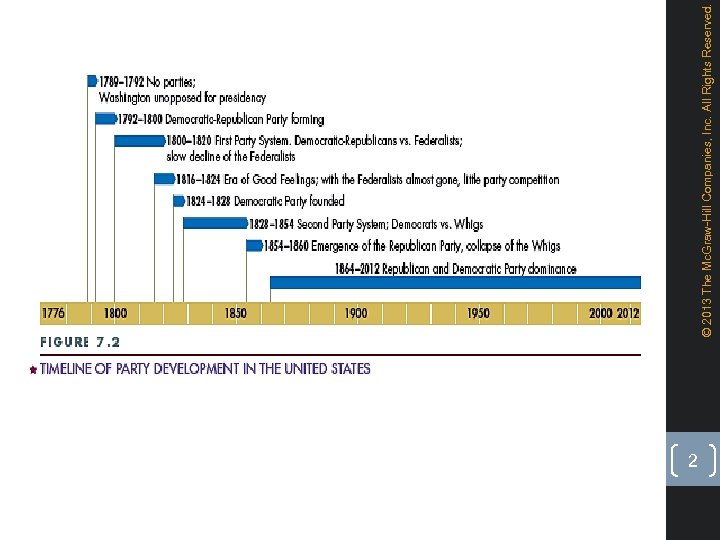 2 © 2013 The Mc. Graw-Hill Companies, Inc. All Rights Reserved.
 © 2013 The Mc. Graw-Hill Companies, Inc. All Rights Reserved. The Development of American Political Parties • Early Party Formation • Founders: electoral college, no parties • Electoral college: distinguished citizens selected by the states would choose the president and vice president. • Each state legislator would appoint the senators. • Founders: imagined and hoped for dignified decision-making in House elections and Senate appointments • Internal conflict within the House • Federalists/Hamilton vs. anti-Federalists/Democratic. Republicans/Jefferson • Hamilton’s coalition did well in the House votes. • Jefferson and Madison turned to organizing an alliance that would become an electoral alliance to elected like-minded individuals under the label of the Democratic-Republican Party. • They were successful and won the presidency and the House in the election of 1800. 3
 © 2013 The Mc. Graw-Hill Companies, Inc. All Rights Reserved. The First Party System, 18001820 • This system is marked by the appearance of the new Democratic-Republican Party and their competition with the Federalist Party. • Federalists declined, but did remain a regional New England party; could not offer a presidential candidate to oppose James Monroe in the election of 1820. • Era of Good Feelings: no opposition to the Democratic. Republican Party and thus no partisan conflict. But this did not last. • Internal disagreements emerged: Democratic. Republicans factionalized. • Sen. Martin Van Buren of New York became upset with James Monroe for cooperating too much with Federalists. • Launched a successful effort to nominate and elect Andrew Jackson. • Van Buren created a new kind of party: mass mobilization; 4
 © 2013 The Mc. Graw-Hill Companies, Inc. All Rights Reserved. The Second Party System, 1828 -1854 • Democratic Party expanded its reach; organized in every state • Opposition: remnants of the Federalists, Jackson opposition emerged as Whig Party • Opposed the extension of presidential power • Supported development of transportation and infrastructure • Second Party System characterized by competition between Whigs and Democrats. • Abundance of third parties as well; policybased • Anti-Masonic and the American Party opposed immigration • Liberty Party and Free Soil Party focused on slavery issue • This issue, slavery, would tear the Second 5
 © 2013 The Mc. Graw-Hill Companies, Inc. All Rights Reserved. 150 Years of Democrats and Republicans • 1854 new anti-slavery party formed: Republican Party • Replaced Whig Party as the main opposition to the Democratic Party • 1860 Republican Abraham Lincoln won the presidency. • Election ignited the Civil War • Marked the beginning of two major parties dominating American politics 6
 © 2013 The Mc. Graw-Hill Companies, Inc. All Rights Reserved. The Golden Age of Parties, 1860 -1900 • High levels of competition between the parties • Intensely partisan voters aligned with well organized, strong parties • After Civil War party system: • Republican North vs. Democratic South • During this period the largest margin any presidential candidate won by was just three percentage points. • Political machines • Patronage • Party bosses 7
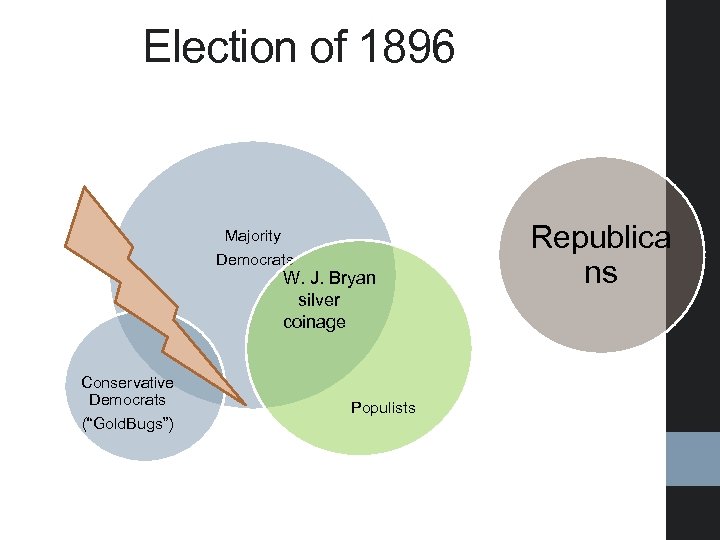 Election of 1896 Majority Democrats W. J. Bryan silver coinage Conservative Democrats (“Gold. Bugs”) Populists Republica ns
 Significance of the 1896 Election • • • End of Gilded Age politics Republican dominance of presidency and congress Republican ideology shift End of Populism Triumph of industry and urban America HOWEVER, Populism ideas were adopted by Republicans and Democrats in the Progressive Era.
 • Republican Party had long era of electoral dominance after the election of 1896. • Average margin of victory: 15% • Only Democrat elected during this period was Woodrow Wilson (1913 -1921) due to a split in the Republican Party. • Parties very regional during this time period; less related to economic status but rather where they lived. © 2013 The Mc. Graw-Hill Companies, Inc. All Rights Reserved. Republican Dominance and Progressive Reform, 1900 -1932 • Democrats: rural, some support in West, strong base of white southerners • Republicans: dominated in all states in Northeast and Midwest • Progressive Movement • • Make politics more open and issue-oriented; rising middle class Direct primaries Civil service Weakened political parties 10
 © 2013 The Mc. Graw-Hill Companies, Inc. All Rights Reserved. The New Deal and Democratic Dominance, 1932 -1964 • Issue of the poor emerges; focus of multiple, smaller parties • Eugene Debs: socialist candidate for president in every election from 1900 to 1920. • Depression 1929: massive unemployment and bankruptcies • FDR wins in 1932 election and in 1936 • Parties began to reshape themselves: • Democrats drew support from labor unions, liberals, northern African Americans and southern whites. • Republicans had support from upper middle class, business interests, regional support in rural areas of Northeast and Midwest. • At the end of the 1950 s, John Birch Society takes over Mc. Carthy’s ideas • Rise of “new conservatives”: Berry Goldwater, George Wallace, Ronald Reagan • Period of Democratic dominance, but uneasy 11
 © 2013 The Mc. Graw-Hill Companies, Inc. All Rights Reserved. Republican Recovery, 1964 Present • Civil Rights movement made it difficult for Democratic Party to hold its coalition together. • Voting Rights Act 1965 – shock to the nation at that time • Civil Rights Act 1964 – changed political landscape • Conservative voters moved to the Republican Party; pulled it more to the ideological right. • Democratic Party picked up strength in old Republican strongholds, while South went for Republicans. • Other changes: • Religious right as dominant force in Republican Party; Tea Party movement • Feminism and environmentalism, racial and ethnic minorities, feminism, labor, low income in Democratic Party 12
 © 2013 The Mc. Graw-Hill Companies, Inc. All Rights Reserved. Reforms Weaken the Parties: Round Two • 1970 s: political reforms weaken the parties • 1968 Democratic Convention • Mc. Govern Fraser Commission • primaries • Federal Election Campaign Act of 1971 • Regulation of party expenditures • Emergence of political action committees • Advent of television • Emergence of split-ticket voting • Voters cast their ballot for a mix of Democratic and Republican candidates rather than just one party’s candidates. 13
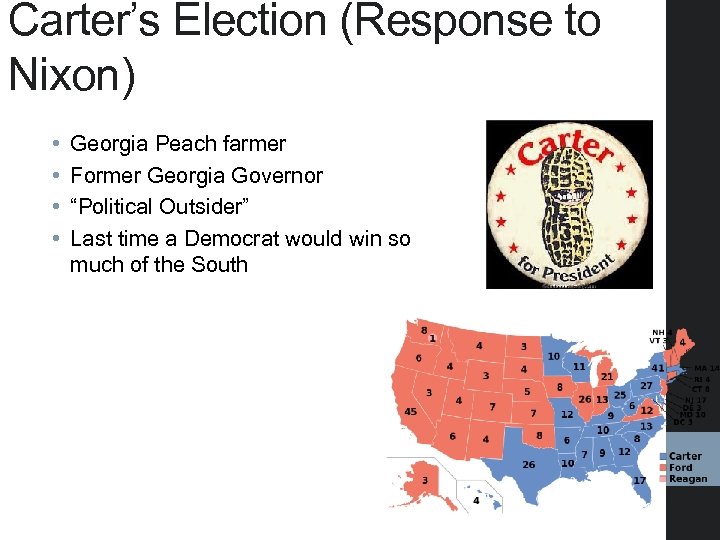 Carter’s Election (Response to Nixon) • • Georgia Peach farmer Former Georgia Governor “Political Outsider” Last time a Democrat would win so much of the South
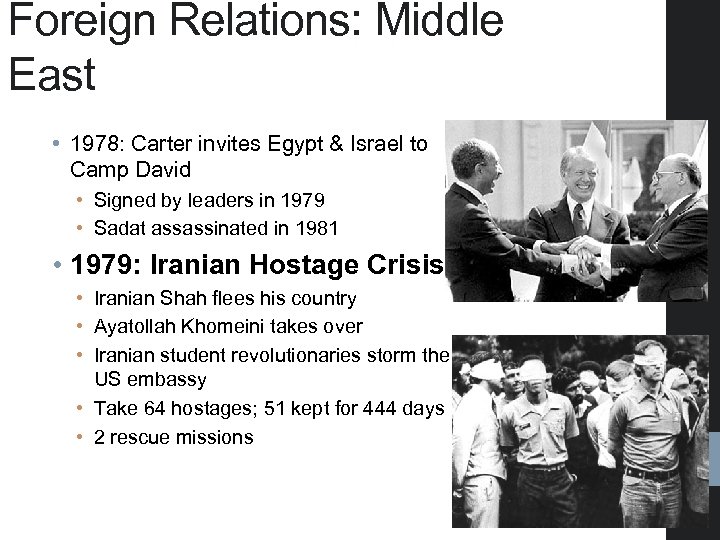 Foreign Relations: Middle East • 1978: Carter invites Egypt & Israel to Camp David • Signed by leaders in 1979 • Sadat assassinated in 1981 • 1979: Iranian Hostage Crisis • Iranian Shah flees his country • Ayatollah Khomeini takes over • Iranian student revolutionaries storm the US embassy • Take 64 hostages; 51 kept for 444 days • 2 rescue missions
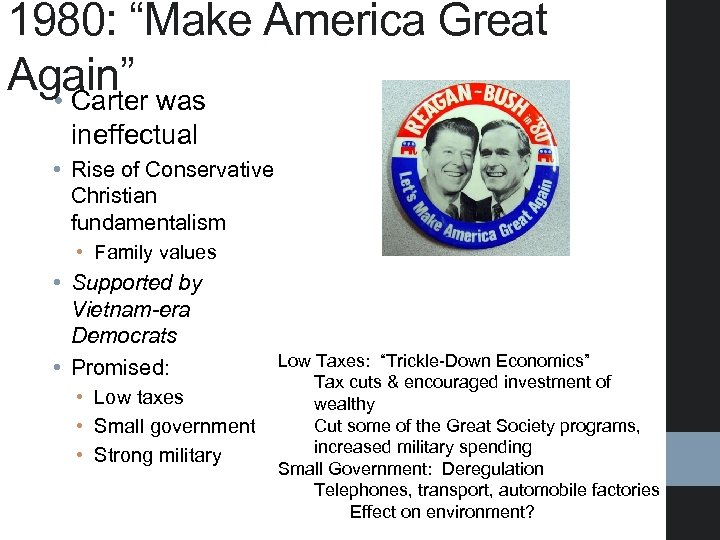 1980: “Make America Great Again” was • Carter ineffectual • Rise of Conservative Christian fundamentalism • Family values • Supported by Vietnam-era Democrats • Promised: • Low taxes • Small government • Strong military Low Taxes: “Trickle-Down Economics” Tax cuts & encouraged investment of wealthy Cut some of the Great Society programs, increased military spending Small Government: Deregulation Telephones, transport, automobile factories Effect on environment?
 Domestic Policy • Low Taxes: “Trickle-Down Economics” • Tax cuts & encouraged investment of wealthy • Cut some of the Great Society programs, increased military spending • Small Government: Deregulation • Telephones, transport, automobile factories • Effect on environment? • Savings & loans • Credit cards • 1987: US government has to bail them out • 1987: Stock Market
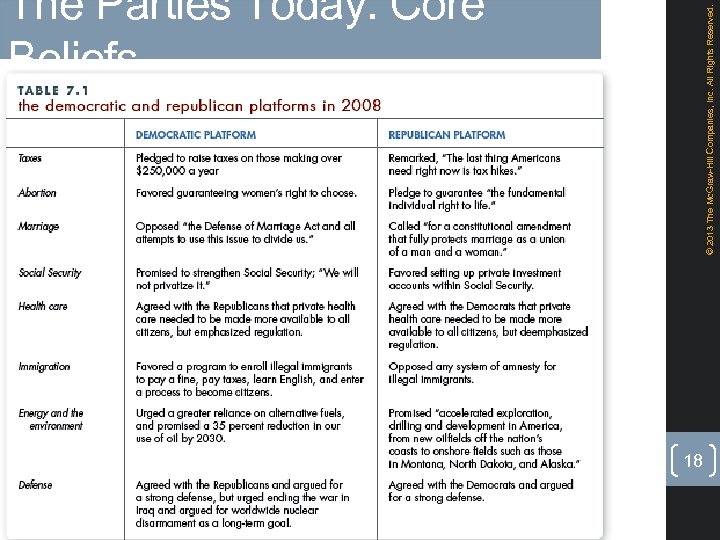 © 2013 The Mc. Graw-Hill Companies, Inc. All Rights Reserved. The Parties Today: Core Beliefs 18
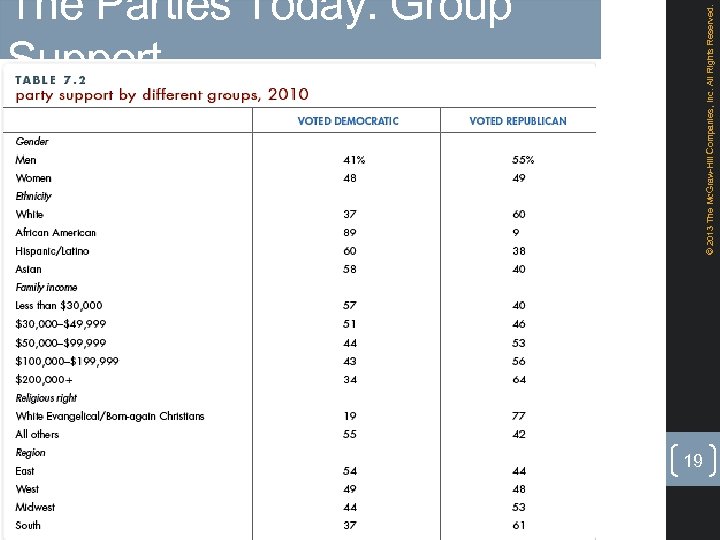 © 2013 The Mc. Graw-Hill Companies, Inc. All Rights Reserved. The Parties Today: Group Support 19