


 Скачать презентацию Political Determinants of Government Loans in Japan Masami
bfac97a3d70ffac7b1ee8f9e6a57e2fa.ppt
- Количество слайдов: 22
 Political Determinants of Government Loans in Japan Masami Imai Wesleyan University
 Motivation • Two competing views on government banks. • Social view (e. g. Stiglitz, 1993). – Government banks fund socially desirable projects. • Political view (e. g. La Porta, Lopez-de-Silanes, and Shleifer, 2002). – Government banks fund politically desirable projects.
 Direct Empirical Evidence on Political View • Sapienza (2004). – Political affiliation of Italy’s state owned banks is related to interest rates on loans. • Dinc (2005). – Government banks tend to increase their lending during election years in developing countries. • Khwaja and Mian (2005) – Government banks in Pakistan provide preferential loans to politically connected borrowers. • Note that according to corruption perception index, – Pakistan is very corrupt. – Italy is not as corrupt as Pakistan, but very corrupt relative to the other developed countries.
 Goal of This Paper • Use prefecture-level panel data on government loan allocation in Japan. • Empirically examine validity of political view. • Complement Sapienza (2004), Dinc (2005), and Khwaja and Mian (2005).
 Why Japan? • Data exist. • Controversial debate on whether government loan program avoided political capture and promoted “Japan Miracle”. – A very influential book, MITI and Japanese Miracle (1983), by Chalmers Johnson (non-economist). – Another influential book, East Asian Miracle (1993), by World Bank. – Beason and Weinsten (1996). • No econometric study has yet to explore whether directed loan program was indeed politicized in Japan.
 Summary of Findings • Prefectures supporting LDP receive more loans (although this correlation is not robust to the inclusion of fixed effects and socio-economic controls). • Prefectures being represented by influential LDP politicians tend to receive more government loans. • Prefectures being represented by electorally vulnerable LDP incumbents also tend to receive more government loans. • In sum, the results support the view that the LDP and its members exploit government banks for their private interests.
 Government Banks in Japan • Fiscal Investment and Loan Program (FILP) and postal saving system (soon to be partially privatized). • Opaque, referred to as “shadow budget”. • 10 -14 percent of total bank loans (1975 -92) • Recent estimate: 75 percent of all FILP loans are nonperforming (Doi and Hoshi, 2003)
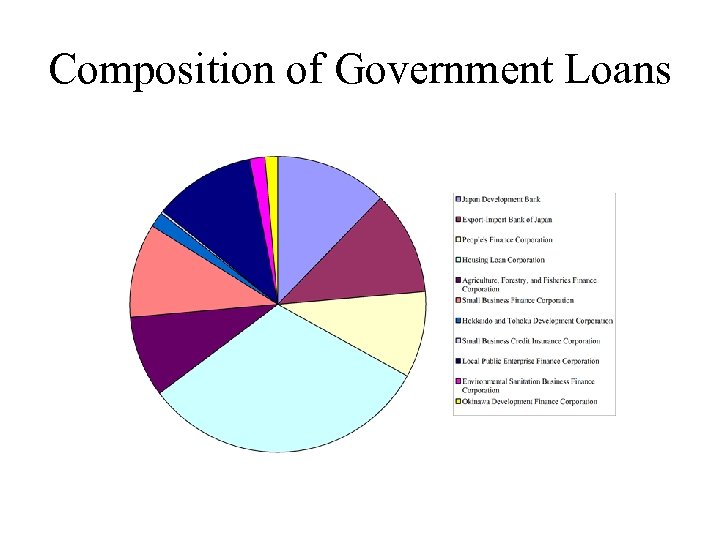 Composition of Government Loans
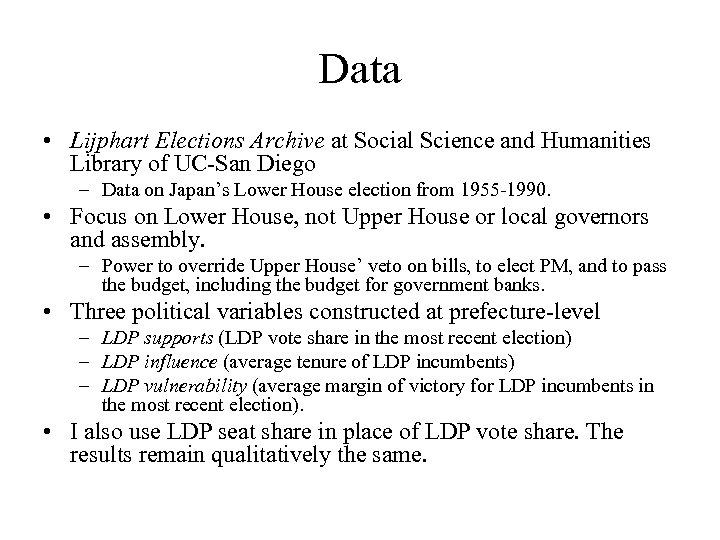 Data • Lijphart Elections Archive at Social Science and Humanities Library of UC-San Diego – Data on Japan’s Lower House election from 1955 -1990. • Focus on Lower House, not Upper House or local governors and assembly. – Power to override Upper House’ veto on bills, to elect PM, and to pass the budget, including the budget for government banks. • Three political variables constructed at prefecture-level – LDP supports (LDP vote share in the most recent election) – LDP influence (average tenure of LDP incumbents) – LDP vulnerability (average margin of victory for LDP incumbents in the most recent election). • I also use LDP seat share in place of LDP vote share. The results remain qualitatively the same.
 More on Data • Basic Data of Prefectures in Japan (Todoufuken Kiso Deta) in CD-ROM. – government loans, private loans, and other socioeconomic characteristics from 1975 to 2002. • Merge these two pieces of data by year and prefecture panel data covering 47 prefectures from 1975 to 1992.
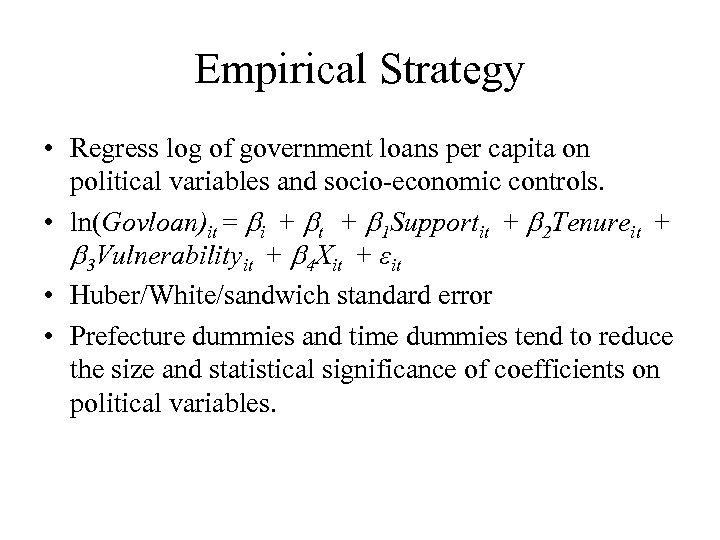 Empirical Strategy • Regress log of government loans per capita on political variables and socio-economic controls. • ln(Govloan)it = i + t + 1 Supportit + 2 Tenureit + 3 Vulnerabilityit + 4 Xit + εit • Huber/White/sandwich standard error • Prefecture dummies and time dummies tend to reduce the size and statistical significance of coefficients on political variables.
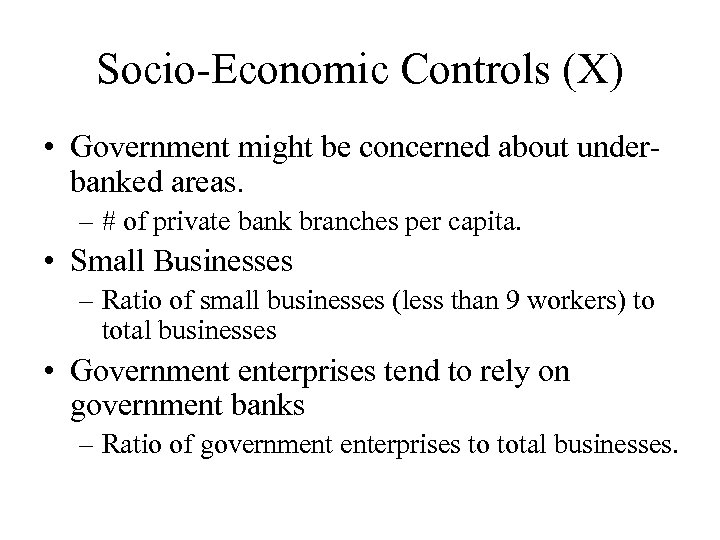 Socio-Economic Controls (X) • Government might be concerned about underbanked areas. – # of private bank branches per capita. • Small Businesses – Ratio of small businesses (less than 9 workers) to total businesses • Government enterprises tend to rely on government banks – Ratio of government enterprises to total businesses.
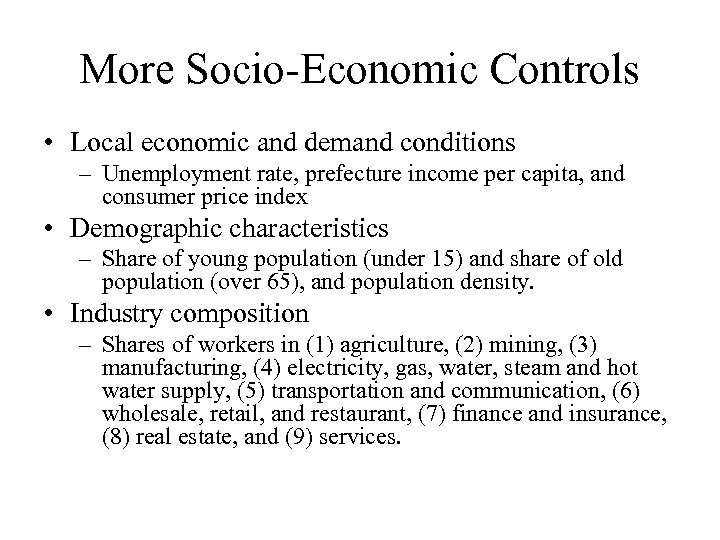 More Socio-Economic Controls • Local economic and demand conditions – Unemployment rate, prefecture income per capita, and consumer price index • Demographic characteristics – Share of young population (under 15) and share of old population (over 65), and population density. • Industry composition – Shares of workers in (1) agriculture, (2) mining, (3) manufacturing, (4) electricity, gas, water, steam and hot water supply, (5) transportation and communication, (6) wholesale, retail, and restaurant, (7) finance and insurance, (8) real estate, and (9) services.
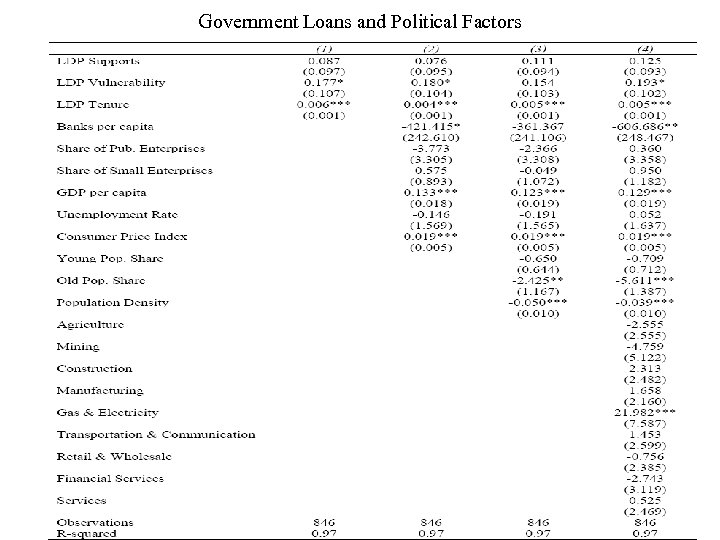 Government Loans and Political Factors
 Robustness Check 1 • Might both loan quantity and political variables be driven by unobserved loan demand? – When local economy is doing well, loan demand generally rises while LDP might, at the same time, perform well in elections • Not easy to address this problem given the absence of data on government bank’s credit policy (no data on interest rates and risk profile of borrowers). • But, if fluctuations in demand conditions are driving the spurious correlation between government loans and political variables, we expect to observe similar correlation between private loans and political variables.
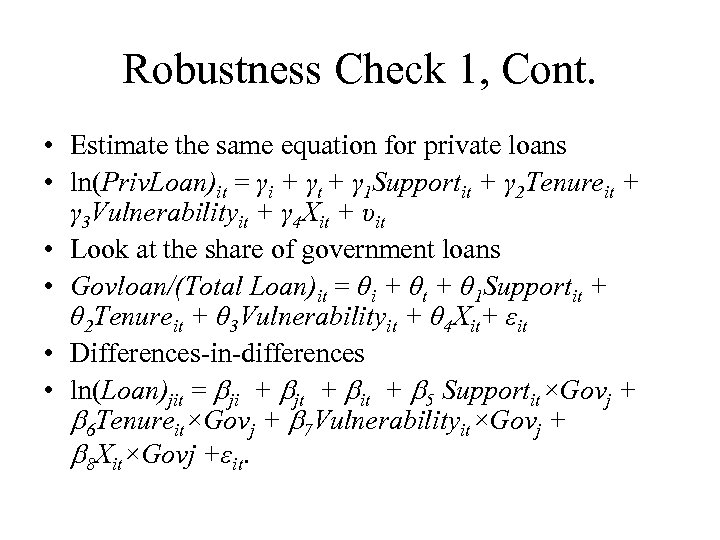 Robustness Check 1, Cont. • Estimate the same equation for private loans • ln(Priv. Loan)it = γi + γt + γ 1 Supportit + γ 2 Tenureit + γ 3 Vulnerabilityit + γ 4 Xit + υit • Look at the share of government loans • Govloan/(Total Loan)it = θi + θt + θ 1 Supportit + θ 2 Tenureit + θ 3 Vulnerabilityit + θ 4 Xit+ εit • Differences-in-differences • ln(Loan)jit = ji + jt + it + 5 Supportit×Govj + 6 Tenureit×Govj + 7 Vulnerabilityit×Govj + 8 Xit×Govj +εit.
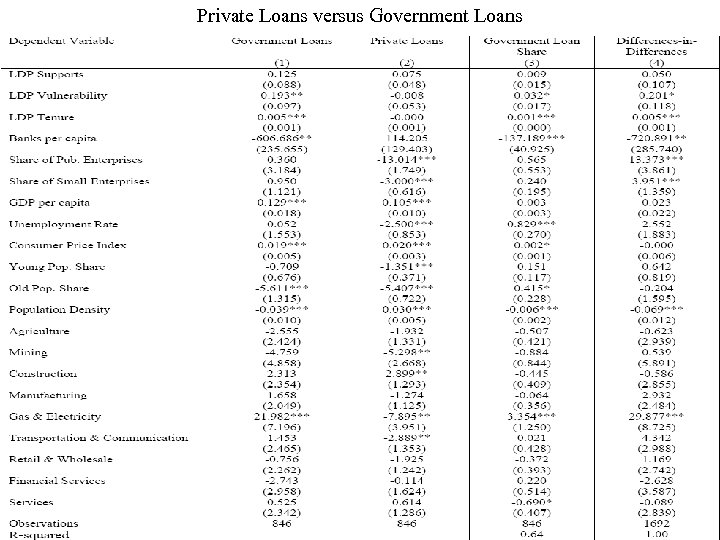 Private Loans versus Government Loans
 Robustness Check 2 • The results might be influenced by urbanization that reduced LDP’s popularity in certain prefectures during the sample period. • Use just government loans or government loans divided by prefecture income as a dependent variable.
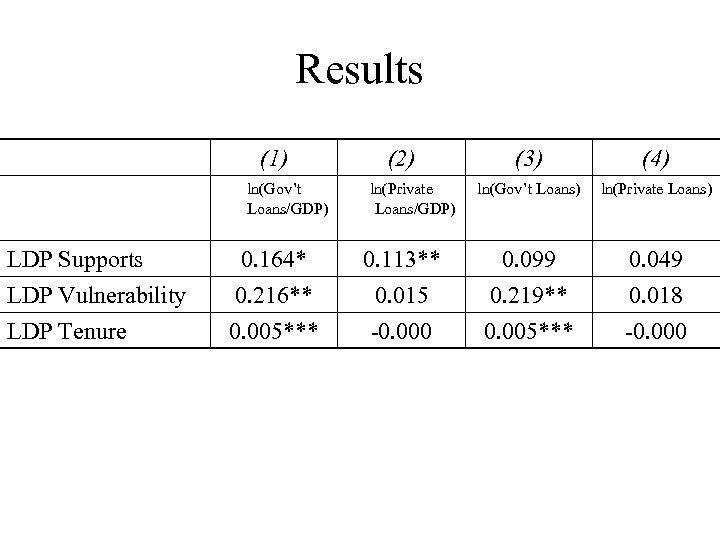 Results (1) ln(Gov’t Loans/GDP) LDP Supports LDP Vulnerability LDP Tenure (2) ln(Private Loans/GDP) (3) (4) ln(Gov’t Loans) ln(Private Loans) 0. 164* 0. 113** 0. 099 0. 049 0. 216** 0. 005*** 0. 015 -0. 000 0. 219** 0. 005*** 0. 018 -0. 000
 Robustness Check 3 • How about those non-LDP politicians? • If, for example, prefectures represented by senior Socialists members also receive more government loans, this observation will undermine the validity of main story.
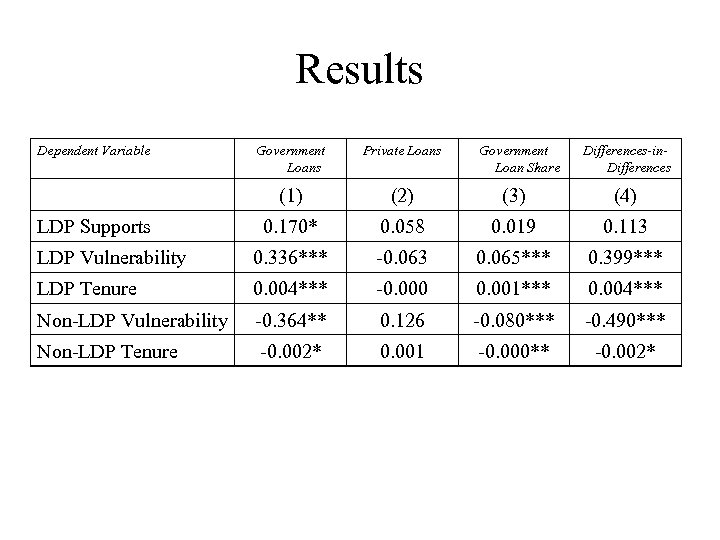 Results Dependent Variable Government Loans Private Loans (1) (2) (3) (4) 0. 170* 0. 058 0. 019 0. 113 LDP Vulnerability 0. 336*** -0. 063 0. 065*** 0. 399*** LDP Tenure 0. 004*** -0. 000 0. 001*** 0. 004*** Non-LDP Vulnerability -0. 364** 0. 126 -0. 080*** -0. 490*** Non-LDP Tenure -0. 002* 0. 001 -0. 000** -0. 002* LDP Supports Government Loan Share Differences-in. Differences
 Conclusions and Extensions • On the contrary to claims that independent bureaucrats directed government loans in Japan, politicians have large influence on government loan provision. • Postal saving system, although providing financial services to under-banked population, might negatively affect financial development.