 Скачать презентацию POLÍTICA AMBIENTAL DEL JAPÓN 8 de agosto de
2805b2e24133477c55458de5debc6250.ppt
- Количество слайдов: 20



POLÍTICA AMBIENTAL DEL JAPÓN 8 de agosto de 2007 Ministro Masaru Watanabe Embajada del Japón en la República Argentina
I. Estado actual del problema II. Experiencia del Japón III. Nueva iniciativa japonesa sobre el calentamiento global IV. Cooperación del Japón con las políticas ambientales de la Argentina
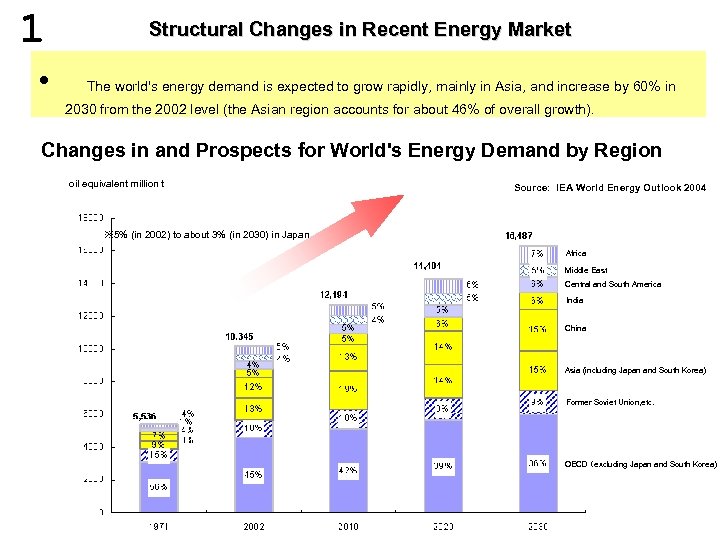
1 Structural Changes in Recent Energy Market • The world's energy demand is expected to grow rapidly, mainly in Asia, and increase by 60% in 2030 from the 2002 level (the Asian region accounts for about 46% of overall growth). Changes in and Prospects for World's Energy Demand by Region oil equivalent million t Source: IEA World Energy Outlook 2004 ※ 5% (in 2002) to about 3% (in 2030) in Japan Africa Middle East Central and South America India China Asia (including Japan and South Korea) Former Soviet Union, etc. OECD (excluding Japan and South Korea)
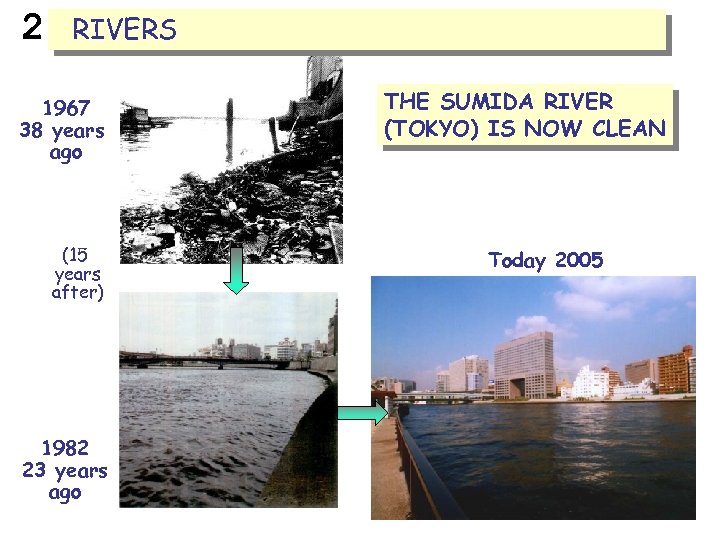
2 RIVERS 1967 38 years ago (15 years after) 1982 23 years ago THE SUMIDA RIVER (TOKYO) IS NOW CLEAN Today 2005
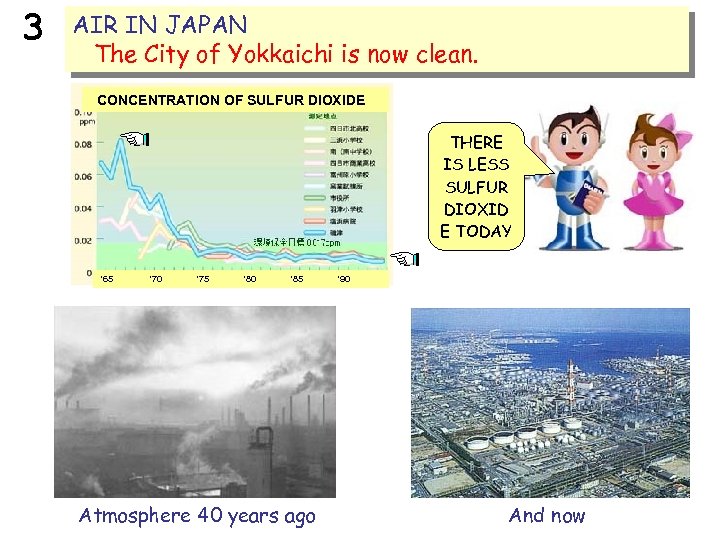
3 AIR IN JAPAN The City of Yokkaichi is now clean. CONCENTRATION OF SULFUR DIOXIDE THERE IS LESS SULFUR DIOXID E TODAY ‘ 65 ‘ 70 ‘ 75 ‘ 80 ‘ 85 Atmosphere 40 years ago ‘ 90 And now
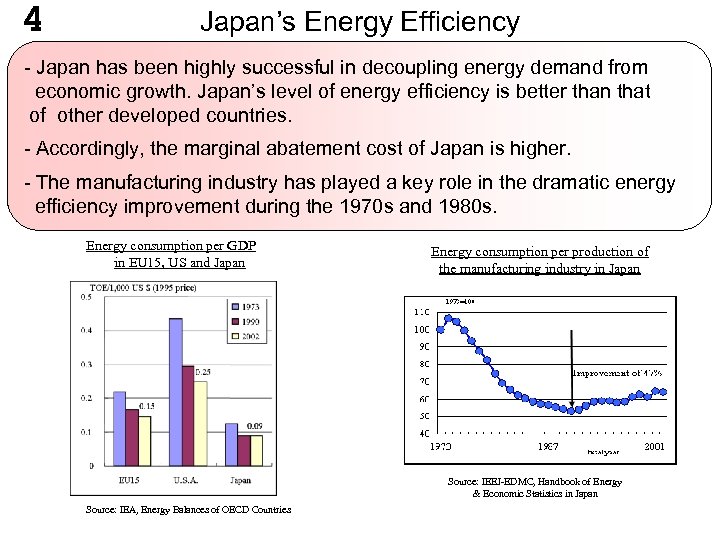
4 Japan’s Energy Efficiency - Japan has been highly successful in decoupling energy demand from economic growth. Japan’s level of energy efficiency is better than that of other developed countries. - Accordingly, the marginal abatement cost of Japan is higher. - The manufacturing industry has played a key role in the dramatic energy efficiency improvement during the 1970 s and 1980 s. Energy consumption per GDP in EU 15, US and Japan Energy consumption per production of the manufacturing industry in Japan Source: IEEJ-EDMC, Handbook of Energy & Economic Statistics in Japan Source: IEA, Energy Balances of OECD Countries
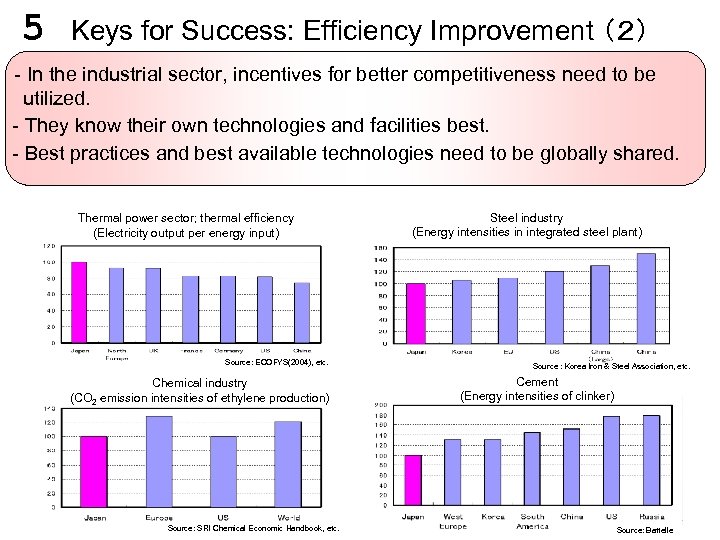
5 Keys for Success: Efficiency Improvement (2) - In the industrial sector, incentives for better competitiveness need to be utilized. - They know their own technologies and facilities best. - Best practices and best available technologies need to be globally shared. Thermal power sector; thermal efficiency (Electricity output per energy input) Source: ECOFYS(2004), etc. Chemical industry (CO 2 emission intensities of ethylene production) Source: SRI Chemical Economic Handbook, etc. Steel industry (Energy intensities in integrated steel plant) Source : Korea Iron & Steel Association, etc. Cement (Energy intensities of clinker) Source: Battelle
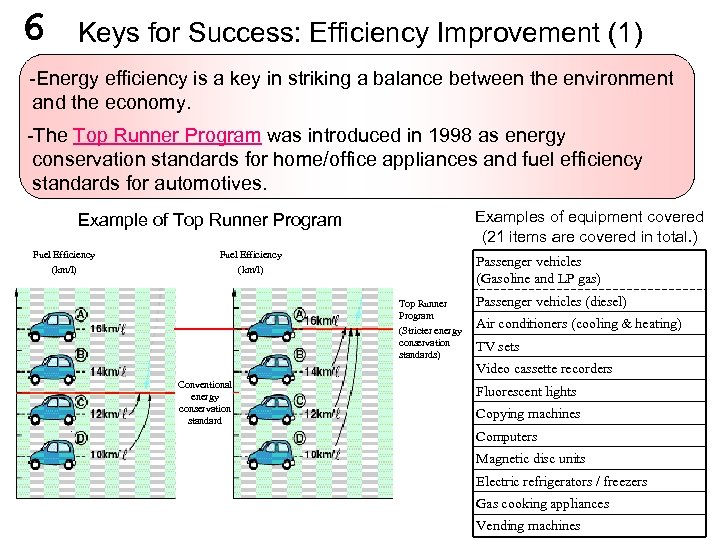
6 Keys for Success: Efficiency Improvement (1) -Energy efficiency is a key in striking a balance between the environment and the economy. -The Top Runner Program was introduced in 1998 as energy conservation standards for home/office appliances and fuel efficiency standards for automotives. Examples of equipment covered (21 items are covered in total. ) Example of Top Runner Program Fuel Efficiency (km/l) Passenger vehicles (Gasoline and LP gas) Top Runner Program (Stricter energy conservation standards) Passenger vehicles (diesel) Air conditioners (cooling & heating) TV sets Video cassette recorders Conventional energy conservation standard Fluorescent lights Copying machines Computers Magnetic disc units Electric refrigerators / freezers Gas cooking appliances Vending machines
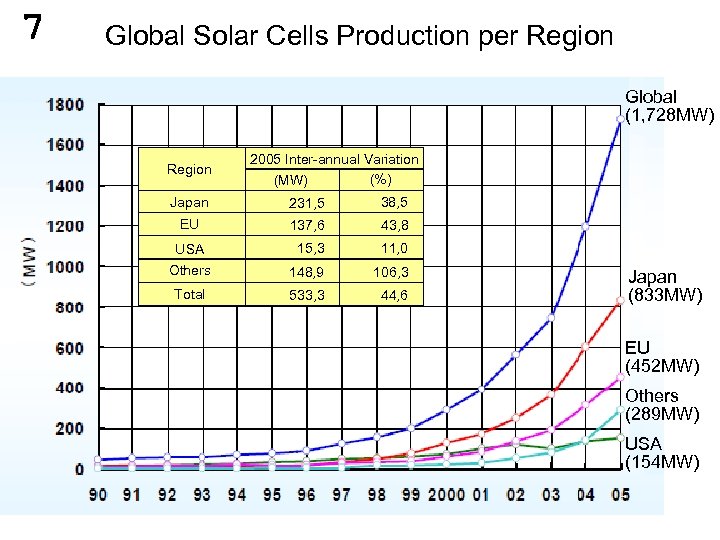
7 Global Solar Cells Production per Region Global (1, 728 MW) Region 2005 Inter-annual Variation (%) (MW) Japan 231, 5 38, 5 EU 137, 6 43, 8 USA 15, 3 11, 0 Others 148, 9 106, 3 Total 533, 3 44, 6 Japan (833 MW) EU (452 MW) Others (289 MW) USA (154 MW)
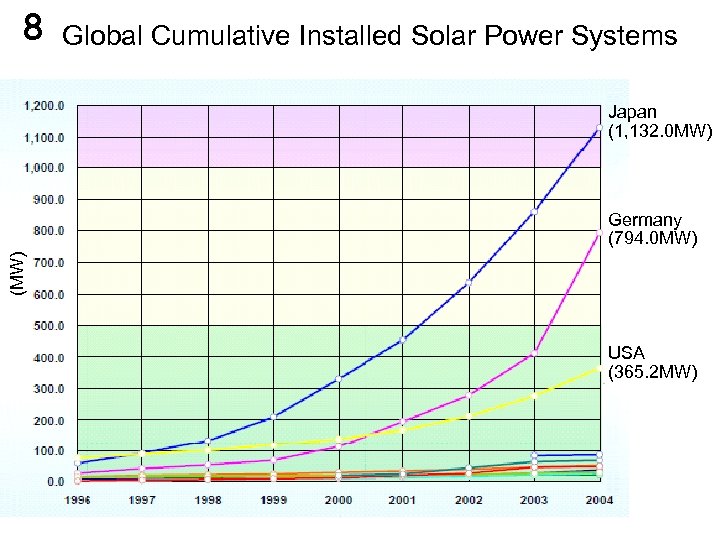
8 Global Cumulative Installed Solar Power Systems Japan (1, 132. 0 MW) (MW) Germany (794. 0 MW) USA (365. 2 MW)
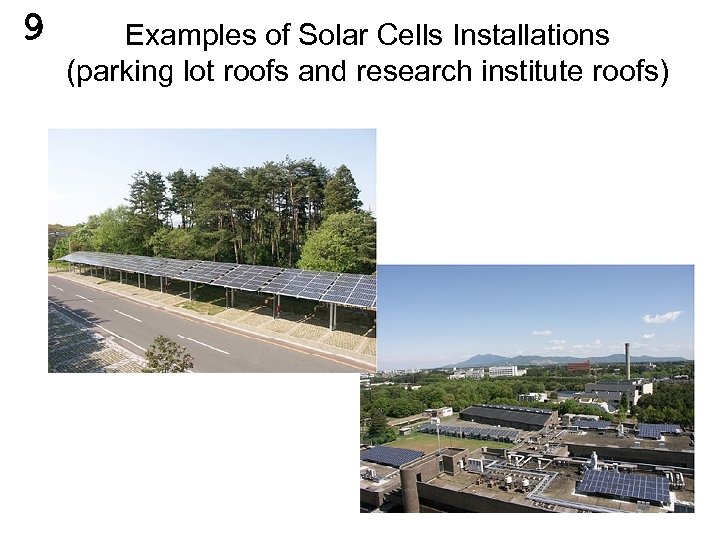
9 Examples of Solar Cells Installations (parking lot roofs and research institute roofs)
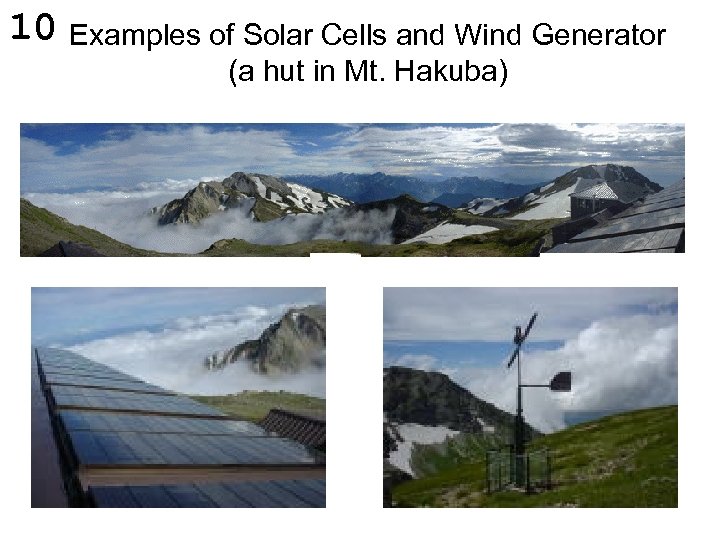
10 Examples of Solar Cells and Wind Generator (a hut in Mt. Hakuba)
11
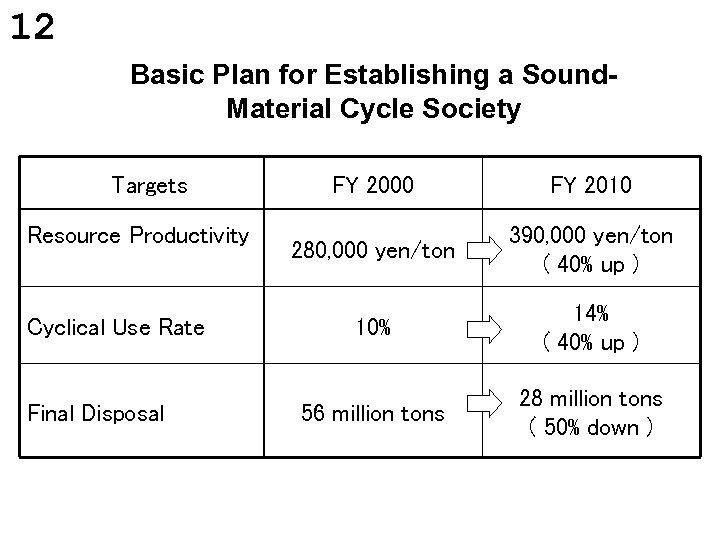
12 Basic Plan for Establishing a Sound. Material Cycle Society Targets Resource Productivity Cyclical Use Rate Final Disposal FY 2000 FY 2010 280, 000 yen/ton 390, 000 yen/ton ( 40% up ) 10% 14% ( 40% up ) 56 million tons 28 million tons ( 50% down )
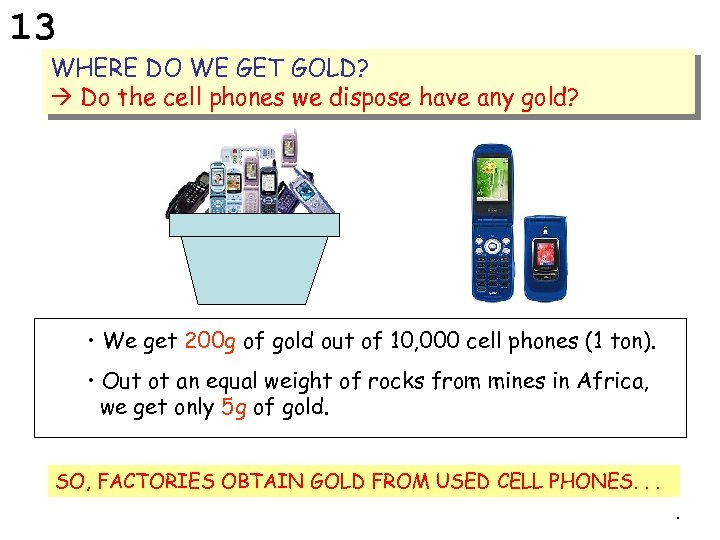
13 WHERE DO WE GET GOLD? Do the cell phones we dispose have any gold? • We get 200 g of gold out of 10, 000 cell phones (1 ton). • Out ot an equal weight of rocks from mines in Africa, we get only 5 g of gold. SO, FACTORIES OBTAIN GOLD FROM USED CELL PHONES. .
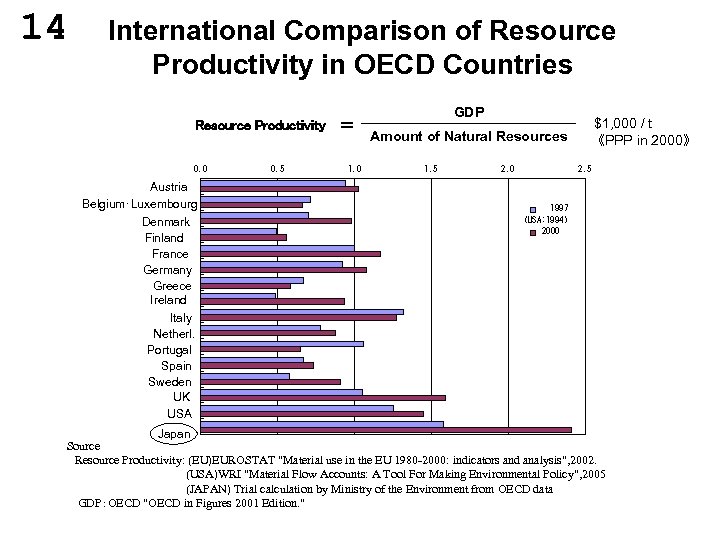
14 International Comparison of Resource Productivity in OECD Countries Resource Productivity = 0. 0 Austria Belgium・Luxembourg Denmark Finland France Germany Greece Ireland Italy Netherl. Portugal Spain Sweden UK USA 0. 5 1. 0 GDP $1, 000 / t 《PPP in 2000》 Amount of Natural Resources 1. 5 2. 0 2. 5 1997 (USA: 1994) 2000 Japan Source Resource Productivity: (EU)EUROSTAT "Material use in the EU 1980 -2000: indicators and analysis", 2002. (USA)WRI "Material Flow Accounts: A Tool For Making Environmental Policy", 2005 (JAPAN) Trial calculation by Ministry of the Environment from OECD data GDP:OECD "OECD in Figures 2001 Edition. "
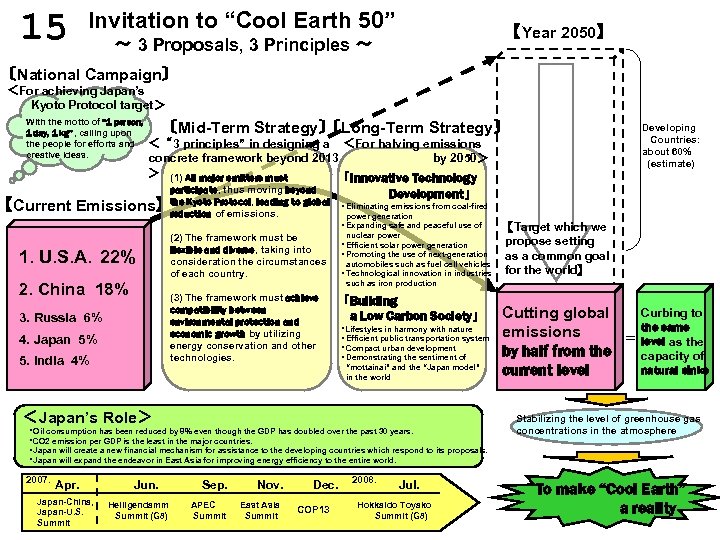
15 Invitation to “Cool Earth 50” ~ 3 Proposals, 3 Principles ~ 【Year 2050】 〔National Campaign〕 <For achieving Japan’s Kyoto Protocol target> With the motto of “ 1 person, 1 day, 1 kg”, calling upon the people for efforts and creative ideas. 〔Mid-Term Strategy〕 〔Long-Term Strategy〕 <“ 3 principles” in designing a <For halving emissions concrete framework beyond 2013 by 2050> > (1) All major emitters must 「Innovative Technology participate, thus moving beyond the Kyoto Protocol, leading to global reduction of emissions. 【Current Emissions】 1. U. S. A. 22% 2. China 18% 3. Russia 6% 4. Japan 5% 5. India 4% (2) The framework must be flexible and diverse, taking into consideration the circumstances of each country. (3) The framework must achieve compatibility between environmental protection and economic growth by utilizing energy conservation and other technologies. Development」 ・Eliminating emissions from coal-fired power generation ・Expanding safe and peaceful use of nuclear power ・Efficient solar power generation ・Promoting the use of next-generation automobiles such as fuel cell vehicles ・Technological innovation in industries such as iron production 「Building a Low Carbon Society」 ・Lifestyles in harmony with nature ・Efficient public transportation system ・Compact urban development ・Demonstrating the sentiment of “mottainai” and the “Japan model” in the world <Japan’s Role> ・Oil consumption has been reduced by 8% even though the GDP has doubled over the past 30 years. ・CO 2 emission per GDP is the least in the major countries. ・Japan will create a new financial mechanism for assistance to the developing countries which respond to its proposals. ・Japan will expand the endeavor in East Asia for improving energy efficiency to the entire world. 2007. Apr. Jun. Sep. Japan-China, Japan-U. S. Summit Developing Countries: about 60% (estimate) Heiligendamm Summit (G 8) APEC Summit Nov. East Asia Summit 2008. Dec. Jul. COP 13 Hokkaido Toyako Summit (G 8) 【Target which we propose setting as a common goal for the world】 Cutting global emissions = by half from the current level Curbing to the same level as the capacity of natural sinks Stabilizing the level of greenhouse gas concentrations in the atmosphere To make “Cool Earth” a reality
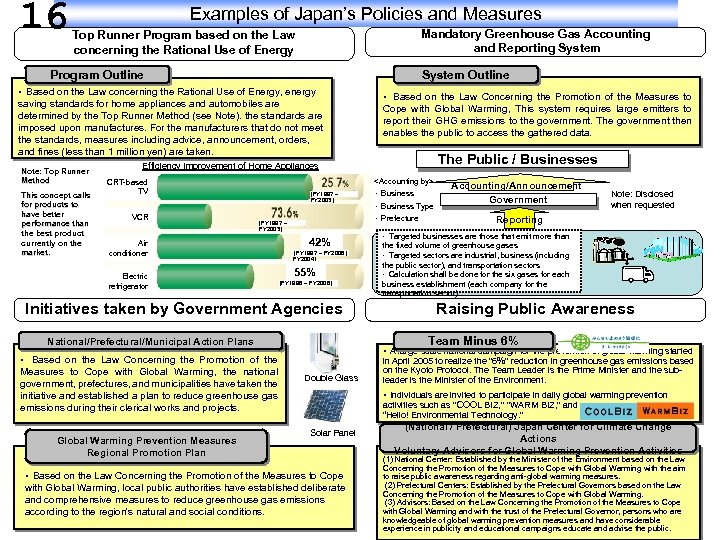
16 Examples of Japan’s Policies and Measures Mandatory Greenhouse Gas Accounting and Reporting System Top Runner Program based on the Law concerning the Rational Use of Energy Program Outline System Outline ・ Based on the Law concerning the Rational Use of Energy, energy saving standards for home appliances and automobiles are determined by the Top Runner Method (see Note). the standards are imposed upon manufactures. For the manufacturers that do not meet the standards, measures including advice, announcement, orders, and fines (less than 1 million yen) are taken. Note: Top Runner Method This concept calls for products to have better performance than the best product currently on the market. ・ Based on the Law Concerning the Promotion of the Measures to Cope with Global Warming, This system requires large emitters to report their GHG emissions to the government. The government then enables the public to access the gathered data. The Public / Businesses Efficiency Improvement of Home Appliances <Accounting by> CRT-based TV VCR (FY 1997 – FY 2003) Electric refrigerator 42% (FY 1997 – FY 2006) (FY 1997 – FY 2004) 55% (FY 1998 – FY 2006) Initiatives taken by Government Agencies Global Warming Prevention Measures Regional Promotion Plan Accounting/Announcement Government Note: Disclosed when requested Reporting ・ Targeted businesses are those that emit more than the fixed volume of greenhouse gases ・ Targeted sectors are industrial, business (including the public sector), and transportation sectors ・ Calculation shall be done for the six gases for each business establishment (each company for the transportation sector) Raising Public Awareness Team Minus 6% National/Prefectural/Municipal Action Plans ・ Based on the Law Concerning the Promotion of the Measures to Cope with Global Warming, the national government, prefectures, and municipalities have taken the initiative and established a plan to reduce greenhouse gas emissions during their clerical works and projects. ・ Business Type ・ Prefecture (FY 1997 – FY 2003) Air conditioner ・ Business Double Glass ・ A large scale national campaign for the prevention of global warming started in April 2005 to realize the "6%" reduction in greenhouse gas emissions based on the Kyoto Protocol. The Team Leader is the Prime Minister and the subleader is the Minister of the Environment. ・ Individuals are invited to participate in daily global warming prevention activities such as "COOL BIZ, " "WARM BIZ, " and “Hello! Environmental Technology. " Solar Panel ・ Based on the Law Concerning the Promotion of the Measures to Cope with Global Warming, local public authorities have established deliberate and comprehensive measures to reduce greenhouse gas emissions according to the region's natural and social conditions. (National / Prefectural) Japan Center for Climate Change Actions Voluntary Advisors for Global Warming Prevention Activities (1) National Center: Established by the Minister of the Environment based on the Law Concerning the Promotion of the Measures to Cope with Global Warming with the aim to raise public awareness regarding anti-global warming measures. (2) Prefectural Centers: Established by the Prefectural Governors based on the Law Concerning the Promotion of the Measures to Cope with Global Warming. (3) Advisors: Based on the Law Concerning the Promotion of the Measures to Cope with Global Warming and with the trust of the Prefectural Governor, persons who are knowledgeable of global warming prevention measures and have considerable experience in publicity and educational campaigns educate and advise the public.
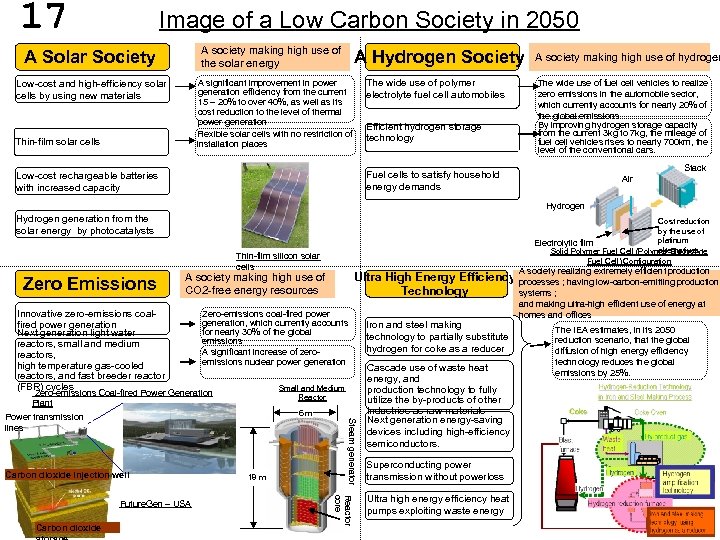
17 Image of a Low Carbon Society in 2050 A society making high use of the solar energy A Solar Society A Hydrogen Society The wide use of polymer electrolyte fuel cell automobiles A significant improvement in power generation efficiency from the current 15 – 20% to over 40%, as well as its cost reduction to the level of thermal power generation Flexible solar cells with no restriction of installation places Low-cost and high-efficiency solar cells by using new materials Thin-film solar cells Efficient hydrogen storage technology A society making high use of hydrogen The wide use of fuel cell vehicles to realize zero emissions in the automobile sector, which currently accounts for nearly 20% of the global emissions By improving hydrogen storage capacity from the current 3 kg to 7 kg, the mileage of fuel cell vehicles rises to nearly 700 km, the level of the conventional cars. Stack Fuel cells to satisfy household energy demands Low-cost rechargeable batteries with increased capacity Air Hydrogen generation from the solar energy by photocatalysts Cost reduction by the use of platinum Electrolytic film alternatives Solid Polymer Fuel Cell (Polymer Electrolyte Fuel Cell) Configuration Thin-film silicon solar cells Zero Emissions Innovative zero-emissions coalfired power generation Next generation light water reactors, small and medium reactors, high temperature gas-cooled reactors, and fast breeder reactor (FBR) cycles Zero-emissions coal-fired power generation, which currently accounts for nearly 30% of the global emissions A significant increase of zeroemissions nuclear power generation Small and Medium Reactor Zero-emissions Coal-fired Power Generation Plant Power transmission lines 18 m Reactor core Future. Gen – USA 6m Steam generator Carbon dioxide injection well Carbon dioxide A society realizing extremely efficient production Ultra High Energy Efficiency processes ; having low-carbon-emitting production Technology systems ; A society making high use of CO 2 -free energy resources Iron and steel making technology to partially substitute hydrogen for coke as a reducer Cascade use of waste heat energy, and production technology to fully utilize the by-products of other industries as raw materials Next generation energy-saving devices including high-efficiency semiconductors. Superconducting power transmission without powerloss Ultra high energy efficiency heat pumps exploiting waste energy and making ultra-high efficient use of energy at homes and offices The IEA estimates, in its 2050 reduction scenario, that the global diffusion of high energy efficiency technology reduces the global emissions by 25%.
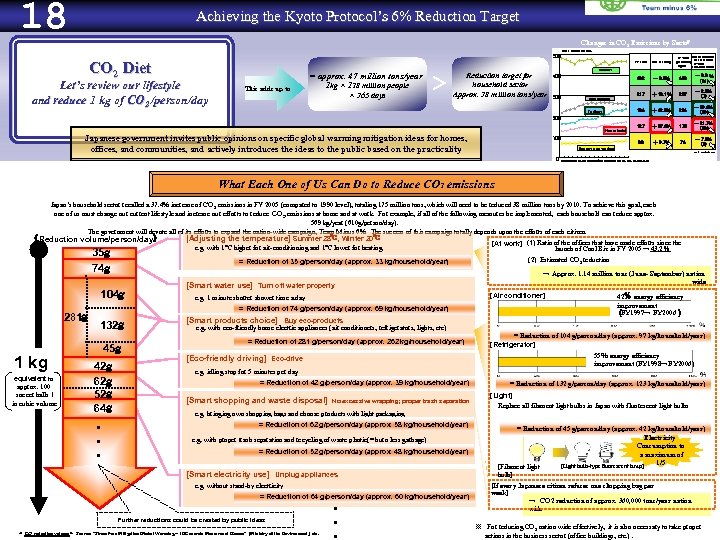
18 Achieving the Kyoto Protocol’s 6% Reduction Target Changes in CO 2 Emissions by Sector Unit : million ton CO 2 500 CO 2 Diet FY 2005 Rate of reduction Needed from (preliminary FY 2005 figure ) ( absolute value ) FY 1990 Let’s review our lifestyle and reduce 1 kg of CO 2 /person/day = approx. 47 million tons/year This adds up to 1 kg × 128 million people × 365 days Rate of change 482 - 3. 2% % 466 - 6. 4 % 6. 8 % (31) 217 + 18. 1% % 257 - 3. 2 2. 6% % (7) 164 + 42. 2% % 234 - 42. 1 29. 4% % (69) 127 + 37. 4% % 175 - 29. 9 21. 7% % (38) 68 + 9. 7% % 74 Industries Reduction target for household sector > Approx. 38 million tons/year 400 300 Transportation Tertiary 200 Household Japanese government invites public opinions on specific global warming mitigation ideas for homes, offices, and communities, and actively introduces the ideas to the public based on the practicality 100 Energy conversion - 7. 4 7. 3% % (5) ( Unit: million ton CO ) 2 0 19901991 1992 1993 19941995 1996 1997 19981999 2000 2001 2002 2003 2004 2005( Preliminary figures ) What Each One of Us Can Do to Reduce CO 2 emissions Japan’s household sector recalled a 37. 4% increase of CO 2 emissions in FY 2005 (compared to 1990 level), totaling 175 million tons, which will need to be reduced 38 million tons by 2010. To achieve this goal, each one of us must change our current lifestyle and increase our efforts to reduce CO 2 emissions at home and at work. For example, if all of the following measures be implemented, each household can reduce approx. 569 kg/year (610 g/person/day). The government will devote all of its efforts to expand the nation-wide campaign, Team Minus 6%. The success of this campaign totally depends upon the efforts of each citizen. [Adjusting the temperature] Summer 28℃, Winter 20℃ 《Reduction volume/person/day》 [At work] (1) Ratio of the offices that have made efforts since the e. g. with 1℃ higher for air-conditioning and 1℃ lower for heating launch of Cool Biz in FY 2005 → 43. 2% 35g 74g = Reduction of 35 g/person/day (approx. 33 kg/household/year) 104g 281g 1 kg equivalent to approx. 100 soccer balls ! in cubic volume [Smart water use] Turn off water properly 45g 42g 62g 52g 64g ・ ・ ・ → Approx. 1. 14 million tons (June- September) nation wide [Air conditioner] e. g. 1 minute shorter shower time a day = Reduction of 74 g/person/day (approx. 69 kg/household/year) 132g (2) Estimated CO 2 reduction [Smart products choice] Buy eco-products 42% energy efficiency improvement ( FY 1997→ FY 2006) e. g. with eco-friendly home electric appliances (air conditioners, refrigerators, lights, etc) = Reduction of 281 g/person/day (approx. 262 kg/household/year) [Eco-friendly driving] Eco-drive = Reduction of 104 g/person/day (approx. 97 kg/household/year) [Refrigerator] 55% energy efficiency improvement (FY 1998→FY 2006) e. g. idling stop for 5 minutes per day = Reduction of 42 g/person/day (approx. 39 kg/household/year) [Smart shopping and waste disposal] No excessive wrapping; proper trash separation e. g. bringing own shopping bags and choose products with light packaging = Reduction of 62 g/person/day (approx. 58 kg/household/year) e. g. with proper trash separation and recycling of waste plastic(= burn less garbage) = Reduction of 52 g/person/day (approx. 48 kg/household/year) [Smart electricity use] Unplug appliances e. g. without stand-by electricity = Reduction of 64 g/person/day (approx. 60 kg/household/year) Further reductions could be created by public ideas < CO 2 reduction volume> Source: “Stress Free Mitigation Global Warming – 10 Concrete Measures at Homes” (Ministry of the Environment), etc. ・ ・ = Reduction of 132 g/person/day (approx. 123 kg/household/year) [Light] Replace all filament light bulbs in Japan with fluorescent light bulbs = Reduction of 45 g/person/day (approx. 42 kg/household/year) Electricity Consumption to a maximum of 1/5 [Light bulb-type fluorescent lamp] [Filament light bulb] [If every Japanese citizen refuses one shopping bag per week] → CO 2 reduction of approx. 360, 000 tons/year nation wide ※ For reducing CO 2 nation wide effectively, it is also necessary to take proper actions in the business sector (office buildings, etc. ).
Скачать презентацию POLÍTICA AMBIENTAL DEL JAPÓN 8 de agosto de
2805b2e24133477c55458de5debc6250.ppt